
SESAR Exploratory Research
1
#SESAR
@WorldATM_now
CONTENTS
Introduction
Dr. Stella Tkatchova, SESAR JU
WPE project example: ACCESS
Ricardo Herranz, Nommon
WPE project example: CASSIOPEIA
Jorge Martín, Innaxis
How we take Science Seriously in SESAR
Peter Hecker, Chairman of the SESAR Scientific Committee
The Way forward and closing
Dr. Stella Tkatchova, SESAR JU
Dr. Stella Tkatchova
SESAR JU
SESAR Exploratory Research
Introduction
3
#SESAR
@WorldATM_now
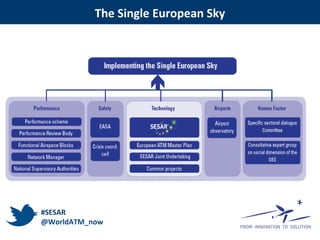
The Single European Sky
#SESAR
@WorldATM_now
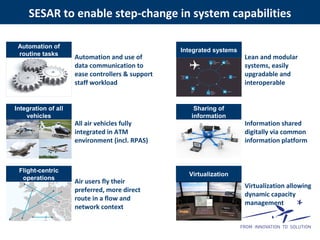
SESAR to enable step-change in system capabilities
Integrated systems
Sharing of
information
Flight-centric
operations
Integration of all
vehicles
Automation of
routine tasks
Virtualization
Air users fly their
preferred, more direct
route in a flow and
network context
Information shared
digitally via common
information platform
All air vehicles fully
integrated in ATM
environment (incl. RPAS)
Virtualization allowing
dynamic capacity
management
Lean and modular
systems, easily
upgradable and
interoperable
Automation and use of
data communication to
ease controllers & support
staff workload
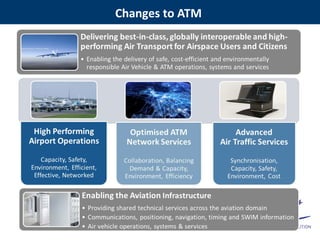
Changes to ATM
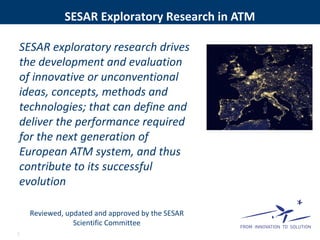
SESAR Exploratory Research in ATM
SESAR exploratory research drives
the development and evaluation
of innovative or unconventional
ideas, concepts, methods and
technologies; that can define and
deliver the performance required
for the next generation of
European ATM system, and thus
contribute to its successful
evolution
Reviewed, updated and approved by the SESAR
Scientific Committee
7
2 FOUNDING MEMBERS
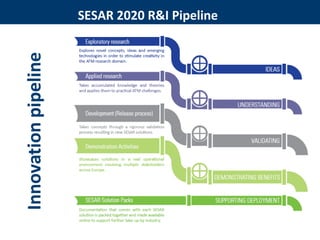
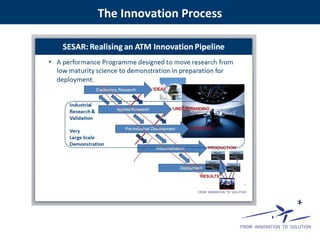
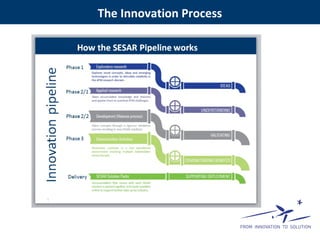
SESAR 2020 R&I Pipeline
SESAR 1 Long-term Research Program
• Long-term research in SESAR1
conducted under the frame of WP E.
• A total of 40 projects of WP-E projects
• The three Research Networks
coordinate research, 20 PhD
• HALA! – Towards Higher Levels of
Automation in ATM
• Complex World –Mastering Complex
Systems Safely
• ALIAS – Addressing the Liability Impact
of Automated Systems
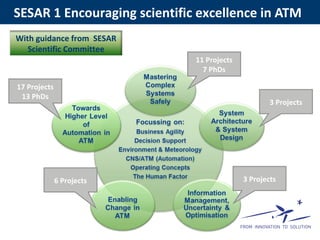
SESAR 1 Encouraging scientific excellence in ATM
11 Projects
7 PhDs
17 Projects
13 PhDs
3 Projects
3 Projects6 Projects
With guidance from SESAR
Scientific Committee
SESAR 1 Lessons Learnt
• The transfer of long-term research
results is difficult into the Industrial
Research activities of the main SESAR
program
• SESAR 2020 will aim at better bridging
the results from Exploratory Research
through Industrial Research, Large Scale
Demos towards
implementation/industrialisation
readiness
• Strengthen the link of the ATM research
community and SESAR stakeholders
through ATM Applications Oriented
topics in SESAR 2020
An Agent-Based Model of Airport Slot
Allocation: the ACCESS project
Ricardo Herranz, Nommon Solutions and Technologies
World ATM Congress, Madrid, 10 March 2016
World ATM Congress - SESAR Exploratory Research (Madrid, 10 March 2016)
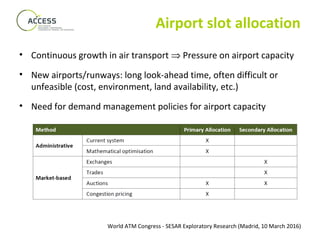
Airport slot allocation
• Continuous growth in air transport ⇒ Pressure on airport capacity
• New airports/runways: long look-ahead time, often difficult or
unfeasible (cost, environment, land availability, etc.)
• Need for demand management policies for airport capacity
World ATM Congress - SESAR Exploratory Research (Madrid, 10 March 2016)
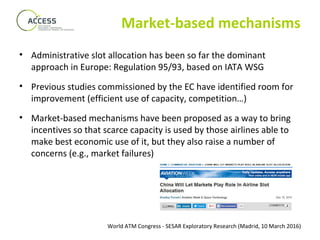
Market-based mechanisms
• Administrative slot allocation has been so far the dominant
approach in Europe: Regulation 95/93, based on IATA WSG
• Previous studies commissioned by the EC have identified room for
improvement (efficient use of capacity, competition…)
• Market-based mechanisms have been proposed as a way to bring
incentives so that scarce capacity is used by those airlines able to
make best economic use of it, but they also raise a number of
concerns (e.g., market failures)
World ATM Congress - SESAR Exploratory Research (Madrid, 10 March 2016)
The ACCESS project
• Review of current slot allocation system + stakeholder analysis
• Performance framework for a comprehensive evaluation and
comparison of different slot allocation mechanisms
• Simulation framework based on ABM + auction theory: appealing
framework to overcome limitations of classical approaches from
economics and operations research: multiplicity of dimensions and
stakeholders, complex combinatorial assignment problem,
bounded rationality, evolutionary behaviour, asymmetry of
information, uncertainty…
• Simulation experiments: comparison of primary allocation through
a combinatorial price-setting auction vs current system
• Policy recommendations
World ATM Congress - SESAR Exploratory Research (Madrid, 10 March 2016)
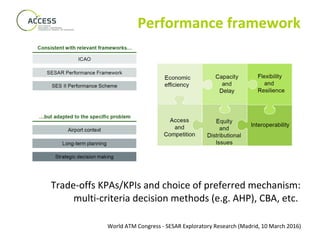
Performance framework
Trade-offs KPAs/KPIs and choice of preferred mechanism:
multi-criteria decision methods (e.g. AHP), CBA, etc.
World ATM Congress - SESAR Exploratory Research (Madrid, 10 March 2016)
ACCESS simulation platform
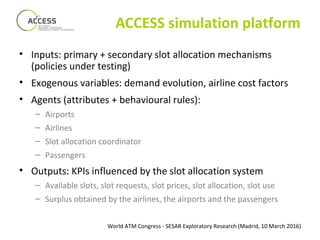
• Inputs: primary + secondary slot allocation mechanisms
(policies under testing)
• Exogenous variables: demand evolution, airline cost factors
• Agents (attributes + behavioural rules):
– Airports
– Airlines
– Slot allocation coordinator
– Passengers
• Outputs: KPIs influenced by the slot allocation system
– Available slots, slot requests, slot prices, slot allocation, slot use
– Surplus obtained by the airlines, the airports and the passengers
World ATM Congress - SESAR Exploratory Research (Madrid, 10 March 2016)
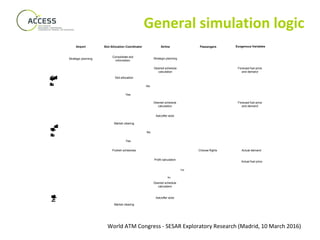
General simulation logic
Airport Slot Allocation Coordinator Airline
Strategic planning
Consolidate slot
information
Desired schedule
calculation
Ask/offer slots
Market clearing
Publish schedules
Passengers Exogenous Variables
Strategic planning
Desired schedule
calculation
Slot allocation
Forecast fuel price
and demand
Pre-seasonPrimary
Allocation
Pre-seasonSecondary
Allocation
Forecast fuel price
and demand
In-seasonSecondaryAllocation
Choose flights Actual demand
Actual fuel price
Profit calculation
Desired schedule
calculation
Ask/offer slots
Market clearing
Stop criteria
met?
No
Yes
Started
season?
No
Yes
Finished
season?
No
Yes
World ATM Congress - SESAR Exploratory Research (Madrid, 10 March 2016)
Case study: primary auctioning
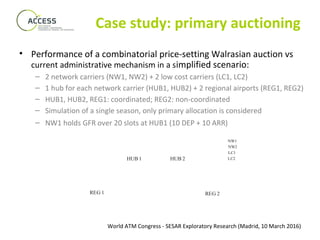
• Performance of a combinatorial price-setting Walrasian auction vs
current administrative mechanism in a simplified scenario:
– 2 network carriers (NW1, NW2) + 2 low cost carriers (LC1, LC2)
– 1 hub for each network carrier (HUB1, HUB2) + 2 regional airports (REG1, REG2)
– HUB1, HUB2, REG1: coordinated; REG2: non-coordinated
– Simulation of a single season, only primary allocation is considered
– NW1 holds GFR over 20 slots at HUB1 (10 DEP + 10 ARR)
HUB 1 HUB 2
REG 1 REG 2
NW1
NW2
LC1
LC2
World ATM Congress - SESAR Exploratory Research (Madrid, 10 March 2016)
Auction type and motivation
World ATM Congress - SESAR Exploratory Research (Madrid, 10 March 2016)
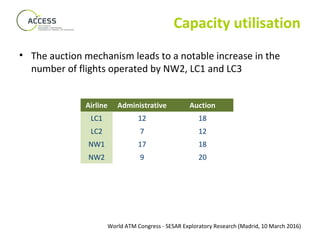
Capacity utilisation
• The auction mechanism leads to a notable increase in the
number of flights operated by NW2, LC1 and LC3
Airline Administrative Auction
LC1 12 18
LC2 7 12
NW1 17 18
NW2 9 20
World ATM Congress - SESAR Exploratory Research (Madrid, 10 March 2016)
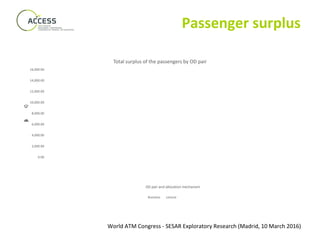
Passenger surplus
0.00
2,000.00
4,000.00
6,000.00
8,000.00
10,000.00
12,000.00
14,000.00
16,000.00
Surplus(€)
OD pair and allocation mechanism
Total surplus of the passengers by OD pair
Business Leisure
World ATM Congress - SESAR Exploratory Research (Madrid, 10 March 2016)
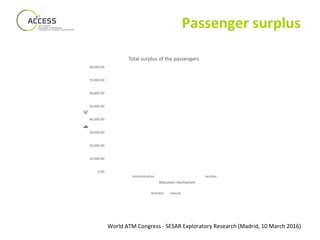
Passenger surplus
0.00
10,000.00
20,000.00
30,000.00
40,000.00
50,000.00
60,000.00
70,000.00
80,000.00
Administrative Auction
Surplus(€)
Allocation mechanism
Total surplus of the passengers
Business Leisure
World ATM Congress - SESAR Exploratory Research (Madrid, 10 March 2016)
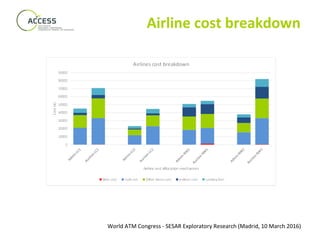
Airline cost breakdown
World ATM Congress - SESAR Exploratory Research (Madrid, 10 March 2016)
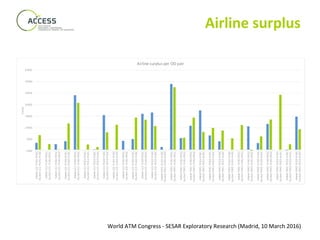
Airline surplus
World ATM Congress - SESAR Exploratory Research (Madrid, 10 March 2016)
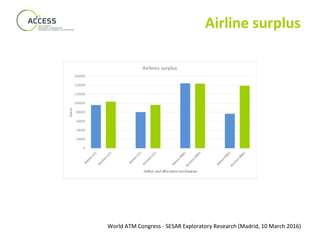
Airline surplus
World ATM Congress - SESAR Exploratory Research (Madrid, 10 March 2016)
Discussion of results
• The auction yields a more efficient use of airport capacity. Market
mechanisms seem to have significant potential to enable a more efficient
use of scarce capacity at busy airports
• In the real life, slot transfers, exchanges and trades would improve the
schedules of the airlines. This result is consistent with the fact that the
current mechanism usually needs a number of adjustments, where users
need to interact several times with coordinators to re-build schedules.
The auction would largely mitigate the need for such adjustments
• The extra surplus is not homogeneously distributed among all
stakeholders:
– The increase is relatively bigger for passengers and airports than for airlines
– While some airlines improve their profits, the profit of the airline that enjoyed
grandfather rights in the baseline scenario is reduced.
World ATM Congress - SESAR Exploratory Research (Madrid, 10 March 2016)
A word of caution
• Results are to be taken with caution (e.g., airport costs and non-
aeronautical revenues not included in airport surplus)
• Further simulations required to investigate whether conclusions hold
for more comprehensive cost models and different congestion levels
• A comprehensive evaluation requires the simulation of different
combinations of primary and secondary slot allocation mechanisms
along several seasons
• Market mechanisms also raise a number of technological and
regulatory challenges that need to be taken into consideration
World ATM Congress - SESAR Exploratory Research (Madrid, 10 March 2016)
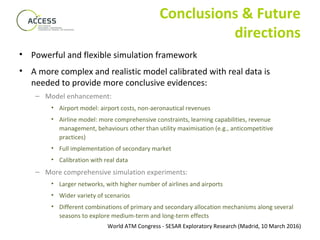
Conclusions & Future
directions
• Powerful and flexible simulation framework
• A more complex and realistic model calibrated with real data is
needed to provide more conclusive evidences:
– Model enhancement:
• Airport model: airport costs, non-aeronautical revenues
• Airline model: more comprehensive constraints, learning capabilities, revenue
management, behaviours other than utility maximisation (e.g., anticompetitive
practices)
• Full implementation of secondary market
• Calibration with real data
– More comprehensive simulation experiments:
• Larger networks, with higher number of airlines and airports
• Wider variety of scenarios
• Different combinations of primary and secondary allocation mechanisms along several
seasons to explore medium-term and long-term effects
www.access-sesar.eu
Ricardo Herranz (Project Coordinator)
Nommon Solutions and Technologies
Diego de León 47, 28006 Madrid, Spain
Tel: +34 91 838 85 94 / +34 616 05 32 51
ricardo.herranz@nommon.es​
CASSIOPEIA concept & approach
2016.03.10. World ATM Congress
Jorge Martín
jm@innaxis.org
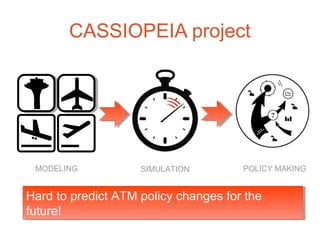
CASSIOPEIA project
MODELING SIMULATION POLICY MAKING
Hard to predict ATM policy changes for the
future!
Hard to predict ATM policy changes for the
future!
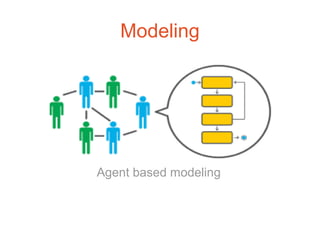
Modeling
Agent based modeling
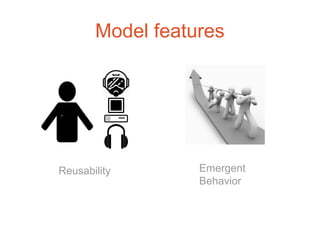
Model features
Reusability Emergent
Behavior
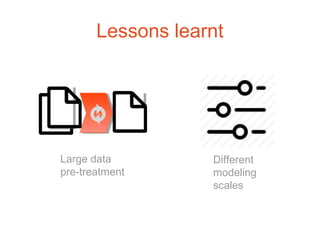
Lessons learnt
Large data
pre-treatment
Different
modeling
scales
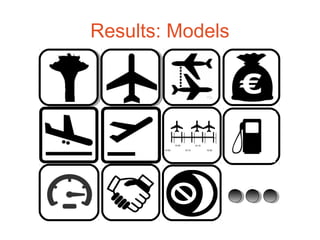
Results: Models
10:00
10:05
10:10
10:15
10:20
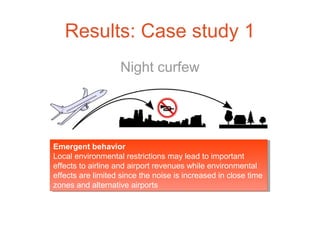
Results: Case study 1
Night curfew
Emergent behavior
Local environmental restrictions may lead to important
effects to airline and airport revenues while environmental
effects are limited since the noise is increased in close time
zones and alternative airports
Emergent behavior
Local environmental restrictions may lead to important
effects to airline and airport revenues while environmental
effects are limited since the noise is increased in close time
zones and alternative airports
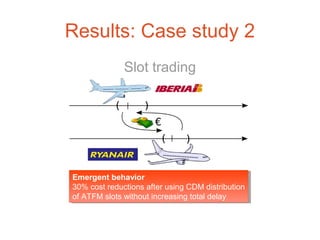
Results: Case study 2
Slot trading
Emergent behavior
30% cost reductions after using CDM distribution
of ATFM slots without increasing total delay
Emergent behavior
30% cost reductions after using CDM distribution
of ATFM slots without increasing total delay
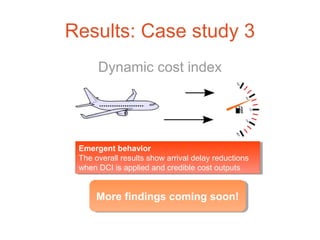
Results: Case study 3
Dynamic cost index
Emergent behavior
The overall results show arrival delay reductions
when DCI is applied and credible cost outputs
Emergent behavior
The overall results show arrival delay reductions
when DCI is applied and credible cost outputs
More findings coming soon!More findings coming soon!
Contact us if interested! innovation@innaxis.org
AKNOWLEDGES
HOW WE TAKE SCIENCE SERIOUSLY
IN SESAR
42
Prof. Dr. Peter Hecker
#SESAR
@WorldATM_now
CONNECTING SCIENCE WITH INNOVATION
43
Prof. Dr. Peter Hecker
#SESAR
@WorldATM_now
Academia has two major functions in developing the
aircraft of the future:
Education and Research & Innovation
According to the Humboldtian model of higher education
research and studies need to be combined in a holistic
way.
Science and Academia in ATM-Research
#SESAR
@WorldATM_now
Peter Hecker
Academia has two major functions in developing the aircraft of the future:
Education and Research & Innovation
According to the Humboldtian model of higher education research and studies
need to be combined in a holistic way.
Education:
• Universities educate the engineers and PhDs required for developing R&I
for the aircraft of the future
• Continuously high demand for human resources
• Significant “pull” from other domains (e.g. automotive)
• Technical and social skills are changing continuously
 Need to work in flexible, international, agile teams
The integration of universities and young talents into innovation processes
will secure the resources of the future
Science and Academia in ATM-Research
Peter Hecker
Academia has two major functions in developing the aircraft of the future:
Education and Research & Innovation
According to the Humboldtian model of higher education research and studies
need to be combined in a holistic way.
Research & Innovation:
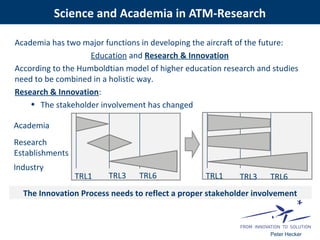
• The stakeholder involvement has changed
TRL1 TRL3 TRL6TRL1 TRL3 TRL6
Academia
Research
Establishments
Industry
The Innovation Process needs to reflect a proper stakeholder involvement
Science and Academia in ATM-Research
The Innovation Process
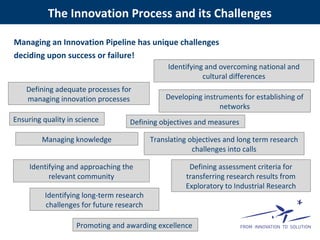
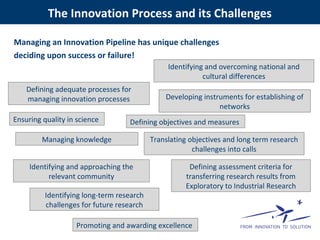
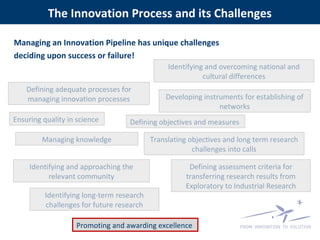
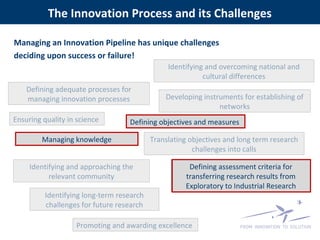
Managing an Innovation Pipeline has unique challenges
deciding upon success or failure!
The Innovation Process and its Challenges
Defining adequate processes for
managing innovation processes
Defining objectives and measures
Identifying long-term research
challenges for future research
Translating objectives and long term research
challenges into calls
Identifying and approaching the
relevant community
Identifying and overcoming national and
cultural differences
Defining assessment criteria for
transferring research results from
Exploratory to Industrial Research
Developing instruments for establishing of
networks
Managing knowledge
Ensuring quality in science
Promoting and awarding excellence
Background
•Set up by the SJU in August 2009 in accordance with Article 1.5 of the Council
Regulation establishing the SJU.
Objective
•Reinforcing the SJUs innovative and scientific approach to researching the
future Air Traffic Management systems and procedures,
•Providing specific advice to its Executive Director.
Constitution
•A First SciCom was established in 2009.
•To maintain and reinforce the role of the SciCom a further call for new
members was issued in September 2012.
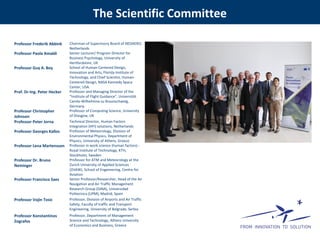
The Scientific Committee
Professor Frederik Abbink Chairman of Supervisory Board of NEDAERO,
Netherlands
Professor Paola Amaldi Senior Lecturer/ Program Director for
Business Psychology, University of
Hertfordshire, UK
Professor Guy A. Boy School of Human-Centered Design,
Innovation and Arts, Florida Institute of
Technology, and Chief Scientist, Human-
Centered Design, NASA Kennedy Space
Center, USA.
Prof. Dr-Ing. Peter Hecker Professor and Managing Director of the
“Institute of Flight Guidance”, Universität
Carolo-Wilhelmina zu Braunschweig,
Germany
Professor Christopher
Johnson
Professor of Computing Science, University
of Glasgow, UK
Professor Peter Jorna Technical Director, Human Factors
Integration (HFI) solutions, Netherlands
Professor Georges Kallos Professor of Meteorology, Division of
Environmental Physics, Department of
Physics, University of Athens, Greece
Professor Lena Martensson Professor in work science (human factors) -
Royal Institute of Technology, KTH,
Stockholm, Sweden
Professor Dr. Bruno
Neininger
Professor for ATM and Meteorology at the
Zurich University of Applied Sciences
(ZHAW), School of Engeneering, Centre for
Aviation
Professor Francisco Saez Senior Professor/Researcher, Head of the Air
Navigation and Air Traffic Management
Research Group (GINA), Universidad
Politecinca (UPM), Madrid, Spain
Professor Vojin Tosic Professor, Division of Airports and Air Traffic
Safety, Faculty of traffic and Transport
Engineering, University of Belgrade, Serbia
Professor Konstantinos
Zografos
Professor, Department of Management
Science and Technology, Athens University
of Economics and Business, Greece
Managing an Innovation Pipeline has unique challenges
deciding upon success or failure!
The Innovation Process and its Challenges
Defining adequate processes for
managing innovation processes
Defining objectives and measures
Identifying long-term research
challenges for future research
Translating objectives and long term research
challenges into calls
Identifying and approaching the
relevant community
Identifying and overcoming national and
cultural differences
Defining assessment criteria for
transferring research results from
Exploratory to Industrial Research
Developing instruments for establishing of
networks
Managing knowledge
Ensuring quality in science
Promoting and awarding excellence
The Innovation Process and its Challenges
Defining adequate processes for
managing innovation processes
Defining objectives and measures
Identifying long-term research
challenges for future research
Translating objectives and long term research
challenges into calls
Identifying and approaching the
relevant community
Identifying and overcoming national and
cultural differences
Defining assessment criteria for
transferring research results from
Exploratory to Industrial Research
Developing instruments for establishing of
networks
Managing knowledge
Promoting and awarding excellence
Managing an Innovation Pipeline has unique challenges
deciding upon success or failure!
Ensuring quality in science
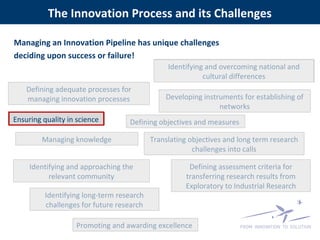
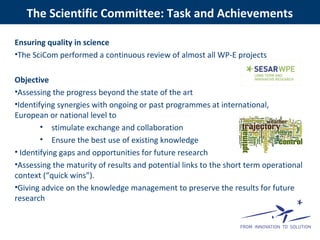
•The SciCom performed a continuous review of almost all WP-E projects
Objective
•Assessing the progress beyond the state of the art
•Identifying synergies with ongoing or past programmes at international,
European or national level to
• stimulate exchange and collaboration
• Ensure the best use of existing knowledge
• Identifying gaps and opportunities for future research
•Assessing the maturity of results and potential links to the short term operational
context (“quick wins”).
•Giving advice on the knowledge management to preserve the results for future
research
The Scientific Committee: Task and Achievements
Ensuring quality in science
The Innovation Process and its Challenges
Defining adequate processes for
managing innovation processes
Defining objectives and measures
Identifying long-term research
challenges for future research
Translating objectives and long term research
challenges into calls
Identifying and approaching the
relevant community
Identifying and overcoming national and
cultural differences
Defining assessment criteria for
transferring research results from
Exploratory to Industrial Research
Developing instruments for establishing of
networks
Managing knowledge
Managing an Innovation Pipeline has unique challenges
deciding upon success or failure!
Promoting and awarding excellence
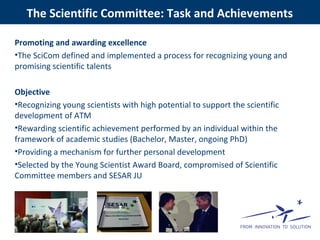
•The SciCom defined and implemented a process for recognizing young and
promising scientific talents
Objective
•Recognizing young scientists with high potential to support the scientific
development of ATM
•Rewarding scientific achievement performed by an individual within the
framework of academic studies (Bachelor, Master, ongoing PhD)
•Providing a mechanism for further personal development
•Selected by the Young Scientist Award Board, compromised of Scientific
Committee members and SESAR JU
The Scientific Committee: Task and Achievements
Ensuring quality in science
The Innovation Process and its Challenges
Defining adequate processes for
managing innovation processes
Defining objectives and measures
Identifying and approaching the
relevant community
Identifying and overcoming national and
cultural differences
Defining assessment criteria for
transferring research results from
Exploratory to Industrial Research
Developing instruments for establishing of
networks
Managing knowledge
Promoting and awarding excellence
Managing an Innovation Pipeline has unique challenges
deciding upon success or failure!
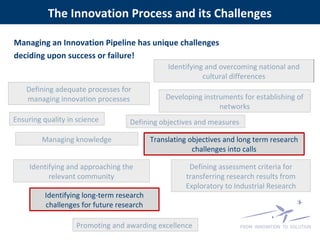
Translating objectives and long term research
challenges into calls
Identifying long-term research
challenges for future research
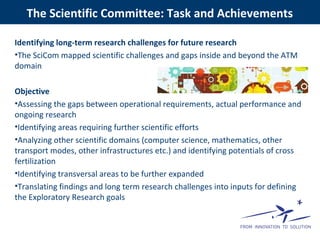
Identifying long-term research challenges for future research
•The SciCom mapped scientific challenges and gaps inside and beyond the ATM
domain
Objective
•Assessing the gaps between operational requirements, actual performance and
ongoing research
•Identifying areas requiring further scientific efforts
•Analyzing other scientific domains (computer science, mathematics, other
transport modes, other infrastructures etc.) and identifying potentials of cross
fertilization
•Identifying transversal areas to be further expanded
•Translating findings and long term research challenges into inputs for defining
the Exploratory Research goals
The Scientific Committee: Task and Achievements
Translating objectives and long term research
challenges into calls
Identifying long-term research
challenges for future research
Ensuring quality in science
The Innovation Process and its Challenges
Defining adequate processes for
managing innovation processes
Identifying and approaching the
relevant community
Identifying and overcoming national and
cultural differences
Developing instruments for establishing of
networks
Promoting and awarding excellence
Managing an Innovation Pipeline has unique challenges
deciding upon success or failure!
Defining assessment criteria for
transferring research results from
Exploratory to Industrial Research
Defining objectives and measures
Managing knowledge
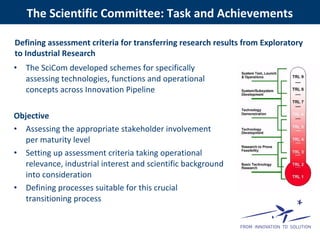
Defining assessment criteria for transferring research results from Exploratory
to Industrial Research
The Scientific Committee: Task and Achievements
• The SciCom developed schemes for specifically
assessing technologies, functions and operational
concepts across Innovation Pipeline
Objective
• Assessing the appropriate stakeholder involvement
per maturity level
• Setting up assessment criteria taking operational
relevance, industrial interest and scientific background
into consideration
• Defining processes suitable for this crucial
transitioning process
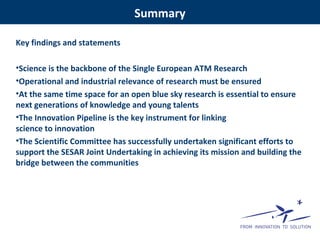
Key findings and statements
•Science is the backbone of the Single European ATM Research
•Operational and industrial relevance of research must be ensured
•At the same time space for an open blue sky research is essential to ensure
next generations of knowledge and young talents
•The Innovation Pipeline is the key instrument for linking
science to innovation
•The Scientific Committee has successfully undertaken significant efforts to
support the SESAR Joint Undertaking in achieving its mission and building the
bridge between the communities
Summary
Thank you for your attention
62
The way forward in SESAR 2020
#SESAR
@WorldATM_now
Dr. Stella Tkatchova
SESAR JU
SESAR Exploratory Research Objectives
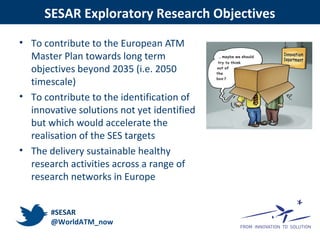
• To contribute to the European ATM
Master Plan towards long term
objectives beyond 2035 (i.e. 2050
timescale)
• To contribute to the identification of
innovative solutions not yet identified
but which would accelerate the
realisation of the SES targets
• The delivery sustainable healthy
research activities across a range of
research networks in Europe
#SESAR
@WorldATM_now
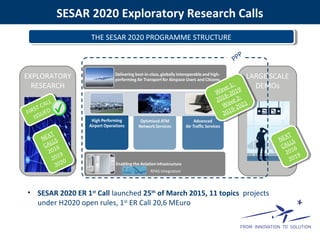
SESAR 2020 Exploratory Research Calls
EXPLORATORY
RESEARCH
LARGE SCALE
DEMOs
THE SESAR 2020 PROGRAMME STRUCTURETHE SESAR 2020 PROGRAMME STRUCTURE
PPP
FIRST CALL
ISSUEDFIRST CALL
ISSUED
NEXT
CALLS
2016
2019
2020
NEXT
CALLS
2016
2019
2020
RPAS Integration
NEXT
CALLS
2016
2019
NEXT
CALLS
2016
2019
Wave 1:
2016-2019
Wave 2:
2019-2021
Wave 1:
2016-2019
Wave 2:
2019-2021
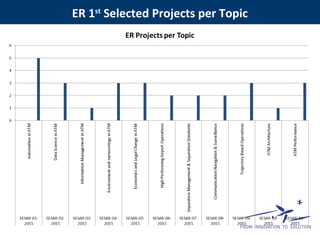
• SESAR 2020 ER 1st
Call launched 25th
of March 2015, 11 topics projects
under H2020 open rules, 1st
ER Call 20,6 MEuro
SESAR 2020 Exploratory Research – Call 1
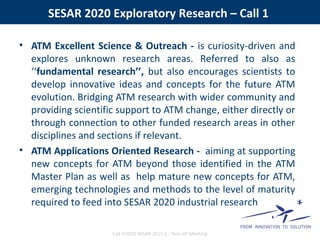
• ATM Excellent Science & Outreach - is curiosity-driven and
explores unknown research areas. Referred to also as
‘‘fundamental research’’, but also encourages scientists to
develop innovative ideas and concepts for the future ATM
evolution. Bridging ATM research with wider community and
providing scientific support to ATM change, either directly or
through connection to other funded research areas in other
disciplines and sections if relevant.
• ATM Applications Oriented Research - aiming at supporting
new concepts for ATM beyond those identified in the ATM
Master Plan as well as help mature new concepts for ATM,
emerging technologies and methods to the level of maturity
required to feed into SESAR 2020 industrial research
Call H2020-SESAR 2015-1 - Kick-off Meeting
SESAR 2020 Exploratory Research Topics
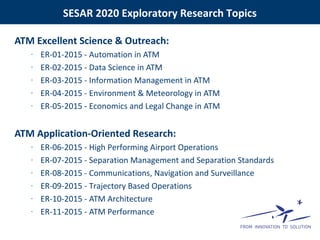
ATM Excellent Science & Outreach:
- ER-01-2015 - Automation in ATM
- ER-02-2015 - Data Science in ATM
- ER-03-2015 - Information Management in ATM
- ER-04-2015 - Environment & Meteorology in ATM
- ER-05-2015 - Economics and Legal Change in ATM
ATM Application-Oriented Research:
- ER-06-2015 - High Performing Airport Operations
- ER-07-2015 - Separation Management and Separation Standards
- ER-08-2015 - Communications, Navigation and Surveillance
- ER-09-2015 - Trajectory Based Operations
- ER-10-2015 - ATM Architecture
- ER-11-2015 - ATM Performance
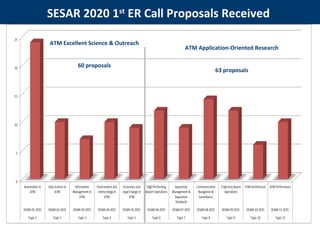
SESAR 2020 1st
ER Call Proposals Received
ATM Excellent Science & Outreach
60 proposals
ATM Application-Oriented Research
63 proposals
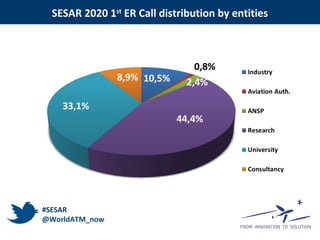
SESAR 2020 1st
ER Call distribution by entities
#SESAR
@WorldATM_now
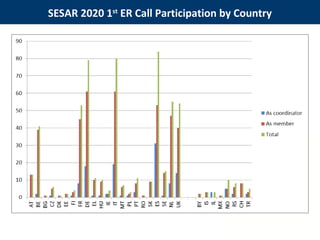
SESAR 2020 1st
ER Call Participation by Country
ER 1st
Selected Projects per Topic
SESAR 2020 ER 1st
Call Lesson Learnt
• Highly competitive 1st
ER
Call with good quality
proposals building upon
WP-E results
• Innovative research
questions and challenges
addressed in the proposals
• Proposals fully in-line with
SESAR 2020 Vision for the
future evolution of the
European ATM
SESAR 2020 The Way Forward
• SESAR ER Calls Scope currently
being defined
• ER-2 focused on RPAS
• ER-3 focused on Transversal and
ATM Applications Oriented topics
• H2020 open calls, so not limited
to SJU Members
SESAR 2020 Transversal Activities
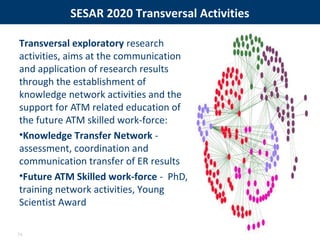
Transversal exploratory research
activities, aims at the communication
and application of research results
through the establishment of
knowledge network activities and the
support for ATM related education of
the future ATM skilled work-force:
•Knowledge Transfer Network -
assessment, coordination and
communication transfer of ER results
•Future ATM Skilled work-force - PhD,
training network activities, Young
Scientist Award
74
SESAR 2020 ATM Applications Oriented Research
Some examples could be….
•High Performing Airport Operations -
enhanced runway throughput, total
airport management etc.
•Optimized ATM Network Management -
advanced airspace management,
dynamic capacity balancing etc.
• Enabling Aviation Infrastructure – CNS,
etc.
•ATM Operations, Architecture,
Performance & Validation – ATM
Resilience, etc.
Conclusions
• SESAR Exploratory Research
will be the driver behind
innovative and disruptive
research ideas
• ER results will feed the next
steps in SESAR Industrial
Research
• The link between research
and deployment is assured
• Its time to get involved
Thank you for your attention

SESAR at World ATM Congress 2016 - Exploratory Research programme

  • 1.
  • 2.
    CONTENTS Introduction Dr. Stella Tkatchova,SESAR JU WPE project example: ACCESS Ricardo Herranz, Nommon WPE project example: CASSIOPEIA Jorge Martín, Innaxis How we take Science Seriously in SESAR Peter Hecker, Chairman of the SESAR Scientific Committee The Way forward and closing Dr. Stella Tkatchova, SESAR JU
  • 3.
    Dr. Stella Tkatchova SESARJU SESAR Exploratory Research Introduction 3 #SESAR @WorldATM_now
  • 4.
    The Single EuropeanSky #SESAR @WorldATM_now
  • 5.
    SESAR to enablestep-change in system capabilities Integrated systems Sharing of information Flight-centric operations Integration of all vehicles Automation of routine tasks Virtualization Air users fly their preferred, more direct route in a flow and network context Information shared digitally via common information platform All air vehicles fully integrated in ATM environment (incl. RPAS) Virtualization allowing dynamic capacity management Lean and modular systems, easily upgradable and interoperable Automation and use of data communication to ease controllers & support staff workload
  • 6.
  • 7.
    SESAR Exploratory Researchin ATM SESAR exploratory research drives the development and evaluation of innovative or unconventional ideas, concepts, methods and technologies; that can define and deliver the performance required for the next generation of European ATM system, and thus contribute to its successful evolution Reviewed, updated and approved by the SESAR Scientific Committee 7
  • 8.
    2 FOUNDING MEMBERS SESAR2020 R&I Pipeline
  • 9.
    SESAR 1 Long-termResearch Program • Long-term research in SESAR1 conducted under the frame of WP E. • A total of 40 projects of WP-E projects • The three Research Networks coordinate research, 20 PhD • HALA! – Towards Higher Levels of Automation in ATM • Complex World –Mastering Complex Systems Safely • ALIAS – Addressing the Liability Impact of Automated Systems
  • 10.
    SESAR 1 Encouragingscientific excellence in ATM 11 Projects 7 PhDs 17 Projects 13 PhDs 3 Projects 3 Projects6 Projects With guidance from SESAR Scientific Committee
  • 11.
    SESAR 1 LessonsLearnt • The transfer of long-term research results is difficult into the Industrial Research activities of the main SESAR program • SESAR 2020 will aim at better bridging the results from Exploratory Research through Industrial Research, Large Scale Demos towards implementation/industrialisation readiness • Strengthen the link of the ATM research community and SESAR stakeholders through ATM Applications Oriented topics in SESAR 2020
  • 12.
    An Agent-Based Modelof Airport Slot Allocation: the ACCESS project Ricardo Herranz, Nommon Solutions and Technologies World ATM Congress, Madrid, 10 March 2016
  • 13.
    World ATM Congress- SESAR Exploratory Research (Madrid, 10 March 2016) Airport slot allocation • Continuous growth in air transport ⇒ Pressure on airport capacity • New airports/runways: long look-ahead time, often difficult or unfeasible (cost, environment, land availability, etc.) • Need for demand management policies for airport capacity
  • 14.
    World ATM Congress- SESAR Exploratory Research (Madrid, 10 March 2016) Market-based mechanisms • Administrative slot allocation has been so far the dominant approach in Europe: Regulation 95/93, based on IATA WSG • Previous studies commissioned by the EC have identified room for improvement (efficient use of capacity, competition…) • Market-based mechanisms have been proposed as a way to bring incentives so that scarce capacity is used by those airlines able to make best economic use of it, but they also raise a number of concerns (e.g., market failures)
  • 15.
    World ATM Congress- SESAR Exploratory Research (Madrid, 10 March 2016) The ACCESS project • Review of current slot allocation system + stakeholder analysis • Performance framework for a comprehensive evaluation and comparison of different slot allocation mechanisms • Simulation framework based on ABM + auction theory: appealing framework to overcome limitations of classical approaches from economics and operations research: multiplicity of dimensions and stakeholders, complex combinatorial assignment problem, bounded rationality, evolutionary behaviour, asymmetry of information, uncertainty… • Simulation experiments: comparison of primary allocation through a combinatorial price-setting auction vs current system • Policy recommendations
  • 16.
    World ATM Congress- SESAR Exploratory Research (Madrid, 10 March 2016) Performance framework Trade-offs KPAs/KPIs and choice of preferred mechanism: multi-criteria decision methods (e.g. AHP), CBA, etc.
  • 17.
    World ATM Congress- SESAR Exploratory Research (Madrid, 10 March 2016) ACCESS simulation platform • Inputs: primary + secondary slot allocation mechanisms (policies under testing) • Exogenous variables: demand evolution, airline cost factors • Agents (attributes + behavioural rules): – Airports – Airlines – Slot allocation coordinator – Passengers • Outputs: KPIs influenced by the slot allocation system – Available slots, slot requests, slot prices, slot allocation, slot use – Surplus obtained by the airlines, the airports and the passengers
  • 18.
    World ATM Congress- SESAR Exploratory Research (Madrid, 10 March 2016) General simulation logic Airport Slot Allocation Coordinator Airline Strategic planning Consolidate slot information Desired schedule calculation Ask/offer slots Market clearing Publish schedules Passengers Exogenous Variables Strategic planning Desired schedule calculation Slot allocation Forecast fuel price and demand Pre-seasonPrimary Allocation Pre-seasonSecondary Allocation Forecast fuel price and demand In-seasonSecondaryAllocation Choose flights Actual demand Actual fuel price Profit calculation Desired schedule calculation Ask/offer slots Market clearing Stop criteria met? No Yes Started season? No Yes Finished season? No Yes
  • 19.
    World ATM Congress- SESAR Exploratory Research (Madrid, 10 March 2016) Case study: primary auctioning • Performance of a combinatorial price-setting Walrasian auction vs current administrative mechanism in a simplified scenario: – 2 network carriers (NW1, NW2) + 2 low cost carriers (LC1, LC2) – 1 hub for each network carrier (HUB1, HUB2) + 2 regional airports (REG1, REG2) – HUB1, HUB2, REG1: coordinated; REG2: non-coordinated – Simulation of a single season, only primary allocation is considered – NW1 holds GFR over 20 slots at HUB1 (10 DEP + 10 ARR) HUB 1 HUB 2 REG 1 REG 2 NW1 NW2 LC1 LC2
  • 20.
    World ATM Congress- SESAR Exploratory Research (Madrid, 10 March 2016) Auction type and motivation
  • 21.
    World ATM Congress- SESAR Exploratory Research (Madrid, 10 March 2016) Capacity utilisation • The auction mechanism leads to a notable increase in the number of flights operated by NW2, LC1 and LC3 Airline Administrative Auction LC1 12 18 LC2 7 12 NW1 17 18 NW2 9 20
  • 22.
    World ATM Congress- SESAR Exploratory Research (Madrid, 10 March 2016) Passenger surplus 0.00 2,000.00 4,000.00 6,000.00 8,000.00 10,000.00 12,000.00 14,000.00 16,000.00 Surplus(€) OD pair and allocation mechanism Total surplus of the passengers by OD pair Business Leisure
  • 23.
    World ATM Congress- SESAR Exploratory Research (Madrid, 10 March 2016) Passenger surplus 0.00 10,000.00 20,000.00 30,000.00 40,000.00 50,000.00 60,000.00 70,000.00 80,000.00 Administrative Auction Surplus(€) Allocation mechanism Total surplus of the passengers Business Leisure
  • 24.
    World ATM Congress- SESAR Exploratory Research (Madrid, 10 March 2016) Airline cost breakdown
  • 25.
    World ATM Congress- SESAR Exploratory Research (Madrid, 10 March 2016) Airline surplus
  • 26.
    World ATM Congress- SESAR Exploratory Research (Madrid, 10 March 2016) Airline surplus
  • 27.
    World ATM Congress- SESAR Exploratory Research (Madrid, 10 March 2016) Discussion of results • The auction yields a more efficient use of airport capacity. Market mechanisms seem to have significant potential to enable a more efficient use of scarce capacity at busy airports • In the real life, slot transfers, exchanges and trades would improve the schedules of the airlines. This result is consistent with the fact that the current mechanism usually needs a number of adjustments, where users need to interact several times with coordinators to re-build schedules. The auction would largely mitigate the need for such adjustments • The extra surplus is not homogeneously distributed among all stakeholders: – The increase is relatively bigger for passengers and airports than for airlines – While some airlines improve their profits, the profit of the airline that enjoyed grandfather rights in the baseline scenario is reduced.
  • 28.
    World ATM Congress- SESAR Exploratory Research (Madrid, 10 March 2016) A word of caution • Results are to be taken with caution (e.g., airport costs and non- aeronautical revenues not included in airport surplus) • Further simulations required to investigate whether conclusions hold for more comprehensive cost models and different congestion levels • A comprehensive evaluation requires the simulation of different combinations of primary and secondary slot allocation mechanisms along several seasons • Market mechanisms also raise a number of technological and regulatory challenges that need to be taken into consideration
  • 29.
    World ATM Congress- SESAR Exploratory Research (Madrid, 10 March 2016) Conclusions & Future directions • Powerful and flexible simulation framework • A more complex and realistic model calibrated with real data is needed to provide more conclusive evidences: – Model enhancement: • Airport model: airport costs, non-aeronautical revenues • Airline model: more comprehensive constraints, learning capabilities, revenue management, behaviours other than utility maximisation (e.g., anticompetitive practices) • Full implementation of secondary market • Calibration with real data – More comprehensive simulation experiments: • Larger networks, with higher number of airlines and airports • Wider variety of scenarios • Different combinations of primary and secondary allocation mechanisms along several seasons to explore medium-term and long-term effects
  • 30.
    www.access-sesar.eu Ricardo Herranz (ProjectCoordinator) Nommon Solutions and Technologies Diego de León 47, 28006 Madrid, Spain Tel: +34 91 838 85 94 / +34 616 05 32 51 ricardo.herranz@nommon.es​
  • 31.
    CASSIOPEIA concept &approach 2016.03.10. World ATM Congress Jorge Martín jm@innaxis.org
  • 32.
    CASSIOPEIA project MODELING SIMULATIONPOLICY MAKING Hard to predict ATM policy changes for the future! Hard to predict ATM policy changes for the future!
  • 33.
  • 34.
  • 35.
  • 36.
  • 37.
    Results: Case study1 Night curfew Emergent behavior Local environmental restrictions may lead to important effects to airline and airport revenues while environmental effects are limited since the noise is increased in close time zones and alternative airports Emergent behavior Local environmental restrictions may lead to important effects to airline and airport revenues while environmental effects are limited since the noise is increased in close time zones and alternative airports
  • 38.
    Results: Case study2 Slot trading Emergent behavior 30% cost reductions after using CDM distribution of ATFM slots without increasing total delay Emergent behavior 30% cost reductions after using CDM distribution of ATFM slots without increasing total delay
  • 39.
    Results: Case study3 Dynamic cost index Emergent behavior The overall results show arrival delay reductions when DCI is applied and credible cost outputs Emergent behavior The overall results show arrival delay reductions when DCI is applied and credible cost outputs More findings coming soon!More findings coming soon!
  • 40.
    Contact us ifinterested! innovation@innaxis.org AKNOWLEDGES
  • 42.
    HOW WE TAKESCIENCE SERIOUSLY IN SESAR 42 Prof. Dr. Peter Hecker #SESAR @WorldATM_now
  • 43.
    CONNECTING SCIENCE WITHINNOVATION 43 Prof. Dr. Peter Hecker #SESAR @WorldATM_now
  • 44.
    Academia has twomajor functions in developing the aircraft of the future: Education and Research & Innovation According to the Humboldtian model of higher education research and studies need to be combined in a holistic way. Science and Academia in ATM-Research #SESAR @WorldATM_now
  • 45.
    Peter Hecker Academia hastwo major functions in developing the aircraft of the future: Education and Research & Innovation According to the Humboldtian model of higher education research and studies need to be combined in a holistic way. Education: • Universities educate the engineers and PhDs required for developing R&I for the aircraft of the future • Continuously high demand for human resources • Significant “pull” from other domains (e.g. automotive) • Technical and social skills are changing continuously  Need to work in flexible, international, agile teams The integration of universities and young talents into innovation processes will secure the resources of the future Science and Academia in ATM-Research
  • 46.
    Peter Hecker Academia hastwo major functions in developing the aircraft of the future: Education and Research & Innovation According to the Humboldtian model of higher education research and studies need to be combined in a holistic way. Research & Innovation: • The stakeholder involvement has changed TRL1 TRL3 TRL6TRL1 TRL3 TRL6 Academia Research Establishments Industry The Innovation Process needs to reflect a proper stakeholder involvement Science and Academia in ATM-Research
  • 47.
  • 48.
  • 49.
    Managing an InnovationPipeline has unique challenges deciding upon success or failure! The Innovation Process and its Challenges Defining adequate processes for managing innovation processes Defining objectives and measures Identifying long-term research challenges for future research Translating objectives and long term research challenges into calls Identifying and approaching the relevant community Identifying and overcoming national and cultural differences Defining assessment criteria for transferring research results from Exploratory to Industrial Research Developing instruments for establishing of networks Managing knowledge Ensuring quality in science Promoting and awarding excellence
  • 50.
    Background •Set up bythe SJU in August 2009 in accordance with Article 1.5 of the Council Regulation establishing the SJU. Objective •Reinforcing the SJUs innovative and scientific approach to researching the future Air Traffic Management systems and procedures, •Providing specific advice to its Executive Director. Constitution •A First SciCom was established in 2009. •To maintain and reinforce the role of the SciCom a further call for new members was issued in September 2012. The Scientific Committee
  • 51.
    The Scientific Committee ProfessorFrederik Abbink Chairman of Supervisory Board of NEDAERO, Netherlands Professor Paola Amaldi Senior Lecturer/ Program Director for Business Psychology, University of Hertfordshire, UK Professor Guy A. Boy School of Human-Centered Design, Innovation and Arts, Florida Institute of Technology, and Chief Scientist, Human- Centered Design, NASA Kennedy Space Center, USA. Prof. Dr-Ing. Peter Hecker Professor and Managing Director of the “Institute of Flight Guidance”, Universität Carolo-Wilhelmina zu Braunschweig, Germany Professor Christopher Johnson Professor of Computing Science, University of Glasgow, UK Professor Peter Jorna Technical Director, Human Factors Integration (HFI) solutions, Netherlands Professor Georges Kallos Professor of Meteorology, Division of Environmental Physics, Department of Physics, University of Athens, Greece Professor Lena Martensson Professor in work science (human factors) - Royal Institute of Technology, KTH, Stockholm, Sweden Professor Dr. Bruno Neininger Professor for ATM and Meteorology at the Zurich University of Applied Sciences (ZHAW), School of Engeneering, Centre for Aviation Professor Francisco Saez Senior Professor/Researcher, Head of the Air Navigation and Air Traffic Management Research Group (GINA), Universidad Politecinca (UPM), Madrid, Spain Professor Vojin Tosic Professor, Division of Airports and Air Traffic Safety, Faculty of traffic and Transport Engineering, University of Belgrade, Serbia Professor Konstantinos Zografos Professor, Department of Management Science and Technology, Athens University of Economics and Business, Greece
  • 52.
    Managing an InnovationPipeline has unique challenges deciding upon success or failure! The Innovation Process and its Challenges Defining adequate processes for managing innovation processes Defining objectives and measures Identifying long-term research challenges for future research Translating objectives and long term research challenges into calls Identifying and approaching the relevant community Identifying and overcoming national and cultural differences Defining assessment criteria for transferring research results from Exploratory to Industrial Research Developing instruments for establishing of networks Managing knowledge Ensuring quality in science Promoting and awarding excellence
  • 53.
    The Innovation Processand its Challenges Defining adequate processes for managing innovation processes Defining objectives and measures Identifying long-term research challenges for future research Translating objectives and long term research challenges into calls Identifying and approaching the relevant community Identifying and overcoming national and cultural differences Defining assessment criteria for transferring research results from Exploratory to Industrial Research Developing instruments for establishing of networks Managing knowledge Promoting and awarding excellence Managing an Innovation Pipeline has unique challenges deciding upon success or failure! Ensuring quality in science
  • 54.
    Ensuring quality inscience •The SciCom performed a continuous review of almost all WP-E projects Objective •Assessing the progress beyond the state of the art •Identifying synergies with ongoing or past programmes at international, European or national level to • stimulate exchange and collaboration • Ensure the best use of existing knowledge • Identifying gaps and opportunities for future research •Assessing the maturity of results and potential links to the short term operational context (“quick wins”). •Giving advice on the knowledge management to preserve the results for future research The Scientific Committee: Task and Achievements
  • 55.
    Ensuring quality inscience The Innovation Process and its Challenges Defining adequate processes for managing innovation processes Defining objectives and measures Identifying long-term research challenges for future research Translating objectives and long term research challenges into calls Identifying and approaching the relevant community Identifying and overcoming national and cultural differences Defining assessment criteria for transferring research results from Exploratory to Industrial Research Developing instruments for establishing of networks Managing knowledge Managing an Innovation Pipeline has unique challenges deciding upon success or failure! Promoting and awarding excellence
  • 56.
    Promoting and awardingexcellence •The SciCom defined and implemented a process for recognizing young and promising scientific talents Objective •Recognizing young scientists with high potential to support the scientific development of ATM •Rewarding scientific achievement performed by an individual within the framework of academic studies (Bachelor, Master, ongoing PhD) •Providing a mechanism for further personal development •Selected by the Young Scientist Award Board, compromised of Scientific Committee members and SESAR JU The Scientific Committee: Task and Achievements
  • 57.
    Ensuring quality inscience The Innovation Process and its Challenges Defining adequate processes for managing innovation processes Defining objectives and measures Identifying and approaching the relevant community Identifying and overcoming national and cultural differences Defining assessment criteria for transferring research results from Exploratory to Industrial Research Developing instruments for establishing of networks Managing knowledge Promoting and awarding excellence Managing an Innovation Pipeline has unique challenges deciding upon success or failure! Translating objectives and long term research challenges into calls Identifying long-term research challenges for future research
  • 58.
    Identifying long-term researchchallenges for future research •The SciCom mapped scientific challenges and gaps inside and beyond the ATM domain Objective •Assessing the gaps between operational requirements, actual performance and ongoing research •Identifying areas requiring further scientific efforts •Analyzing other scientific domains (computer science, mathematics, other transport modes, other infrastructures etc.) and identifying potentials of cross fertilization •Identifying transversal areas to be further expanded •Translating findings and long term research challenges into inputs for defining the Exploratory Research goals The Scientific Committee: Task and Achievements
  • 59.
    Translating objectives andlong term research challenges into calls Identifying long-term research challenges for future research Ensuring quality in science The Innovation Process and its Challenges Defining adequate processes for managing innovation processes Identifying and approaching the relevant community Identifying and overcoming national and cultural differences Developing instruments for establishing of networks Promoting and awarding excellence Managing an Innovation Pipeline has unique challenges deciding upon success or failure! Defining assessment criteria for transferring research results from Exploratory to Industrial Research Defining objectives and measures Managing knowledge
  • 60.
    Defining assessment criteriafor transferring research results from Exploratory to Industrial Research The Scientific Committee: Task and Achievements • The SciCom developed schemes for specifically assessing technologies, functions and operational concepts across Innovation Pipeline Objective • Assessing the appropriate stakeholder involvement per maturity level • Setting up assessment criteria taking operational relevance, industrial interest and scientific background into consideration • Defining processes suitable for this crucial transitioning process
  • 61.
    Key findings andstatements •Science is the backbone of the Single European ATM Research •Operational and industrial relevance of research must be ensured •At the same time space for an open blue sky research is essential to ensure next generations of knowledge and young talents •The Innovation Pipeline is the key instrument for linking science to innovation •The Scientific Committee has successfully undertaken significant efforts to support the SESAR Joint Undertaking in achieving its mission and building the bridge between the communities Summary
  • 62.
    Thank you foryour attention 62
  • 63.
    The way forwardin SESAR 2020 #SESAR @WorldATM_now Dr. Stella Tkatchova SESAR JU
  • 64.
    SESAR Exploratory ResearchObjectives • To contribute to the European ATM Master Plan towards long term objectives beyond 2035 (i.e. 2050 timescale) • To contribute to the identification of innovative solutions not yet identified but which would accelerate the realisation of the SES targets • The delivery sustainable healthy research activities across a range of research networks in Europe #SESAR @WorldATM_now
  • 65.
    SESAR 2020 ExploratoryResearch Calls EXPLORATORY RESEARCH LARGE SCALE DEMOs THE SESAR 2020 PROGRAMME STRUCTURETHE SESAR 2020 PROGRAMME STRUCTURE PPP FIRST CALL ISSUEDFIRST CALL ISSUED NEXT CALLS 2016 2019 2020 NEXT CALLS 2016 2019 2020 RPAS Integration NEXT CALLS 2016 2019 NEXT CALLS 2016 2019 Wave 1: 2016-2019 Wave 2: 2019-2021 Wave 1: 2016-2019 Wave 2: 2019-2021 • SESAR 2020 ER 1st Call launched 25th of March 2015, 11 topics projects under H2020 open rules, 1st ER Call 20,6 MEuro
  • 66.
    SESAR 2020 ExploratoryResearch – Call 1 • ATM Excellent Science & Outreach - is curiosity-driven and explores unknown research areas. Referred to also as ‘‘fundamental research’’, but also encourages scientists to develop innovative ideas and concepts for the future ATM evolution. Bridging ATM research with wider community and providing scientific support to ATM change, either directly or through connection to other funded research areas in other disciplines and sections if relevant. • ATM Applications Oriented Research - aiming at supporting new concepts for ATM beyond those identified in the ATM Master Plan as well as help mature new concepts for ATM, emerging technologies and methods to the level of maturity required to feed into SESAR 2020 industrial research Call H2020-SESAR 2015-1 - Kick-off Meeting
  • 67.
    SESAR 2020 ExploratoryResearch Topics ATM Excellent Science & Outreach: - ER-01-2015 - Automation in ATM - ER-02-2015 - Data Science in ATM - ER-03-2015 - Information Management in ATM - ER-04-2015 - Environment & Meteorology in ATM - ER-05-2015 - Economics and Legal Change in ATM ATM Application-Oriented Research: - ER-06-2015 - High Performing Airport Operations - ER-07-2015 - Separation Management and Separation Standards - ER-08-2015 - Communications, Navigation and Surveillance - ER-09-2015 - Trajectory Based Operations - ER-10-2015 - ATM Architecture - ER-11-2015 - ATM Performance
  • 68.
    SESAR 2020 1st ERCall Proposals Received ATM Excellent Science & Outreach 60 proposals ATM Application-Oriented Research 63 proposals
  • 69.
    SESAR 2020 1st ERCall distribution by entities #SESAR @WorldATM_now
  • 70.
    SESAR 2020 1st ERCall Participation by Country
  • 71.
  • 72.
    SESAR 2020 ER1st Call Lesson Learnt • Highly competitive 1st ER Call with good quality proposals building upon WP-E results • Innovative research questions and challenges addressed in the proposals • Proposals fully in-line with SESAR 2020 Vision for the future evolution of the European ATM
  • 73.
    SESAR 2020 TheWay Forward • SESAR ER Calls Scope currently being defined • ER-2 focused on RPAS • ER-3 focused on Transversal and ATM Applications Oriented topics • H2020 open calls, so not limited to SJU Members
  • 74.
    SESAR 2020 TransversalActivities Transversal exploratory research activities, aims at the communication and application of research results through the establishment of knowledge network activities and the support for ATM related education of the future ATM skilled work-force: •Knowledge Transfer Network - assessment, coordination and communication transfer of ER results •Future ATM Skilled work-force - PhD, training network activities, Young Scientist Award 74
  • 75.
    SESAR 2020 ATMApplications Oriented Research Some examples could be…. •High Performing Airport Operations - enhanced runway throughput, total airport management etc. •Optimized ATM Network Management - advanced airspace management, dynamic capacity balancing etc. • Enabling Aviation Infrastructure – CNS, etc. •ATM Operations, Architecture, Performance & Validation – ATM Resilience, etc.
  • 76.
    Conclusions • SESAR ExploratoryResearch will be the driver behind innovative and disruptive research ideas • ER results will feed the next steps in SESAR Industrial Research • The link between research and deployment is assured • Its time to get involved
  • 77.
    Thank you foryour attention

Editor's Notes

  • #7 Step 1-,2 and 3 – Time Based Operations, TBO-PBO will lead will lead ultimately to these 5 functional changes and aspect of interoperability These changes do not differ from the global ICAO ones Complex highly interconnected system of systems Often there are more reasons put forward for not changing than to actually change An increasing ‘pain’ and reducing ‘gain’ motivates the appetite for change Must deliver more for less, maintain and improve interoperability, ensure seamless global operations while respecting local, European and international regulation Unpredictable disruptive change is blocked - Safety Need vision, buy-in and plan of how to get there
  • #8 Beyond PBO – beyond 2035-2050 To contribute to the European ATM Master Plan towards long term objectives beyond 2035 (i.e. 2050 timescale) To contribute to the identification of innovative solutions not yet identified but which would accelerate the realisation of the SES targets The delivery sustainable healthy research activities across a range of research networks in Europe
  • #9 The SJU manages the SESAR programme - - a unique Public Private Partnership SESAR has enabled Europe to have a stronger impact on global standard setting, which will have positive effects on the competitiveness of European industry. SESAR is leading the global innovation process towards a new ATM system. The common roadmap for the development and deployment of these technologies and procedures, linking them to the SES performance objectives, is the European ATM Master plan. It defines the essential operational changes that need to occur in order to achieve the SES performance objectives and also identifies the related functionalities and the actions that operational stakeholders will have to implement at a given time and place. Exploratory Research Concentrates on early maturity excellent science and initial applications to ATM Uses H2020 open calls Industrial Research & Validation Concentrates on maturing and validating through applied research, pre-industrial development and validation of high benefit applications for ATM Uses an industrial PPP with involvement of all stakeholders Very Large Scale Demonstration Concentrates on taking the concepts and technology to a wider geographic and stakeholder application to reduce deployment risk Uses a mixture of industrial PPP and open calls
  • #10 WP-E Call 1 projects Theme 1: Legal Aspects of the Paradigm Shift – ALIAS Theme 2: Toward Higher Levels of Automation in ATM – SUPERPORT, MUFASA, STREAM, SPAD, TESA,ADAHR, C-SHARE, UTOPIA, ZefMAP Theme 3: Mastering Complex Systems Safely – ONBOARD, ASHiCs, MAREA, COMPASS, NEWO, CASSIOPEIA, ELSA, Them e 4 Economics and Performance – POEM Complex World Research Network – Complexity Science in ATM has identified research areas of Uncertainty, Emergent Behaviour, Complex Data Analysis, Complex Metrics, Resilience in ATM HALA Research Network – Automation in ATM has identified research areas in the areas of Human automation interaction, trajectory predictions, knowledge management/decision support systems, separation assurance
  • #11 WP-E is the most diverse WP from all the SESAR work packages. Its objective is to create a healthy European research capability for ATM beyond the SESAR programme, but address the development of applications-oriented research beyond the nominal SESAR timeframe. Towards Higher Levels of Automation in ATM – has the highest number of WP-E projects Mastering Complex Systems Safely in ATM and Enabling Change encompasses projects linked to economics, legal, regulatory aspects
  • #12 WP-E lessons learnt – difficulties WP-E results transfer into the SESAR mainstream workpackages, lack of interest from industrial partners, small projects of 300K work very well, co-funding too, content oriented Gate Reviews work well, Honesty/ transparency on reporting negative research results is essential in order to prevent others to repeat the same research mistakes. Demonstrated the importance of transferring WP-E projects results to the SESAR mainstream program It is essential to realise the concept of a ‘pipeline to innovation’ described in the overall SESAR Programme 2020 and the realisation of important benefits to the SJU stakeholders of transferring Exploratory Research results to the rest of SESAR 2020 program. Limited possibility to pass results at V0 or V1 into the SESAR mainstream programme combined with low level of interest in long-term research from the majority of PPP industrial partners SESAR 2020 Exploratory Research will have to also bring benefits to SESAR SJU Industrial stakeholders . Therefore, the importance of the transfer of ER results to IR in SESAR 2020 is essential
  • #68 Follow- up on WP-E activities
  • #70 Follow- up on WP-E activities
  • #71 Follow- up on WP-E activities