Non-Exclusion
Reynolds School District
February 2015
Lonnie Jackson
John Lenssen
Dr. Centae Richards
Objectives:
Reynolds School District leaders
will:
 Increase understanding of the impact of culture, history,
and structures on students, especially students of color.
 Explore own dynamics of culture, bias, power, and
beliefs in relation to student discipline.
 Examine ways and skills to reconnect students of color,
and other students to learning through non-
exclusionary practices.
Essential Questions
 Who is in the room? Why are we here?
 Who are you in this work? How is your identity
affirmed/marginalized? How does this
affirmation/marginalization impact your work?
 How does status quo, our values and beliefs impact our
expectations and our students?
Essential Questions
 What is the purpose of discipline?
 How do I connect with cultural difference?
 How can I practice with real life scenarios?
 How do I evaluate success?
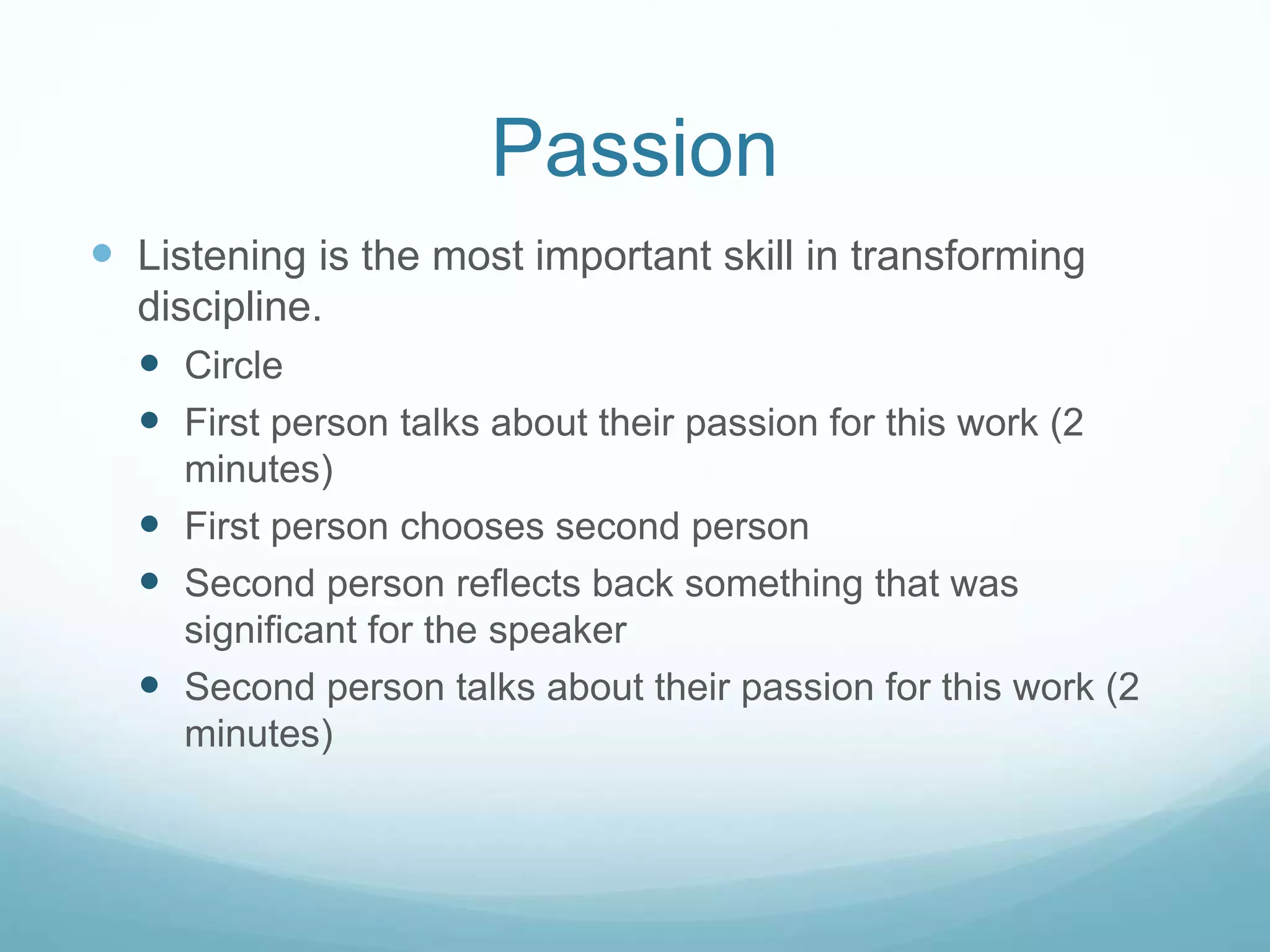
Passion
 Listening is the most important skill in transforming
discipline.
 Circle
 First person talks about their passion for this work (2
minutes)
 First person chooses second person
 Second person reflects back something that was
significant for the speaker
 Second person talks about their passion for this work (2
minutes)
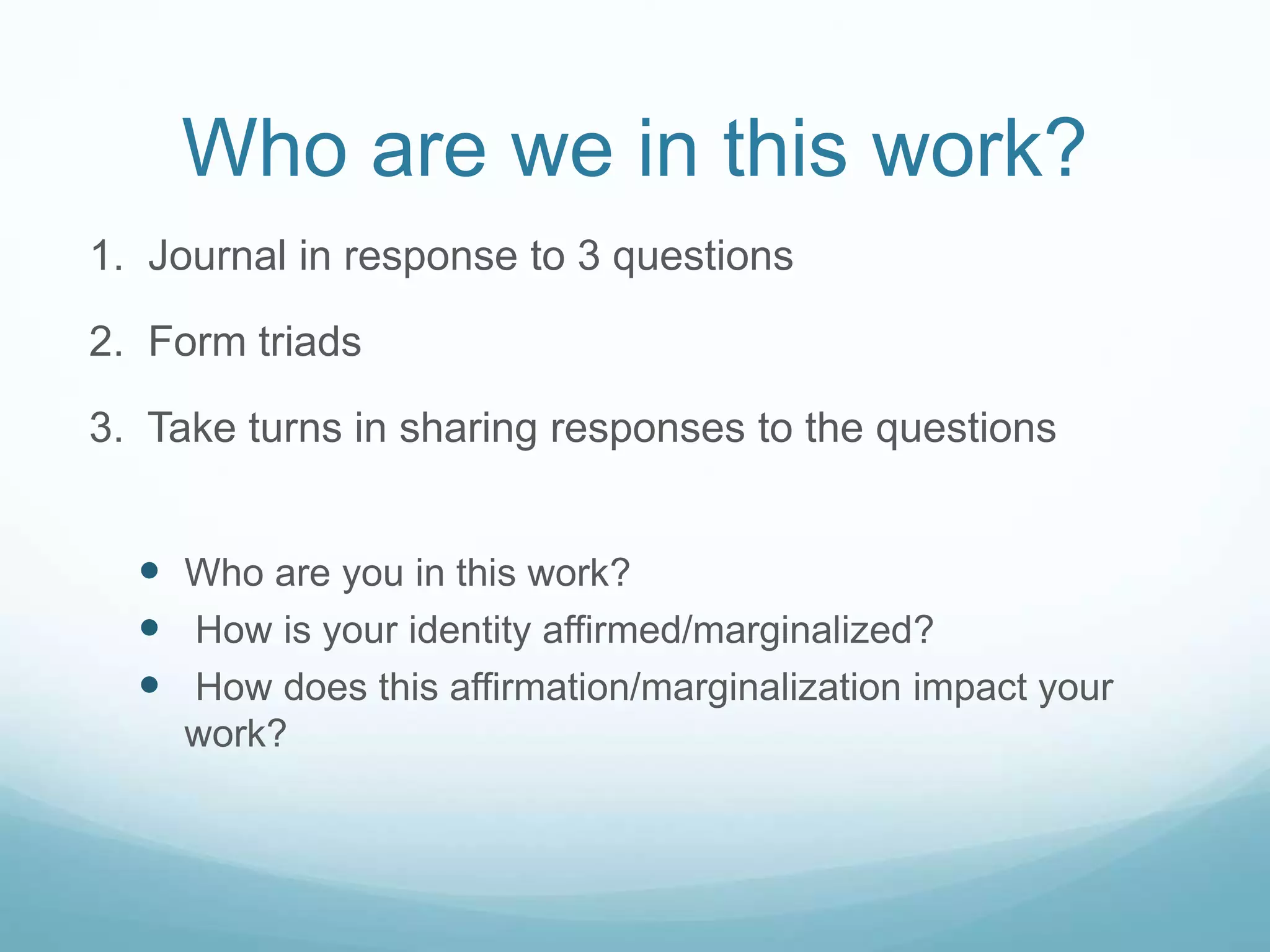
Who are we in this work?
1. Journal in response to 3 questions
2. Form triads
3. Take turns in sharing responses to the questions
 Who are you in this work?
 How is your identity affirmed/marginalized?
 How does this affirmation/marginalization impact your
work?
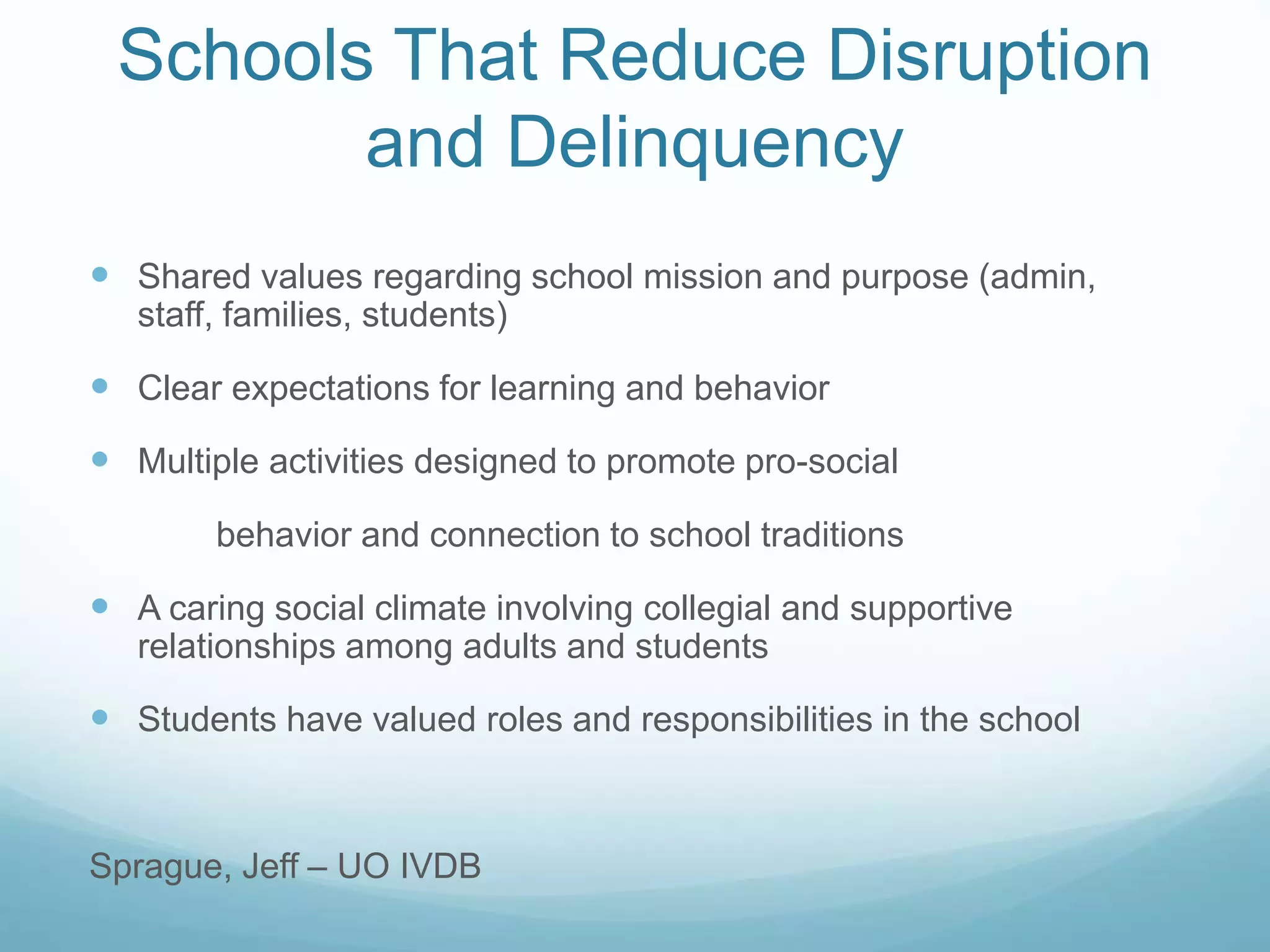
Schools That Reduce Disruption
and Delinquency
 Shared values regarding school mission and purpose (admin,
staff, families, students)
 Clear expectations for learning and behavior
 Multiple activities designed to promote pro-social
behavior and connection to school traditions
 A caring social climate involving collegial and supportive
relationships among adults and students
 Students have valued roles and responsibilities in the school
Sprague, Jeff – UO IVDB
“If you always do what you always
did, you’ll always get what you
always got.”
“Moms” Mably
• ‘What happened, who is to blame, what
punishment or sanction is needed?’
–The easiest consequence is the one
most likely to be delivered
• ‘What happened, what harm has resulted
and what needs to happen to make things
right?’ (O’Connell, 2004)
–A restorative process will initially be
viewed as more effortful
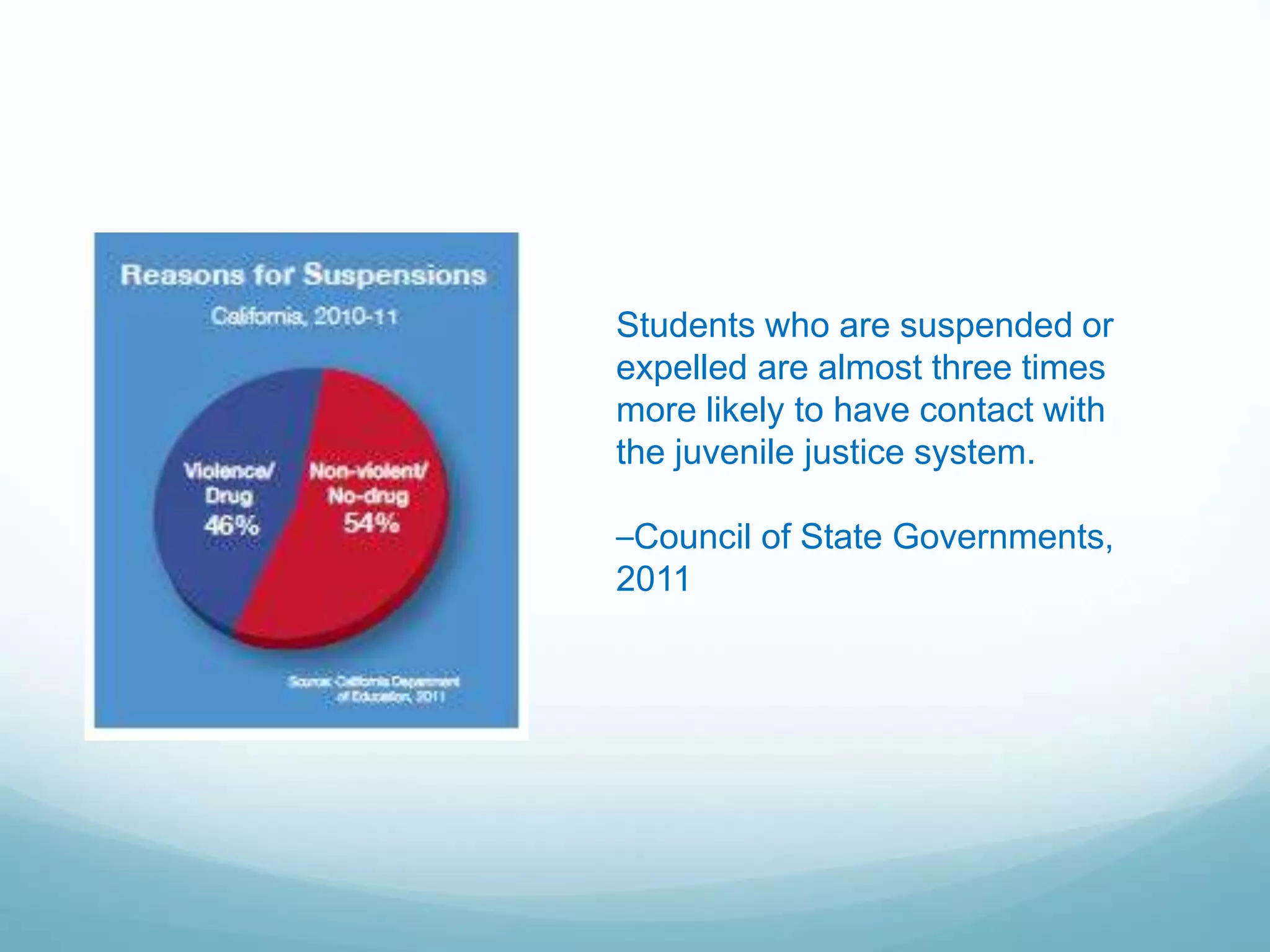
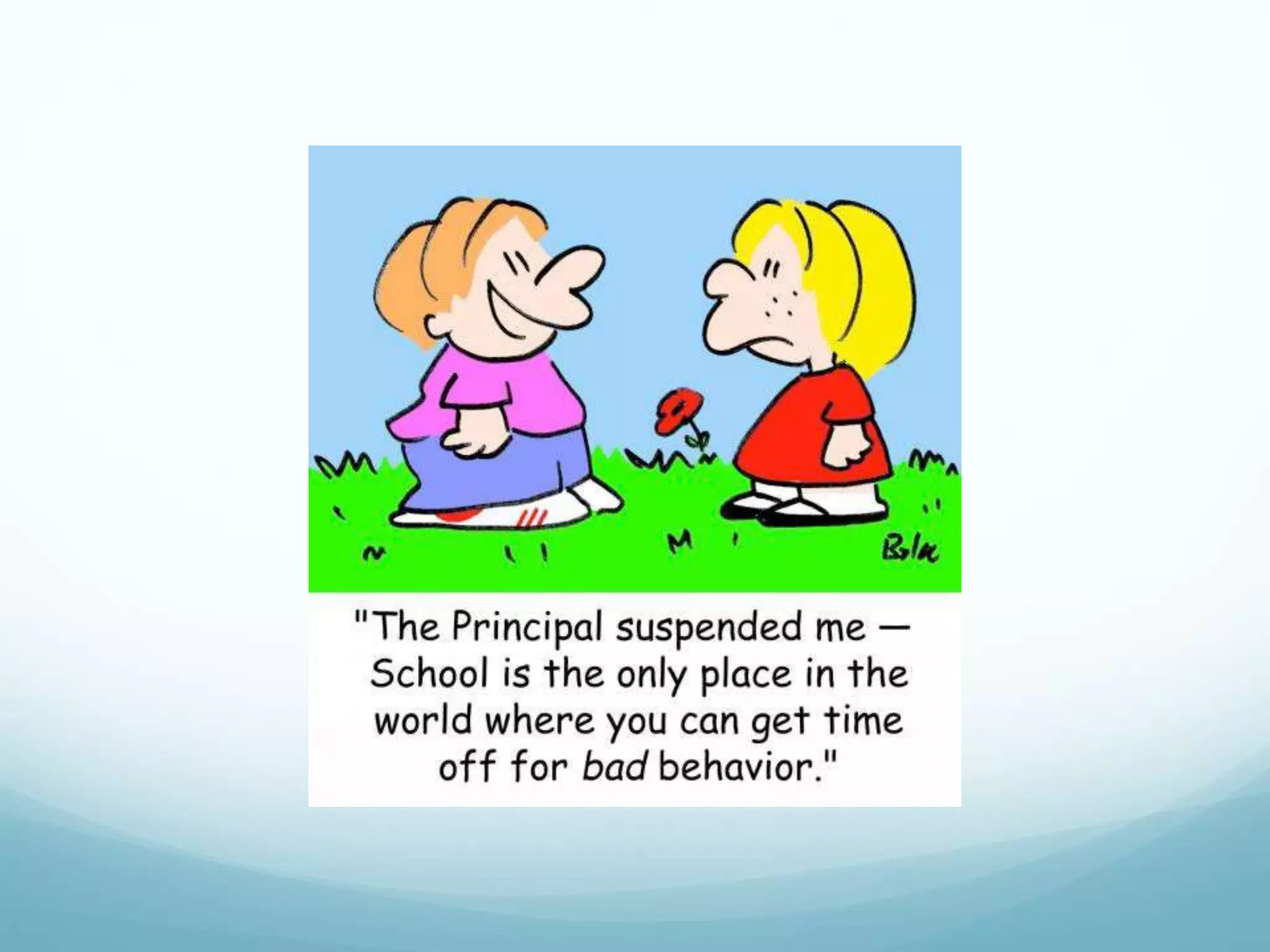
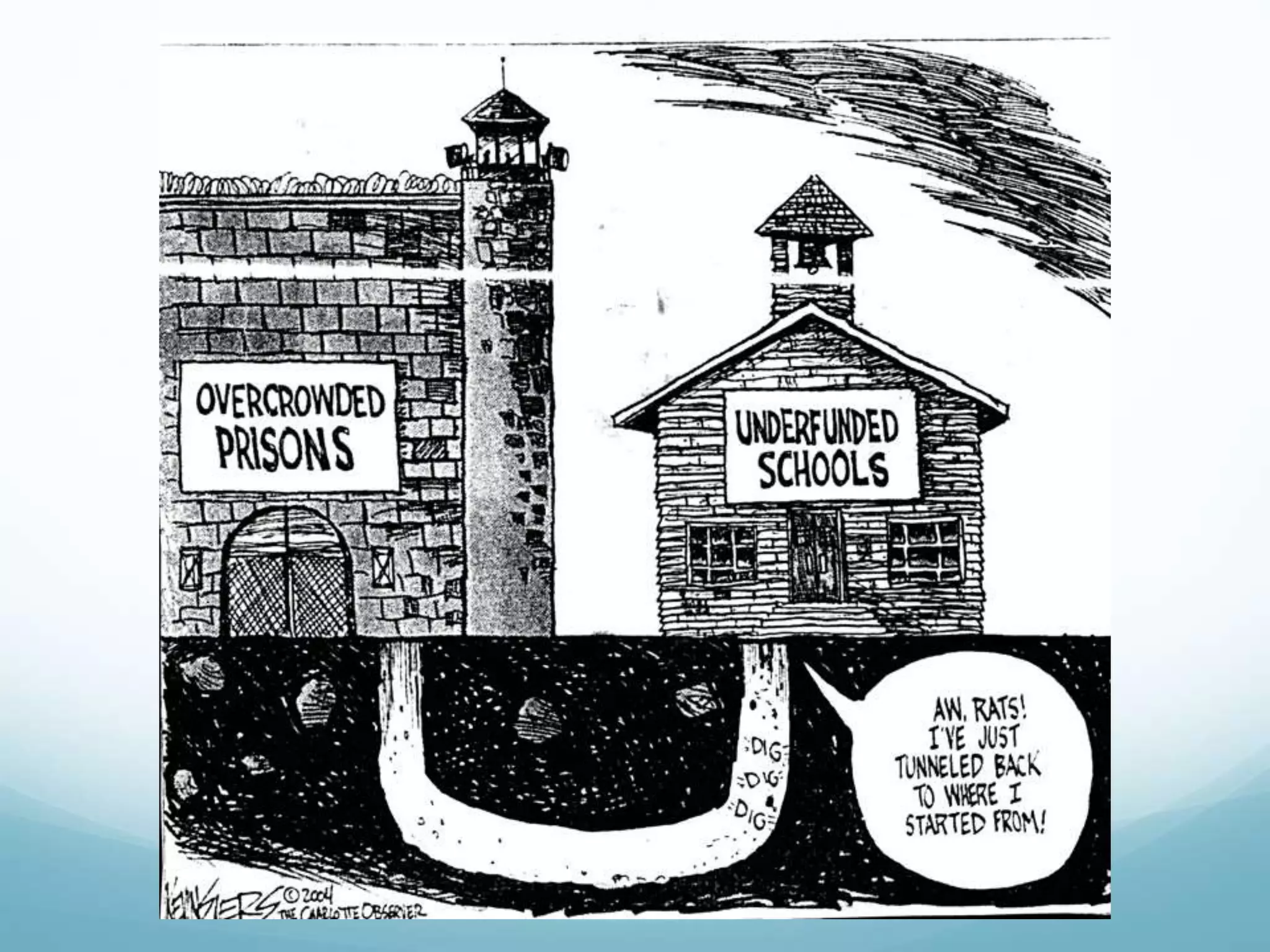
Students who are suspended or
expelled are almost three times
more likely to have contact with
the juvenile justice system.
–Council of State Governments,
2011
• Punishment practices may appear
to “work” in the short term
–Remove student
–Provide relief to teachers,
students, administrator
–Attribute responsibility for change
to student &/or others (family)
When youth are not in school, they are:
– More likely to become involved in a physical
fight and to carry a weapon.
– Smoke; use alcohol, marijuana, and cocaine;
and engage in sexual intercourse.
– Suicidal ideation and behavior may be
expected to occur more often at these times of
isolation among susceptible youth.
– Drop out of school
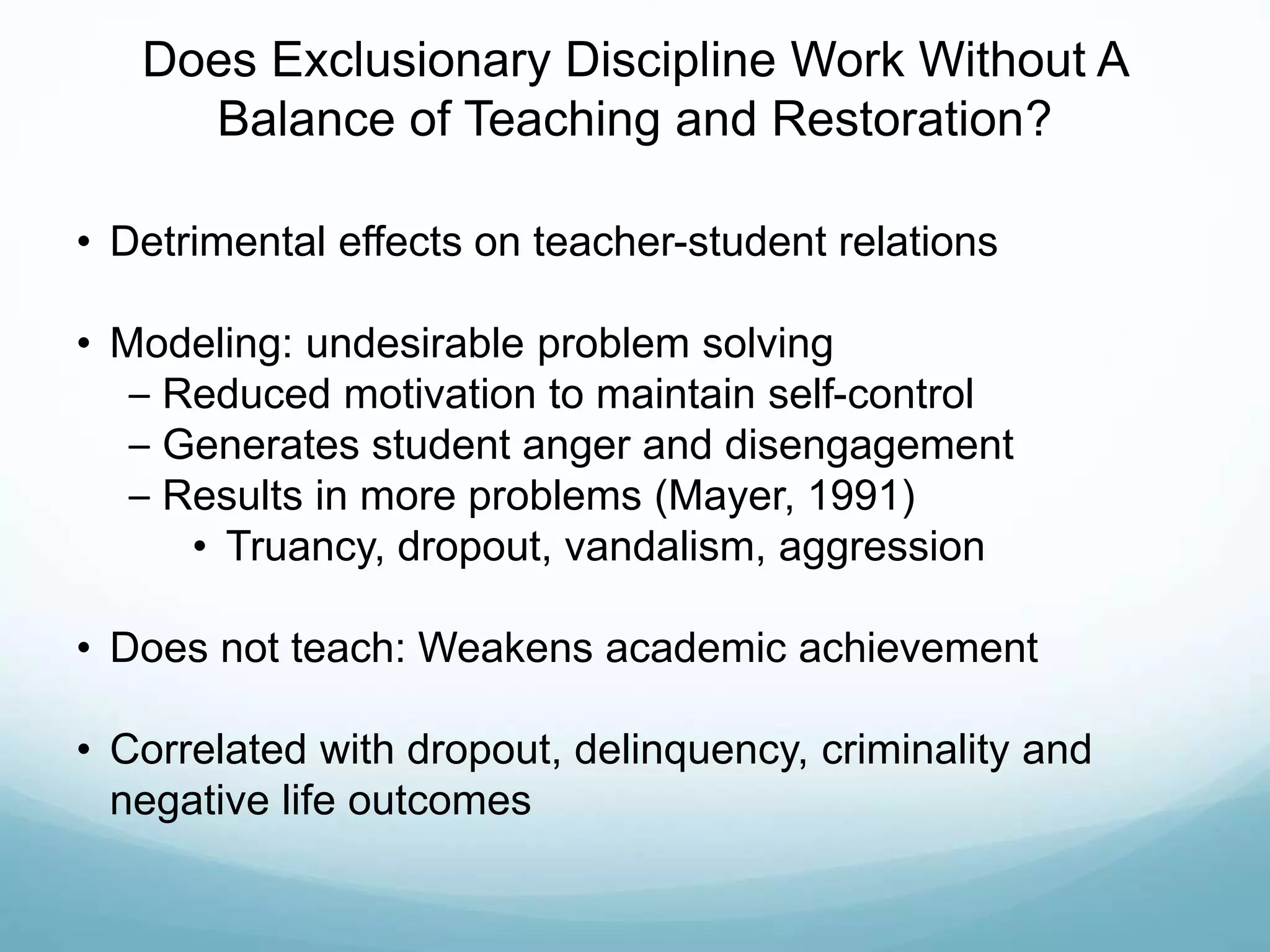
Does Exclusionary Discipline Work Without A
Balance of Teaching and Restoration?
• Detrimental effects on teacher-student relations
• Modeling: undesirable problem solving
– Reduced motivation to maintain self-control
– Generates student anger and disengagement
– Results in more problems (Mayer, 1991)
• Truancy, dropout, vandalism, aggression
• Does not teach: Weakens academic achievement
• Correlated with dropout, delinquency, criminality and
negative life outcomes
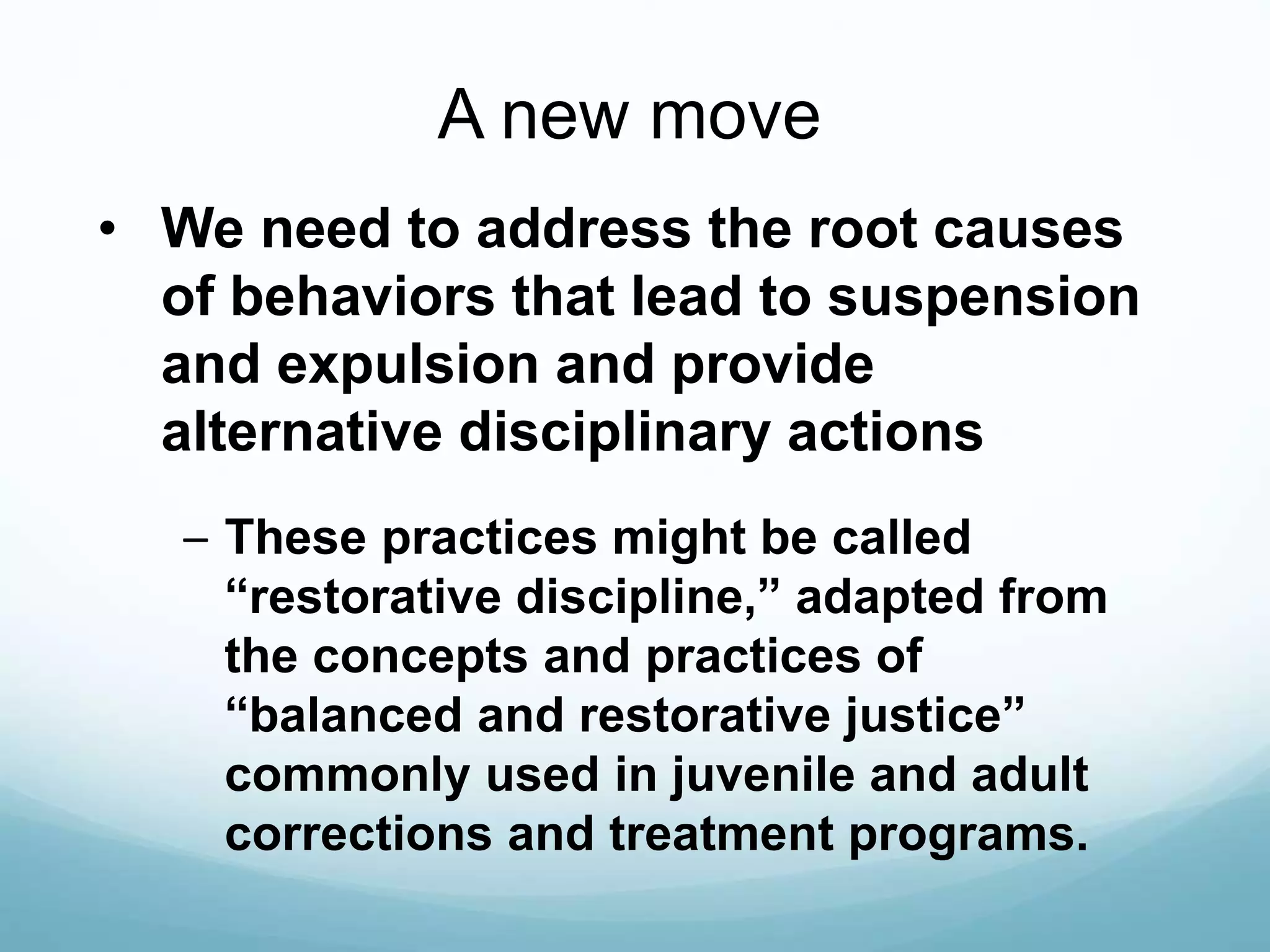
A new move
• We need to address the root causes
of behaviors that lead to suspension
and expulsion and provide
alternative disciplinary actions
– These practices might be called
“restorative discipline,” adapted from
the concepts and practices of
“balanced and restorative justice”
commonly used in juvenile and adult
corrections and treatment programs.
“Changing the Discourse in
Schools”
“Schools are a major part of society’s
institutional processes for maintaining a
relatively stable system of in- equality. They
contribute to these results by active
acceptance and utilization of a dominant set
of values, norms and beliefs, which, while
appearing to offer opportunities to all, actually
support the success of a privileged minority
and hinder the efforts and visions of a
majority.”
— Eugene Eubanks, Ralph Parish, and Dianne Smith
What Is Discipline For
 Read/skim the article by Dr. Pedro Noguera.
 In small groups, discuss using the 4 A’s Text Protocol.
 Assumptions
 Agree
 Argue
 Aspire
Principles for Restorative
Circles
• Encouraging accountability and
responsibility through personal
reflection within a collaborative
environment.
• Reintegrating the harmer into the
community as a valuable,
contributing member of society.
• Changing the system when it
contributes to harm.
Connecting to Students and
Parents with Cultural
Differences
Why not use a “Color Blind or One
Size Fits All Model?”
1) Why should we question what we
are doing?
2) Isn’t what we are doing enough?
3) What’s wrong with doing the same
thing for everyone?
As America’s classrooms become
increasingly diverse many teachers
and school disciplinarians face a
culture gap that can hinder positive
relationships with students and
families.
To begin bridging that gap they must
first take a close look at their own
assumptions
and then find new ways to reach out to
those from different racial and ethnic
Key Steps to Connecting with
Students Across Cultural
Differences:
• Acknowledge, Respect, and Value Cultural
Differences
• What are the different cultures at your
school?
• Work to replace bias with an appreciation
and a tolerance for culturally different
students will greatly increase likelihood for
student success
Key Steps to Connecting with Students
Across Cultural Differences:
• Be aware of cultural differences/ commonalities
and strive to interpret true meaning of behavior
• Establish expectations and clearly communicate
them in policy and practice
• Strive for consistency in how you treat all students
• Create welcoming school and classroom
environments that value diversity.
• Give positive strokes on student progress
and achievements.
• DO THE INTAGIBLES: Listen, Talk, Humor,
Engagement, Attend activities/events,
Caring and Positive attitudes.
• Believe all students can be learners and
successful
Building Positive Relationships with Parents:
• Do outreach to parents before school year
• Establish rapport with parents. Encourage them to
share about their cultures and experiences with
you. Helps build trust and they will feel more
respected.
• Be consistent and honest. Parents from certain
cultures can be particularly unforgiving if they feel
betrayed. It is harder to reestablish trust after it’s
been damaged than to build it the first time.
• Regularly communicate with parents about
information regarding student
expectations, policies and procedures, and
effective methods to have their questions
responded to.
• Help parents locate community resources
(keeping student out of school to baby sit
etc…)
• Plan activities and events to bring parents
to school. Share volunteer opportunities,
welcoming environment.- Doing the
intangibles!!
Principles for Restorative Circles
* Creating caring climates to support healthy
communities.
* Understanding the harm and developing empathy
for both the harmed and the harmer.
* Listening and responding to the needs of the
person harmed and the person who harmed.
Mindful Questions
• What might be your biases?
• How has the system contributed to this
situation?
• What is this student’s history?
• What is your relationship with this student?
• What are the student’s assets and
strengths?
Mindful Questions
 What were the antecedent behaviors?
 What triggers you?
 How does the student perceive you?
 What is this student’s value in the student community?
Discourse II Questions
 What might be multiple perspectives in this situation?
 What are the dynamics of privilege and oppression?
 How has this student been excluded and denied the
opportunity to learn?
 Is the school offering relevant and meaningful
opportunities to learn?
Discourse II Questions
 Is this student engaged in alienation and resistance?
 How can relationships and trust be built through this
situation?
 How can we focus on learning from this situation?
 How do we change a significant pattern of behavior?

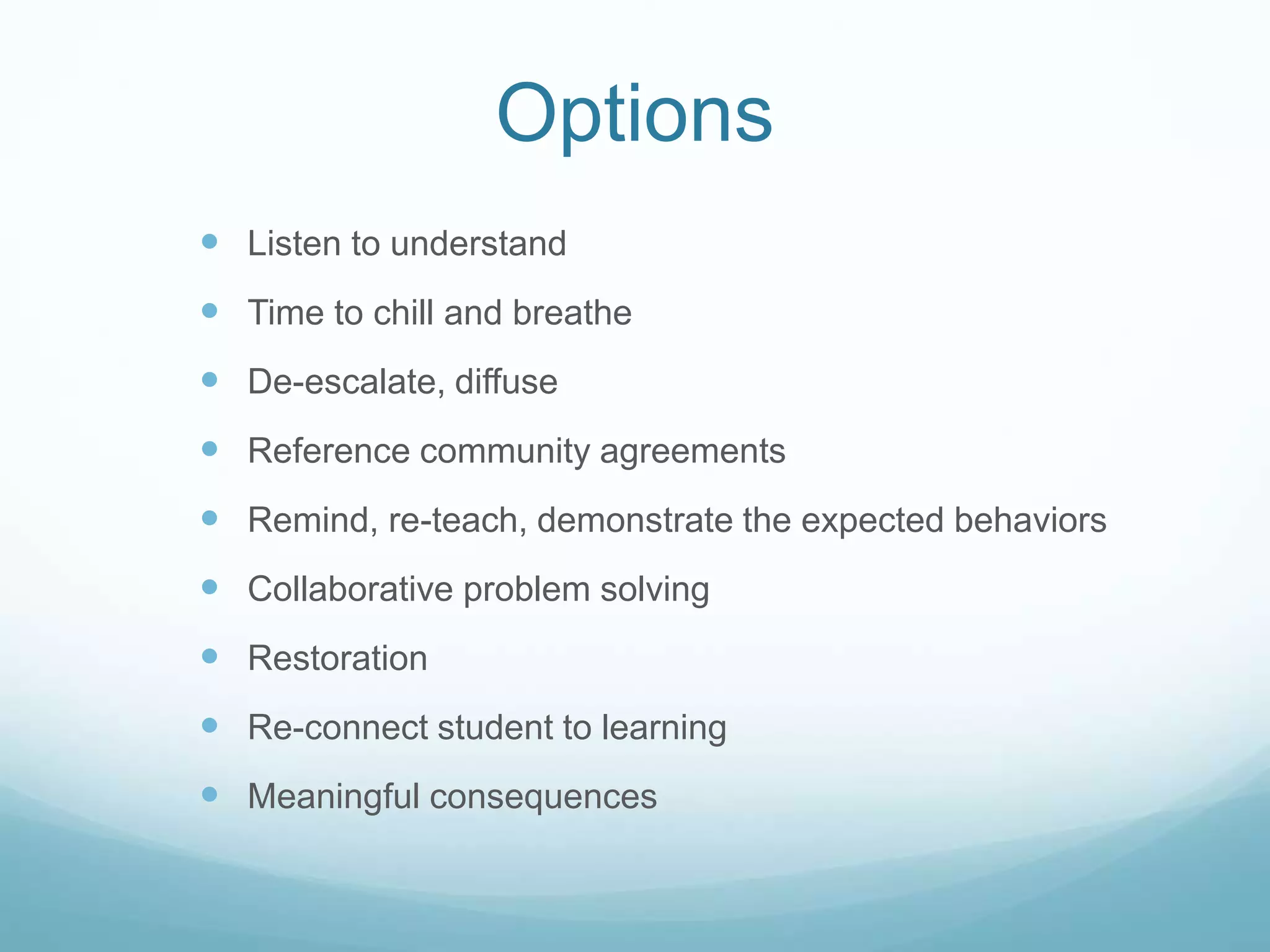
Options
 Listen to understand
 Time to chill and breathe
 De-escalate, diffuse
 Reference community agreements
 Remind, re-teach, demonstrate the expected behaviors
 Collaborative problem solving
 Restoration
 Re-connect student to learning
 Meaningful consequences

Non-exclusionary Practices

  • 1.
    Non-Exclusion Reynolds School District February2015 Lonnie Jackson John Lenssen Dr. Centae Richards
  • 2.
    Objectives: Reynolds School Districtleaders will:  Increase understanding of the impact of culture, history, and structures on students, especially students of color.  Explore own dynamics of culture, bias, power, and beliefs in relation to student discipline.  Examine ways and skills to reconnect students of color, and other students to learning through non- exclusionary practices.
  • 3.
    Essential Questions  Whois in the room? Why are we here?  Who are you in this work? How is your identity affirmed/marginalized? How does this affirmation/marginalization impact your work?  How does status quo, our values and beliefs impact our expectations and our students?
  • 4.
    Essential Questions  Whatis the purpose of discipline?  How do I connect with cultural difference?  How can I practice with real life scenarios?  How do I evaluate success?
  • 5.
    Passion  Listening isthe most important skill in transforming discipline.  Circle  First person talks about their passion for this work (2 minutes)  First person chooses second person  Second person reflects back something that was significant for the speaker  Second person talks about their passion for this work (2 minutes)
  • 6.
    Who are wein this work? 1. Journal in response to 3 questions 2. Form triads 3. Take turns in sharing responses to the questions  Who are you in this work?  How is your identity affirmed/marginalized?  How does this affirmation/marginalization impact your work?
  • 7.
    Schools That ReduceDisruption and Delinquency  Shared values regarding school mission and purpose (admin, staff, families, students)  Clear expectations for learning and behavior  Multiple activities designed to promote pro-social behavior and connection to school traditions  A caring social climate involving collegial and supportive relationships among adults and students  Students have valued roles and responsibilities in the school Sprague, Jeff – UO IVDB
  • 8.
    “If you alwaysdo what you always did, you’ll always get what you always got.” “Moms” Mably
  • 11.
    • ‘What happened,who is to blame, what punishment or sanction is needed?’ –The easiest consequence is the one most likely to be delivered • ‘What happened, what harm has resulted and what needs to happen to make things right?’ (O’Connell, 2004) –A restorative process will initially be viewed as more effortful
  • 13.
    Students who aresuspended or expelled are almost three times more likely to have contact with the juvenile justice system. –Council of State Governments, 2011
  • 14.
    • Punishment practicesmay appear to “work” in the short term –Remove student –Provide relief to teachers, students, administrator –Attribute responsibility for change to student &/or others (family)
  • 16.
    When youth arenot in school, they are: – More likely to become involved in a physical fight and to carry a weapon. – Smoke; use alcohol, marijuana, and cocaine; and engage in sexual intercourse. – Suicidal ideation and behavior may be expected to occur more often at these times of isolation among susceptible youth. – Drop out of school
  • 17.
    Does Exclusionary DisciplineWork Without A Balance of Teaching and Restoration? • Detrimental effects on teacher-student relations • Modeling: undesirable problem solving – Reduced motivation to maintain self-control – Generates student anger and disengagement – Results in more problems (Mayer, 1991) • Truancy, dropout, vandalism, aggression • Does not teach: Weakens academic achievement • Correlated with dropout, delinquency, criminality and negative life outcomes
  • 20.
    A new move •We need to address the root causes of behaviors that lead to suspension and expulsion and provide alternative disciplinary actions – These practices might be called “restorative discipline,” adapted from the concepts and practices of “balanced and restorative justice” commonly used in juvenile and adult corrections and treatment programs.
  • 21.
    “Changing the Discoursein Schools” “Schools are a major part of society’s institutional processes for maintaining a relatively stable system of in- equality. They contribute to these results by active acceptance and utilization of a dominant set of values, norms and beliefs, which, while appearing to offer opportunities to all, actually support the success of a privileged minority and hinder the efforts and visions of a majority.” — Eugene Eubanks, Ralph Parish, and Dianne Smith
  • 22.
    What Is DisciplineFor  Read/skim the article by Dr. Pedro Noguera.  In small groups, discuss using the 4 A’s Text Protocol.  Assumptions  Agree  Argue  Aspire
  • 23.
    Principles for Restorative Circles •Encouraging accountability and responsibility through personal reflection within a collaborative environment. • Reintegrating the harmer into the community as a valuable, contributing member of society. • Changing the system when it contributes to harm.
  • 24.
    Connecting to Studentsand Parents with Cultural Differences
  • 25.
    Why not usea “Color Blind or One Size Fits All Model?” 1) Why should we question what we are doing? 2) Isn’t what we are doing enough? 3) What’s wrong with doing the same thing for everyone?
  • 26.
    As America’s classroomsbecome increasingly diverse many teachers and school disciplinarians face a culture gap that can hinder positive relationships with students and families. To begin bridging that gap they must first take a close look at their own assumptions and then find new ways to reach out to those from different racial and ethnic
  • 27.
    Key Steps toConnecting with Students Across Cultural Differences: • Acknowledge, Respect, and Value Cultural Differences • What are the different cultures at your school? • Work to replace bias with an appreciation and a tolerance for culturally different students will greatly increase likelihood for student success
  • 28.
    Key Steps toConnecting with Students Across Cultural Differences: • Be aware of cultural differences/ commonalities and strive to interpret true meaning of behavior • Establish expectations and clearly communicate them in policy and practice • Strive for consistency in how you treat all students
  • 29.
    • Create welcomingschool and classroom environments that value diversity. • Give positive strokes on student progress and achievements. • DO THE INTAGIBLES: Listen, Talk, Humor, Engagement, Attend activities/events, Caring and Positive attitudes. • Believe all students can be learners and successful
  • 30.
    Building Positive Relationshipswith Parents: • Do outreach to parents before school year • Establish rapport with parents. Encourage them to share about their cultures and experiences with you. Helps build trust and they will feel more respected. • Be consistent and honest. Parents from certain cultures can be particularly unforgiving if they feel betrayed. It is harder to reestablish trust after it’s been damaged than to build it the first time.
  • 31.
    • Regularly communicatewith parents about information regarding student expectations, policies and procedures, and effective methods to have their questions responded to. • Help parents locate community resources (keeping student out of school to baby sit etc…) • Plan activities and events to bring parents to school. Share volunteer opportunities, welcoming environment.- Doing the intangibles!!
  • 32.
    Principles for RestorativeCircles * Creating caring climates to support healthy communities. * Understanding the harm and developing empathy for both the harmed and the harmer. * Listening and responding to the needs of the person harmed and the person who harmed.
  • 33.
    Mindful Questions • Whatmight be your biases? • How has the system contributed to this situation? • What is this student’s history? • What is your relationship with this student? • What are the student’s assets and strengths?
  • 34.
    Mindful Questions  Whatwere the antecedent behaviors?  What triggers you?  How does the student perceive you?  What is this student’s value in the student community?
  • 35.
    Discourse II Questions What might be multiple perspectives in this situation?  What are the dynamics of privilege and oppression?  How has this student been excluded and denied the opportunity to learn?  Is the school offering relevant and meaningful opportunities to learn?
  • 36.
    Discourse II Questions Is this student engaged in alienation and resistance?  How can relationships and trust be built through this situation?  How can we focus on learning from this situation?  How do we change a significant pattern of behavior? 
  • 37.
    Options  Listen tounderstand  Time to chill and breathe  De-escalate, diffuse  Reference community agreements  Remind, re-teach, demonstrate the expected behaviors  Collaborative problem solving  Restoration  Re-connect student to learning  Meaningful consequences