Detection & Tracking
Table of content
• Thermal Detection.
• Object detection.
• Object Tracking
Thermal Detection
• Due to an object high temperature (drone 80 degC) compared to its environment. Since heat is often emitted as infrared (IR) radiation thermal
camera is used for detection with hogh contrast imaging.
• Infra-red radiation (0.75um-1mm) rather than visible (0.4-0.7um) light:
Advantages:
Invisible (can also be a disadvantage).
Less scattering (of atmosphere and surfaces).
Can pass through obstacles that vis can’t (Thin Plastics, Clothing and Textiles, Skin and Biological Tissue).
low visibility contrition (dark).
Disadvantages:
Lower resolution.
More sensitive to temperature variation compared to vis.
Costly.
Thermal imaging and tracking
• Deep Learning Applications:
Utilizing deep learning models, such as convolutional neural networks (CNNs), for detecting and tracking objects in thermal imagery. This can involve
training models on thermal images directly or adapting models trained on RGB data to work with thermal data.
• Algorithmic Approaches (Classic computer vision):
Investigating specific algorithms developed for tracking in thermal imagery. This could include methods for object detection, motion tracking,
and integrating thermal data with data from other sensors.
• Statistical Analysis (Bayesian filter):
Studies that perform statistical analysis of target tracking algorithms in thermal imagery, comparing the effectiveness of different tracking approaches
under various conditions.
• Synthetic Data Generation:
Research into generating synthetic thermal images for training deep learning models, addressing the challenge of limited available datasets for thermal
imagery.
• Thermal and Visible Image Fusion:
Exploring methods for integrating thermal and visible spectrum data to improve tracking performance, especially in challenging visibility conditions.
Object Tracking
The methods:
- Template Matching: target patch matching (mainly correlation)
- Kalman Filters: linear projections state estimation - Taking into account uncertainties in measurements and motions.
- Particle Filters: sequential Monte Carlo state estimation.
- Mean Shift Algorithm: maximum probability density centroid shifting.
- Histogram-Based Tracking: Histogram features (color, texture, gradients) tracking.
- Deep Learning-Based Methods: mainly CNNs.
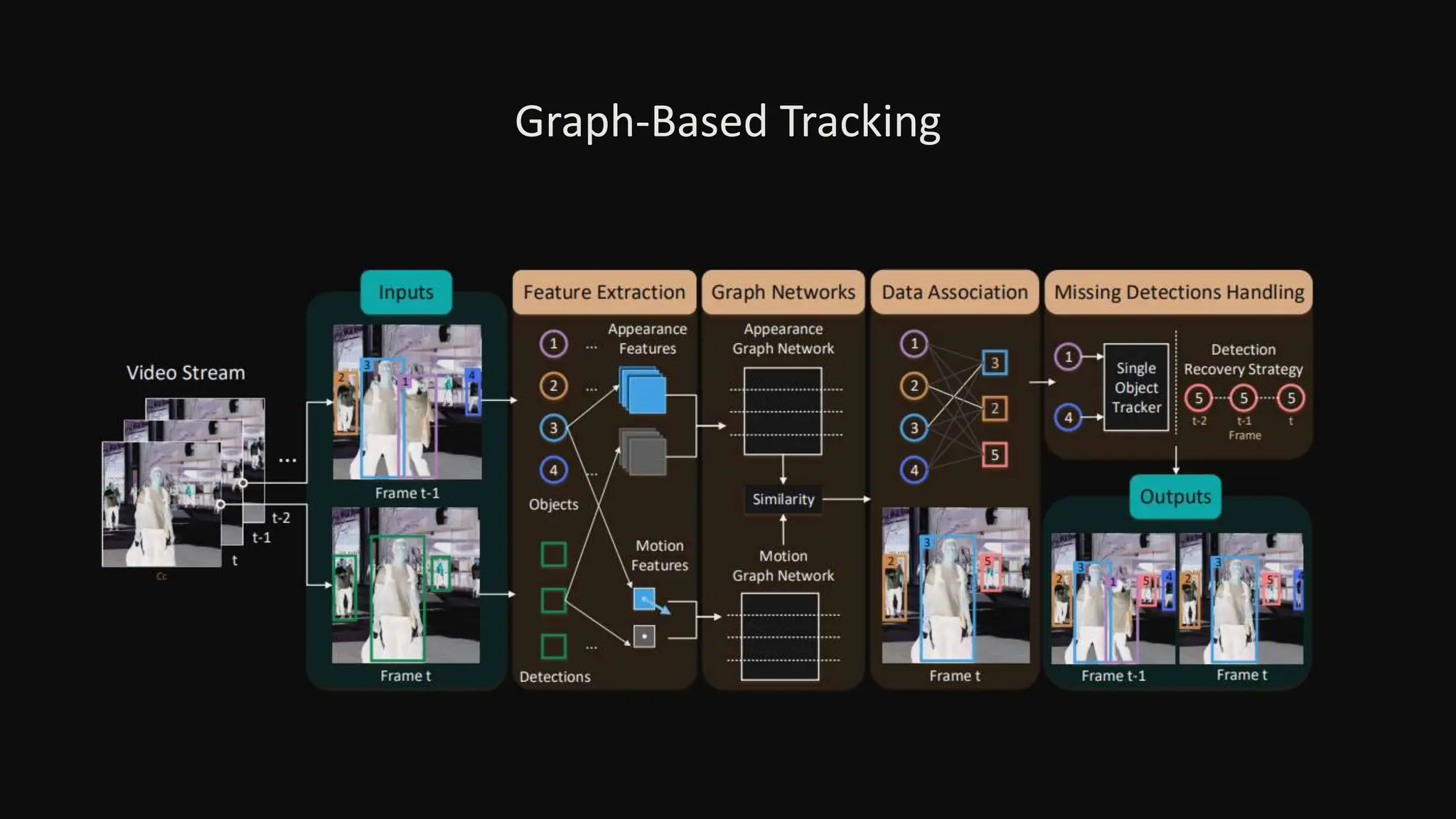
- Graph-Based Tracking: Multiple object tracking – Model objects and relationships into nodes and edges to track
in complex scenes.
"Because tracking is easier than detection, tracking algorithms can use fewer computational resources than
running an object detector on every frame." [Bolme 2010]
*Constraints: scene complexity, objects nature computational, real-time and accuracy requirements.
- An hybrid approach is often used.
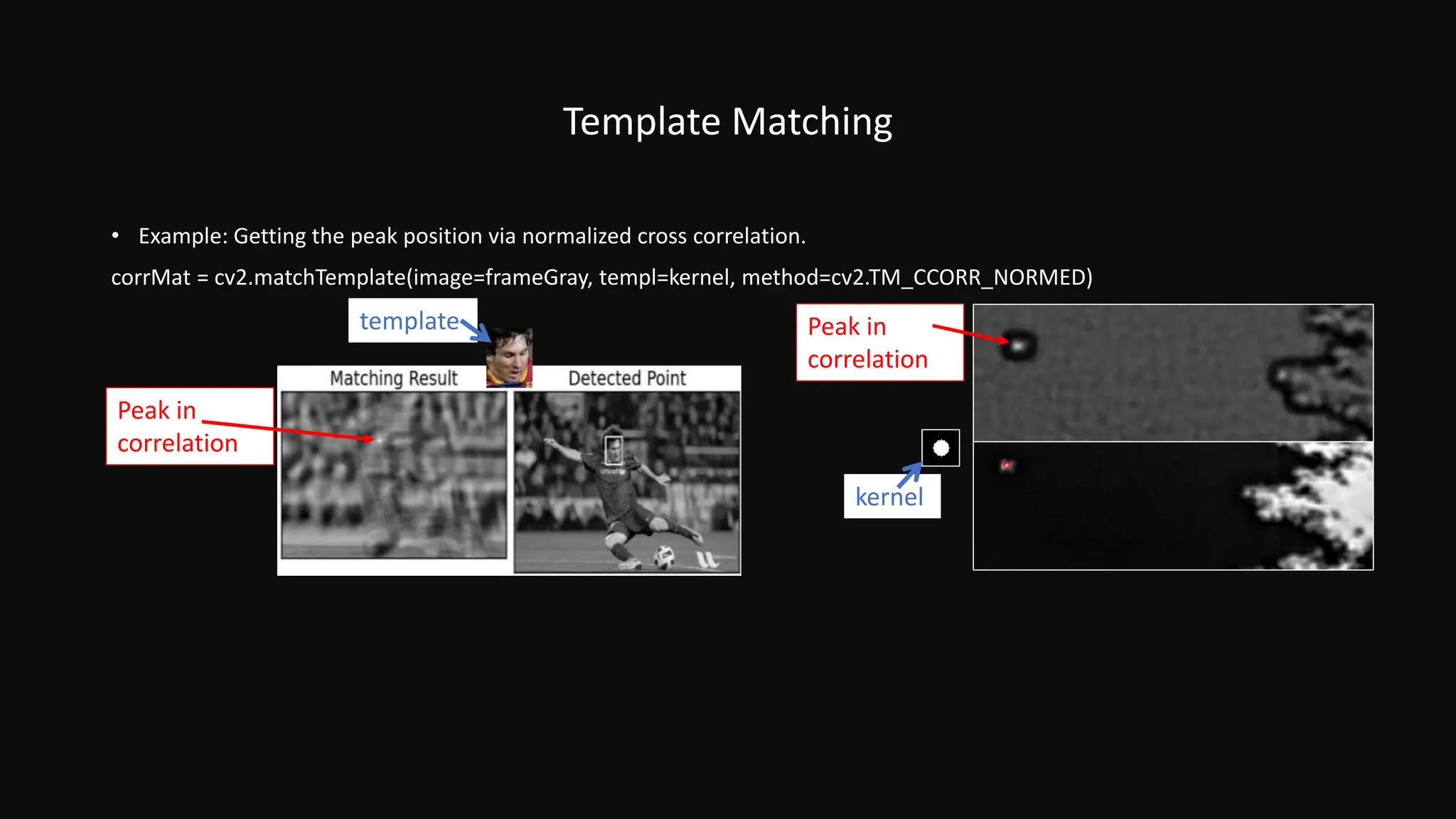
Peak in
correlation
Peak in
correlation
Template Matching
• Example: Getting the peak position via normalized cross correlation.
corrMat = cv2.matchTemplate(image=frameGray, templ=kernel, method=cv2.TM_CCORR_NORMED)
kernel
template
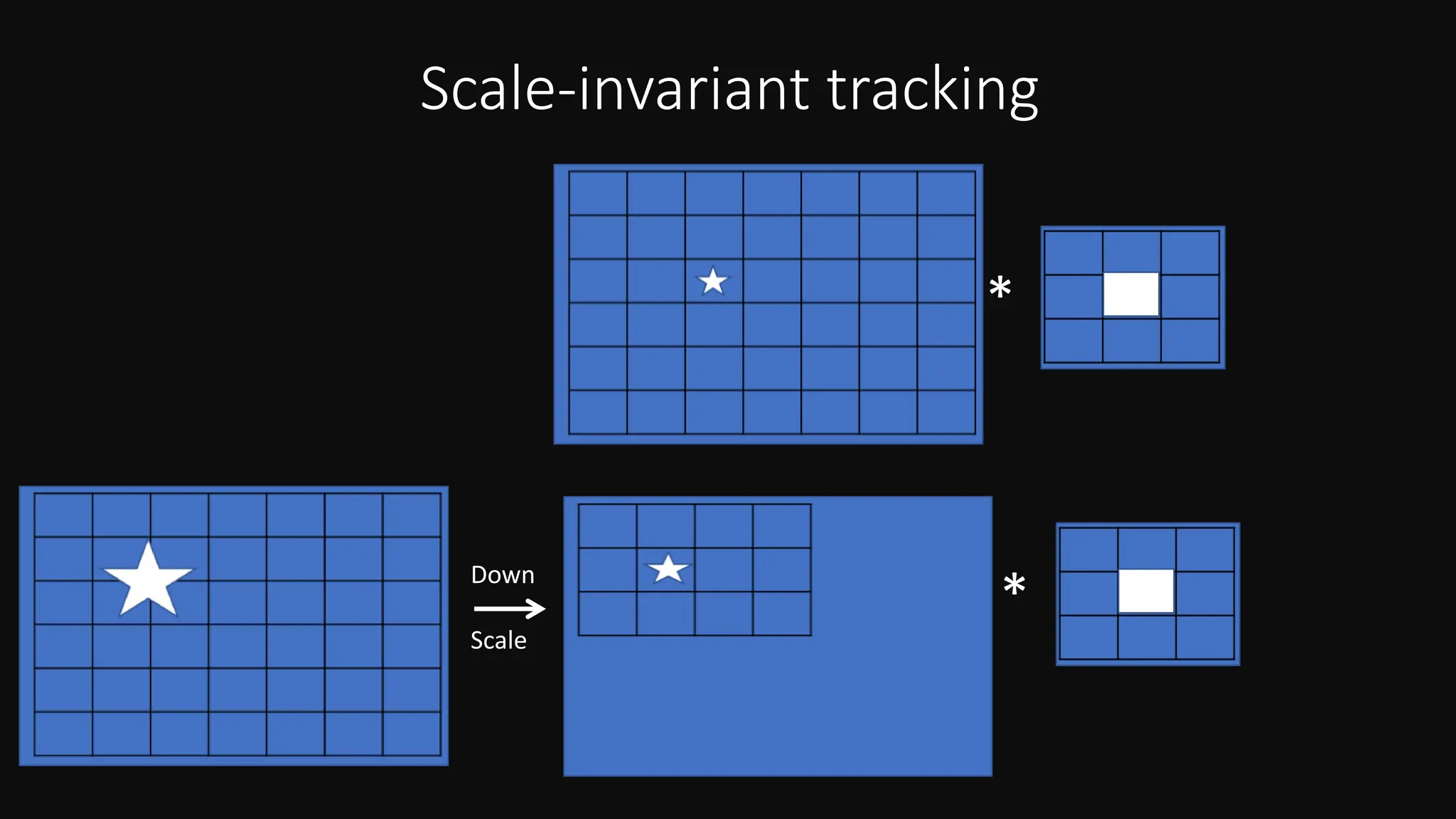
Scale-invariant tracking
*
*
Down
Scale
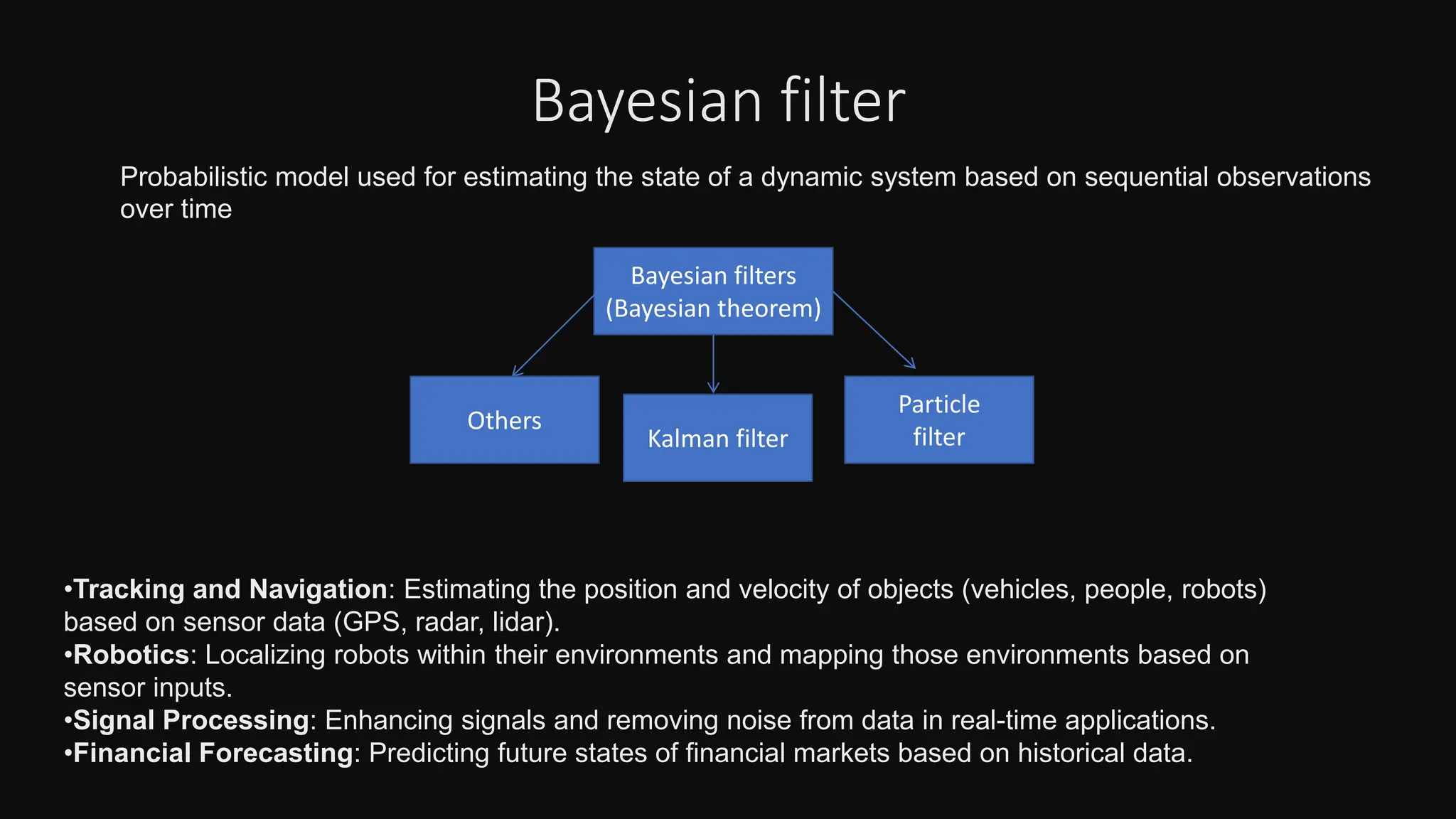
Bayesian filters
(Bayesian theorem)
Kalman filter
Others
Particle
filter
Bayesian filter
Probabilistic model used for estimating the state of a dynamic system based on sequential observations
over time
•Tracking and Navigation: Estimating the position and velocity of objects (vehicles, people, robots)
based on sensor data (GPS, radar, lidar).
•Robotics: Localizing robots within their environments and mapping those environments based on
sensor inputs.
•Signal Processing: Enhancing signals and removing noise from data in real-time applications.
•Financial Forecasting: Predicting future states of financial markets based on historical data.
Bayesian filters
(Bayesian theorem)
Kalman filter
Others
Particle
filter
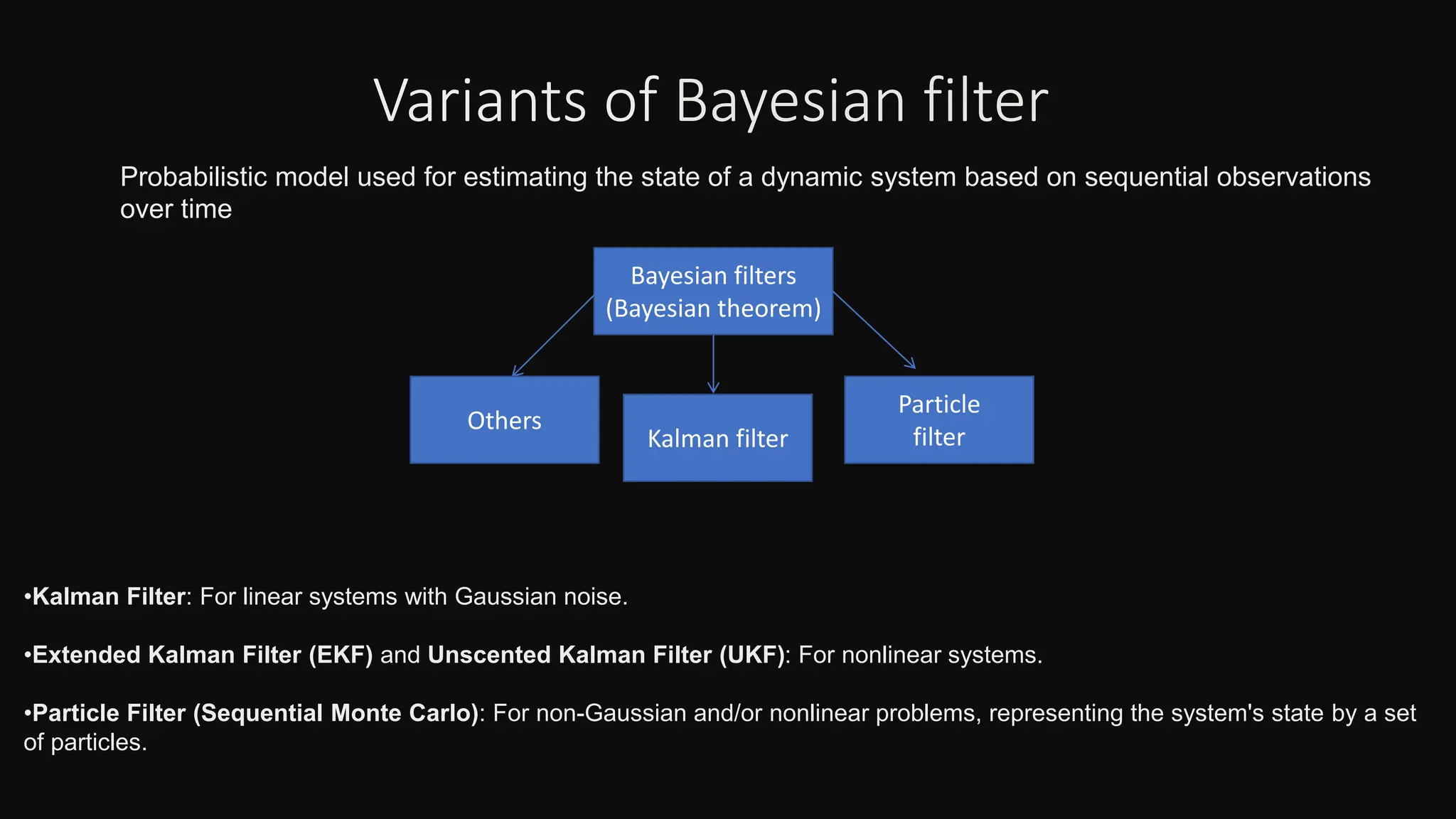
Variants of Bayesian filter
Probabilistic model used for estimating the state of a dynamic system based on sequential observations
over time
•Kalman Filter: For linear systems with Gaussian noise.
•Extended Kalman Filter (EKF) and Unscented Kalman Filter (UKF): For nonlinear systems.
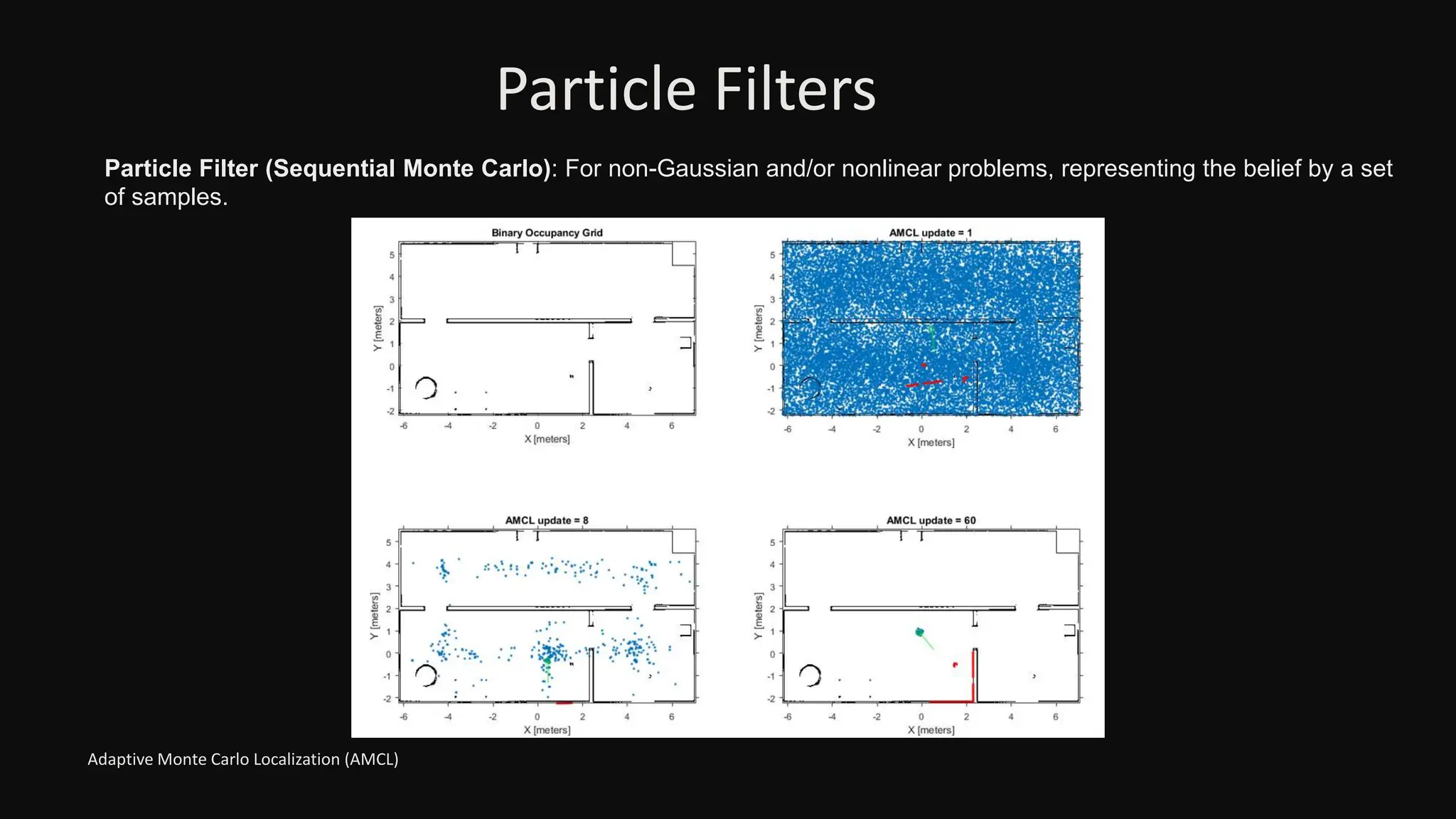
•Particle Filter (Sequential Monte Carlo): For non-Gaussian and/or nonlinear problems, representing the system's state by a set
of particles.
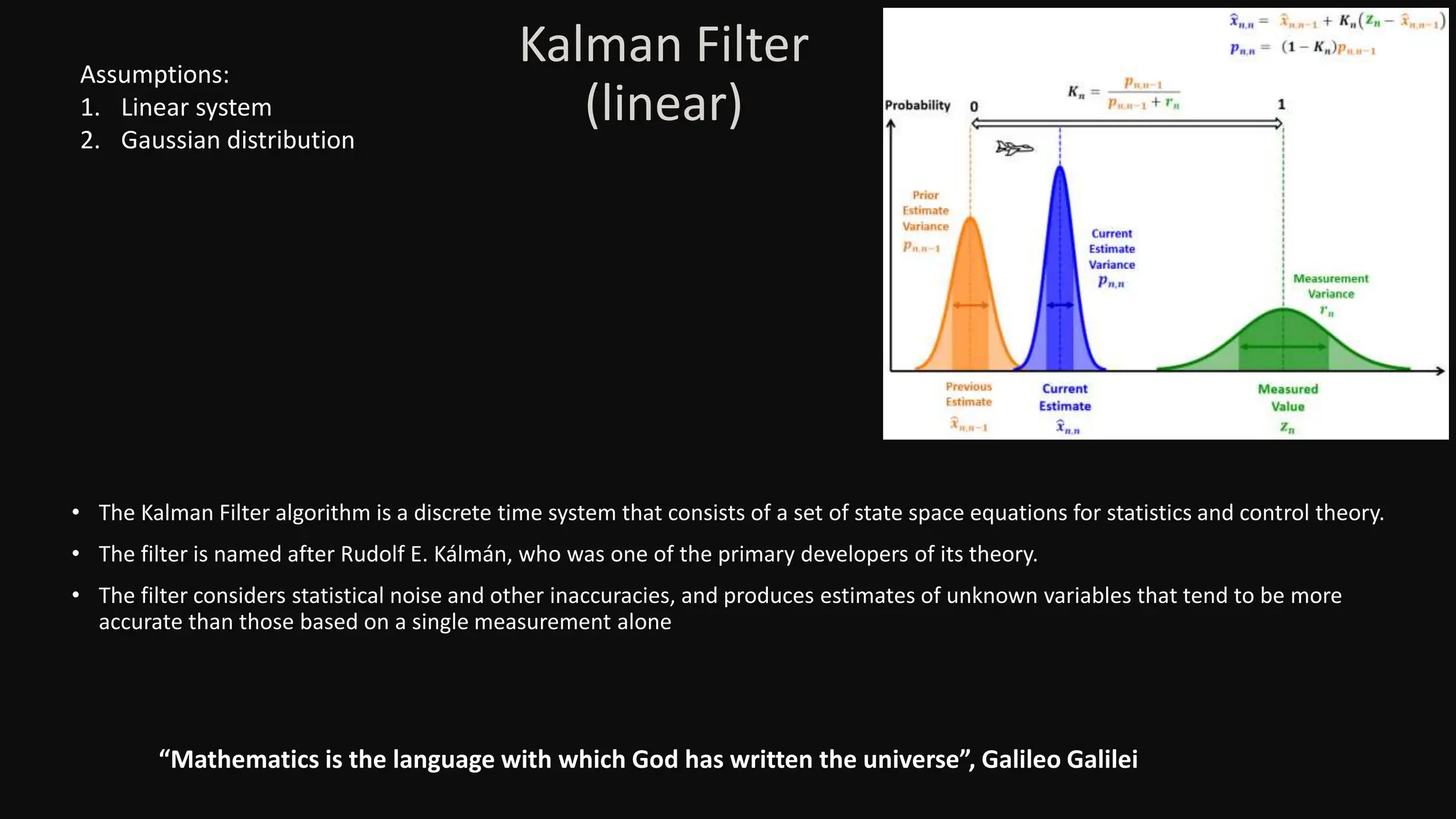
Kalman Filter
(linear)
• The Kalman Filter algorithm is a discrete time system that consists of a set of state space equations for statistics and control theory.
• The filter is named after Rudolf E. Kálmán, who was one of the primary developers of its theory.
• The filter considers statistical noise and other inaccuracies, and produces estimates of unknown variables that tend to be more
accurate than those based on a single measurement alone
“Mathematics is the language with which God has written the universe”, Galileo Galilei
Assumptions:
1. Linear system
2. Gaussian distribution
Kalman Filter
(linear)
“Mathematics is the language with which God has written the universe”, Galileo Galilei
Assumptions:
1. Linear system
2. Gaussian distribution
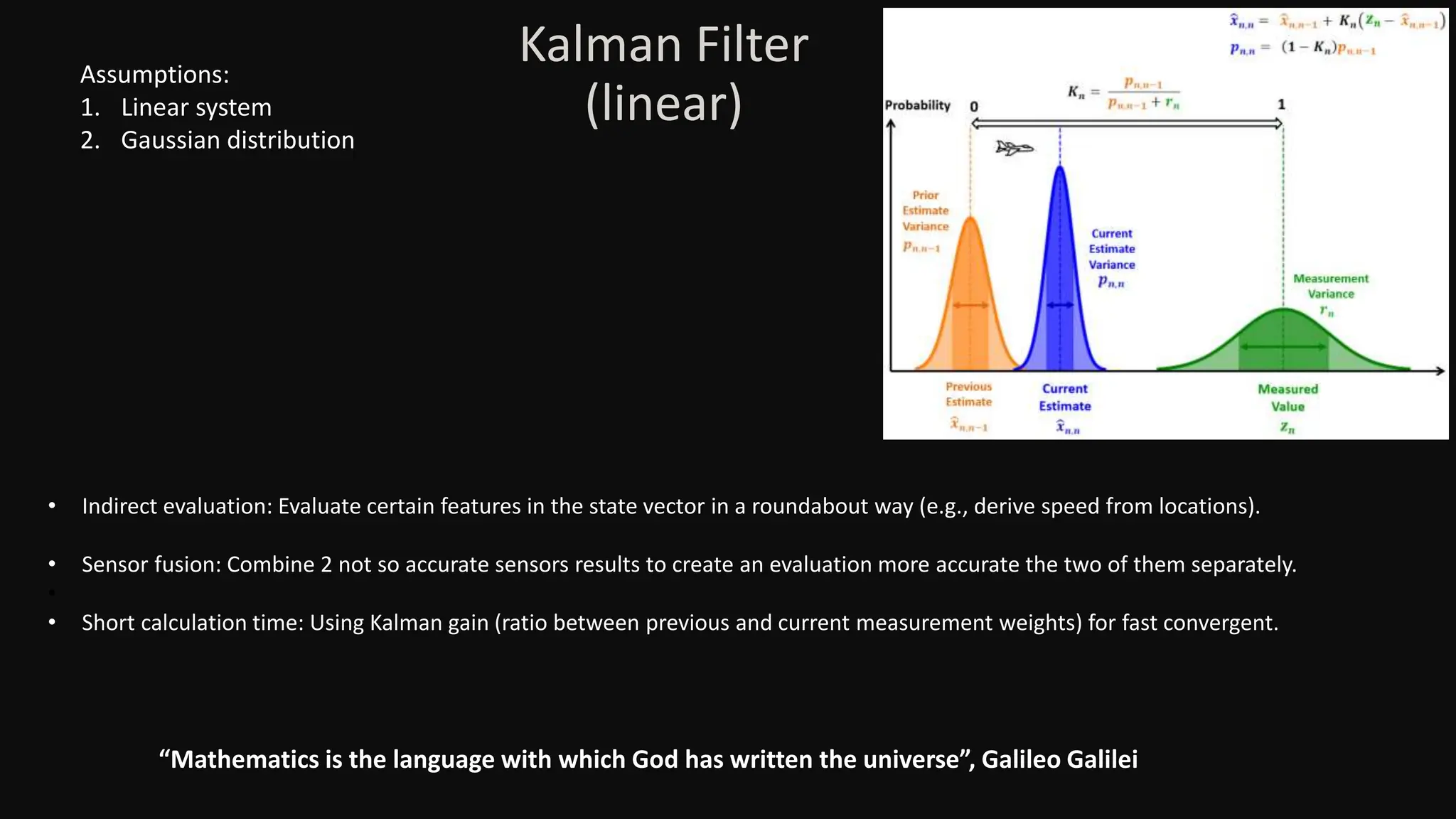
• Indirect evaluation: Evaluate certain features in the state vector in a roundabout way (e.g., derive speed from locations).
• Sensor fusion: Combine 2 not so accurate sensors results to create an evaluation more accurate the two of them separately.
•
• Short calculation time:​ Using Kalman gain (ratio between previous and current measurement weights) for fast convergent.
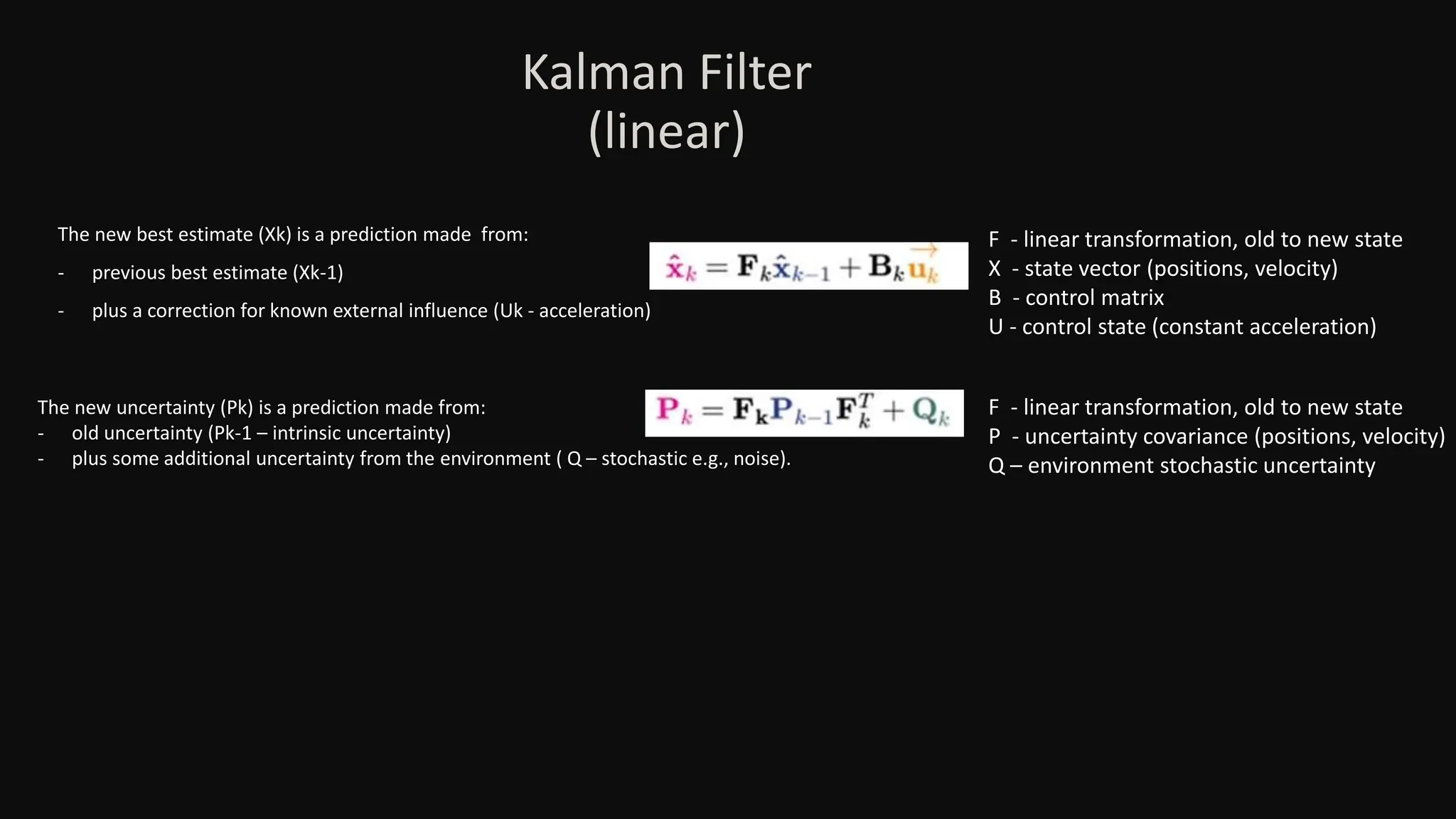
The new best estimate (Xk) is a prediction made from:
- previous best estimate (Xk-1)
- plus a correction for known external influence (Uk - acceleration)
The new uncertainty (Pk) is a prediction made from:
- old uncertainty (Pk-1 – intrinsic uncertainty)
- plus some additional uncertainty from the environment ( Q – stochastic e.g., noise).
F - linear transformation, old to new state
X - state vector (positions, velocity)
B - control matrix
U - control state (constant acceleration)
F - linear transformation, old to new state
P - uncertainty covariance (positions, velocity)
Q – environment stochastic uncertainty
Kalman Filter
(linear)
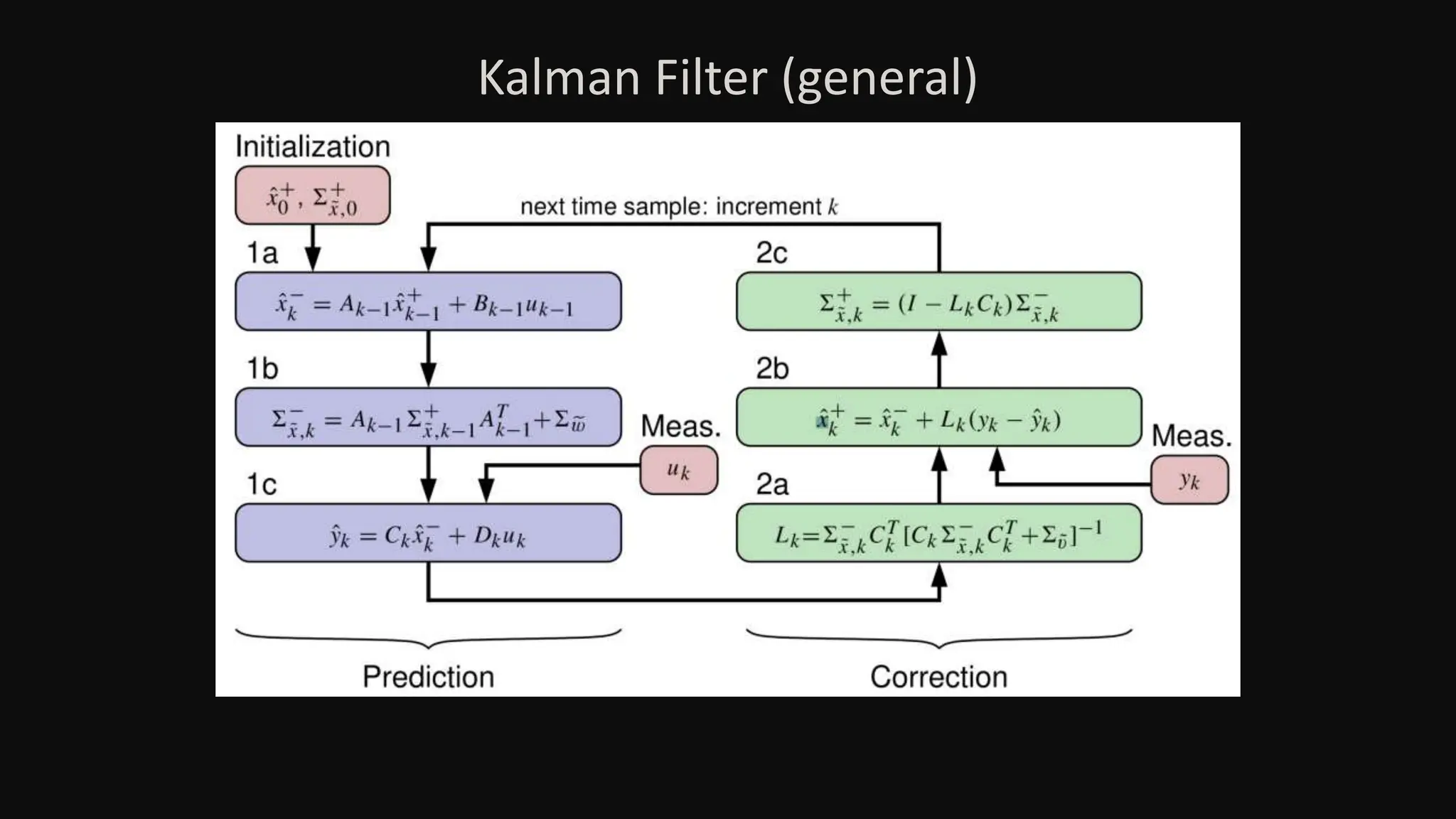
Kalman Filter (general)
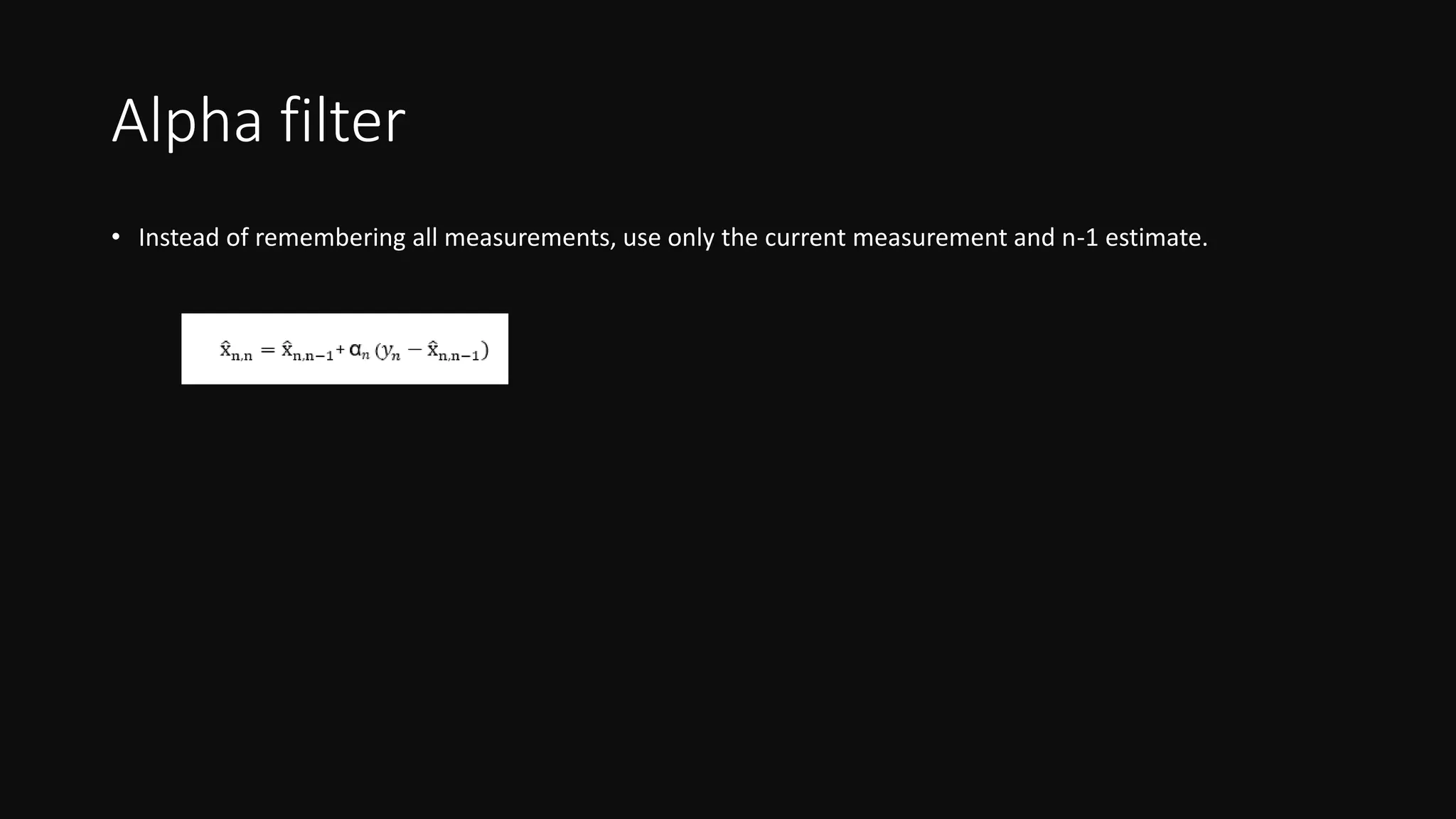
Alpha filter
• Instead of remembering all measurements, use only the current measurement and n-1 estimate.
Non-Linear Kalman Filters
• Extended Kalman filter (EKF)
This method performs an analytic linearization of the non-linear model equations at each point in time.
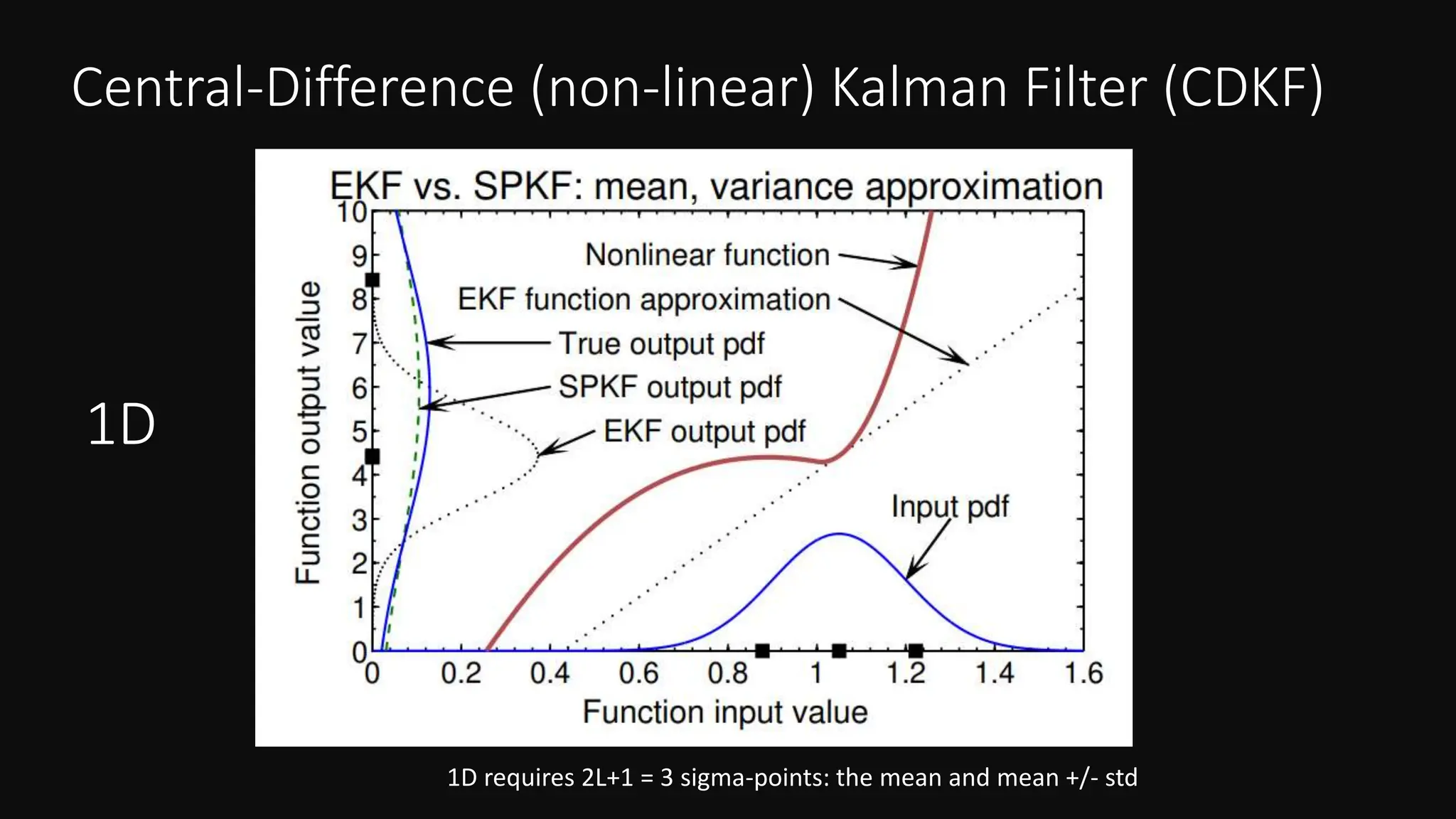
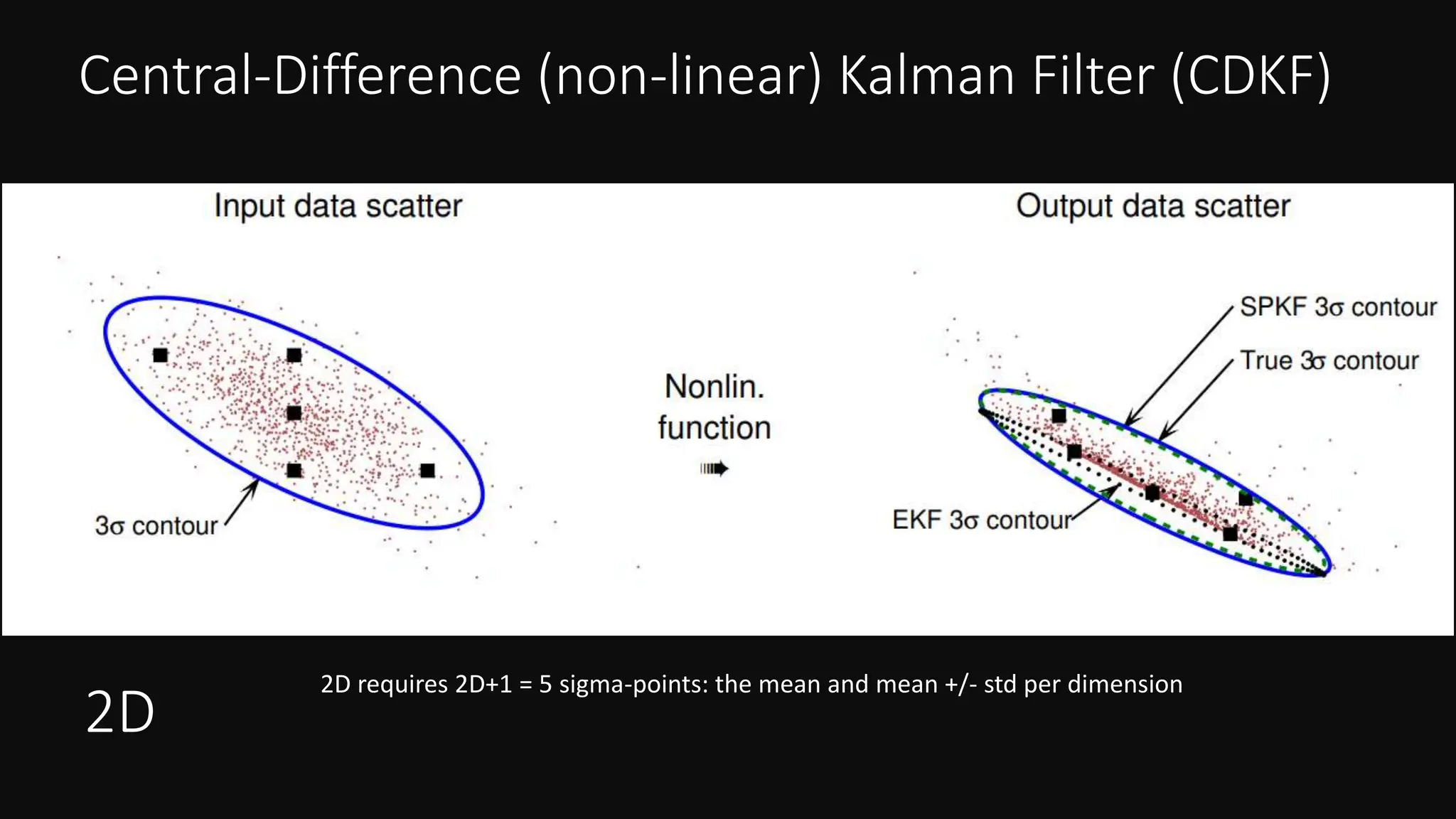
• Sigma Point Kalman Filter (SPKF) – e.g., Unscented (UKF), Central-difference (CDKF)
Approach of statistical/empirical linearization instead of analytic linearization (propagate those inputs through the model equations to come up
with a linear approximation). Better results than EKF with the same Computational complexity as EKF but worse conceptual complexity.
For Gaussian random variables, the CDKF is implemented quite readily and also show a little bit higher theoretic accuracy than the unscented
Kalman filter
• Particle filters
Particle filters give the most precise estimates of a non-linear model state. However, thousands of times more computationally complex than
either the EKF or the SPKF (not real-time).
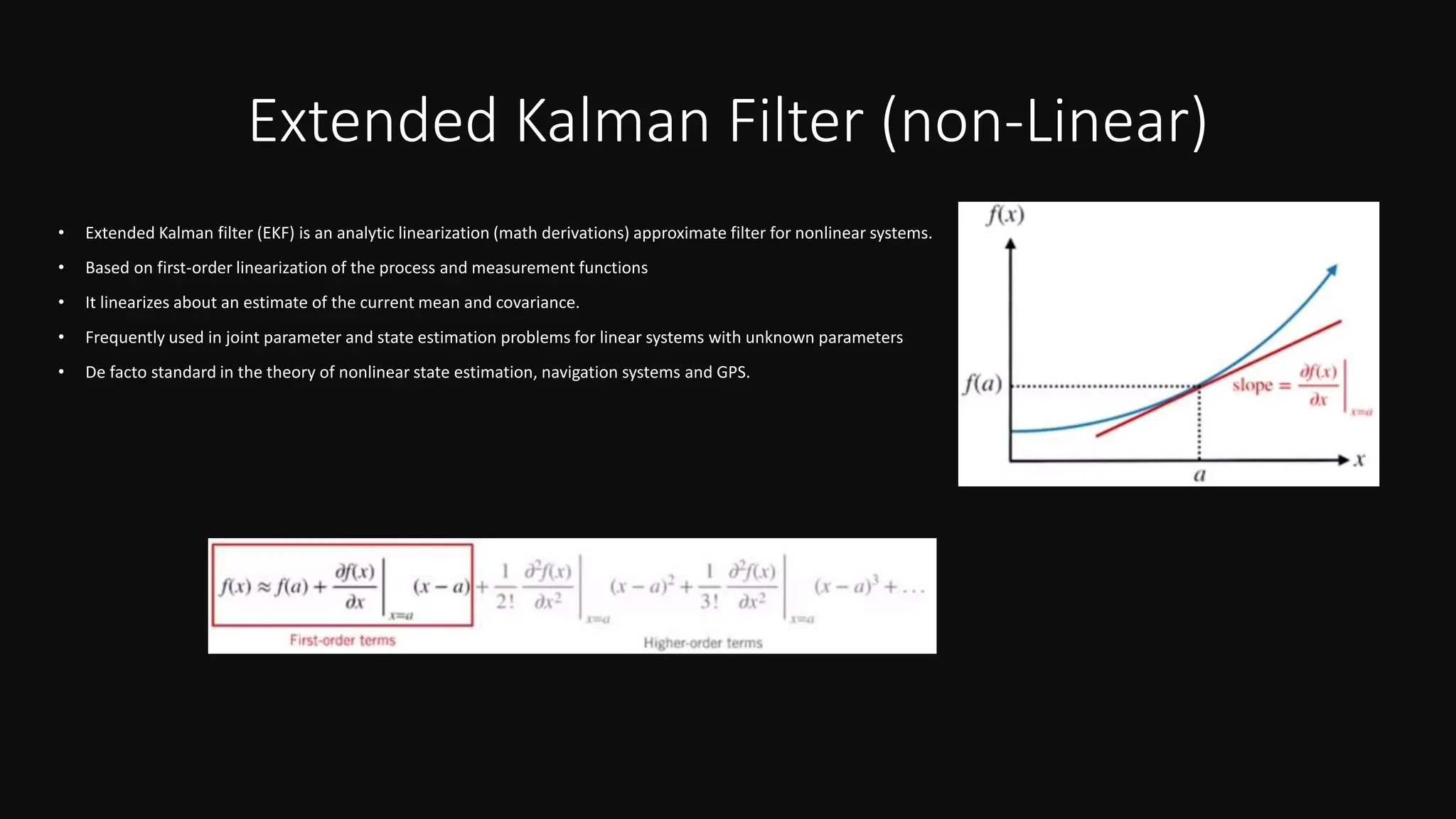
Extended Kalman Filter (non-Linear)
• Extended Kalman filter (EKF) is an analytic linearization (math derivations) approximate filter for nonlinear systems.
• Based on first-order linearization of the process and measurement functions
• It linearizes about an estimate of the current mean and covariance.
• Frequently used in joint parameter and state estimation problems for linear systems with unknown parameters
• De facto standard in the theory of nonlinear state estimation, navigation systems and GPS.
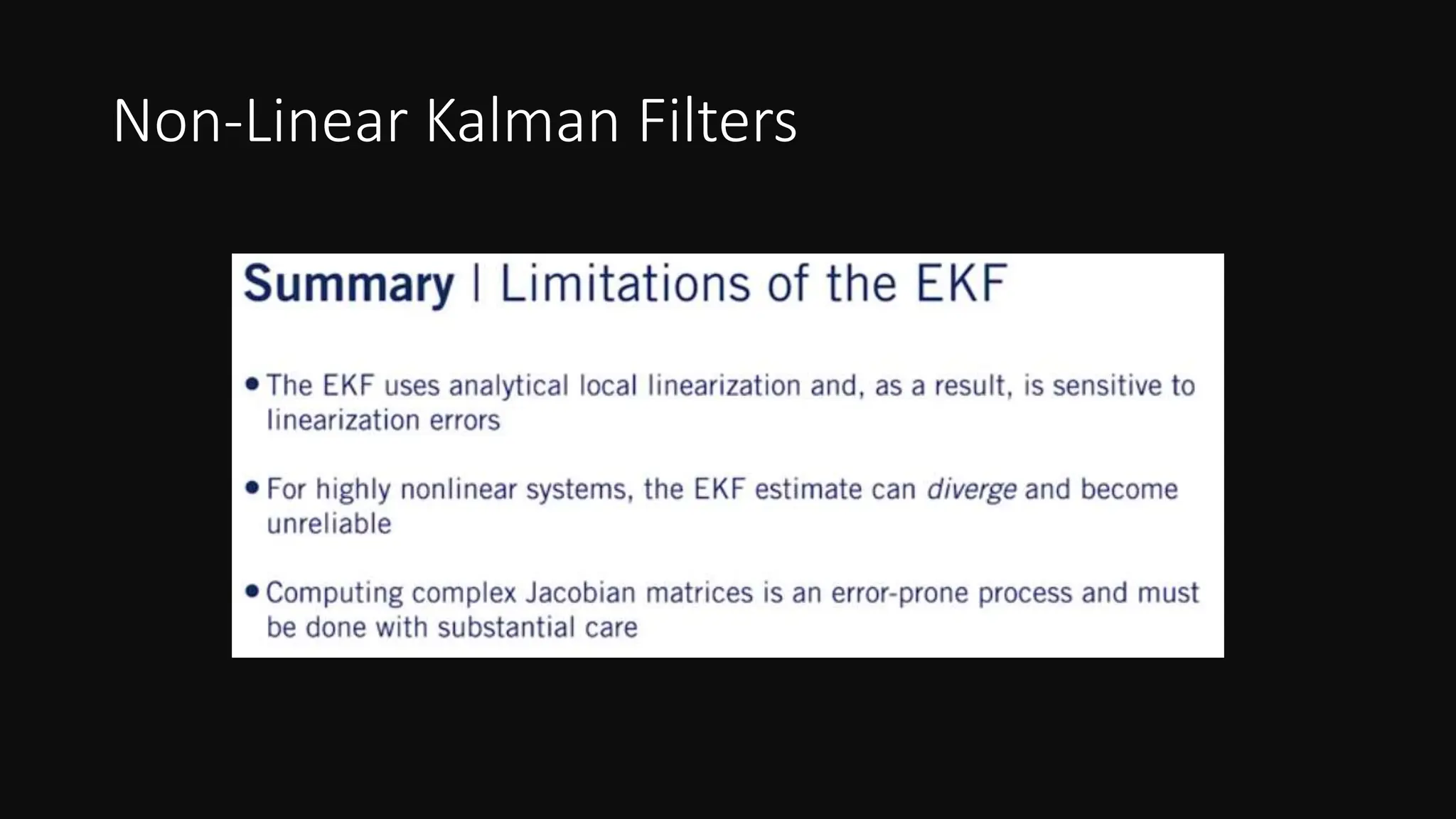
Non-Linear Kalman Filters
Unscented Kalman Filter (non-linear)
(UKF, linear quadratic estimation)
• Simplifying the EKF, linear quadratic estimation (LQE), is an algorithm that uses a series of measurements observed over time.
• Estimating a joint probability distribution over the variables for each timeframe.
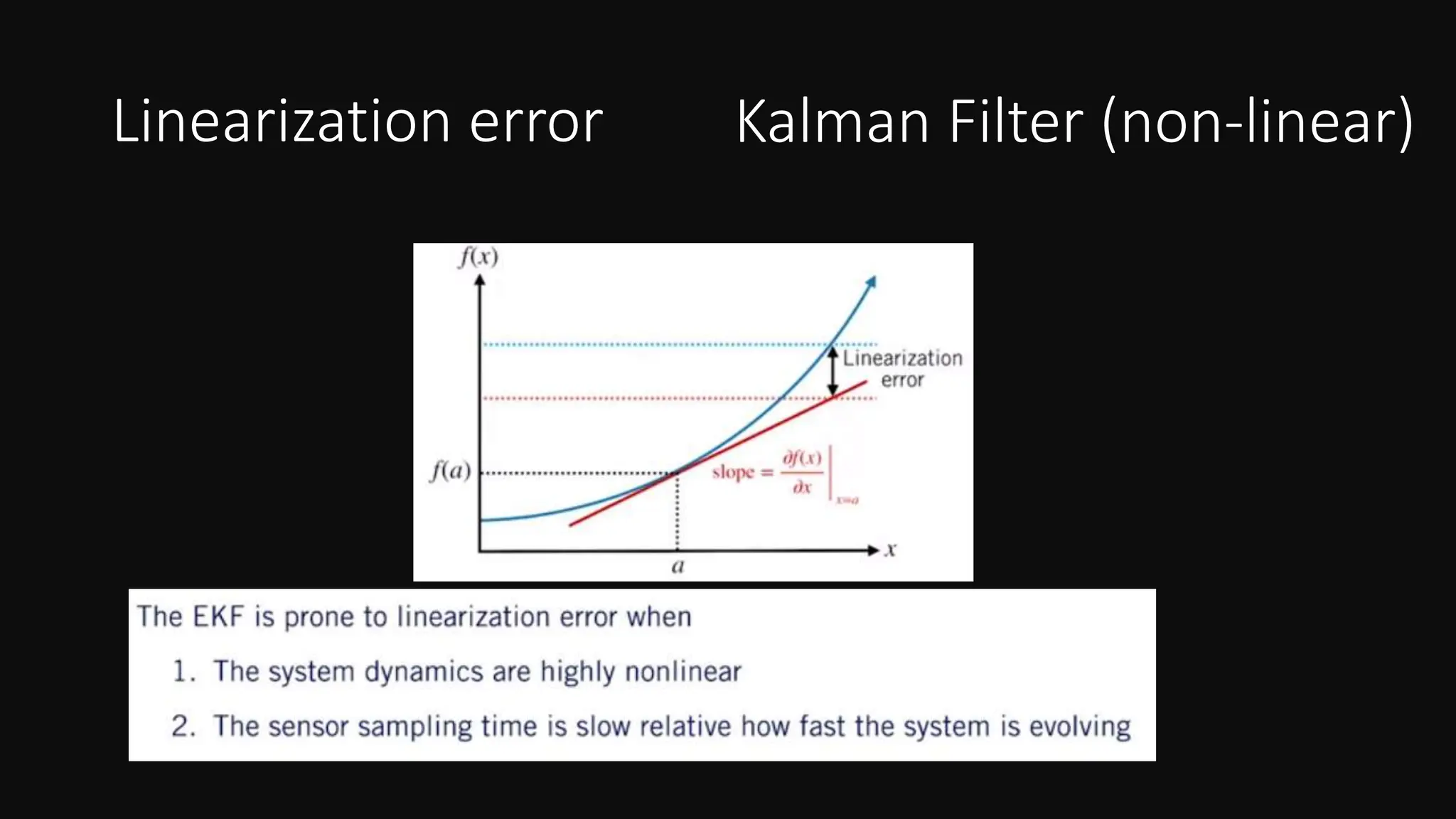
Linearization error Kalman Filter (non-linear)
Central-Difference (non-linear) Kalman Filter (CDKF)
1D requires 2L+1 = 3 sigma-points: the mean and mean +/- std
1D
2D requires 2D+1 = 5 sigma-points: the mean and mean +/- std per dimension
Central-Difference (non-linear) Kalman Filter (CDKF)
2D
Particle Filters
Adaptive Monte Carlo Localization (AMCL)
Particle Filter (Sequential Monte Carlo): For non-Gaussian and/or nonlinear problems, representing the belief by a set
of samples.
Graph-Based Tracking
Thanks

Detection&Tracking - Thermal imaging object detection and tracking

  • 1.
  • 2.
    Table of content •Thermal Detection. • Object detection. • Object Tracking
  • 3.
    Thermal Detection • Dueto an object high temperature (drone 80 degC) compared to its environment. Since heat is often emitted as infrared (IR) radiation thermal camera is used for detection with hogh contrast imaging. • Infra-red radiation (0.75um-1mm) rather than visible (0.4-0.7um) light: Advantages: Invisible (can also be a disadvantage). Less scattering (of atmosphere and surfaces). Can pass through obstacles that vis can’t (Thin Plastics, Clothing and Textiles, Skin and Biological Tissue). low visibility contrition (dark). Disadvantages: Lower resolution. More sensitive to temperature variation compared to vis. Costly.
  • 4.
    Thermal imaging andtracking • Deep Learning Applications: Utilizing deep learning models, such as convolutional neural networks (CNNs), for detecting and tracking objects in thermal imagery. This can involve training models on thermal images directly or adapting models trained on RGB data to work with thermal data. • Algorithmic Approaches (Classic computer vision): Investigating specific algorithms developed for tracking in thermal imagery. This could include methods for object detection, motion tracking, and integrating thermal data with data from other sensors. • Statistical Analysis (Bayesian filter): Studies that perform statistical analysis of target tracking algorithms in thermal imagery, comparing the effectiveness of different tracking approaches under various conditions. • Synthetic Data Generation: Research into generating synthetic thermal images for training deep learning models, addressing the challenge of limited available datasets for thermal imagery. • Thermal and Visible Image Fusion: Exploring methods for integrating thermal and visible spectrum data to improve tracking performance, especially in challenging visibility conditions.
  • 5.
    Object Tracking The methods: -Template Matching: target patch matching (mainly correlation) - Kalman Filters: linear projections state estimation - Taking into account uncertainties in measurements and motions. - Particle Filters: sequential Monte Carlo state estimation. - Mean Shift Algorithm: maximum probability density centroid shifting. - Histogram-Based Tracking: Histogram features (color, texture, gradients) tracking. - Deep Learning-Based Methods: mainly CNNs. - Graph-Based Tracking: Multiple object tracking – Model objects and relationships into nodes and edges to track in complex scenes. "Because tracking is easier than detection, tracking algorithms can use fewer computational resources than running an object detector on every frame." [Bolme 2010] *Constraints: scene complexity, objects nature computational, real-time and accuracy requirements. - An hybrid approach is often used.
  • 6.
    Peak in correlation Peak in correlation TemplateMatching • Example: Getting the peak position via normalized cross correlation. corrMat = cv2.matchTemplate(image=frameGray, templ=kernel, method=cv2.TM_CCORR_NORMED) kernel template
  • 7.
  • 8.
    Bayesian filters (Bayesian theorem) Kalmanfilter Others Particle filter Bayesian filter Probabilistic model used for estimating the state of a dynamic system based on sequential observations over time •Tracking and Navigation: Estimating the position and velocity of objects (vehicles, people, robots) based on sensor data (GPS, radar, lidar). •Robotics: Localizing robots within their environments and mapping those environments based on sensor inputs. •Signal Processing: Enhancing signals and removing noise from data in real-time applications. •Financial Forecasting: Predicting future states of financial markets based on historical data.
  • 9.
    Bayesian filters (Bayesian theorem) Kalmanfilter Others Particle filter Variants of Bayesian filter Probabilistic model used for estimating the state of a dynamic system based on sequential observations over time •Kalman Filter: For linear systems with Gaussian noise. •Extended Kalman Filter (EKF) and Unscented Kalman Filter (UKF): For nonlinear systems. •Particle Filter (Sequential Monte Carlo): For non-Gaussian and/or nonlinear problems, representing the system's state by a set of particles.
  • 10.
    Kalman Filter (linear) • TheKalman Filter algorithm is a discrete time system that consists of a set of state space equations for statistics and control theory. • The filter is named after Rudolf E. Kálmán, who was one of the primary developers of its theory. • The filter considers statistical noise and other inaccuracies, and produces estimates of unknown variables that tend to be more accurate than those based on a single measurement alone “Mathematics is the language with which God has written the universe”, Galileo Galilei Assumptions: 1. Linear system 2. Gaussian distribution
  • 11.
    Kalman Filter (linear) “Mathematics isthe language with which God has written the universe”, Galileo Galilei Assumptions: 1. Linear system 2. Gaussian distribution • Indirect evaluation: Evaluate certain features in the state vector in a roundabout way (e.g., derive speed from locations). • Sensor fusion: Combine 2 not so accurate sensors results to create an evaluation more accurate the two of them separately. • • Short calculation time:​ Using Kalman gain (ratio between previous and current measurement weights) for fast convergent.
  • 12.
    The new bestestimate (Xk) is a prediction made from: - previous best estimate (Xk-1) - plus a correction for known external influence (Uk - acceleration) The new uncertainty (Pk) is a prediction made from: - old uncertainty (Pk-1 – intrinsic uncertainty) - plus some additional uncertainty from the environment ( Q – stochastic e.g., noise). F - linear transformation, old to new state X - state vector (positions, velocity) B - control matrix U - control state (constant acceleration) F - linear transformation, old to new state P - uncertainty covariance (positions, velocity) Q – environment stochastic uncertainty Kalman Filter (linear)
  • 13.
  • 15.
    Alpha filter • Insteadof remembering all measurements, use only the current measurement and n-1 estimate.
  • 16.
    Non-Linear Kalman Filters •Extended Kalman filter (EKF) This method performs an analytic linearization of the non-linear model equations at each point in time. • Sigma Point Kalman Filter (SPKF) – e.g., Unscented (UKF), Central-difference (CDKF) Approach of statistical/empirical linearization instead of analytic linearization (propagate those inputs through the model equations to come up with a linear approximation). Better results than EKF with the same Computational complexity as EKF but worse conceptual complexity. For Gaussian random variables, the CDKF is implemented quite readily and also show a little bit higher theoretic accuracy than the unscented Kalman filter • Particle filters Particle filters give the most precise estimates of a non-linear model state. However, thousands of times more computationally complex than either the EKF or the SPKF (not real-time).
  • 17.
    Extended Kalman Filter(non-Linear) • Extended Kalman filter (EKF) is an analytic linearization (math derivations) approximate filter for nonlinear systems. • Based on first-order linearization of the process and measurement functions • It linearizes about an estimate of the current mean and covariance. • Frequently used in joint parameter and state estimation problems for linear systems with unknown parameters • De facto standard in the theory of nonlinear state estimation, navigation systems and GPS.
  • 18.
  • 19.
    Unscented Kalman Filter(non-linear) (UKF, linear quadratic estimation) • Simplifying the EKF, linear quadratic estimation (LQE), is an algorithm that uses a series of measurements observed over time. • Estimating a joint probability distribution over the variables for each timeframe.
  • 20.
    Linearization error KalmanFilter (non-linear)
  • 21.
    Central-Difference (non-linear) KalmanFilter (CDKF) 1D requires 2L+1 = 3 sigma-points: the mean and mean +/- std 1D
  • 22.
    2D requires 2D+1= 5 sigma-points: the mean and mean +/- std per dimension Central-Difference (non-linear) Kalman Filter (CDKF) 2D
  • 23.
    Particle Filters Adaptive MonteCarlo Localization (AMCL) Particle Filter (Sequential Monte Carlo): For non-Gaussian and/or nonlinear problems, representing the belief by a set of samples.
  • 24.
  • 25.

Editor's Notes

  • #4 There are several Most common detectors Microbolometers typically use materials like Vanadium Oxide (VOx) or Amorphous Silicon (a-Si), which have proven effective in detecting infrared radiation. Mercury Cadmium Telluride (HgCdTe) HgCdTe detectors are widely used in thermal imaging systems, including those for drone detection. They are sensitive across a broad range of the IR spectrum, including the wavelengths typical of the heat signatures emitted by drones. Advantages: Can be engineered to have high sensitivity at specific wavelengths by adjusting the mercury-to-cadmium ratio, making it versatile for different thermal imaging applications.
  • #6 D. S. Bolme, J. R. Beveridge, B. A. Draper and Y. M. Lui, "Visual object tracking using adaptive correlation filters," 2010 IEEE Computer Society Conference on Computer Vision and Pattern Recognition, San Francisco, CA, USA, 2010, pp. 2544-2550, doi: 10.1109/CVPR.2010.5539960. Object tracking involves locating a specific object or multiple objects in a series of frames in a video or images. Several methods are used for object tracking, each with its own strengths and weaknesses. Here are some common methods: Optical Flow Methods: These methods track objects by analyzing the motion of pixels between consecutive frames. They estimate the apparent motion of objects by observing the displacement of features in the image sequence. Template Matching: Template matching involves comparing a template (an image patch representing the object to be tracked) with sub-images in the next frames. The goal is to find the best match, usually based on similarity metrics like correlation. Kalman Filters: The Kalman Filter algorithm is a discrete time system that consists of a set of state space equations. These are used for state estimation in dynamic systems. They predict the next state of the object based on previous states and measurements, taking into account uncertainties in measurements and motions. Mean Shift Algorithm: This algorithm is used for locating the maxima of a density function. It iteratively shifts the centroid of a window to the region with the maximum probability density within the given window. Histogram-Based Tracking: Histograms of object features (color, texture, gradients) are used to track the object across frames. Histograms help to identify the object based on its distinctive features. Deep Learning-Based Methods: Convolutional Neural Networks (CNNs) and other deep learning architectures have been increasingly used for object tracking. They involve training models to detect and track objects by learning from large annotated datasets. Particle Filters: These methods represent the object's state as a set of particles, which are then propagated over time based on motion and observation models. They're effective in handling non-linear and non-Gaussian distributions. Correlation Filters: These methods use correlation operations to track objects efficiently. They involve training a filter to respond strongly at the location of the object being tracked. Graph-Based Tracking: Modeling objects and their relationships as nodes and edges in a graph allows for the tracking of objects in complex scenes where multiple objects interact. The choice of tracking method often depends on various factors such as the complexity of the scene, the nature of the objects being tracked, computational requirements, accuracy needed, and real-time constraints. Often, a combination of these methods or a hybrid approach is used for robust and accurate object tracking in different scenarios. CNN: Siamese Networks for Tracking: A popular approach involves using Siamese CNNs, which take pairs of image patches (e.g., a patch containing the object of interest and another patch from a subsequent frame) as inputs and learn to distinguish the target object from the background or other objects. By evaluating the similarity between feature representations, Siamese networks can be trained to track objects in video sequences. Online Learning and Adaptation: Some CNN-based trackers are designed to update their model online, using the initial detection to learn the appearance of the object continuously as the video progresses. This adaptability helps the tracker maintain accuracy even when the object changes appearance.
  • #11 Using previous sensor data, estimated changes in parameters, and covariance information, the Kalman Filter estimates the actual output as compared to an input measurement from reality. This algorithm can be applied to position, direction, timing offsets, and accelerometer offsets to name a few.
  • #12 Using previous sensor data, estimated changes in parameters, and covariance information, the Kalman Filter estimates the actual output as compared to an input measurement from reality. This algorithm can be applied to position, direction, timing offsets, and accelerometer offsets to name a few.
  • #13 בסרטון הנוכחי אנחנו מקבלים מידע דרך קובץ – גם מחיישן הרדאר וגם מחיישן הלידאר. שימו לב איך צריך לקרוא את הקובץ data.txt. עבור שורות המתארות מדידה של ה- (L)LIDAR העמודות הן בסדר הזה: sensor_type, x_measured, y_measured, timestamp, x_groundtruth, y_groundtruth, vx_groundtruth, vy_groundtruth, yaw_groundtruth, yawrate_groundtruth. עבור שורות המתארות מדידה של הרדאר (R) העמודות הן בסדר הזה: sensor_type, rho_measured, phi_measured, rhodot_measured, timestamp, x_groundtruth, y_groundtruth, vx_groundtruth, vy_groundtruth, yaw_groundtruth, yawrate_groundtruth.
  • #18 In estimation theory, the extended Kalman filter (EKF) is the nonlinear version of the Kalman filter which linearizes about an estimate of the current mean and covariance. In the case of well defined transition models, the EKF has been considered[1] the de facto standard in the theory of nonlinear state estimation, navigation systems and GPS.
  • #21  In general, the linearization error for any function depends on two things. The first thing is how non-linear the original function is to begin with.  If our nonlinear function varies slowly or is quite flat much of the time,  linear approximation is going to be a pretty good fit.  On the other hand, if the function varies quickly,  linear approximation is not going to do a great job of  capturing the true shape of the function over most of its domain.  The second thing linearization error depends  on is how far away from the operating point you are.  The further away you move from the operating point,  the more likely the linear approximation  is to diverge from the true function.
  • #24 The Adaptive Monte Carlo Localization (AMCL) is a probabilistic localization module which estimates the position and orientation (i.e. Pose) for mobile robot localization problem. However, AMCL performs poorly on localization when robot navigates to a featureless environment. an enhanced AMCL is proposed through using the information from laser scan points to improve the preciseness and robustness of the localization problem Adaptive Monte Carlo Localization (AMCL) is a probabilistic localization module which estimates the position and orientation (i.e. Pose) of a robot in a given known map using a 2D laser scanner.
  • #25 Pipeline of our Multiple object tracking (MOT) model. Inputs are the frame t − 1, the frame t, the object set Ot from frame t and the detection set Dt at frame t. Outputs are tracking results. For example, there are four objects from frame t − 1 and three detections from frame t, and their features are extracted and sent into the graph networks. Afterwards, data association and missing detections handling are performed.