Toby Iloba
MGT 522 – Human Resources Seminar
Jacksonville State University
Hill Mayfield
 Characteristics of Gen-Xers
 Characteristics of Millennials
 How to attract and retain employees
 Impacts of not having reward systems
 Characteristics of employment
 Engaging and retaining all generations
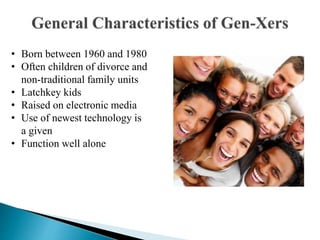
• Born between 1960 and 1980
• Often children of divorce and
non-traditional family units
• Latchkey kids
• Raised on electronic media
• Use of newest technology is
a given
• Function well alone
• Tend to be pessimistic and
skeptical of authority and
institutions
• Have short attention spans
• “Work to Live” - GUPPIES
• Sometimes younger siblings of Gen-Xers
• Benefitted from parents’ later life success
• Often have at least one immigrant parent
• Are racially and ethnically diverse
• Identify with parents’
values
• Gravitate toward
group activities
• Believe it’s cool to be
smart
• New technology is a
given
• Short attention spans
• Money/Financial rewards
• Rewarding performance: group vs individual
• Facilitating the mentoring and career
development
• Job Enrichment
• Job Empowerment
 Lack of motivation
 Increase in long term cost such as training
and recruiting
 Loss in veteran work force
 Turnover rate and impact to brand image
 Decline in organizational culture
 Millennial workers are characterized by
◦ Technology skills
◦ Expectation of diversity
◦ Expectation of rapid results
◦ Flexible schedules
◦ Want balance of work and home life
◦ Need for independence in decision making
◦ Desire for challenge and growth
◦ Expect immediate feedback
 Generation X workers are characterized by
◦ Technology skills
◦ Entrepreneurial spirit
◦ Mobility and flexibility at work
◦ Focus on personal professional growth over
employer interests
◦ Perceived lack of loyalty
 Generation X workers are characterized by
◦ Want balance of work and home life
◦ Need immediate feedback
◦ Will balance end result with desire for quick
resolution
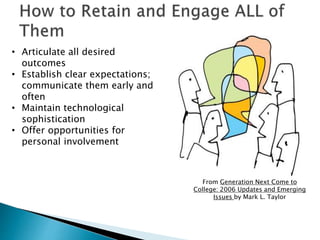
• Articulate all desired
outcomes
• Establish clear expectations;
communicate them early and
often
• Maintain technological
sophistication
• Offer opportunities for
personal involvement
From Generation Next Come to
College: 2006 Updates and Emerging
Issues by Mark L. Taylor
• Design “real world”
assignments
• End the “sage on the stage”
approach
• Provide transparency and
clear communication
• Address multiple learning
options
• Use meaningful assessments:
require demonstration rather
than the ability to memorize
 Key learning
 Carlson, Scott. “The Net Generation Goes to
College.”
 Epstein, Molly. (2007).
 Mouchayleh, Terry Stewart. (2009). “The More
Things Change, The More They Stay the Same:
Working With Generational Issues in our
Students.”
 ---. (2007). “Generational Differences Among
Higher Education Faculty.”
 Taylor, Mark L. (2006). “Generation Next Come
to College: 2006 Updates and Emerging
Issues.”

Mgt 522

  • 1.
    Toby Iloba MGT 522– Human Resources Seminar Jacksonville State University Hill Mayfield
  • 2.
     Characteristics ofGen-Xers  Characteristics of Millennials  How to attract and retain employees  Impacts of not having reward systems  Characteristics of employment  Engaging and retaining all generations
  • 3.
    • Born between1960 and 1980 • Often children of divorce and non-traditional family units • Latchkey kids • Raised on electronic media • Use of newest technology is a given • Function well alone
  • 4.
    • Tend tobe pessimistic and skeptical of authority and institutions • Have short attention spans • “Work to Live” - GUPPIES
  • 5.
    • Sometimes youngersiblings of Gen-Xers • Benefitted from parents’ later life success • Often have at least one immigrant parent • Are racially and ethnically diverse • Identify with parents’ values
  • 6.
    • Gravitate toward groupactivities • Believe it’s cool to be smart • New technology is a given • Short attention spans
  • 7.
    • Money/Financial rewards •Rewarding performance: group vs individual • Facilitating the mentoring and career development • Job Enrichment • Job Empowerment
  • 8.
     Lack ofmotivation  Increase in long term cost such as training and recruiting  Loss in veteran work force  Turnover rate and impact to brand image  Decline in organizational culture
  • 9.
     Millennial workersare characterized by ◦ Technology skills ◦ Expectation of diversity ◦ Expectation of rapid results ◦ Flexible schedules ◦ Want balance of work and home life ◦ Need for independence in decision making ◦ Desire for challenge and growth ◦ Expect immediate feedback
  • 10.
     Generation Xworkers are characterized by ◦ Technology skills ◦ Entrepreneurial spirit ◦ Mobility and flexibility at work ◦ Focus on personal professional growth over employer interests ◦ Perceived lack of loyalty
  • 11.
     Generation Xworkers are characterized by ◦ Want balance of work and home life ◦ Need immediate feedback ◦ Will balance end result with desire for quick resolution
  • 12.
    • Articulate alldesired outcomes • Establish clear expectations; communicate them early and often • Maintain technological sophistication • Offer opportunities for personal involvement From Generation Next Come to College: 2006 Updates and Emerging Issues by Mark L. Taylor
  • 13.
    • Design “realworld” assignments • End the “sage on the stage” approach • Provide transparency and clear communication • Address multiple learning options • Use meaningful assessments: require demonstration rather than the ability to memorize
  • 14.
  • 15.
     Carlson, Scott.“The Net Generation Goes to College.”  Epstein, Molly. (2007).  Mouchayleh, Terry Stewart. (2009). “The More Things Change, The More They Stay the Same: Working With Generational Issues in our Students.”  ---. (2007). “Generational Differences Among Higher Education Faculty.”  Taylor, Mark L. (2006). “Generation Next Come to College: 2006 Updates and Emerging Issues.”