Learning in a
Connected
Workplace
Benjamin Carmel
E-Learning Strategist
Education Northwest
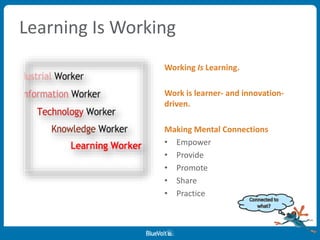
Learning Is Working
Working Is Learning.
Work is learner- and innovation-
driven.
Making Mental Connections
• Empower
• Provide
• Promote
• Share
• Practice
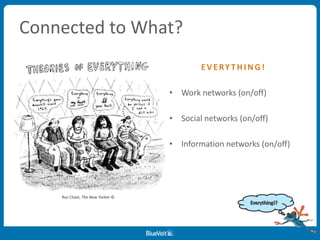
Connected to What?
EV ERYT HI NG!
• Work networks (on/off)
• Social networks (on/off)
• Information networks (on/off)
Roz Chast, The New Yorker ©
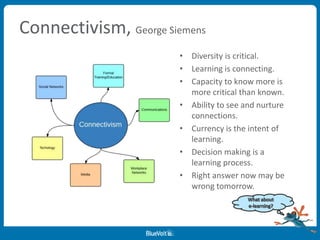
Connectivism, George Siemens
• Diversity is critical.
• Learning is connecting.
• Capacity to know more is
more critical than known.
• Ability to see and nurture
connections.
• Currency is the intent of
learning.
• Decision making is a
learning process.
• Right answer now may be
wrong tomorrow.
eLearning
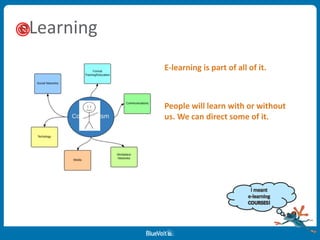
E-learning is part of all of it.
People will learn with or without
us. We can direct some of it.
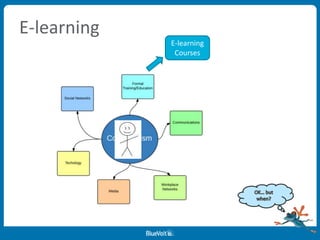
E-learning
E-learning
Courses
E-learning Courses (self-contained)
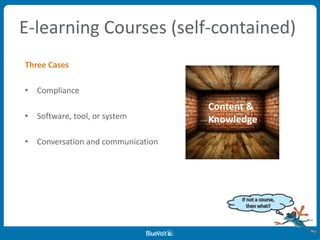
Three Cases
• Compliance
• Software, tool, or system
• Conversation and communication
Content &
Knowledge
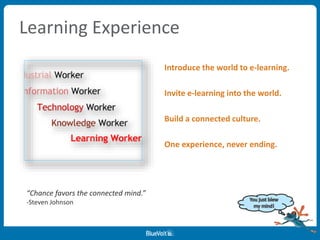
Learning Experience
Introduce the world to e-learning.
Invite e-learning into the world.
Build a connected culture.
One experience, never ending.
“Chance favors the connected mind.”
-Steven Johnson
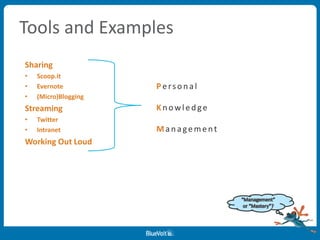
Tools and Examples
Sharing
• Scoop.it
• Evernote
• (Micro)Blogging
Streaming
• Twitter
• Intranet
Working Out Loud
P erson al
Knowledge
Man agement
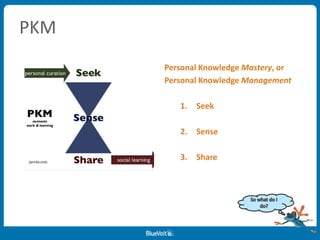
PKM
Personal Knowledge Mastery, or
Personal Knowledge Management
1. Seek
2. Sense
3. Share
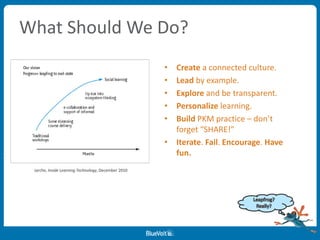
What Should We Do?
• Create a connected culture.
• Lead by example.
• Explore and be transparent.
• Personalize learning.
• Build PKM practice – don’t
forget “SHARE!”
• Iterate. Fail. Encourage. Have
fun.
Jarche, Inside Learning Technology, December 2010
Questions & Discussion
-Centre for Learning & Performance Technologies (C4LPT)
-Working Out Loud and Jane Bozarth’s Show Your Work
-Personal Knowledge Mastery (PKM), Harold Jarche
-Connectivism, George Siemens
-Serious eLearning Manifesto
-Steven Johnson
………………..
-In the Learning Age
-My Scoop.it page
Thank You!
Benjamin Carmel
Carmel.Ben@gmail.com
@BenCpdx
Inthelearningage.com

Learning in a Connected Workplace

Editor's Notes

  • #3 We live in an age that has moved beyond “information” worker or “knowledge” worker We are all learning workers now. Learning and innovation drive work – not production or even efficiency. Knowledge is individual at its core, but all learning is social Learning is a practice, a conversation When we can’t have that conversation in person, we reach out to our network – Brains are wired to store and retrieve information. But our networks are even better than we are Organizations need to: Empower Provide Promote Share Practice
  • #4 Connected to everything. Information is at our fingertips. Friends and colleagues or a text or IM or call away. We have VPNs from home, and facebook in the office. Facts are facts… no fighting it. Don’t fear that people are distracted. Of course they are!! The question is: How do we cope, what the new mental model?
  • #5 Behaviorism? Constructivism? Cognitivism? Determinism? Connectivism: Learning and knowledge rest in diversity of opinions Learning is a process of connecting. Learning may reside in in machines and networks (not individuals) Capacity to know more is more critical than what is currently known. Nurturing and maintaining connections facilitates continual learning. Ability to see connections between fields, ideas, and concepts is a core skill. Currency (accurate, up-to-date knowledge) is the intent of all connectivist learning activities. Decision making is itself a learning process. Choosing what to learn and the meaning of incoming information are parts of it. While there is a right answer now, it may be wrong tomorrow due to alterations in the information climate affecting the decision.
  • #6 People will learn what they need to do to get by. Our aim needs to be to raise the expectations, to build towards mastery. E-learning is part of all of this. We sit at a screen to work, and we learn. We learn at a screen, and apply it to work. People don’t know how to normalize, codify, contain and apply that loop. ELP have a role, a big role, to help develop that faculty and capacity. Different role for us, different for our learners. Take the “e” out of e-learning? In traditional e-learning courses, we have “success.” What is the success of the broader view of e-learning?
  • #7 If we need a place for courses, e – f2f, they belong In formal training/education When does a course make sense?
  • #8 I can think of three examples in which a course makes sense. We had better make them interactive, engaging, purposeful, actionable, etc. Become familiar with the Serious eLearning Manifesto. Courses are not THE solution even in those cases, they are only part of the solution. The danger is, once you’ve created a “course” you’ve effectively built a wall around that content. Once in a while it is good to have that wall, but have some nice windows, and a door, and a tall chimney.  Nothing is about just what it is a bout: It’s all context.
  • #9 Remember, learning is not about task, or even performance per se. It is about innovation and personal mastery. Learning is a never-ending process, and relies on the connections we have, build, nurture, prune and constantly shape.
  • #10 PKM is a practice. Work out loud. “Save is the new share.” Tools: Twitter Intranet Scoop.it Delicious Evernote Blogs (and microblogs) Yammer, Asana, Ning, etc. http://www.scoop.it/t/training-learning-and-instructional-design https://twitter.com/BenCpdx http://inthelearningage.com/ https://delicious.com/bendancar/training