How Entrepreneurs Are Expanding the Boundaries of
Global Learning Beyond the Classroom
Lisa A. Petrides, Ph.D.
President and Founder, Institute for the Study
of Knowledge Management in Education
(ISKME)
iskme.org
Education is different
In technology,
Entrepreneurs
develop game-
changing
innovations on the
edges of an
ecosystem built to
adapt to rapid
change.
vs.
In education,
Culture tuned to standardization
Risk adverse
Political, legal & legislative barriers
Limited early-stage investment
Multiple vision and goals
Highly fragmented efforts
Restricted knowledge sharing
Disruptive innovations that
advance one component,
break others.
Progress breaks things
But in education, risk tolerance and energy
to implement new ideas is low.
So…can any one innovation be the sole catalyst or tipping point that
changes the whole? Or do we really need innovation of systems and
the models themselves first?
Game Changers in Education Space
• Information is free and everywhere
• High demand for personalized anytime anyplace learning
• How we measure learning and knowledge is changing
• Collaborating and social learning is now accepted
• Unbundling of services in education
• We are always connected to the Net
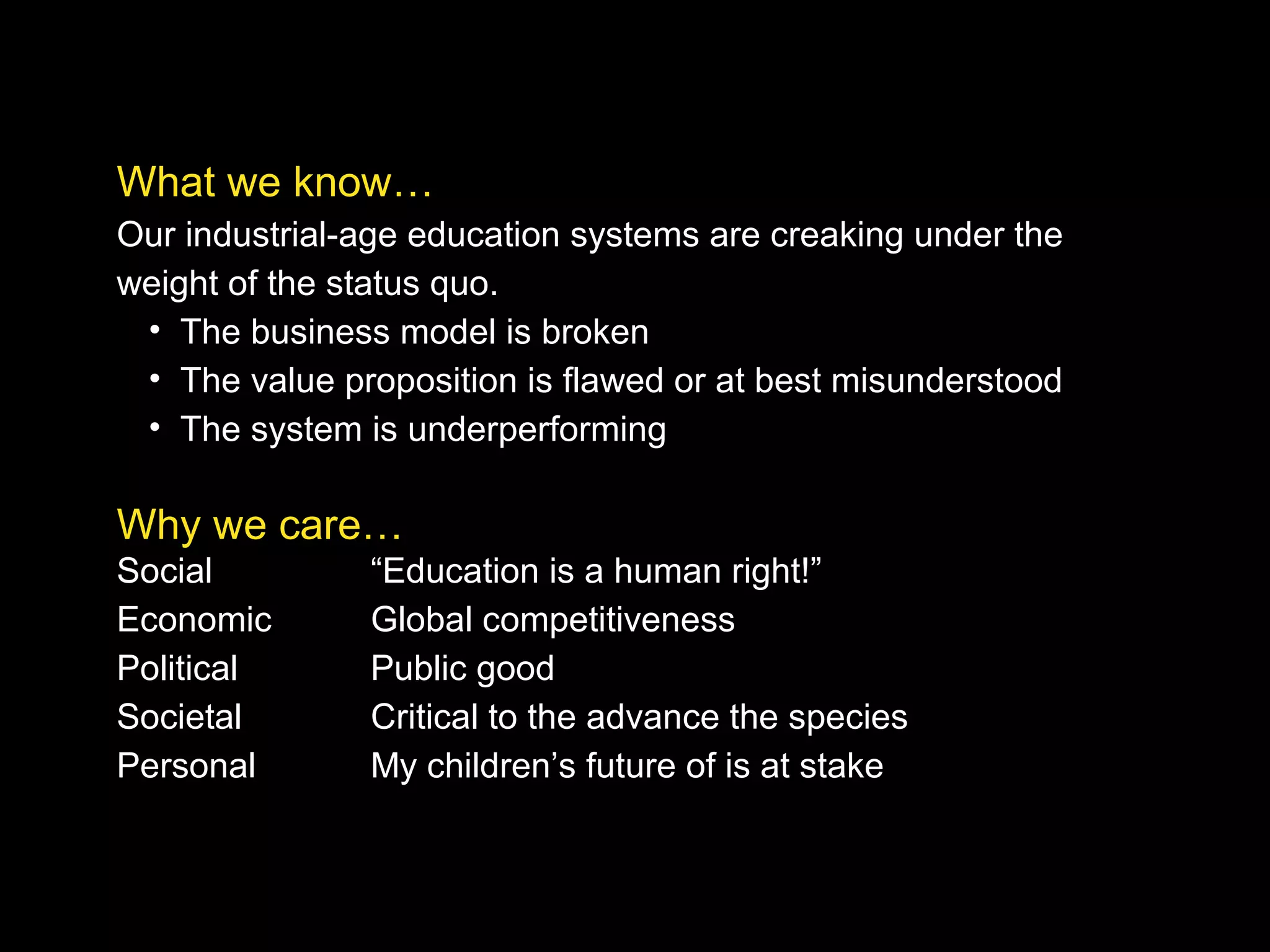
What we know…
Our industrial-age education systems are creaking under the
weight of the status quo.
• The business model is broken
• The value proposition is flawed or at best misunderstood
• The system is underperforming
Why we care…
Social “Education is a human right!”
Economic Global competitiveness
Political Public good
Societal Critical to the advance the species
Personal My children’s future of is at stake
Some questions to ponder (and answer!) in the next 90 minutes
1.What is the tipping point?
2.Is the tipping point financial? Or one in which basic education
(math and literacy) have been achieved?
3.What is actionable today?
4.Are these innovations sustainable?
5.Are there new hybrid business models?
What else do we need?
Some questions to ponder (and answer!) in the next 90 minutes
1.What is the tipping point?
2.Is the tipping point financial? Or one in which basic education
(math and literacy) have been achieved?
3.What is actionable today?
4.Are these innovations sustainable?
5.Are there new hybrid business models?
What else do we need?

Lisa Petrides VLAB moderator comments 11.16.10

  • 1.
    How Entrepreneurs AreExpanding the Boundaries of Global Learning Beyond the Classroom Lisa A. Petrides, Ph.D. President and Founder, Institute for the Study of Knowledge Management in Education (ISKME) iskme.org
  • 2.
    Education is different Intechnology, Entrepreneurs develop game- changing innovations on the edges of an ecosystem built to adapt to rapid change. vs. In education, Culture tuned to standardization Risk adverse Political, legal & legislative barriers Limited early-stage investment Multiple vision and goals Highly fragmented efforts Restricted knowledge sharing
  • 3.
    Disruptive innovations that advanceone component, break others. Progress breaks things But in education, risk tolerance and energy to implement new ideas is low. So…can any one innovation be the sole catalyst or tipping point that changes the whole? Or do we really need innovation of systems and the models themselves first?
  • 4.
    Game Changers inEducation Space • Information is free and everywhere • High demand for personalized anytime anyplace learning • How we measure learning and knowledge is changing • Collaborating and social learning is now accepted • Unbundling of services in education • We are always connected to the Net
  • 5.
    What we know… Ourindustrial-age education systems are creaking under the weight of the status quo. • The business model is broken • The value proposition is flawed or at best misunderstood • The system is underperforming Why we care… Social “Education is a human right!” Economic Global competitiveness Political Public good Societal Critical to the advance the species Personal My children’s future of is at stake
  • 6.
    Some questions toponder (and answer!) in the next 90 minutes 1.What is the tipping point? 2.Is the tipping point financial? Or one in which basic education (math and literacy) have been achieved? 3.What is actionable today? 4.Are these innovations sustainable? 5.Are there new hybrid business models? What else do we need?
  • 7.
    Some questions toponder (and answer!) in the next 90 minutes 1.What is the tipping point? 2.Is the tipping point financial? Or one in which basic education (math and literacy) have been achieved? 3.What is actionable today? 4.Are these innovations sustainable? 5.Are there new hybrid business models? What else do we need?