6400 –  Administración de servicios de Información Management and Leadership Martes, 15 de abril de 2008
Management vs. leadership Management Helps an organization set and achieve goals by planning and organizing their resources.  Leadership Leading a team to achieve the planned objectives. Do you  manage  people or  lead  people? Are leaders always born with the needed skills? Plan, organize, lead, control, achieve
The leadership myths Leadership is a rare skill Leaders are born Leaders are charismatic Leaders are only at the top of an organization Leaders control and direct an organization.
Functional skills of a manager Leader Interpersonal roles Administrator Informational roles Decision maker (fixer) Negotiating role Shift is now towards managing with a more people centered and holistic approach.
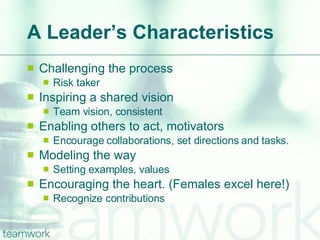
A Leader’s Characteristics Challenging the process Risk taker Inspiring a shared vision Team vision, consistent Enabling others to act, motivators Encourage collaborations, set directions and tasks. Modeling the way  Setting examples, values Encouraging the heart. (Females excel here!) Recognize contributions
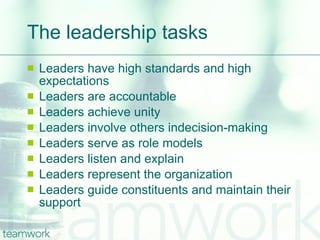
The leadership tasks Leaders have high standards and high expectations  Leaders are accountable  Leaders achieve unity  Leaders involve others indecision-making  Leaders serve as role models  Leaders listen and explain  Leaders represent the organization  Leaders guide constituents and maintain their support
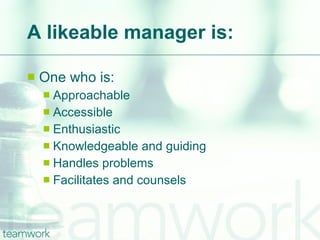
A likeable manager is: One who is: Approachable Accessible Enthusiastic Knowledgeable and guiding Handles problems  Facilitates and counsels
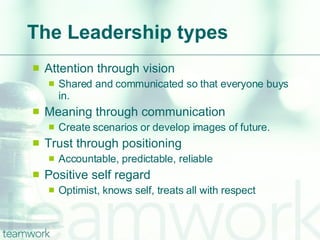
The Leadership types Attention through vision Shared and communicated so that everyone buys in. Meaning through communication Create scenarios or develop images of future. Trust through positioning Accountable, predictable, reliable Positive self regard Optimist, knows self, treats all with respect
Effective leaders Are proactive Are good time managers Can prioritize and set objectives Are skilled at interpersonal communications Can perform personal reflections Can listen actively, facilitate, valorize, and motivate Can segregate and delegate work
Changing leadership contexts From Industrial to information society High public awareness of corporate activities. From bureaucratic to networked societies Creating a high-tech society Physical and virtual leaders
Information professional    Manager As generic managerial skills are developed, the highly skilled information specialist’s expertise diminishes.  An IP    manager transition happens when an IP learns how to challenge existing situation and become a change agent. They should then learn to: Plan and allocate work Set goals Monitor progress for set tasks Develop staff Motivate and inspire Evaluate team members Communicate with stakeholders.
Exercise  1 - bad bosses Interview the person sitting next to you (max. 5 minutes) and write down the characteristics of a bad boss that he/she may have experienced.  Then switch roles. Now the interviewer becomes an interviewee. Again the five minute interview. Finally compare your two responses and come up with a common set of identified characteristics. Each group presents its findings to the class.
Exercise 1…. continued Interview the person sitting next to you (five minutes) and write down the characteristics of a bad boss that he/she may have experienced.  Then switch roles. Now the interviewer becomes an interviewee. Finally compare your two responses and come up with a common set of identified characteristics. Consider the following issues keeping in mind the management characteristics identified in the handout. The  personal characteristics  of the boss that was disliked. The  management characteristics  of the boss that was disliked. The impact of these bossy characteristics on the working of the staff. The impact of these bossy characteristics on the general work environment.
Exercise 2 – Virtual leaders What are the characteristics of virtual leaders? Discuss with a partner and list a few. Think about: Email Geographically dispersed locations Distance education Blogs and wikis
References Roberts, S. and Rowley, J. (2004) Managing Information Services, London: Facet publishing, pp. 31-63 Prentice, A. (2005) Managing in the Information Age. Lanham: Scarecrow Press.

Mgmt And Leadership

  • 1.
    6400 – Administración de servicios de Información Management and Leadership Martes, 15 de abril de 2008
  • 2.
    Management vs. leadershipManagement Helps an organization set and achieve goals by planning and organizing their resources. Leadership Leading a team to achieve the planned objectives. Do you manage people or lead people? Are leaders always born with the needed skills? Plan, organize, lead, control, achieve
  • 3.
    The leadership mythsLeadership is a rare skill Leaders are born Leaders are charismatic Leaders are only at the top of an organization Leaders control and direct an organization.
  • 4.
    Functional skills ofa manager Leader Interpersonal roles Administrator Informational roles Decision maker (fixer) Negotiating role Shift is now towards managing with a more people centered and holistic approach.
  • 5.
    A Leader’s CharacteristicsChallenging the process Risk taker Inspiring a shared vision Team vision, consistent Enabling others to act, motivators Encourage collaborations, set directions and tasks. Modeling the way Setting examples, values Encouraging the heart. (Females excel here!) Recognize contributions
  • 6.
    The leadership tasksLeaders have high standards and high expectations Leaders are accountable Leaders achieve unity Leaders involve others indecision-making Leaders serve as role models Leaders listen and explain Leaders represent the organization Leaders guide constituents and maintain their support
  • 7.
    A likeable manageris: One who is: Approachable Accessible Enthusiastic Knowledgeable and guiding Handles problems Facilitates and counsels
  • 8.
    The Leadership typesAttention through vision Shared and communicated so that everyone buys in. Meaning through communication Create scenarios or develop images of future. Trust through positioning Accountable, predictable, reliable Positive self regard Optimist, knows self, treats all with respect
  • 9.
    Effective leaders Areproactive Are good time managers Can prioritize and set objectives Are skilled at interpersonal communications Can perform personal reflections Can listen actively, facilitate, valorize, and motivate Can segregate and delegate work
  • 10.
    Changing leadership contextsFrom Industrial to information society High public awareness of corporate activities. From bureaucratic to networked societies Creating a high-tech society Physical and virtual leaders
  • 11.
    Information professional  Manager As generic managerial skills are developed, the highly skilled information specialist’s expertise diminishes. An IP  manager transition happens when an IP learns how to challenge existing situation and become a change agent. They should then learn to: Plan and allocate work Set goals Monitor progress for set tasks Develop staff Motivate and inspire Evaluate team members Communicate with stakeholders.
  • 12.
    Exercise 1- bad bosses Interview the person sitting next to you (max. 5 minutes) and write down the characteristics of a bad boss that he/she may have experienced. Then switch roles. Now the interviewer becomes an interviewee. Again the five minute interview. Finally compare your two responses and come up with a common set of identified characteristics. Each group presents its findings to the class.
  • 13.
    Exercise 1…. continuedInterview the person sitting next to you (five minutes) and write down the characteristics of a bad boss that he/she may have experienced. Then switch roles. Now the interviewer becomes an interviewee. Finally compare your two responses and come up with a common set of identified characteristics. Consider the following issues keeping in mind the management characteristics identified in the handout. The personal characteristics of the boss that was disliked. The management characteristics of the boss that was disliked. The impact of these bossy characteristics on the working of the staff. The impact of these bossy characteristics on the general work environment.
  • 14.
    Exercise 2 –Virtual leaders What are the characteristics of virtual leaders? Discuss with a partner and list a few. Think about: Email Geographically dispersed locations Distance education Blogs and wikis
  • 15.
    References Roberts, S.and Rowley, J. (2004) Managing Information Services, London: Facet publishing, pp. 31-63 Prentice, A. (2005) Managing in the Information Age. Lanham: Scarecrow Press.