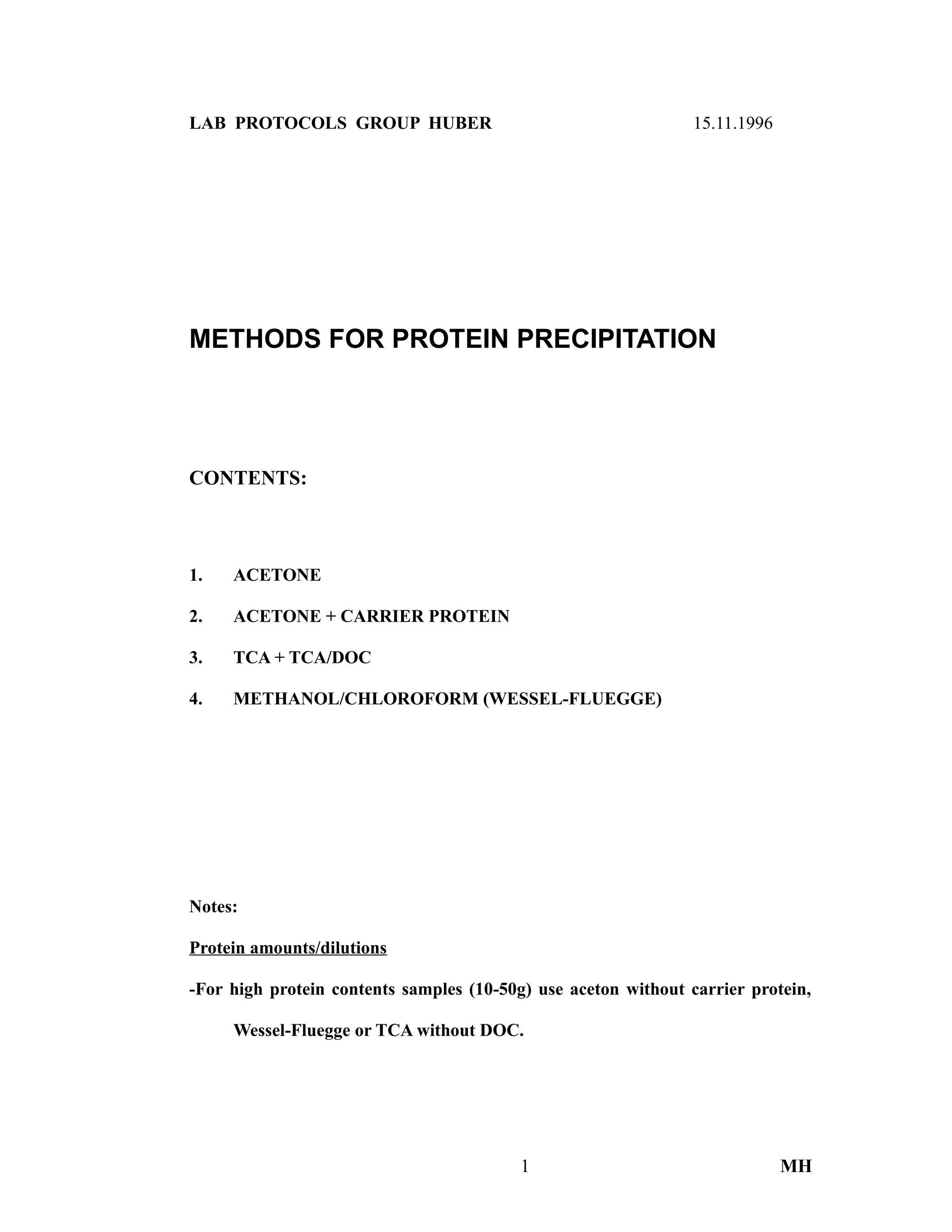
LAB PROTOCOLS GROUP HUBER 15.11.1996
METHODS FOR PROTEIN PRECIPITATION
CONTENTS:
1. ACETONE
2. ACETONE + CARRIER PROTEIN
3. TCA + TCA/DOC
4. METHANOL/CHLOROFORM (WESSEL-FLUEGGE)
Notes:
Protein amounts/dilutions
-For high protein contents samples (10-50g) use aceton without carrier protein,
Wessel-Fluegge or TCA without DOC.
1 MH
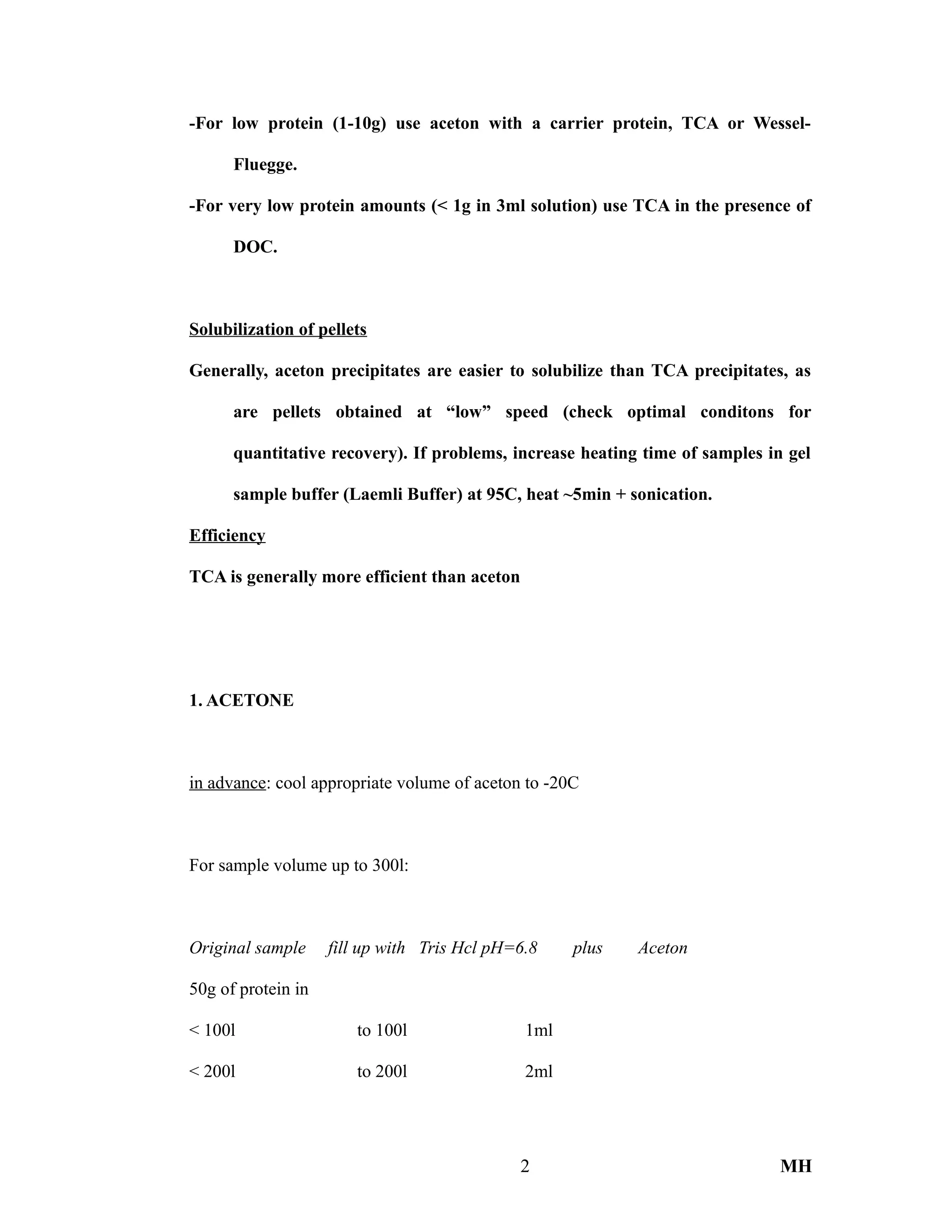
-For low protein (1-10g) use aceton with a carrier protein, TCA or Wessel-
Fluegge.
-For very low protein amounts (< 1g in 3ml solution) use TCA in the presence of
DOC.
Solubilization of pellets
Generally, aceton precipitates are easier to solubilize than TCA precipitates, as
are pellets obtained at “low” speed (check optimal conditons for
quantitative recovery). If problems, increase heating time of samples in gel
sample buffer (Laemli Buffer) at 95C, heat ~5min + sonication.
Efficiency
TCA is generally more efficient than aceton
1. ACETONE
in advance: cool appropriate volume of aceton to -20C
For sample volume up to 300l:
Original sample fill up with Tris Hcl pH=6.8 plus Aceton
50g of protein in
< 100l to 100l 1ml
< 200l to 200l 2ml
2 MH
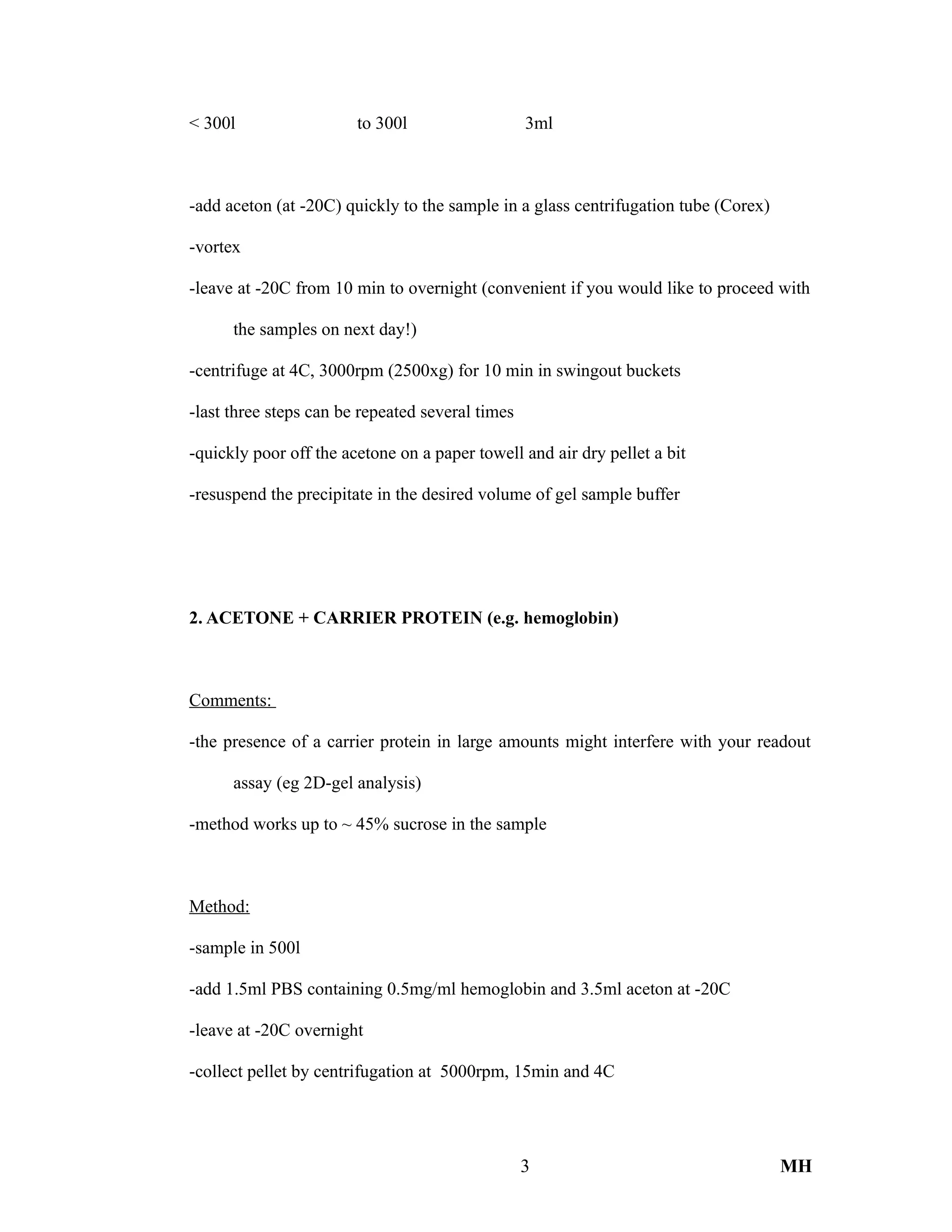
< 300l to 300l 3ml
-add aceton (at -20C) quickly to the sample in a glass centrifugation tube (Corex)
-vortex
-leave at -20C from 10 min to overnight (convenient if you would like to proceed with
the samples on next day!)
-centrifuge at 4C, 3000rpm (2500xg) for 10 min in swingout buckets
-last three steps can be repeated several times
-quickly poor off the acetone on a paper towell and air dry pellet a bit
-resuspend the precipitate in the desired volume of gel sample buffer
2. ACETONE + CARRIER PROTEIN (e.g. hemoglobin)
Comments:
-the presence of a carrier protein in large amounts might interfere with your readout
assay (eg 2D-gel analysis)
-method works up to ~ 45% sucrose in the sample
Method:
-sample in 500l
-add 1.5ml PBS containing 0.5mg/ml hemoglobin and 3.5ml aceton at -20C
-leave at -20C overnight
-collect pellet by centrifugation at 5000rpm, 15min and 4C
3 MH
3. TCA/DOC
Reference: Bensadoun & Weinstein. 1976. Assays of proteins in the presence of
interfering materials. Anal. Biochem. 70:241:250.
-bring sample to 3.0 ml with aqua dest. in 15ml centrifugation tube (Corex)
-add 25l of 2% Na-deoxycholate (DOC), final conc of 125g/ml
-vortex
-RT 15min
- + 1ml 24% trichloroacetic acid (TCA)
-vortex
-centrifuge 3000 rpm, 30min, 4C with swingout buckets
-aspirate supernatant carefully with drawn out pasteur pipette
-wash once by centrifugation with aceton (-20C) to remove excess of TCA
-take up pellets in gel loading buffer
For many assays (e.g. scintillation counting of radioactive samples in most counters),
it is important to readjust the pH after resuspension of the TCA pellet [e.g. pellet
to 1ml with aqua dest + 30l NaOH 1N yields a final pH of 9-10, which is OK for
most assays].
4 MH
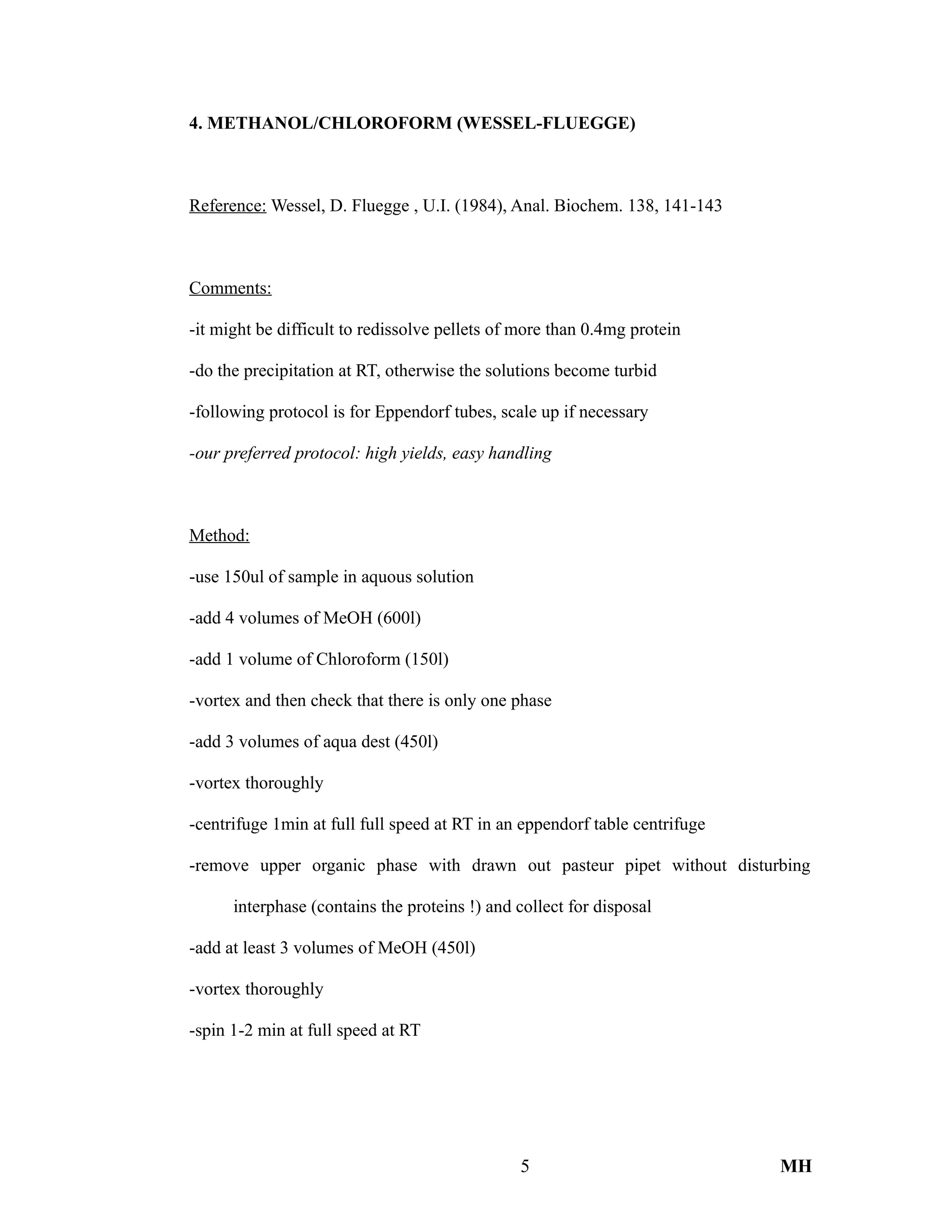
4. METHANOL/CHLOROFORM (WESSEL-FLUEGGE)
Reference: Wessel, D. Fluegge , U.I. (1984), Anal. Biochem. 138, 141-143
Comments:
-it might be difficult to redissolve pellets of more than 0.4mg protein
-do the precipitation at RT, otherwise the solutions become turbid
-following protocol is for Eppendorf tubes, scale up if necessary
-our preferred protocol: high yields, easy handling
Method:
-use 150ul of sample in aquous solution
-add 4 volumes of MeOH (600l)
-add 1 volume of Chloroform (150l)
-vortex and then check that there is only one phase
-add 3 volumes of aqua dest (450l)
-vortex thoroughly
-centrifuge 1min at full full speed at RT in an eppendorf table centrifuge
-remove upper organic phase with drawn out pasteur pipet without disturbing
interphase (contains the proteins !) and collect for disposal
-add at least 3 volumes of MeOH (450l)
-vortex thoroughly
-spin 1-2 min at full speed at RT
5 MH
-remove supernatant with drawn out pasteur pipet; be careful not to loose the pellet
(mark tube side!)
-air dry pellet, but not completly (easier to dissolve afterwards), eventuelly dry in
speedvac for ~10min
-take up in PBS, adequate buffer or loading buffer
6 MH
7 MH
8 MH

Methodsforproteinprec

  • 1.
    LAB PROTOCOLS GROUPHUBER 15.11.1996 METHODS FOR PROTEIN PRECIPITATION CONTENTS: 1. ACETONE 2. ACETONE + CARRIER PROTEIN 3. TCA + TCA/DOC 4. METHANOL/CHLOROFORM (WESSEL-FLUEGGE) Notes: Protein amounts/dilutions -For high protein contents samples (10-50g) use aceton without carrier protein, Wessel-Fluegge or TCA without DOC. 1 MH
  • 2.
    -For low protein(1-10g) use aceton with a carrier protein, TCA or Wessel- Fluegge. -For very low protein amounts (< 1g in 3ml solution) use TCA in the presence of DOC. Solubilization of pellets Generally, aceton precipitates are easier to solubilize than TCA precipitates, as are pellets obtained at “low” speed (check optimal conditons for quantitative recovery). If problems, increase heating time of samples in gel sample buffer (Laemli Buffer) at 95C, heat ~5min + sonication. Efficiency TCA is generally more efficient than aceton 1. ACETONE in advance: cool appropriate volume of aceton to -20C For sample volume up to 300l: Original sample fill up with Tris Hcl pH=6.8 plus Aceton 50g of protein in < 100l to 100l 1ml < 200l to 200l 2ml 2 MH
  • 3.
    < 300l to300l 3ml -add aceton (at -20C) quickly to the sample in a glass centrifugation tube (Corex) -vortex -leave at -20C from 10 min to overnight (convenient if you would like to proceed with the samples on next day!) -centrifuge at 4C, 3000rpm (2500xg) for 10 min in swingout buckets -last three steps can be repeated several times -quickly poor off the acetone on a paper towell and air dry pellet a bit -resuspend the precipitate in the desired volume of gel sample buffer 2. ACETONE + CARRIER PROTEIN (e.g. hemoglobin) Comments: -the presence of a carrier protein in large amounts might interfere with your readout assay (eg 2D-gel analysis) -method works up to ~ 45% sucrose in the sample Method: -sample in 500l -add 1.5ml PBS containing 0.5mg/ml hemoglobin and 3.5ml aceton at -20C -leave at -20C overnight -collect pellet by centrifugation at 5000rpm, 15min and 4C 3 MH
  • 4.
    3. TCA/DOC Reference: Bensadoun& Weinstein. 1976. Assays of proteins in the presence of interfering materials. Anal. Biochem. 70:241:250. -bring sample to 3.0 ml with aqua dest. in 15ml centrifugation tube (Corex) -add 25l of 2% Na-deoxycholate (DOC), final conc of 125g/ml -vortex -RT 15min - + 1ml 24% trichloroacetic acid (TCA) -vortex -centrifuge 3000 rpm, 30min, 4C with swingout buckets -aspirate supernatant carefully with drawn out pasteur pipette -wash once by centrifugation with aceton (-20C) to remove excess of TCA -take up pellets in gel loading buffer For many assays (e.g. scintillation counting of radioactive samples in most counters), it is important to readjust the pH after resuspension of the TCA pellet [e.g. pellet to 1ml with aqua dest + 30l NaOH 1N yields a final pH of 9-10, which is OK for most assays]. 4 MH
  • 5.
    4. METHANOL/CHLOROFORM (WESSEL-FLUEGGE) Reference:Wessel, D. Fluegge , U.I. (1984), Anal. Biochem. 138, 141-143 Comments: -it might be difficult to redissolve pellets of more than 0.4mg protein -do the precipitation at RT, otherwise the solutions become turbid -following protocol is for Eppendorf tubes, scale up if necessary -our preferred protocol: high yields, easy handling Method: -use 150ul of sample in aquous solution -add 4 volumes of MeOH (600l) -add 1 volume of Chloroform (150l) -vortex and then check that there is only one phase -add 3 volumes of aqua dest (450l) -vortex thoroughly -centrifuge 1min at full full speed at RT in an eppendorf table centrifuge -remove upper organic phase with drawn out pasteur pipet without disturbing interphase (contains the proteins !) and collect for disposal -add at least 3 volumes of MeOH (450l) -vortex thoroughly -spin 1-2 min at full speed at RT 5 MH
  • 6.
    -remove supernatant withdrawn out pasteur pipet; be careful not to loose the pellet (mark tube side!) -air dry pellet, but not completly (easier to dissolve afterwards), eventuelly dry in speedvac for ~10min -take up in PBS, adequate buffer or loading buffer 6 MH
  • 7.
  • 8.