






















































methods of
psychotherapy
mental hygiene and personality development
by
mitch shiela s. diokno
What is Therapy?
• Psychotherapy is a blanket expression
pertaining to the healing interplay or
approach negotiated between a qualified
expert and a patient, couple, group, family, or
client. The difficulties discussed are emotional
in nature and can differ in terms of the origins,
triggers, impacts, and possible
recommendations.
What is Therapy?
• Therapy includes interactive processes
between a person or group and a qualified
mental health professional (psychologist,
clinical social worker, licensed counselor, or
psychiatrist). Its purpose is the exploration of
feelings, behaviors and thoughts to increase
problem solving skills or achieve higher levels
of functioning.
What is Therapy?
• Psychotherapy strives to increase a sense of
well-being.
• Psychotherapists apply a variety of methods
based on communication, discussion,
experiential relationship building and
performance, all of which have the intention
to improve the mental health of a client, or to
enhance relationships.
The Purpose of Therapy
• Treatment is a commitment to improve
emotional and physical health.
• A few people may be truly independent and
have fears of losing that freedom, or have
fears of the label “crazy” which surprisingly is
a belief that continues to exist.
Why people choose therapy
• Counseling is helpful for those who are facing
a change, experiencing a loss or for those
wanting to greet the day with more passion.
• The decision to seek treatment is for most
people a conscious courageous choice to try
to change or solve a difficult life circumstance.
How to evaluate the need for therapy?
• At times just talking out a problem with a sympathetic listener
will help, though, if talking about the concerns has not helped
it might be a good idea to assess the benefits of going into
treatment.
• A professional therapist can observe the situation in a non-
judgmental fashion and has the qualifications to assist with
problem solving.
• Therapy is more about the relationship and less about the
technique.
What are the Benefits of Therapy?
• Acquisition of a broader understanding of
personal values and goals.
• Develop abilities that cultivate healthy
relationships.
• Manage and discover ways to cope with
difficulties, such as an eating
disorder, depression, bipolar illness,
schizophrenia, physical
illness, pain, abuse, codependency or stress.
• Make advancements in learning problem solving
skills
The Rules of Therapy:
Privacy and Confidentiality
• There are extremely strict privacy
rules pertaining to psychology and everything
the therapist examines is in strict confidence
• psychologists have a legal mandate to report
any severe and persistent suicidal threats, any
threats to hurt someone and any abuse
against a child or senior citizen.
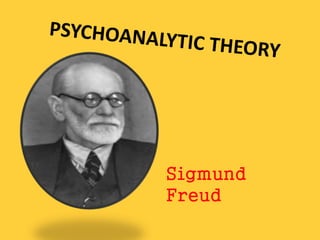
Sigmund
Freud
INTRODUCTION
• According to Corey (2013), the psychoanalytic
system of Freud is a model of personality
development and an approach to psychotherapy.
He gave psychotherapy a new look and new
horizons, calling attentions to psychodynamic
factors that motivate behavior, focusing on the
role of the unconscoius, and developing the first
therapeutic procedured for understanding and
modifying the structure of one’s basic character.
Freud’s theory is a benchmark against which
other theories are measured.
CONCEPTS
• View of Human Nature
– The Freudian view if human nature is basically
deterministic.
– For him, human’s behavior is determined by
irrational forces, unsconscious motivations and
biological and instinctual drives a these evolve
through key psychosexual stages in the first years
of life.
CONCEPTS
• he used the term libido to refer to sexual energy, he
later broadened it to include the enrgy of all the life
instincts. He believed that these instincts serve as
survival of the individual and the human race; they
are oriented toward growth, development, and
creativity.
• he also postulates death instincts, which account for
the aggressive drive. He explains that, at times
people manifest through their behavior an
unconscious wish to die or to hurt themseve or
others.
Structure of Personality
• THE ID. Pleasure principle
- aimed at reducing tension, avoiding pain, and gaining
pleasure, the id is illogical, amoral, and driven to satisfy
instinctual needs. The id never matures, remaining the spoiled
brat of personality. It does not think, but only wishes or acts.
The id is largle unconscoius, or out of awareness.
• THE EGO. The ego has contact with the external world of
reality. It is “the executive” that governs, controls, and
regulates the personality.
Structure of Personality
-Ruled by the reality principle, the ego does realistic
and logical thinking and formulates plans of action for
satisfying needs.
- The ego, as the seat of intelligence and rationality,
checks and controls the blind impulses of the id.
• THE SUPEREGO. The superego is the judicial branch of
personality. It includes a person’s moral code, the main
concern being whether an action is good or bad, right
or wrong. It represents the ideal rather than thre real
and strives not for pleasure but for perfection.
CONSCIOUSNESS AND THE
UNCONSCIOUSNESS
• For him, consciousness is only a thin slice of
the total mind. He used the iceberg to
illustrate the structure of personality. In line
with this, the psychoanalytic therapy aims to
make the unconscious motives conscious, for
only then can an individual exercise choice.
Understanding the role of unconscious is
central in grasping the essence of the
psychoanalytic model of behavior.
CONSCIOUSNESS AND THE
UNCONSCIOUSNESS
• Unconscious processes are at the root of all
forms of neurotic symptoms and behaviors.
From this perspective, a ‘cure” is based on
uncovering the meaning of symptoms the
causes of behavior, and the repressed
materials that interfere with healthy
functioning.
ANXIETY
• Anxiey is a feeling of dread that results from
repressed feelings, memories, desires, and
experience that emerge to the surface of awareness.
It can be considered as a state of tension that
motivates us to do something. It develops out of a
conflict among the id, ego, and superego over
control of the available psychic energy. The function
of anxiety is to warn of impending danger.
Three Kinds of Anxiety
• Reality Anxiety is the fear of danger from the
external world, and the level of such anxiety is
proportionate to the degree of real threat.
• Neurotic Anxiety is the fear that the instincts will
get out of hand and cause one to do something
for which one will be punished.
• Moral Anxiety is the fear of one’s own
conscience. People with a well-developed
conscience tend to feel guilty when they do
something contrary to their moral code.
EGO-DEFENSE MECHANISM
• Ego-defense mechanisms help the individual
cope with anxiety and prevent the ego from
being overwhelmed. Rather than being
pathological, ego defenses are normal
behaviors that can have adaptive value
provided they do not become a style of life
that enables the individual to avoid facing
reality.
EGO-DEFENSE MECHANISM
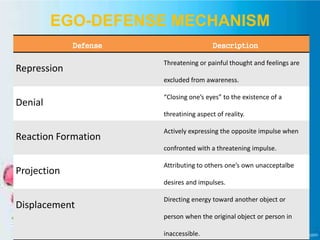
Defense Description
Repression
Threatening or painful thought and feelings are
excluded from awareness.
Denial
“Closing one’s eyes” to the existence of a
threatining aspect of reality.
Reaction Formation
Actively expressing the opposite impulse when
confronted with a threatening impulse.
Projection
Attributing to others one’s own unacceptalbe
desires and impulses.
Displacement
Directing energy toward another object or
person when the original object or person in
inaccessible.
EGO-DEFENSE MECHANISM
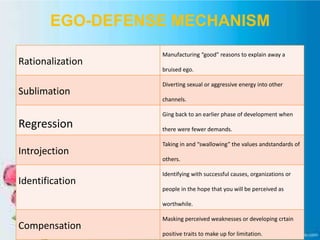
Rationalization
Manufacturing “good” reasons to explain away a
bruised ego.
Sublimation
Diverting sexual or aggressive energy into other
channels.
Regression
Ging back to an earlier phase of development when
there were fewer demands.
Introjection
Taking in and “swallowing” the values andstandards of
others.
Identification
Identifying with successful causes, organizations or
people in the hope that you will be perceived as
worthwhile.
Compensation
Masking perceived weaknesses or developing crtain
positive traits to make up for limitation.
FREE ASSOCIATION
• It is a central technique in psychoanalytic therapy, and it plays
a key role in the process of maintaining the analytic
framework. In free association, clients are encouraged to say
whatever comes to mind, regardless of how painful, silly,
trivial, illogical, or irrelevant it may seem.
• It is one of the basic tools used to open the doors to
unconscious wishes, fantasies, conflicts, and motivations. This
technique often leads to some recollection of past
experiences and, at times, a catharsis or release of intense
feelings that have been blocked.
INTERPRETATION
• It consists of the analyst’s pointing out,
explaining, and even teaching the client the
meanings of behavior that is manifested in
dreams, free association, resistances, and the
therapeutic relationship itself. The functions
of interpretation are to enable the ego to
assimilate new material and to speed up the
process of uncovering further unconscious
material.
DREAM ANALYSIS
• Dream analysis is an important procedure for
uncovering unconscious material and giving
the client insight into some areas of
unresolved problems. According to Freud,
during sleep, defenses are lowered and
repressed feelings surface. He sees dreams as
the “royal road to unconscious,” for in them
one’s unconscious wishes, needs, and fears
are expressed.
RESISTANCE
• Resistnce is a concept fundamental to the
practice of psychoanalysis, is anything that
works against the progress of therapy and
prevents the client the producing previously
unconscious material. Specifically, resistance is
the client’s reluctance to bring to the surface
of awareness unconscious material that has
been repressed.
William
Glasser
Introduction
• There are clearly identifiable interventions that constitute the
essence of reality therapy. Glasser (1990a) said, “the art of
counseling is to weave these components together in ways
that lead clients to evaluate their lives and decide to move in
more effective directions.”
• Wubbolding (1991a, 1992) has formulated these components
into the WDEP system, with each letter representing a cluster
of skills and techniques for assisting clients to take better
control of their own lives and thereby fulfill their needs in
ways satisfying to them and to society.
WDEP SYSTEM
• W: Ask clients what they want. By skillful and
persistent questioning, the therapist helps
clients formulate, clarify, delineate, and
prioritize the elements (desires) contained in
their quality world of mental pictures.
WDEP SYSTEM
• D: Ask clients what they are doing and their overall direction.
“Where are your current choices taking you?” “Are you
headed in a direction where you want to be in a month, a
year, two years from now?” “Will you describe the direction
you are going without making a judgment about it?” These
global questions are an attempt to help clients increase their
awareness of what their choices look like “from a distance.”
By describing their overall destination, clients become ready
to evaluate and change their thinking and behavior.
WDEP SYSTEM
• E: Ask clients to conduct a searching self-
evaluation. Glasser (1990a, 1990b) has
described self-evaluation as the core of reality
therapy. Wubbolding (1990) sees it as the
keystone in the arch of procedures. It holds
the other elements together, and if it is
removed, the arch crumbles.
WDEP SYSTEM
The many forms of self-evaluation include the
following:
• 1. Evaluation of wants as realistic. Clients are
asked to evaluate the attainability of their
wants.
• 2. Evaluation of wants as genuinely beneficial.
All wants are related to needs and thus appear
to be need-satisfying and genuinely helpful to
the client.
WDEP SYSTEM
• 3. Evaluation of behavioral direction. Clients are
asked to examine whether their overall life
journey is headed toward a desirable destination.
• 4. Evaluation of specific actions. The most
commonly used form of evaluation is a judgment
made about the effectiveness of specific actions.
The student is asked, “Did your procrastination
help you study for the test?”
WDEP SYSTEM
• 5. Evaluation of perception. After helping clients
describe their perceptions of the current situation,
especially their perceived locus of control, the reality
therapist asks clients to decide if the way they see the
world is genuinely the best for them.
• 6. Evaluation of the plan of action. One of the hoped-
for outcomes of therapy sessions is the formulation
and execution of action plans. Clients are asked
questions such as, “If you follow through on your plans,
how will your life be better?
WDEP SYSTEM
• 7. Professional self-evaluation. Part of this
procedure is the inner self-evaluation of the
therapist including such questions as: “How
am I facilitating my own professional growth?
Do I work within the boundaries of my
limitations?
WDEP SYSTEM
• P: Ask clients to make Plans to more effectively fulfill
their needs. When clients make plans and follow
through, they are taking charge of their lives by
redirecting their energy. The therapist facilitates plan
formulation by teaching clients that successful plans
have several characteristics. The plan should have
SAMIC characteristics—i.e., it should be Simple,
Attainable, Measurable, Immediate, and Committed
to.
GOALS OF THERAPY
• The goals of reality therapy are behavioral
changes, personal growth, improved and
enhanced life-style, better decision making,
remediation of personal deficits and, in the
language of control theory, the more effective
satisfaction of the human needs of belonging,
power, fun, and freedom.
• therapist spends a minimal amount of time
discussing problems and a maximum amount of
time exploring better ways to fulfill needs
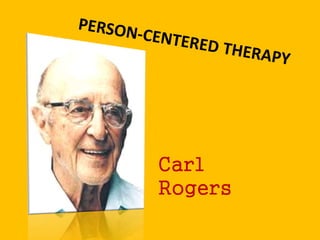
Carl
Rogers
VIEW OF HUMAN NATURE
• Carl Rogers trusts the clients that they have
the ability to move forward in a constructive
manner if conditions fostering growth are
present. He believed that people are
trustworthy, resourceful, capable of self-
understanding and self-direction, able to make
constructive changes and able to live effective
and productive lives.
VIEW OF HUMAN NATURE
• the individual has an inherent capacity to move away
from maladjustment and toward psychological health
and growth. Here, the therapist places the primary
responsibility on the client. The person-centered
approach
• In the person-centered approach rejects the role of the
therapist as the authority who knows best and of the
passive client who merely follows the beliefs of the
therapist.
• This therapy is rooted in the client’s capacity for
awareness and self-directed change in attitudes and
behavior.
VIEW OF HUMAN NATURE
• This approach emphasizes how the client act in
their world with others, how they move forward
in a constructive directions and how they can
successfully deal with obstacles (both from within
themselves and outside of themselves) that are
blocking their growth.
• It promotes self-awareness and self-reflection,
clients learn to exercise choice.
• Humanistic therapists emphasize a discovery-
oriented approach in which clients are th experts
on their own inner experience.
Six Factors Necessary for Growth in
Rogerian Theory
• 1. Therapist-Client Psychological Contact: there must
be a distinct and recognizable relationship between the
therapist and the client and it must be validated by
both parties.
• 2. Client Incongruence, or Vulnerability: a client is
vulnerable to fears and anxieties that keep them from
leaving a relationship or situation and that there is
clear evidence of incongruence between what a client
is aware of and the actual experience.
Six Factors Necessary for Growth in
Rogerian Theory
• 3. Therapist Congruence, or Genuineness: it is evident that the
therapist is invested in the relationship with the client for the
purpose of healing. The therapist is genuinely interested in
their recovery and can access their own experiences as an aid
in the recovery process.
• 4. Therapist Unconditional Positive Regard (UPR): there is an
element that supercedes all others, and that is the element of
unconditional acceptance. By providing a platform of openness
and acceptance, a client can begin to dispel their skewed
perceptions of themselves that they gathered from others.
Six Factors Necessary for Growth in
Rogerian Theory
• 5. Therapist Empathic understanding: a client feels
genuine empathy from the therapist with regard to
their internal construct and perception. This feeling
of empathy helps reinforce the feeling of
unconditional love.
• 6. Client Perception: the perception of unconditional
positive regard and complete empathic acceptance
and understanding is perceived by the client, if even
only minimally.
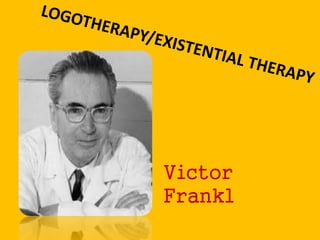
Victor
Frankl
Introduction
• Logotherapy is a term derived from “logos,” a
Greek word that translates as “meaning.”
Therapy is defined as treatment of a disorder,
illness, or maladjustment.
• Developed by Viktor Frankl, the theory is
founded on the belief that human nature is
motivated by the search for a life purpose;
logotherapy is the pursuit of that meaning for
one’s life.
Components of Franklian
Philosophy
There are three main components that are at
the heart of the Franklian philosophy:
• Each person has a healthy core.
• The primary focus is to enlighten a person to t
heir own internal resources and provide them
with the tools to use their inner core.
• Life offers you purpose and meaning; it does n
ot owe you a sense of fulfillment or happiness.
THERAPEUTIC GOAL
• The goal of existential therapy is to assist
clients in their exploration of the existential
“givens of life,” how these are sometimes
ignored or denied and how addressing them
can ultimately lead to deeper, more reflective
and meaningful existence.
• We are the authors of our own lives, and we
design the pathway we follow.
THERAPEUTIC GOAL
• The central goal of the existential therapy
is increased awareness, this will allow the
client discover the alternative
possibilities existing, where none were
recognized before.
• At the end of the therapy the client is
expected to realize that they can make
changes in their way of living in the world
.
Role of the Therapist
• To assist clients in seeing the ways in which they consist their
awareness and the cost of each constriction.
• He/she can hold up a mirror, so to speak, so that clients can
gradually engage in self-confrontation the way they live.
• He/she should aim toward removing roadblocks to meaningful
living and helping clients assume responsibility for their
condition.
• To assist people in facing life with courage, hope, and
willingness to find meaning in life.
Logotherapy Techniques
• Dereflection - Dereflection is used when a person is overly
self-absorbed on an issue or attainment of a goal. By
redirecting the attention, or dereflecting the attention away
from the self, the person can fully become whole by thinking
about others rather than themselves.
• Paradoxical intention - Paradoxical intention involves asking
for the thing we fear the most. For clients who suffer anxiety
or phobias, fear can paralyze them. But by using humor and
ridicule, they can wish for the thing they fear the most, thus
removing the fear from their intention and relieving the
anxious symptoms associated with it.
Logotherapy Techniques
• Socratic dialogue - Socratic dialogue is a technique in
which the logotherapist uses the own person's words
as a method of self-discovery. By listening intently to
what the person says, the therapist can point out
specific patterns of words, or word solutions to the
client, and let the client see new meaning in them.
This process allows a person to realize that the
answer lies within them and is just waiting to be
discovered.
Logotherapy Techniques
• Parable Method – sharing or providing a story
of another person which is the same or almost
the same with the experience of the client.
This is a away of setting the environment or
the situation as a normal occurrence so that
the client’s situation will be less threatening
and appear that others experience it too.
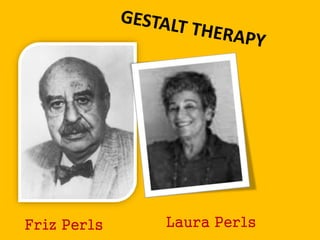
Friz Perls Laura Perls
INTRODUCTION
• Gestalt Therapy is an existential,
phenomenological, and process-based approach
created on the premise that individuals must be
understood in the context of their ongoing
relationship with the environment.
• It is phenomenological because it focuses onthe
client’s perception of reality and existential
because it is grounded in the notion that people
are always in the process of becoming, remaking,
and rediscovering themselves.
INTRODUCTION
• It focuses on the process than on content, the
here and now, the what and how, and the
I/Thou of relating. Gestalt therapists assume
that individuals have the capacity to self-
regulate when they are aware of what is
happening in and around them.
CONCEPTS
• Holism. All of nature is seen as a unified and coherent
whole, and the whole is different from the sum of its
parts. Gestalt therapists are interested in the whole
person, they place no superior value on a particular
aspect of the individual.
• Field Theory. Asserts that the organism must be seen in
its environment or in its context as part of the constant
ly changing field. Gestalt therapist pay attention to and
explore what is occurring at the boundary between the
person and the environment.
CONCEPTS
• The Figure-formation Process. It tracks how some aspect of
the environmental field emerges from the background and
becomes the focal point of the individuals attention and
interest.
• Organismic Self-Regulation. A process by which equilibrium is
disturbed by the emergence of a need, a sensation, or an
interest. What emerges on the therapeutic work is associated
with what is of interest or what the client needs to pursue a
sense of equilibrium or change. Gestalt therapists direct the
client’s awareness to the figures that emerge from the
background during a therapy session and use the figure-forma
tion process as a guide for the focus of therapeutic work.
CONCEPTS
The Now
• The Gestalt approach puts emphasis on
learning to appreciate and fully experience the
present moment. Phenomenological inquiry
involves paying attention to what is occuring
now. To help the client make contact with the
present moment, therapists ask “what” and
“how” questions, but rarely ask “why”
questions.
CONCEPTS
Unfinished Business
• These are the figures that emerge from the background but
are not completed and resolved that can be manifested in
unexpressed feelings such as resentment rage, hatred, pain,
anxiety, grief, guilt, and abandonment. Unacknowledged
feelings create unnecessary emotional debris that clutters pre
sent-centered awareness. Its effects often show up in some
blockage within the body. Gestalt therapy gives attention to
these unexpressed feelings because they tend to result in
some physical sensation or problems.
CONCEPTS
Contact and resistances to contact
• Aiming for change and growth, contact is
necessary in gestalt therapy. It is made by seeing,
hearing, smelling, touching, and moving. Effective
contact means interacting with the nature
another people without losing one’s sense of
individuality. Meanwhile, resistance are
developed as a means of coping with life
situations, they possess positive qualities as well
as problematic ones, and many contemporary.
CONCEPTS
Energy and blocks to energy
• In Gestalt therapy special attention is given to where the
energy is located, how it is used, and how it can be blocked.
Blocked energy is another form of defensive behavior. It can
be manifested by tension in some part of the body, by posture
, by keeping one’s body tight and closed, by into breathing
deeply, by looking away from people when speaking to avoid
contact, by choking off sensations by numbing feelings, and by
speaking with restricted voice. Clients can be encouraged to
delve fully into tension states. For instance, by allowing to
exaggerate their tight mouth and shaking legs.
Therapists function and role
• Furthermore, the work within a context of
I/thou dialogue in a here and now framework.
They also pay attention to the client’s body
language. It provides rich information as to
how the client represent feelings which they
are not aware. Therapist may ask the client,
“What do your eyes say?” If your hands could
speak at this moment, what would they say?”
“can you carry on a conversation between
your right and left hand?”
Therapists function and role
• The counselor also places emphasis on the
relationship between language patterns and
personality believing that client’s speech
patterns are often an expression of their
feelings, thoughts, and attitudes.
TECHNIQUES
• “It” talk. When the client say “it” instead of “I” they are
using depersonalizing language. The counselor may ask them
t o substitute personal pronouns for impersonal ones so that
they will assume an increased sense of responsibility.
– Example: “It is difficult to make friends” to “I have trouble making
friends”
• “You” talk. Global and impersonal language tends to keep the
person hidden. The therapist often points out generalized use
s of “you” and asks the client to substitute “I” when this is
what is meant.
TECHNIQUES
• Questions. Questions have a tendency to keep the questioner
hidden, safe and unknown. The counselor often asks clients to
change their questions to statements.
• Language that denies power. Some clients have a tendency to deny
their personal power by adding qualifiers or disclaimers to their
statements.
– Example: maybe, perhaps, sort of, I guess, possibly, I suppose
• Listening to client’s metaphors. The therapists gets rich clues to
client’s internal struggles by tuning to their metaphors.
– Example: It’s hard for me to spill my guts in here
– At times I feel that i don’t have a leg to stand on
– I feel like I have a hole in my soul
TECHNIQUES
• Listening for Language that uncovers a story.
Clients often use language that is elusive yet
gives significant clues to a story that illustrates
their life struggles. Polsters believed that story
telling is not always a form of resistance
instead it can be the heart of the therapeutic
process.
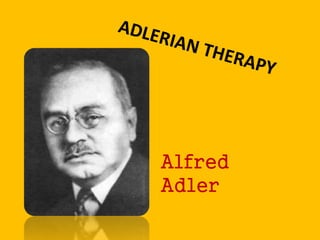
Alfred
Adler
INTRODUCTION
• Adlerians believe that human beings are essentially social,
purposeful, subjective and interpretive in their approach to
life (Sweeney, 1998). These attributes are no accident. They
are required at least in part from the moment of birth.
Without the social, physical, and emotional nurturing
provided in the family, no infant would survive. Within the
family, children quickly become active agents, defining and
redefining the family constellation or system; striving for
growth, significance, and meaning; and acting in line with
their subjective, and too often mistaken, interpretations of
life.
CONCEPTS
• Family Atmosphere
– “The conjunction of all the family forces—the
climate of relationships that exist between
people—is termed family atmosphere” (Sherman
& Dinkmeyer, 1987, p. 9). Because the family is a
system, each member exerts an influence on
every other member. In each family, an
atmosphere or climate develops that can be said
to characterize how the family members relate to
each other.
CONCEPTS
• When both parents maintain and support the same
value, Adlerians call it a family value: It is a value that
cannot be ignored and that will require each child to take a
stand in relation to it.
• The Family Constellation
• Adler (1930, 1931, 1938) often noted that the family
system or constellation consisted of the parents, children,
and even extended family members, but then he would
immediately shift to a discussion of birth order. Adler made
reference to essentially five birth positions: only, oldest,
second of only two, middle, and youngest.
CONCEPTS
• Adler was under the firm belief that each person strives to
belong and feel significant.
• Adler believed strongly that “a misbehaving child is a
discouraged child,” and that children’s behavior patterns will
improve most significantly when they are filled with feelings
of acceptance, significance, and respect.
• places its emphasis on a person’s ability to adapt to feelings of
inadequacy and inferiority relative to others.
• This method of therapy pays particular attention to behavior
patterns and belief systems that were developed in childhood.
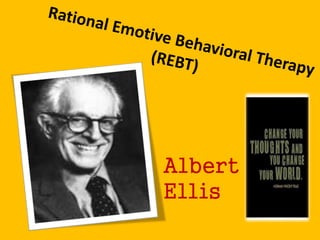
Albert
Ellis
INTRODUCTION
• developed by Albert Ellis in 1955 and originally called
rational therapy, laid the foundation for what is now
known as cognitive behavioral therapy. REBT is built
on the idea that how we feel is largely influenced by
how we think.
• As is implied by the name, this form of therapy
encourages the development of rational thinking to
facilitate healthy emotional expression and behavior.
The ABCs of REBT
• Activating (or Adverse) Event. First, it is essential to identify the
situation or event that triggers the negative emotional and/or
behavioral response. In the case of the above example, the
activating event is the downcast expression or lack of positive
feedback from a colleague.
• Beliefs. Second, the core beliefs that are attached to the emotional
or behavioral response must be identified and examined. Again,
using the above scenario, the core beliefs would be “I am an
outcast. Nobody likes me.” A therapist employing REBT techniques
would guide a person to explore where these beliefs originate and
develop a plan for recognizing and replacing them with positive
affirmations.
•
The ABCs of REBT
• Consequences. The combination of the activating
event and the core beliefs will produce a result or
consequence, such as depression, social anxiety,
antisocial behavior, or issues with self-esteem.
Similarly, the deconstruction of these ingrained
negative beliefs and integration of fresh, positive
perceptions can drastically improve a person’s
outlook and experience of life.
INTRODUCTION
• It is a relatively new form of psychology that has its
emphasis on the practical realization of the positive
influences in one’s life, such as positive character
strengths, optimistic emotions, and constructive
institutions.
• This theory is based on the belief that happiness is
derived from various factors, both emotional and
mental. Positive psychology aims to help people
identify the happiness moment to moment, rather
than only in retrospection
When is Positive Psychology Helpful?
• Oftentimes clients do not know what influences the
happiness in their life from one event to another.
Many professionals believe this incongruity is a result
of perception. A person may not be able to identify
emotions during the experience, but can clearly see
them when they reflect upon that same experience
later on.
• the negative emotions are often diminished and are
overshadowed by the more positive emotions of the
event. This is the goal of positive psychology.
INTRODUCTION
• Journal therapy, often referred to as “writing
theraapy,” is an effective way to treat many medical,
social, developmental, and psychological issues. This
extremely beneficial therapy has been shown to help
a person manage their behavior and inner and outer
conflicts. People who journal find a higher sense of
self-awareness and are able to reduce anxiety and
gain a sense of empowerment.
How to Journal for Therapy
• Journaling is a very therapeutic technique, but for
some, it can be a difficult exercise to start. The best
way to approach journaling is to set a time limit for
your writing. Set a goal of writing for 5, 10, or 15
minutes initially, and then slowly increase it. Begin by
reflecting on what emotions or feelings you are
having or what issues you are struggling with.
INTRODUCTION
• Art therapy utilizes a person’s creative faculties in
the area of art to develop their physical and
emotional health. Its roots are entrenched in the
concept of relying on self-expression to awaken an
individual’s own problem solving capacities. This
form of therapy focuses on a person’s positive well-
being and strives to increase their self-awareness,
self-esteem, and productive behavior traits.
Psychological Issues Treated by Art Therapy
• Anxiety
• Depression
• Addiction
• Trauma
• Other emotional and relational issues
Thankyou for participating

Methods of psychotherapy

  • 1.
    methods of psychotherapy mental hygieneand personality development by mitch shiela s. diokno
  • 2.
    What is Therapy? •Psychotherapy is a blanket expression pertaining to the healing interplay or approach negotiated between a qualified expert and a patient, couple, group, family, or client. The difficulties discussed are emotional in nature and can differ in terms of the origins, triggers, impacts, and possible recommendations.
  • 3.
    What is Therapy? •Therapy includes interactive processes between a person or group and a qualified mental health professional (psychologist, clinical social worker, licensed counselor, or psychiatrist). Its purpose is the exploration of feelings, behaviors and thoughts to increase problem solving skills or achieve higher levels of functioning.
  • 4.
    What is Therapy? •Psychotherapy strives to increase a sense of well-being. • Psychotherapists apply a variety of methods based on communication, discussion, experiential relationship building and performance, all of which have the intention to improve the mental health of a client, or to enhance relationships.
  • 5.
    The Purpose ofTherapy • Treatment is a commitment to improve emotional and physical health. • A few people may be truly independent and have fears of losing that freedom, or have fears of the label “crazy” which surprisingly is a belief that continues to exist.
  • 6.
    Why people choosetherapy • Counseling is helpful for those who are facing a change, experiencing a loss or for those wanting to greet the day with more passion. • The decision to seek treatment is for most people a conscious courageous choice to try to change or solve a difficult life circumstance.
  • 7.
    How to evaluatethe need for therapy? • At times just talking out a problem with a sympathetic listener will help, though, if talking about the concerns has not helped it might be a good idea to assess the benefits of going into treatment. • A professional therapist can observe the situation in a non- judgmental fashion and has the qualifications to assist with problem solving. • Therapy is more about the relationship and less about the technique.
  • 8.
    What are theBenefits of Therapy? • Acquisition of a broader understanding of personal values and goals. • Develop abilities that cultivate healthy relationships. • Manage and discover ways to cope with difficulties, such as an eating disorder, depression, bipolar illness, schizophrenia, physical illness, pain, abuse, codependency or stress. • Make advancements in learning problem solving skills
  • 9.
    The Rules ofTherapy: Privacy and Confidentiality • There are extremely strict privacy rules pertaining to psychology and everything the therapist examines is in strict confidence • psychologists have a legal mandate to report any severe and persistent suicidal threats, any threats to hurt someone and any abuse against a child or senior citizen.
  • 11.
  • 12.
    INTRODUCTION • According toCorey (2013), the psychoanalytic system of Freud is a model of personality development and an approach to psychotherapy. He gave psychotherapy a new look and new horizons, calling attentions to psychodynamic factors that motivate behavior, focusing on the role of the unconscoius, and developing the first therapeutic procedured for understanding and modifying the structure of one’s basic character. Freud’s theory is a benchmark against which other theories are measured.
  • 13.
    CONCEPTS • View ofHuman Nature – The Freudian view if human nature is basically deterministic. – For him, human’s behavior is determined by irrational forces, unsconscious motivations and biological and instinctual drives a these evolve through key psychosexual stages in the first years of life.
  • 14.
    CONCEPTS • he usedthe term libido to refer to sexual energy, he later broadened it to include the enrgy of all the life instincts. He believed that these instincts serve as survival of the individual and the human race; they are oriented toward growth, development, and creativity. • he also postulates death instincts, which account for the aggressive drive. He explains that, at times people manifest through their behavior an unconscious wish to die or to hurt themseve or others.
  • 15.
    Structure of Personality •THE ID. Pleasure principle - aimed at reducing tension, avoiding pain, and gaining pleasure, the id is illogical, amoral, and driven to satisfy instinctual needs. The id never matures, remaining the spoiled brat of personality. It does not think, but only wishes or acts. The id is largle unconscoius, or out of awareness. • THE EGO. The ego has contact with the external world of reality. It is “the executive” that governs, controls, and regulates the personality.
  • 16.
    Structure of Personality -Ruledby the reality principle, the ego does realistic and logical thinking and formulates plans of action for satisfying needs. - The ego, as the seat of intelligence and rationality, checks and controls the blind impulses of the id. • THE SUPEREGO. The superego is the judicial branch of personality. It includes a person’s moral code, the main concern being whether an action is good or bad, right or wrong. It represents the ideal rather than thre real and strives not for pleasure but for perfection.
  • 17.
    CONSCIOUSNESS AND THE UNCONSCIOUSNESS •For him, consciousness is only a thin slice of the total mind. He used the iceberg to illustrate the structure of personality. In line with this, the psychoanalytic therapy aims to make the unconscious motives conscious, for only then can an individual exercise choice. Understanding the role of unconscious is central in grasping the essence of the psychoanalytic model of behavior.
  • 18.
    CONSCIOUSNESS AND THE UNCONSCIOUSNESS •Unconscious processes are at the root of all forms of neurotic symptoms and behaviors. From this perspective, a ‘cure” is based on uncovering the meaning of symptoms the causes of behavior, and the repressed materials that interfere with healthy functioning.
  • 19.
    ANXIETY • Anxiey isa feeling of dread that results from repressed feelings, memories, desires, and experience that emerge to the surface of awareness. It can be considered as a state of tension that motivates us to do something. It develops out of a conflict among the id, ego, and superego over control of the available psychic energy. The function of anxiety is to warn of impending danger.
  • 20.
    Three Kinds ofAnxiety • Reality Anxiety is the fear of danger from the external world, and the level of such anxiety is proportionate to the degree of real threat. • Neurotic Anxiety is the fear that the instincts will get out of hand and cause one to do something for which one will be punished. • Moral Anxiety is the fear of one’s own conscience. People with a well-developed conscience tend to feel guilty when they do something contrary to their moral code.
  • 21.
    EGO-DEFENSE MECHANISM • Ego-defensemechanisms help the individual cope with anxiety and prevent the ego from being overwhelmed. Rather than being pathological, ego defenses are normal behaviors that can have adaptive value provided they do not become a style of life that enables the individual to avoid facing reality.
  • 22.
    EGO-DEFENSE MECHANISM Defense Description Repression Threateningor painful thought and feelings are excluded from awareness. Denial “Closing one’s eyes” to the existence of a threatining aspect of reality. Reaction Formation Actively expressing the opposite impulse when confronted with a threatening impulse. Projection Attributing to others one’s own unacceptalbe desires and impulses. Displacement Directing energy toward another object or person when the original object or person in inaccessible.
  • 23.
    EGO-DEFENSE MECHANISM Rationalization Manufacturing “good”reasons to explain away a bruised ego. Sublimation Diverting sexual or aggressive energy into other channels. Regression Ging back to an earlier phase of development when there were fewer demands. Introjection Taking in and “swallowing” the values andstandards of others. Identification Identifying with successful causes, organizations or people in the hope that you will be perceived as worthwhile. Compensation Masking perceived weaknesses or developing crtain positive traits to make up for limitation.
  • 24.
    FREE ASSOCIATION • Itis a central technique in psychoanalytic therapy, and it plays a key role in the process of maintaining the analytic framework. In free association, clients are encouraged to say whatever comes to mind, regardless of how painful, silly, trivial, illogical, or irrelevant it may seem. • It is one of the basic tools used to open the doors to unconscious wishes, fantasies, conflicts, and motivations. This technique often leads to some recollection of past experiences and, at times, a catharsis or release of intense feelings that have been blocked.
  • 25.
    INTERPRETATION • It consistsof the analyst’s pointing out, explaining, and even teaching the client the meanings of behavior that is manifested in dreams, free association, resistances, and the therapeutic relationship itself. The functions of interpretation are to enable the ego to assimilate new material and to speed up the process of uncovering further unconscious material.
  • 26.
    DREAM ANALYSIS • Dreamanalysis is an important procedure for uncovering unconscious material and giving the client insight into some areas of unresolved problems. According to Freud, during sleep, defenses are lowered and repressed feelings surface. He sees dreams as the “royal road to unconscious,” for in them one’s unconscious wishes, needs, and fears are expressed.
  • 27.
    RESISTANCE • Resistnce isa concept fundamental to the practice of psychoanalysis, is anything that works against the progress of therapy and prevents the client the producing previously unconscious material. Specifically, resistance is the client’s reluctance to bring to the surface of awareness unconscious material that has been repressed.
  • 28.
  • 29.
    Introduction • There areclearly identifiable interventions that constitute the essence of reality therapy. Glasser (1990a) said, “the art of counseling is to weave these components together in ways that lead clients to evaluate their lives and decide to move in more effective directions.” • Wubbolding (1991a, 1992) has formulated these components into the WDEP system, with each letter representing a cluster of skills and techniques for assisting clients to take better control of their own lives and thereby fulfill their needs in ways satisfying to them and to society.
  • 30.
    WDEP SYSTEM • W:Ask clients what they want. By skillful and persistent questioning, the therapist helps clients formulate, clarify, delineate, and prioritize the elements (desires) contained in their quality world of mental pictures.
  • 31.
    WDEP SYSTEM • D:Ask clients what they are doing and their overall direction. “Where are your current choices taking you?” “Are you headed in a direction where you want to be in a month, a year, two years from now?” “Will you describe the direction you are going without making a judgment about it?” These global questions are an attempt to help clients increase their awareness of what their choices look like “from a distance.” By describing their overall destination, clients become ready to evaluate and change their thinking and behavior.
  • 32.
    WDEP SYSTEM • E:Ask clients to conduct a searching self- evaluation. Glasser (1990a, 1990b) has described self-evaluation as the core of reality therapy. Wubbolding (1990) sees it as the keystone in the arch of procedures. It holds the other elements together, and if it is removed, the arch crumbles.
  • 33.
    WDEP SYSTEM The manyforms of self-evaluation include the following: • 1. Evaluation of wants as realistic. Clients are asked to evaluate the attainability of their wants. • 2. Evaluation of wants as genuinely beneficial. All wants are related to needs and thus appear to be need-satisfying and genuinely helpful to the client.
  • 34.
    WDEP SYSTEM • 3.Evaluation of behavioral direction. Clients are asked to examine whether their overall life journey is headed toward a desirable destination. • 4. Evaluation of specific actions. The most commonly used form of evaluation is a judgment made about the effectiveness of specific actions. The student is asked, “Did your procrastination help you study for the test?”
  • 35.
    WDEP SYSTEM • 5.Evaluation of perception. After helping clients describe their perceptions of the current situation, especially their perceived locus of control, the reality therapist asks clients to decide if the way they see the world is genuinely the best for them. • 6. Evaluation of the plan of action. One of the hoped- for outcomes of therapy sessions is the formulation and execution of action plans. Clients are asked questions such as, “If you follow through on your plans, how will your life be better?
  • 36.
    WDEP SYSTEM • 7.Professional self-evaluation. Part of this procedure is the inner self-evaluation of the therapist including such questions as: “How am I facilitating my own professional growth? Do I work within the boundaries of my limitations?
  • 37.
    WDEP SYSTEM • P:Ask clients to make Plans to more effectively fulfill their needs. When clients make plans and follow through, they are taking charge of their lives by redirecting their energy. The therapist facilitates plan formulation by teaching clients that successful plans have several characteristics. The plan should have SAMIC characteristics—i.e., it should be Simple, Attainable, Measurable, Immediate, and Committed to.
  • 38.
    GOALS OF THERAPY •The goals of reality therapy are behavioral changes, personal growth, improved and enhanced life-style, better decision making, remediation of personal deficits and, in the language of control theory, the more effective satisfaction of the human needs of belonging, power, fun, and freedom. • therapist spends a minimal amount of time discussing problems and a maximum amount of time exploring better ways to fulfill needs
  • 39.
  • 40.
    VIEW OF HUMANNATURE • Carl Rogers trusts the clients that they have the ability to move forward in a constructive manner if conditions fostering growth are present. He believed that people are trustworthy, resourceful, capable of self- understanding and self-direction, able to make constructive changes and able to live effective and productive lives.
  • 41.
    VIEW OF HUMANNATURE • the individual has an inherent capacity to move away from maladjustment and toward psychological health and growth. Here, the therapist places the primary responsibility on the client. The person-centered approach • In the person-centered approach rejects the role of the therapist as the authority who knows best and of the passive client who merely follows the beliefs of the therapist. • This therapy is rooted in the client’s capacity for awareness and self-directed change in attitudes and behavior.
  • 42.
    VIEW OF HUMANNATURE • This approach emphasizes how the client act in their world with others, how they move forward in a constructive directions and how they can successfully deal with obstacles (both from within themselves and outside of themselves) that are blocking their growth. • It promotes self-awareness and self-reflection, clients learn to exercise choice. • Humanistic therapists emphasize a discovery- oriented approach in which clients are th experts on their own inner experience.
  • 43.
    Six Factors Necessaryfor Growth in Rogerian Theory • 1. Therapist-Client Psychological Contact: there must be a distinct and recognizable relationship between the therapist and the client and it must be validated by both parties. • 2. Client Incongruence, or Vulnerability: a client is vulnerable to fears and anxieties that keep them from leaving a relationship or situation and that there is clear evidence of incongruence between what a client is aware of and the actual experience.
  • 44.
    Six Factors Necessaryfor Growth in Rogerian Theory • 3. Therapist Congruence, or Genuineness: it is evident that the therapist is invested in the relationship with the client for the purpose of healing. The therapist is genuinely interested in their recovery and can access their own experiences as an aid in the recovery process. • 4. Therapist Unconditional Positive Regard (UPR): there is an element that supercedes all others, and that is the element of unconditional acceptance. By providing a platform of openness and acceptance, a client can begin to dispel their skewed perceptions of themselves that they gathered from others.
  • 45.
    Six Factors Necessaryfor Growth in Rogerian Theory • 5. Therapist Empathic understanding: a client feels genuine empathy from the therapist with regard to their internal construct and perception. This feeling of empathy helps reinforce the feeling of unconditional love. • 6. Client Perception: the perception of unconditional positive regard and complete empathic acceptance and understanding is perceived by the client, if even only minimally.
  • 46.
  • 47.
    Introduction • Logotherapy isa term derived from “logos,” a Greek word that translates as “meaning.” Therapy is defined as treatment of a disorder, illness, or maladjustment. • Developed by Viktor Frankl, the theory is founded on the belief that human nature is motivated by the search for a life purpose; logotherapy is the pursuit of that meaning for one’s life.
  • 48.
    Components of Franklian Philosophy Thereare three main components that are at the heart of the Franklian philosophy: • Each person has a healthy core. • The primary focus is to enlighten a person to t heir own internal resources and provide them with the tools to use their inner core. • Life offers you purpose and meaning; it does n ot owe you a sense of fulfillment or happiness.
  • 49.
    THERAPEUTIC GOAL • Thegoal of existential therapy is to assist clients in their exploration of the existential “givens of life,” how these are sometimes ignored or denied and how addressing them can ultimately lead to deeper, more reflective and meaningful existence. • We are the authors of our own lives, and we design the pathway we follow.
  • 50.
    THERAPEUTIC GOAL • Thecentral goal of the existential therapy is increased awareness, this will allow the client discover the alternative possibilities existing, where none were recognized before. • At the end of the therapy the client is expected to realize that they can make changes in their way of living in the world .
  • 51.
    Role of theTherapist • To assist clients in seeing the ways in which they consist their awareness and the cost of each constriction. • He/she can hold up a mirror, so to speak, so that clients can gradually engage in self-confrontation the way they live. • He/she should aim toward removing roadblocks to meaningful living and helping clients assume responsibility for their condition. • To assist people in facing life with courage, hope, and willingness to find meaning in life.
  • 52.
    Logotherapy Techniques • Dereflection- Dereflection is used when a person is overly self-absorbed on an issue or attainment of a goal. By redirecting the attention, or dereflecting the attention away from the self, the person can fully become whole by thinking about others rather than themselves. • Paradoxical intention - Paradoxical intention involves asking for the thing we fear the most. For clients who suffer anxiety or phobias, fear can paralyze them. But by using humor and ridicule, they can wish for the thing they fear the most, thus removing the fear from their intention and relieving the anxious symptoms associated with it.
  • 53.
    Logotherapy Techniques • Socraticdialogue - Socratic dialogue is a technique in which the logotherapist uses the own person's words as a method of self-discovery. By listening intently to what the person says, the therapist can point out specific patterns of words, or word solutions to the client, and let the client see new meaning in them. This process allows a person to realize that the answer lies within them and is just waiting to be discovered.
  • 54.
    Logotherapy Techniques • ParableMethod – sharing or providing a story of another person which is the same or almost the same with the experience of the client. This is a away of setting the environment or the situation as a normal occurrence so that the client’s situation will be less threatening and appear that others experience it too.
  • 55.
  • 56.
    INTRODUCTION • Gestalt Therapyis an existential, phenomenological, and process-based approach created on the premise that individuals must be understood in the context of their ongoing relationship with the environment. • It is phenomenological because it focuses onthe client’s perception of reality and existential because it is grounded in the notion that people are always in the process of becoming, remaking, and rediscovering themselves.
  • 57.
    INTRODUCTION • It focuseson the process than on content, the here and now, the what and how, and the I/Thou of relating. Gestalt therapists assume that individuals have the capacity to self- regulate when they are aware of what is happening in and around them.
  • 58.
    CONCEPTS • Holism. Allof nature is seen as a unified and coherent whole, and the whole is different from the sum of its parts. Gestalt therapists are interested in the whole person, they place no superior value on a particular aspect of the individual. • Field Theory. Asserts that the organism must be seen in its environment or in its context as part of the constant ly changing field. Gestalt therapist pay attention to and explore what is occurring at the boundary between the person and the environment.
  • 59.
    CONCEPTS • The Figure-formationProcess. It tracks how some aspect of the environmental field emerges from the background and becomes the focal point of the individuals attention and interest. • Organismic Self-Regulation. A process by which equilibrium is disturbed by the emergence of a need, a sensation, or an interest. What emerges on the therapeutic work is associated with what is of interest or what the client needs to pursue a sense of equilibrium or change. Gestalt therapists direct the client’s awareness to the figures that emerge from the background during a therapy session and use the figure-forma tion process as a guide for the focus of therapeutic work.
  • 60.
    CONCEPTS The Now • TheGestalt approach puts emphasis on learning to appreciate and fully experience the present moment. Phenomenological inquiry involves paying attention to what is occuring now. To help the client make contact with the present moment, therapists ask “what” and “how” questions, but rarely ask “why” questions.
  • 61.
    CONCEPTS Unfinished Business • Theseare the figures that emerge from the background but are not completed and resolved that can be manifested in unexpressed feelings such as resentment rage, hatred, pain, anxiety, grief, guilt, and abandonment. Unacknowledged feelings create unnecessary emotional debris that clutters pre sent-centered awareness. Its effects often show up in some blockage within the body. Gestalt therapy gives attention to these unexpressed feelings because they tend to result in some physical sensation or problems.
  • 62.
    CONCEPTS Contact and resistancesto contact • Aiming for change and growth, contact is necessary in gestalt therapy. It is made by seeing, hearing, smelling, touching, and moving. Effective contact means interacting with the nature another people without losing one’s sense of individuality. Meanwhile, resistance are developed as a means of coping with life situations, they possess positive qualities as well as problematic ones, and many contemporary.
  • 63.
    CONCEPTS Energy and blocksto energy • In Gestalt therapy special attention is given to where the energy is located, how it is used, and how it can be blocked. Blocked energy is another form of defensive behavior. It can be manifested by tension in some part of the body, by posture , by keeping one’s body tight and closed, by into breathing deeply, by looking away from people when speaking to avoid contact, by choking off sensations by numbing feelings, and by speaking with restricted voice. Clients can be encouraged to delve fully into tension states. For instance, by allowing to exaggerate their tight mouth and shaking legs.
  • 64.
    Therapists function androle • Furthermore, the work within a context of I/thou dialogue in a here and now framework. They also pay attention to the client’s body language. It provides rich information as to how the client represent feelings which they are not aware. Therapist may ask the client, “What do your eyes say?” If your hands could speak at this moment, what would they say?” “can you carry on a conversation between your right and left hand?”
  • 65.
    Therapists function androle • The counselor also places emphasis on the relationship between language patterns and personality believing that client’s speech patterns are often an expression of their feelings, thoughts, and attitudes.
  • 66.
    TECHNIQUES • “It” talk.When the client say “it” instead of “I” they are using depersonalizing language. The counselor may ask them t o substitute personal pronouns for impersonal ones so that they will assume an increased sense of responsibility. – Example: “It is difficult to make friends” to “I have trouble making friends” • “You” talk. Global and impersonal language tends to keep the person hidden. The therapist often points out generalized use s of “you” and asks the client to substitute “I” when this is what is meant.
  • 67.
    TECHNIQUES • Questions. Questionshave a tendency to keep the questioner hidden, safe and unknown. The counselor often asks clients to change their questions to statements. • Language that denies power. Some clients have a tendency to deny their personal power by adding qualifiers or disclaimers to their statements. – Example: maybe, perhaps, sort of, I guess, possibly, I suppose • Listening to client’s metaphors. The therapists gets rich clues to client’s internal struggles by tuning to their metaphors. – Example: It’s hard for me to spill my guts in here – At times I feel that i don’t have a leg to stand on – I feel like I have a hole in my soul
  • 68.
    TECHNIQUES • Listening forLanguage that uncovers a story. Clients often use language that is elusive yet gives significant clues to a story that illustrates their life struggles. Polsters believed that story telling is not always a form of resistance instead it can be the heart of the therapeutic process.
  • 69.
  • 70.
    INTRODUCTION • Adlerians believethat human beings are essentially social, purposeful, subjective and interpretive in their approach to life (Sweeney, 1998). These attributes are no accident. They are required at least in part from the moment of birth. Without the social, physical, and emotional nurturing provided in the family, no infant would survive. Within the family, children quickly become active agents, defining and redefining the family constellation or system; striving for growth, significance, and meaning; and acting in line with their subjective, and too often mistaken, interpretations of life.
  • 71.
    CONCEPTS • Family Atmosphere –“The conjunction of all the family forces—the climate of relationships that exist between people—is termed family atmosphere” (Sherman & Dinkmeyer, 1987, p. 9). Because the family is a system, each member exerts an influence on every other member. In each family, an atmosphere or climate develops that can be said to characterize how the family members relate to each other.
  • 72.
    CONCEPTS • When bothparents maintain and support the same value, Adlerians call it a family value: It is a value that cannot be ignored and that will require each child to take a stand in relation to it. • The Family Constellation • Adler (1930, 1931, 1938) often noted that the family system or constellation consisted of the parents, children, and even extended family members, but then he would immediately shift to a discussion of birth order. Adler made reference to essentially five birth positions: only, oldest, second of only two, middle, and youngest.
  • 73.
    CONCEPTS • Adler wasunder the firm belief that each person strives to belong and feel significant. • Adler believed strongly that “a misbehaving child is a discouraged child,” and that children’s behavior patterns will improve most significantly when they are filled with feelings of acceptance, significance, and respect. • places its emphasis on a person’s ability to adapt to feelings of inadequacy and inferiority relative to others. • This method of therapy pays particular attention to behavior patterns and belief systems that were developed in childhood.
  • 74.
  • 75.
    INTRODUCTION • developed byAlbert Ellis in 1955 and originally called rational therapy, laid the foundation for what is now known as cognitive behavioral therapy. REBT is built on the idea that how we feel is largely influenced by how we think. • As is implied by the name, this form of therapy encourages the development of rational thinking to facilitate healthy emotional expression and behavior.
  • 76.
    The ABCs ofREBT • Activating (or Adverse) Event. First, it is essential to identify the situation or event that triggers the negative emotional and/or behavioral response. In the case of the above example, the activating event is the downcast expression or lack of positive feedback from a colleague. • Beliefs. Second, the core beliefs that are attached to the emotional or behavioral response must be identified and examined. Again, using the above scenario, the core beliefs would be “I am an outcast. Nobody likes me.” A therapist employing REBT techniques would guide a person to explore where these beliefs originate and develop a plan for recognizing and replacing them with positive affirmations. •
  • 77.
    The ABCs ofREBT • Consequences. The combination of the activating event and the core beliefs will produce a result or consequence, such as depression, social anxiety, antisocial behavior, or issues with self-esteem. Similarly, the deconstruction of these ingrained negative beliefs and integration of fresh, positive perceptions can drastically improve a person’s outlook and experience of life.
  • 79.
    INTRODUCTION • It isa relatively new form of psychology that has its emphasis on the practical realization of the positive influences in one’s life, such as positive character strengths, optimistic emotions, and constructive institutions. • This theory is based on the belief that happiness is derived from various factors, both emotional and mental. Positive psychology aims to help people identify the happiness moment to moment, rather than only in retrospection
  • 80.
    When is PositivePsychology Helpful? • Oftentimes clients do not know what influences the happiness in their life from one event to another. Many professionals believe this incongruity is a result of perception. A person may not be able to identify emotions during the experience, but can clearly see them when they reflect upon that same experience later on. • the negative emotions are often diminished and are overshadowed by the more positive emotions of the event. This is the goal of positive psychology.
  • 82.
    INTRODUCTION • Journal therapy,often referred to as “writing theraapy,” is an effective way to treat many medical, social, developmental, and psychological issues. This extremely beneficial therapy has been shown to help a person manage their behavior and inner and outer conflicts. People who journal find a higher sense of self-awareness and are able to reduce anxiety and gain a sense of empowerment.
  • 83.
    How to Journalfor Therapy • Journaling is a very therapeutic technique, but for some, it can be a difficult exercise to start. The best way to approach journaling is to set a time limit for your writing. Set a goal of writing for 5, 10, or 15 minutes initially, and then slowly increase it. Begin by reflecting on what emotions or feelings you are having or what issues you are struggling with.
  • 85.
    INTRODUCTION • Art therapyutilizes a person’s creative faculties in the area of art to develop their physical and emotional health. Its roots are entrenched in the concept of relying on self-expression to awaken an individual’s own problem solving capacities. This form of therapy focuses on a person’s positive well- being and strives to increase their self-awareness, self-esteem, and productive behavior traits.
  • 86.
    Psychological Issues Treatedby Art Therapy • Anxiety • Depression • Addiction • Trauma • Other emotional and relational issues
  • 91.