Methodology & Tools CLILMethodology & Tools CLIL
TrainingTraining
MaltaMalta
July 9-20, 2018July 9-20, 2018
Methodology & Tools CLILMethodology & Tools CLIL
Introduction to CLILIntroduction to CLIL
The 5CsThe 5Cs
Lesson PlanningLesson Planning
Communication BICS & CALPCommunication BICS & CALP
Cognition Bloom’s Revised TaxonomyCognition Bloom’s Revised Taxonomy
Methodology & Tools CLILMethodology & Tools CLIL
Thinking Skills: HOTS & LOTSThinking Skills: HOTS & LOTS
CompetencesCompetences
Scaffolding & ZPDScaffolding & ZPD
Graphic OrganisersGraphic Organisers
Multiple IntelligencesMultiple Intelligences
Looking at scenariosLooking at scenarios
Methodology & Tools CLILMethodology & Tools CLIL
Multidict & WordlinkMultidict & Wordlink
Intro to WebquestsIntro to Webquests
Building a CLIL store UnitBuilding a CLIL store Unit
Setting up a WebquestSetting up a Webquest
Multimodality in TeachingMultimodality in Teaching
Methodology & Tools CLILMethodology & Tools CLIL
Interactive ExercisesInteractive Exercises
Setting up interactive ExercisesSetting up interactive Exercises
Putting Webquests onlinePutting Webquests online
Presentations with a differencePresentations with a difference
Project WorkProject Work
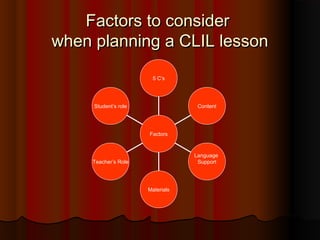
Factors to considerFactors to consider
when planning a CLIL lessonwhen planning a CLIL lesson
Student’s role
Teacher’s Role
Materials
Language
Support
Content
5 C’s
Factors
The 5 C’sThe 5 C’s
ContentContent
CommunicationCommunication
CognitionCognition
CompetenceCompetence
Community/cultureCommunity/culture
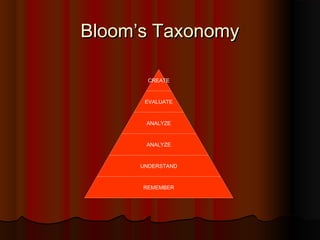
Bloom’s TaxonomyBloom’s Taxonomy
CREATE
EVALUATE
ANALYZE
ANALYZE
UNDERSTAND
REMEMBER
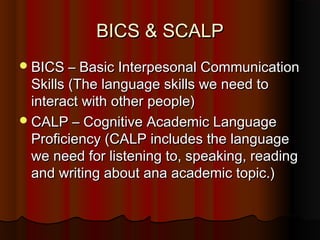
BICS & SCALPBICS & SCALP
BICS – Basic Interpesonal CommunicationBICS – Basic Interpesonal Communication
Skills (The language skills we need toSkills (The language skills we need to
interact with other people)interact with other people)
CALP – Cognitive Academic LanguageCALP – Cognitive Academic Language
Proficiency (CALP includes the languageProficiency (CALP includes the language
we need for listening to, speaking, readingwe need for listening to, speaking, reading
and writing about ana academic topic.)and writing about ana academic topic.)
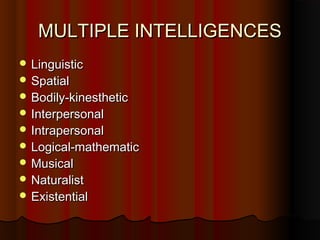
MULTIPLE INTELLIGENCESMULTIPLE INTELLIGENCES
 LinguisticLinguistic
 SpatialSpatial
 Bodily-kinestheticBodily-kinesthetic
 InterpersonalInterpersonal
 IntrapersonalIntrapersonal
 Logical-mathematicLogical-mathematic
 MusicalMusical
 NaturalistNaturalist
 ExistentialExistential

Methodology & Tools CLIL

  • 1.
    Methodology & ToolsCLILMethodology & Tools CLIL TrainingTraining MaltaMalta July 9-20, 2018July 9-20, 2018
  • 2.
    Methodology & ToolsCLILMethodology & Tools CLIL Introduction to CLILIntroduction to CLIL The 5CsThe 5Cs Lesson PlanningLesson Planning Communication BICS & CALPCommunication BICS & CALP Cognition Bloom’s Revised TaxonomyCognition Bloom’s Revised Taxonomy
  • 3.
    Methodology & ToolsCLILMethodology & Tools CLIL Thinking Skills: HOTS & LOTSThinking Skills: HOTS & LOTS CompetencesCompetences Scaffolding & ZPDScaffolding & ZPD Graphic OrganisersGraphic Organisers Multiple IntelligencesMultiple Intelligences Looking at scenariosLooking at scenarios
  • 4.
    Methodology & ToolsCLILMethodology & Tools CLIL Multidict & WordlinkMultidict & Wordlink Intro to WebquestsIntro to Webquests Building a CLIL store UnitBuilding a CLIL store Unit Setting up a WebquestSetting up a Webquest Multimodality in TeachingMultimodality in Teaching
  • 5.
    Methodology & ToolsCLILMethodology & Tools CLIL Interactive ExercisesInteractive Exercises Setting up interactive ExercisesSetting up interactive Exercises Putting Webquests onlinePutting Webquests online Presentations with a differencePresentations with a difference Project WorkProject Work
  • 6.
    Factors to considerFactorsto consider when planning a CLIL lessonwhen planning a CLIL lesson Student’s role Teacher’s Role Materials Language Support Content 5 C’s Factors
  • 7.
    The 5 C’sThe5 C’s ContentContent CommunicationCommunication CognitionCognition CompetenceCompetence Community/cultureCommunity/culture
  • 8.
  • 9.
    BICS & SCALPBICS& SCALP BICS – Basic Interpesonal CommunicationBICS – Basic Interpesonal Communication Skills (The language skills we need toSkills (The language skills we need to interact with other people)interact with other people) CALP – Cognitive Academic LanguageCALP – Cognitive Academic Language Proficiency (CALP includes the languageProficiency (CALP includes the language we need for listening to, speaking, readingwe need for listening to, speaking, reading and writing about ana academic topic.)and writing about ana academic topic.)
  • 10.
    MULTIPLE INTELLIGENCESMULTIPLE INTELLIGENCES LinguisticLinguistic  SpatialSpatial  Bodily-kinestheticBodily-kinesthetic  InterpersonalInterpersonal  IntrapersonalIntrapersonal  Logical-mathematicLogical-mathematic  MusicalMusical  NaturalistNaturalist  ExistentialExistential