 MAYRA ALPUSIG GRANJA
 DIEGO GRANJA PEÑAHERRERA
TOPIC:
“DO TEENAGERS OF THIRD LEVEL IN THE
PROFICIENCY PROGRAM AT ITSA INCREASE
THEIR SPEAKING ENGLISH ABILITY THROUGH
LISTENING ACTIVITIES?”
PROBLEM:
 Students don´t have enough listening
actvities in order to improve their
pronunciation andfluency when they speak.
 Gathering relevant data to analize the most
useful listening activities.
 Surveys, classroom observations, interviews.
 Methods: Analitic, and experimental
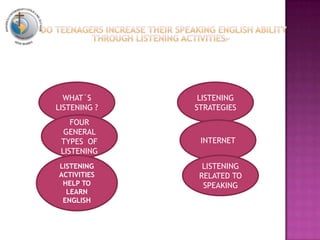
LISTENING
STRATEGIES
INTERNET
LISTENING
RELATED TO
SPEAKING
WHAT´S
LISTENING ?
FOUR
GENERAL
TYPES OF
LISTENING
LISTENING
ACTIVITIES
HELP TO
LEARN
ENGLISH
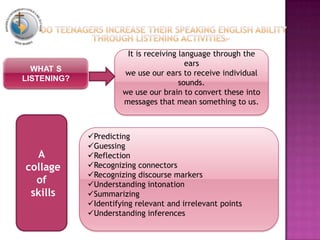
WHAT S
LISTENING?
It is receiving language through the
ears
we use our ears to receive individual
sounds.
we use our brain to convert these into
messages that mean something to us.
Predicting
Guessing
Reflection
Recognizing connectors
Recognizing discourse markers
Understanding intonation
Summarizing
Identifying relevant and irrelevant points
Understanding inferences
A
collage
of
skills
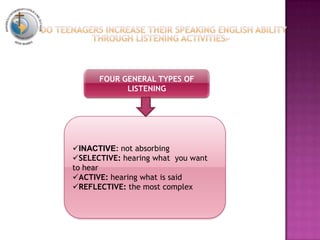
FOUR GENERAL TYPES OF
LISTENING
INACTIVE: not absorbing
SELECTIVE: hearing what you want
to hear
ACTIVE: hearing what is said
REFLECTIVE: the most complex
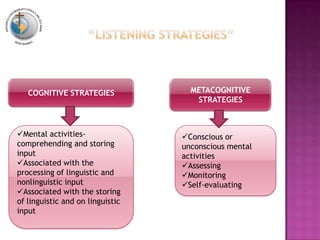
COGNITIVE STRATEGIES
Mental activities-
comprehending and storing
input
Associated with the
processing of linguistic and
nonlinguistic input
Associated with the storing
of linguistic and on linguistic
input
METACOGNITIVE
STRATEGIES
Conscious or
unconscious mental
activities
Assessing
Monitoring
Self-evaluating
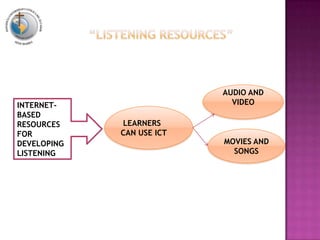
INTERNET-
BASED
RESOURCES
FOR
DEVELOPING
LISTENING
LEARNERS
CAN USE ICT
AUDIO AND
VIDEO
MOVIES AND
SONGS

Methodology research paper