THE CATHOLIC SOCIAL TEACHINGS  The Method
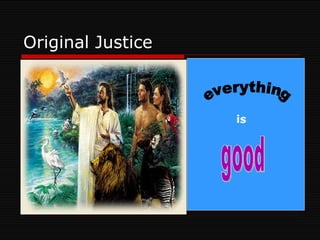
Original Justice everything good is
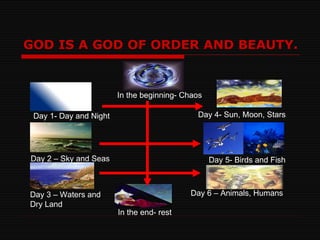
GOD IS A GOD OF ORDER AND BEAUTY. In the beginning- Chaos Day 1- Day and Night Day 2 – Sky and Seas Day 3 – Waters and  Dry Land Day 4- Sun, Moon, Stars Day 5- Birds and Fish Day 6 – Animals, Humans In the end- rest
WE BELONG TO EACH OTHER No man is an island… - John Donne … life is like a big spiderweb…   - Frederick Buechner
SOCIETY a group of persons bound together organically by a principle of unity that goes beyond each one of them.  (CCC 1880) Is made for the benefit of the people and not the other way around “  the social order and its development  must invariably work to the benefit of the human person” (Gaudium et Spes 26)
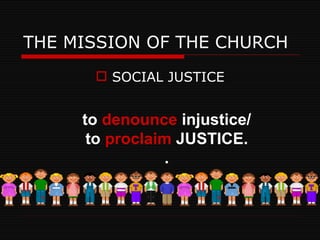
THE MISSION OF THE CHURCH SOCIAL JUSTICE to  denounce  injustice/ to  proclaim  JUSTICE. .
poverty, injustices, war, calamities, soaring prices of basic commodities, transportation and fuel, maltreatment and abuses, etc.  FACES OF CRISIS IS THIS A REAL CHRISTIAN COMMUNITY?
THE CHURCH DREAMS OF INDIVIDUAL MEMBERS OF THE COMMUNITY WHO ARE: ALIVE AND LIFE-GIVING FREE AND FREEING RESPONSIVE AND RESPONSIBLE LOVING AND LOVABLE CARING AND COMMUNITY MINDED
The Church dreams of people becoming persons reflecting God’s image in themselves, their actions, their beings. The Church also dreams of a community that: 1. speaks and listens, 2. a community that discerns and decides together  in implementing their decisions, 3. prays and celebrate their joys and sorrows  together, 4. honestly looks at what they had done and failed.
 
THE METHOD Of Catholic Social Teaching
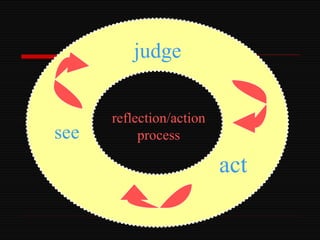
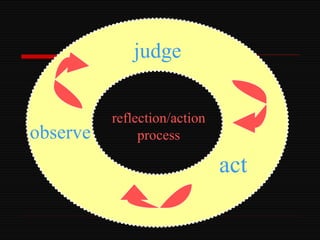
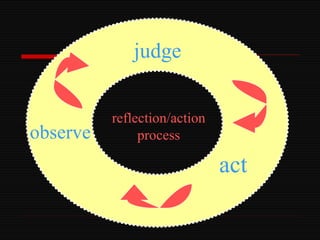
see judge act reflection/action process
SEE  – Principles of Reflection JUDGE  – Criteria for Judgment ACT  – Direction for Action
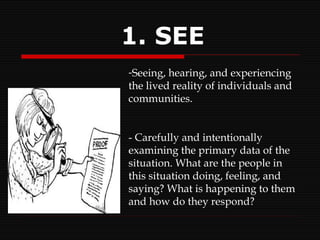
1. SEE  Seeing, hearing, and experiencing the lived reality of individuals and communities. - Carefully and intentionally examining the primary data of the situation. What are the people in this situation doing, feeling, and saying? What is happening to them and how do they respond?
Reflection/Action Worksheet See : What do you know about this issue or what did you observe? What specific facts can you cite about this issue or experience? What did you learn or observe? How do you feel in the face of this issue or experience? How does it touch you personally?
2. Judge  (the heart of the process) a.  Social Analysis   - Obtaining a more complete picture of the social situation by exploring its historical and structural relationships. In this step, we attempt to make sense of the reality that was observed in Step 1.  Why are things this way ?  What are the root causes ?
2. Judge :  a. Social Analysis Why does this situation exist? What are the root causes? Economic factors   -- Who owns? Who controls? Who pays? Who gets? Who gets left out? Why? Political factors   – Who decides? For whom do they decide? How do decisions get made? Who is left out of the process? Why? Social Factors   – Who is left out? Who is included? Why? Historic Factors   – What past events influence the situation today? Cultural Factors   – What values are evident? What do people believe in? Who influences what people believe?
2. Judge  (the heart of the process) b.  Theological Reflection   – Analyzing the experience in the light of scripture and the Catholic social tradition? How do biblical values and the principles of Catholic social teaching help us to see this reality in a different way? How do they serve as a measuring stick for this experience?
2. Judge   b. Theological Reflection What lessons or values from scripture can help us to interpret this experience? E.g . the prophets, the Beatitudes, the example of Jesus himself, and the parables he told. What key principles from Catholic Social Teaching apply to this situation? E.g.  human dignity, the common good, human rights, the option for the poor.
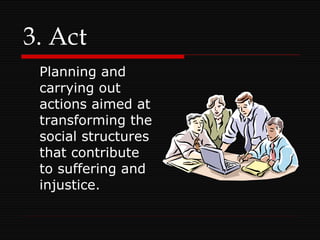
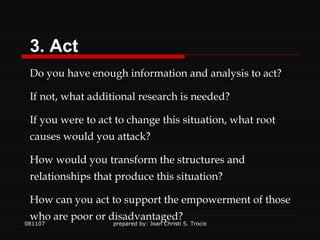
3. Act Planning and carrying out actions aimed at transforming the social structures that contribute to suffering and injustice.
081107 prepared by: Joan Christi S. Trocio 3. Act Do you have enough information and analysis to act? If not, what additional research is needed? If you were to act to change this situation, what root causes would you attack? How would you transform the structures and relationships that produce this situation? How can you act to support the empowerment of those who are poor or disadvantaged?
observe judge act reflection/action process


SEE  JUDGE ACT
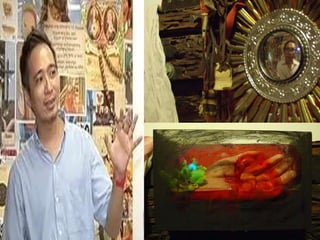
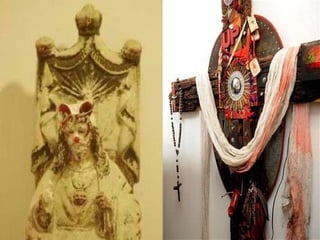
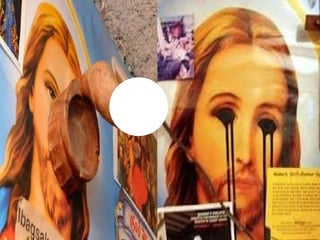
SEE Featured photographs of Jesus Christ and the Virgin Mary adorned with objects not related to Christianity. A crucifix was decorated with a piece of wood in a shape of a phallic symbol. One Christ the King figurine had rabbit ears (mickey mouse).
JUDGE Art? Art involves the use of imagination, craftsmanship and originality. “ It is not -- I repeat -- it is not art! It is an immature and juvenile attempt at caricature” – F.Sionil Jose (National Artist)  On Religion sacrilegious and blasphemous “ It is not only sick, it is also sickening. Binabastos mo ‘yung pananampalataya ng iba,“ -  Archbishop O. Cruz.
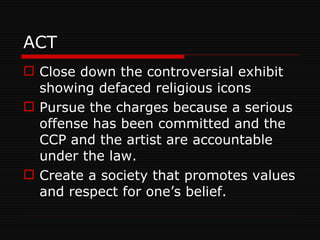
ACT Close down the controversial exhibit showing defaced religious icons Pursue the charges because a serious offense has been committed and the CCP and the artist are accountable under the law. Create a society that promotes values and respect for one’s belief.
observe judge act reflection/action process
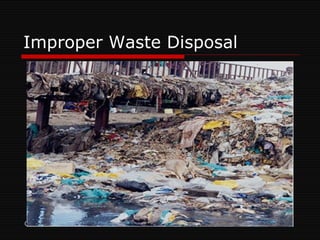
Improper Waste Disposal 081107
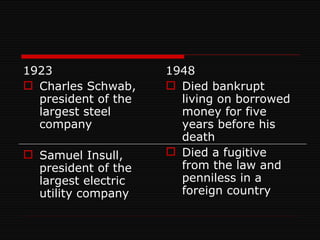
1923 Charles Schwab, president of the largest steel company Samuel Insull, president of the largest electric utility company 1948 Died bankrupt living on borrowed money for five years before his death Died a fugitive from the law and penniless in a foreign country
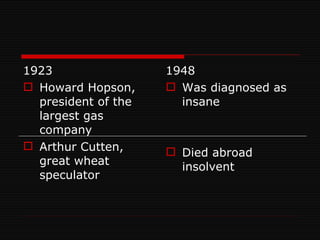
1923 Howard Hopson, president of the largest gas company Arthur Cutten, great wheat speculator 1948 Was diagnosed as insane Died abroad insolvent
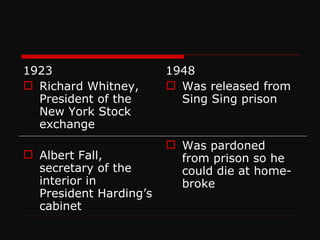
1923 Richard Whitney, President of the New York Stock exchange Albert Fall, secretary of the interior in President Harding’s cabinet 1948 Was released from Sing Sing prison Was pardoned from prison so he could die at home- broke
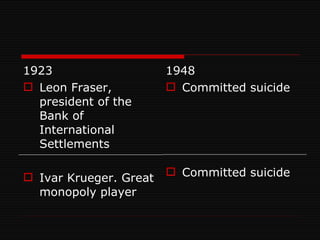
1923 Leon Fraser, president of the Bank of International Settlements Ivar Krueger. Great monopoly player 1948 Committed suicide Committed suicide

Method of CST

  • 1.
    THE CATHOLIC SOCIALTEACHINGS The Method
  • 2.
  • 3.
    GOD IS AGOD OF ORDER AND BEAUTY. In the beginning- Chaos Day 1- Day and Night Day 2 – Sky and Seas Day 3 – Waters and Dry Land Day 4- Sun, Moon, Stars Day 5- Birds and Fish Day 6 – Animals, Humans In the end- rest
  • 4.
    WE BELONG TOEACH OTHER No man is an island… - John Donne … life is like a big spiderweb… - Frederick Buechner
  • 5.
    SOCIETY a groupof persons bound together organically by a principle of unity that goes beyond each one of them. (CCC 1880) Is made for the benefit of the people and not the other way around “ the social order and its development must invariably work to the benefit of the human person” (Gaudium et Spes 26)
  • 6.
    THE MISSION OFTHE CHURCH SOCIAL JUSTICE to denounce injustice/ to proclaim JUSTICE. .
  • 7.
    poverty, injustices, war,calamities, soaring prices of basic commodities, transportation and fuel, maltreatment and abuses, etc. FACES OF CRISIS IS THIS A REAL CHRISTIAN COMMUNITY?
  • 8.
    THE CHURCH DREAMSOF INDIVIDUAL MEMBERS OF THE COMMUNITY WHO ARE: ALIVE AND LIFE-GIVING FREE AND FREEING RESPONSIVE AND RESPONSIBLE LOVING AND LOVABLE CARING AND COMMUNITY MINDED
  • 9.
    The Church dreamsof people becoming persons reflecting God’s image in themselves, their actions, their beings. The Church also dreams of a community that: 1. speaks and listens, 2. a community that discerns and decides together in implementing their decisions, 3. prays and celebrate their joys and sorrows together, 4. honestly looks at what they had done and failed.
  • 10.
  • 11.
    THE METHOD OfCatholic Social Teaching
  • 12.
    see judge actreflection/action process
  • 13.
    SEE –Principles of Reflection JUDGE – Criteria for Judgment ACT – Direction for Action
  • 14.
    1. SEE Seeing, hearing, and experiencing the lived reality of individuals and communities. - Carefully and intentionally examining the primary data of the situation. What are the people in this situation doing, feeling, and saying? What is happening to them and how do they respond?
  • 15.
    Reflection/Action Worksheet See: What do you know about this issue or what did you observe? What specific facts can you cite about this issue or experience? What did you learn or observe? How do you feel in the face of this issue or experience? How does it touch you personally?
  • 16.
    2. Judge (the heart of the process) a. Social Analysis - Obtaining a more complete picture of the social situation by exploring its historical and structural relationships. In this step, we attempt to make sense of the reality that was observed in Step 1. Why are things this way ? What are the root causes ?
  • 17.
    2. Judge : a. Social Analysis Why does this situation exist? What are the root causes? Economic factors -- Who owns? Who controls? Who pays? Who gets? Who gets left out? Why? Political factors – Who decides? For whom do they decide? How do decisions get made? Who is left out of the process? Why? Social Factors – Who is left out? Who is included? Why? Historic Factors – What past events influence the situation today? Cultural Factors – What values are evident? What do people believe in? Who influences what people believe?
  • 18.
    2. Judge (the heart of the process) b. Theological Reflection – Analyzing the experience in the light of scripture and the Catholic social tradition? How do biblical values and the principles of Catholic social teaching help us to see this reality in a different way? How do they serve as a measuring stick for this experience?
  • 19.
    2. Judge b. Theological Reflection What lessons or values from scripture can help us to interpret this experience? E.g . the prophets, the Beatitudes, the example of Jesus himself, and the parables he told. What key principles from Catholic Social Teaching apply to this situation? E.g. human dignity, the common good, human rights, the option for the poor.
  • 20.
    3. Act Planningand carrying out actions aimed at transforming the social structures that contribute to suffering and injustice.
  • 21.
    081107 prepared by:Joan Christi S. Trocio 3. Act Do you have enough information and analysis to act? If not, what additional research is needed? If you were to act to change this situation, what root causes would you attack? How would you transform the structures and relationships that produce this situation? How can you act to support the empowerment of those who are poor or disadvantaged?
  • 22.
    observe judge actreflection/action process
  • 23.
  • 24.
  • 25.
  • 26.
  • 27.
  • 28.
  • 29.
    SEE Featured photographsof Jesus Christ and the Virgin Mary adorned with objects not related to Christianity. A crucifix was decorated with a piece of wood in a shape of a phallic symbol. One Christ the King figurine had rabbit ears (mickey mouse).
  • 30.
    JUDGE Art? Artinvolves the use of imagination, craftsmanship and originality. “ It is not -- I repeat -- it is not art! It is an immature and juvenile attempt at caricature” – F.Sionil Jose (National Artist)  On Religion sacrilegious and blasphemous “ It is not only sick, it is also sickening. Binabastos mo ‘yung pananampalataya ng iba,“ - Archbishop O. Cruz.
  • 31.
    ACT Close downthe controversial exhibit showing defaced religious icons Pursue the charges because a serious offense has been committed and the CCP and the artist are accountable under the law. Create a society that promotes values and respect for one’s belief.
  • 32.
    observe judge actreflection/action process
  • 33.
  • 34.
    1923 Charles Schwab,president of the largest steel company Samuel Insull, president of the largest electric utility company 1948 Died bankrupt living on borrowed money for five years before his death Died a fugitive from the law and penniless in a foreign country
  • 35.
    1923 Howard Hopson,president of the largest gas company Arthur Cutten, great wheat speculator 1948 Was diagnosed as insane Died abroad insolvent
  • 36.
    1923 Richard Whitney,President of the New York Stock exchange Albert Fall, secretary of the interior in President Harding’s cabinet 1948 Was released from Sing Sing prison Was pardoned from prison so he could die at home- broke
  • 37.
    1923 Leon Fraser,president of the Bank of International Settlements Ivar Krueger. Great monopoly player 1948 Committed suicide Committed suicide