Metadata and Open Access:
Reliably Finding Content and
Finding Reliable Content
Moderated by Laurie Kaplan
Director of Editorial Operations
ProQuest: Serials Solutions Content Operations team
November 8, 2013
Conference Hashtag #chs13
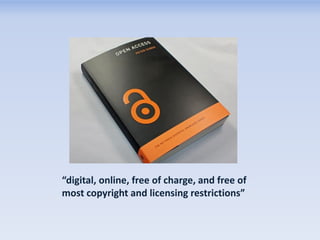
“digital, online, free of charge, and free of
most copyright and licensing restrictions”
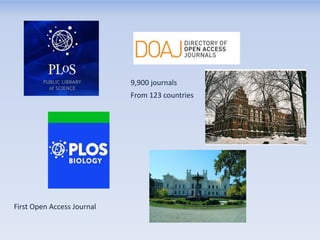
9,900 journals
From 123 countries

First Open Access Journal
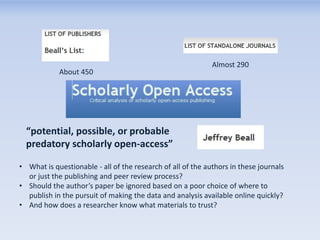
About 450

Almost 290

“potential, possible, or probable
predatory scholarly open-access”
• What is questionable - all of the research of all of the authors in these journals
or just the publishing and peer review process?
• Should the author’s paper be ignored based on a poor choice of where to
publish in the pursuit of making the data and analysis available online quickly?
• And how does a researcher know what materials to trust?
• As a global directory of periodicals, including journals, magazines, newspapers
and other serials, we strive to list everything published resource we learn about,
and even announced for publication resources.
• We leave the scrutiny of individual publishers’ author engagement to librarians
and researchers.
• We include Open Access publications among the Ulrich’s titles reviewed by the
professional librarians of Magazines for Libraries, another ProQuest publication.
• Several well-known commercial publishers have joined the Open Access
movement, creating fully open journals, or hybrids that incorporate open
articles in otherwise subscription journals.
• Are these publications more trustworthy?
• And many aggregators, including ProQuest, have begun to include Open
Access journals in their collections in order to make available in one
database all of the relevant subject-related materials for a researcher.
• Does the inclusion of an open access article by an aggregator confer
legitimacy, or is it up to the researcher to determine the quality of the
article?
Note: All images retrieved from Google Images or Flickr.
All have a Creative Commons or otherwise unrestricted license
Metadata and Open Access:
Reliably Finding Content and
Finding Reliable Content
• Sommer Browning
• Head of Head of Electronic Access
& Discovery Services
• University of Colorado, Denver,
Auraria Library
• Librarian perspective
• (Slides follow)

• Jean-Claude Guédon
• Professor, Department of
Comparative Literature
• University of Montreal, Quebec,
Canada
• Perspective of a researcher
• (No slides)
METADATA AND OPEN ACCESS:
RELIABLY FINDING CONTENT AND
FINDING RELIABLE CONTENT
Looking at How Auraria Library Uses & Discovers Open Access Material

Presented by Sommer Browning
Head of Electronic Resources Access & Discovery Services
Auraria Library, University of Colorado, Denver
November 8, 2013
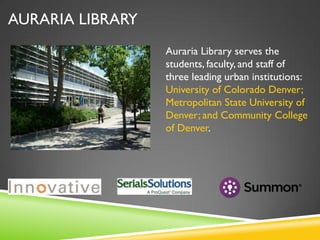
AURARIA LIBRARY
Auraria Library serves the
students, faculty, and staff of
three leading urban institutions:
University of Colorado Denver;
Metropolitan State University of
Denver; and Community College
of Denver.
OPEN ACCESS AT AURARIA
 We do not have an official institutional or library open

access policy.
 When you think about open access the typical Auraria

patron does not come to mind.
 When we do track open access resources, we don’t always

have a positive experience.
OPEN ACCESS DISCOVERY PROBLEMS
 All of the usual electronic access issues (broken links,

missing content, platform changes), but OA access issues
are particularly hard to resolve.
 Access can be out of the library’s hands

(HathiTrust/Scirus).
 OA discovery issues can affect other departments.
METADATA THAT WOULD HELP US
PROMOTE AND USE OPEN ACCESS
MATERIALS
 Metadata to find or exclude OA resources
 Metadata to help us troubleshoot OA resources
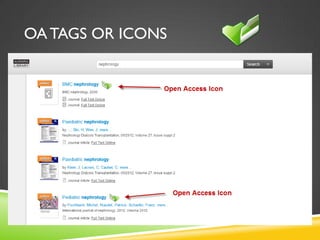
OA TAGS OR ICONS
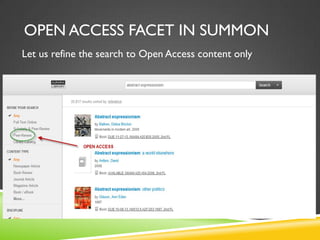
OPEN ACCESS FACET IN SUMMON
Let us refine the search to Open Access content only
MORE CONTROL OVER OUR METADATA
More transparency about metadata
 Where is it coming from?
 What are the standards?
 How is this journal indexed? How is this database harvested?

Make analysis easy
Make customization easy
METADATA TO HELP US TROUBLESHOOT
 Contact information

 Email addresses

 Editors’ names

 Statements of responsibility

 Platforms

 Browsers

 Pop-up blockers
WHAT CAN I DO TO HELP?
 Report, report, report. Crowdsourcing is a powerful way to keep the

metadata for these journals up to date.

 Become more familiar with NISO standards and cite them vendors

and publishers.

 Specification for Open Access Metadata and Indicators

http://www.niso.org/apps/group_public/download.php/9845/Open%20A
ccess%20Metadata%20-%20Work%20Item%20for%20ballot.pdf
 Open Discovery Initiative: Promoting Transparency in Discovery

http://www.niso.org/news/pr/view/www.niso.org/workrooms/odi/
OPEN ACCESS WORLD?!
And in conclusion, a plea!
Serials Solutions, will you create one huge publically

accessible Open Access Summon instance that includes
all the open access content you index?
THANK YOU FOR YOUR TIME
And have a great conference!
Thank you!
Sommer Browning: sommer.browning@ucdenver.edu

Jean-Claude Guédon: jean.claude.guedon@umontreal.ca
Laurie Kaplan: laurie.kaplan@proquest.com

Metadata and Open Access – Reliably Finding Content and Finding Reliable Content

  • 1.
    Metadata and OpenAccess: Reliably Finding Content and Finding Reliable Content Moderated by Laurie Kaplan Director of Editorial Operations ProQuest: Serials Solutions Content Operations team November 8, 2013 Conference Hashtag #chs13
  • 3.
    “digital, online, freeof charge, and free of most copyright and licensing restrictions”
  • 4.
    9,900 journals From 123countries First Open Access Journal
  • 5.
    About 450 Almost 290 “potential,possible, or probable predatory scholarly open-access” • What is questionable - all of the research of all of the authors in these journals or just the publishing and peer review process? • Should the author’s paper be ignored based on a poor choice of where to publish in the pursuit of making the data and analysis available online quickly? • And how does a researcher know what materials to trust?
  • 6.
    • As aglobal directory of periodicals, including journals, magazines, newspapers and other serials, we strive to list everything published resource we learn about, and even announced for publication resources. • We leave the scrutiny of individual publishers’ author engagement to librarians and researchers. • We include Open Access publications among the Ulrich’s titles reviewed by the professional librarians of Magazines for Libraries, another ProQuest publication.
  • 7.
    • Several well-knowncommercial publishers have joined the Open Access movement, creating fully open journals, or hybrids that incorporate open articles in otherwise subscription journals. • Are these publications more trustworthy? • And many aggregators, including ProQuest, have begun to include Open Access journals in their collections in order to make available in one database all of the relevant subject-related materials for a researcher. • Does the inclusion of an open access article by an aggregator confer legitimacy, or is it up to the researcher to determine the quality of the article?
  • 8.
    Note: All imagesretrieved from Google Images or Flickr. All have a Creative Commons or otherwise unrestricted license
  • 9.
    Metadata and OpenAccess: Reliably Finding Content and Finding Reliable Content • Sommer Browning • Head of Head of Electronic Access & Discovery Services • University of Colorado, Denver, Auraria Library • Librarian perspective • (Slides follow) • Jean-Claude Guédon • Professor, Department of Comparative Literature • University of Montreal, Quebec, Canada • Perspective of a researcher • (No slides)
  • 10.
    METADATA AND OPENACCESS: RELIABLY FINDING CONTENT AND FINDING RELIABLE CONTENT Looking at How Auraria Library Uses & Discovers Open Access Material Presented by Sommer Browning Head of Electronic Resources Access & Discovery Services Auraria Library, University of Colorado, Denver November 8, 2013
  • 11.
    AURARIA LIBRARY Auraria Libraryserves the students, faculty, and staff of three leading urban institutions: University of Colorado Denver; Metropolitan State University of Denver; and Community College of Denver.
  • 12.
    OPEN ACCESS ATAURARIA  We do not have an official institutional or library open access policy.  When you think about open access the typical Auraria patron does not come to mind.  When we do track open access resources, we don’t always have a positive experience.
  • 13.
    OPEN ACCESS DISCOVERYPROBLEMS  All of the usual electronic access issues (broken links, missing content, platform changes), but OA access issues are particularly hard to resolve.  Access can be out of the library’s hands (HathiTrust/Scirus).  OA discovery issues can affect other departments.
  • 14.
    METADATA THAT WOULDHELP US PROMOTE AND USE OPEN ACCESS MATERIALS  Metadata to find or exclude OA resources  Metadata to help us troubleshoot OA resources
  • 15.
  • 16.
    OPEN ACCESS FACETIN SUMMON Let us refine the search to Open Access content only
  • 17.
    MORE CONTROL OVEROUR METADATA More transparency about metadata  Where is it coming from?  What are the standards?  How is this journal indexed? How is this database harvested? Make analysis easy Make customization easy
  • 18.
    METADATA TO HELPUS TROUBLESHOOT  Contact information  Email addresses  Editors’ names  Statements of responsibility  Platforms  Browsers  Pop-up blockers
  • 19.
    WHAT CAN IDO TO HELP?  Report, report, report. Crowdsourcing is a powerful way to keep the metadata for these journals up to date.  Become more familiar with NISO standards and cite them vendors and publishers.  Specification for Open Access Metadata and Indicators http://www.niso.org/apps/group_public/download.php/9845/Open%20A ccess%20Metadata%20-%20Work%20Item%20for%20ballot.pdf  Open Discovery Initiative: Promoting Transparency in Discovery http://www.niso.org/news/pr/view/www.niso.org/workrooms/odi/
  • 20.
    OPEN ACCESS WORLD?! Andin conclusion, a plea! Serials Solutions, will you create one huge publically accessible Open Access Summon instance that includes all the open access content you index?
  • 21.
    THANK YOU FORYOUR TIME And have a great conference!
  • 22.
    Thank you! Sommer Browning:sommer.browning@ucdenver.edu Jean-Claude Guédon: jean.claude.guedon@umontreal.ca Laurie Kaplan: laurie.kaplan@proquest.com