MESUR Making Use and Sense of Scholarly Usage Data <http://www.mesur.org> Johan Bollen  -  [email_address]   Herbert Van de Sompel  - herbertv@lanl.gov Digital Library Research & Prototyping Team Research Library Los Alamos National Laboratory, USA Acknowledgements: Marko A. Rodriguez (LANL), Ryan Chute (LANL),  Lyudmila L. Balakireva (LANL),  Aric Hagberg (LANL), Luis Bettencourt (LANL) The MESUR research was funded by the Andrew W. Mellon Foundation
MESUR is Paradigm Shift Material MESUR looks into new approaches to assess scholarly impact The Thomson Scientific IF was about the only metrics that could be computed in a paper-based era. But we don’t live in the paper-based era anymore. So MESUR researches metrics for the digital era: Usage-based metrics: Access to scholarly materials happens via networked systems, not via paper stored in libraries. Networked systems can record a great deal about access to materials; much more than libraries could about access to paper. Network-based metrics: Scholarly communication generates networks, e.g. citation networks, co-authorship networks, usage networks, … A wide variety of metrics can be computed for such networks; much more than simple citation counts.
The Promise of Usage Data Metrics based on usage data have significant potential Interactions be recorded for all digital scholarly content, i.e. papers, journals, preprints, blog postings, datasets, chemical structures, software, … Not just for ~ 10,000 journals Interactions reflects the activities of all users of scholarly information, not only of scholarly authors Interactions are recorded starting immediately after  publication Not once read and cited (think publication delays) Rapid indicator of scholarly trends So the interest in usage data from projects such as COUNTER, Citebase, IKS and MESUR should not come as a surprise!
And the Obvious Challenges of Usage Data Usage data comes with significant challenges What exactly is usage?  E.g. various types of usage (download pdf, email abstract, …); impact of user interface on usage recordings, … Attention data  would be a better term. Privacy concerns Aggregating item-level usage data across networked systems: Standardized recording Standardized aggregating Click-streams across networked systems How to deal with bots?
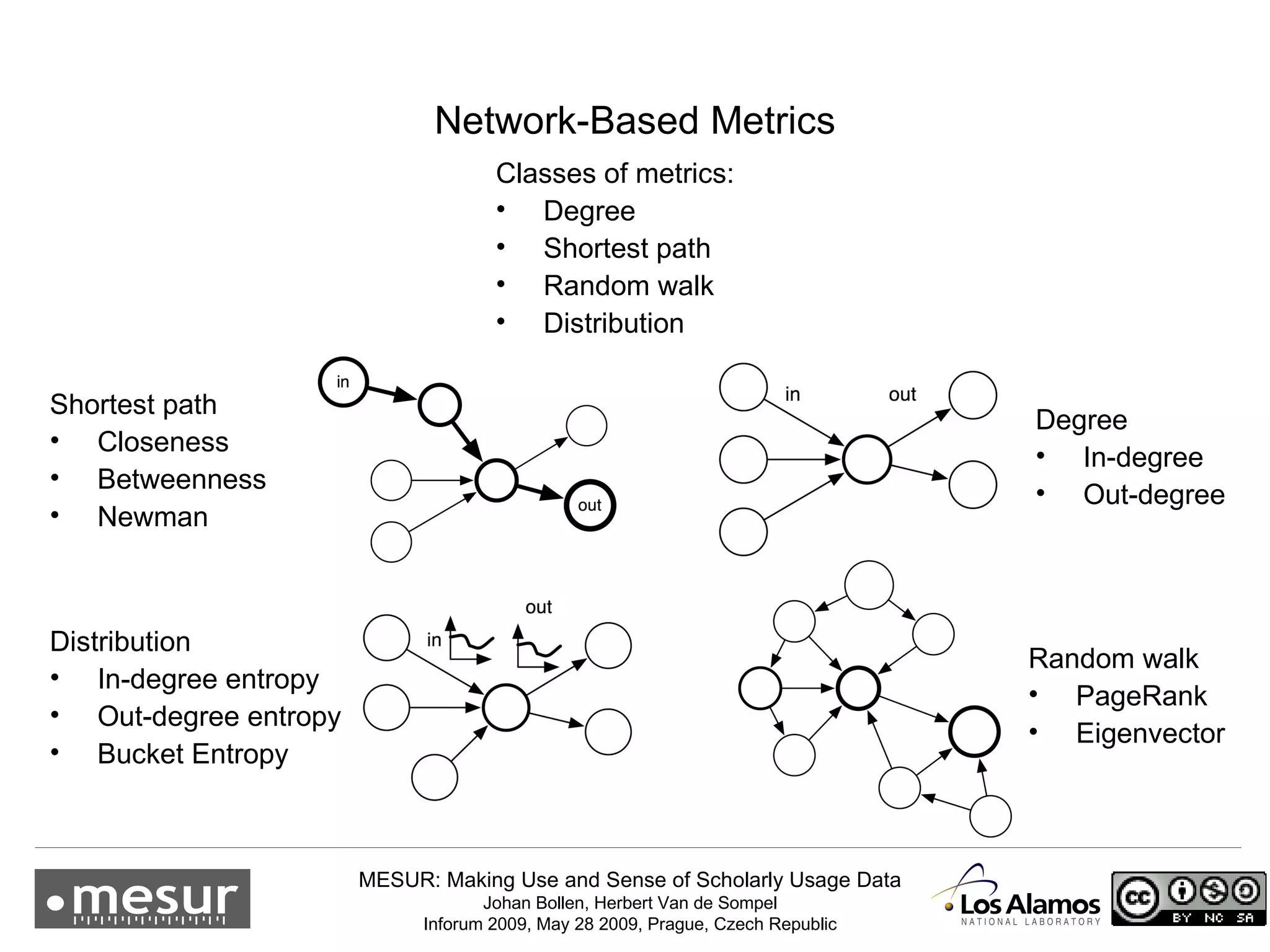
Network-Based Metrics We have 50 years of network science available to us  A wide variety of metrics has been proposed to characterize networks, and to assess the importance of nodes in a network E.g. social network analysis, small world graphs, graph theory, social modeling So when defining metrics for scholarly communication (clearly a network), we should probably leverage network science Cf. Google’s PageRank versus Alta Vista’s statistical ranking A network (and hence a network-based metric) takes context into account; a statistical count does not.  Readings: Barabasi (2003) Linked. Wasserman (1994). Social network analysis.
Classes of metrics: Degree Shortest path Random walk Distribution Degree In-degree Out-degree Shortest path Closeness Betweenness Newman Random walk PageRank Eigenvector Distribution In-degree entropy Out-degree entropy Bucket Entropy Network-Based Metrics
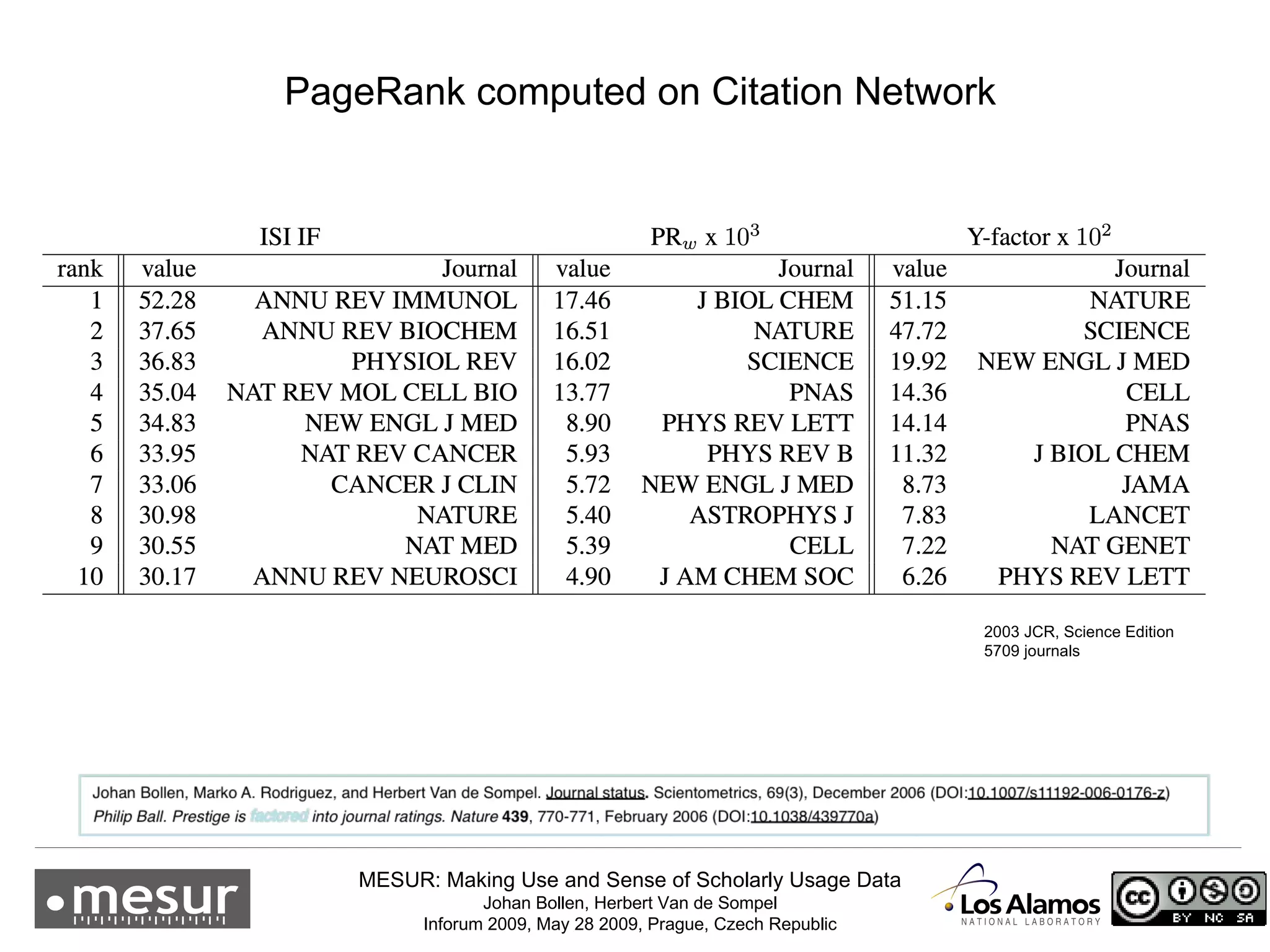
PageRank computed on Citation Network 2003 JCR, Science Edition 5709 journals
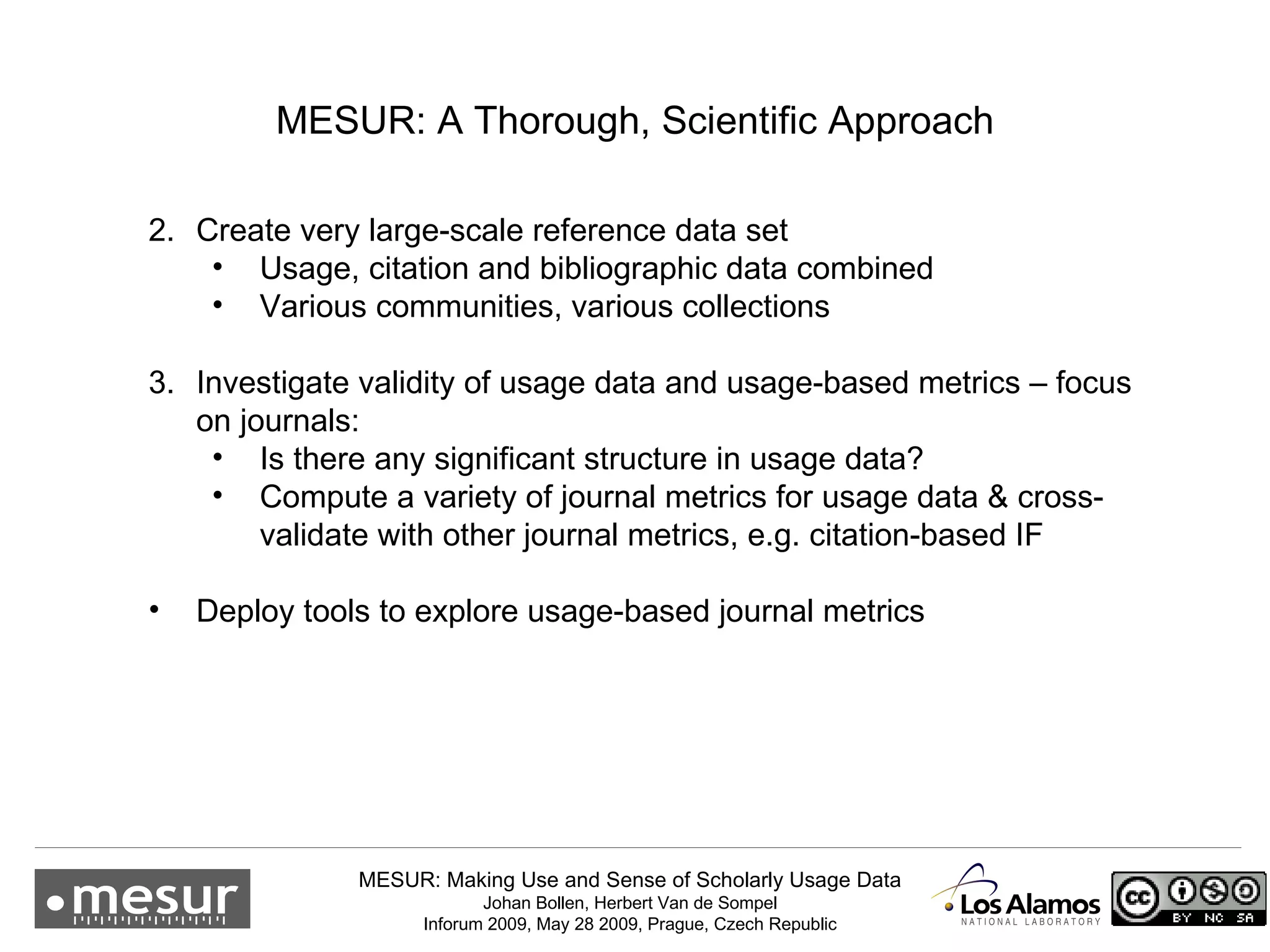
Create very large-scale reference data set Usage, citation and bibliographic data combined Various communities, various collections Investigate validity of usage data and usage-based metrics – focus on journals: Is there any significant structure in usage data? Compute a variety of journal metrics for usage data & cross-validate with other journal metrics, e.g. citation-based IF Deploy tools to explore usage-based journal metrics MESUR: A Thorough, Scientific Approach
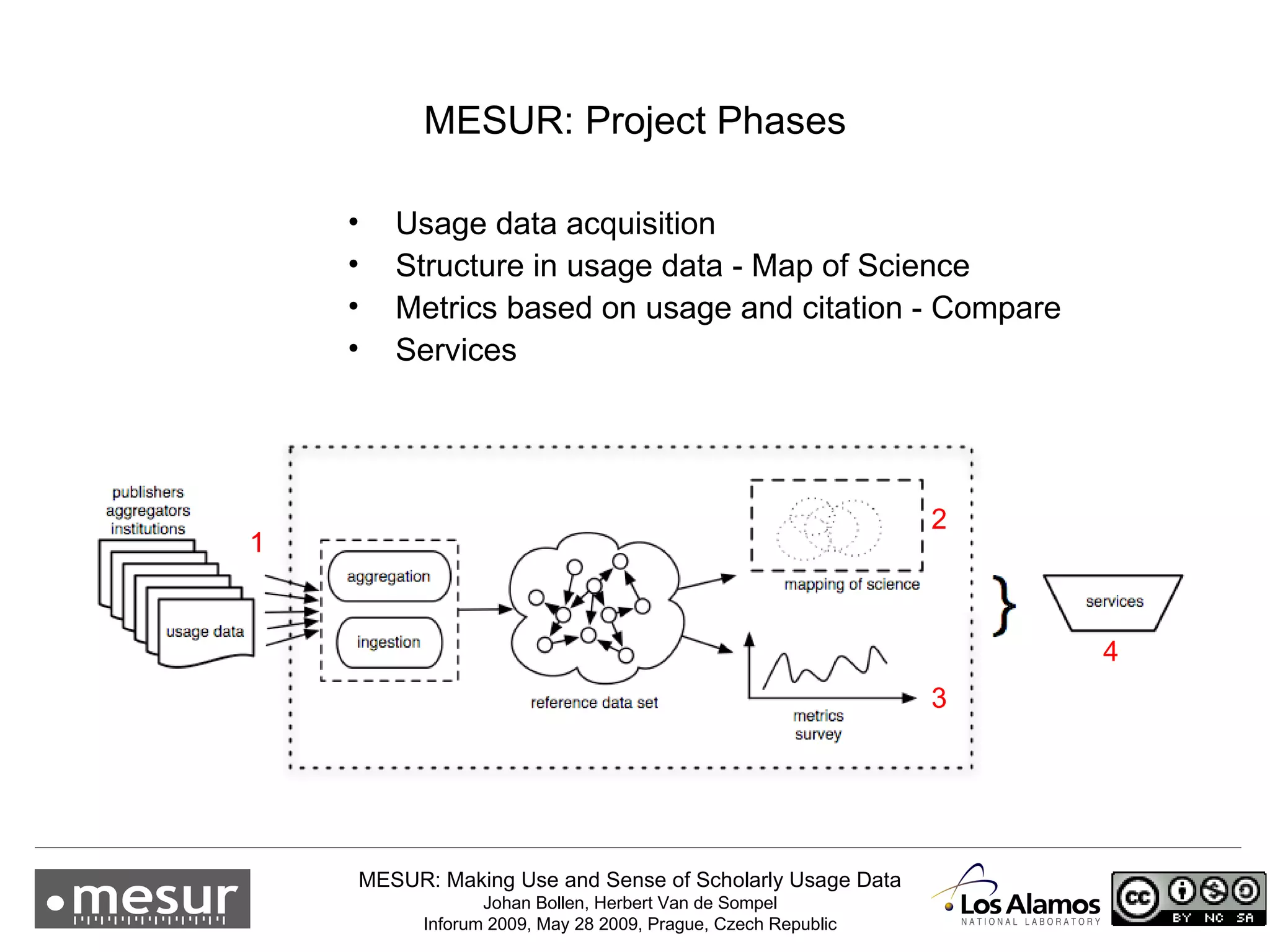
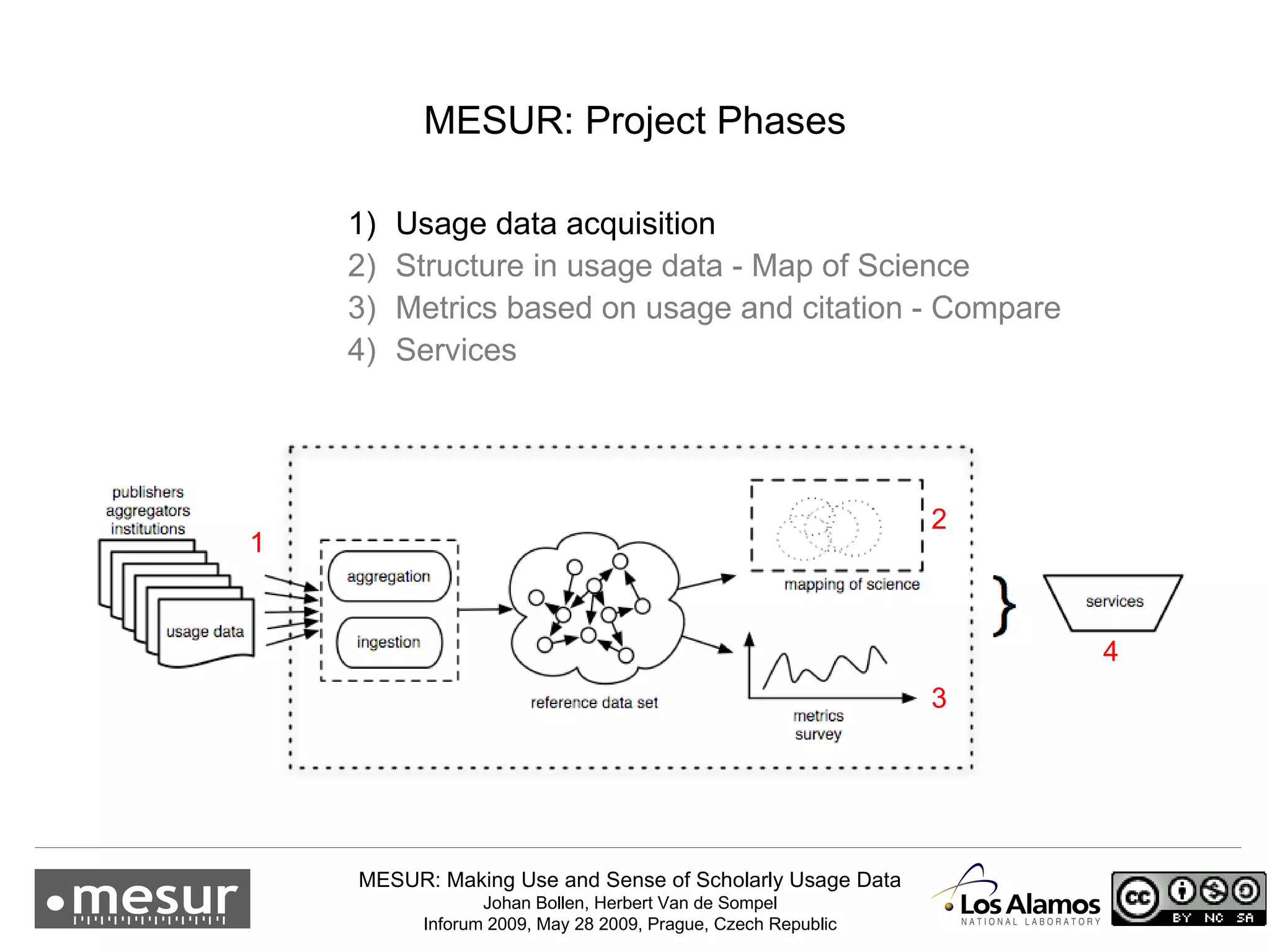
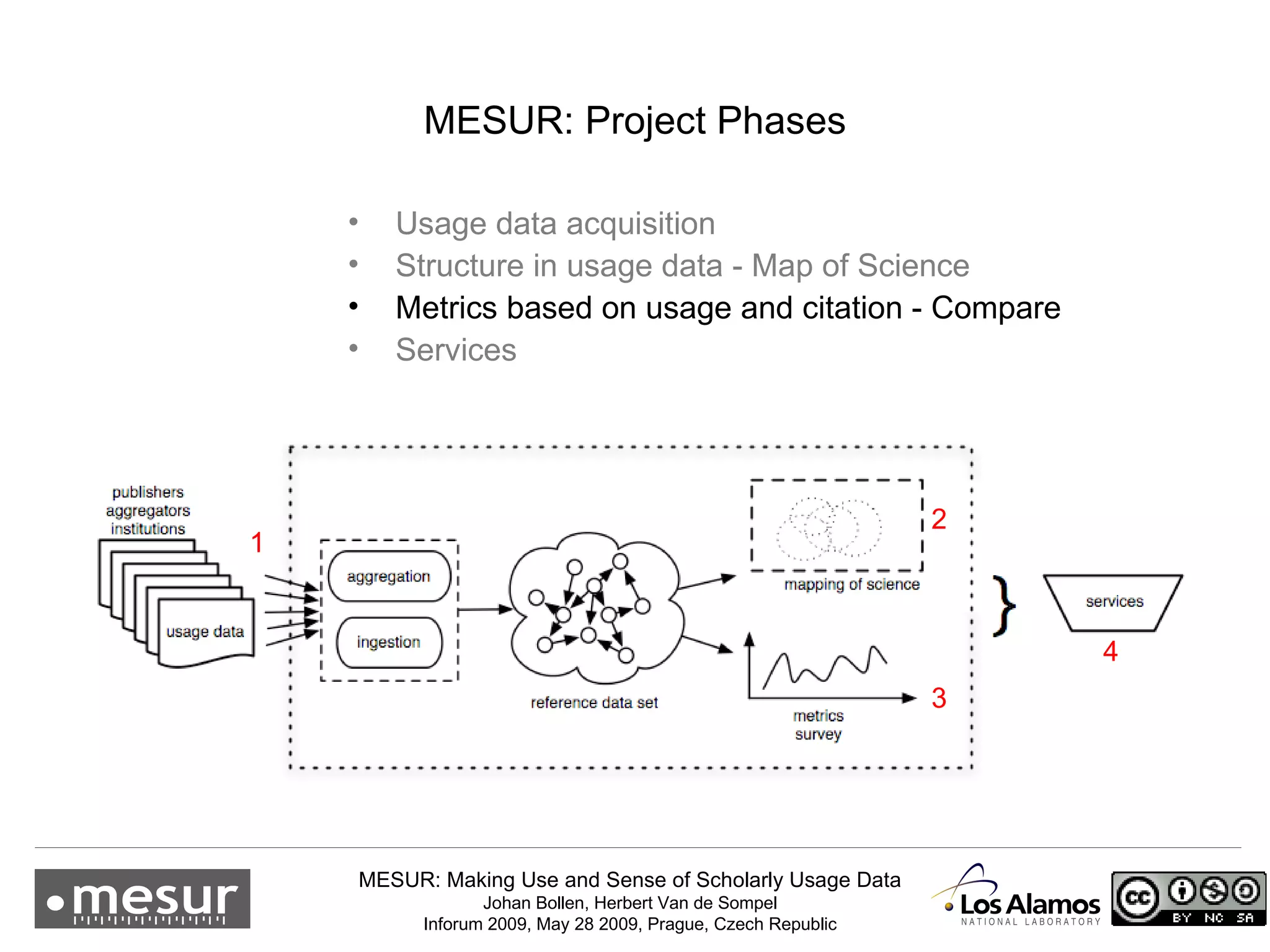
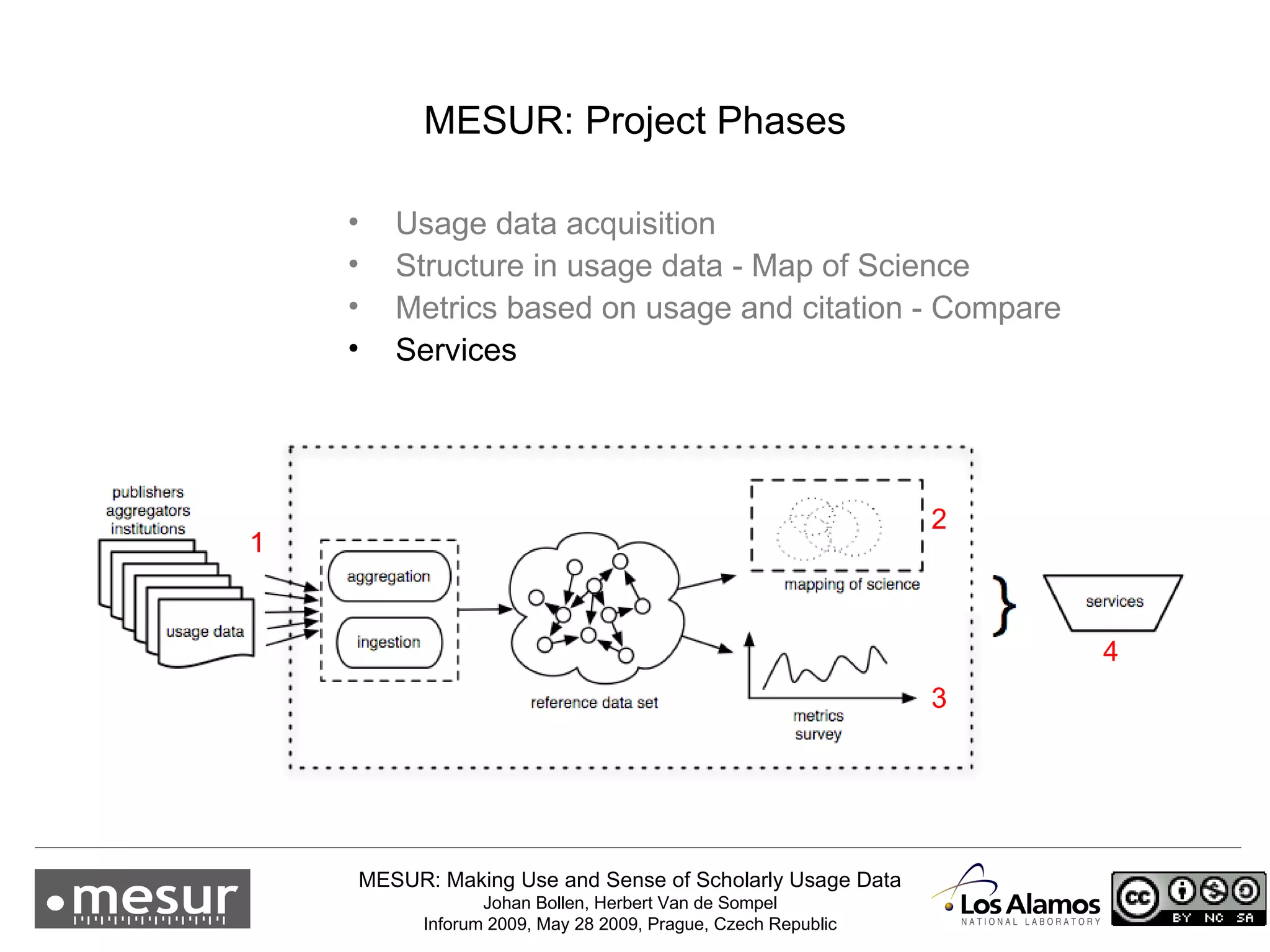
Usage data acquisition Structure in usage data - Map of Science Metrics based on usage and citation - Compare Services 1 2 3 4 MESUR: Project Phases
1 2 3 4 MESUR: Project Phases Usage data acquisition Structure in usage data - Map of Science Metrics based on usage and citation - Compare Services
How to Obtain 1,000,000,000 Usage Events? Politely ask publishers, aggregators, institutions  Scale: > 1,000,000,000 usage events Period: 2002-2007, but mostly 2006 Span: > 50M articles ; > 100,000 journals (inc. newspapers, magazines,…) Publishers, Aggregators, Linking Servers, Proxy Servers: BMC, Blackwell, UC, CSU (23), EBSCO, ELSEVIER, EMERALD, INGENTA, JSTOR, LANL, MIMAS/ZETOC, THOMSON, UPENN (9), UTEXAS Strict agreements regarding confidentiality of data
Some Minimal Requirements for Usage Data In order to be able to construct usage-based networks  Article level usage events Fields: unique session ID, date/time, unique document ID and/or metadata, request type
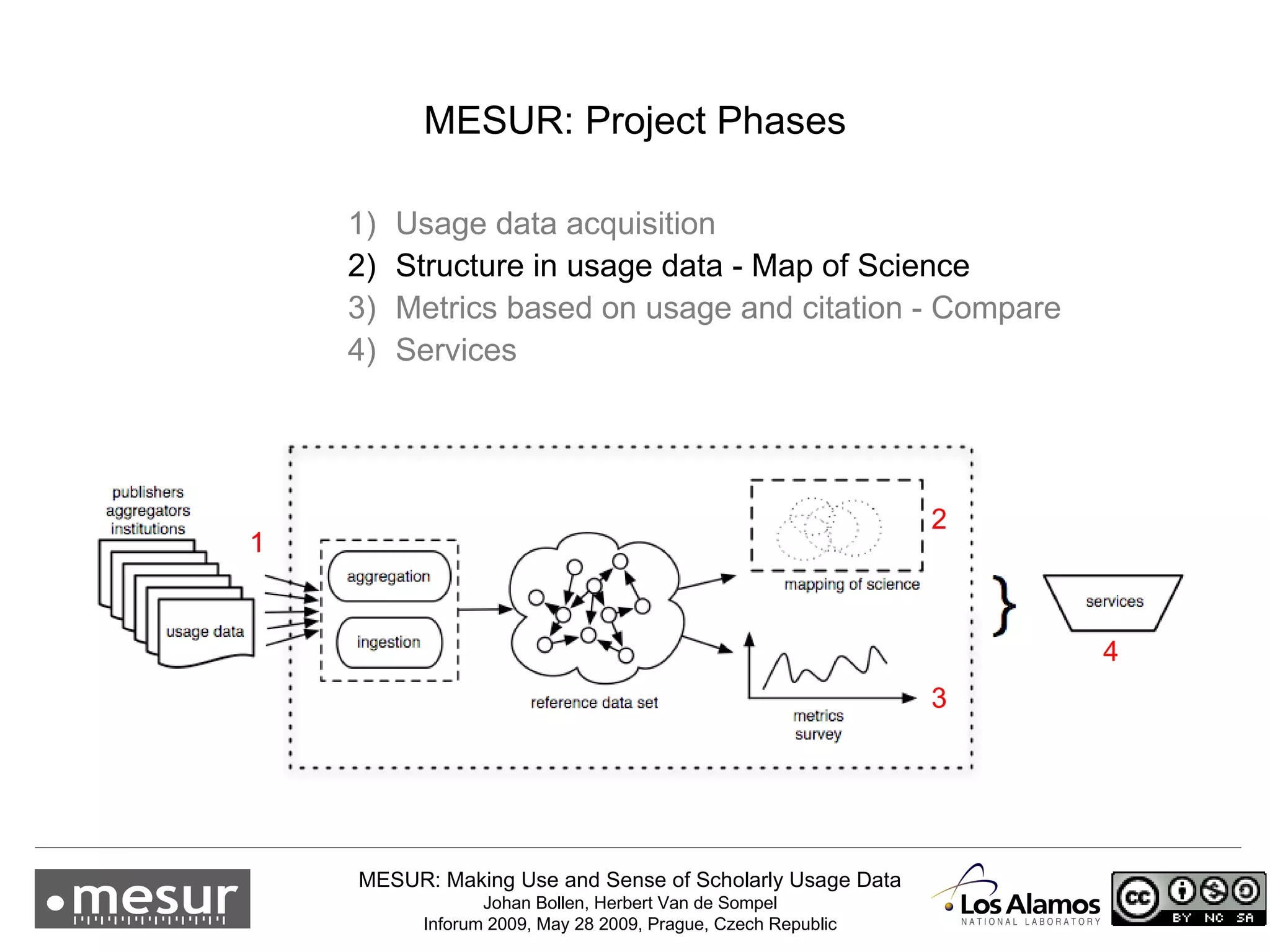
1 2 3 4 MESUR: Project Phases Usage data acquisition Structure in usage data - Map of Science Metrics based on usage and citation - Compare Services
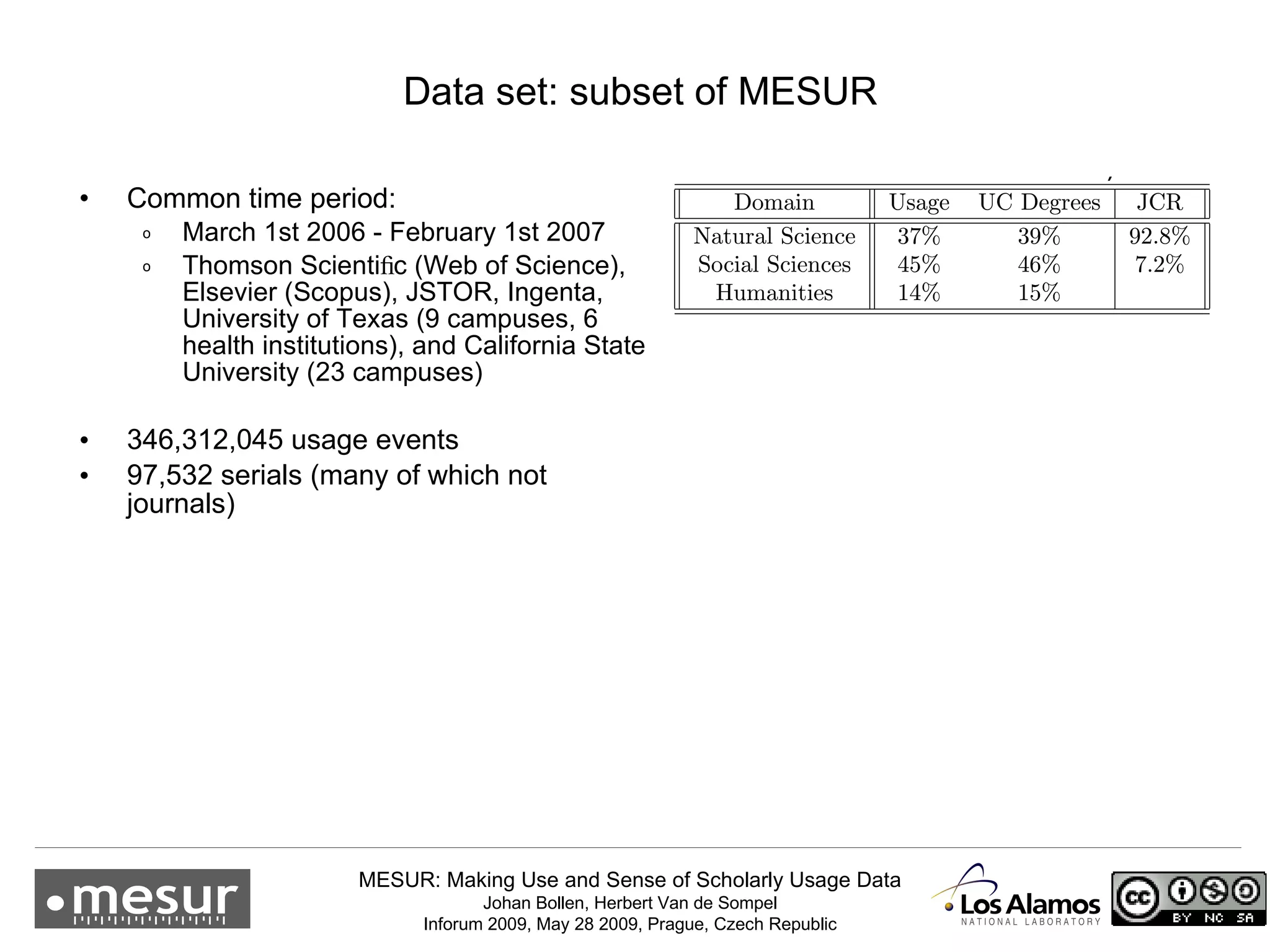
Data set: subset of MESUR Common time period: March 1st 2006 - February 1st 2007  Thomson Scientific (Web of Science), Elsevier (Scopus), JSTOR, Ingenta, University of Texas (9 campuses, 6 health institutions), and California State University (23 campuses) 346,312,045 usage events 97,532 serials (many of which not journals)
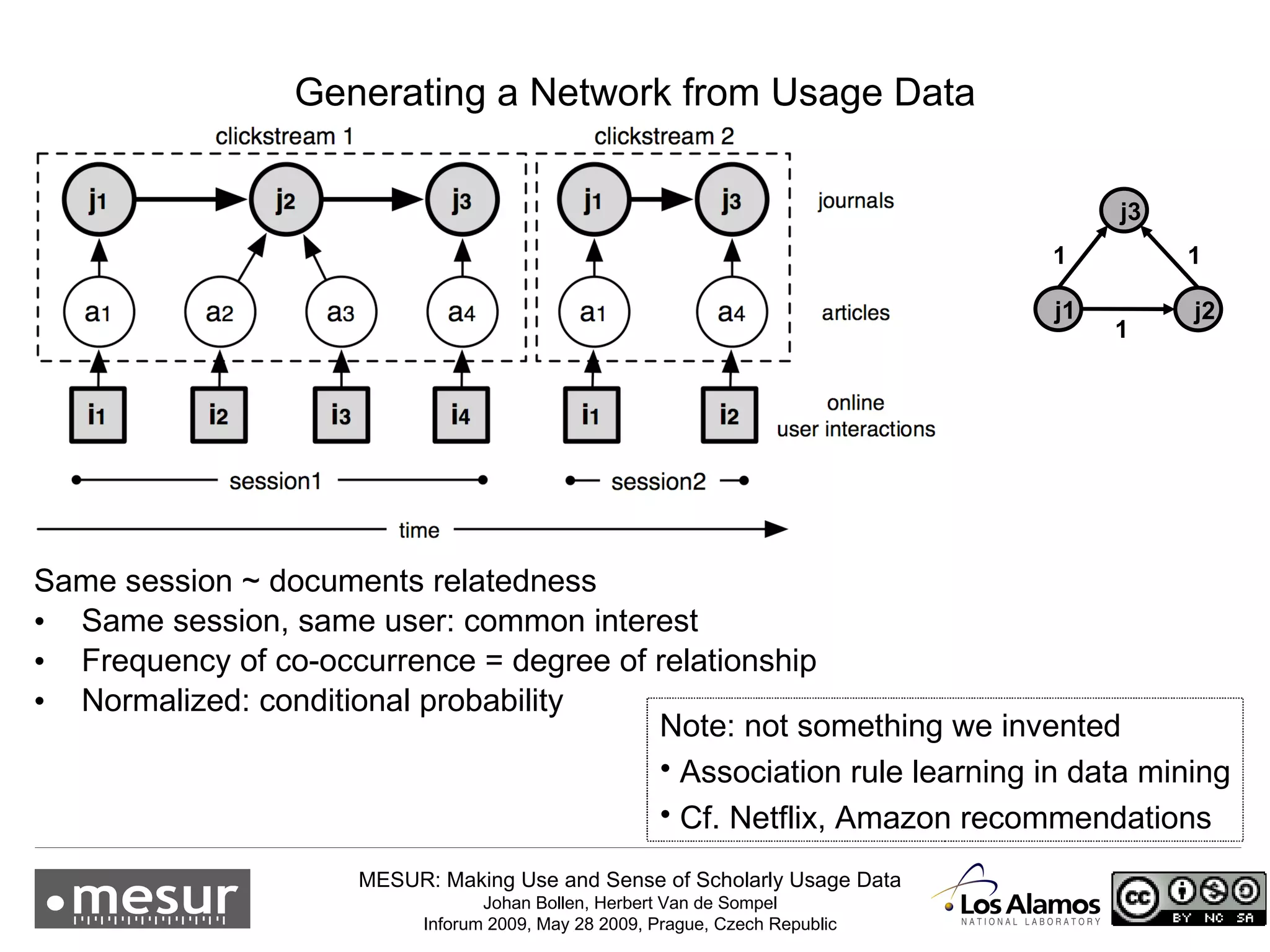
Same session ~ documents relatedness Same session, same user: common interest Frequency of co-occurrence = degree of relationship Normalized: conditional probability Generating a Network from Usage Data Note: not something we invented Association rule learning in data mining Cf. Netflix, Amazon recommendations j1 j2 j3 1 1 1
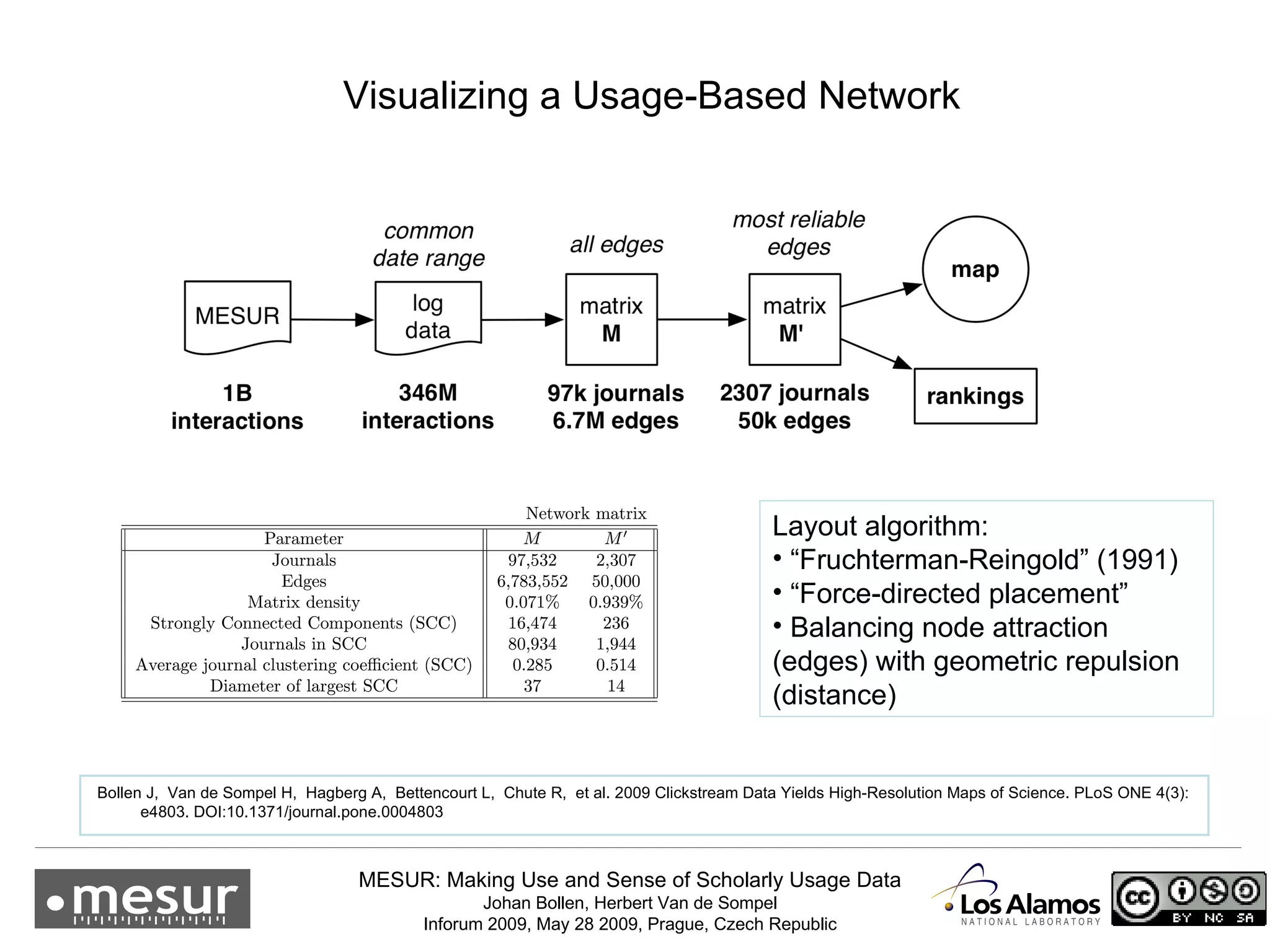
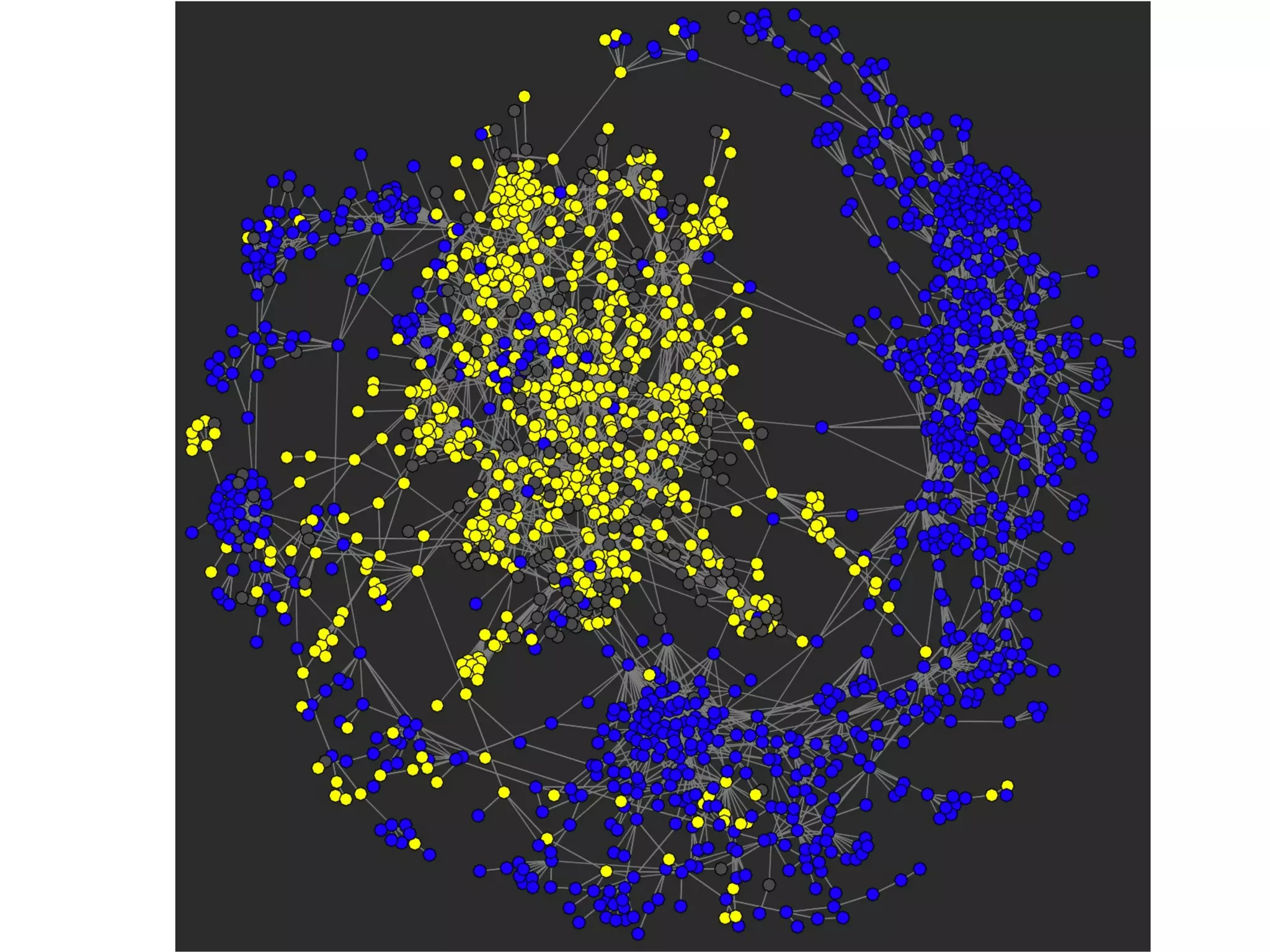
Visualizing a Usage-Based Network Layout algorithm: “ Fruchterman-Reingold” (1991) “ Force-directed placement” Balancing node attraction (edges) with geometric repulsion (distance)  Bollen J,  Van de Sompel H,  Hagberg A,  Bettencourt L,  Chute R,  et al. 2009 Clickstream Data Yields High-Resolution Maps of Science. PLoS ONE 4(3): e4803. DOI: 10.1371/journal.pone.0004803
 
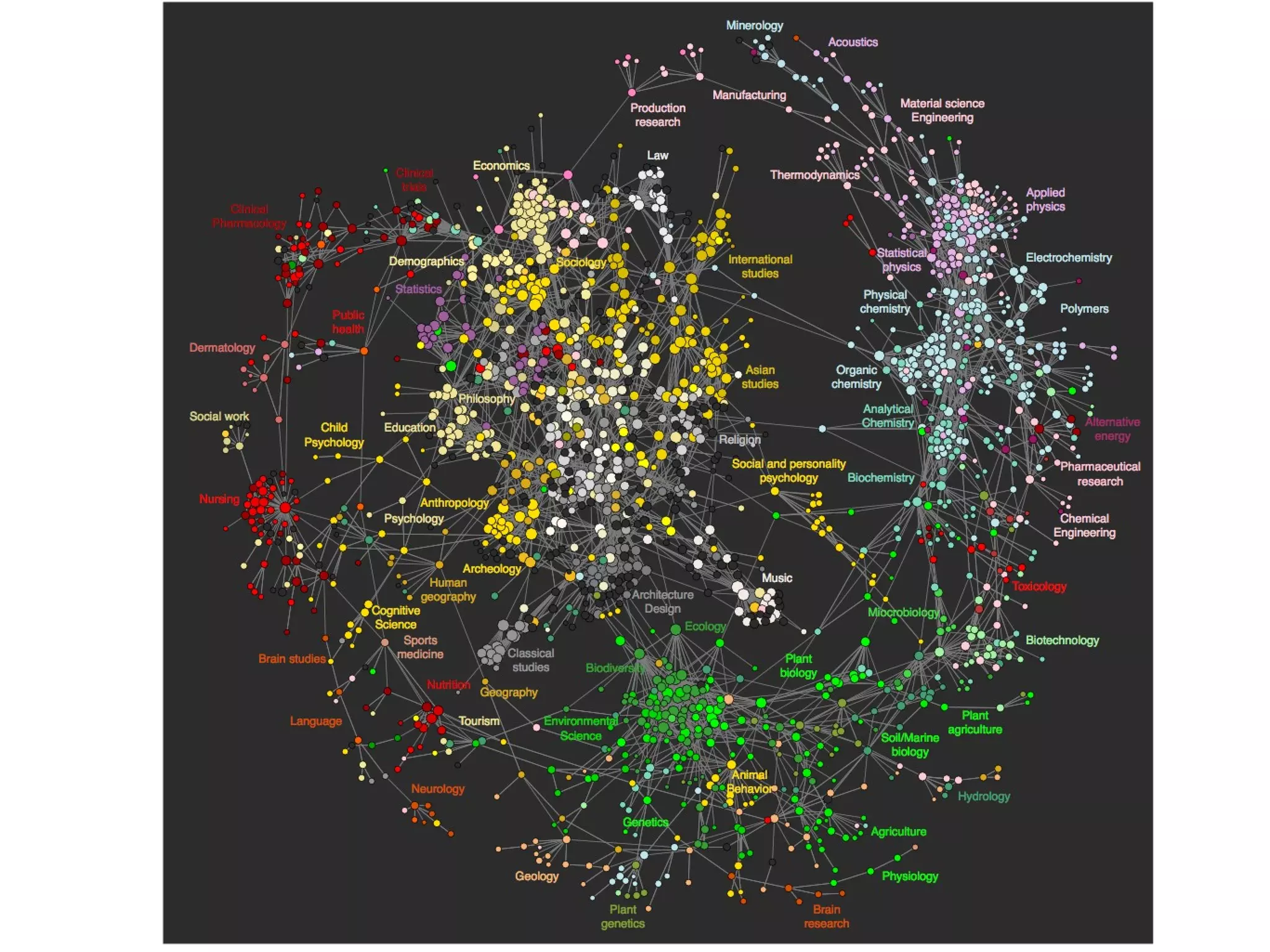
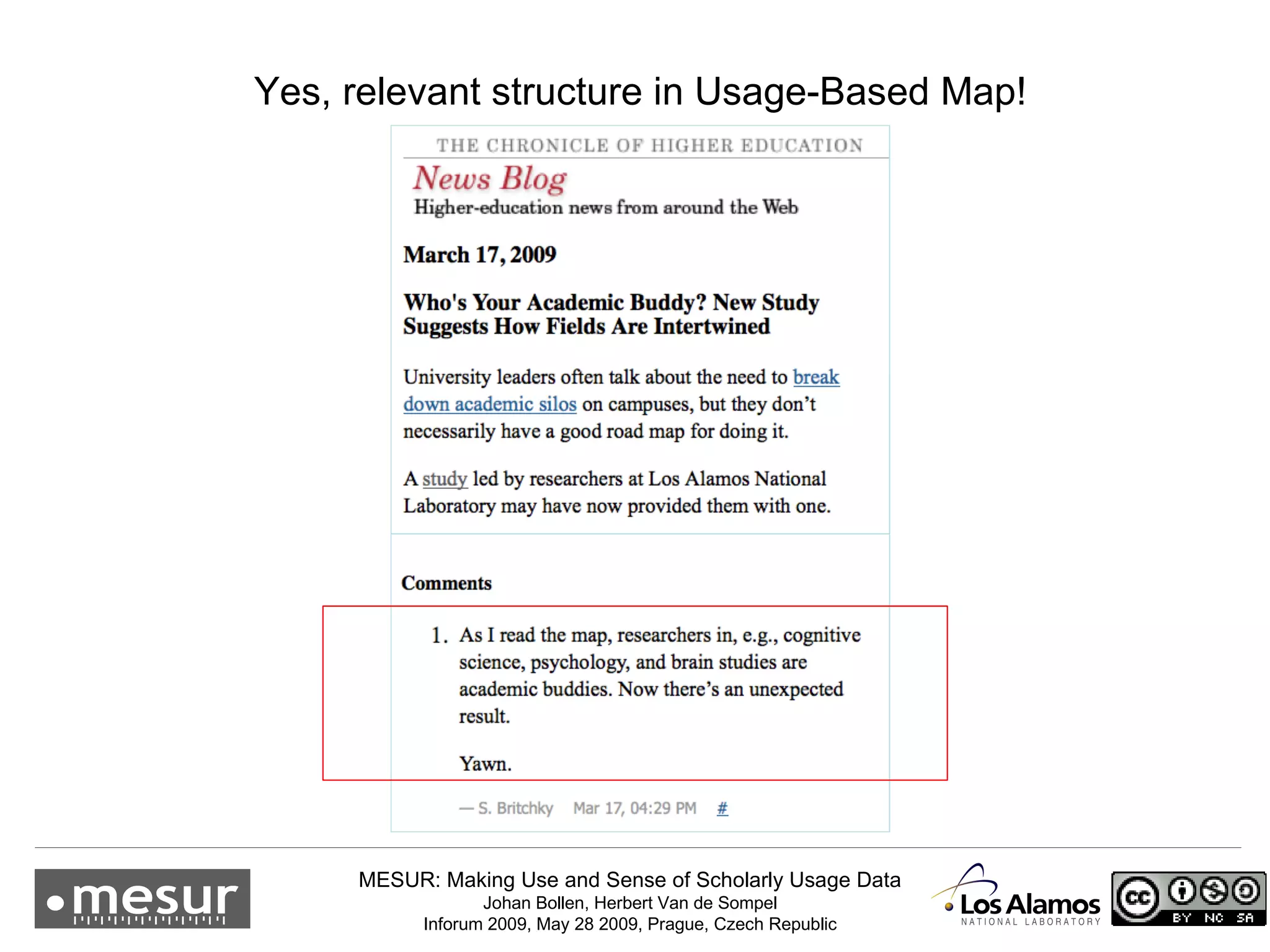
Yes, relevant structure in Usage-Based Map!
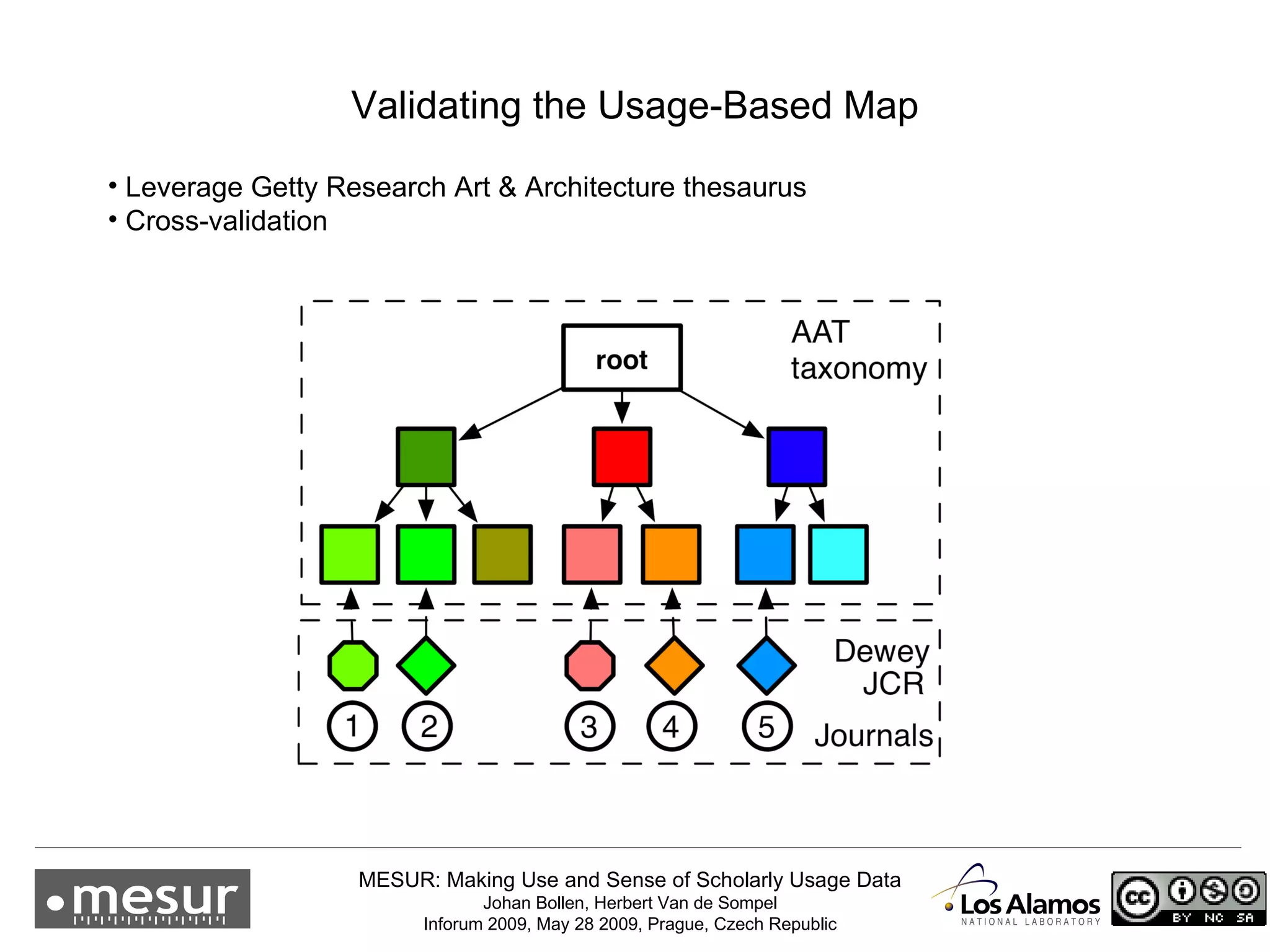
Validating the Usage-Based Map Leverage Getty Research Art & Architecture thesaurus Cross-validation
 
1 2 3 4 MESUR: Project Phases Usage data acquisition Structure in usage data - Map of Science Metrics based on usage and citation - Compare Services
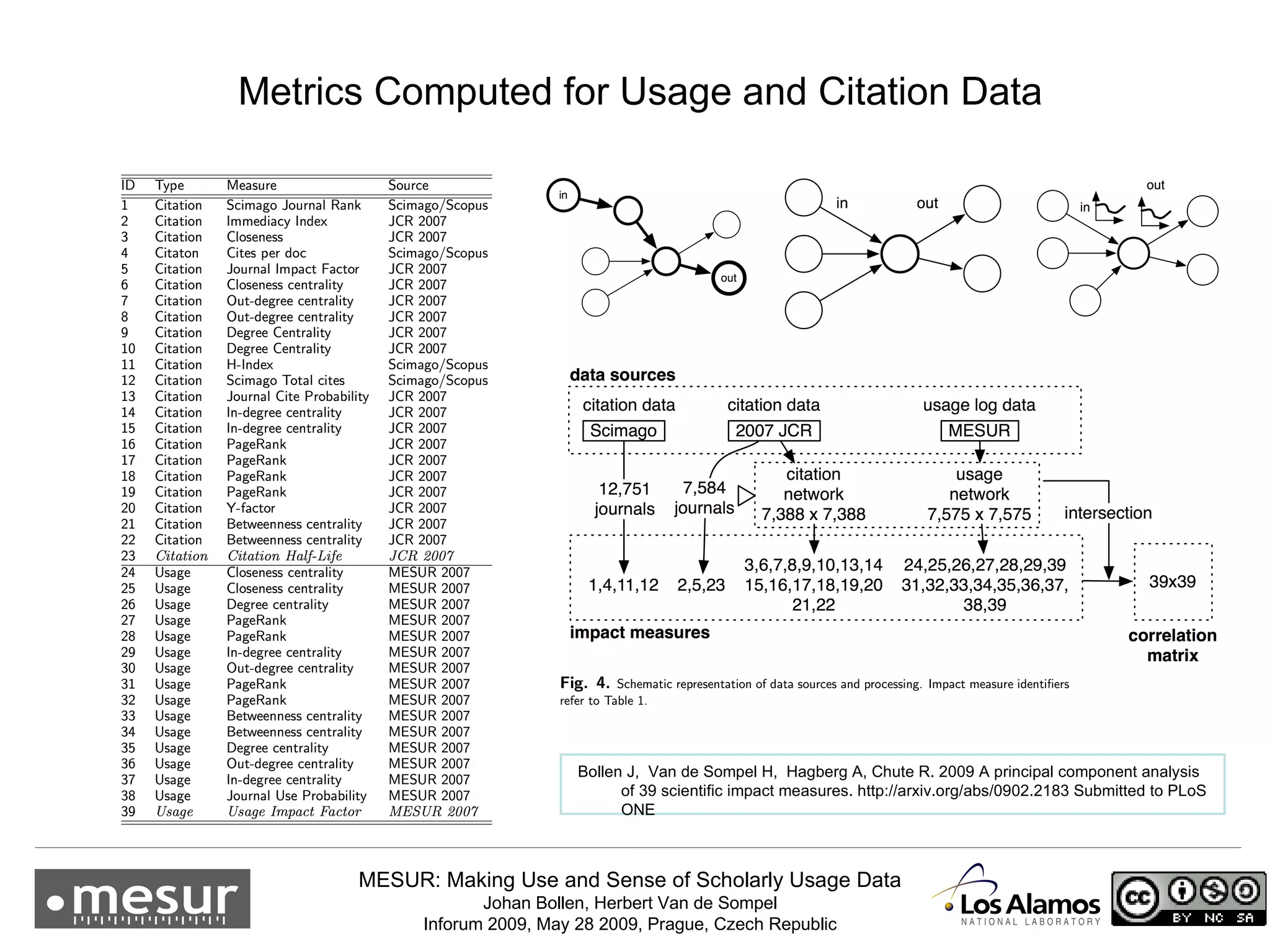
Metrics Computed for Usage and Citation Data Bollen J,  Van de Sompel H,  Hagberg A, Chute R. 2009 A principal component analysis of 39 scientific impact measures.  http://arxiv.org/abs/0902.2183  Submitted to PLoS ONE
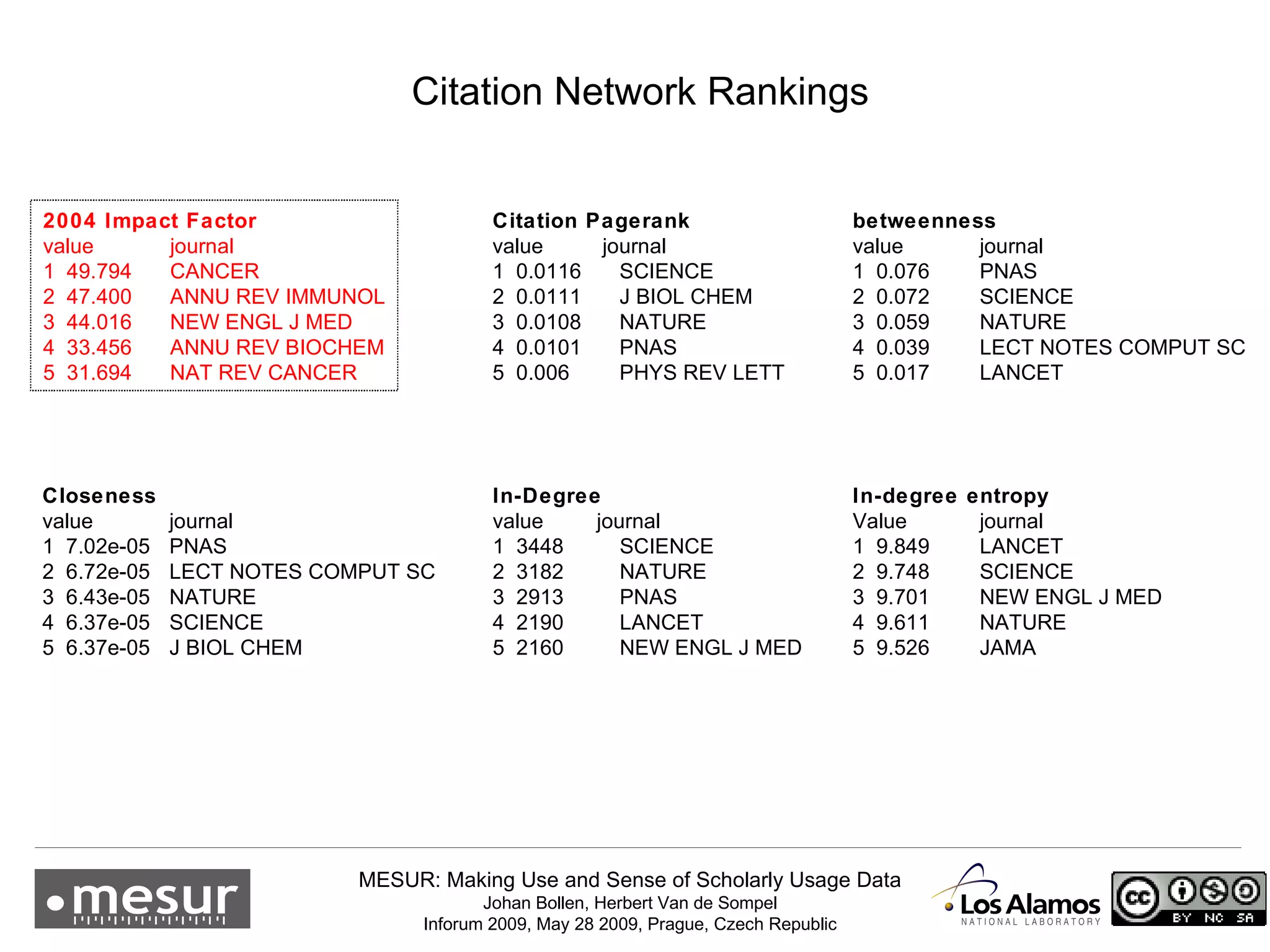
Citation Network Rankings 2004 Impact Factor value journal 1  49.794 CANCER 2  47.400 ANNU REV IMMUNOL 3  44.016 NEW ENGL J MED 4  33.456 ANNU REV BIOCHEM 5  31.694 NAT REV CANCER Citation Pagerank value  journal 1  0.0116 SCIENCE 2  0.0111 J BIOL CHEM 3  0.0108 NATURE 4  0.0101 PNAS 5  0.006 PHYS REV LETT betweenness value journal 1  0.076 PNAS 2  0.072 SCIENCE 3  0.059 NATURE 4  0.039 LECT NOTES COMPUT SC 5  0.017 LANCET Closeness value journal 1  7.02e-05 PNAS 2  6.72e-05 LECT NOTES COMPUT SC 3  6.43e-05 NATURE 4  6.37e-05 SCIENCE 5  6.37e-05 J BIOL CHEM In-Degree   value  journal 1  3448 SCIENCE 2  3182 NATURE 3  2913  PNAS 4  2190 LANCET 5  2160 NEW ENGL J MED In-degree entropy   Value journal 1  9.849 LANCET 2  9.748 SCIENCE 3  9.701 NEW ENGL J MED 4  9.611 NATURE 5  9.526 JAMA
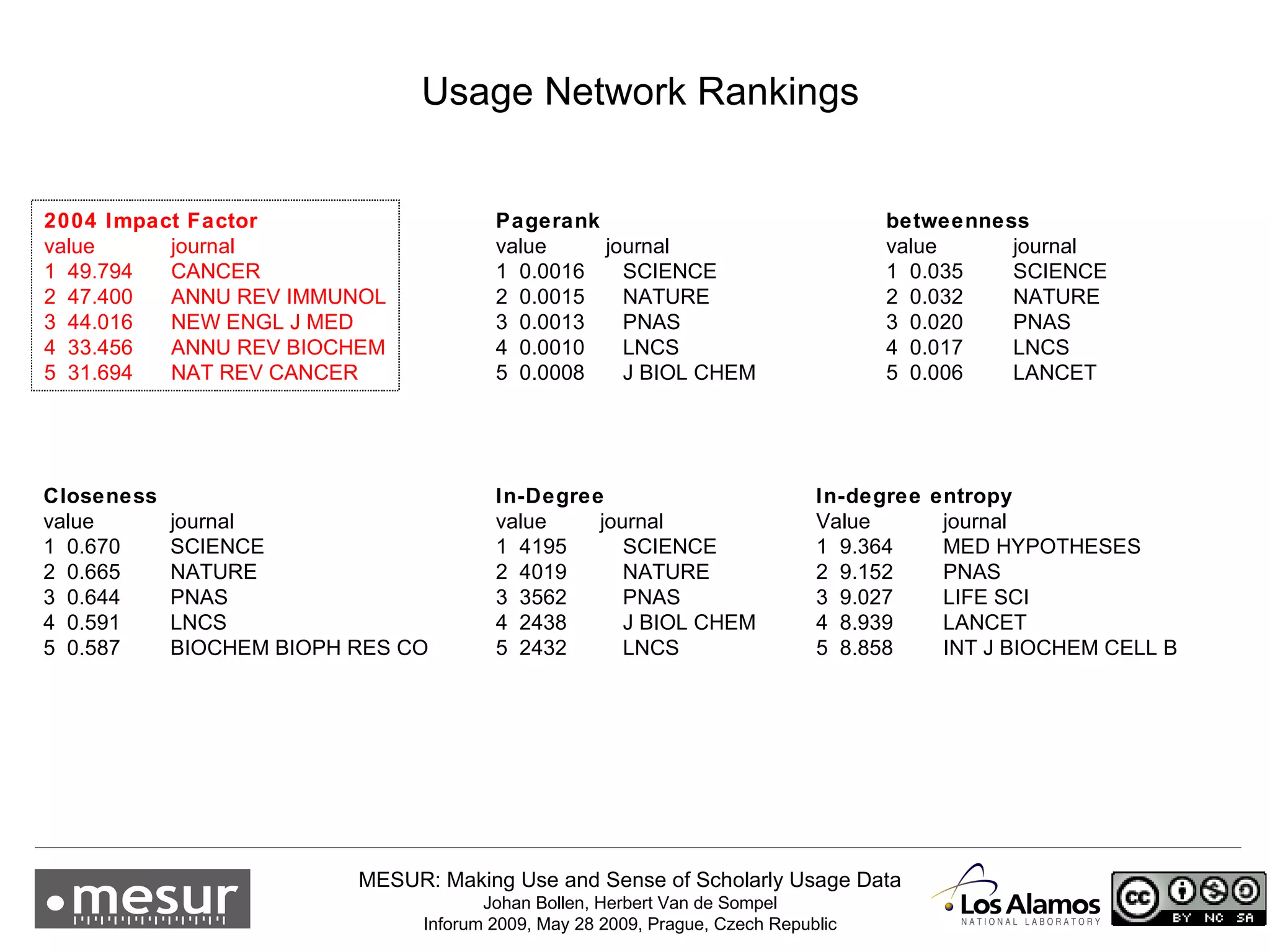
Usage Network Rankings In-Degree   value  journal 1  4195 SCIENCE 2  4019 NATURE 3  3562 PNAS 4  2438 J BIOL CHEM 5  2432  LNCS In-degree entropy   Value journal 1  9.364 MED HYPOTHESES 2  9.152 PNAS 3  9.027 LIFE SCI 4  8.939 LANCET 5  8.858 INT J BIOCHEM CELL B betweenness value journal 1  0.035 SCIENCE 2  0.032 NATURE 3  0.020 PNAS 4  0.017 LNCS 5  0.006 LANCET Closeness value journal 1  0.670 SCIENCE 2  0.665 NATURE 3  0.644 PNAS 4  0.591 LNCS 5  0.587 BIOCHEM BIOPH RES CO Pagerank value  journal 1  0.0016 SCIENCE 2  0.0015 NATURE 3  0.0013 PNAS 4  0.0010 LNCS 5  0.0008 J BIOL CHEM 2004 Impact Factor value journal 1  49.794 CANCER 2  47.400 ANNU REV IMMUNOL 3  44.016 NEW ENGL J MED 4  33.456 ANNU REV BIOCHEM 5  31.694 NAT REV CANCER
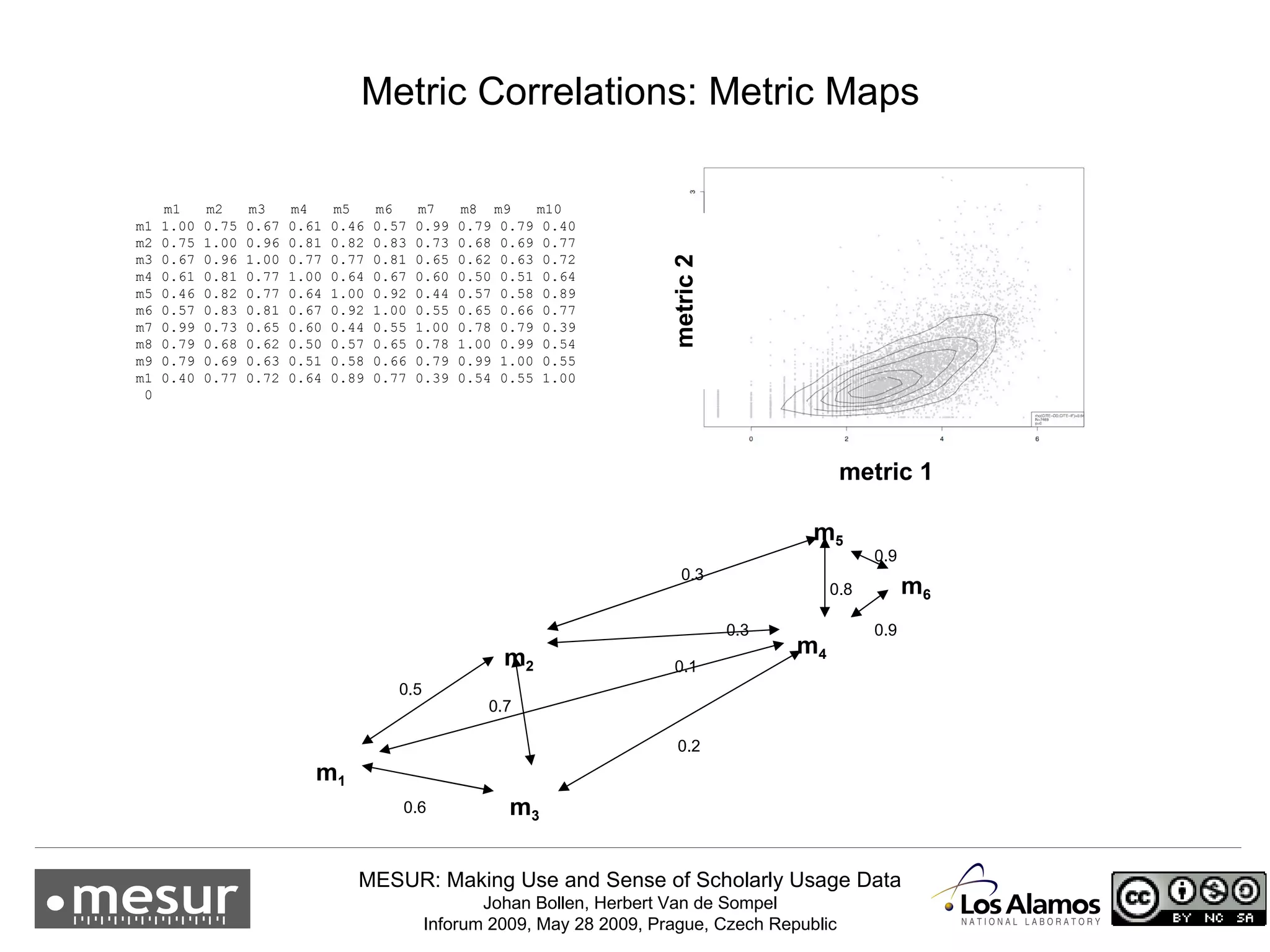
Metric Correlations: Metric Maps m 1 m1  m2  m3  m4  m5  m6  m7  m8  m9  m10 m1 1.00 0.75 0.67 0.61 0.46 0.57 0.99 0.79 0.79 0.40 m2 0.75 1.00 0.96 0.81 0.82 0.83 0.73 0.68 0.69 0.77 m3 0.67 0.96 1.00 0.77 0.77 0.81 0.65 0.62 0.63 0.72 m4 0.61 0.81 0.77 1.00 0.64 0.67 0.60 0.50 0.51 0.64 m5 0.46 0.82 0.77 0.64 1.00 0.92 0.44 0.57 0.58 0.89 m6 0.57 0.83 0.81 0.67 0.92 1.00 0.55 0.65 0.66 0.77 m7 0.99 0.73 0.65 0.60 0.44 0.55 1.00 0.78 0.79 0.39 m8 0.79 0.68 0.62 0.50 0.57 0.65 0.78 1.00 0.99 0.54 m9 0.79 0.69 0.63 0.51 0.58 0.66 0.79 0.99 1.00 0.55 m1 0.40 0.77 0.72 0.64 0.89 0.77 0.39 0.54 0.55 1.00 0 metric 1 metric 2 m 2 0.5 m 3 0.7 0.6 0.3 0.2 m 4 0.1 m 5 0.8 0.3 m 6 0.9 0.9
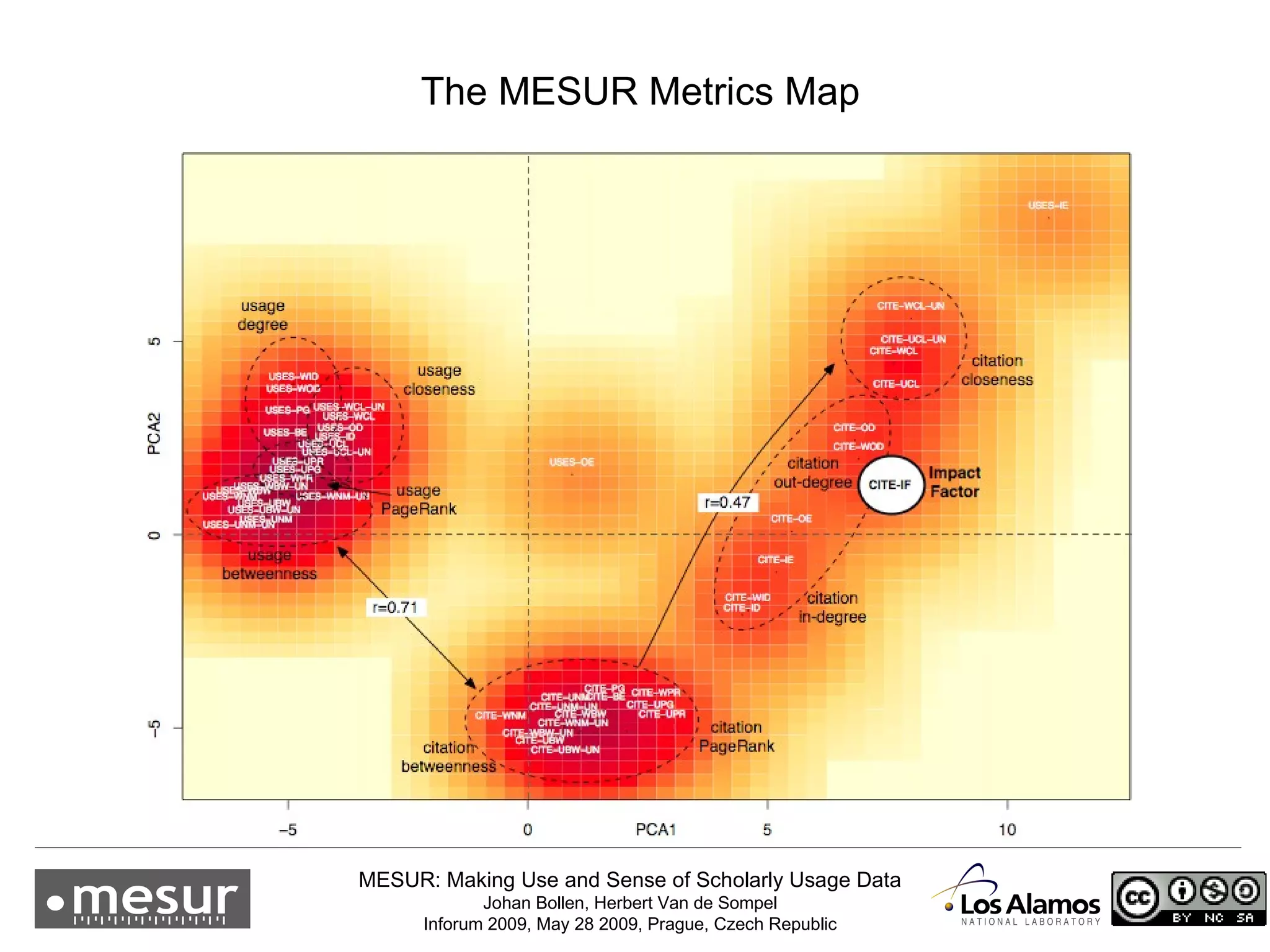
The MESUR Metrics Map
1 2 3 4 MESUR: Project Phases Usage data acquisition Structure in usage data - Map of Science Metrics based on usage and citation - Compare Services
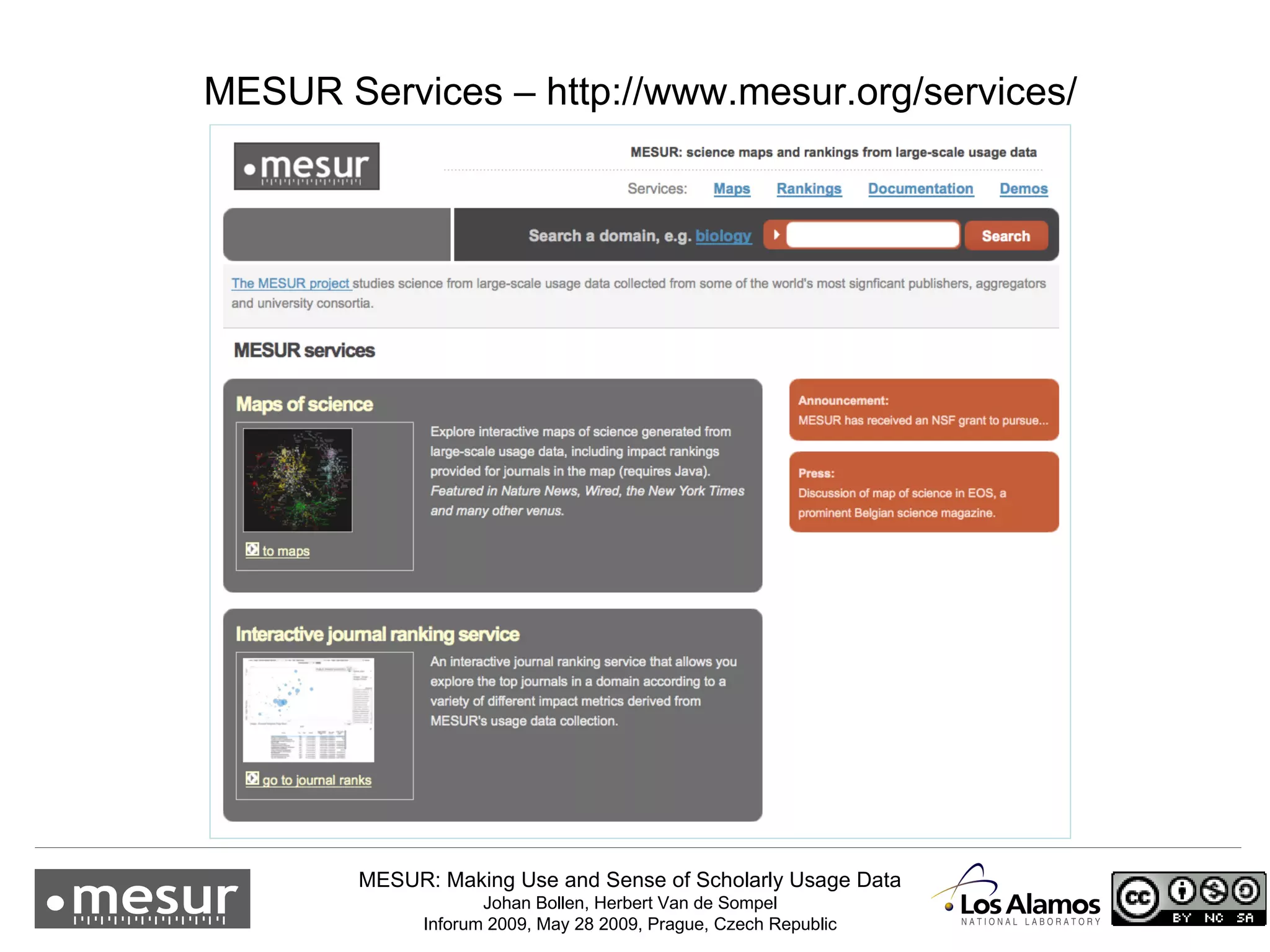
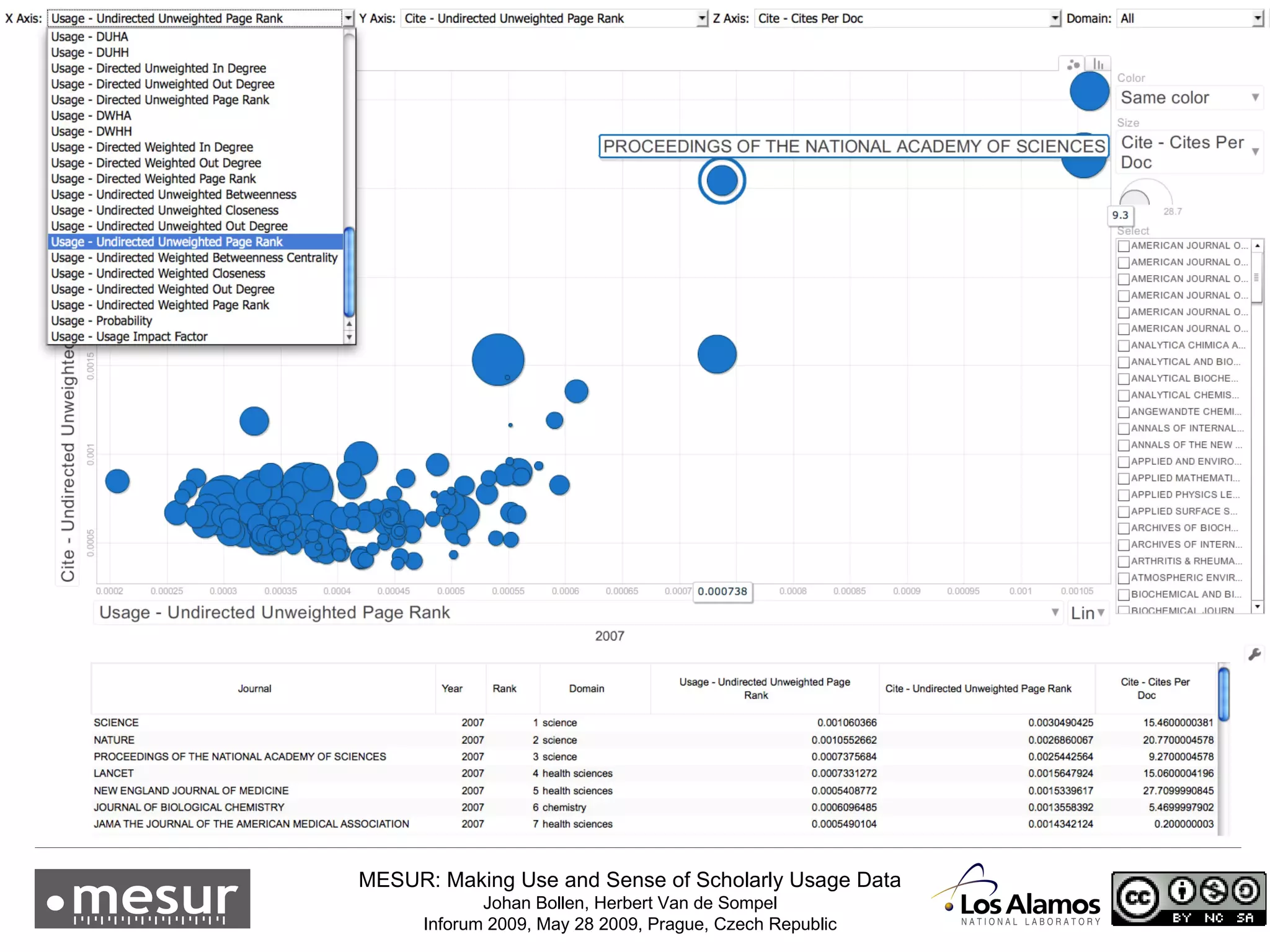
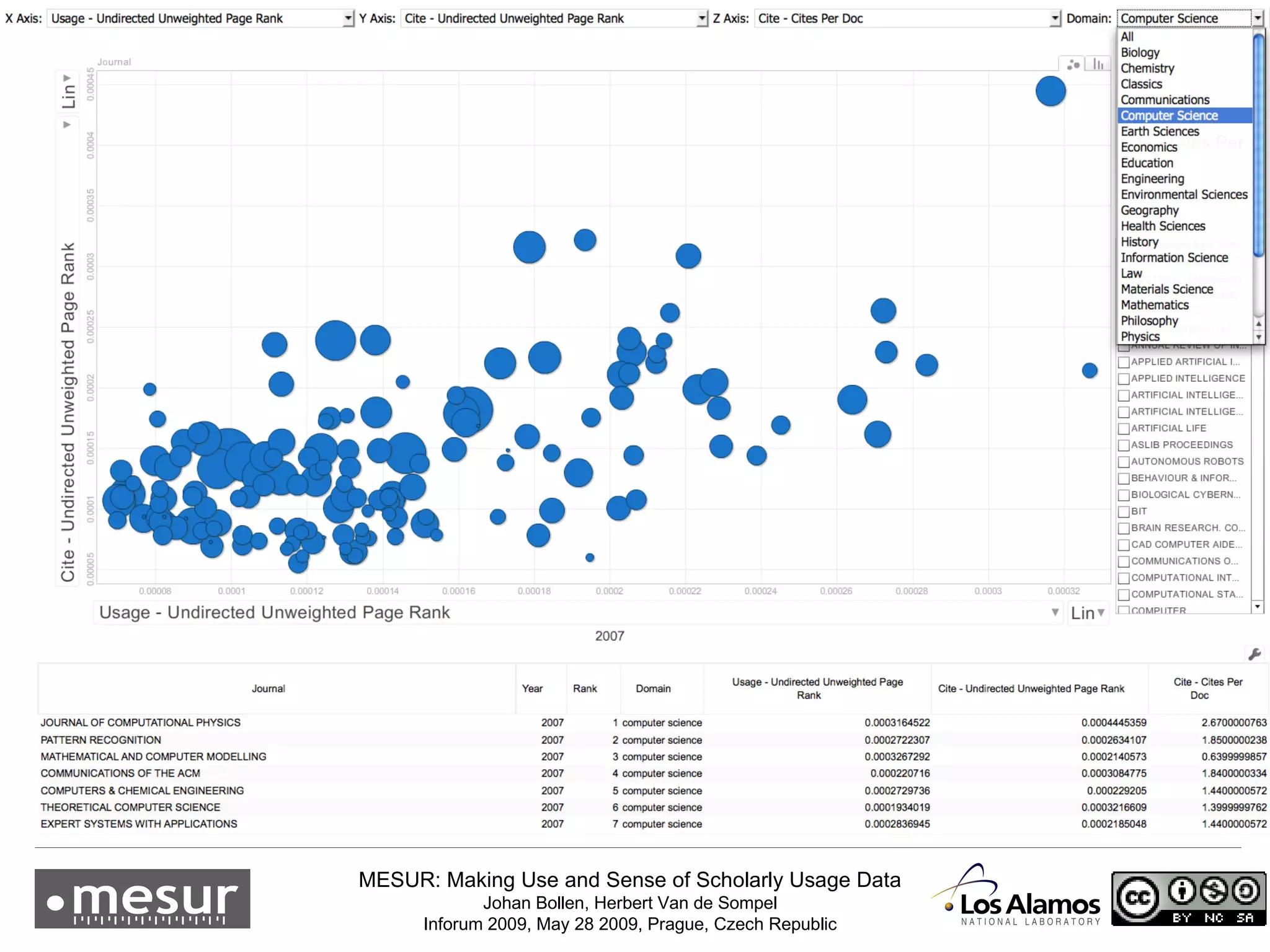
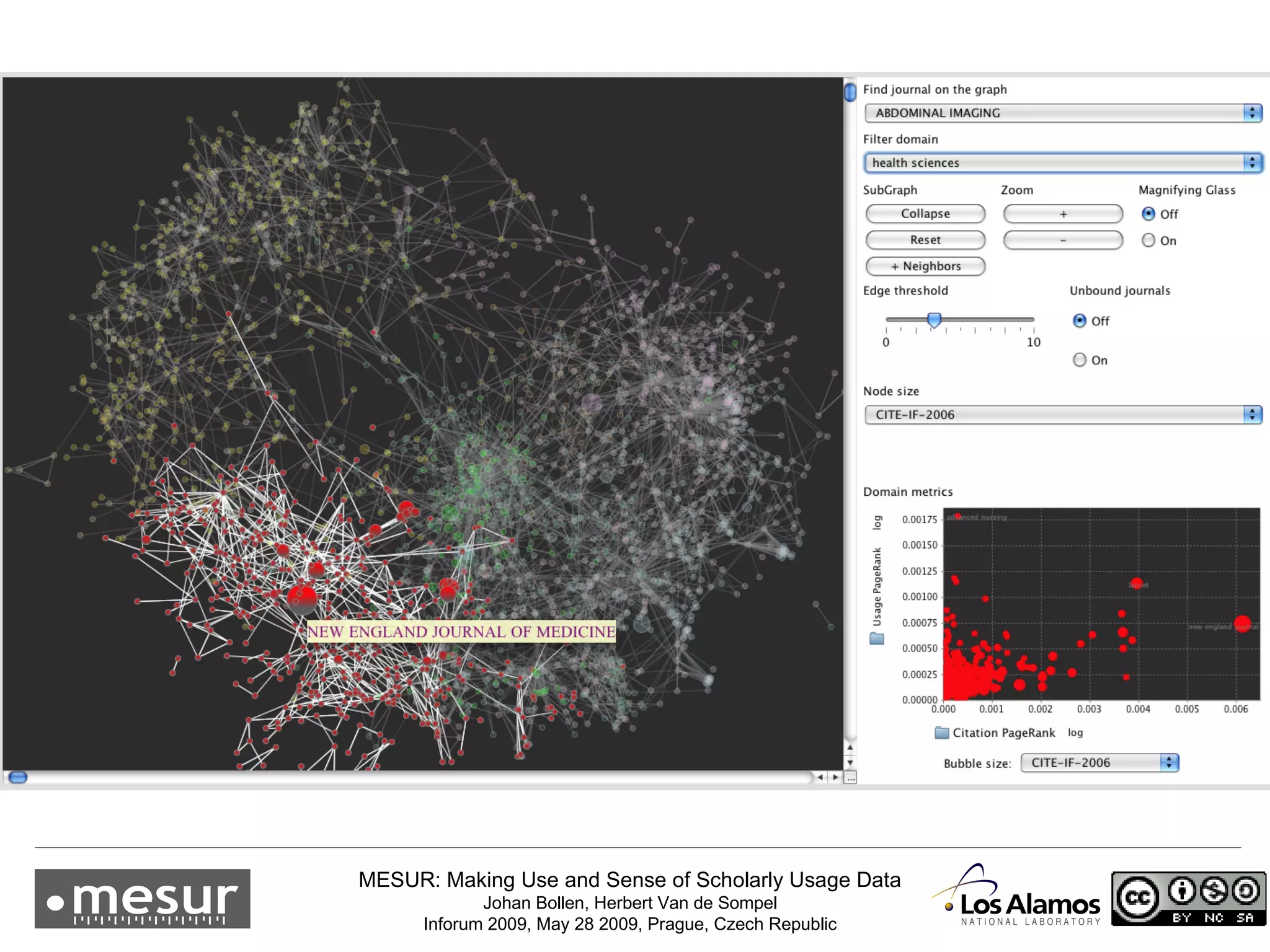
MESUR Services – http://www.mesur.org/services/
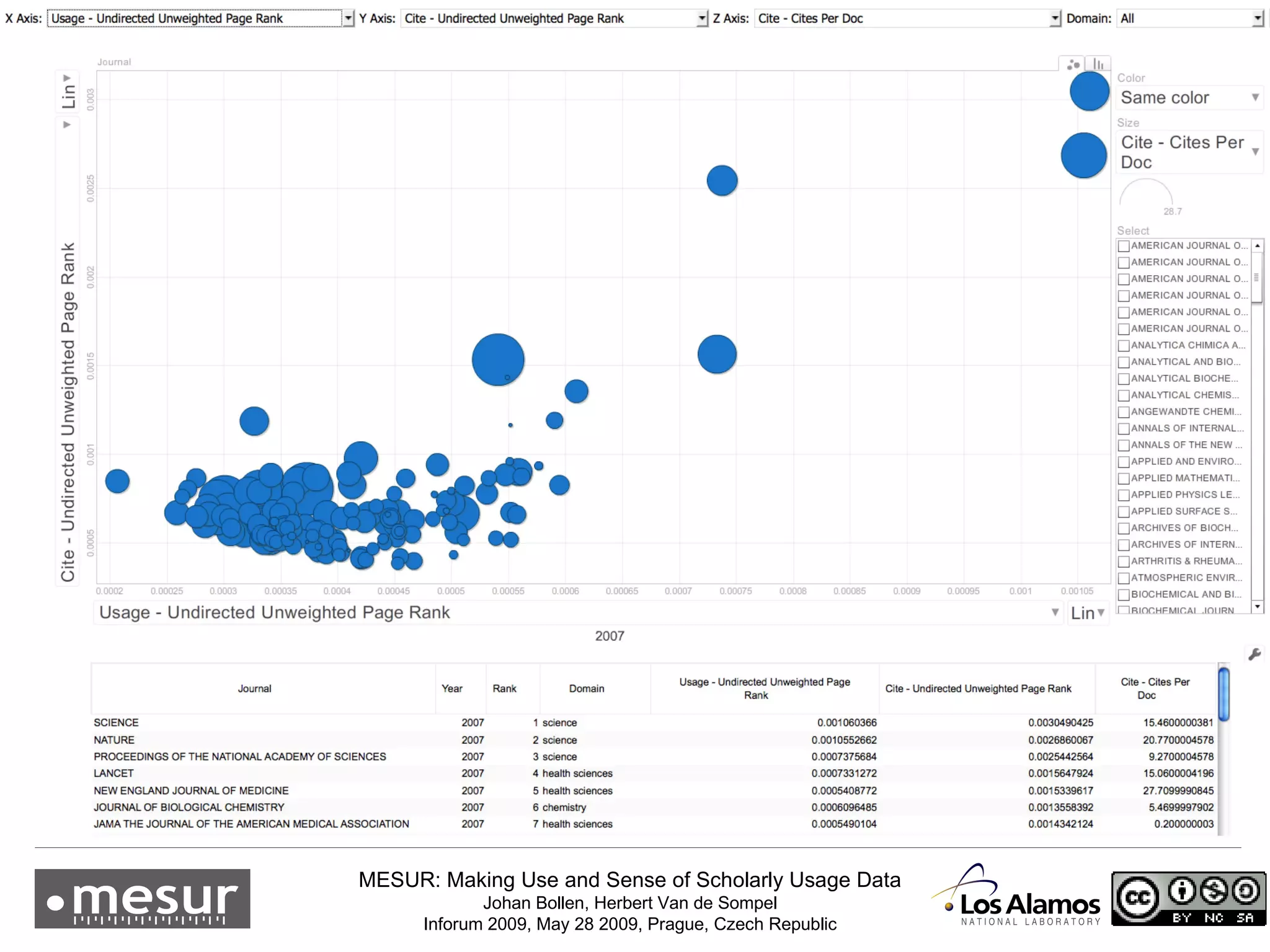
MESUR Services: Metrics Explorer
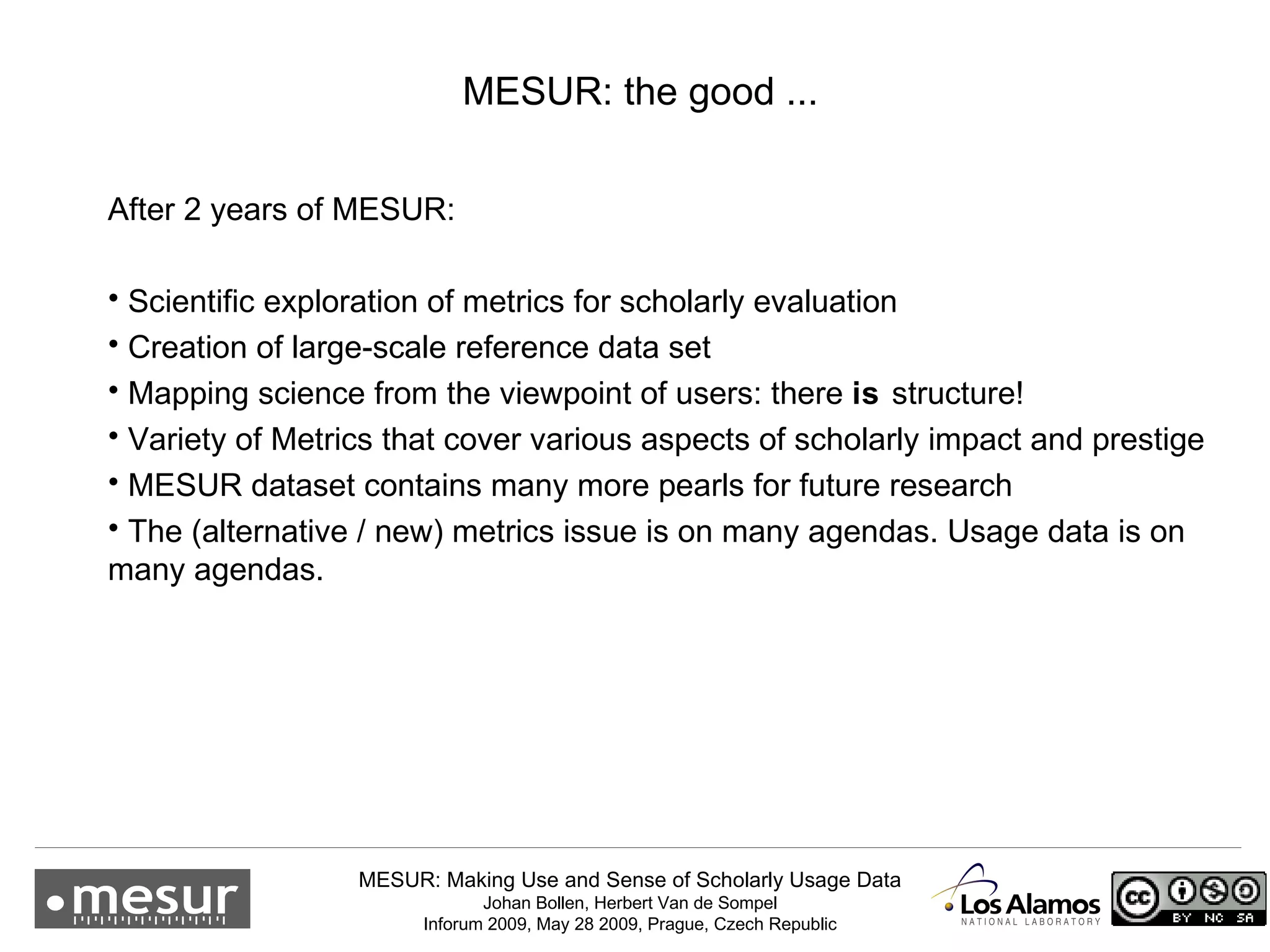
MESUR: the good ... After 2 years of MESUR: Scientific exploration of metrics for scholarly evaluation Creation of large-scale reference data set Mapping science from the viewpoint of users: there  is  structure! Variety of Metrics that cover various aspects of scholarly impact and prestige MESUR dataset contains many more pearls for future research The (alternative / new) metrics issue is on many agendas. Usage data is on many agendas.
Scalability of the approach: Lengthy negotiations to obtain log data No infrastructure standards: Recording, aggregating, normalization, ingestion, de-duplication,… No generally accepted policies: privacy, property, … No census data: when is a sample large and representative enough? Quality control: Bots, Crawlers (detectable but never perfect) Cheating, manipulation (easier with usage statistics than network metrics) Acceptance: Network-based usage metrics require session information. This is overlooked! As a result, will we end up with usage-based statistics only? MESUR: the bad and the ugly …
Publications related to MESUR Johan Bollen,  Herbert Van de Sompel, Aric Hagberg, Luis Bettencourt, Ryan Chute, Marko A. Rodriguez, Lyudmila Balakireva.  Clickstream data yields high-resolution maps of science.  PLoS One, March 2009. Johan Bollen, Herbert Van de Sompel, Aric HagBerg, Ryan Chute.  A principal component analysis of 39 scientific impact measures.   arXiv.org/abs/0902.2183 Johan Bollen, Herbert Van de Sompel, and Marko A. Rodriguez.  Towards usage-based impact metrics: first results from the MESUR project.  In Proceedings of the Joint Conference on Digital Libraries, Pittsburgh, June 2008 Marko A. Rodriguez, Johan Bollen and Herbert Van de Sompel.  A Practical Ontology for the Large-Scale Modeling of Scholarly Artifacts and their Usage,  In Proceedings of the Joint Conference on Digital Libraries, Vancouver, June 2007 Johan Bollen and Herbert Van de Sompel.  Usage Impact Factor: the effects of sample characteristics on  usage-based impact metrics.  (cs.DL/0610154) Johan Bollen and Herbert Van   de Sompel.  An architecture for the aggregation and analysis of scholarly usage data.  In Joint Conference on Digital Libraries (JCDL2006),  pages 298 - 307, June 2006. Johan Bollen and Herbert Van de Sompel.  Mapping the structure of science through usage.  Scientometrics, 69(2), 2006. Johan  Bollen, Marko A. Rodriguez, and Herbert Van de   Sompel.  Journal status.  Scientometrics, 69(3), December 2006 (arxiv.org:cs.DL/0601030)  Johan  Bollen, Herbert Van de Sompel, Joan Smith, and Rick Luce.  Toward alternative metrics of  journal impact: a comparison of download and citation data.  Information Processing and Management, 41(6):1419 - 1440, 2005.

MESUR: Making sense and use of usage data

  • 1.
    MESUR Making Useand Sense of Scholarly Usage Data <http://www.mesur.org> Johan Bollen - [email_address] Herbert Van de Sompel - herbertv@lanl.gov Digital Library Research & Prototyping Team Research Library Los Alamos National Laboratory, USA Acknowledgements: Marko A. Rodriguez (LANL), Ryan Chute (LANL), Lyudmila L. Balakireva (LANL), Aric Hagberg (LANL), Luis Bettencourt (LANL) The MESUR research was funded by the Andrew W. Mellon Foundation
  • 2.
    MESUR is ParadigmShift Material MESUR looks into new approaches to assess scholarly impact The Thomson Scientific IF was about the only metrics that could be computed in a paper-based era. But we don’t live in the paper-based era anymore. So MESUR researches metrics for the digital era: Usage-based metrics: Access to scholarly materials happens via networked systems, not via paper stored in libraries. Networked systems can record a great deal about access to materials; much more than libraries could about access to paper. Network-based metrics: Scholarly communication generates networks, e.g. citation networks, co-authorship networks, usage networks, … A wide variety of metrics can be computed for such networks; much more than simple citation counts.
  • 3.
    The Promise ofUsage Data Metrics based on usage data have significant potential Interactions be recorded for all digital scholarly content, i.e. papers, journals, preprints, blog postings, datasets, chemical structures, software, … Not just for ~ 10,000 journals Interactions reflects the activities of all users of scholarly information, not only of scholarly authors Interactions are recorded starting immediately after publication Not once read and cited (think publication delays) Rapid indicator of scholarly trends So the interest in usage data from projects such as COUNTER, Citebase, IKS and MESUR should not come as a surprise!
  • 4.
    And the ObviousChallenges of Usage Data Usage data comes with significant challenges What exactly is usage? E.g. various types of usage (download pdf, email abstract, …); impact of user interface on usage recordings, … Attention data would be a better term. Privacy concerns Aggregating item-level usage data across networked systems: Standardized recording Standardized aggregating Click-streams across networked systems How to deal with bots?
  • 5.
    Network-Based Metrics Wehave 50 years of network science available to us A wide variety of metrics has been proposed to characterize networks, and to assess the importance of nodes in a network E.g. social network analysis, small world graphs, graph theory, social modeling So when defining metrics for scholarly communication (clearly a network), we should probably leverage network science Cf. Google’s PageRank versus Alta Vista’s statistical ranking A network (and hence a network-based metric) takes context into account; a statistical count does not. Readings: Barabasi (2003) Linked. Wasserman (1994). Social network analysis.
  • 6.
    Classes of metrics:Degree Shortest path Random walk Distribution Degree In-degree Out-degree Shortest path Closeness Betweenness Newman Random walk PageRank Eigenvector Distribution In-degree entropy Out-degree entropy Bucket Entropy Network-Based Metrics
  • 7.
    PageRank computed onCitation Network 2003 JCR, Science Edition 5709 journals
  • 8.
    Create very large-scalereference data set Usage, citation and bibliographic data combined Various communities, various collections Investigate validity of usage data and usage-based metrics – focus on journals: Is there any significant structure in usage data? Compute a variety of journal metrics for usage data & cross-validate with other journal metrics, e.g. citation-based IF Deploy tools to explore usage-based journal metrics MESUR: A Thorough, Scientific Approach
  • 9.
    Usage data acquisitionStructure in usage data - Map of Science Metrics based on usage and citation - Compare Services 1 2 3 4 MESUR: Project Phases
  • 10.
    1 2 34 MESUR: Project Phases Usage data acquisition Structure in usage data - Map of Science Metrics based on usage and citation - Compare Services
  • 11.
    How to Obtain1,000,000,000 Usage Events? Politely ask publishers, aggregators, institutions Scale: > 1,000,000,000 usage events Period: 2002-2007, but mostly 2006 Span: > 50M articles ; > 100,000 journals (inc. newspapers, magazines,…) Publishers, Aggregators, Linking Servers, Proxy Servers: BMC, Blackwell, UC, CSU (23), EBSCO, ELSEVIER, EMERALD, INGENTA, JSTOR, LANL, MIMAS/ZETOC, THOMSON, UPENN (9), UTEXAS Strict agreements regarding confidentiality of data
  • 12.
    Some Minimal Requirementsfor Usage Data In order to be able to construct usage-based networks Article level usage events Fields: unique session ID, date/time, unique document ID and/or metadata, request type
  • 13.
    1 2 34 MESUR: Project Phases Usage data acquisition Structure in usage data - Map of Science Metrics based on usage and citation - Compare Services
  • 14.
    Data set: subsetof MESUR Common time period: March 1st 2006 - February 1st 2007 Thomson Scientific (Web of Science), Elsevier (Scopus), JSTOR, Ingenta, University of Texas (9 campuses, 6 health institutions), and California State University (23 campuses) 346,312,045 usage events 97,532 serials (many of which not journals)
  • 15.
    Same session ~documents relatedness Same session, same user: common interest Frequency of co-occurrence = degree of relationship Normalized: conditional probability Generating a Network from Usage Data Note: not something we invented Association rule learning in data mining Cf. Netflix, Amazon recommendations j1 j2 j3 1 1 1
  • 16.
    Visualizing a Usage-BasedNetwork Layout algorithm: “ Fruchterman-Reingold” (1991) “ Force-directed placement” Balancing node attraction (edges) with geometric repulsion (distance) Bollen J, Van de Sompel H, Hagberg A, Bettencourt L, Chute R, et al. 2009 Clickstream Data Yields High-Resolution Maps of Science. PLoS ONE 4(3): e4803. DOI: 10.1371/journal.pone.0004803
  • 17.
  • 18.
    Yes, relevant structurein Usage-Based Map!
  • 19.
    Validating the Usage-BasedMap Leverage Getty Research Art & Architecture thesaurus Cross-validation
  • 20.
  • 21.
    1 2 34 MESUR: Project Phases Usage data acquisition Structure in usage data - Map of Science Metrics based on usage and citation - Compare Services
  • 22.
    Metrics Computed forUsage and Citation Data Bollen J, Van de Sompel H, Hagberg A, Chute R. 2009 A principal component analysis of 39 scientific impact measures. http://arxiv.org/abs/0902.2183 Submitted to PLoS ONE
  • 23.
    Citation Network Rankings2004 Impact Factor value journal 1 49.794 CANCER 2 47.400 ANNU REV IMMUNOL 3 44.016 NEW ENGL J MED 4 33.456 ANNU REV BIOCHEM 5 31.694 NAT REV CANCER Citation Pagerank value journal 1 0.0116 SCIENCE 2 0.0111 J BIOL CHEM 3 0.0108 NATURE 4 0.0101 PNAS 5 0.006 PHYS REV LETT betweenness value journal 1 0.076 PNAS 2 0.072 SCIENCE 3 0.059 NATURE 4 0.039 LECT NOTES COMPUT SC 5 0.017 LANCET Closeness value journal 1 7.02e-05 PNAS 2 6.72e-05 LECT NOTES COMPUT SC 3 6.43e-05 NATURE 4 6.37e-05 SCIENCE 5 6.37e-05 J BIOL CHEM In-Degree value journal 1 3448 SCIENCE 2 3182 NATURE 3 2913 PNAS 4 2190 LANCET 5 2160 NEW ENGL J MED In-degree entropy Value journal 1 9.849 LANCET 2 9.748 SCIENCE 3 9.701 NEW ENGL J MED 4 9.611 NATURE 5 9.526 JAMA
  • 24.
    Usage Network RankingsIn-Degree value journal 1 4195 SCIENCE 2 4019 NATURE 3 3562 PNAS 4 2438 J BIOL CHEM 5 2432 LNCS In-degree entropy Value journal 1 9.364 MED HYPOTHESES 2 9.152 PNAS 3 9.027 LIFE SCI 4 8.939 LANCET 5 8.858 INT J BIOCHEM CELL B betweenness value journal 1 0.035 SCIENCE 2 0.032 NATURE 3 0.020 PNAS 4 0.017 LNCS 5 0.006 LANCET Closeness value journal 1 0.670 SCIENCE 2 0.665 NATURE 3 0.644 PNAS 4 0.591 LNCS 5 0.587 BIOCHEM BIOPH RES CO Pagerank value journal 1 0.0016 SCIENCE 2 0.0015 NATURE 3 0.0013 PNAS 4 0.0010 LNCS 5 0.0008 J BIOL CHEM 2004 Impact Factor value journal 1 49.794 CANCER 2 47.400 ANNU REV IMMUNOL 3 44.016 NEW ENGL J MED 4 33.456 ANNU REV BIOCHEM 5 31.694 NAT REV CANCER
  • 25.
    Metric Correlations: MetricMaps m 1 m1 m2 m3 m4 m5 m6 m7 m8 m9 m10 m1 1.00 0.75 0.67 0.61 0.46 0.57 0.99 0.79 0.79 0.40 m2 0.75 1.00 0.96 0.81 0.82 0.83 0.73 0.68 0.69 0.77 m3 0.67 0.96 1.00 0.77 0.77 0.81 0.65 0.62 0.63 0.72 m4 0.61 0.81 0.77 1.00 0.64 0.67 0.60 0.50 0.51 0.64 m5 0.46 0.82 0.77 0.64 1.00 0.92 0.44 0.57 0.58 0.89 m6 0.57 0.83 0.81 0.67 0.92 1.00 0.55 0.65 0.66 0.77 m7 0.99 0.73 0.65 0.60 0.44 0.55 1.00 0.78 0.79 0.39 m8 0.79 0.68 0.62 0.50 0.57 0.65 0.78 1.00 0.99 0.54 m9 0.79 0.69 0.63 0.51 0.58 0.66 0.79 0.99 1.00 0.55 m1 0.40 0.77 0.72 0.64 0.89 0.77 0.39 0.54 0.55 1.00 0 metric 1 metric 2 m 2 0.5 m 3 0.7 0.6 0.3 0.2 m 4 0.1 m 5 0.8 0.3 m 6 0.9 0.9
  • 26.
  • 27.
    1 2 34 MESUR: Project Phases Usage data acquisition Structure in usage data - Map of Science Metrics based on usage and citation - Compare Services
  • 28.
    MESUR Services –http://www.mesur.org/services/
  • 29.
  • 30.
  • 31.
  • 32.
  • 33.
    MESUR: the good... After 2 years of MESUR: Scientific exploration of metrics for scholarly evaluation Creation of large-scale reference data set Mapping science from the viewpoint of users: there is structure! Variety of Metrics that cover various aspects of scholarly impact and prestige MESUR dataset contains many more pearls for future research The (alternative / new) metrics issue is on many agendas. Usage data is on many agendas.
  • 34.
    Scalability of theapproach: Lengthy negotiations to obtain log data No infrastructure standards: Recording, aggregating, normalization, ingestion, de-duplication,… No generally accepted policies: privacy, property, … No census data: when is a sample large and representative enough? Quality control: Bots, Crawlers (detectable but never perfect) Cheating, manipulation (easier with usage statistics than network metrics) Acceptance: Network-based usage metrics require session information. This is overlooked! As a result, will we end up with usage-based statistics only? MESUR: the bad and the ugly …
  • 35.
    Publications related toMESUR Johan Bollen, Herbert Van de Sompel, Aric Hagberg, Luis Bettencourt, Ryan Chute, Marko A. Rodriguez, Lyudmila Balakireva. Clickstream data yields high-resolution maps of science. PLoS One, March 2009. Johan Bollen, Herbert Van de Sompel, Aric HagBerg, Ryan Chute. A principal component analysis of 39 scientific impact measures. arXiv.org/abs/0902.2183 Johan Bollen, Herbert Van de Sompel, and Marko A. Rodriguez. Towards usage-based impact metrics: first results from the MESUR project. In Proceedings of the Joint Conference on Digital Libraries, Pittsburgh, June 2008 Marko A. Rodriguez, Johan Bollen and Herbert Van de Sompel. A Practical Ontology for the Large-Scale Modeling of Scholarly Artifacts and their Usage, In Proceedings of the Joint Conference on Digital Libraries, Vancouver, June 2007 Johan Bollen and Herbert Van de Sompel. Usage Impact Factor: the effects of sample characteristics on usage-based impact metrics. (cs.DL/0610154) Johan Bollen and Herbert Van de Sompel. An architecture for the aggregation and analysis of scholarly usage data. In Joint Conference on Digital Libraries (JCDL2006), pages 298 - 307, June 2006. Johan Bollen and Herbert Van de Sompel. Mapping the structure of science through usage. Scientometrics, 69(2), 2006. Johan Bollen, Marko A. Rodriguez, and Herbert Van de Sompel. Journal status. Scientometrics, 69(3), December 2006 (arxiv.org:cs.DL/0601030) Johan Bollen, Herbert Van de Sompel, Joan Smith, and Rick Luce. Toward alternative metrics of journal impact: a comparison of download and citation data. Information Processing and Management, 41(6):1419 - 1440, 2005.