GEOGRAPHY OF MESOPOTAMIA
      Social Studies for 8th E.G.B.
       Teacher: Mauricio Torres
WATER IS LIFE
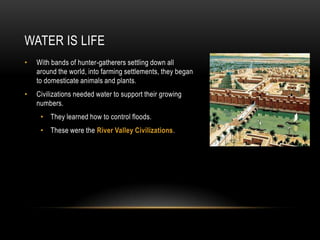
•   With bands of hunter-gatherers settling down all
    around the world, into farming settlements, they began
    to domesticate animals and plants.
•   Civilizations needed water to support their growing
    numbers.
     • They learned how to control floods.
     • These were the River Valley Civilizations.
THE LAND BETWEEN RIVERS
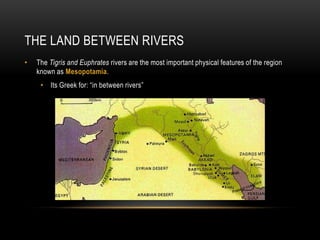
•   The Tigris and Euphrates rivers are the most important physical features of the region
    known as Mesopotamia.
     • Its Greek for: “in between rivers”
THE LAND BETWEEN RIVERS
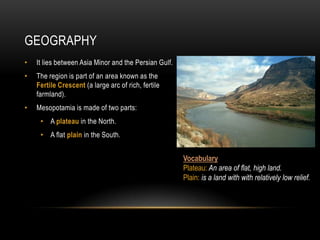
GEOGRAPHY
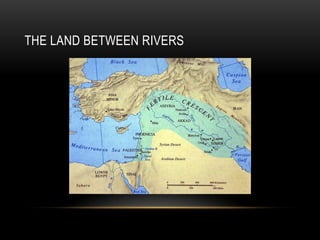
•   It lies between Asia Minor and the Persian Gulf.
•   The region is part of an area known as the
    Fertile Crescent (a large arc of rich, fertile
    farmland).
•   Mesopotamia is made of two parts:
     • A plateau in the North.
     • A flat plain in the South.


                                                       Vocabulary
                                                       Plateau: An area of flat, high land.
                                                       Plain: is a land with with relatively low relief.
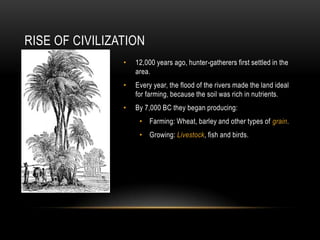
RISE OF CIVILIZATION
                •   12,000 years ago, hunter-gatherers first settled in the
                    area.
                •   Every year, the flood of the rivers made the land ideal
                    for farming, because the soil was rich in nutrients.
                •   By 7,000 BC they began producing:
                     • Farming: Wheat, barley and other types of grain.
                     • Growing: Livestock, fish and birds.
FARMING & CITIES
•   The first thing farmers needed, was to control
    water.
     • If it rained too much were the rivers
       began, floods would destroy crops, kill
       livestock and wash away everything.
     • It it didn’t, then crops dried up.
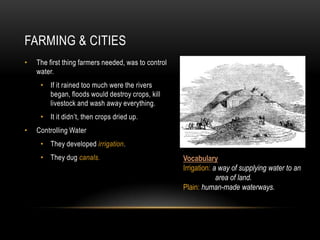
•   Controlling Water
     • They developed irrigation.
     • They dug canals.                              Vocabulary
                                                     Irrigation: a way of supplying water to an
                                                                  area of land.
                                                     Plain: human-made waterways.
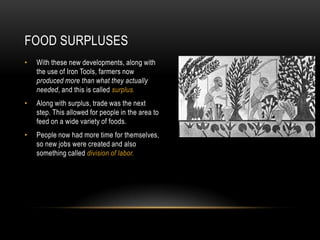
FOOD SURPLUSES
•   With these new developments, along with
    the use of Iron Tools, farmers now
    produced more than what they actually
    needed, and this is called surplus.
•   Along with surplus, trade was the next
    step. This allowed for people in the area to
    feed on a wide variety of foods.
•   People now had more time for themselves,
    so new jobs were created and also
    something called division of labor.
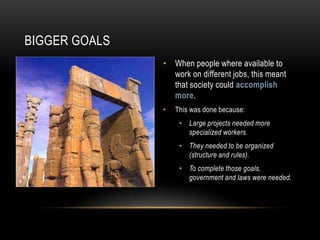
BIGGER GOALS
               • When people where available to
                 work on different jobs, this meant
                 that society could accomplish
                 more.
               •   This was done because:
                    • Large projects needed more
                      specialized workers.
                    • They needed to be organized
                      (structure and rules).
                    • To complete those goals,
                      government and laws were needed.
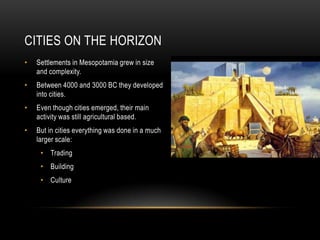
CITIES ON THE HORIZON
•   Settlements in Mesopotamia grew in size
    and complexity.
•   Between 4000 and 3000 BC they developed
    into cities.
•   Even though cities emerged, their main
    activity was still agricultural based.
•   But in cities everything was done in a much
    larger scale:
     • Trading
     • Building
     • Culture
ASK YOURSELF
(FOR FURTHER READING USE YOUR BOOKS, CHAPTER 3, SECTION 1)

•   Identify:
     • What does Mesopotamia mean?
     • What were the two rivers where it developed?
•   Explain:
     • What is the Fertile Crescent?
     • How did irrigation help farmers?
•   Summarize:
     • When, how and why were settlements established in Mesopotamia?
•   Analyze:
     • What effects did irrigation have on farming?
ASSIGNMENT!


• Type a paragraph describing your life in Mesopotamia as a
  farmer, and bring it for next class.
   • It hasn’t rained in a very long time, but you know the rainy
     season is coming.
   • What will you have to do in order to use the floods to your
     advantage?
   • Draw an image, beneath the paragraph, showing your home.
BIBLIOGRAPHY
•   Burstein, S. M., & Shek, R. (2012). World History (Teacher´s Edition) (1st Edition ed.). (H.
    McDougal, Ed.) Orlando, Florida, US.: Houghton Mifflin Harcourt Publishing Company.
•   Images taken from Google.com

Mesopotamian Geography

  • 1.
    GEOGRAPHY OF MESOPOTAMIA Social Studies for 8th E.G.B. Teacher: Mauricio Torres
  • 2.
    WATER IS LIFE • With bands of hunter-gatherers settling down all around the world, into farming settlements, they began to domesticate animals and plants. • Civilizations needed water to support their growing numbers. • They learned how to control floods. • These were the River Valley Civilizations.
  • 3.
    THE LAND BETWEENRIVERS • The Tigris and Euphrates rivers are the most important physical features of the region known as Mesopotamia. • Its Greek for: “in between rivers”
  • 4.
  • 5.
    GEOGRAPHY • It lies between Asia Minor and the Persian Gulf. • The region is part of an area known as the Fertile Crescent (a large arc of rich, fertile farmland). • Mesopotamia is made of two parts: • A plateau in the North. • A flat plain in the South. Vocabulary Plateau: An area of flat, high land. Plain: is a land with with relatively low relief.
  • 6.
    RISE OF CIVILIZATION • 12,000 years ago, hunter-gatherers first settled in the area. • Every year, the flood of the rivers made the land ideal for farming, because the soil was rich in nutrients. • By 7,000 BC they began producing: • Farming: Wheat, barley and other types of grain. • Growing: Livestock, fish and birds.
  • 7.
    FARMING & CITIES • The first thing farmers needed, was to control water. • If it rained too much were the rivers began, floods would destroy crops, kill livestock and wash away everything. • It it didn’t, then crops dried up. • Controlling Water • They developed irrigation. • They dug canals. Vocabulary Irrigation: a way of supplying water to an area of land. Plain: human-made waterways.
  • 8.
    FOOD SURPLUSES • With these new developments, along with the use of Iron Tools, farmers now produced more than what they actually needed, and this is called surplus. • Along with surplus, trade was the next step. This allowed for people in the area to feed on a wide variety of foods. • People now had more time for themselves, so new jobs were created and also something called division of labor.
  • 9.
    BIGGER GOALS • When people where available to work on different jobs, this meant that society could accomplish more. • This was done because: • Large projects needed more specialized workers. • They needed to be organized (structure and rules). • To complete those goals, government and laws were needed.
  • 10.
    CITIES ON THEHORIZON • Settlements in Mesopotamia grew in size and complexity. • Between 4000 and 3000 BC they developed into cities. • Even though cities emerged, their main activity was still agricultural based. • But in cities everything was done in a much larger scale: • Trading • Building • Culture
  • 11.
    ASK YOURSELF (FOR FURTHERREADING USE YOUR BOOKS, CHAPTER 3, SECTION 1) • Identify: • What does Mesopotamia mean? • What were the two rivers where it developed? • Explain: • What is the Fertile Crescent? • How did irrigation help farmers? • Summarize: • When, how and why were settlements established in Mesopotamia? • Analyze: • What effects did irrigation have on farming?
  • 12.
    ASSIGNMENT! • Type aparagraph describing your life in Mesopotamia as a farmer, and bring it for next class. • It hasn’t rained in a very long time, but you know the rainy season is coming. • What will you have to do in order to use the floods to your advantage? • Draw an image, beneath the paragraph, showing your home.
  • 13.
    BIBLIOGRAPHY • Burstein, S. M., & Shek, R. (2012). World History (Teacher´s Edition) (1st Edition ed.). (H. McDougal, Ed.) Orlando, Florida, US.: Houghton Mifflin Harcourt Publishing Company. • Images taken from Google.com