Mesh Tensorflow
2019/3/4 kuroko1t
自己紹介
kuroko(@kuroko1t)
● 仕事
○ 前は..次世代スパコンの CPUの論理回路設計
○ 最近は..深層学習向けフレームワークの調査したり( Tensorflow,horovod...)
● その他
○ GoでDeep Learningを試みたり(link)
○ horovodの記事書いてみたり (Qiita)
○ horovodにTensorflowのeager対応のPRだしたり
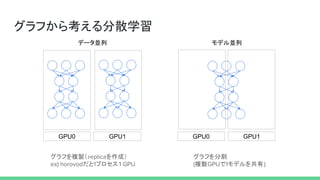
グラフから考える分散学習
データ並列 モデル並列
グラフを複製(replicaを作成)
ex) horovodだと1プロセス1GPU
GPU0 GPU1 GPU0 GPU1
グラフを分割
(複数GPUで1モデルを共有)
Mesh Tensorflowって?
● データ並列,モデル並列両方をカバー
● python only
● DNNモデル
○ Mesh Tensorflowのメインターゲットは Transformer
■ 言語モデルのパラメータが5億近くなってきていて,モデル並列しないと計算できない
○ exampleにはmnist(cnn)のみ
● 独自の演算API
○ 本家Tensorflowとは異なるAPIを用いる
● single Process
Mesh Tensorflowの概念
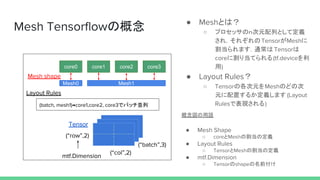
概念図の用語
● Mesh Shape
○ coreとMeshの割当の定義
● Layout Rules
○ TensorとMeshの割当の定義
● mtf.Dimension
○ Tensorのshapeの名前付け
● Meshとは?
○ プロセッサのn次元配列として定義
され,それぞれのTensorがMeshに
割当られます.通常は Tensorは
coreに割り当てられる(tf.deviceを利
用)
● Layout Rules?
○ Tensorの各次元をMeshのどの次
元に配置するか定義します (Layout
Rulesで表現される)
(“batch”,3)
Mesh0
core0 core1 core2 core3
Mesh1
Tensor
T1
(“col”,2)
(“row”,2)
mtf.Dimension
Mesh shape
(batch, mesh1)→core1,core2, core3でバッチ並列
Layout Rules
サンプルソースを見てみる。。
Mesh Tensorflow実行例
graph = mtf.Graph()
mesh = mtf.Mesh(graph, "my_mesh")
row_x = mtf.Dimension("row_x", 6)
col_x = mtf.Dimension("col_x", 4)
row_y = mtf.Dimension("row_y", 4)
col_y = mtf.Dimension("col_y", 5)
x = mtf.import_tf_tensor(
mesh, tf.random.uniform([6,4]),
mtf.Shape([row_x, col_x]))
y = mtf.import_tf_tensor(
mesh, tf.random.uniform([4,5]),
mtf.Shape([row_y, col_y]))
result = mtf.matmul(x, y, output_shape=[row_x, col_y])
mesh_shape = "b1:2"
mesh_layout = "col_x:b1"
mesh_shape = mtf.convert_to_shape(mesh_shape)
mesh_devices = [""] * mesh_shape.size
mesh_impl = mtf.placement_mesh_impl.PlacementMeshImpl(
mesh_shape, mesh_layout, mesh_devices)
lowering = mtf.Lowering(graph, {mesh: mesh_impl})
restore_hook = mtf.MtfRestoreHook(lowering)
tf_result = lowering.export_to_tf_tensor(result)
with tf.train.MonitoredTrainingSession(hooks=[restore_hook]) as sess:
print(sess.run(tf_result).shape)
mtf用のGraph, Mesh の作成
tfのtensor→mtfのtensorへ変換API
mtfの演算APIの呼び出し
mtf→tfへop,tensorの変換(lowering)
Session run()を実行
Meshのshape, layout定義
mesh_shape = [("rows:2"), ("cols:2")]
layout_rules = [("batch", "rows"), ("hidden", "cols")]
mesh_impl = mtf.placement_mesh_impl.PlacementMeshImpl(
mesh_shape, layout_rules, mesh_devices)
● meshのcore割当数を定義.
○ coreの割当数を定義(ex: rowsという名前のMeshに2個coreを割り当て)
○ [("rows:2"), ("cols:2")]
● meshとTensor Shapeの対応
○ mtf.Dimensionとmeshの対応を定義する
○ [("batch", "rows"), ("hidden", "cols")]
● PlacementMeshImpl(CPU,GPU向け)
○ 上記layout ruleに応じてvariableをデバイスに割当(session起動時)
○ 集合演算の実装がされている
○ TPU向けにSimdMeshImplというのも用意されている
Tensor
“cols”
“rows”
mtf.Dimension
演算のデバイス割り振り
def parallel(devices, fn, *args, **kwargs):
...
for i, device in enumerate(devices):
with tf.device(device):
with tf.variable_scope("parallel_%d" % i):
my_args = [x[i] for x in args]
my_kwargs = {k: v[i] for k, v in six.iteritems(kwargs)}
ret.append(fn(*my_args, **my_kwargs))
内部的にwith tf.deviceで各デバイスに演算を割り当てている
Mesh Tensorflowの演算API
演算API
# tensor importの例
x = mtf.import_tf_tensor(
mesh, tf.ones([50, 10]),
mtf.Shape([col_x, row_x]))
# 演算APIの例
f1 = mtf.relu(mtf.conv2d_with_blocks(
x, kernel1, strides=[1, 1, 1, 1], padding="SAME",
h_blocks_dim=row_blocks_dim, w_blocks_dim=col_blocks_dim))
● 演算APIにおける次元定義
○ 次元の定義はtf.Dimension()で定義した名前で行う。
○ この段階だとTensorの次元がどのように Mesh分割されるかは定義されない
● mtf.layer系 API
○ mtf.layer.dense, attention系など30個
○ Attention専用APIが多い(mtf.layer.masked_local_attention_1d()...)
● mtf 系 API
○ mtf.add, mtf.conv2d, mtf.maximum… 演算系APIが120個
演算APIの例:mtf.matmul()
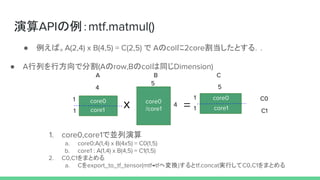
● 例えば。A(2,4) x B(4,5) = C(2,5) で Aのcolに2core割当したとする..
core1 =xcore01
1
4
4
5
core0
/core1
● A行列を行方向で分割(Aのrow,Bのcolは同じDimension)
1. core0,core1で並列演算
a. core0:A(1,4) x B(4x5) = C0(1,5)
b. core1 : A(1,4) x B(4,5) = C1(1,5)
2. C0,C1をまとめる
a. Cをexport_to_tf_tensor(mtf→tfへ変換)するとtf.concat実行してC0,C1をまとめる
core0
core1
A B C
C0
C1
1
1
5
演算APIの例:mtf.matmul()
core1 =xcore02
2
2
5
core0
2
core1 2
2
5
A B C(core0/core1) = C0(core0) + C1(core1)
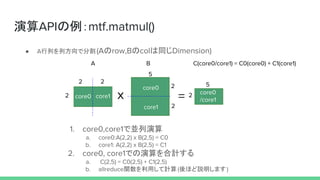
● A行列を列方向で分割 (Aのrow,Bのcolは同じDimension)
1. core0,core1で並列演算
a. core0:A(2,2) x B(2,5) = C0
b. core1: A(2,2) x B(2,5) = C1
2. core0, core1での演算を合計する
a. C(2,5) = C0(2,5) + C1(2,5)
b. allreduce関数を利用して計算 (後ほど説明します)
core0
/core1
Mesh Tensorflowの集合通信
デバイス間の集合通信
PlacementMeshImpl内に定義
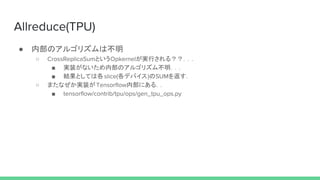
● allreduce
○ 各TensorのSumをとる
○ add, optimizer, layer.batch_norm, reduce系のopで利用されている
● allconcat
○ 各Tensorをconcatenateする(like a allgather)
● alltoall
○ MPIのalltoallと同等.
Allreduce(CPU,GPU)
GPU0 GPU1 GPU2 GPU3 GPU4 GPU5
left center right center
tf.add
tf.add
tf.add
tf.add
SUM値 SUM値
tf.identitytf.identity
分配分配
for i in xrange(1, left_center + 1):
with tf.device(devices[i]):
left_sum = binary_reduction(left_sum, xs[i])
right_sum = xs[n-1]
演算デバイスを
制御
tf.add tf.add
1. 2グループに分割
2. 各グループ内でtf.add
3. 2グループ間でtf.add
4. tf.identityで分配
allreduceの方法
Allreduce(TPU)
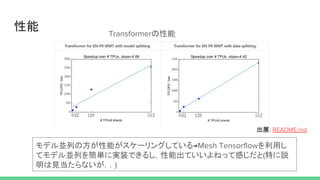
● 内部のアルゴリズムは不明
○ CrossReplicaSumというOpkernelが実行される??...
■ 実装がないため内部のアルゴリズム不明...
■ 結果としては各slice(各デバイス)のSUMを返す.
○ またなぜか実装がTensorflow内部にある..
■ tensorflow/contrib/tpu/ops/gen_tpu_ops.py
mtf.Lowering, optimizer
# optimizerの登録
optimizer = mtf.optimize.SgdOptimizer()
update_ops = optimizer.apply_grads(var_grads, graph.trainable_variables)
lowering = mtf.Lowering(graph, {mesh: mesh_impl})
# optimizer operationのlowering
tf_update_ops = [lowering.lowered_operation(op) for op in update_ops]
tf_update_ops.append(tf.assign_add(global_step, 1))
train_op = tf.group(tf_update_ops)
● OptimizerはSGDとAdafactorのみサポート
● Lowering()の機能としてはmtf→tfの橋渡しで,tensorflowのAPIに変換したり
,実行デバイスの割当をおこなう
○ 演算ごとにどのようにloweringするか定義されている
性能 Transformerの性能
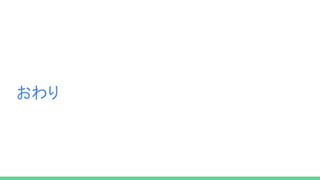
モデル並列の方が性能がスケーリングしている→Mesh Tensorflowを利用し
てモデル並列を簡単に実装できるし,性能出ていいよねって感じだと(特に説
明は見当たらないが..)
出展:README.md
おわり

Mesh tensorflow

  • 1.
  • 2.
    自己紹介 kuroko(@kuroko1t) ● 仕事 ○ 前は..次世代スパコンのCPUの論理回路設計 ○ 最近は..深層学習向けフレームワークの調査したり( Tensorflow,horovod...) ● その他 ○ GoでDeep Learningを試みたり(link) ○ horovodの記事書いてみたり (Qiita) ○ horovodにTensorflowのeager対応のPRだしたり
  • 3.
  • 4.
    Mesh Tensorflowって? ● データ並列,モデル並列両方をカバー ●python only ● DNNモデル ○ Mesh Tensorflowのメインターゲットは Transformer ■ 言語モデルのパラメータが5億近くなってきていて,モデル並列しないと計算できない ○ exampleにはmnist(cnn)のみ ● 独自の演算API ○ 本家Tensorflowとは異なるAPIを用いる ● single Process
  • 5.
    Mesh Tensorflowの概念 概念図の用語 ● MeshShape ○ coreとMeshの割当の定義 ● Layout Rules ○ TensorとMeshの割当の定義 ● mtf.Dimension ○ Tensorのshapeの名前付け ● Meshとは? ○ プロセッサのn次元配列として定義 され,それぞれのTensorがMeshに 割当られます.通常は Tensorは coreに割り当てられる(tf.deviceを利 用) ● Layout Rules? ○ Tensorの各次元をMeshのどの次 元に配置するか定義します (Layout Rulesで表現される) (“batch”,3) Mesh0 core0 core1 core2 core3 Mesh1 Tensor T1 (“col”,2) (“row”,2) mtf.Dimension Mesh shape (batch, mesh1)→core1,core2, core3でバッチ並列 Layout Rules
  • 6.
  • 7.
    Mesh Tensorflow実行例 graph =mtf.Graph() mesh = mtf.Mesh(graph, "my_mesh") row_x = mtf.Dimension("row_x", 6) col_x = mtf.Dimension("col_x", 4) row_y = mtf.Dimension("row_y", 4) col_y = mtf.Dimension("col_y", 5) x = mtf.import_tf_tensor( mesh, tf.random.uniform([6,4]), mtf.Shape([row_x, col_x])) y = mtf.import_tf_tensor( mesh, tf.random.uniform([4,5]), mtf.Shape([row_y, col_y])) result = mtf.matmul(x, y, output_shape=[row_x, col_y]) mesh_shape = "b1:2" mesh_layout = "col_x:b1" mesh_shape = mtf.convert_to_shape(mesh_shape) mesh_devices = [""] * mesh_shape.size mesh_impl = mtf.placement_mesh_impl.PlacementMeshImpl( mesh_shape, mesh_layout, mesh_devices) lowering = mtf.Lowering(graph, {mesh: mesh_impl}) restore_hook = mtf.MtfRestoreHook(lowering) tf_result = lowering.export_to_tf_tensor(result) with tf.train.MonitoredTrainingSession(hooks=[restore_hook]) as sess: print(sess.run(tf_result).shape) mtf用のGraph, Mesh の作成 tfのtensor→mtfのtensorへ変換API mtfの演算APIの呼び出し mtf→tfへop,tensorの変換(lowering) Session run()を実行
  • 8.
    Meshのshape, layout定義 mesh_shape =[("rows:2"), ("cols:2")] layout_rules = [("batch", "rows"), ("hidden", "cols")] mesh_impl = mtf.placement_mesh_impl.PlacementMeshImpl( mesh_shape, layout_rules, mesh_devices) ● meshのcore割当数を定義. ○ coreの割当数を定義(ex: rowsという名前のMeshに2個coreを割り当て) ○ [("rows:2"), ("cols:2")] ● meshとTensor Shapeの対応 ○ mtf.Dimensionとmeshの対応を定義する ○ [("batch", "rows"), ("hidden", "cols")] ● PlacementMeshImpl(CPU,GPU向け) ○ 上記layout ruleに応じてvariableをデバイスに割当(session起動時) ○ 集合演算の実装がされている ○ TPU向けにSimdMeshImplというのも用意されている Tensor “cols” “rows” mtf.Dimension
  • 9.
    演算のデバイス割り振り def parallel(devices, fn,*args, **kwargs): ... for i, device in enumerate(devices): with tf.device(device): with tf.variable_scope("parallel_%d" % i): my_args = [x[i] for x in args] my_kwargs = {k: v[i] for k, v in six.iteritems(kwargs)} ret.append(fn(*my_args, **my_kwargs)) 内部的にwith tf.deviceで各デバイスに演算を割り当てている
  • 10.
  • 11.
    演算API # tensor importの例 x= mtf.import_tf_tensor( mesh, tf.ones([50, 10]), mtf.Shape([col_x, row_x])) # 演算APIの例 f1 = mtf.relu(mtf.conv2d_with_blocks( x, kernel1, strides=[1, 1, 1, 1], padding="SAME", h_blocks_dim=row_blocks_dim, w_blocks_dim=col_blocks_dim)) ● 演算APIにおける次元定義 ○ 次元の定義はtf.Dimension()で定義した名前で行う。 ○ この段階だとTensorの次元がどのように Mesh分割されるかは定義されない ● mtf.layer系 API ○ mtf.layer.dense, attention系など30個 ○ Attention専用APIが多い(mtf.layer.masked_local_attention_1d()...) ● mtf 系 API ○ mtf.add, mtf.conv2d, mtf.maximum… 演算系APIが120個
  • 12.
    演算APIの例:mtf.matmul() ● 例えば。A(2,4) xB(4,5) = C(2,5) で Aのcolに2core割当したとする.. core1 =xcore01 1 4 4 5 core0 /core1 ● A行列を行方向で分割(Aのrow,Bのcolは同じDimension) 1. core0,core1で並列演算 a. core0:A(1,4) x B(4x5) = C0(1,5) b. core1 : A(1,4) x B(4,5) = C1(1,5) 2. C0,C1をまとめる a. Cをexport_to_tf_tensor(mtf→tfへ変換)するとtf.concat実行してC0,C1をまとめる core0 core1 A B C C0 C1 1 1 5
  • 13.
    演算APIの例:mtf.matmul() core1 =xcore02 2 2 5 core0 2 core1 2 2 5 AB C(core0/core1) = C0(core0) + C1(core1) ● A行列を列方向で分割 (Aのrow,Bのcolは同じDimension) 1. core0,core1で並列演算 a. core0:A(2,2) x B(2,5) = C0 b. core1: A(2,2) x B(2,5) = C1 2. core0, core1での演算を合計する a. C(2,5) = C0(2,5) + C1(2,5) b. allreduce関数を利用して計算 (後ほど説明します) core0 /core1
  • 14.
  • 15.
    デバイス間の集合通信 PlacementMeshImpl内に定義 ● allreduce ○ 各TensorのSumをとる ○add, optimizer, layer.batch_norm, reduce系のopで利用されている ● allconcat ○ 各Tensorをconcatenateする(like a allgather) ● alltoall ○ MPIのalltoallと同等.
  • 16.
    Allreduce(CPU,GPU) GPU0 GPU1 GPU2GPU3 GPU4 GPU5 left center right center tf.add tf.add tf.add tf.add SUM値 SUM値 tf.identitytf.identity 分配分配 for i in xrange(1, left_center + 1): with tf.device(devices[i]): left_sum = binary_reduction(left_sum, xs[i]) right_sum = xs[n-1] 演算デバイスを 制御 tf.add tf.add 1. 2グループに分割 2. 各グループ内でtf.add 3. 2グループ間でtf.add 4. tf.identityで分配 allreduceの方法
  • 17.
    Allreduce(TPU) ● 内部のアルゴリズムは不明 ○ CrossReplicaSumというOpkernelが実行される??... ■実装がないため内部のアルゴリズム不明... ■ 結果としては各slice(各デバイス)のSUMを返す. ○ またなぜか実装がTensorflow内部にある.. ■ tensorflow/contrib/tpu/ops/gen_tpu_ops.py
  • 18.
    mtf.Lowering, optimizer # optimizerの登録 optimizer= mtf.optimize.SgdOptimizer() update_ops = optimizer.apply_grads(var_grads, graph.trainable_variables) lowering = mtf.Lowering(graph, {mesh: mesh_impl}) # optimizer operationのlowering tf_update_ops = [lowering.lowered_operation(op) for op in update_ops] tf_update_ops.append(tf.assign_add(global_step, 1)) train_op = tf.group(tf_update_ops) ● OptimizerはSGDとAdafactorのみサポート ● Lowering()の機能としてはmtf→tfの橋渡しで,tensorflowのAPIに変換したり ,実行デバイスの割当をおこなう ○ 演算ごとにどのようにloweringするか定義されている
  • 19.
  • 20.