 Sawsan Mustafa Abdalla
 Associate Professor
 Community Medicine
 Faculty of Medicine
In temperate climates coronavirus respiratory
infections occur
primarily in the winter
although smaller peaks are sometimes seen in the
fall or spring
and infections can occur at any time of the year
and HCoV appear to predominate unpredictably in
certain years and in certain parts of the world.
Because of the varying sensitivity of different
diagnostic assays, as well as the unpredictable
prevalence of the various strains from year to year, it
is difficult to say which, if any, of the strains is the
most common.
Coronaviruses are important human and animal pathogens.
 cause of up to one-third of community-acquired upper
respiratory tract infections in both children and adults.
certain coronaviruses cause diarrhea in infants and children
Cause central nervous diseases (has been suggested but not proven).
 medium-sized
 Enveloped
 positive-stranded RNA viruses
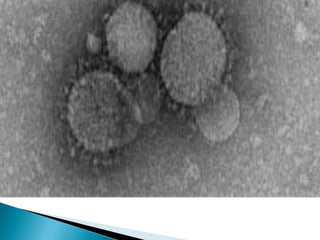
 whose name derives from their characteristic crown-
like appearance in electron micrographs
 These viruses have the largest known viral RNA
genomes, with a length of 27 to 32 kb.
Replication of viral RNA occurs in the host
cytoplasm
in which RNA polymerase binds to a leader
sequence and
then detaches and reattaches at multiple locations,
allowing for the
production of a nested set of mRNA molecules with
common 3’ ends
 Coronaviruses are named so for the crown-like
spikes on their surface.
 They are common viruses that most people get in
their lifetime. These
 viruses usually cause mild to moderate upper-
respiratory tract illnesses.
It was first reported on 24th September 2012 by 
Egyptian virologist Dr. Ali Mohamed Zaki in Jeddah, 
Saudi Arabia
This virus is different from any other coronavirus
previously found in people.
 It is also different from the coronavirus that
caused SARS (Severe Acute Respiratory
Syndrome) in 2003.
 Until 23 May2013, MERS-CoV had frequently
been referred to as a SARS-like virus,[8]
novel coronavirus that emerged in Saudi Arabia two
years ago,
Recently 244 people were infected in the kingdom,
of whom 76 have died.
( Health Ministry)
 In an outbreak of MERS-CoV in Saudi Arabia that
resulted in laboratory-confirmed MERS-CoV in 23
individuals,
the median incubation period was 5.2 days
secondary case that occurred in a patient in France
the incubation period was estimated at 9 to 12 days
Most patients with MERS-CoV :
severely ill with pneumonia and acute respiratory
distress syndrome
acute kidney injury.
Many patients have required mechanical ventilation
and extracorporeal membrane oxygenation.
gastrointestinal symptoms:
anorexia
nausea
vomiting
abdominal pain
diarrhea)
pericarditis
disseminated intravascular coagulation
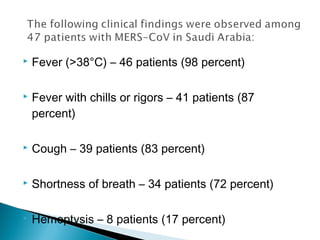
 Fever (>38°C) – 46 patients (98 percent)
 Fever with chills or rigors – 41 patients (87
percent)
 Cough – 39 patients (83 percent)
 Shortness of breath – 34 patients (72 percent)
 Hemoptysis – 8 patients (17 percent)
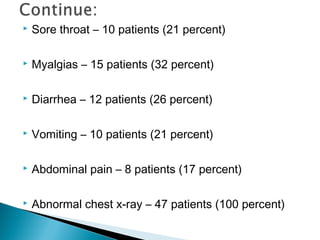
 Sore throat – 10 patients (21 percent)
 Myalgias – 15 patients (32 percent)
 Diarrhea – 12 patients (26 percent)
 Vomiting – 10 patients (21 percent)
 Abdominal pain – 8 patients (17 percent)
 Abnormal chest x-ray – 47 patients (100 percent)
Air: by droplets from coughing, sneezing ,ect.
Come in contact with ill patients
It is not certain whether the infections are result
of asingle zoonotic event with subsequent human-to-
human transmission
or if the multiple geographic sites of infection
represent multiple zoonotic events from a common
unknown source.
The virus MERS-CoV belongs to the
genus Betacoronavirus some researchers believe
the virus is related to one found in the tomb bat.
An Epidemiologist Ian Lipkin of Columbia University
in New York city claims
the virus isolated from the bat was a 100% match to
the virus found in humans.
On April 17, 2014 a Saudi expert on the virus
announced a link between the virus and camels,
stating that a virus sample from a camel was a 100%
match to that found in a Saudi patient.[
As noted above, it is likely that animals serve
as intermediate hosts for MERS-CoV. In 2013,
MERS-CoV sequences were detected by
reverse-transcriptase polymerase chain
reaction (RT-PCR) in samples from a juvenile camel
belonging to a patient with MERS-CoV in Jeddah, Saudi
Arabia
Taking these everyday actions can help prevent the
spread of germs and protect against colds, flu, and
other illnesses:
 Wash your hands often with soap and water. If
soap and water are not available, use an alcohol-
based hand sanitizer.
 Avoid touching your eyes, nose, and mouth.
Germs spread this way.
 Avoid close contact with sick people.
If Traveling:
Be sure you are up-to-date with all of your shots,
and if possible, see your healthcare provider at least
4–6 weeks before travel to get any additional shots.
If you are sick:
Cover your mouth with a tissue when you cough or
sneeze, and throw the tissue in the trash.
Avoid contact with other people to keep from infecting
them.
Visit a health care provider if you develop:
fever
lower respiratory illness
cough
shortness of breath
within 14 days after traveling from countries in or
near the Arabian Peninsula*.
Health care providers should be alert to
patients who develop:
Severe acute lower respiratory illness (e.g.,
requiring hospitalization) within
14 days after traveling from countries in the
Arabian Peninsula* or
Consider other more common causes of respiratory
illness, such as influenza.
Evaluate patients using CDC’s case definitions and
guidance.
Immediately report patients with unexplained
respiratory illness and who meet CDC’s criteria for
“patient under investigation (PUI)” to local health
department.
Saudi Arabia recommends that the following groups
should postpone their plans for Hajj and Umrah this
year:
People over 65 years old
Children under 12 years old
Pregnant women
People with chronic diseases (such as heart
disease, kidney disease, diabetes, or respiratory
disease)
People with weakened immune systems
People with cancer or terminal illnesses
Countries considered in the Arabian Peninsula and
neighboring include:
Bahrain, Iraq, Iran, Israel, Jordan, Kuwait, Lebanon,
Oman, Palestinian
territories, Qatar, Saudi Arabia, Syria, the United
Arab Emirates (UAE),
and Yemen.
THANKS

MERS.COV-Majmaah University.

  • 1.
     Sawsan MustafaAbdalla  Associate Professor  Community Medicine  Faculty of Medicine
  • 2.
    In temperate climatescoronavirus respiratory infections occur primarily in the winter although smaller peaks are sometimes seen in the fall or spring and infections can occur at any time of the year
  • 3.
    and HCoV appearto predominate unpredictably in certain years and in certain parts of the world. Because of the varying sensitivity of different diagnostic assays, as well as the unpredictable prevalence of the various strains from year to year, it is difficult to say which, if any, of the strains is the most common.
  • 4.
    Coronaviruses are importanthuman and animal pathogens.  cause of up to one-third of community-acquired upper respiratory tract infections in both children and adults. certain coronaviruses cause diarrhea in infants and children Cause central nervous diseases (has been suggested but not proven).
  • 5.
     medium-sized  Enveloped positive-stranded RNA viruses  whose name derives from their characteristic crown- like appearance in electron micrographs  These viruses have the largest known viral RNA genomes, with a length of 27 to 32 kb.
  • 7.
    Replication of viralRNA occurs in the host cytoplasm in which RNA polymerase binds to a leader sequence and then detaches and reattaches at multiple locations, allowing for the production of a nested set of mRNA molecules with common 3’ ends
  • 8.
     Coronaviruses arenamed so for the crown-like spikes on their surface.  They are common viruses that most people get in their lifetime. These  viruses usually cause mild to moderate upper- respiratory tract illnesses.
  • 9.
    It was firstreported on 24th September 2012 by  Egyptian virologist Dr. Ali Mohamed Zaki in Jeddah,  Saudi Arabia This virus is different from any other coronavirus previously found in people.
  • 10.
     It isalso different from the coronavirus that caused SARS (Severe Acute Respiratory Syndrome) in 2003.  Until 23 May2013, MERS-CoV had frequently been referred to as a SARS-like virus,[8]
  • 11.
    novel coronavirus thatemerged in Saudi Arabia two years ago, Recently 244 people were infected in the kingdom, of whom 76 have died. ( Health Ministry)
  • 12.
     In an outbreakof MERS-CoV in Saudi Arabia that resulted in laboratory-confirmed MERS-CoV in 23 individuals, the median incubation period was 5.2 days secondary case that occurred in a patient in France the incubation period was estimated at 9 to 12 days
  • 13.
    Most patients withMERS-CoV : severely ill with pneumonia and acute respiratory distress syndrome acute kidney injury. Many patients have required mechanical ventilation and extracorporeal membrane oxygenation.
  • 14.
  • 15.
     Fever (>38°C)– 46 patients (98 percent)  Fever with chills or rigors – 41 patients (87 percent)  Cough – 39 patients (83 percent)  Shortness of breath – 34 patients (72 percent)  Hemoptysis – 8 patients (17 percent)
  • 16.
     Sore throat– 10 patients (21 percent)  Myalgias – 15 patients (32 percent)  Diarrhea – 12 patients (26 percent)  Vomiting – 10 patients (21 percent)  Abdominal pain – 8 patients (17 percent)  Abnormal chest x-ray – 47 patients (100 percent)
  • 17.
    Air: by dropletsfrom coughing, sneezing ,ect. Come in contact with ill patients
  • 18.
    It is notcertain whether the infections are result of asingle zoonotic event with subsequent human-to- human transmission or if the multiple geographic sites of infection represent multiple zoonotic events from a common unknown source.
  • 19.
    The virus MERS-CoVbelongs to the genus Betacoronavirus some researchers believe the virus is related to one found in the tomb bat. An Epidemiologist Ian Lipkin of Columbia University in New York city claims the virus isolated from the bat was a 100% match to the virus found in humans.
  • 20.
    On April 17,2014 a Saudi expert on the virus announced a link between the virus and camels, stating that a virus sample from a camel was a 100% match to that found in a Saudi patient.[
  • 21.
    As noted above,it is likely that animals serve as intermediate hosts for MERS-CoV. In 2013, MERS-CoV sequences were detected by reverse-transcriptase polymerase chain reaction (RT-PCR) in samples from a juvenile camel belonging to a patient with MERS-CoV in Jeddah, Saudi Arabia
  • 22.
    Taking these everydayactions can help prevent the spread of germs and protect against colds, flu, and other illnesses:
  • 23.
     Wash yourhands often with soap and water. If soap and water are not available, use an alcohol- based hand sanitizer.  Avoid touching your eyes, nose, and mouth. Germs spread this way.  Avoid close contact with sick people.
  • 24.
    If Traveling: Be sureyou are up-to-date with all of your shots, and if possible, see your healthcare provider at least 4–6 weeks before travel to get any additional shots.
  • 25.
    If you aresick: Cover your mouth with a tissue when you cough or sneeze, and throw the tissue in the trash. Avoid contact with other people to keep from infecting them.
  • 26.
    Visit a healthcare provider if you develop: fever lower respiratory illness cough shortness of breath within 14 days after traveling from countries in or near the Arabian Peninsula*.
  • 27.
    Health care providersshould be alert to patients who develop: Severe acute lower respiratory illness (e.g., requiring hospitalization) within 14 days after traveling from countries in the Arabian Peninsula* or
  • 28.
    Consider other morecommon causes of respiratory illness, such as influenza. Evaluate patients using CDC’s case definitions and guidance. Immediately report patients with unexplained respiratory illness and who meet CDC’s criteria for “patient under investigation (PUI)” to local health department.
  • 29.
    Saudi Arabia recommendsthat the following groups should postpone their plans for Hajj and Umrah this year: People over 65 years old Children under 12 years old Pregnant women
  • 30.
    People with chronicdiseases (such as heart disease, kidney disease, diabetes, or respiratory disease) People with weakened immune systems People with cancer or terminal illnesses
  • 31.
    Countries considered inthe Arabian Peninsula and neighboring include: Bahrain, Iraq, Iran, Israel, Jordan, Kuwait, Lebanon, Oman, Palestinian territories, Qatar, Saudi Arabia, Syria, the United Arab Emirates (UAE), and Yemen.
  • 33.