De-mystifiying the market   By Sarah Butcher – Editor eFinancialCareers.com
Agenda Part 1 – The current market place and how did we get here. Part 2 – Government rescue. Part 3 – Where are we going and the implications for the future. Part 4 – Questions and Answers
Taking stock: where we are now   Writedowns:  -  $50 trillion of financial assets (stocks, bonds and currencies) written down in 2008 according to the Asian Development Bank. Equivalent to one year’s global GDP -  40-45% of the world’s wealth destroyed says Stephen   Schwarzman, chairman and chief executive of Blackstone Group
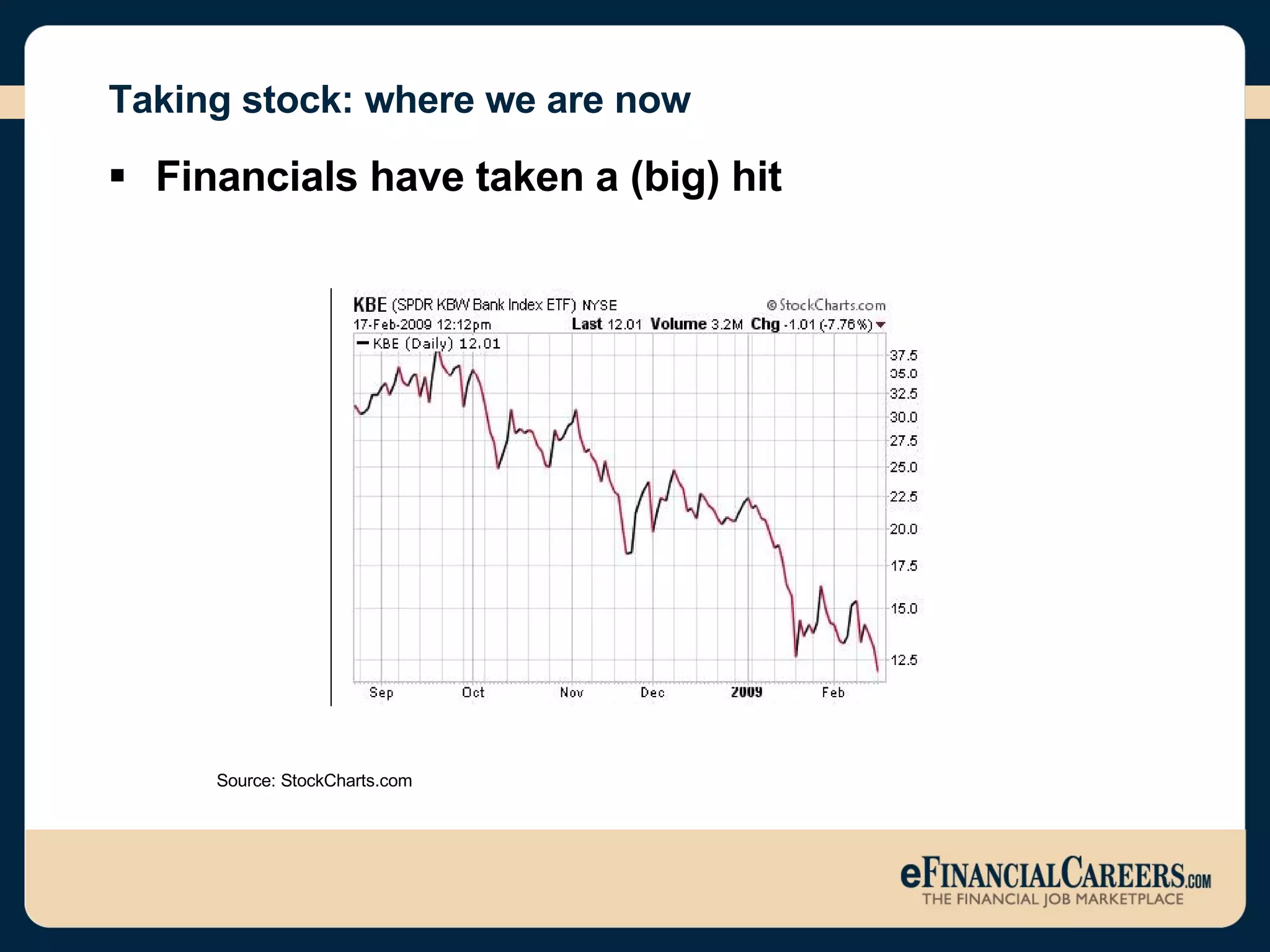
Taking stock: where we are now Financials have taken a (big) hit  Source: StockCharts.com
Taking stock: where we are now Financials have taken a (big) hit  Citigroup shares fell to $1, down from highs of $55 in 2007 Further writedowns from Eastern Europe, credit cards, corporate and consumer debt are very possible 277,400 finance industry jobs lost worldwide (Bloomberg)
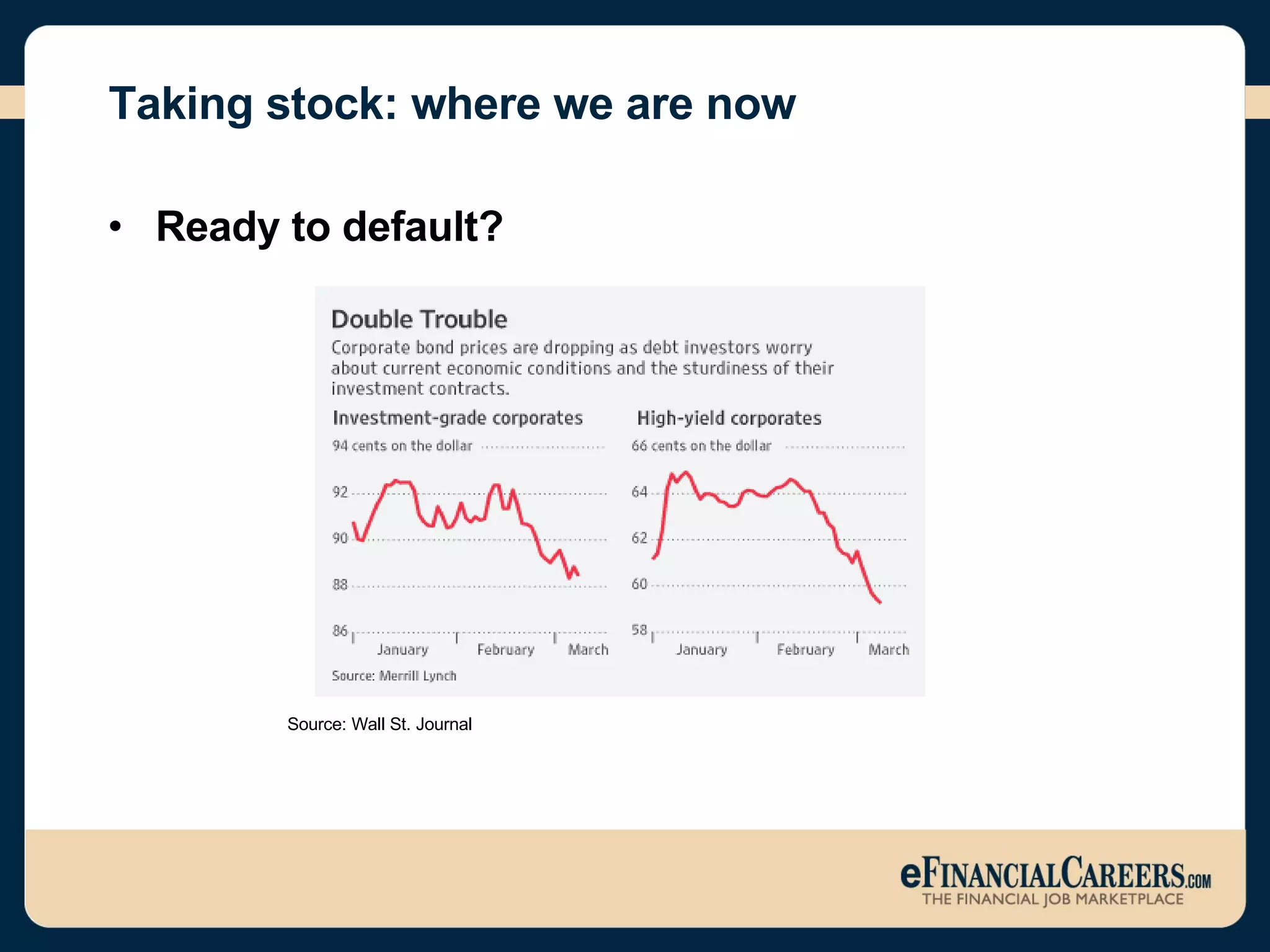
Taking stock: where we are now Ready to default? Source: Wall St. Journal
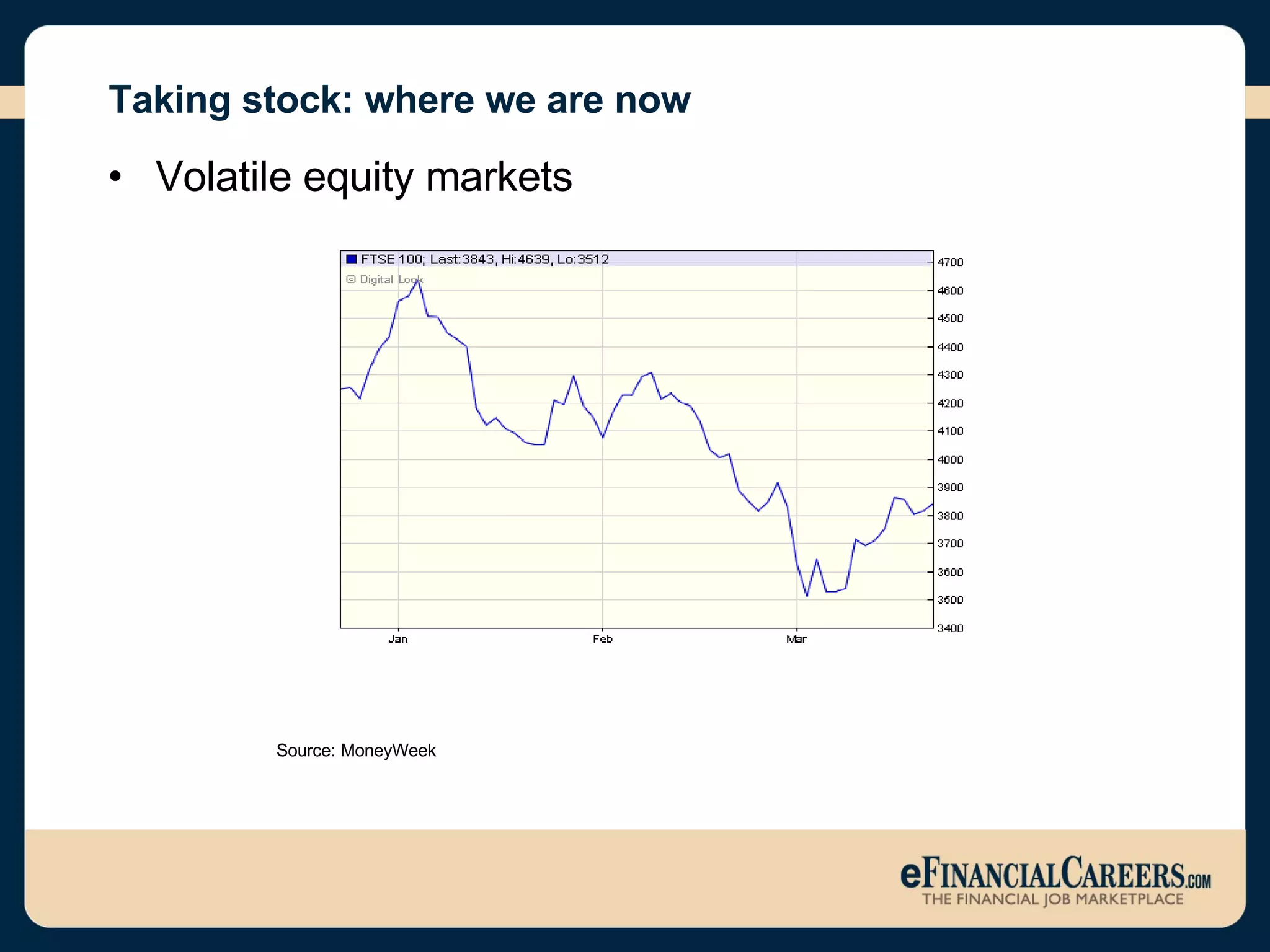
Taking stock: where we are now Volatile equity markets -  FTSE at 6 year low in late February S&P 500 at 12 year low in late February 20% recovery in S&P by late March 2009, 7% recovery on Monday March 23 rd  after the Geithner plan was announced From March 9 to March 20 2009, the KBW bank index rose by 33 percent, while the overall Dow Industrials rose by only 11 percent. Citibank quadrupled in value from early March to mid-April.  Bear market rally? Star fund managers call the bottom of the market – March 15 th  Anthony Bolton said we may be near the bottom, and entering a new bull market.
Taking stock: where we are now Volatile equity markets Source: MoneyWeek
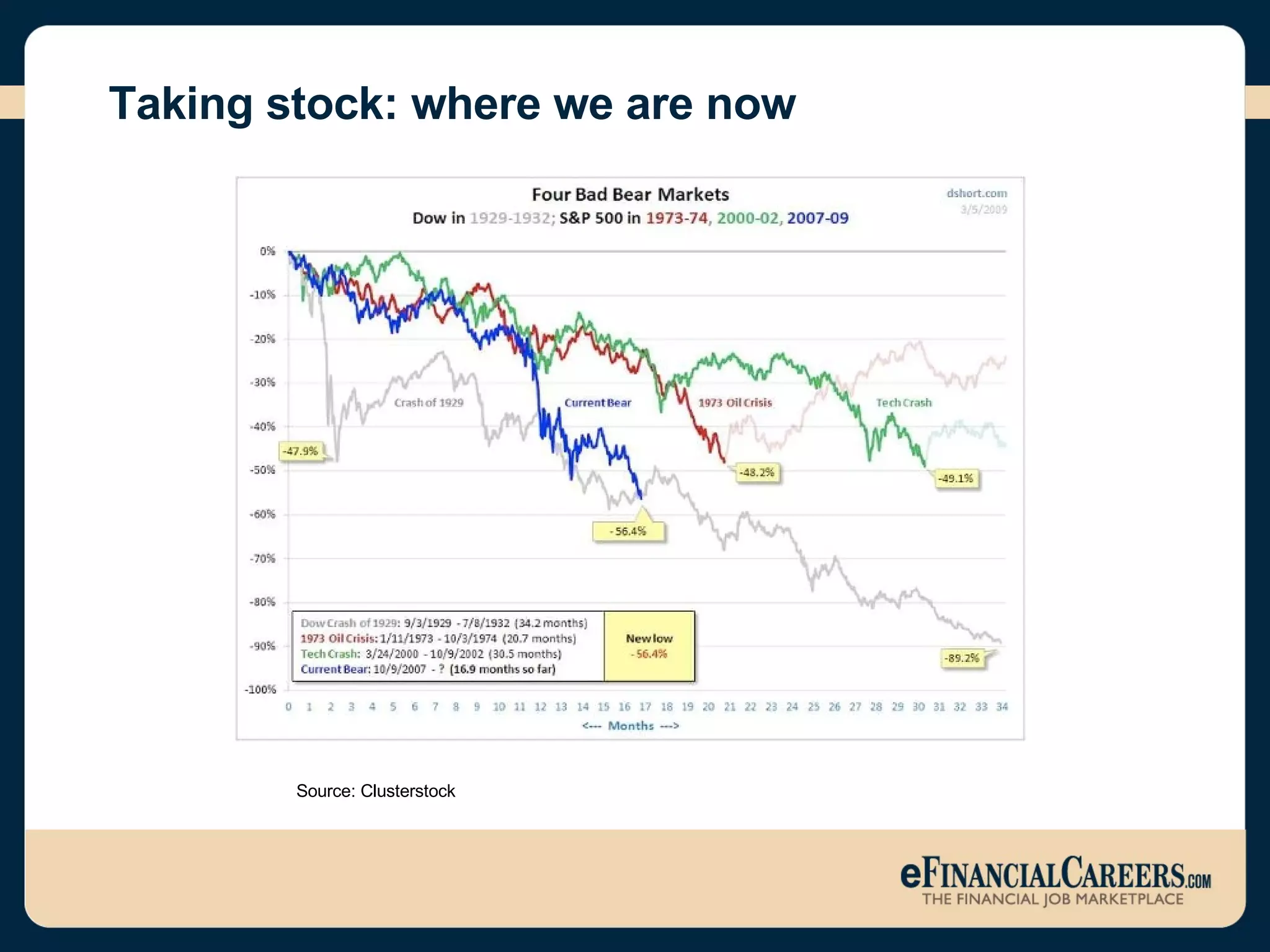
Taking stock: where we are now Source: Clusterstock
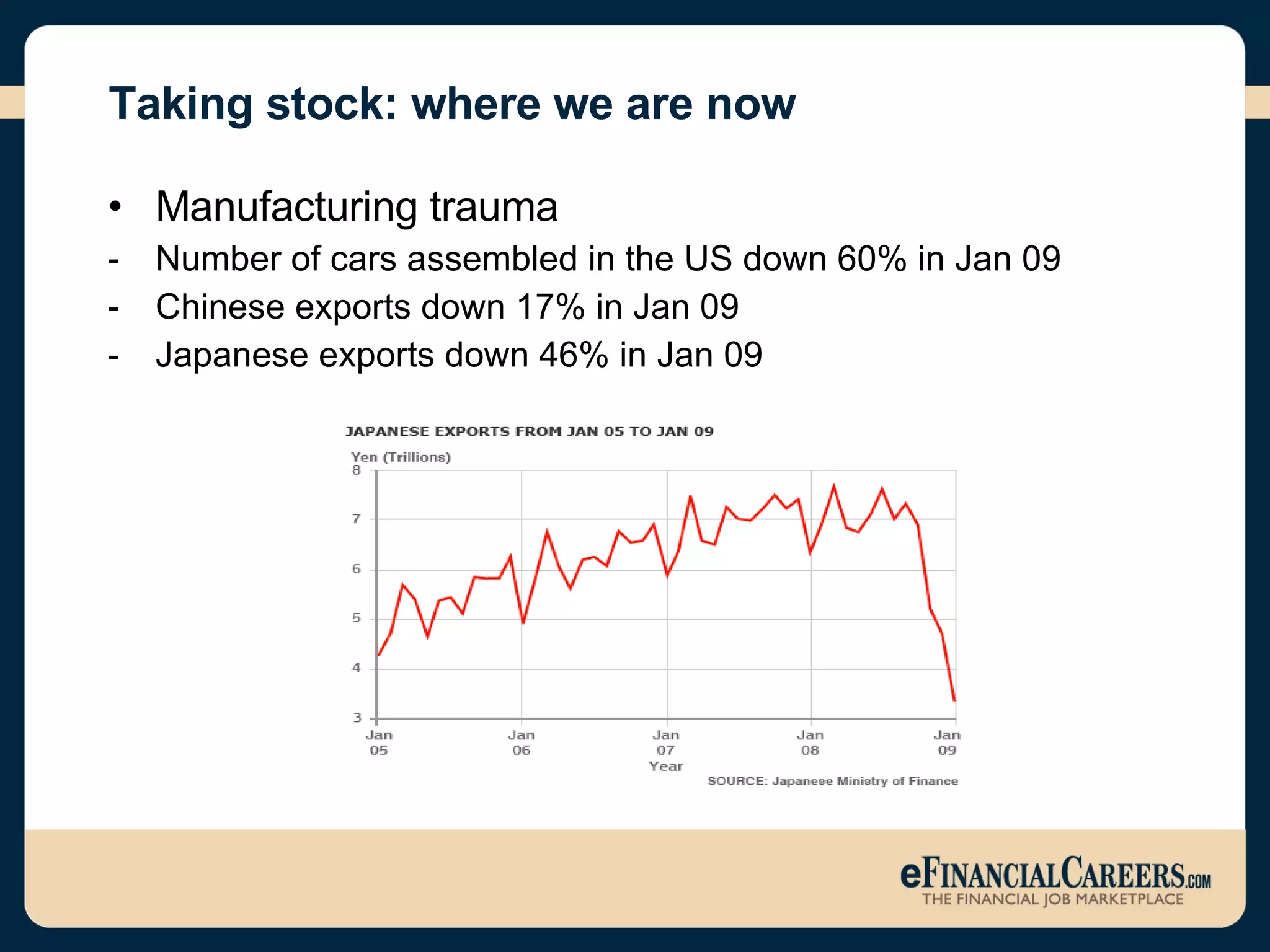
Taking stock: where we are now Manufacturing trauma Number of cars assembled in the US down 60% in Jan 09 Chinese exports down 17% in Jan 09 Japanese exports down 46% in Jan 09
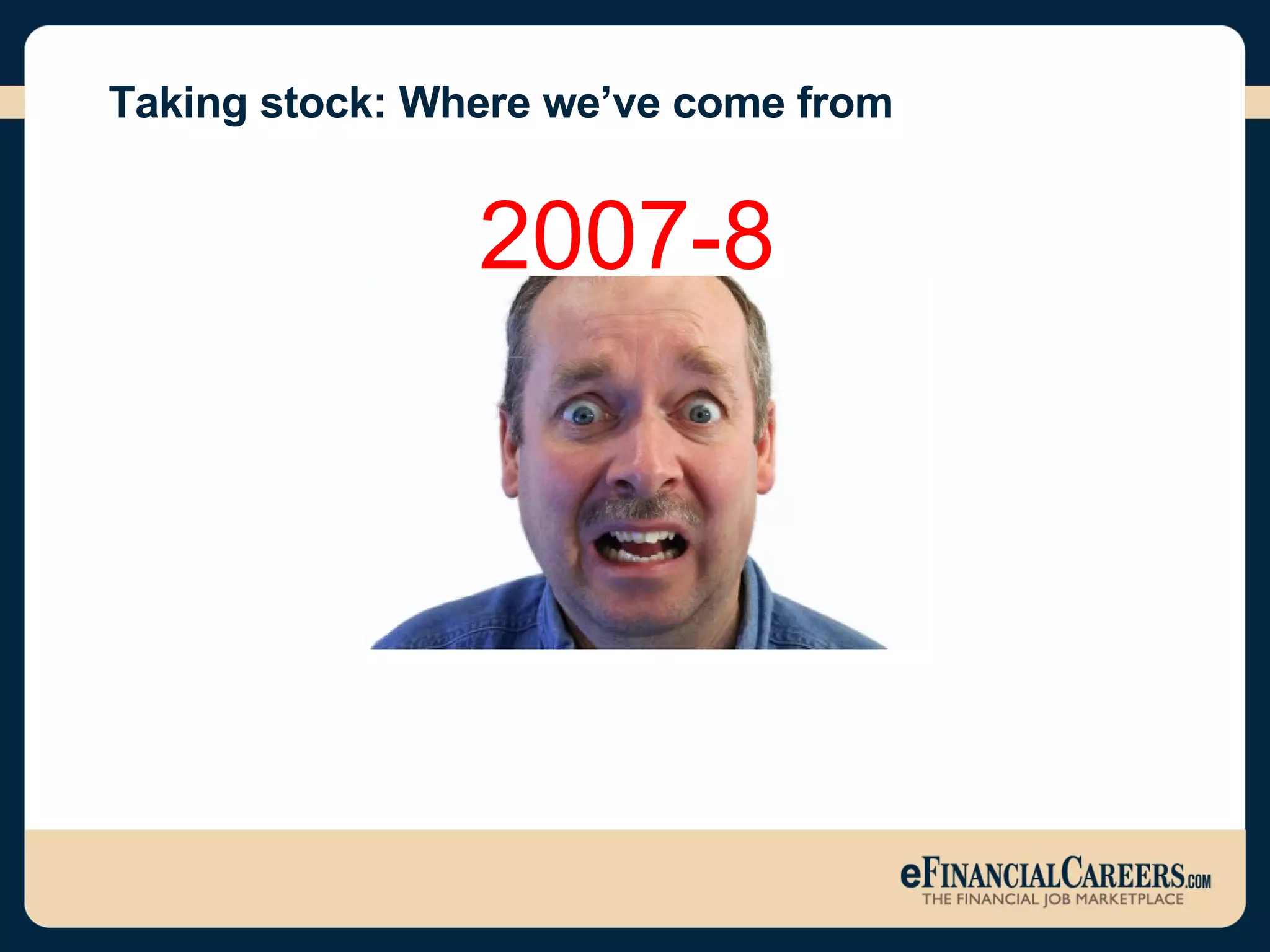
Taking stock: Where we’ve come from 2007-8
Taking stock: Where we’ve come from 2007: Rumblings February: HSBC fires chiefs of US division (Household International) May: UBS closes Dillon Reed Capital Management  June: Bear Stearns bails out its hedge funds for the first time August:  3 BNP Paribas funds, once worth €1.6bn, suspended August: Stock markets tumble, central banks intervene September: Northern Rock October: $8.4bn loss at ML, Stan O’Neal ousted
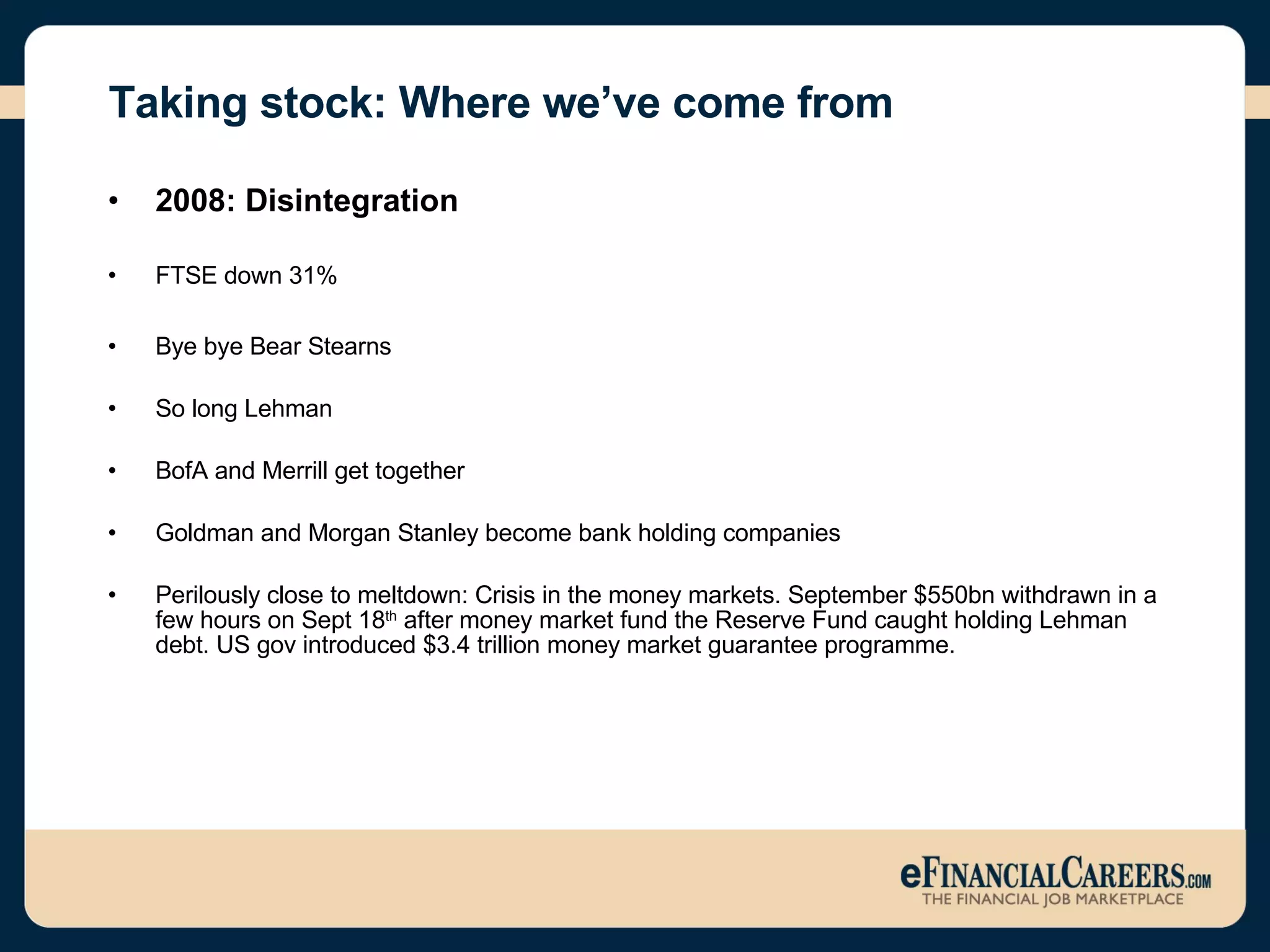
Taking stock: Where we’ve come from 2008: Disintegration FTSE down 31%  Bye bye Bear Stearns So long Lehman  BofA and Merrill get together Goldman and Morgan Stanley become bank holding companies Perilously close to meltdown: Crisis in the money markets. September $550bn withdrawn in a few hours on Sept 18 th  after money market fund the Reserve Fund caught holding Lehman debt. US gov introduced $3.4 trillion money market guarantee programme.
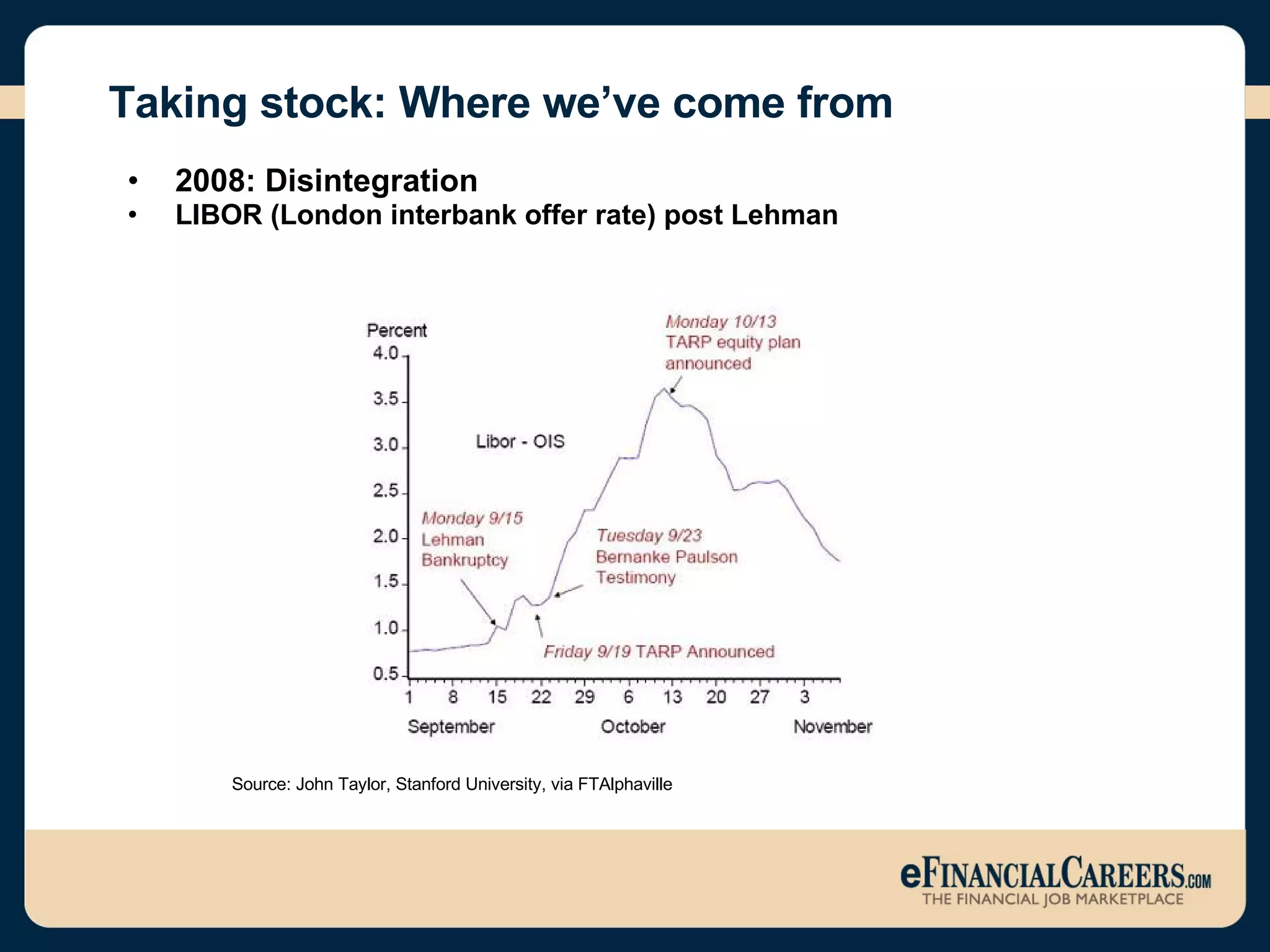
Taking stock: Where we’ve come from 2008: Disintegration LIBOR (London interbank offer rate) post Lehman  Source: John Taylor, Stanford University, via FTAlphaville
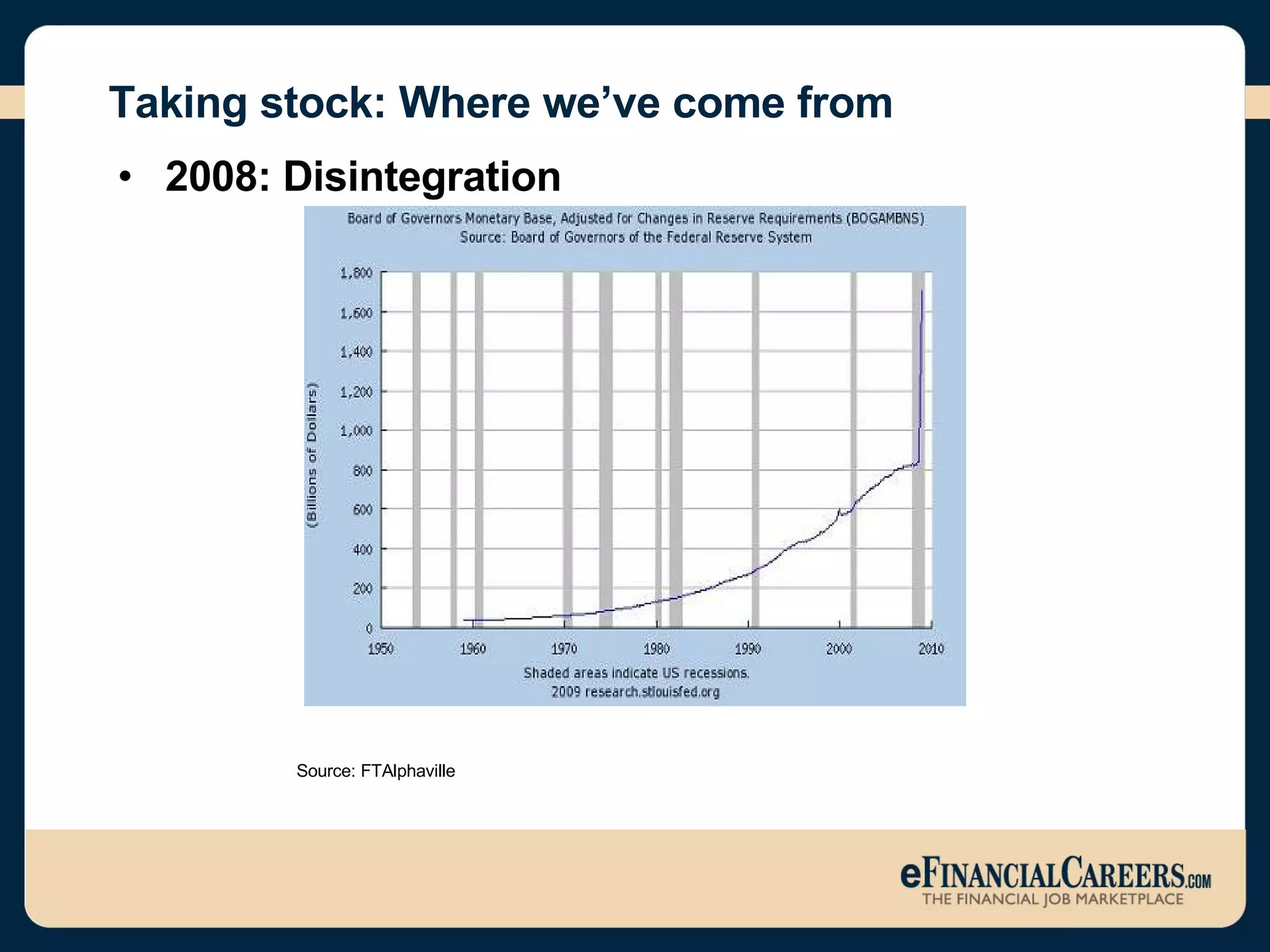
Taking stock: Where we’ve come from 2008: Disintegration Source: FTAlphaville
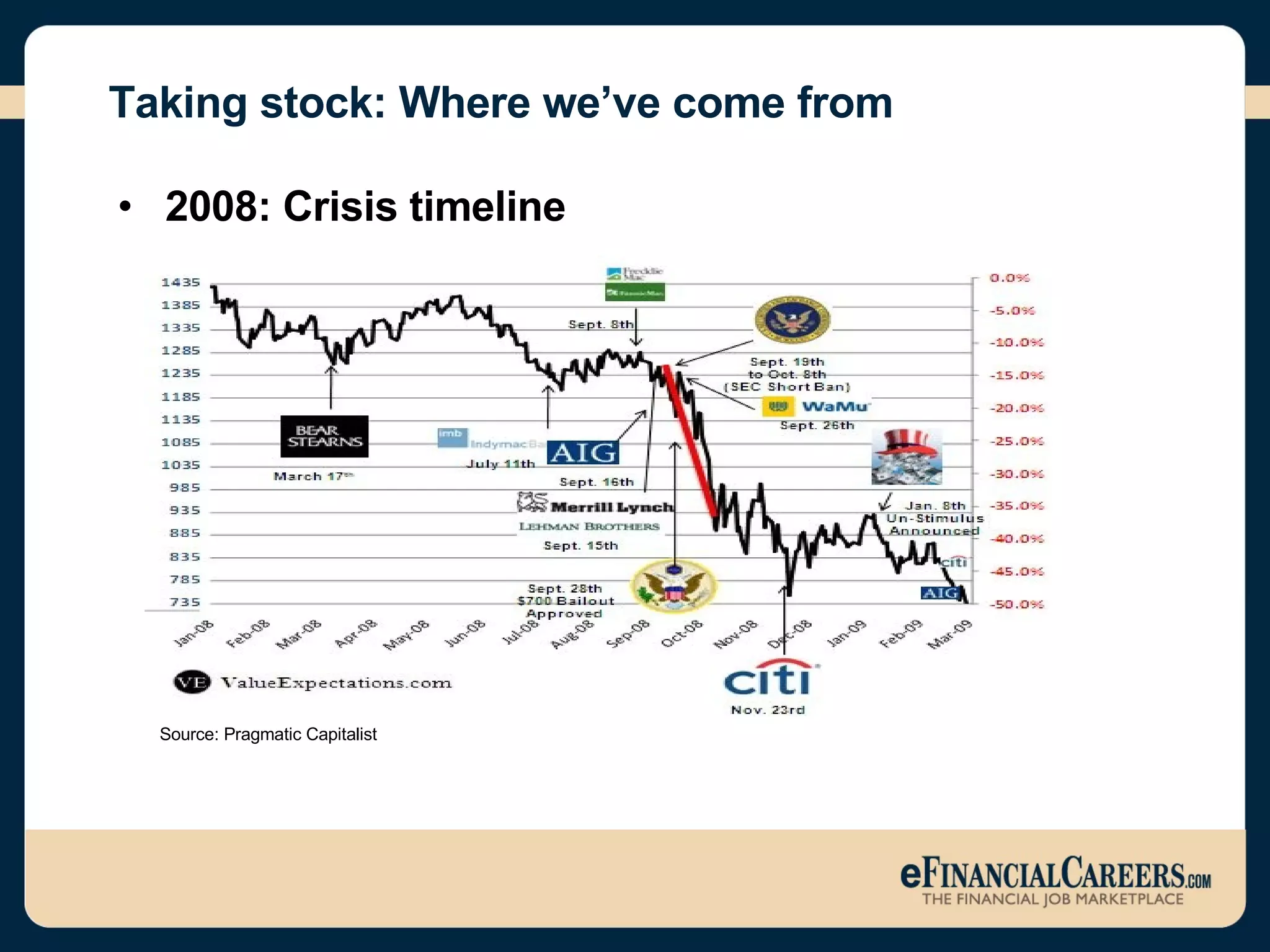
Taking stock: Where we’ve come from 2008: Crisis timeline  Source: Pragmatic Capitalist
How did it come to this?
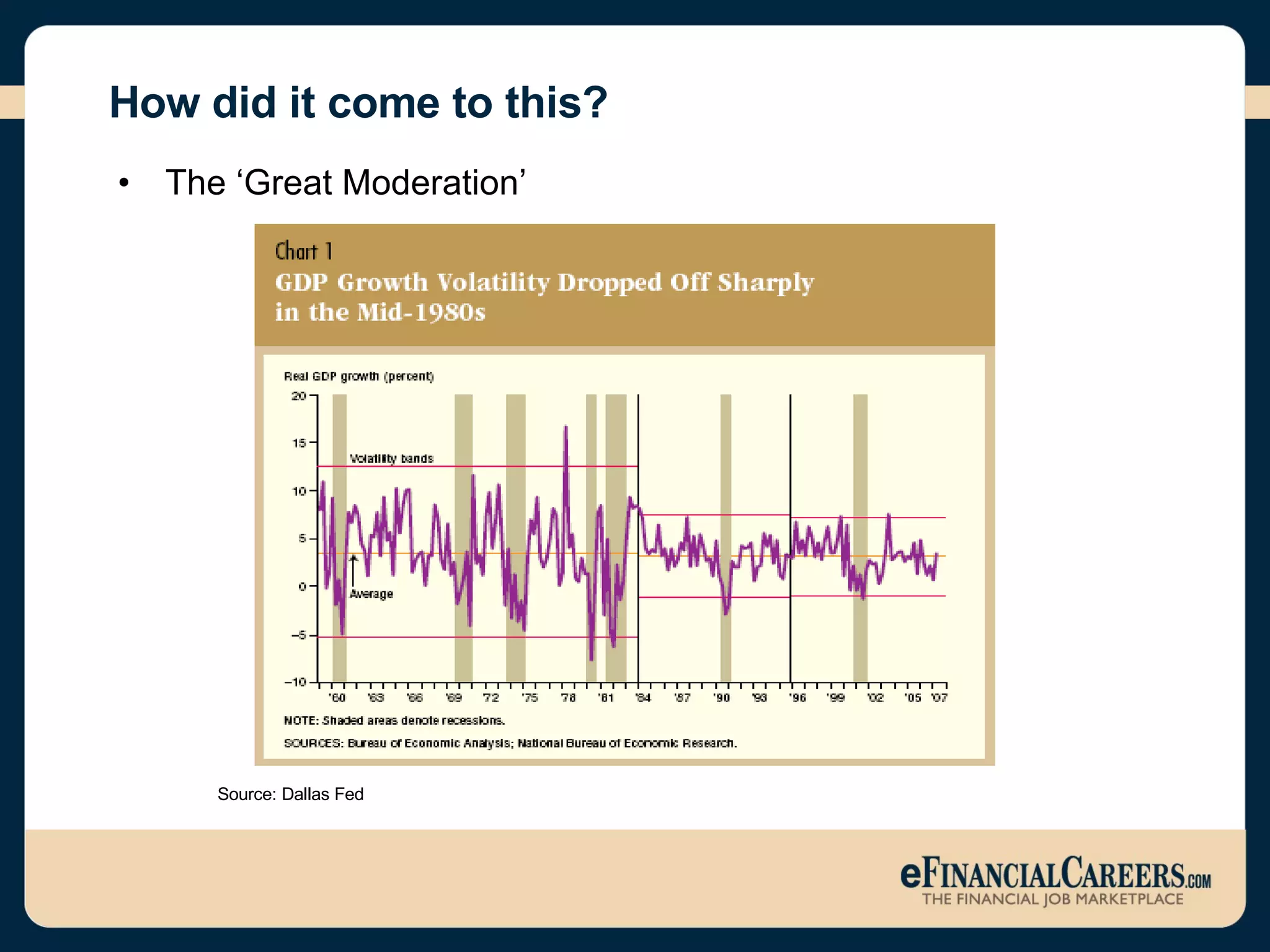
How did it come to this? The ‘Great Moderation’ Source: Dallas Fed
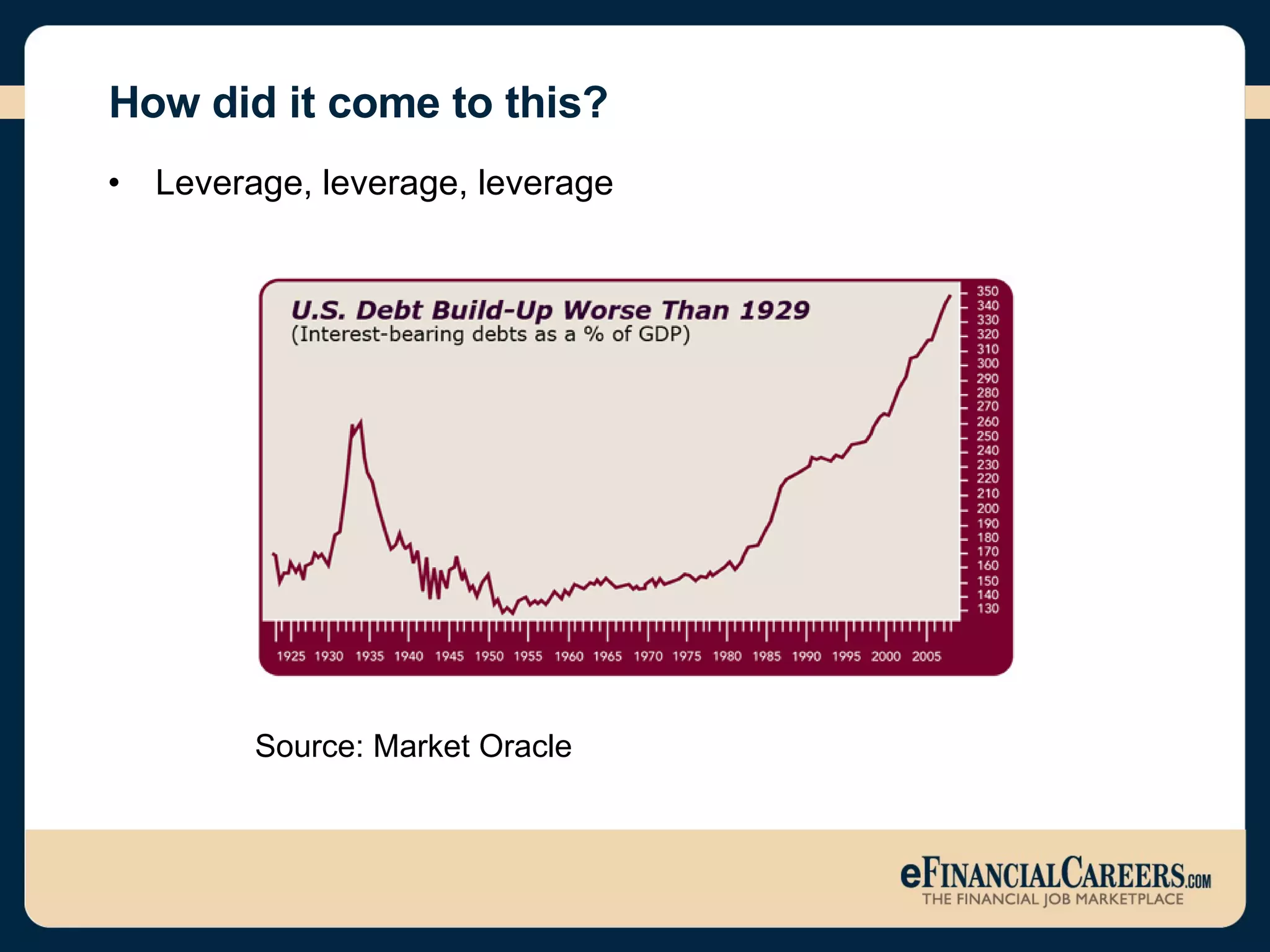
How did it come to this? Leverage, leverage, leverage Source: Market Oracle
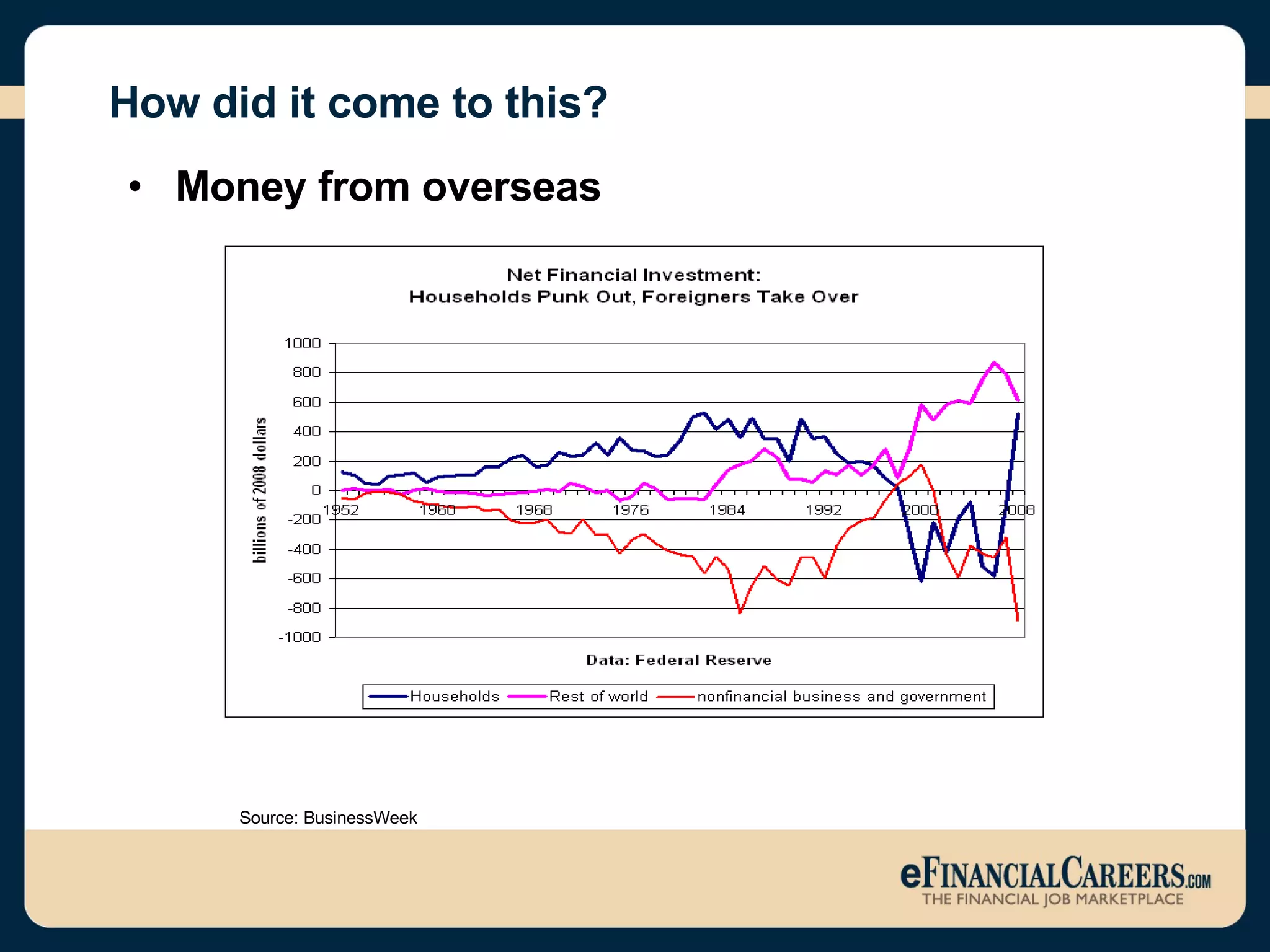
How did it come to this? Money from overseas  Source: BusinessWeek
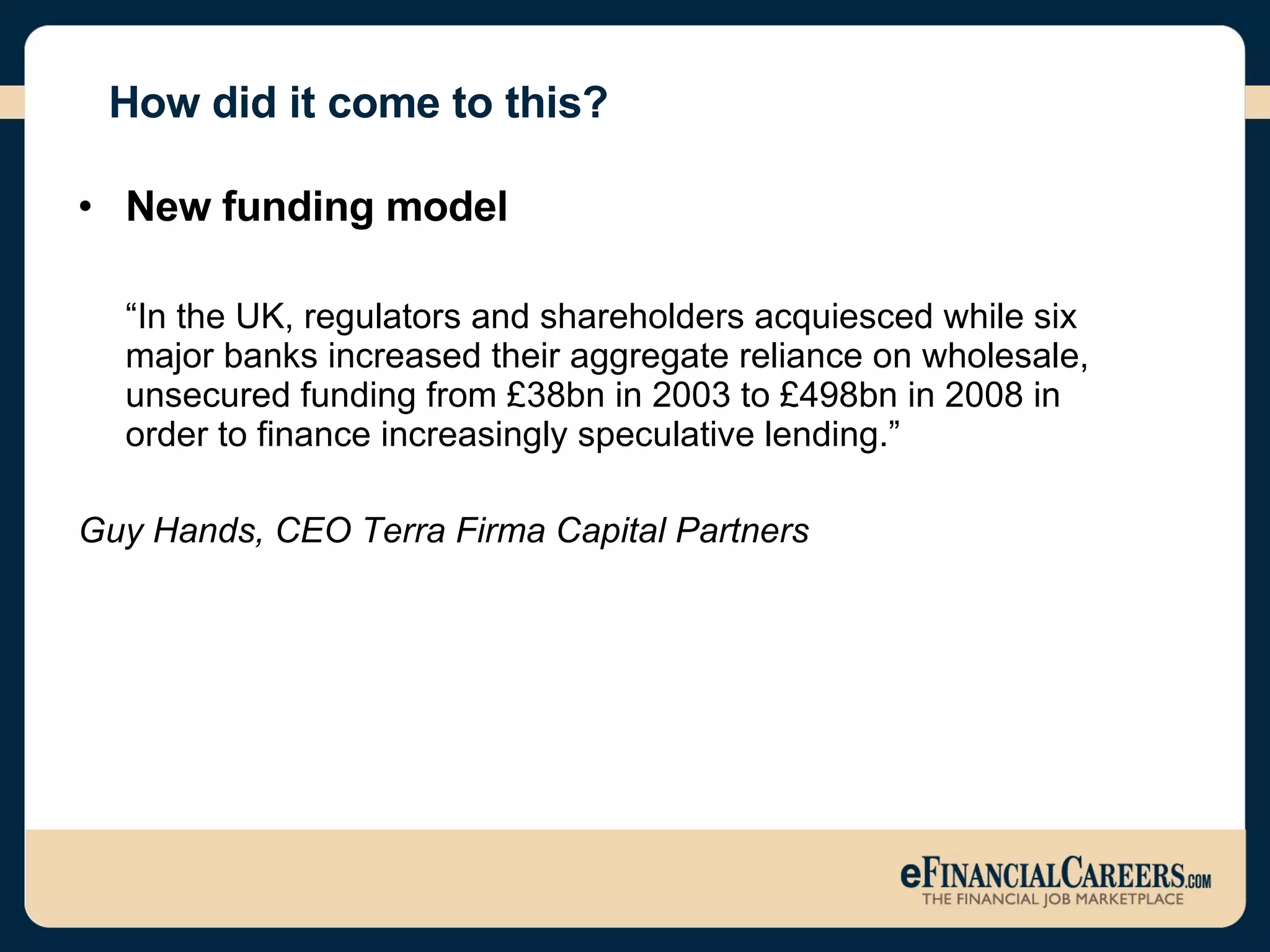
How did it come to this? New funding model  “ In the UK, regulators and shareholders acquiesced while six major banks increased their aggregate reliance on wholesale, unsecured funding from £38bn in 2003 to £498bn in 2008 in order to finance increasingly speculative lending.” Guy Hands, CEO Terra Firma Capital Partners
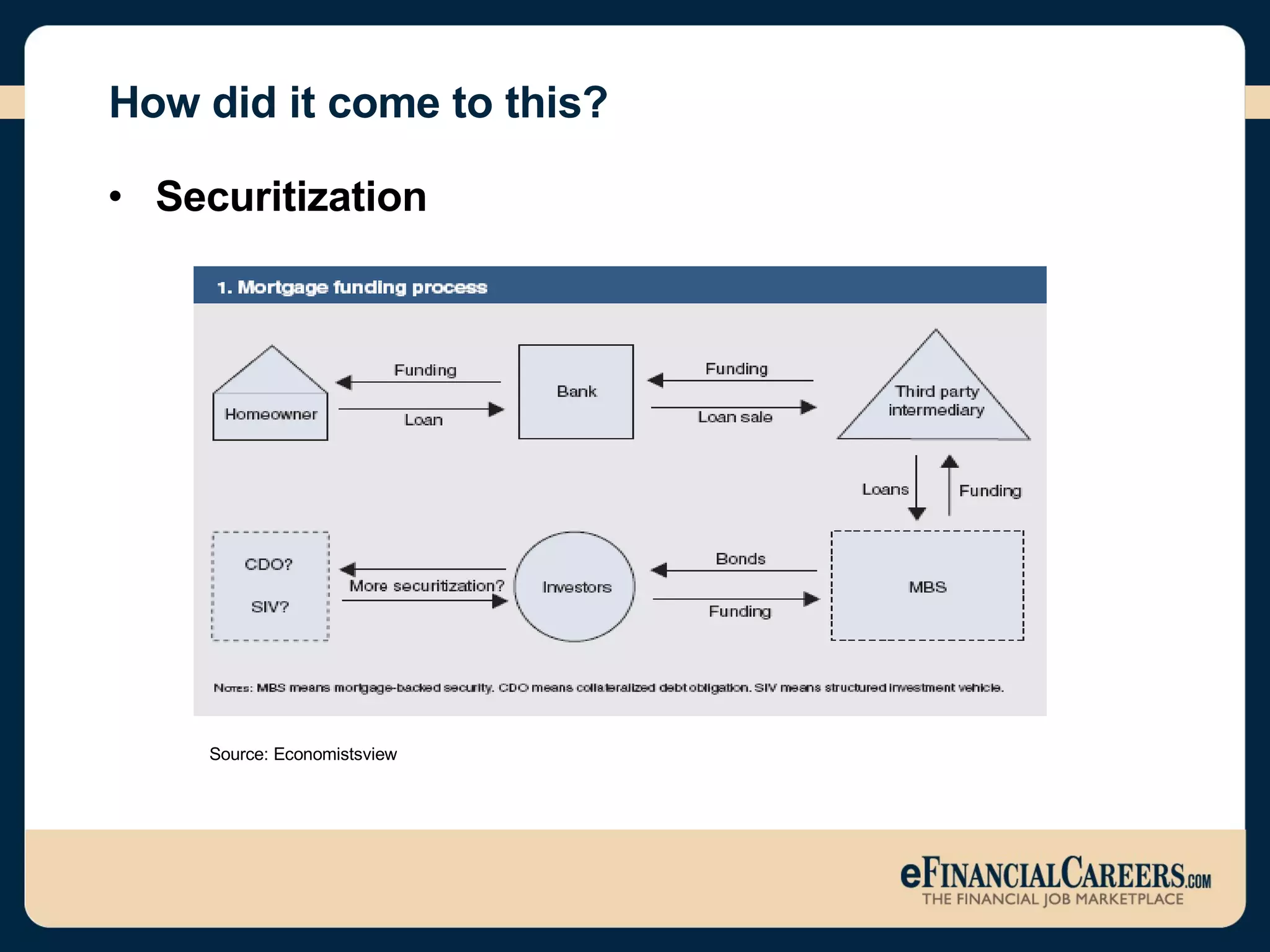
How did it come to this? Securitization  Source: Economistsview
How did it come to this? Securitization Think David Bowie’s back catalogue Pools of mortgaged backed securities collected and re-securitized SIV= Structured investment vehicle – issues short and medium term debt payable in 2-270 days  CDO= Collateralised debt obligation – longer term debt
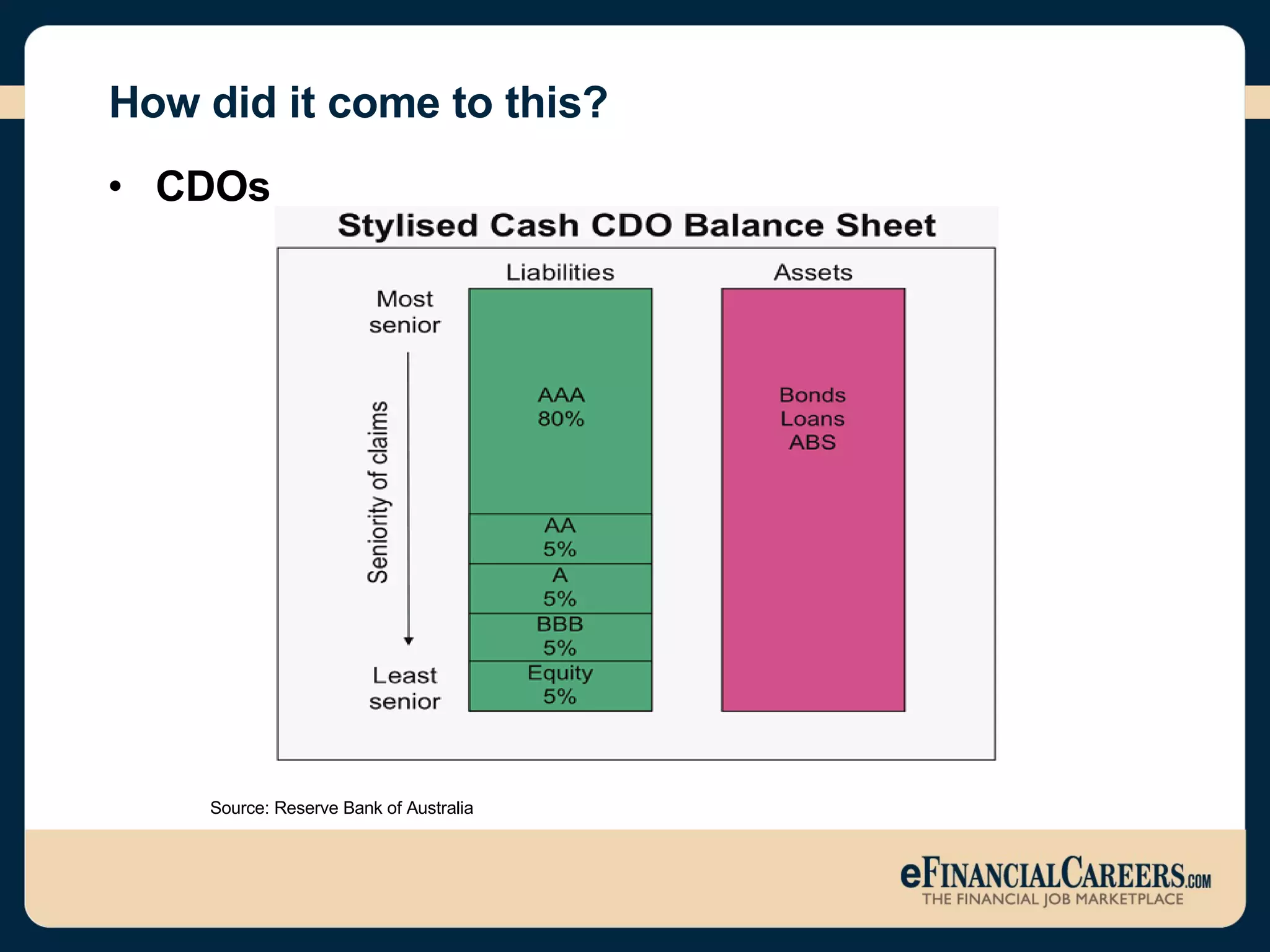
How did it come to this? CDOs Source: Reserve Bank of Australia
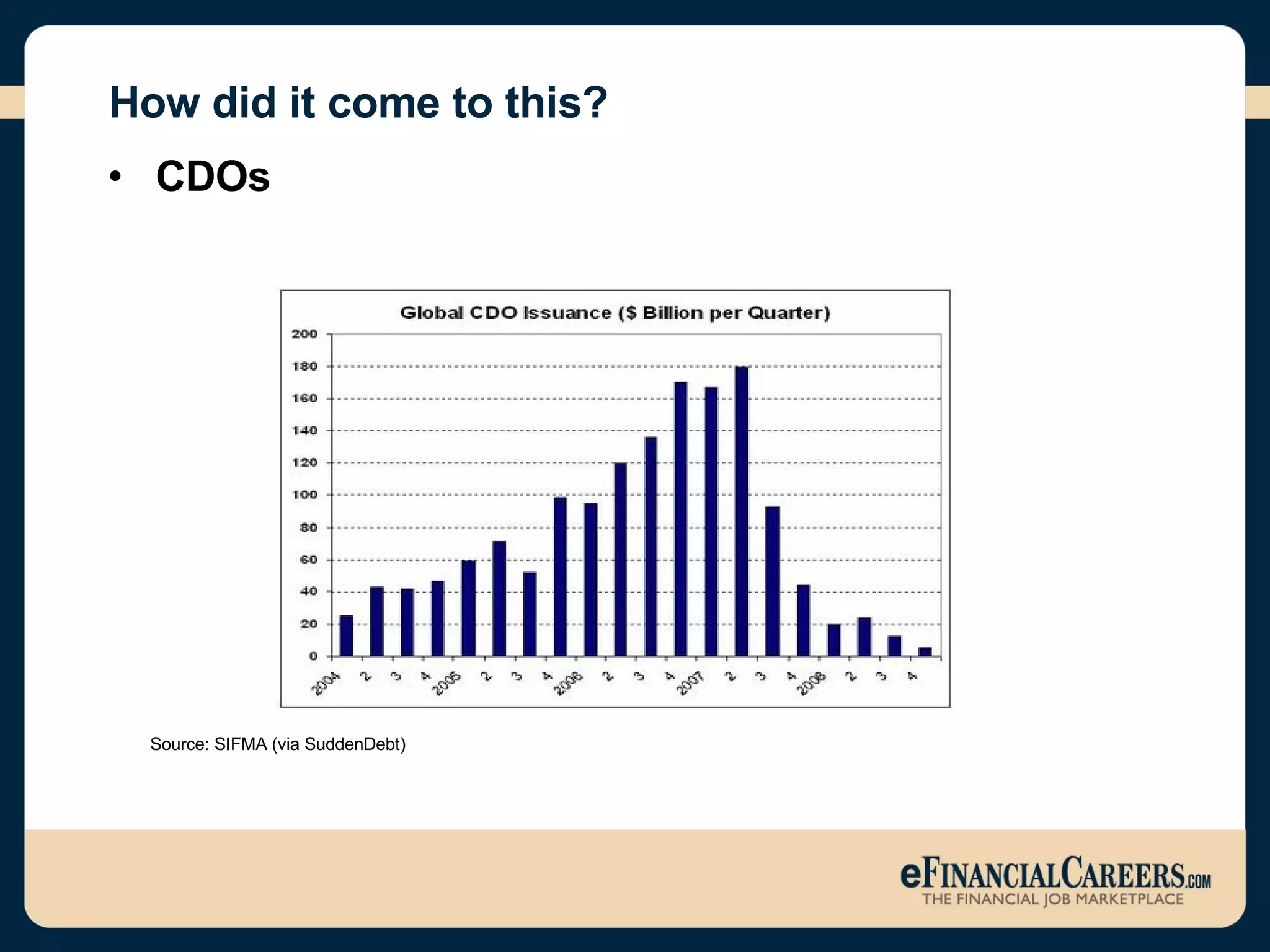
How did it come to this? CDOs Source: SIFMA (via SuddenDebt)
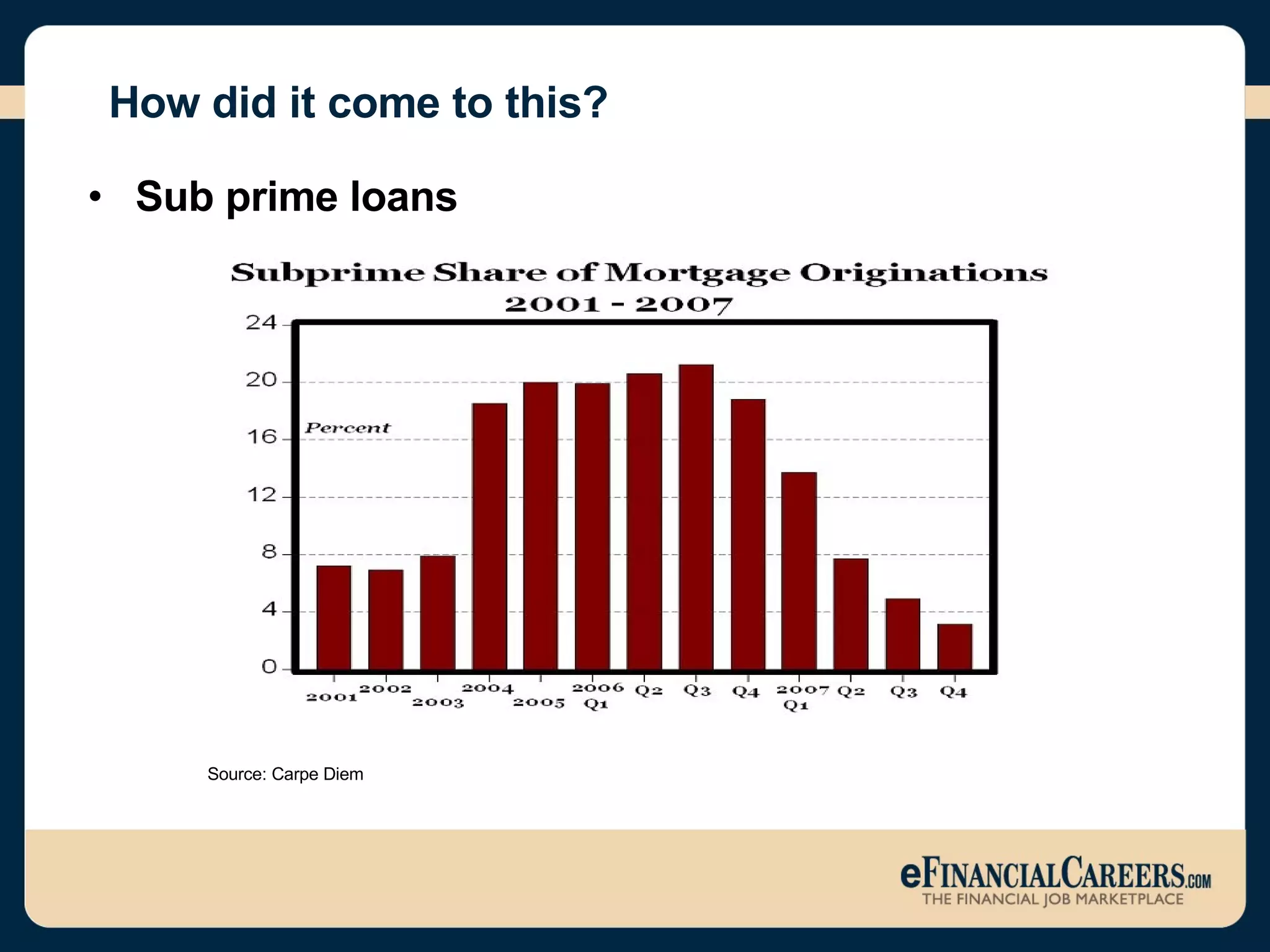
How did it come to this? Sub prime loans  Source: Carpe Diem
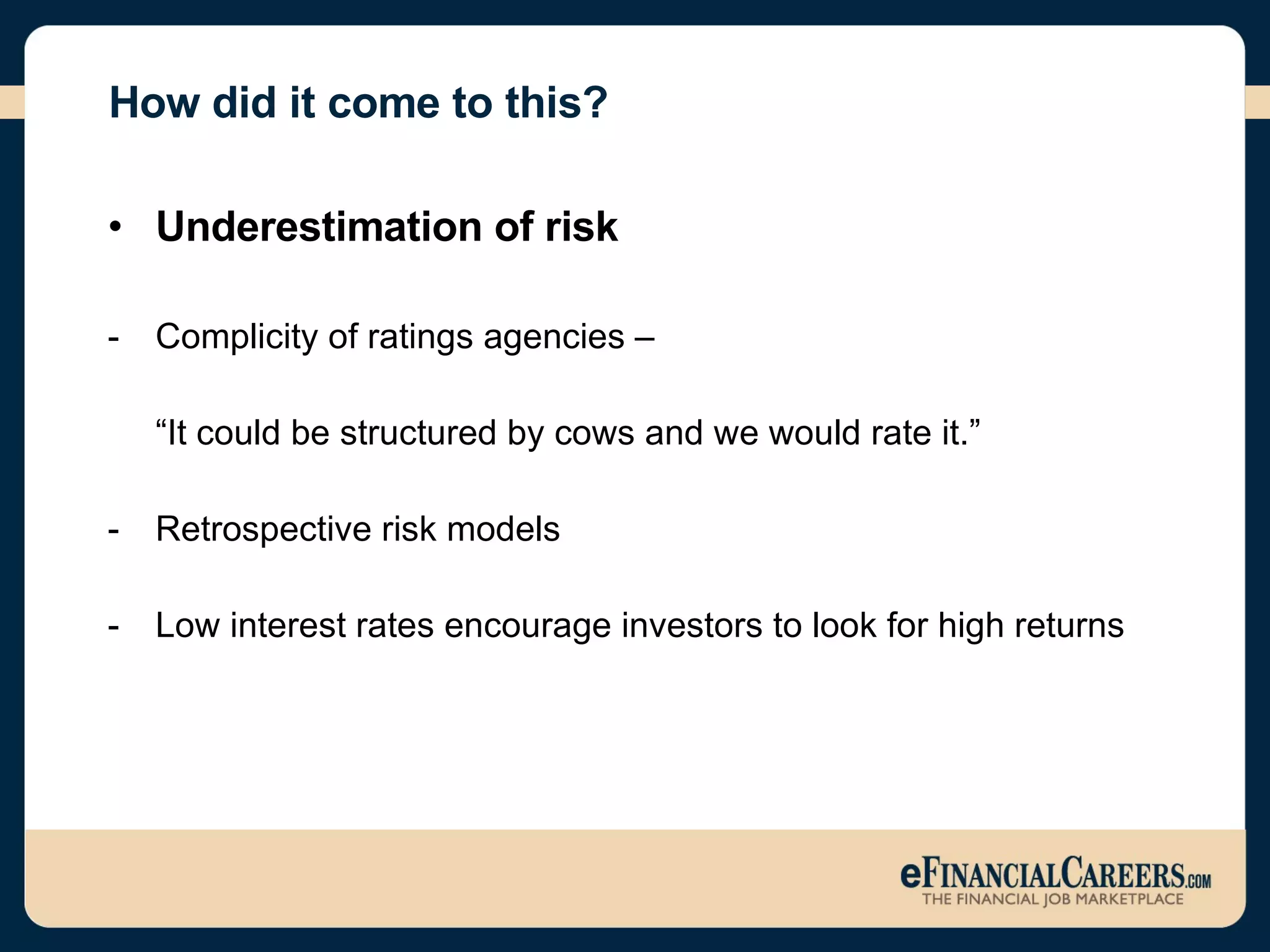
How did it come to this? Underestimation of risk Complicity of ratings agencies –  “ It could be structured by cows and we would rate it.” Retrospective risk models  Low interest rates encourage investors to look for high returns
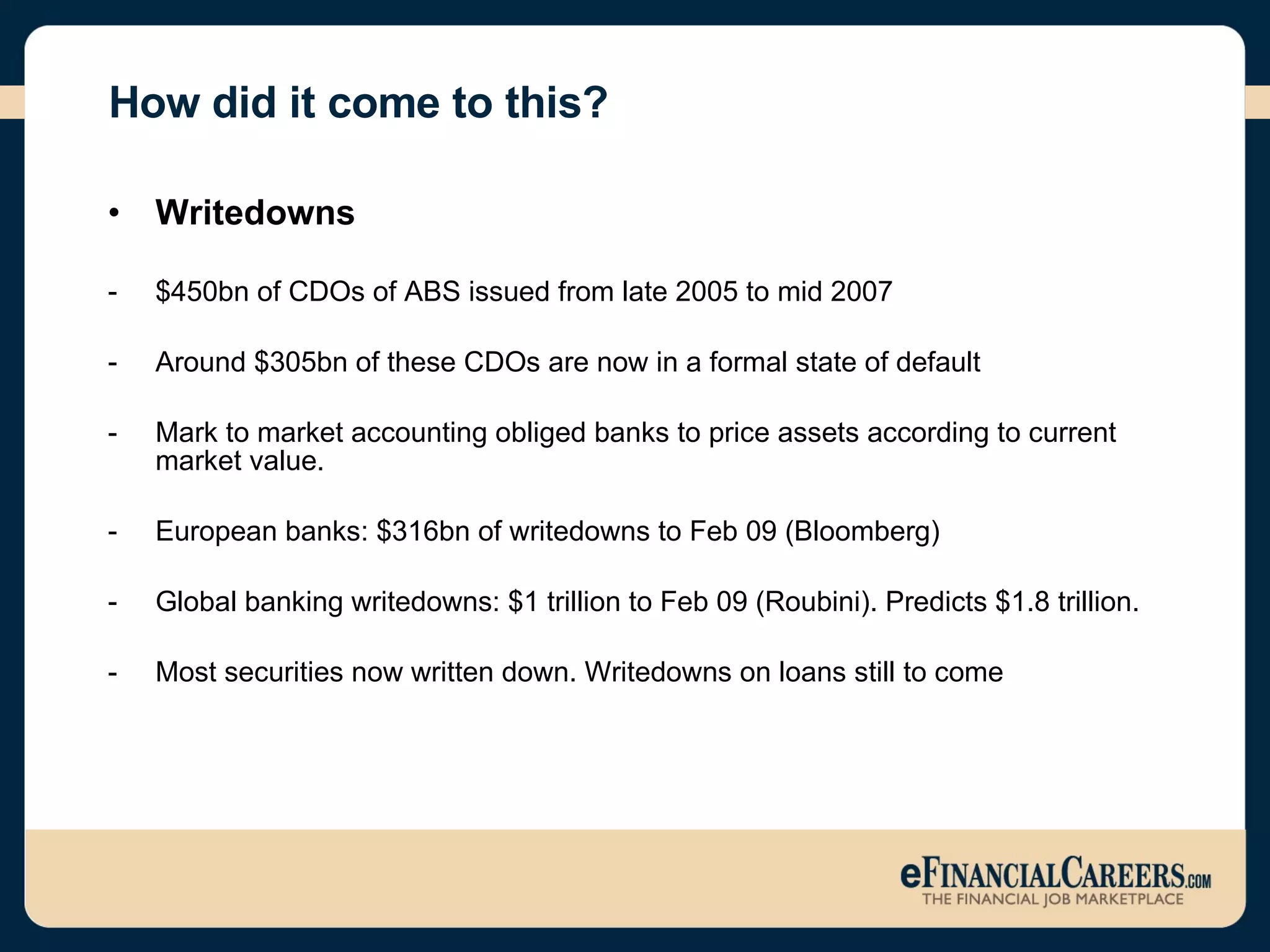
How did it come to this? Writedowns $450bn of CDOs of ABS issued from late 2005 to mid 2007 Around $305bn of these CDOs are now in a formal state of default Mark to market accounting obliged banks to price assets according to current market value. European banks: $316bn of writedowns to Feb 09 (Bloomberg) Global banking writedowns: $1 trillion to Feb 09 (Roubini). Predicts $1.8 trillion.  Most securities now written down. Writedowns on loans still to come
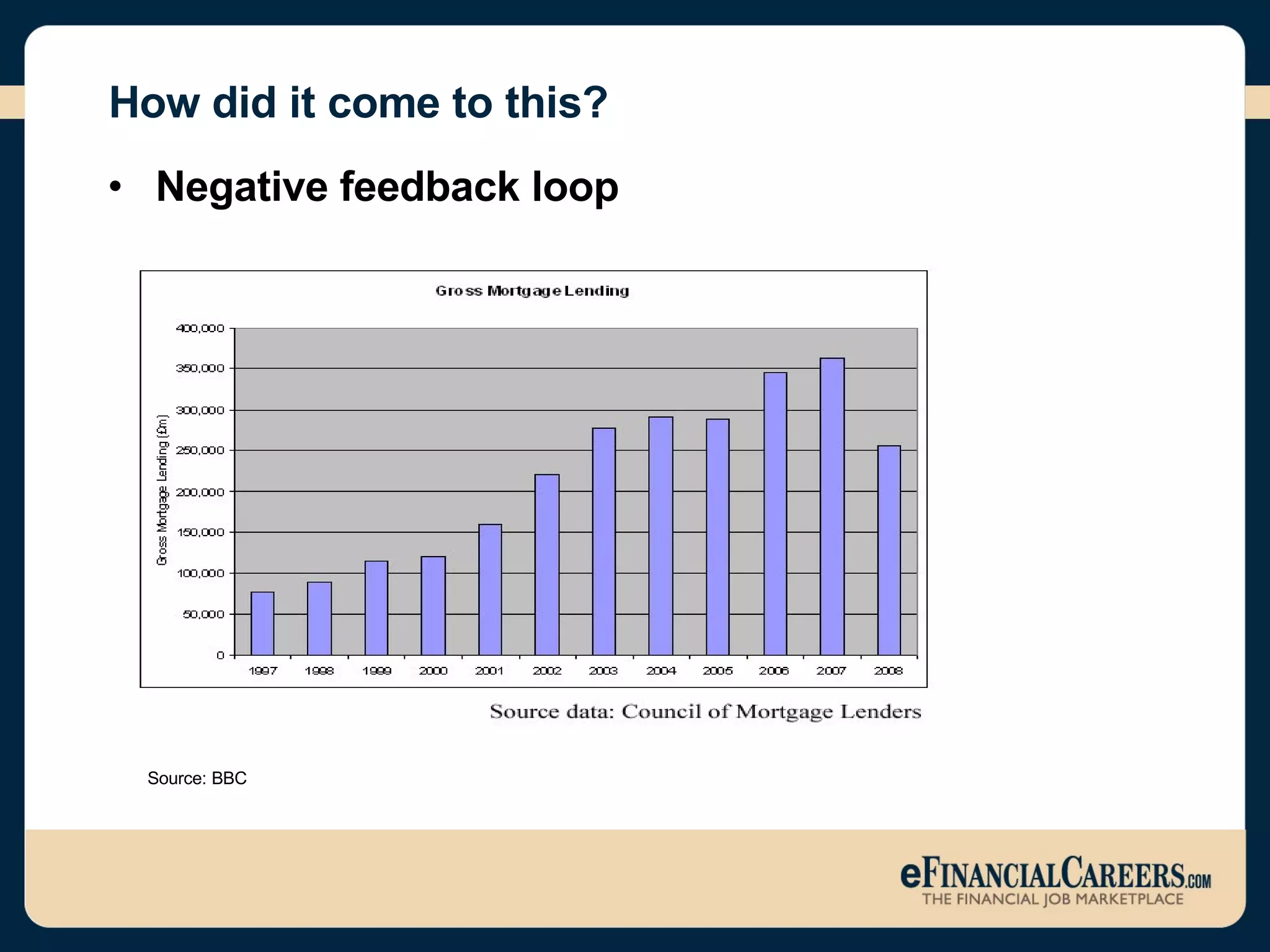
How did it come to this? Negative feedback loop Source: BBC
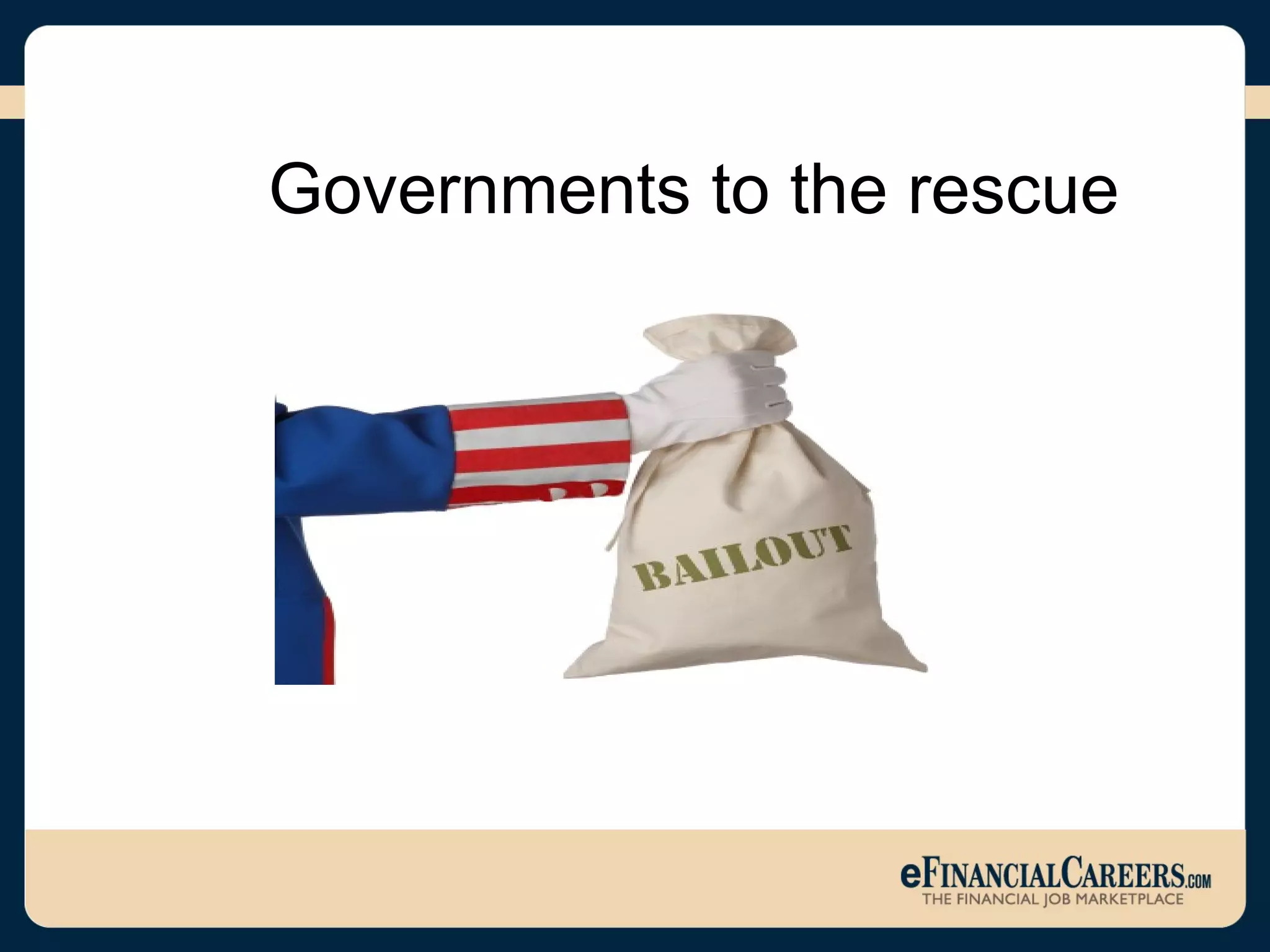
Governments to the rescue
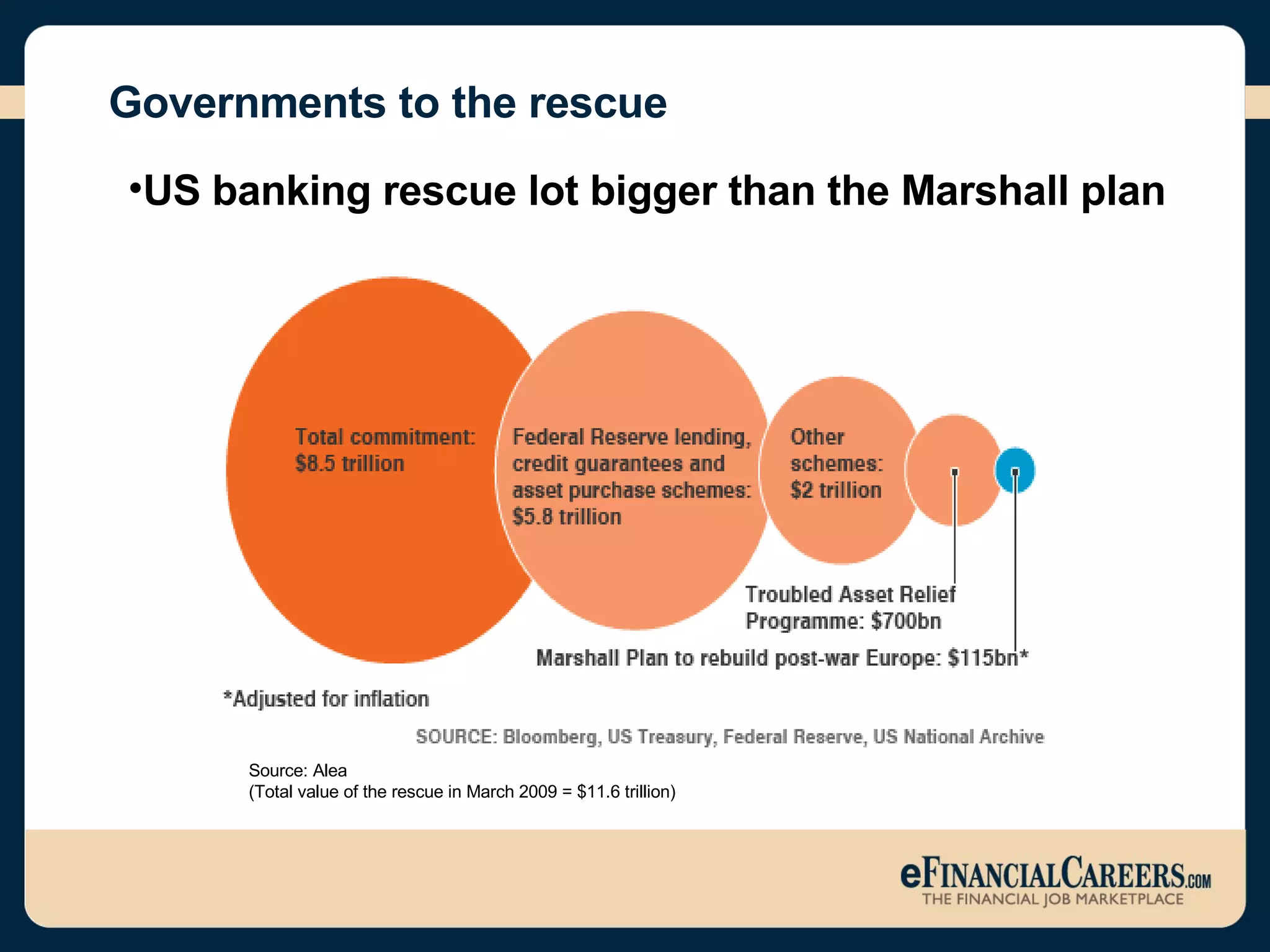
Governments to the rescue  US banking rescue lot bigger than the Marshall plan Source: Alea (Total value of the rescue in March 2009 = $11.6 trillion)
Governments to the rescue Rescues by genre  Capital injections (buying preferred equity/ordinary stock) Unfreezing credit markets (Eg. Central banks swap cash/government bonds for asset backed securities). Attempts to buy up banks’ toxic assets – Eg. Original TARP and Geithner plan  Guarantees/insurance programmes – Eg. above a pre-determined level, governments insure banks against losses on their toxic assets. Loans to get markets moving again – Eg.  US government lending up to $200bn to holders of asset backed securities under TALF.
Governments to the rescue So, who’s been bailed out? Fannie and Freddie, UBS, Commerzbank, Bank of America, Citigroup, RBS, AIG, Bradford & Bingley, Lloyds Banking Group, Northern Rock, Fortis, Dexia, SocGen, BNP Paribas, Credit Agricole, Bank of Ireland, Allied Irish, Goldman Sachs, Morgan Stanley, JPMorgan Chase, State Street, Northern Trust, Unicredit, Gulf Bank…
What? Very big insurance company. Insures 90% of Fortune 500. Operating in 140 countries globally Offered both standard insurance (eg. car insurance) and insurance against financial products defaulting.  $1.6 trillion in ‘notional derivatives exposures.’
Why bailed out? Systemic risk from loss of AAA rating. ‘Confidential report said’ –  ‘ The failure of AIG would cause turmoil in the US economy and global markets and have multiple and potentially catastrophic unforseen consequences.’ - Eg.   Plummeting dollar. ‘Enormous downward pressure’ on securities valuations as products dumped.
How bailed out? On 16th September 2008, the day after Lehman went under, the US government lent AIG an initial $85bn to save it from collapse. It received a 79% stake in the company in return.
Was the bailout successful? - Yes: meltdown averted. No: AIG has needed multiple bailouts. US government injected more money in November 2008 and March 2009 .  The US government has $160bn pledged so far. In 4Q08 AIG lost  $465,421 every single minute.
What? The biggest bank in the world until 2008. Operating in over 100 countries globally. 325,000 employees worldwide in 2007
Why bailed out? -  Big exposure to toxic assets, comparatively small capital base. $60bn of market to market losses on asset writedowns by early 2009. $300bn plus in additional toxic debt. Share price fell below $1 in March 2009 (after bailout).
How bailed out? Bailout No. 1: October 2008, US gov invests $25bn in preferred shares (without voting rights).  Bailout No. 2: November 2008, US gov invests another $20bn investment in preferred shares; guarantees to cover most of the losses on $300bn toxic debt. Bailout No 3:  No more cash, conversion of gov’s preferred stock into into ordinary stock. 36% voting stake as a result.
Was the bailout successful? Yes: meltdown averted No: Citigroup’s stock fell 60% immediately after third bailout, but rose on reassuring words from the CEO. Concerns of further big writedowns to come. Eg. On credit card debt.
What? One of the UK’s largest mortgage lenders. Former building society, formed 1965, floated on the stock exchange 1997 and changed its business model
Why bailed out? Over-reliance on funding in wholesale markets Wholesale funding dried up in August 2007. 12/9/07 it emerged that Northern Rock needed an emergency loan from Bank of England. Run on the bank.
How bailed out? UK gov tried, failed, to find a buyer. Feb 2008, UK gov lent Northern Rock £26.9bn: nationalization.  Little compensation offered to Northern Rock shareholders.
Was the bailout successful? Yes: meltdown averted. £18bn of government loan repaid in February 2009. Northern Rock could form core of a good bank.  But bad debts on Northern Rock’s mortgages are rising.
What? Very large and venerable Scottish bank. Founded founded in 1727 by a Royal Charter of King George I.
Why bailed out? Too many debts, too little capital.  Expensive ABN AMRO acquisition: £10bn at the top of the market. RBS stock fell 40% in October 2008.  RBS stock fell 70% in February 2009 before reported biggest loss in UK corporate history: £24.1bn.
How bailed out? Bailout No. 1: £20bn from UK gov in October 2008.  60% stake in preference shares.  Converted to ordinary shares Jan 09; RBS agrees to increase lending. Bailout No. 2: £19bn from UK government in Feb 2009. 75% stake in preference shares. Gov guarantee against losses on £325bn of toxic assets.
Was the bailout successful? Yes: no meltdown.  RBS could be start of a bad bank. ‘Non-core’ RBS to include £300bn of unwanted operations and toxic assets.
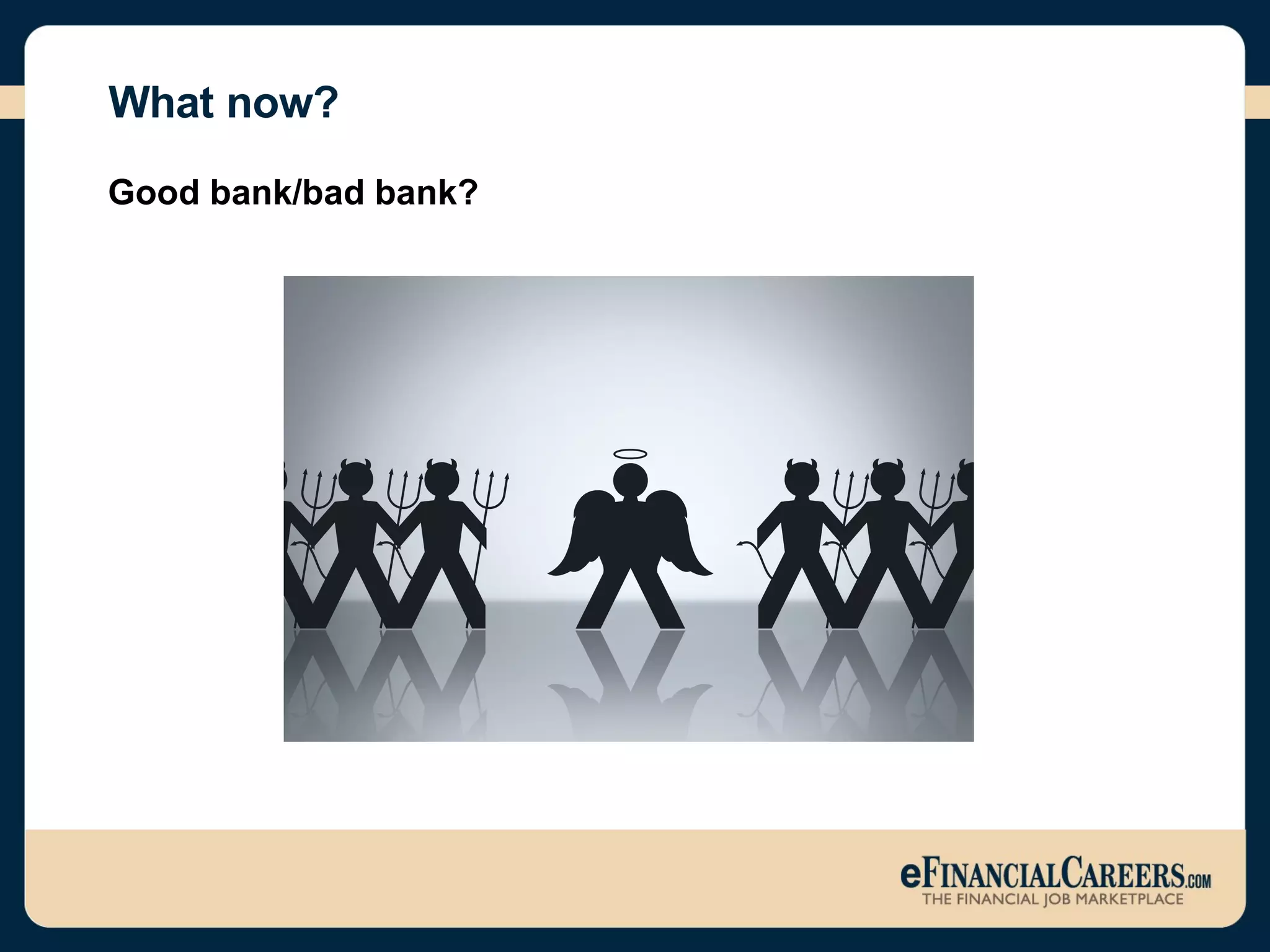
What now? Good bank/bad bank?
What about quantitative easing? Creating money in the hope banks start lending again. Bank of England:  buying up to  £100bn in short and medium term government bonds; up to £50bn in high grade corporate debt. Federal Reserve :  buying up to $300 billion of longer-dated Treasuries over the next six months and buy another $850 billion of mortgage securities. Banks could either hoard the extra money or there could be…
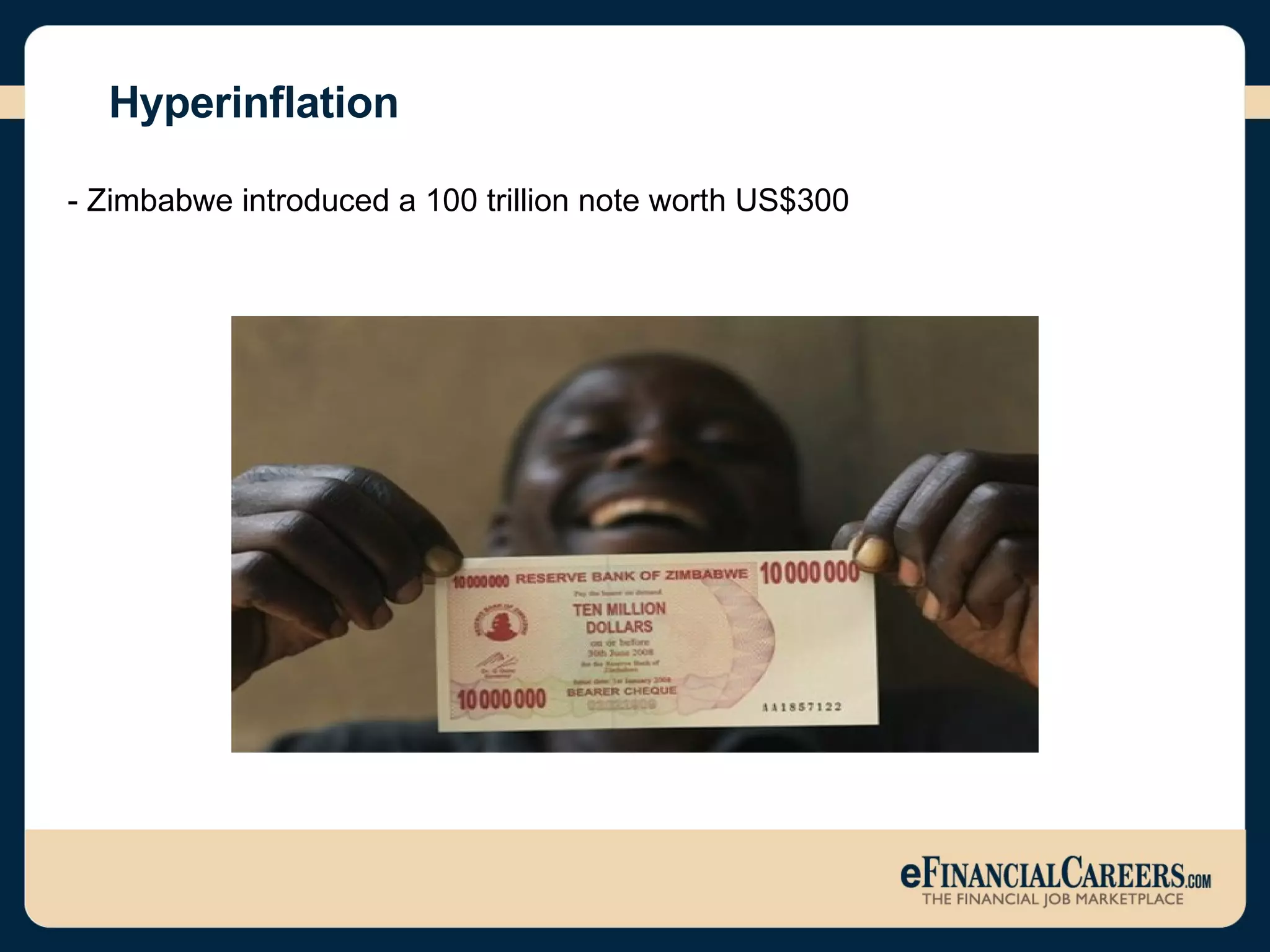
- Zimbabwe introduced a 100 trillion note worth US$300 Hyperinflation
What does this mean for you?
What does this mean for you? Fewer jobs Lower pay More uncertainty  Danger of redundancy New institutions?
What does this mean for you? The havens: FX trading  Sales and trading, simple products  Risk Compliance (and working for the regulator) Old-fashioned relationship banking  Private banking (at least until recently)  Fund management

Merrill Lynch Demystifying The Market

  • 1.
    De-mystifiying the market By Sarah Butcher – Editor eFinancialCareers.com
  • 2.
    Agenda Part 1– The current market place and how did we get here. Part 2 – Government rescue. Part 3 – Where are we going and the implications for the future. Part 4 – Questions and Answers
  • 3.
    Taking stock: wherewe are now Writedowns: - $50 trillion of financial assets (stocks, bonds and currencies) written down in 2008 according to the Asian Development Bank. Equivalent to one year’s global GDP - 40-45% of the world’s wealth destroyed says Stephen Schwarzman, chairman and chief executive of Blackstone Group
  • 4.
    Taking stock: wherewe are now Financials have taken a (big) hit Source: StockCharts.com
  • 5.
    Taking stock: wherewe are now Financials have taken a (big) hit Citigroup shares fell to $1, down from highs of $55 in 2007 Further writedowns from Eastern Europe, credit cards, corporate and consumer debt are very possible 277,400 finance industry jobs lost worldwide (Bloomberg)
  • 6.
    Taking stock: wherewe are now Ready to default? Source: Wall St. Journal
  • 7.
    Taking stock: wherewe are now Volatile equity markets - FTSE at 6 year low in late February S&P 500 at 12 year low in late February 20% recovery in S&P by late March 2009, 7% recovery on Monday March 23 rd after the Geithner plan was announced From March 9 to March 20 2009, the KBW bank index rose by 33 percent, while the overall Dow Industrials rose by only 11 percent. Citibank quadrupled in value from early March to mid-April. Bear market rally? Star fund managers call the bottom of the market – March 15 th Anthony Bolton said we may be near the bottom, and entering a new bull market.
  • 8.
    Taking stock: wherewe are now Volatile equity markets Source: MoneyWeek
  • 9.
    Taking stock: wherewe are now Source: Clusterstock
  • 10.
    Taking stock: wherewe are now Manufacturing trauma Number of cars assembled in the US down 60% in Jan 09 Chinese exports down 17% in Jan 09 Japanese exports down 46% in Jan 09
  • 11.
    Taking stock: Wherewe’ve come from 2007-8
  • 12.
    Taking stock: Wherewe’ve come from 2007: Rumblings February: HSBC fires chiefs of US division (Household International) May: UBS closes Dillon Reed Capital Management June: Bear Stearns bails out its hedge funds for the first time August: 3 BNP Paribas funds, once worth €1.6bn, suspended August: Stock markets tumble, central banks intervene September: Northern Rock October: $8.4bn loss at ML, Stan O’Neal ousted
  • 13.
    Taking stock: Wherewe’ve come from 2008: Disintegration FTSE down 31% Bye bye Bear Stearns So long Lehman BofA and Merrill get together Goldman and Morgan Stanley become bank holding companies Perilously close to meltdown: Crisis in the money markets. September $550bn withdrawn in a few hours on Sept 18 th after money market fund the Reserve Fund caught holding Lehman debt. US gov introduced $3.4 trillion money market guarantee programme.
  • 14.
    Taking stock: Wherewe’ve come from 2008: Disintegration LIBOR (London interbank offer rate) post Lehman Source: John Taylor, Stanford University, via FTAlphaville
  • 15.
    Taking stock: Wherewe’ve come from 2008: Disintegration Source: FTAlphaville
  • 16.
    Taking stock: Wherewe’ve come from 2008: Crisis timeline Source: Pragmatic Capitalist
  • 17.
    How did itcome to this?
  • 18.
    How did itcome to this? The ‘Great Moderation’ Source: Dallas Fed
  • 19.
    How did itcome to this? Leverage, leverage, leverage Source: Market Oracle
  • 20.
    How did itcome to this? Money from overseas Source: BusinessWeek
  • 21.
    How did itcome to this? New funding model “ In the UK, regulators and shareholders acquiesced while six major banks increased their aggregate reliance on wholesale, unsecured funding from £38bn in 2003 to £498bn in 2008 in order to finance increasingly speculative lending.” Guy Hands, CEO Terra Firma Capital Partners
  • 22.
    How did itcome to this? Securitization Source: Economistsview
  • 23.
    How did itcome to this? Securitization Think David Bowie’s back catalogue Pools of mortgaged backed securities collected and re-securitized SIV= Structured investment vehicle – issues short and medium term debt payable in 2-270 days CDO= Collateralised debt obligation – longer term debt
  • 24.
    How did itcome to this? CDOs Source: Reserve Bank of Australia
  • 25.
    How did itcome to this? CDOs Source: SIFMA (via SuddenDebt)
  • 26.
    How did itcome to this? Sub prime loans Source: Carpe Diem
  • 27.
    How did itcome to this? Underestimation of risk Complicity of ratings agencies – “ It could be structured by cows and we would rate it.” Retrospective risk models Low interest rates encourage investors to look for high returns
  • 28.
    How did itcome to this? Writedowns $450bn of CDOs of ABS issued from late 2005 to mid 2007 Around $305bn of these CDOs are now in a formal state of default Mark to market accounting obliged banks to price assets according to current market value. European banks: $316bn of writedowns to Feb 09 (Bloomberg) Global banking writedowns: $1 trillion to Feb 09 (Roubini). Predicts $1.8 trillion. Most securities now written down. Writedowns on loans still to come
  • 29.
    How did itcome to this? Negative feedback loop Source: BBC
  • 30.
  • 31.
    Governments to therescue US banking rescue lot bigger than the Marshall plan Source: Alea (Total value of the rescue in March 2009 = $11.6 trillion)
  • 32.
    Governments to therescue Rescues by genre Capital injections (buying preferred equity/ordinary stock) Unfreezing credit markets (Eg. Central banks swap cash/government bonds for asset backed securities). Attempts to buy up banks’ toxic assets – Eg. Original TARP and Geithner plan Guarantees/insurance programmes – Eg. above a pre-determined level, governments insure banks against losses on their toxic assets. Loans to get markets moving again – Eg. US government lending up to $200bn to holders of asset backed securities under TALF.
  • 33.
    Governments to therescue So, who’s been bailed out? Fannie and Freddie, UBS, Commerzbank, Bank of America, Citigroup, RBS, AIG, Bradford & Bingley, Lloyds Banking Group, Northern Rock, Fortis, Dexia, SocGen, BNP Paribas, Credit Agricole, Bank of Ireland, Allied Irish, Goldman Sachs, Morgan Stanley, JPMorgan Chase, State Street, Northern Trust, Unicredit, Gulf Bank…
  • 34.
    What? Very biginsurance company. Insures 90% of Fortune 500. Operating in 140 countries globally Offered both standard insurance (eg. car insurance) and insurance against financial products defaulting. $1.6 trillion in ‘notional derivatives exposures.’
  • 35.
    Why bailed out?Systemic risk from loss of AAA rating. ‘Confidential report said’ – ‘ The failure of AIG would cause turmoil in the US economy and global markets and have multiple and potentially catastrophic unforseen consequences.’ - Eg. Plummeting dollar. ‘Enormous downward pressure’ on securities valuations as products dumped.
  • 36.
    How bailed out?On 16th September 2008, the day after Lehman went under, the US government lent AIG an initial $85bn to save it from collapse. It received a 79% stake in the company in return.
  • 37.
    Was the bailoutsuccessful? - Yes: meltdown averted. No: AIG has needed multiple bailouts. US government injected more money in November 2008 and March 2009 . The US government has $160bn pledged so far. In 4Q08 AIG lost $465,421 every single minute.
  • 38.
    What? The biggestbank in the world until 2008. Operating in over 100 countries globally. 325,000 employees worldwide in 2007
  • 39.
    Why bailed out?- Big exposure to toxic assets, comparatively small capital base. $60bn of market to market losses on asset writedowns by early 2009. $300bn plus in additional toxic debt. Share price fell below $1 in March 2009 (after bailout).
  • 40.
    How bailed out?Bailout No. 1: October 2008, US gov invests $25bn in preferred shares (without voting rights). Bailout No. 2: November 2008, US gov invests another $20bn investment in preferred shares; guarantees to cover most of the losses on $300bn toxic debt. Bailout No 3: No more cash, conversion of gov’s preferred stock into into ordinary stock. 36% voting stake as a result.
  • 41.
    Was the bailoutsuccessful? Yes: meltdown averted No: Citigroup’s stock fell 60% immediately after third bailout, but rose on reassuring words from the CEO. Concerns of further big writedowns to come. Eg. On credit card debt.
  • 42.
    What? One ofthe UK’s largest mortgage lenders. Former building society, formed 1965, floated on the stock exchange 1997 and changed its business model
  • 43.
    Why bailed out?Over-reliance on funding in wholesale markets Wholesale funding dried up in August 2007. 12/9/07 it emerged that Northern Rock needed an emergency loan from Bank of England. Run on the bank.
  • 44.
    How bailed out?UK gov tried, failed, to find a buyer. Feb 2008, UK gov lent Northern Rock £26.9bn: nationalization. Little compensation offered to Northern Rock shareholders.
  • 45.
    Was the bailoutsuccessful? Yes: meltdown averted. £18bn of government loan repaid in February 2009. Northern Rock could form core of a good bank. But bad debts on Northern Rock’s mortgages are rising.
  • 46.
    What? Very largeand venerable Scottish bank. Founded founded in 1727 by a Royal Charter of King George I.
  • 47.
    Why bailed out?Too many debts, too little capital. Expensive ABN AMRO acquisition: £10bn at the top of the market. RBS stock fell 40% in October 2008. RBS stock fell 70% in February 2009 before reported biggest loss in UK corporate history: £24.1bn.
  • 48.
    How bailed out?Bailout No. 1: £20bn from UK gov in October 2008. 60% stake in preference shares. Converted to ordinary shares Jan 09; RBS agrees to increase lending. Bailout No. 2: £19bn from UK government in Feb 2009. 75% stake in preference shares. Gov guarantee against losses on £325bn of toxic assets.
  • 49.
    Was the bailoutsuccessful? Yes: no meltdown. RBS could be start of a bad bank. ‘Non-core’ RBS to include £300bn of unwanted operations and toxic assets.
  • 50.
    What now? Goodbank/bad bank?
  • 51.
    What about quantitativeeasing? Creating money in the hope banks start lending again. Bank of England: buying up to £100bn in short and medium term government bonds; up to £50bn in high grade corporate debt. Federal Reserve : buying up to $300 billion of longer-dated Treasuries over the next six months and buy another $850 billion of mortgage securities. Banks could either hoard the extra money or there could be…
  • 52.
    - Zimbabwe introduceda 100 trillion note worth US$300 Hyperinflation
  • 53.
    What does thismean for you?
  • 54.
    What does thismean for you? Fewer jobs Lower pay More uncertainty Danger of redundancy New institutions?
  • 55.
    What does thismean for you? The havens: FX trading Sales and trading, simple products Risk Compliance (and working for the regulator) Old-fashioned relationship banking Private banking (at least until recently) Fund management