Subprime
Mortgage Crisis
Your Company Name
2008 Financial Crisis Impact Explained in Numbers
2
01 Housing Prices fell 31.8%
02 Unemployment was still above 9% in 2010
03 $30 Bn federal guarantee for deal between JP
Morgan Chase & Bear Stearns
04 $182 Bn federal bailout for AIG
05 Fannie Mae & Freddie Mac guarantee 90% of
all mortgages
06 Treasury department spent $439.6 Bn buying
bank & car stocks
07 $144.5 Bn moved from money market to
treasury bonds
Source: The Balance 2020
This slide is 100% editable. Adapt it to your needs and capture your audience's attention.
Major Financial Bubble Burst of all Times
3
NASADQ & the
Internet boom
Fell 30% 1 month after
record high
2000
Nikkei 225
20-year bear market,
losses hit 82%
1989
Precious Metal
Silver fell 66% in 2
months
1980
Dow Jones
Industrial Average
Losses neared 90%
by 1932
1929
US Housing Market
Homebuilding stocks
lost 90%in value
2005
Crude Oil
Dropped 77% in 6
months
2008
Precious Metals
Silver fell 25% in 5 Days
2011
Bitcoin
Loss of 25% in
just 1 day
2020
Note: 1Bank of America acquired Merrill Lynch in September 2008; 2Lehman filed for bankruptcy and sold it’s investment
banking business to Barclays & Nomura
Impact of the Great Recession on Investment Banks
4
Rank in 2007 Investment Bank Rank in 2020
1 Goldman Sachs 2
2 Deutsche Bank 6
3 Morgan Stanley 4
4 Citi 2
5 JP Morgan 1
6 Credit Suisse 7
7 UBS 10
8 Merrill Lynch1 NA
9 Lehman Brothers2 NA
10 Barclays 7
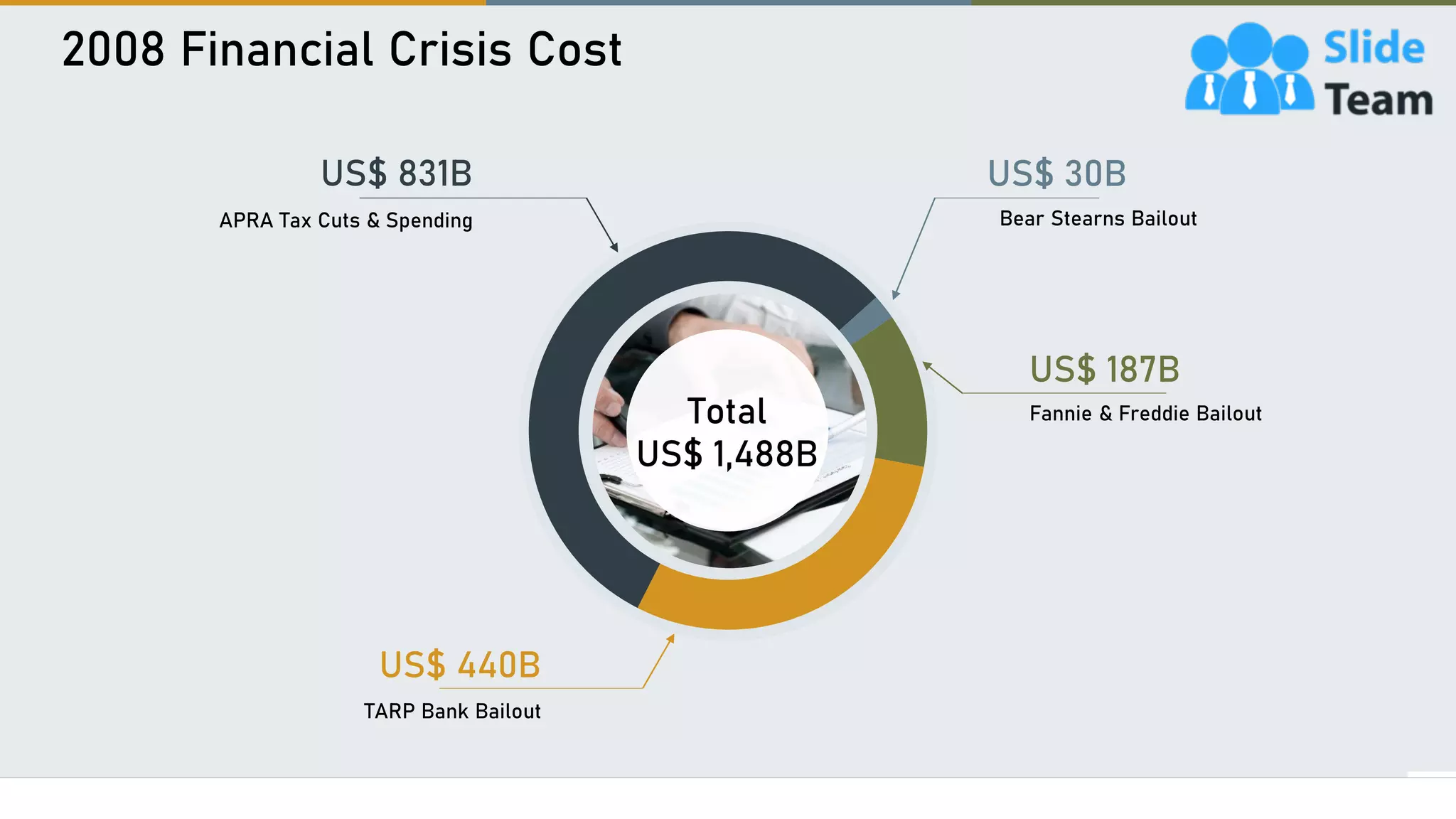
2008 Financial Crisis Cost
5
Bear Stearns Bailout
US$ 30B
Fannie & Freddie Bailout
US$ 187B
APRA Tax Cuts & Spending
US$ 831B
TARP Bank Bailout
US$ 440B
Total
US$ 1,488B
This graph/chart is linked to excel, and changes automatically based on data. Just left click on it and select “Edit Data”.
Key Figures of the Crisis
6
This slide is 100% editable. Adapt it to your needs and capture your audience's attention.
John Thain
Then: Chairman & CEO, Merrill Lynch
Now: Member of Supervisory board, Deutsche
bank AG
Jamie Dimon
Then: Chairman & CEO, JP Morgan Chase &
Co
Now: Same
Richard Fuld
Then: Chairman & CEO, Lehman Brothers
Holdings
Now: Founder, Chairman & CEO Matrix
Investment Management
Ben Bernanke
Then: Chairman, Federal Reserve
Now: Senior advisor to Citadel, a hedge fund
Timothy Geithner
Then: President, Federal Reserve bank of
New York, and later, treasury secretary
Now: President Warburg Pincus
Hank Paulson
Then: US Treasury Secretary
Now: Chairman of Paulson institute, a think tank he
set up at the University of Chicago in 2011
02
03
01 04
05
06
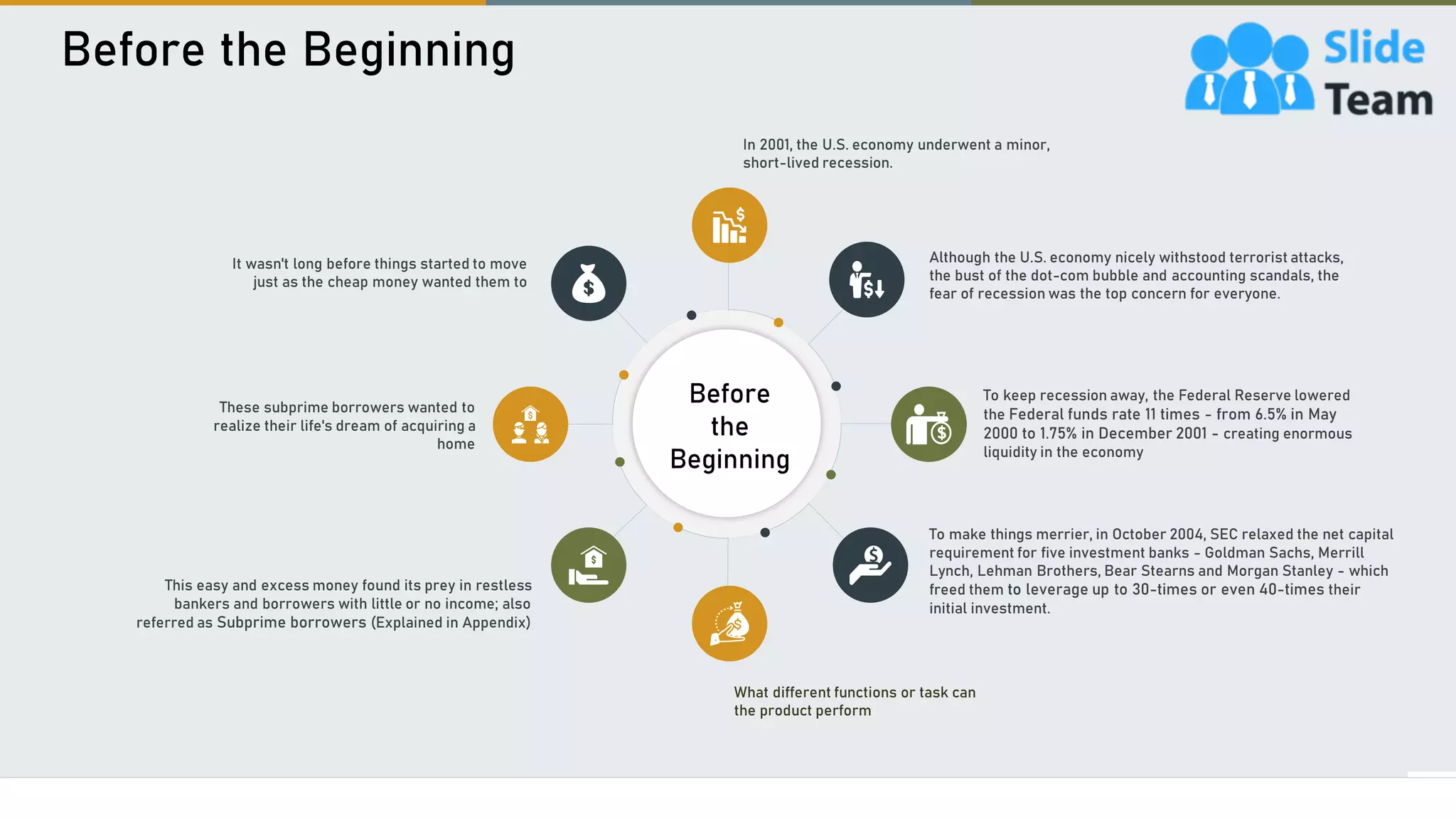
Before the Beginning
7
In 2001, the U.S. economy underwent a minor,
short-lived recession.
What different functions or task can
the product perform
It wasn't long before things started to move
just as the cheap money wanted them to
These subprime borrowers wanted to
realize their life's dream of acquiring a
home
To make things merrier, in October 2004, SEC relaxed the net capital
requirement for five investment banks - Goldman Sachs, Merrill
Lynch, Lehman Brothers, Bear Stearns and Morgan Stanley - which
freed them to leverage up to 30-times or even 40-times their
initial investment.
This easy and excess money found its prey in restless
bankers and borrowers with little or no income; also
referred as Subprime borrowers (Explained in Appendix)
To keep recession away, the Federal Reserve lowered
the Federal funds rate 11 times - from 6.5% in May
2000 to 1.75% in December 2001 - creating enormous
liquidity in the economy
Although the U.S. economy nicely withstood terrorist attacks,
the bust of the dot-com bubble and accounting scandals, the
fear of recession was the top concern for everyone.
Before
the
Beginning
What Happened then?
8
This environment of easy credit and the upward spiral of home prices made
investments in higher yielding subprime mortgages look like a new rush for gold
Even this wasn’t enough, what was going to happen next worsened the situation
This environment of easy credit and the upward spiral of home prices made
investments in higher yielding subprime mortgages look like a new rush for gold.
The mortgage lenders wanted more money to lend to homebuyers, so they sold
their existing loans to banks and to Freddie Mac and Fannie May, which in turn
sold these to investment banks
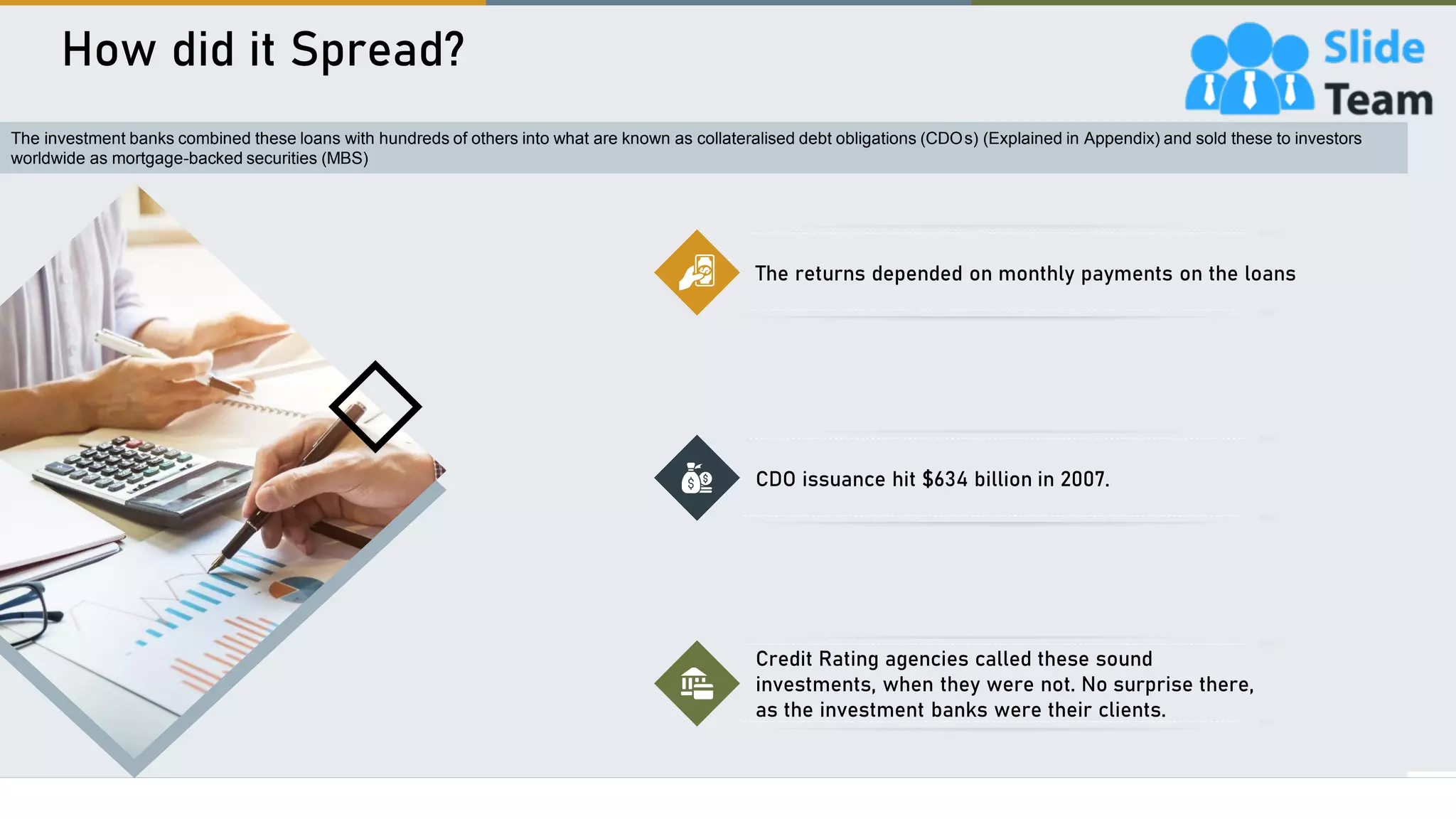
How did it Spread?
9
The investment banks combined these loans with hundreds of others into what are known as collateralised debt obligations (CDOs) (Explained in Appendix) and sold these to investors
worldwide as mortgage-backed securities (MBS)
The returns depended on monthly payments on the loans
CDO issuance hit $634 billion in 2007.
Credit Rating agencies called these sound
investments, when they were not. No surprise there,
as the investment banks were their clients.
How did those who Bought CDO Protect themselves?
10
This is where another
infamous term from
the crisis comes in:
credit default swaps.
Insurance companies
used these
instruments to cover
investors’ losses if
homebuyers defaulted
on loans.
No one expected the
party to wind down
and so there were no
worries.
They thought an
insurance product
called credit default
swaps protected them.
A traditional insurance
company known as the
American International
Group (AIG) sold these
swaps. When the
derivatives lost value,
AIG didn't have enough
cash flow to honor all
the swaps.
Beginning of the End
11
£90bn was wiped off the value of Britain’s biggest companies in
a single day
Housing prices started falling in 2006 and homebuyers began defaulting on
their loans, which meant insurance companies couldn’t honour all their
credit default swaps.
Within a few weeks in September 2008, Lehman Brothers, one of the
world’s biggest financial institutions, went bankrupt
Banks panicked when they realized they would have to absorb the losses.
They stopped lending to each other. They didn't want other banks giving
them worthless mortgages as collateral.
As a result, interbank borrowing costs, LIBOR, rose. This mistrust within
the banking community was the primary cause of the 2008 financial crisis
The Federal Reserve began pumping liquidity into the banking system via
the Term Auction Facility. But that wasn't enough.
Subprime Effect
12
Sub-Prime Effect
This graph/chart is linked to excel, and changes automatically based on data. Just left click on it and select “Edit Data”.
USA
France
Belgium
UK
Netherlands
Germany
China
Australia
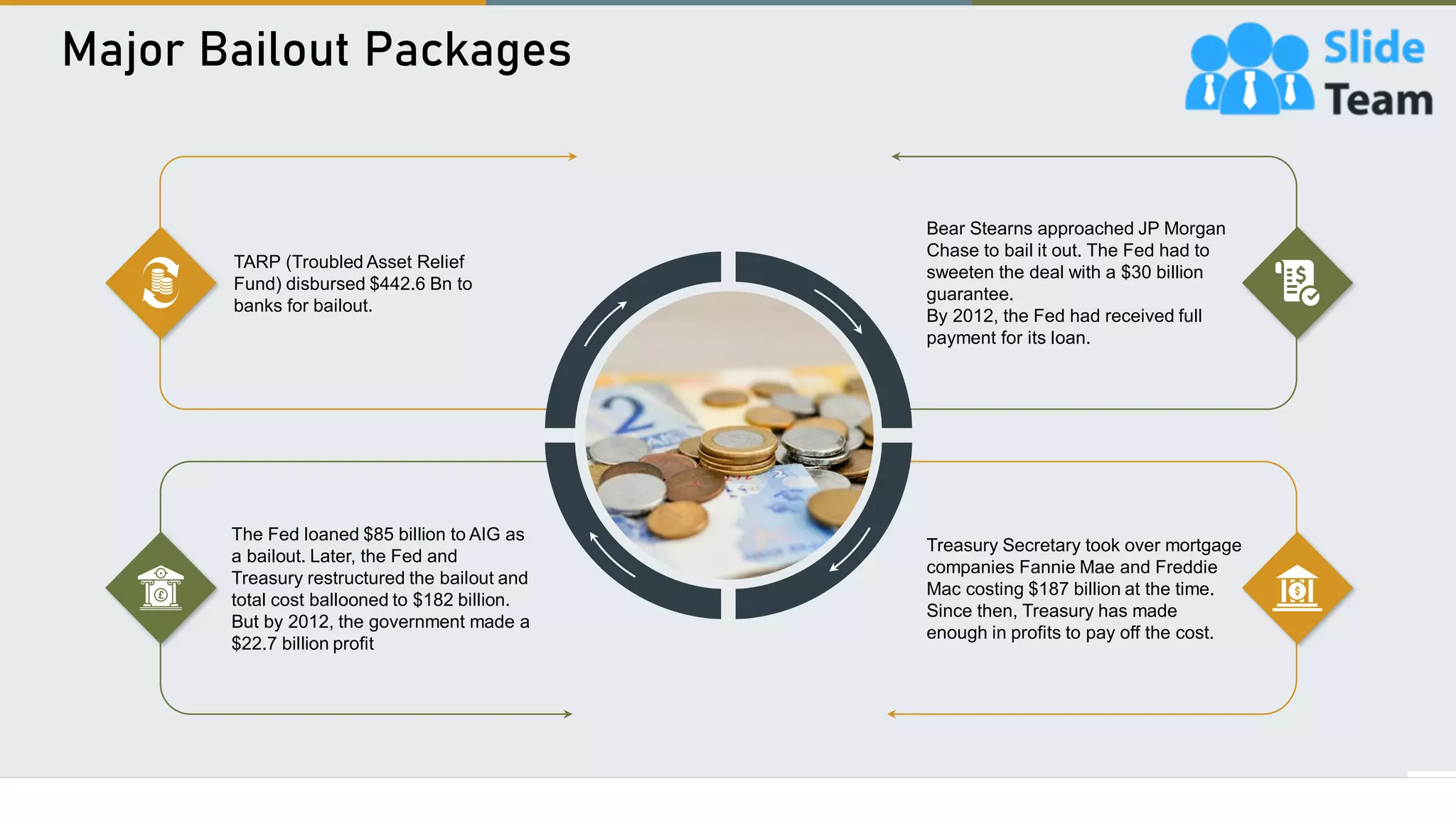
Major Bailout Packages
13
Treasury Secretary took over mortgage
companies Fannie Mae and Freddie
Mac costing $187 billion at the time.
Since then, Treasury has made
enough in profits to pay off the cost.
The Fed loaned $85 billion to AIG as
a bailout. Later, the Fed and
Treasury restructured the bailout and
total cost ballooned to $182 billion.
But by 2012, the government made a
$22.7 billion profit
Bear Stearns approached JP Morgan
Chase to bail it out. The Fed had to
sweeten the deal with a $30 billion
guarantee.
By 2012, the Fed had received full
payment for its loan.
TARP (Troubled Asset Relief
Fund) disbursed $442.6 Bn to
banks for bailout.
Banks have Paid Billions of Dollars in Fine
14
Source: Boston Consulting Group; Thomson Reuters
This graph/chart is linked to excel, and changes automatically based on data. Just left click on it and select “Edit Data”.
North American
Banks
63% European
Banks
37%
Penalties paid by banks between 2009 & 2016 is $321 Bn
Recipients of Penalties
56%
38%
6%
Consumers
European Regulators North American Regulators
Sales
While the world
economy has recovered
from the crisis and the
Dow Jones Industrial
Average has risen
nearly four times since
its 12-year low in March
2009, big worries
remain:
S&P, Fitch and Moody’s
are still dominant
players, earning more
than $9 out of every $10
in the credit-rating
industry
Top 10 commercial
banks still account for
more than half of the
assets held by 100
largest commercial
banks, similar to a
decade ago
Some complex derivative
instruments vilified
during the crisis are
back in demand. For
instance, synthetic CDOs,
which invest in CDSs,
were expected to
quadruple to $100 bn in
2017 from 2015
US President Donald
Trump wants to
dismantle the Dodd-
Frank Wall Street
Reform and Consumer
Protection Act, a key law
passed in 2010 to tighten
financial regulation in the
aftermath of the crisis
After a Decade – Current Scenario
15
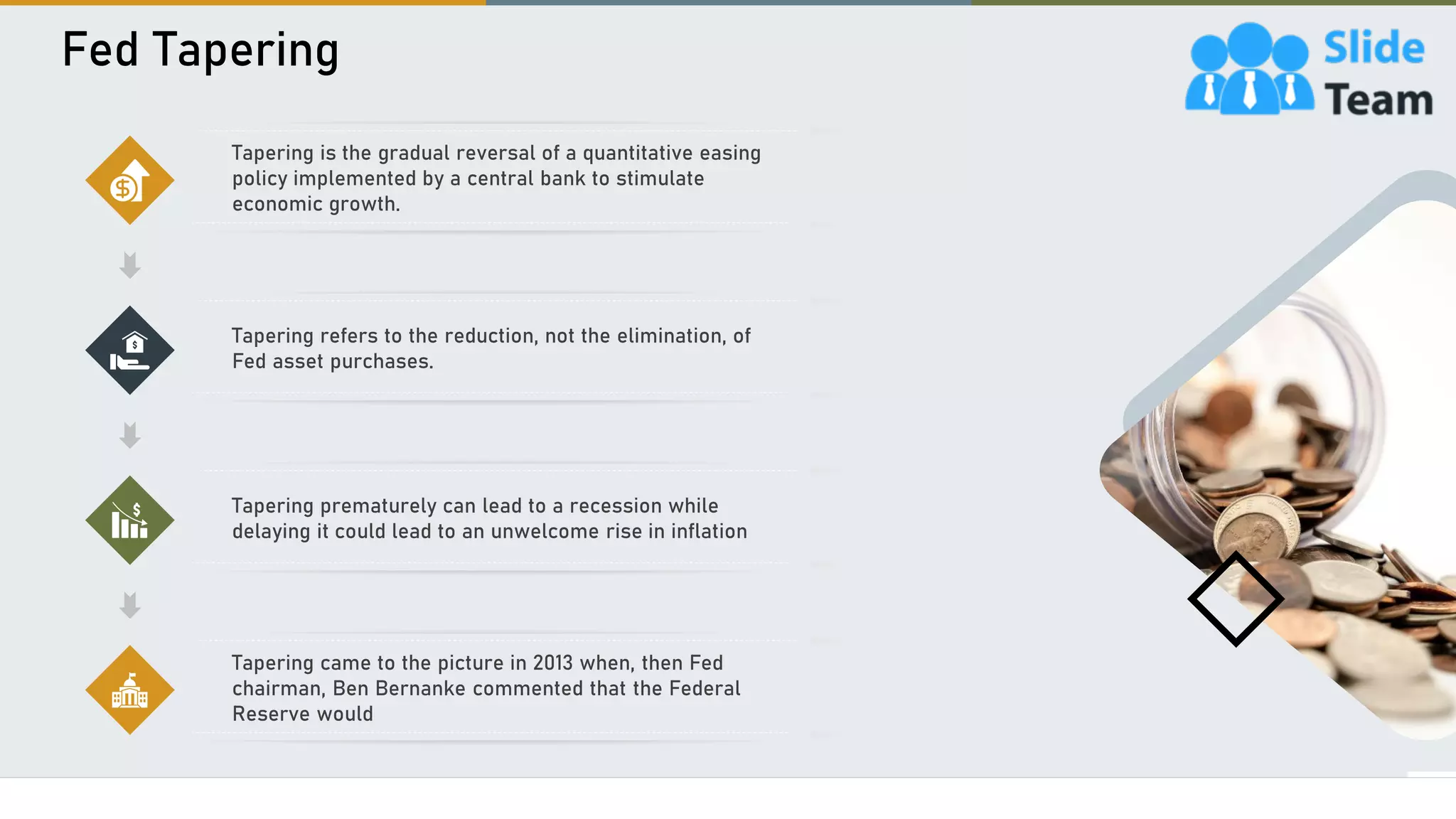
Fed Tapering
16
Tapering is the gradual reversal of a quantitative easing
policy implemented by a central bank to stimulate
economic growth.
Tapering refers to the reduction, not the elimination, of
Fed asset purchases.
Tapering prematurely can lead to a recession while
delaying it could lead to an unwelcome rise in inflation
Tapering came to the picture in 2013 when, then Fed
chairman, Ben Bernanke commented that the Federal
Reserve would
Quantitative Easing
17
Quantitative easing is an
unconventional monetary
policy in which a central
bank purchases government
securities or other securities
from the market in order to
lower interest rates and
increase the money supply
Quantitative easing
increases the money
supply by flooding
financial institutions with
capital in an effort to
promote increased lending
and liquidity
Quantitative easing is
considered when short-term
interest rates are at or
approaching zero, and does
not involve the printing of
new banknotes
A central bank can
implement quantitative
easing by purchasing
government bonds from
commercial banks and other
private institutions, which
should lower short-term
interest rates and increase
the capital available to
institutions to promote
increased lending and
liquidity
Subprime Mortgage Crisis Icons Slide
18
19
Additional Slides
Our Mission
20
Vision
This slide is 100% editable. Adapt it to your needs and capture your
audience's attention.
Mission
This slide is 100% editable. Adapt it to your needs and capture your
audience's attention.
Goal
This slide is 100% editable. Adapt it to your needs and capture your
audience's attention.
Our Team
21
Name Here
Designation
This slide is 100% editable. Adapt it
to your needs and capture your
audience's attention.
Name Here
Designation
This slide is 100% editable. Adapt it
to your needs and capture your
audience's attention.
Name Here
Designation
This slide is 100% editable. Adapt it
to your needs and capture your
audience's attention.
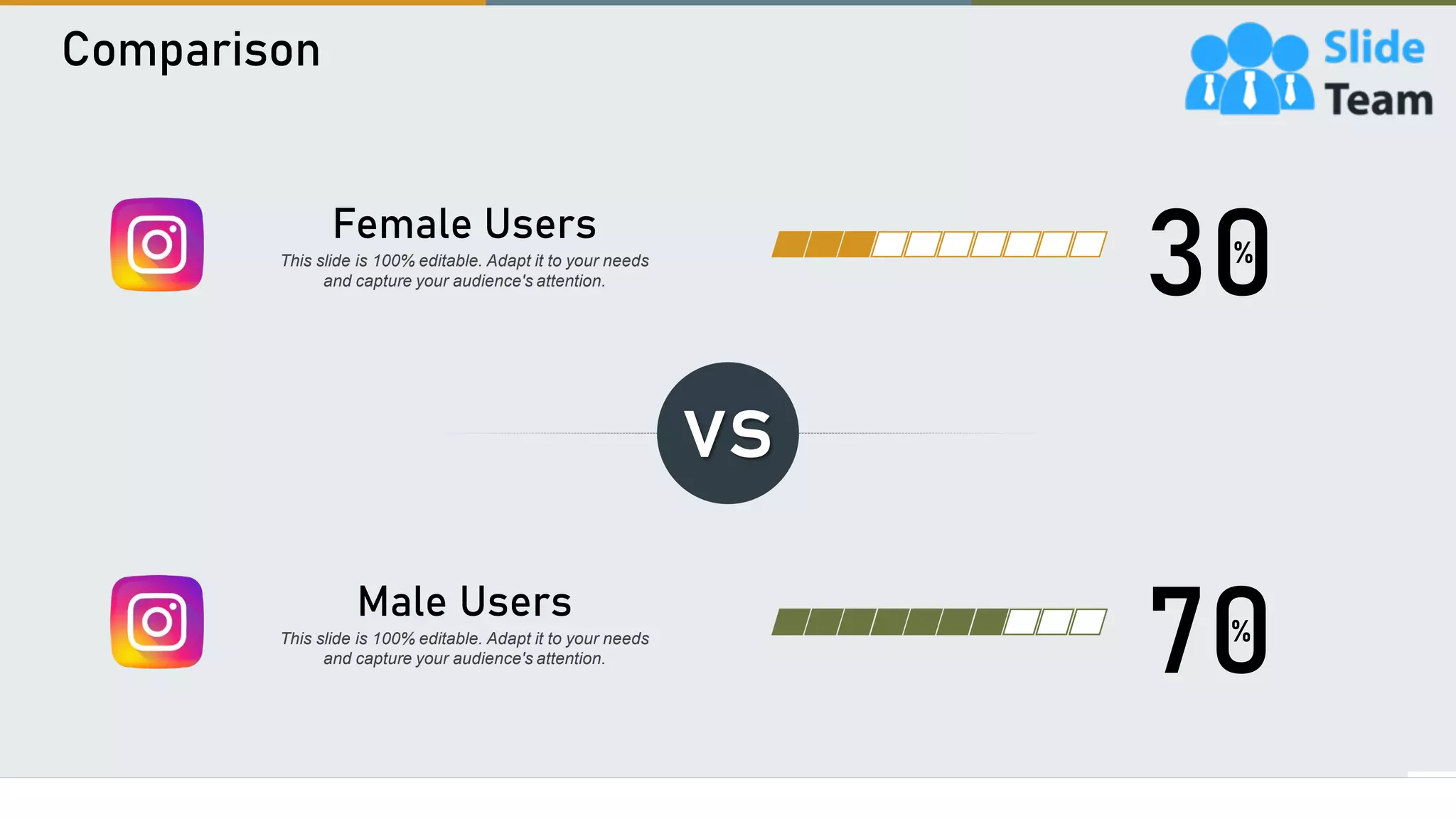
Comparison
22
vs
70
%
This slide is 100% editable. Adapt it to your needs
and capture your audience's attention.
Male Users
30
%
This slide is 100% editable. Adapt it to your needs
and capture your audience's attention.
Female Users
Our Target
23
Target 01
This slide is 100% editable. Adapt it to your needs and capture your
audience's attention.
Target 02
This slide is 100% editable. Adapt it to your needs and capture your
audience's attention.
Target 03
This slide is 100% editable. Adapt it to your needs and capture your
audience's attention.
30 60 90 Days
24
This slide is 100%
editable. Adapt it to your
needs and capture your
audience's attention.
30
Days Plan
This slide is 100%
editable. Adapt it to your
needs and capture your
audience's attention.
60
Days Plan
This slide is 100%
editable. Adapt it to your
needs and capture your
audience's attention.
90
Days Plan
Financial
25
Minimum
This slide is 100% editable. Adapt it to your needs and capture your
audience's attention.
20%
Medium
This slide is 100% editable. Adapt it to your needs and capture your
audience's attention.
30%
Maximum
This slide is 100% editable. Adapt it to your needs and capture your
audience's attention.
70%
Timeline
26
• Text here
• Text here
2013
• Text here
• Text here
2015
• Text here
• Text here
2019
• Text here
• Text here
2017
• Text here
• Text here
2014
• Text here
• Text here
2016
• Text here
• Text here
2018
• Text here
• Text here
2020
Thanks for Watching!
27
Address
# street number, city, state
Contact Number
0123456789
Email Address
emailaddress123@gmail.com

Subprime Mortgage Crisis Powerpoint Presentation Slides

  • 1.
  • 2.
    2008 Financial CrisisImpact Explained in Numbers 2 01 Housing Prices fell 31.8% 02 Unemployment was still above 9% in 2010 03 $30 Bn federal guarantee for deal between JP Morgan Chase & Bear Stearns 04 $182 Bn federal bailout for AIG 05 Fannie Mae & Freddie Mac guarantee 90% of all mortgages 06 Treasury department spent $439.6 Bn buying bank & car stocks 07 $144.5 Bn moved from money market to treasury bonds Source: The Balance 2020 This slide is 100% editable. Adapt it to your needs and capture your audience's attention.
  • 3.
    Major Financial BubbleBurst of all Times 3 NASADQ & the Internet boom Fell 30% 1 month after record high 2000 Nikkei 225 20-year bear market, losses hit 82% 1989 Precious Metal Silver fell 66% in 2 months 1980 Dow Jones Industrial Average Losses neared 90% by 1932 1929 US Housing Market Homebuilding stocks lost 90%in value 2005 Crude Oil Dropped 77% in 6 months 2008 Precious Metals Silver fell 25% in 5 Days 2011 Bitcoin Loss of 25% in just 1 day 2020
  • 4.
    Note: 1Bank ofAmerica acquired Merrill Lynch in September 2008; 2Lehman filed for bankruptcy and sold it’s investment banking business to Barclays & Nomura Impact of the Great Recession on Investment Banks 4 Rank in 2007 Investment Bank Rank in 2020 1 Goldman Sachs 2 2 Deutsche Bank 6 3 Morgan Stanley 4 4 Citi 2 5 JP Morgan 1 6 Credit Suisse 7 7 UBS 10 8 Merrill Lynch1 NA 9 Lehman Brothers2 NA 10 Barclays 7
  • 5.
    2008 Financial CrisisCost 5 Bear Stearns Bailout US$ 30B Fannie & Freddie Bailout US$ 187B APRA Tax Cuts & Spending US$ 831B TARP Bank Bailout US$ 440B Total US$ 1,488B This graph/chart is linked to excel, and changes automatically based on data. Just left click on it and select “Edit Data”.
  • 6.
    Key Figures ofthe Crisis 6 This slide is 100% editable. Adapt it to your needs and capture your audience's attention. John Thain Then: Chairman & CEO, Merrill Lynch Now: Member of Supervisory board, Deutsche bank AG Jamie Dimon Then: Chairman & CEO, JP Morgan Chase & Co Now: Same Richard Fuld Then: Chairman & CEO, Lehman Brothers Holdings Now: Founder, Chairman & CEO Matrix Investment Management Ben Bernanke Then: Chairman, Federal Reserve Now: Senior advisor to Citadel, a hedge fund Timothy Geithner Then: President, Federal Reserve bank of New York, and later, treasury secretary Now: President Warburg Pincus Hank Paulson Then: US Treasury Secretary Now: Chairman of Paulson institute, a think tank he set up at the University of Chicago in 2011 02 03 01 04 05 06
  • 7.
    Before the Beginning 7 In2001, the U.S. economy underwent a minor, short-lived recession. What different functions or task can the product perform It wasn't long before things started to move just as the cheap money wanted them to These subprime borrowers wanted to realize their life's dream of acquiring a home To make things merrier, in October 2004, SEC relaxed the net capital requirement for five investment banks - Goldman Sachs, Merrill Lynch, Lehman Brothers, Bear Stearns and Morgan Stanley - which freed them to leverage up to 30-times or even 40-times their initial investment. This easy and excess money found its prey in restless bankers and borrowers with little or no income; also referred as Subprime borrowers (Explained in Appendix) To keep recession away, the Federal Reserve lowered the Federal funds rate 11 times - from 6.5% in May 2000 to 1.75% in December 2001 - creating enormous liquidity in the economy Although the U.S. economy nicely withstood terrorist attacks, the bust of the dot-com bubble and accounting scandals, the fear of recession was the top concern for everyone. Before the Beginning
  • 8.
    What Happened then? 8 Thisenvironment of easy credit and the upward spiral of home prices made investments in higher yielding subprime mortgages look like a new rush for gold Even this wasn’t enough, what was going to happen next worsened the situation This environment of easy credit and the upward spiral of home prices made investments in higher yielding subprime mortgages look like a new rush for gold. The mortgage lenders wanted more money to lend to homebuyers, so they sold their existing loans to banks and to Freddie Mac and Fannie May, which in turn sold these to investment banks
  • 9.
    How did itSpread? 9 The investment banks combined these loans with hundreds of others into what are known as collateralised debt obligations (CDOs) (Explained in Appendix) and sold these to investors worldwide as mortgage-backed securities (MBS) The returns depended on monthly payments on the loans CDO issuance hit $634 billion in 2007. Credit Rating agencies called these sound investments, when they were not. No surprise there, as the investment banks were their clients.
  • 10.
    How did thosewho Bought CDO Protect themselves? 10 This is where another infamous term from the crisis comes in: credit default swaps. Insurance companies used these instruments to cover investors’ losses if homebuyers defaulted on loans. No one expected the party to wind down and so there were no worries. They thought an insurance product called credit default swaps protected them. A traditional insurance company known as the American International Group (AIG) sold these swaps. When the derivatives lost value, AIG didn't have enough cash flow to honor all the swaps.
  • 11.
    Beginning of theEnd 11 £90bn was wiped off the value of Britain’s biggest companies in a single day Housing prices started falling in 2006 and homebuyers began defaulting on their loans, which meant insurance companies couldn’t honour all their credit default swaps. Within a few weeks in September 2008, Lehman Brothers, one of the world’s biggest financial institutions, went bankrupt Banks panicked when they realized they would have to absorb the losses. They stopped lending to each other. They didn't want other banks giving them worthless mortgages as collateral. As a result, interbank borrowing costs, LIBOR, rose. This mistrust within the banking community was the primary cause of the 2008 financial crisis The Federal Reserve began pumping liquidity into the banking system via the Term Auction Facility. But that wasn't enough.
  • 12.
    Subprime Effect 12 Sub-Prime Effect Thisgraph/chart is linked to excel, and changes automatically based on data. Just left click on it and select “Edit Data”. USA France Belgium UK Netherlands Germany China Australia
  • 13.
    Major Bailout Packages 13 TreasurySecretary took over mortgage companies Fannie Mae and Freddie Mac costing $187 billion at the time. Since then, Treasury has made enough in profits to pay off the cost. The Fed loaned $85 billion to AIG as a bailout. Later, the Fed and Treasury restructured the bailout and total cost ballooned to $182 billion. But by 2012, the government made a $22.7 billion profit Bear Stearns approached JP Morgan Chase to bail it out. The Fed had to sweeten the deal with a $30 billion guarantee. By 2012, the Fed had received full payment for its loan. TARP (Troubled Asset Relief Fund) disbursed $442.6 Bn to banks for bailout.
  • 14.
    Banks have PaidBillions of Dollars in Fine 14 Source: Boston Consulting Group; Thomson Reuters This graph/chart is linked to excel, and changes automatically based on data. Just left click on it and select “Edit Data”. North American Banks 63% European Banks 37% Penalties paid by banks between 2009 & 2016 is $321 Bn Recipients of Penalties 56% 38% 6% Consumers European Regulators North American Regulators Sales
  • 15.
    While the world economyhas recovered from the crisis and the Dow Jones Industrial Average has risen nearly four times since its 12-year low in March 2009, big worries remain: S&P, Fitch and Moody’s are still dominant players, earning more than $9 out of every $10 in the credit-rating industry Top 10 commercial banks still account for more than half of the assets held by 100 largest commercial banks, similar to a decade ago Some complex derivative instruments vilified during the crisis are back in demand. For instance, synthetic CDOs, which invest in CDSs, were expected to quadruple to $100 bn in 2017 from 2015 US President Donald Trump wants to dismantle the Dodd- Frank Wall Street Reform and Consumer Protection Act, a key law passed in 2010 to tighten financial regulation in the aftermath of the crisis After a Decade – Current Scenario 15
  • 16.
    Fed Tapering 16 Tapering isthe gradual reversal of a quantitative easing policy implemented by a central bank to stimulate economic growth. Tapering refers to the reduction, not the elimination, of Fed asset purchases. Tapering prematurely can lead to a recession while delaying it could lead to an unwelcome rise in inflation Tapering came to the picture in 2013 when, then Fed chairman, Ben Bernanke commented that the Federal Reserve would
  • 17.
    Quantitative Easing 17 Quantitative easingis an unconventional monetary policy in which a central bank purchases government securities or other securities from the market in order to lower interest rates and increase the money supply Quantitative easing increases the money supply by flooding financial institutions with capital in an effort to promote increased lending and liquidity Quantitative easing is considered when short-term interest rates are at or approaching zero, and does not involve the printing of new banknotes A central bank can implement quantitative easing by purchasing government bonds from commercial banks and other private institutions, which should lower short-term interest rates and increase the capital available to institutions to promote increased lending and liquidity
  • 18.
  • 19.
  • 20.
    Our Mission 20 Vision This slideis 100% editable. Adapt it to your needs and capture your audience's attention. Mission This slide is 100% editable. Adapt it to your needs and capture your audience's attention. Goal This slide is 100% editable. Adapt it to your needs and capture your audience's attention.
  • 21.
    Our Team 21 Name Here Designation Thisslide is 100% editable. Adapt it to your needs and capture your audience's attention. Name Here Designation This slide is 100% editable. Adapt it to your needs and capture your audience's attention. Name Here Designation This slide is 100% editable. Adapt it to your needs and capture your audience's attention.
  • 22.
    Comparison 22 vs 70 % This slide is100% editable. Adapt it to your needs and capture your audience's attention. Male Users 30 % This slide is 100% editable. Adapt it to your needs and capture your audience's attention. Female Users
  • 23.
    Our Target 23 Target 01 Thisslide is 100% editable. Adapt it to your needs and capture your audience's attention. Target 02 This slide is 100% editable. Adapt it to your needs and capture your audience's attention. Target 03 This slide is 100% editable. Adapt it to your needs and capture your audience's attention.
  • 24.
    30 60 90Days 24 This slide is 100% editable. Adapt it to your needs and capture your audience's attention. 30 Days Plan This slide is 100% editable. Adapt it to your needs and capture your audience's attention. 60 Days Plan This slide is 100% editable. Adapt it to your needs and capture your audience's attention. 90 Days Plan
  • 25.
    Financial 25 Minimum This slide is100% editable. Adapt it to your needs and capture your audience's attention. 20% Medium This slide is 100% editable. Adapt it to your needs and capture your audience's attention. 30% Maximum This slide is 100% editable. Adapt it to your needs and capture your audience's attention. 70%
  • 26.
    Timeline 26 • Text here •Text here 2013 • Text here • Text here 2015 • Text here • Text here 2019 • Text here • Text here 2017 • Text here • Text here 2014 • Text here • Text here 2016 • Text here • Text here 2018 • Text here • Text here 2020
  • 27.
    Thanks for Watching! 27 Address #street number, city, state Contact Number 0123456789 Email Address emailaddress123@gmail.com