1
MeetingsMERI
Programmation
Parallèle en .NET
Animé par
Sylvain Rescourio – Expert .NET
Olivier Navarre – Directeur Technique
Mardi 27 Mai 2014
2
 Introduction
 What is parallel programming ?
 Why parallel programming ?
 The issues that come with parallel
programming ?
 How to do parallel programming
in C# ?
 Thread
 ThreadPool
 Task
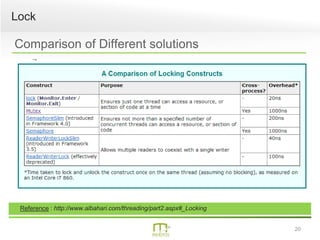
 Parallel
 Async
 PLinq
 How to synchronize in C# ?
 Lock
 Mutex
 SpinLock
 Semaphore
 ReaderWriterLock
 Semaphore Slim
 ReaderWriterLockSlim
 How to signal in C# ?
 Wait / Pulse
 Barrier
 How to store shared items in C# ?
 Wait / Pulse
 Barrier
 Conclusion
Sommaire
3
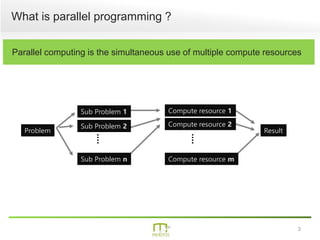
What is parallel programming ?
Parallel computing is the simultaneous use of multiple compute resources
Problem Result
Compute resource 1
Compute resource 2
Compute resource m
Sub Problem 1
Sub Problem 2
Sub Problem n
4
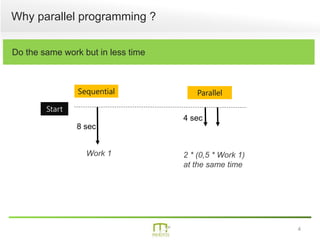
Why parallel programming ?
Do the same work but in less time
8 sec
4 sec
Work 1 2 * (0,5 * Work 1)
at the same time
Sequential Parallel
Start
5
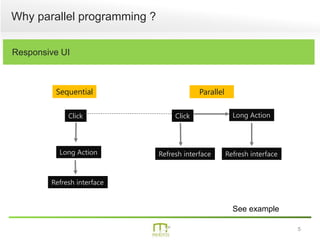
Why parallel programming ?
Responsive UI
Long Action
Refresh interface
Refresh interface Refresh interface
Sequential Parallel
See example
Click Click Long Action
6
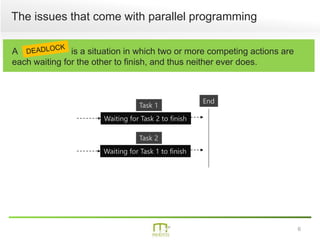
The issues that come with parallel programming
A is a situation in which two or more competing actions are
each waiting for the other to finish, and thus neither ever does.
Waiting for Task 2 to finish
Task 1
Task 2
End
Waiting for Task 1 to finish
7
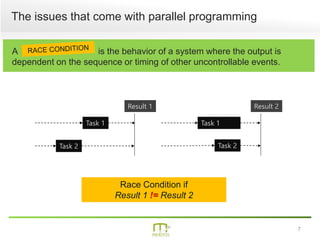
The issues that come with parallel programming
A is the behavior of a system where the output is
dependent on the sequence or timing of other uncontrollable events.
Task 1
Task 2
Result 1
Task 1
Task 2
Result 2
Race Condition if
Result 1 != Result 2
8
How to do parallel
programming in C# ?
Thread
ThreadPool
Task
Parallel
Async
PLinq
9
Thread
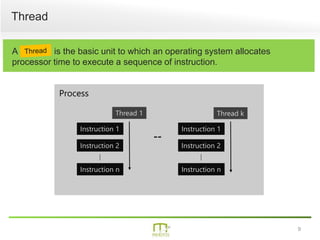
A is the basic unit to which an operating system allocates
processor time to execute a sequence of instruction.
Process
Thread 1
Instruction 1
Instruction 2
Instruction n
Thread k
Instruction 1
Instruction 2
Instruction n
10
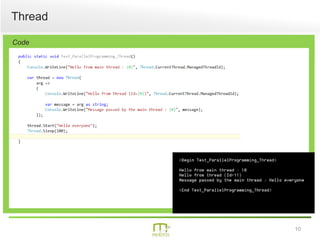
Thread
Code
11
Solutions Thread, ThreadPool, Task, Parallel,
Async, Plinq, …
Differents solutions
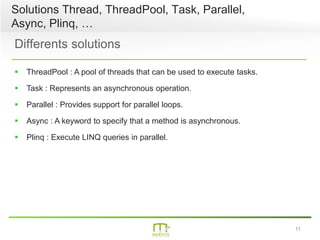
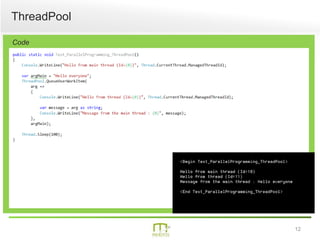
 ThreadPool : A pool of threads that can be used to execute tasks.
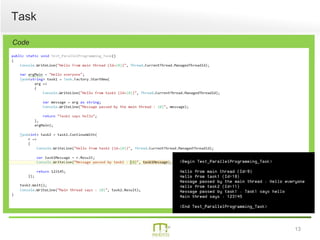
 Task : Represents an asynchronous operation.
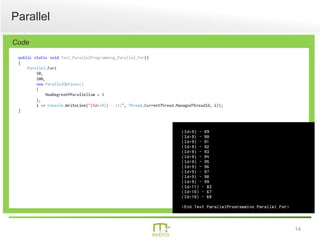
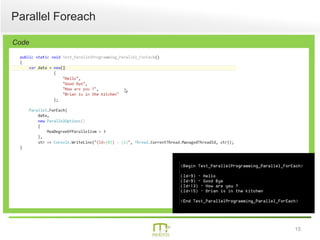
 Parallel : Provides support for parallel loops.
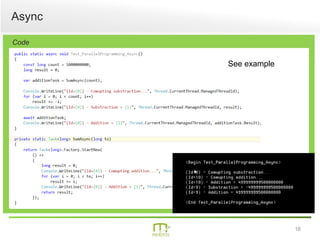
 Async : A keyword to specify that a method is asynchronous.
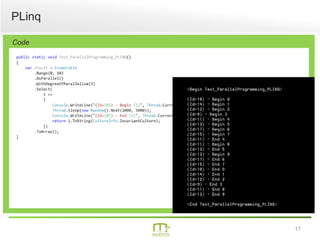
 Plinq : Execute LINQ queries in parallel.
12
ThreadPool
Code
13
Task
Code
14
Parallel
Code
15
Parallel Foreach
Code
16
Async
Code
See example
17
PLinq
Code
18
How to synchronize in C# ?
Lock
Mutex
SpinLock
Semaphore
ReaderWriterLock
Semaphore Slim
ReaderWriterLockSlim
19
Different solutions
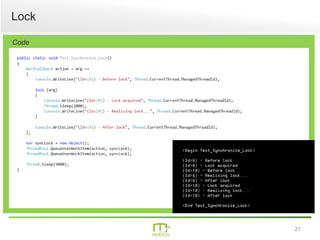
 Lock
 Protect a section of code.
 Mutex
 Locking across processes.
 SpinLock
 Locking few instructions (Sum, variable copy, …).
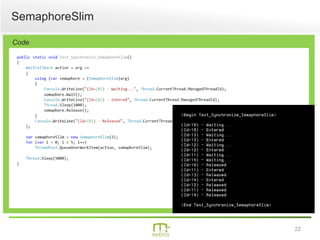
 Semaphore
 Cap the access of a resource to a fixed number of
thread.
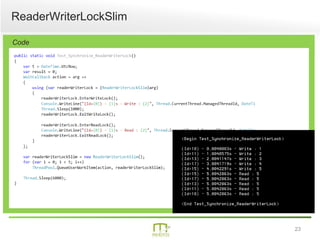
 ReaderWriterLock
 Control the access of a resource by multiple thread,
allowing 1 writer or many reader at the same time.
Lock
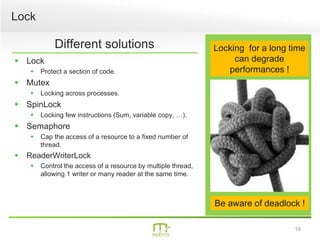
Locking for a long time
can degrade
performances !
Be aware of deadlock !
20
Lock
Comparison of Different solutions
Reference : http://www.albahari.com/threading/part2.aspx#_Locking
21
Lock
Code
22
SemaphoreSlim
Code
23
ReaderWriterLockSlim
Code
24
How to signal in C# ?
Wait / Pulse
Barrier
25
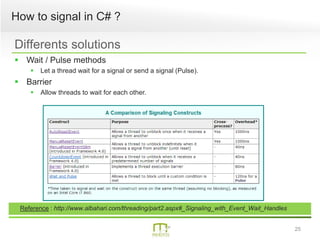
How to signal in C# ?
Reference : http://www.albahari.com/threading/part2.aspx#_Signaling_with_Event_Wait_Handles
Differents solutions
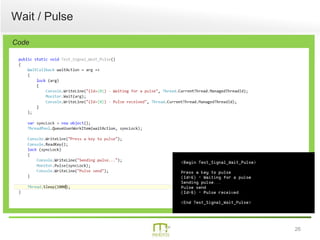
 Wait / Pulse methods
 Let a thread wait for a signal or send a signal (Pulse).
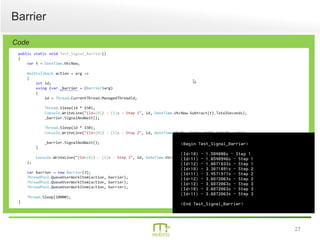
 Barrier
 Allow threads to wait for each other.
26
Wait / Pulse
Code
27
Barrier
Code
28
A quick word about
atomicity in C#
29
A quick word about atomicity in C#
An atomic operation
 An atomic operation cannot be interrupted by other thread.
 Example : Incrementing a variable is not atomic
 Read the variable
 Add 1
 Store the result in the same variable
 What if in the middle, another thread access this variable ?
 Solution
 Interlocked.Add, Interlocked.Increment
 Interlocked.Exchange, Interlocked.CompareExchange
 Interlocked.Read
30
DEMO
31
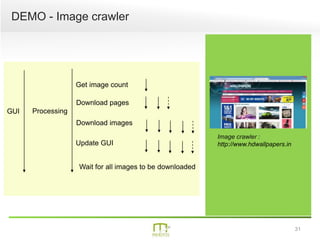
DEMO - Image crawler
Image crawler :
http://www.hdwallpapers.in
GUI Processing
Get image count
Download pages
Download images
Update GUI
Wait for all images to be downloaded
32
How to store shared items
in C# ?
33
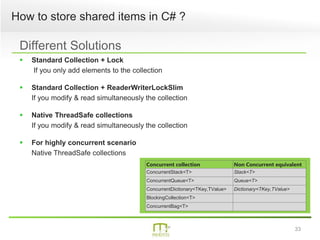
How to store shared items in C# ?
Different Solutions
 Standard Collection + Lock
If you only add elements to the collection
 Standard Collection + ReaderWriterLockSlim
If you modify & read simultaneously the collection
 Native ThreadSafe collections
If you modify & read simultaneously the collection
 For highly concurrent scenario
Native ThreadSafe collections
Concurrent collection Non Concurrent equivalent
ConcurrentStack<T> Stack<T>
ConcurrentQueue<T> Queue<T>
ConcurrentDictionary<TKey,TValue> Dictionary<TKey,TValue>
BlockingCollection<T>
ConcurrentBag<T>
34
Conclusion
35
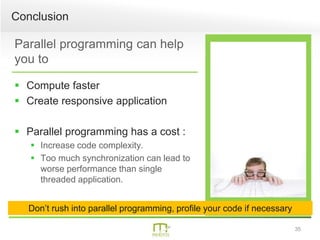
Parallel programming can help
you to
 Compute faster
 Create responsive application
 Parallel programming has a cost :
 Increase code complexity.
 Too much synchronization can lead to
worse performance than single
threaded application.
Conclusion
Don’t rush into parallel programming, profile your code if necessary
36
Partenaire Microsoft
MERITIS GOLD PARTNER 2015
Répondre aux attentes de nos
clients et de nos collaborateurs
Améliorer notre expertise sur les
solutions Microsoft
Accompagner nos clients sur ces
domaines technologiques
Être innovant autours des
technologies Microsoft
37
Conseil et Ingénierie en Banque, Finance et Assurance
Siège Social : 14, rue Gaillon – Paris 2ème
Tél. : 01 44 56 88 10 / Fax : 01 44 56 88 11
www.meritis.fr
Merci de votre
attention

MERIMeeting du 27 mai 2014 - Parallel Programming

  • 1.
    1 MeetingsMERI Programmation Parallèle en .NET Animépar Sylvain Rescourio – Expert .NET Olivier Navarre – Directeur Technique Mardi 27 Mai 2014
  • 2.
    2  Introduction  Whatis parallel programming ?  Why parallel programming ?  The issues that come with parallel programming ?  How to do parallel programming in C# ?  Thread  ThreadPool  Task  Parallel  Async  PLinq  How to synchronize in C# ?  Lock  Mutex  SpinLock  Semaphore  ReaderWriterLock  Semaphore Slim  ReaderWriterLockSlim  How to signal in C# ?  Wait / Pulse  Barrier  How to store shared items in C# ?  Wait / Pulse  Barrier  Conclusion Sommaire
  • 3.
    3 What is parallelprogramming ? Parallel computing is the simultaneous use of multiple compute resources Problem Result Compute resource 1 Compute resource 2 Compute resource m Sub Problem 1 Sub Problem 2 Sub Problem n
  • 4.
    4 Why parallel programming? Do the same work but in less time 8 sec 4 sec Work 1 2 * (0,5 * Work 1) at the same time Sequential Parallel Start
  • 5.
    5 Why parallel programming? Responsive UI Long Action Refresh interface Refresh interface Refresh interface Sequential Parallel See example Click Click Long Action
  • 6.
    6 The issues thatcome with parallel programming A is a situation in which two or more competing actions are each waiting for the other to finish, and thus neither ever does. Waiting for Task 2 to finish Task 1 Task 2 End Waiting for Task 1 to finish
  • 7.
    7 The issues thatcome with parallel programming A is the behavior of a system where the output is dependent on the sequence or timing of other uncontrollable events. Task 1 Task 2 Result 1 Task 1 Task 2 Result 2 Race Condition if Result 1 != Result 2
  • 8.
    8 How to doparallel programming in C# ? Thread ThreadPool Task Parallel Async PLinq
  • 9.
    9 Thread A is thebasic unit to which an operating system allocates processor time to execute a sequence of instruction. Process Thread 1 Instruction 1 Instruction 2 Instruction n Thread k Instruction 1 Instruction 2 Instruction n
  • 10.
  • 11.
    11 Solutions Thread, ThreadPool,Task, Parallel, Async, Plinq, … Differents solutions  ThreadPool : A pool of threads that can be used to execute tasks.  Task : Represents an asynchronous operation.  Parallel : Provides support for parallel loops.  Async : A keyword to specify that a method is asynchronous.  Plinq : Execute LINQ queries in parallel.
  • 12.
  • 13.
  • 14.
  • 15.
  • 16.
  • 17.
  • 18.
    18 How to synchronizein C# ? Lock Mutex SpinLock Semaphore ReaderWriterLock Semaphore Slim ReaderWriterLockSlim
  • 19.
    19 Different solutions  Lock Protect a section of code.  Mutex  Locking across processes.  SpinLock  Locking few instructions (Sum, variable copy, …).  Semaphore  Cap the access of a resource to a fixed number of thread.  ReaderWriterLock  Control the access of a resource by multiple thread, allowing 1 writer or many reader at the same time. Lock Locking for a long time can degrade performances ! Be aware of deadlock !
  • 20.
    20 Lock Comparison of Differentsolutions Reference : http://www.albahari.com/threading/part2.aspx#_Locking
  • 21.
  • 22.
  • 23.
  • 24.
    24 How to signalin C# ? Wait / Pulse Barrier
  • 25.
    25 How to signalin C# ? Reference : http://www.albahari.com/threading/part2.aspx#_Signaling_with_Event_Wait_Handles Differents solutions  Wait / Pulse methods  Let a thread wait for a signal or send a signal (Pulse).  Barrier  Allow threads to wait for each other.
  • 26.
  • 27.
  • 28.
    28 A quick wordabout atomicity in C#
  • 29.
    29 A quick wordabout atomicity in C# An atomic operation  An atomic operation cannot be interrupted by other thread.  Example : Incrementing a variable is not atomic  Read the variable  Add 1  Store the result in the same variable  What if in the middle, another thread access this variable ?  Solution  Interlocked.Add, Interlocked.Increment  Interlocked.Exchange, Interlocked.CompareExchange  Interlocked.Read
  • 30.
  • 31.
    31 DEMO - Imagecrawler Image crawler : http://www.hdwallpapers.in GUI Processing Get image count Download pages Download images Update GUI Wait for all images to be downloaded
  • 32.
    32 How to storeshared items in C# ?
  • 33.
    33 How to storeshared items in C# ? Different Solutions  Standard Collection + Lock If you only add elements to the collection  Standard Collection + ReaderWriterLockSlim If you modify & read simultaneously the collection  Native ThreadSafe collections If you modify & read simultaneously the collection  For highly concurrent scenario Native ThreadSafe collections Concurrent collection Non Concurrent equivalent ConcurrentStack<T> Stack<T> ConcurrentQueue<T> Queue<T> ConcurrentDictionary<TKey,TValue> Dictionary<TKey,TValue> BlockingCollection<T> ConcurrentBag<T>
  • 34.
  • 35.
    35 Parallel programming canhelp you to  Compute faster  Create responsive application  Parallel programming has a cost :  Increase code complexity.  Too much synchronization can lead to worse performance than single threaded application. Conclusion Don’t rush into parallel programming, profile your code if necessary
  • 36.
    36 Partenaire Microsoft MERITIS GOLDPARTNER 2015 Répondre aux attentes de nos clients et de nos collaborateurs Améliorer notre expertise sur les solutions Microsoft Accompagner nos clients sur ces domaines technologiques Être innovant autours des technologies Microsoft
  • 37.
    37 Conseil et Ingénierieen Banque, Finance et Assurance Siège Social : 14, rue Gaillon – Paris 2ème Tél. : 01 44 56 88 10 / Fax : 01 44 56 88 11 www.meritis.fr Merci de votre attention