ØMQ @ NodeJS
ØMQ: Small Pieces for Scalable Software
Fernando D. Alonso
1. Facts about ØMQ
[ ]
Facts about ØMQ
Low level messaging library
○ It is written in C++.
○ A thin layer between application and transport
layers.
○ Message-passing using in-memory queues.
○ Concise API which talks over the ZMTP protocol.
○ Works on top of TCP, IPC, in-memory, and
PGM/EPGM communication protocols.
○ Philosophy: horizontal scalability to reduce points
of failure.
○ Network topology aware. Point to point
communication reduce latencies.
○ Communication is reduced to a few patterns, which
combined are powerful.
○ No need to have a multitenant service.
Facts about ØMQ
A broker is not mandatory
Facts about ØMQ
Messaged oriented communication
○ Messages as first-class citizen. No need to fight
with framing or buffering.
○ You can send multipart messages.
○ Messages are atomic.
○ Asynchronous messaging. A single background I/O
thread does the job for ØMQ sockets.
"A ØMQ message is a discrete unit of data passed between
applications or components of the same application. ØMQ messages
have no internal structure and from the point of view of ØMQ itself
they are considered to be opaque binary data."
Facts about ØMQ
Fast for development
○ Interchangeable transports: e.g, scaling from one
IPC server to a bunch of TCP.
○ Automatic reconnections.
○ Multicore made easy.
○ Provides zmq_poll to read BSD sockets.
○ It doesn't provide message persistence.
○ It doesn't provide data serialization.
○ It doesn't provide data compression.
○ It doesn't provide message encryption.
○ It doesn't provide security mechanisms. Not in the
next version of the ZMTP protocol !
(*) ZTMP 3.0 draft protocol: http://hintjens.com/blog:39
Facts about ØMQ
Aims for simplicity
Facts about ØMQ
Platforms & Languages
○ Bindings for 30+ languages including NodeJS, Ruby,
Python, Java, C, C++, Scala, Erlang, Perl, PHP, .NET.
○ Linux & Windows.
○ Raspberry PI.
○ Android OS.
2. Install
[ , ]
Install
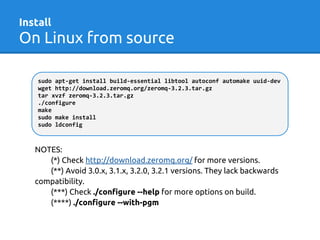
On Linux from source
sudo apt-get install build-essential libtool autoconf automake uuid-dev
wget http://download.zeromq.org/zeromq-3.2.3.tar.gz
tar xvzf zeromq-3.2.3.tar.gz
./configure
make
sudo make install
sudo ldconfig
NOTES:
(*) Check http://download.zeromq.org/ for more versions.
(**) Avoid 3.0.x, 3.1.x, 3.2.0, 3.2.1 versions. They lack backwards
compatibility.
(***) Check ./configure --help for more options on build.
(****) ./configure --with-pgm
Install
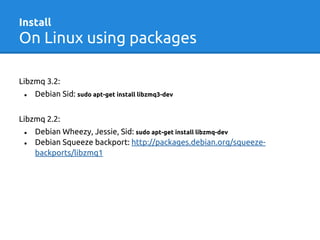
On Linux using packages
Libzmq 3.2:
● Debian Sid: sudo apt-get install libzmq3-dev
Libzmq 2.2:
● Debian Wheezy, Jessie, Sid: sudo apt-get install libzmq-dev
● Debian Squeeze backport: http://packages.debian.org/squeeze-
backports/libzmq1
Install
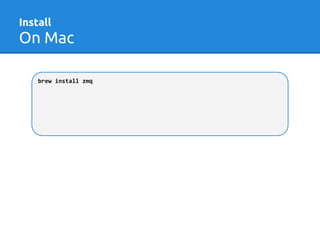
On Mac
brew install zmq
Install
NodeJS bindings
NPM Packages:
● zmq (https://github.com/JustinTulloss/zeromq.node) [RECOMMENDED]
● zmq-stream (https://github.com/Schoonology/zmq-stream)
npm install zmq
node
> var zmq = require('zmq');
Install
Bindings in other languages
Ruby: https://github.com/chuckremes/ffi-rzmq [RECOMMENDED]
Python: https://github.com/zeromq/pyzmq
Erlang: https://github.com/zeromq/erlzmq2
Java JZMQ (uses JNI): https://github.com/zeromq/jzmq
Java JeroMQ: https://github.com/zeromq/jeromq
Scala ZeroMQ: https://github.com/mDialog/scala-zeromq
Scala ZeroMQ (official): https://github.com/valotrading/zeromq-scala-binding
...
3. Sockets
Sockets
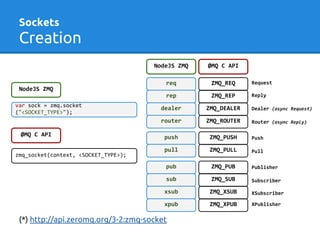
Creation
(*) http://api.zeromq.org/3-2:zmq-socket
ØMQ C API
NodeJS ZMQ
req ZMQ_REQ
rep ZMQ_REP
dealer ZMQ_DEALER
router ZMQ_ROUTER
push ZMQ_PUSH
pull ZMQ_PULL
ØMQ C APINodeJS ZMQ
pub ZMQ_PUB
sub ZMQ_SUB
xsub ZMQ_XSUB
xpub ZMQ_XPUB
var sock = zmq.socket
("<SOCKET_TYPE>");
zmq_socket(context, <SOCKET_TYPE>);
Request
Reply
Dealer (async Request)
Router (async Reply)
Push
Pull
Publisher
Subscriber
XSubscriber
XPublisher
Sockets
Bind & Connect
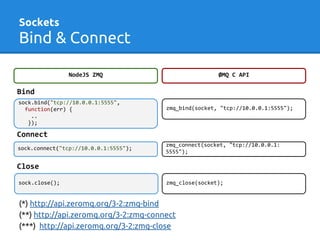
sock.bind("tcp://10.0.0.1:5555",
function(err) {
..
});
sock.connect("tcp://10.0.0.1:5555");
sock.close();
(*) http://api.zeromq.org/3-2:zmq-bind
(**) http://api.zeromq.org/3-2:zmq-connect
(***) http://api.zeromq.org/3-2:zmq-close
ØMQ C API
zmq_bind(socket, "tcp://10.0.0.1:5555");
zmq_connect(socket, "tcp://10.0.0.1:
5555");
zmq_close(socket);
NodeJS ZMQ
Bind
Connect
Close
Sockets
Bind & Connect
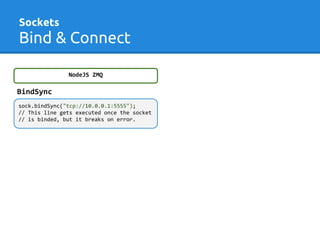
sock.bindSync("tcp://10.0.0.1:5555");
// This line gets executed once the socket
// is binded, but it breaks on error.
NodeJS ZMQ
BindSync
Sockets
Transports
TCP
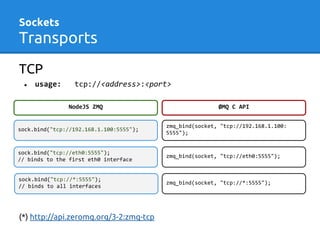
● usage: tcp://<address>:<port>
sock.bind("tcp://192.168.1.100:5555");
sock.bind("tcp://eth0:5555");
// binds to the first eth0 interface
sock.bind("tcp://*:5555");
// binds to all interfaces
(*) http://api.zeromq.org/3-2:zmq-tcp
ØMQ C API
zmq_bind(socket, "tcp://192.168.1.100:
5555");
zmq_bind(socket, "tcp://eth0:5555");
zmq_bind(socket, "tcp://*:5555");
NodeJS ZMQ
Sockets
Transports
Inter-Process Communication (IPC)
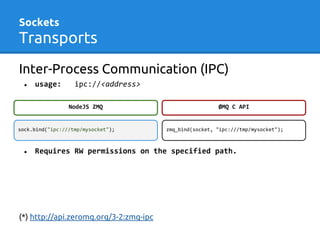
● usage: ipc://<address>
● Requires RW permissions on the specified path.
(*) http://api.zeromq.org/3-2:zmq-ipc
sock.bind("ipc:///tmp/mysocket");
ØMQ C API
zmq_bind(socket, "ipc:///tmp/mysocket");
NodeJS ZMQ
Sockets
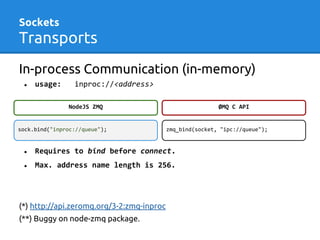
Transports
In-process Communication (in-memory)
● usage: inproc://<address>
● Requires to bind before connect.
● Max. address name length is 256.
(*) http://api.zeromq.org/3-2:zmq-inproc
(**) Buggy on node-zmq package.
sock.bind("inproc://queue");
ØMQ C API
zmq_bind(socket, "ipc://queue");
NodeJS ZMQ
Sockets
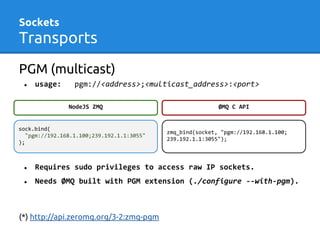
Transports
PGM (multicast)
● usage: pgm://<address>;<multicast_address>:<port>
● Requires sudo privileges to access raw IP sockets.
● Needs ØMQ built with PGM extension (./configure --with-pgm).
(*) http://api.zeromq.org/3-2:zmq-pgm
sock.bind(
"pgm://192.168.1.100;239.192.1.1:3055"
);
ØMQ C API
zmq_bind(socket, "pgm://192.168.1.100;
239.192.1.1:3055");
NodeJS ZMQ
Sockets
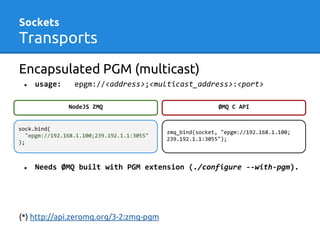
Transports
Encapsulated PGM (multicast)
● usage: epgm://<address>;<multicast_address>:<port>
● Needs ØMQ built with PGM extension (./configure --with-pgm).
(*) http://api.zeromq.org/3-2:zmq-pgm
sock.bind(
"epgm://192.168.1.100;239.192.1.1:3055"
);
ØMQ C API
zmq_bind(socket, "epgm://192.168.1.100;
239.192.1.1:3055");
NodeJS ZMQ
Sockets
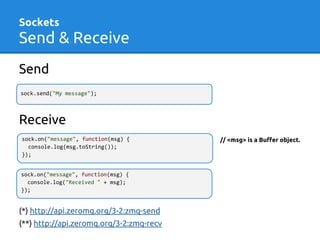
Send & Receive
Send
sock.send("My message");
sock.on("message", function(msg) {
console.log(msg.toString());
});
(*) http://api.zeromq.org/3-2:zmq-send
(**) http://api.zeromq.org/3-2:zmq-recv
Receive
sock.on("message", function(msg) {
console.log("Received " + msg);
});
// <msg> is a Buffer object.
Sockets
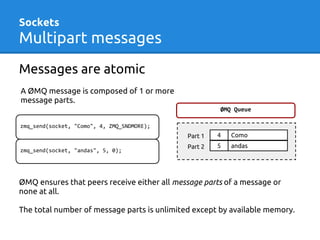
Multipart messages
ØMQ Queue
zmq_send(socket, "Como", 4, ZMQ_SNDMORE);
Messages are atomic
A ØMQ message is composed of 1 or more
message parts.
zmq_send(socket, "andas", 5, 0);
4 ComoPart 1
5 andasPart 2
ØMQ ensures that peers receive either all message parts of a message or
none at all.
The total number of message parts is unlimited except by available memory.
Sockets
Multipart messages
sock.send("First part", zmq.ZMQ_SNDMORE);
sock.send("Second part");
sock.send(["First part", "Second part"]);
Send
var r = sock.send("Como", zmq.
ZMQ_SNDMORE);
console.log(r);
Check the outgoing buffer and socket state:
running this
will output ->
> { type: 'req',
_zmq: { state: 0, onReady:
[Function] },
_outgoing: [ [ <Buffer 43 6f
6d 6f>, 2 ] ],
_shouldFlush: true,
_events: { message: [Function]
} }
Sockets
Multipart messages
sock.on("message", function(first_part, second_part) {
console.log(first_part.toString());
console.log(second_part.toString());
});
sock.on("message", function() {
for(var key in arguments) {
console.log("Part " + key + ": " + arguments[key]);
};
});
Receive
sock.on("message", function() {
var messages = Array.prototype.slice.call(arguments);
messages.forEach(function(msg) {
console.log("Part:" + msg);
});
});
Sockets
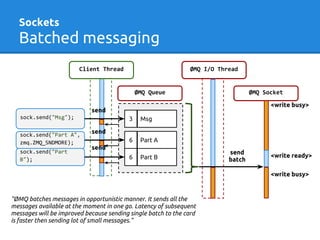
Batched messaging
ØMQ Queue
3 Msg
"ØMQ batches messages in opportunistic manner. It sends all the
messages available at the moment in one go. Latency of subsequent
messages will be improved because sending single batch to the card
is faster then sending lot of small messages."
sock.send("Part A",
zmq.ZMQ_SNDMORE);
sock.send("Msg");
sock.send("Part
B");
6 Part A
6 Part B
ØMQ Socket
send
send
send
<write busy>
<write ready>
Client Thread ØMQ I/O Thread
send
batch
<write busy>
Patterns
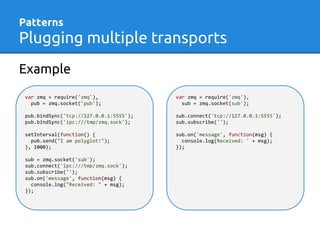
Plugging multiple transports
Example
var zmq = require('zmq'),
pub = zmq.socket('pub');
pub.bindSync('tcp://127.0.0.1:5555');
pub.bindSync('ipc:///tmp/zmq.sock');
setInterval(function() {
pub.send("I am polyglot!");
}, 1000);
sub = zmq.socket('sub');
sub.connect('ipc:///tmp/zmq.sock');
sub.subscribe('');
sub.on('message', function(msg) {
console.log("Received: " + msg);
});
var zmq = require('zmq'),
sub = zmq.socket(sub');
sub.connect('tcp://127.0.0.1:5555');
sub.subscribe('');
sub.on('message', function(msg) {
console.log(Received: ' + msg);
});
Sockets
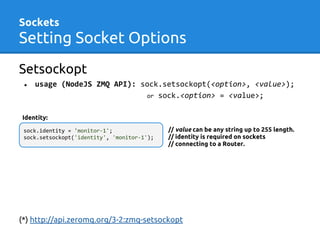
Setting Socket Options
(*) http://api.zeromq.org/3-2:zmq-setsockopt
Setsockopt
● usage (NodeJS ZMQ API): sock.setsockopt(<option>, <value>);
or sock.<option> = <value>;
sock.identity = 'monitor-1';
sock.setsockopt('identity', 'monitor-1');
Identity:
// value can be any string up to 255 length.
// identity is required on sockets
// connecting to a Router.
Sockets
Setting Socket Options
Setsockopt
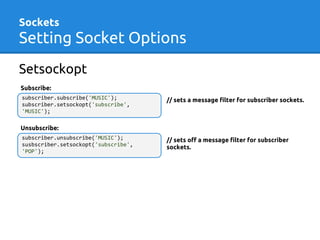
subscriber.subscribe('MUSIC');
subscriber.setsockopt('subscribe',
'MUSIC');
Subscribe:
// sets a message filter for subscriber sockets.
subscriber.unsubscribe('MUSIC');
susbscriber.setsockopt('subscribe',
'POP');
Unsubscribe:
// sets off a message filter for subscriber
sockets.
4. Patterns
[ ]
Patterns
Request / Reply
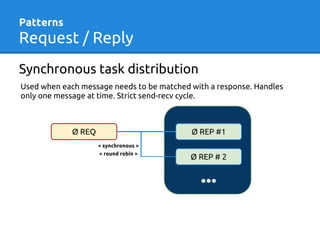
Synchronous task distribution
Ø REP #1
Ø REP # 2
Ø REQ
< round robin >
...
< synchronous >
Used when each message needs to be matched with a response. Handles
only one message at time. Strict send-recv cycle.
Patterns
Request / Reply
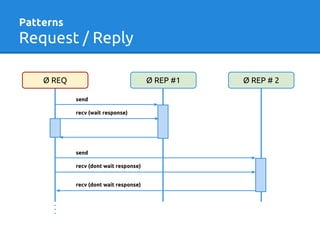
Ø REP #1 Ø REP # 2Ø REQ
send
recv (wait response)
send
recv (dont wait response)
Patterns
Request / Reply
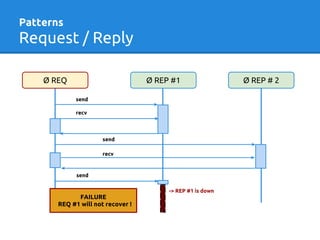
Ø REP #1 Ø REP # 2Ø REQ
send
recv
recv
send
send
-> REP #1 is down
FAILURE
REQ #1 will not recover !
Patterns
Request / Reply
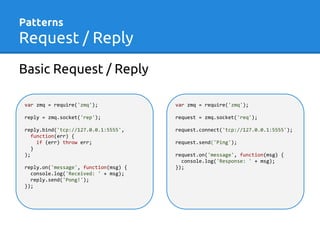
Basic Request / Reply
var zmq = require('zmq');
reply = zmq.socket('rep');
reply.bind('tcp://127.0.0.1:5555',
function(err) {
if (err) throw err;
}
);
reply.on('message', function(msg) {
console.log('Received: ' + msg);
reply.send('Pong!');
});
var zmq = require('zmq');
request = zmq.socket('req');
request.connect('tcp://127.0.0.1:5555');
request.send('Ping');
request.on('message', function(msg) {
console.log('Response: ' + msg);
});
Patterns
Request / Reply
Dealer socket message delivery
Messages have to be multipart, consisting on: an empty delimiter header,
followed by the content body parts.
sock.send("Body");
Outgoing Queue
0
6 Body
sock.send(new Buffer([]), zmq.
ZMQ_SNDMORE);
send
send
Patterns
Request / Reply
Dealer socket message delivery
Outgoing messages are round-robined among all connected peers.
However, sending depends on the availability of the receiver.
sock.send(
["", "Msg"]);
Outgoing Queue
3 Msg
6 Part A
Peer Socket A Peer Socket B
sock.send(
["", "Bla");
sock.send(
["", "Msg2"]);
send
send
send
To A
To B
To A
send
<write
ready>
<write
busy>
<write
ready>
0
0
4 Msg2
0
Patterns
Request / Reply
Dealer socket message delivery
Reconnections are handled automatically: messages are asynchronously
delivered. Response time does not block sending more messages.
Outgoing Queue Peer Socket A Peer Socket B
send
-> Up again
sock.send(
["", "Msg"]);
3 Msg
sock.send(
["", "Msg2"]);
send
send
To A
To A
0
4 Msg2
0
Patterns
Request / Reply
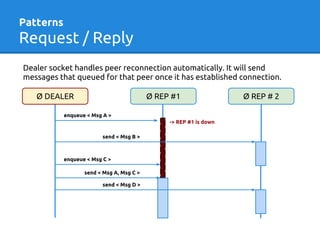
Ø REP #1 Ø REP # 2Ø DEALER
enqueue < Msg A >
send < Msg B >
-> REP #1 is down
enqueue < Msg C >
send < Msg A, Msg C >
send < Msg D >
Dealer socket handles peer reconnection automatically. It will send
messages that queued for that peer once it has established connection.
Patterns
Request / Reply
> Response from: 5001
> Response from: 5002
> Response from: 5001
> Response from: 5002
> ...
Dealer example
var dealer = zmq.socket('dealer');
dealer.connect('tcp://127.0.0.1:5001');
dealer.connect('tcp://127.0.0.1:5002');
setInterval(function() {
dealer.send(["", "Msg"]);
}, 1000);
dealer.on('message', function(h, msg) {
console.log('Response from: ' + msg);
});
running this
'might' output
->
Patterns
Request / Reply
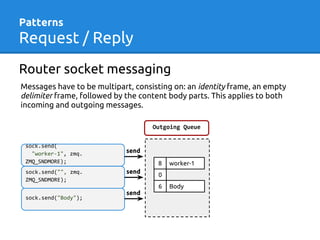
Router socket messaging
Messages have to be multipart, consisting on: an identity frame, an empty
delimiter frame, followed by the content body parts. This applies to both
incoming and outgoing messages.
sock.send("Body");
Outgoing Queue
0
6 Body
sock.send("", zmq.
ZMQ_SNDMORE);
send
send
sock.send(
"worker-1", zmq.
ZMQ_SNDMORE); 8 worker-1
send
Patterns
Request / Reply
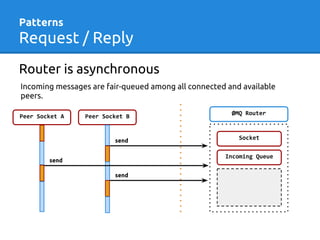
Router is asynchronous
Incoming messages are fair-queued among all connected and available
peers.
Peer Socket A Peer Socket B
ØMQ Router
Incoming Queue
Socketsend
send
send
Patterns
Request / Reply
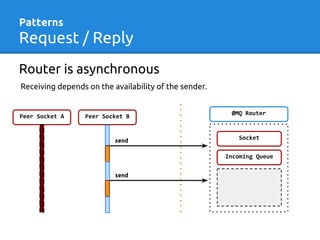
Router is asynchronous
Receiving depends on the availability of the sender.
Peer Socket A Peer Socket B
ØMQ Router
Incoming Queue
Socketsend
send
Patterns
Push / Pull
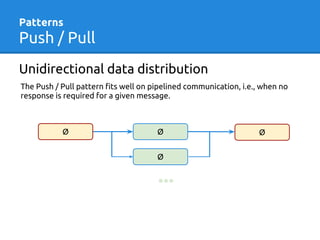
Unidirectional data distribution
The Push / Pull pattern fits well on pipelined communication, i.e., when no
response is required for a given message.
Ø
Ø
...
ØØ
Patterns
Push / Pull
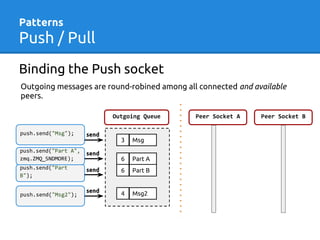
Binding the Push socket
Outgoing messages are round-robined among all connected and available
peers.
push.send("Msg");
push.send("Part
B");
Outgoing Queue Peer Socket A Peer Socket B
push.send("Part A",
zmq.ZMQ_SNDMORE);
push.send("Msg2");
3 Msg
6 Part A
6 Part B
4 Msg2
send
send
send
send
Patterns
Push / Pull
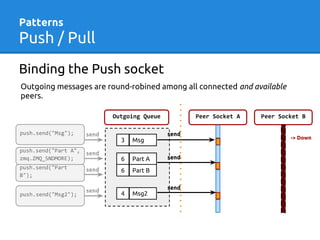
Binding the Push socket
Outgoing messages are round-robined among all connected and available
peers.
Outgoing Queue Peer Socket A Peer Socket B
-> Down3 Msg
6 Part A
6 Part B
4 Msg2
send
send
send
push.send("Msg");
push.send("Part
B");
push.send("Part A",
zmq.ZMQ_SNDMORE);
push.send("Msg2");
send
send
send
send
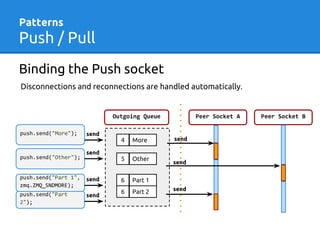
Patterns
Push / Pull
Binding the Push socket
Disconnections and reconnections are handled automatically.
Outgoing Queue Peer Socket A Peer Socket B
4 More
6 Part 1
6 Part 2
5 Other
send
send
send
push.send("More"); send
push.send("Part
2");
push.send("Part 1",
zmq.ZMQ_SNDMORE);
send
send
push.send("Other");
send
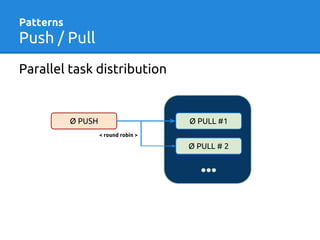
Patterns
Push / Pull
Parallel task distribution
Ø PULL #1
Ø PULL # 2
Ø PUSH
< round robin >
...
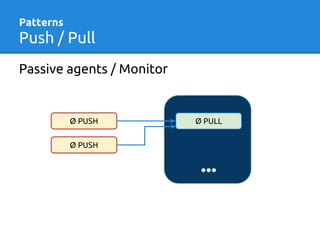
Patterns
Push / Pull
Passive agents / Monitor
Ø PULLØ PUSH
...
Ø PUSH
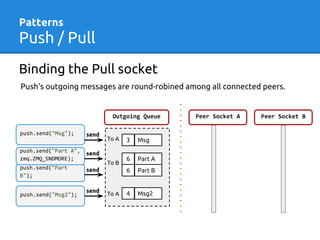
Patterns
Push / Pull
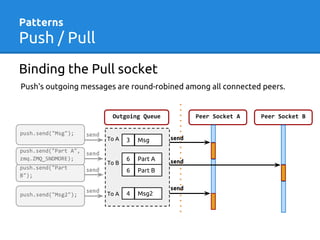
Binding the Pull socket
Push's outgoing messages are round-robined among all connected peers.
push.send("Msg");
push.send("Part
B");
Outgoing Queue Peer Socket A Peer Socket B
push.send("Part A",
zmq.ZMQ_SNDMORE);
push.send("Msg2");
send
send
send
send
3 Msg
6 Part A
6 Part B
4 Msg2
To A
To B
To A
Patterns
Push / Pull
Binding the Pull socket
Push's outgoing messages are round-robined among all connected peers.
push.send("Msg");
push.send("Part
B");
Outgoing Queue Peer Socket A Peer Socket B
push.send("Part A",
zmq.ZMQ_SNDMORE);
push.send("Msg2");
send
send
send
send
send
send
send
3 Msg
6 Part A
6 Part B
4 Msg2
To A
To B
To A
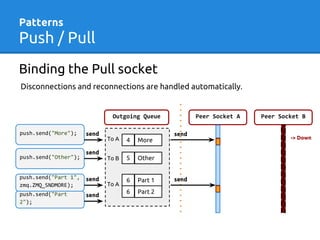
Patterns
Push / Pull
Binding the Pull socket
Disconnections and reconnections are handled automatically.
Outgoing Queue Peer Socket A Peer Socket B
send
send
-> Down4 More
6 Part 1
6 Part 2
5 Other
To A
To A
To B
push.send("More"); send
push.send("Part
2");
push.send("Part 1",
zmq.ZMQ_SNDMORE);
send
send
push.send("Other");
send
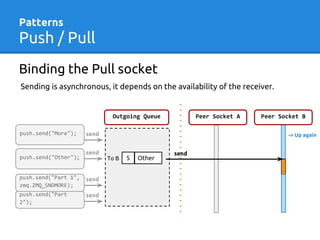
Patterns
Push / Pull
Binding the Pull socket
Sending is asynchronous, it depends on the availability of the receiver.
Outgoing Queue Peer Socket A Peer Socket B
send
-> Up again
5 OtherTo B
push.send("More"); send
push.send("Part
2");
push.send("Part 1",
zmq.ZMQ_SNDMORE);
send
send
push.send("Other");
send
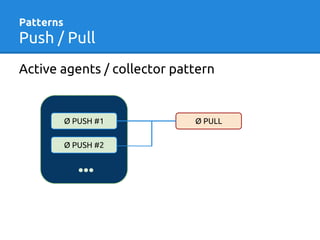
Patterns
Push / Pull
Ø PULLØ PUSH #1
...
Ø PUSH #2
Active agents / collector pattern
Patterns
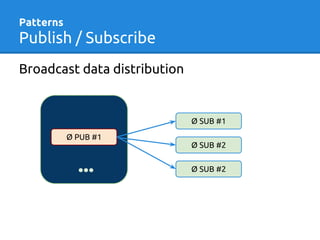
Publish / Subscribe
Broadcast data distribution
Ø SUB #1
Ø PUB #1
...
Ø SUB #2
Ø SUB #2
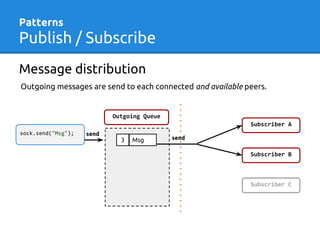
Message distribution
Patterns
Publish / Subscribe
sock.send("Msg");
Outgoing Queue
3 Msg
Subscriber A
Subscriber B
send
send
Outgoing messages are send to each connected and available peers.
Subscriber C
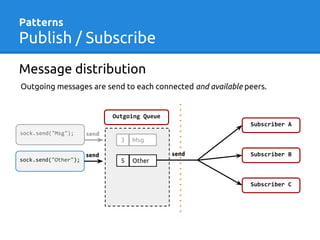
Message distribution
Patterns
Publish / Subscribe
sock.send("Msg");
Outgoing Queue
3 Msg
Subscriber A
Subscriber B
send
send
Outgoing messages are send to each connected and available peers.
Subscriber C
5 Othersock.send("Other");
send
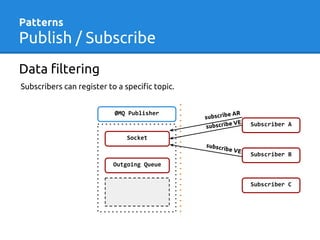
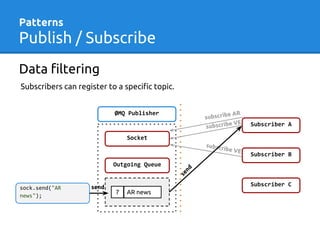
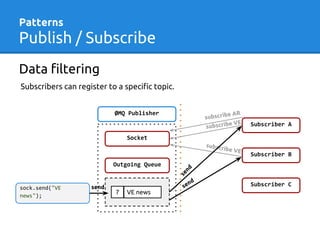
Subscribers can register to a specific topic.
Data filtering
Patterns
Publish / Subscribe
ØMQ Publisher
Subscriber A
Subscriber B
Subscriber C
Outgoing Queue
subscribe AR
subscribe VE
Socket
subscribe VE
Subscribers can register to a specific topic.
Data filtering
Patterns
Publish / Subscribe
ØMQ Publisher
Subscriber A
Subscriber B
Subscriber C
Outgoing Queue
subscribe AR
subscribe VE
Socket
subscribe VE
sock.send("AR
news");
send
7 AR news
send
Subscribers can register to a specific topic.
Data filtering
Patterns
Publish / Subscribe
ØMQ Publisher
Subscriber A
Subscriber B
Subscriber C
Outgoing Queue
subscribe AR
subscribe VE
Socket
subscribe VE
sock.send("VE
news");
send
7 VE news
sendsend
Patterns
Publish / Subscribe
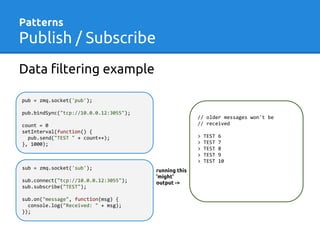
Data filtering example
pub = zmq.socket('pub');
pub.bindSync("tcp://10.0.0.12:3055");
count = 0
setInterval(function() {
pub.send("TEST " + count++);
}, 1000);
sub = zmq.socket('sub');
sub.connect("tcp://10.0.0.12:3055");
sub.subscribe("TEST");
sub.on("message", function(msg) {
console.log("Received: " + msg);
});
// older messages won't be
// received
> TEST 6
> TEST 7
> TEST 8
> TEST 9
> TEST 10
running this
'might'
output ->
Patterns
Publish / Subscribe
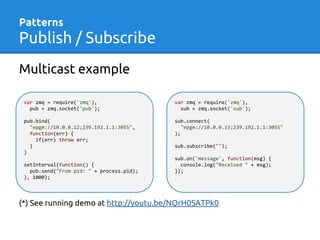
Multicast example
var zmq = require('zmq'),
pub = zmq.socket('pub');
pub.bind(
"epgm://10.0.0.12;239.192.1.1:3055",
function(err) {
if(err) throw err;
}
)
setInterval(function() {
pub.send("From pid: " + process.pid);
}, 1000);
var zmq = require('zmq'),
sub = zmq.socket('sub');
sub.connect(
"epgm://10.0.0.13;239.192.1.1:3055"
);
sub.subscribe("");
sub.on('message', function(msg) {
console.log("Received " + msg);
});
(*) See running demo at http://youtu.be/NQrH0SATPk0
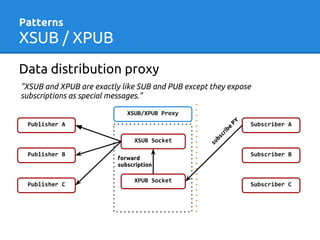
"XSUB and XPUB are exactly like SUB and PUB except they expose
subscriptions as special messages."
Data distribution proxy
Patterns
XSUB / XPUB
XSUB/XPUB Proxy
Subscriber A
Subscriber B
Subscriber C
XPUB Socket
XSUB Socket
Publisher A
Publisher B
Publisher C
subscribe
PY
forward
subscription
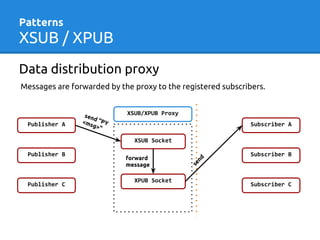
Messages are forwarded by the proxy to the registered subscribers.
Data distribution proxy
Patterns
XSUB / XPUB
XSUB/XPUB Proxy
Subscriber A
Subscriber B
Subscriber C
XPUB Socket
XSUB Socket
Publisher A
Publisher B
Publisher C
forward
message
send "PY<msg>"
send
5. Useful links
[ ]
Useful Links
Workshop examples
http://github.com/krakatoa/node_zmq_workshop
Useful Links
The Guide
http://zguide.zeromq.org/page:all
Useful Links
Pieter Hintjens personal blog
http://hintjens.com/
Useful Links
API References
http://api.zeromq.org/3-2:zmq-socket
http://api.zeromq.org/3-2:zmq-setsockopt
Preguntas ?
fedario@gmail.com
github.com/krakatoa
Fernando Dario Alonso
Gracias !

ZeroMQ with NodeJS

  • 1.
    ØMQ @ NodeJS ØMQ:Small Pieces for Scalable Software Fernando D. Alonso
  • 2.
  • 3.
    Facts about ØMQ Lowlevel messaging library ○ It is written in C++. ○ A thin layer between application and transport layers. ○ Message-passing using in-memory queues. ○ Concise API which talks over the ZMTP protocol. ○ Works on top of TCP, IPC, in-memory, and PGM/EPGM communication protocols.
  • 4.
    ○ Philosophy: horizontalscalability to reduce points of failure. ○ Network topology aware. Point to point communication reduce latencies. ○ Communication is reduced to a few patterns, which combined are powerful. ○ No need to have a multitenant service. Facts about ØMQ A broker is not mandatory
  • 5.
    Facts about ØMQ Messagedoriented communication ○ Messages as first-class citizen. No need to fight with framing or buffering. ○ You can send multipart messages. ○ Messages are atomic. ○ Asynchronous messaging. A single background I/O thread does the job for ØMQ sockets. "A ØMQ message is a discrete unit of data passed between applications or components of the same application. ØMQ messages have no internal structure and from the point of view of ØMQ itself they are considered to be opaque binary data."
  • 6.
    Facts about ØMQ Fastfor development ○ Interchangeable transports: e.g, scaling from one IPC server to a bunch of TCP. ○ Automatic reconnections. ○ Multicore made easy. ○ Provides zmq_poll to read BSD sockets.
  • 7.
    ○ It doesn'tprovide message persistence. ○ It doesn't provide data serialization. ○ It doesn't provide data compression. ○ It doesn't provide message encryption. ○ It doesn't provide security mechanisms. Not in the next version of the ZMTP protocol ! (*) ZTMP 3.0 draft protocol: http://hintjens.com/blog:39 Facts about ØMQ Aims for simplicity
  • 8.
    Facts about ØMQ Platforms& Languages ○ Bindings for 30+ languages including NodeJS, Ruby, Python, Java, C, C++, Scala, Erlang, Perl, PHP, .NET. ○ Linux & Windows. ○ Raspberry PI. ○ Android OS.
  • 9.
  • 10.
    Install On Linux fromsource sudo apt-get install build-essential libtool autoconf automake uuid-dev wget http://download.zeromq.org/zeromq-3.2.3.tar.gz tar xvzf zeromq-3.2.3.tar.gz ./configure make sudo make install sudo ldconfig NOTES: (*) Check http://download.zeromq.org/ for more versions. (**) Avoid 3.0.x, 3.1.x, 3.2.0, 3.2.1 versions. They lack backwards compatibility. (***) Check ./configure --help for more options on build. (****) ./configure --with-pgm
  • 11.
    Install On Linux usingpackages Libzmq 3.2: ● Debian Sid: sudo apt-get install libzmq3-dev Libzmq 2.2: ● Debian Wheezy, Jessie, Sid: sudo apt-get install libzmq-dev ● Debian Squeeze backport: http://packages.debian.org/squeeze- backports/libzmq1
  • 12.
  • 13.
    Install NodeJS bindings NPM Packages: ●zmq (https://github.com/JustinTulloss/zeromq.node) [RECOMMENDED] ● zmq-stream (https://github.com/Schoonology/zmq-stream) npm install zmq node > var zmq = require('zmq');
  • 14.
    Install Bindings in otherlanguages Ruby: https://github.com/chuckremes/ffi-rzmq [RECOMMENDED] Python: https://github.com/zeromq/pyzmq Erlang: https://github.com/zeromq/erlzmq2 Java JZMQ (uses JNI): https://github.com/zeromq/jzmq Java JeroMQ: https://github.com/zeromq/jeromq Scala ZeroMQ: https://github.com/mDialog/scala-zeromq Scala ZeroMQ (official): https://github.com/valotrading/zeromq-scala-binding ...
  • 15.
  • 16.
    Sockets Creation (*) http://api.zeromq.org/3-2:zmq-socket ØMQ CAPI NodeJS ZMQ req ZMQ_REQ rep ZMQ_REP dealer ZMQ_DEALER router ZMQ_ROUTER push ZMQ_PUSH pull ZMQ_PULL ØMQ C APINodeJS ZMQ pub ZMQ_PUB sub ZMQ_SUB xsub ZMQ_XSUB xpub ZMQ_XPUB var sock = zmq.socket ("<SOCKET_TYPE>"); zmq_socket(context, <SOCKET_TYPE>); Request Reply Dealer (async Request) Router (async Reply) Push Pull Publisher Subscriber XSubscriber XPublisher
  • 17.
    Sockets Bind & Connect sock.bind("tcp://10.0.0.1:5555", function(err){ .. }); sock.connect("tcp://10.0.0.1:5555"); sock.close(); (*) http://api.zeromq.org/3-2:zmq-bind (**) http://api.zeromq.org/3-2:zmq-connect (***) http://api.zeromq.org/3-2:zmq-close ØMQ C API zmq_bind(socket, "tcp://10.0.0.1:5555"); zmq_connect(socket, "tcp://10.0.0.1: 5555"); zmq_close(socket); NodeJS ZMQ Bind Connect Close
  • 18.
    Sockets Bind & Connect sock.bindSync("tcp://10.0.0.1:5555"); //This line gets executed once the socket // is binded, but it breaks on error. NodeJS ZMQ BindSync
  • 19.
    Sockets Transports TCP ● usage: tcp://<address>:<port> sock.bind("tcp://192.168.1.100:5555"); sock.bind("tcp://eth0:5555"); //binds to the first eth0 interface sock.bind("tcp://*:5555"); // binds to all interfaces (*) http://api.zeromq.org/3-2:zmq-tcp ØMQ C API zmq_bind(socket, "tcp://192.168.1.100: 5555"); zmq_bind(socket, "tcp://eth0:5555"); zmq_bind(socket, "tcp://*:5555"); NodeJS ZMQ
  • 20.
    Sockets Transports Inter-Process Communication (IPC) ●usage: ipc://<address> ● Requires RW permissions on the specified path. (*) http://api.zeromq.org/3-2:zmq-ipc sock.bind("ipc:///tmp/mysocket"); ØMQ C API zmq_bind(socket, "ipc:///tmp/mysocket"); NodeJS ZMQ
  • 21.
    Sockets Transports In-process Communication (in-memory) ●usage: inproc://<address> ● Requires to bind before connect. ● Max. address name length is 256. (*) http://api.zeromq.org/3-2:zmq-inproc (**) Buggy on node-zmq package. sock.bind("inproc://queue"); ØMQ C API zmq_bind(socket, "ipc://queue"); NodeJS ZMQ
  • 22.
    Sockets Transports PGM (multicast) ● usage:pgm://<address>;<multicast_address>:<port> ● Requires sudo privileges to access raw IP sockets. ● Needs ØMQ built with PGM extension (./configure --with-pgm). (*) http://api.zeromq.org/3-2:zmq-pgm sock.bind( "pgm://192.168.1.100;239.192.1.1:3055" ); ØMQ C API zmq_bind(socket, "pgm://192.168.1.100; 239.192.1.1:3055"); NodeJS ZMQ
  • 23.
    Sockets Transports Encapsulated PGM (multicast) ●usage: epgm://<address>;<multicast_address>:<port> ● Needs ØMQ built with PGM extension (./configure --with-pgm). (*) http://api.zeromq.org/3-2:zmq-pgm sock.bind( "epgm://192.168.1.100;239.192.1.1:3055" ); ØMQ C API zmq_bind(socket, "epgm://192.168.1.100; 239.192.1.1:3055"); NodeJS ZMQ
  • 24.
    Sockets Send & Receive Send sock.send("Mymessage"); sock.on("message", function(msg) { console.log(msg.toString()); }); (*) http://api.zeromq.org/3-2:zmq-send (**) http://api.zeromq.org/3-2:zmq-recv Receive sock.on("message", function(msg) { console.log("Received " + msg); }); // <msg> is a Buffer object.
  • 25.
    Sockets Multipart messages ØMQ Queue zmq_send(socket,"Como", 4, ZMQ_SNDMORE); Messages are atomic A ØMQ message is composed of 1 or more message parts. zmq_send(socket, "andas", 5, 0); 4 ComoPart 1 5 andasPart 2 ØMQ ensures that peers receive either all message parts of a message or none at all. The total number of message parts is unlimited except by available memory.
  • 26.
    Sockets Multipart messages sock.send("First part",zmq.ZMQ_SNDMORE); sock.send("Second part"); sock.send(["First part", "Second part"]); Send var r = sock.send("Como", zmq. ZMQ_SNDMORE); console.log(r); Check the outgoing buffer and socket state: running this will output -> > { type: 'req', _zmq: { state: 0, onReady: [Function] }, _outgoing: [ [ <Buffer 43 6f 6d 6f>, 2 ] ], _shouldFlush: true, _events: { message: [Function] } }
  • 27.
    Sockets Multipart messages sock.on("message", function(first_part,second_part) { console.log(first_part.toString()); console.log(second_part.toString()); }); sock.on("message", function() { for(var key in arguments) { console.log("Part " + key + ": " + arguments[key]); }; }); Receive sock.on("message", function() { var messages = Array.prototype.slice.call(arguments); messages.forEach(function(msg) { console.log("Part:" + msg); }); });
  • 28.
    Sockets Batched messaging ØMQ Queue 3Msg "ØMQ batches messages in opportunistic manner. It sends all the messages available at the moment in one go. Latency of subsequent messages will be improved because sending single batch to the card is faster then sending lot of small messages." sock.send("Part A", zmq.ZMQ_SNDMORE); sock.send("Msg"); sock.send("Part B"); 6 Part A 6 Part B ØMQ Socket send send send <write busy> <write ready> Client Thread ØMQ I/O Thread send batch <write busy>
  • 29.
    Patterns Plugging multiple transports Example varzmq = require('zmq'), pub = zmq.socket('pub'); pub.bindSync('tcp://127.0.0.1:5555'); pub.bindSync('ipc:///tmp/zmq.sock'); setInterval(function() { pub.send("I am polyglot!"); }, 1000); sub = zmq.socket('sub'); sub.connect('ipc:///tmp/zmq.sock'); sub.subscribe(''); sub.on('message', function(msg) { console.log("Received: " + msg); }); var zmq = require('zmq'), sub = zmq.socket(sub'); sub.connect('tcp://127.0.0.1:5555'); sub.subscribe(''); sub.on('message', function(msg) { console.log(Received: ' + msg); });
  • 30.
    Sockets Setting Socket Options (*)http://api.zeromq.org/3-2:zmq-setsockopt Setsockopt ● usage (NodeJS ZMQ API): sock.setsockopt(<option>, <value>); or sock.<option> = <value>; sock.identity = 'monitor-1'; sock.setsockopt('identity', 'monitor-1'); Identity: // value can be any string up to 255 length. // identity is required on sockets // connecting to a Router.
  • 31.
    Sockets Setting Socket Options Setsockopt subscriber.subscribe('MUSIC'); subscriber.setsockopt('subscribe', 'MUSIC'); Subscribe: //sets a message filter for subscriber sockets. subscriber.unsubscribe('MUSIC'); susbscriber.setsockopt('subscribe', 'POP'); Unsubscribe: // sets off a message filter for subscriber sockets.
  • 32.
  • 33.
    Patterns Request / Reply Synchronoustask distribution Ø REP #1 Ø REP # 2 Ø REQ < round robin > ... < synchronous > Used when each message needs to be matched with a response. Handles only one message at time. Strict send-recv cycle.
  • 34.
    Patterns Request / Reply ØREP #1 Ø REP # 2Ø REQ send recv (wait response) send recv (dont wait response) recv (dont wait response)
  • 35.
    Patterns Request / Reply ØREP #1 Ø REP # 2Ø REQ send recv recv send send -> REP #1 is down FAILURE REQ #1 will not recover !
  • 36.
    Patterns Request / Reply BasicRequest / Reply var zmq = require('zmq'); reply = zmq.socket('rep'); reply.bind('tcp://127.0.0.1:5555', function(err) { if (err) throw err; } ); reply.on('message', function(msg) { console.log('Received: ' + msg); reply.send('Pong!'); }); var zmq = require('zmq'); request = zmq.socket('req'); request.connect('tcp://127.0.0.1:5555'); request.send('Ping'); request.on('message', function(msg) { console.log('Response: ' + msg); });
  • 37.
    Patterns Request / Reply Dealersocket message delivery Messages have to be multipart, consisting on: an empty delimiter header, followed by the content body parts. sock.send("Body"); Outgoing Queue 0 6 Body sock.send(new Buffer([]), zmq. ZMQ_SNDMORE); send send
  • 38.
    Patterns Request / Reply Dealersocket message delivery Outgoing messages are round-robined among all connected peers. However, sending depends on the availability of the receiver. sock.send( ["", "Msg"]); Outgoing Queue 3 Msg 6 Part A Peer Socket A Peer Socket B sock.send( ["", "Bla"); sock.send( ["", "Msg2"]); send send send To A To B To A send <write ready> <write busy> <write ready> 0 0 4 Msg2 0
  • 39.
    Patterns Request / Reply Dealersocket message delivery Reconnections are handled automatically: messages are asynchronously delivered. Response time does not block sending more messages. Outgoing Queue Peer Socket A Peer Socket B send -> Up again sock.send( ["", "Msg"]); 3 Msg sock.send( ["", "Msg2"]); send send To A To A 0 4 Msg2 0
  • 40.
    Patterns Request / Reply ØREP #1 Ø REP # 2Ø DEALER enqueue < Msg A > send < Msg B > -> REP #1 is down enqueue < Msg C > send < Msg A, Msg C > send < Msg D > Dealer socket handles peer reconnection automatically. It will send messages that queued for that peer once it has established connection.
  • 41.
    Patterns Request / Reply >Response from: 5001 > Response from: 5001 > Response from: 5002 > Response from: 5001 > Response from: 5001 > Response from: 5002 > ... Dealer example var dealer = zmq.socket('dealer'); dealer.connect('tcp://127.0.0.1:5001'); dealer.connect('tcp://127.0.0.1:5002'); setInterval(function() { dealer.send(["", "Msg"]); }, 1000); dealer.on('message', function(h, msg) { console.log('Response from: ' + msg); }); running this 'might' output ->
  • 42.
    Patterns Request / Reply Routersocket messaging Messages have to be multipart, consisting on: an identity frame, an empty delimiter frame, followed by the content body parts. This applies to both incoming and outgoing messages. sock.send("Body"); Outgoing Queue 0 6 Body sock.send("", zmq. ZMQ_SNDMORE); send send sock.send( "worker-1", zmq. ZMQ_SNDMORE); 8 worker-1 send
  • 43.
    Patterns Request / Reply Routeris asynchronous Incoming messages are fair-queued among all connected and available peers. Peer Socket A Peer Socket B ØMQ Router Incoming Queue Socketsend send send
  • 44.
    Patterns Request / Reply Routeris asynchronous Receiving depends on the availability of the sender. Peer Socket A Peer Socket B ØMQ Router Incoming Queue Socketsend send
  • 45.
    Patterns Push / Pull Unidirectionaldata distribution The Push / Pull pattern fits well on pipelined communication, i.e., when no response is required for a given message. Ø Ø ... ØØ
  • 46.
    Patterns Push / Pull Bindingthe Push socket Outgoing messages are round-robined among all connected and available peers. push.send("Msg"); push.send("Part B"); Outgoing Queue Peer Socket A Peer Socket B push.send("Part A", zmq.ZMQ_SNDMORE); push.send("Msg2"); 3 Msg 6 Part A 6 Part B 4 Msg2 send send send send
  • 47.
    Patterns Push / Pull Bindingthe Push socket Outgoing messages are round-robined among all connected and available peers. Outgoing Queue Peer Socket A Peer Socket B -> Down3 Msg 6 Part A 6 Part B 4 Msg2 send send send push.send("Msg"); push.send("Part B"); push.send("Part A", zmq.ZMQ_SNDMORE); push.send("Msg2"); send send send send
  • 48.
    Patterns Push / Pull Bindingthe Push socket Disconnections and reconnections are handled automatically. Outgoing Queue Peer Socket A Peer Socket B 4 More 6 Part 1 6 Part 2 5 Other send send send push.send("More"); send push.send("Part 2"); push.send("Part 1", zmq.ZMQ_SNDMORE); send send push.send("Other"); send
  • 49.
    Patterns Push / Pull Paralleltask distribution Ø PULL #1 Ø PULL # 2 Ø PUSH < round robin > ...
  • 50.
    Patterns Push / Pull Passiveagents / Monitor Ø PULLØ PUSH ... Ø PUSH
  • 51.
    Patterns Push / Pull Bindingthe Pull socket Push's outgoing messages are round-robined among all connected peers. push.send("Msg"); push.send("Part B"); Outgoing Queue Peer Socket A Peer Socket B push.send("Part A", zmq.ZMQ_SNDMORE); push.send("Msg2"); send send send send 3 Msg 6 Part A 6 Part B 4 Msg2 To A To B To A
  • 52.
    Patterns Push / Pull Bindingthe Pull socket Push's outgoing messages are round-robined among all connected peers. push.send("Msg"); push.send("Part B"); Outgoing Queue Peer Socket A Peer Socket B push.send("Part A", zmq.ZMQ_SNDMORE); push.send("Msg2"); send send send send send send send 3 Msg 6 Part A 6 Part B 4 Msg2 To A To B To A
  • 53.
    Patterns Push / Pull Bindingthe Pull socket Disconnections and reconnections are handled automatically. Outgoing Queue Peer Socket A Peer Socket B send send -> Down4 More 6 Part 1 6 Part 2 5 Other To A To A To B push.send("More"); send push.send("Part 2"); push.send("Part 1", zmq.ZMQ_SNDMORE); send send push.send("Other"); send
  • 54.
    Patterns Push / Pull Bindingthe Pull socket Sending is asynchronous, it depends on the availability of the receiver. Outgoing Queue Peer Socket A Peer Socket B send -> Up again 5 OtherTo B push.send("More"); send push.send("Part 2"); push.send("Part 1", zmq.ZMQ_SNDMORE); send send push.send("Other"); send
  • 55.
    Patterns Push / Pull ØPULLØ PUSH #1 ... Ø PUSH #2 Active agents / collector pattern
  • 56.
    Patterns Publish / Subscribe Broadcastdata distribution Ø SUB #1 Ø PUB #1 ... Ø SUB #2 Ø SUB #2
  • 57.
    Message distribution Patterns Publish /Subscribe sock.send("Msg"); Outgoing Queue 3 Msg Subscriber A Subscriber B send send Outgoing messages are send to each connected and available peers. Subscriber C
  • 58.
    Message distribution Patterns Publish /Subscribe sock.send("Msg"); Outgoing Queue 3 Msg Subscriber A Subscriber B send send Outgoing messages are send to each connected and available peers. Subscriber C 5 Othersock.send("Other"); send
  • 59.
    Subscribers can registerto a specific topic. Data filtering Patterns Publish / Subscribe ØMQ Publisher Subscriber A Subscriber B Subscriber C Outgoing Queue subscribe AR subscribe VE Socket subscribe VE
  • 60.
    Subscribers can registerto a specific topic. Data filtering Patterns Publish / Subscribe ØMQ Publisher Subscriber A Subscriber B Subscriber C Outgoing Queue subscribe AR subscribe VE Socket subscribe VE sock.send("AR news"); send 7 AR news send
  • 61.
    Subscribers can registerto a specific topic. Data filtering Patterns Publish / Subscribe ØMQ Publisher Subscriber A Subscriber B Subscriber C Outgoing Queue subscribe AR subscribe VE Socket subscribe VE sock.send("VE news"); send 7 VE news sendsend
  • 62.
    Patterns Publish / Subscribe Datafiltering example pub = zmq.socket('pub'); pub.bindSync("tcp://10.0.0.12:3055"); count = 0 setInterval(function() { pub.send("TEST " + count++); }, 1000); sub = zmq.socket('sub'); sub.connect("tcp://10.0.0.12:3055"); sub.subscribe("TEST"); sub.on("message", function(msg) { console.log("Received: " + msg); }); // older messages won't be // received > TEST 6 > TEST 7 > TEST 8 > TEST 9 > TEST 10 running this 'might' output ->
  • 63.
    Patterns Publish / Subscribe Multicastexample var zmq = require('zmq'), pub = zmq.socket('pub'); pub.bind( "epgm://10.0.0.12;239.192.1.1:3055", function(err) { if(err) throw err; } ) setInterval(function() { pub.send("From pid: " + process.pid); }, 1000); var zmq = require('zmq'), sub = zmq.socket('sub'); sub.connect( "epgm://10.0.0.13;239.192.1.1:3055" ); sub.subscribe(""); sub.on('message', function(msg) { console.log("Received " + msg); }); (*) See running demo at http://youtu.be/NQrH0SATPk0
  • 64.
    "XSUB and XPUBare exactly like SUB and PUB except they expose subscriptions as special messages." Data distribution proxy Patterns XSUB / XPUB XSUB/XPUB Proxy Subscriber A Subscriber B Subscriber C XPUB Socket XSUB Socket Publisher A Publisher B Publisher C subscribe PY forward subscription
  • 65.
    Messages are forwardedby the proxy to the registered subscribers. Data distribution proxy Patterns XSUB / XPUB XSUB/XPUB Proxy Subscriber A Subscriber B Subscriber C XPUB Socket XSUB Socket Publisher A Publisher B Publisher C forward message send "PY<msg>" send
  • 66.
  • 67.
  • 68.
  • 69.
    Useful Links Pieter Hintjenspersonal blog http://hintjens.com/
  • 70.
  • 71.