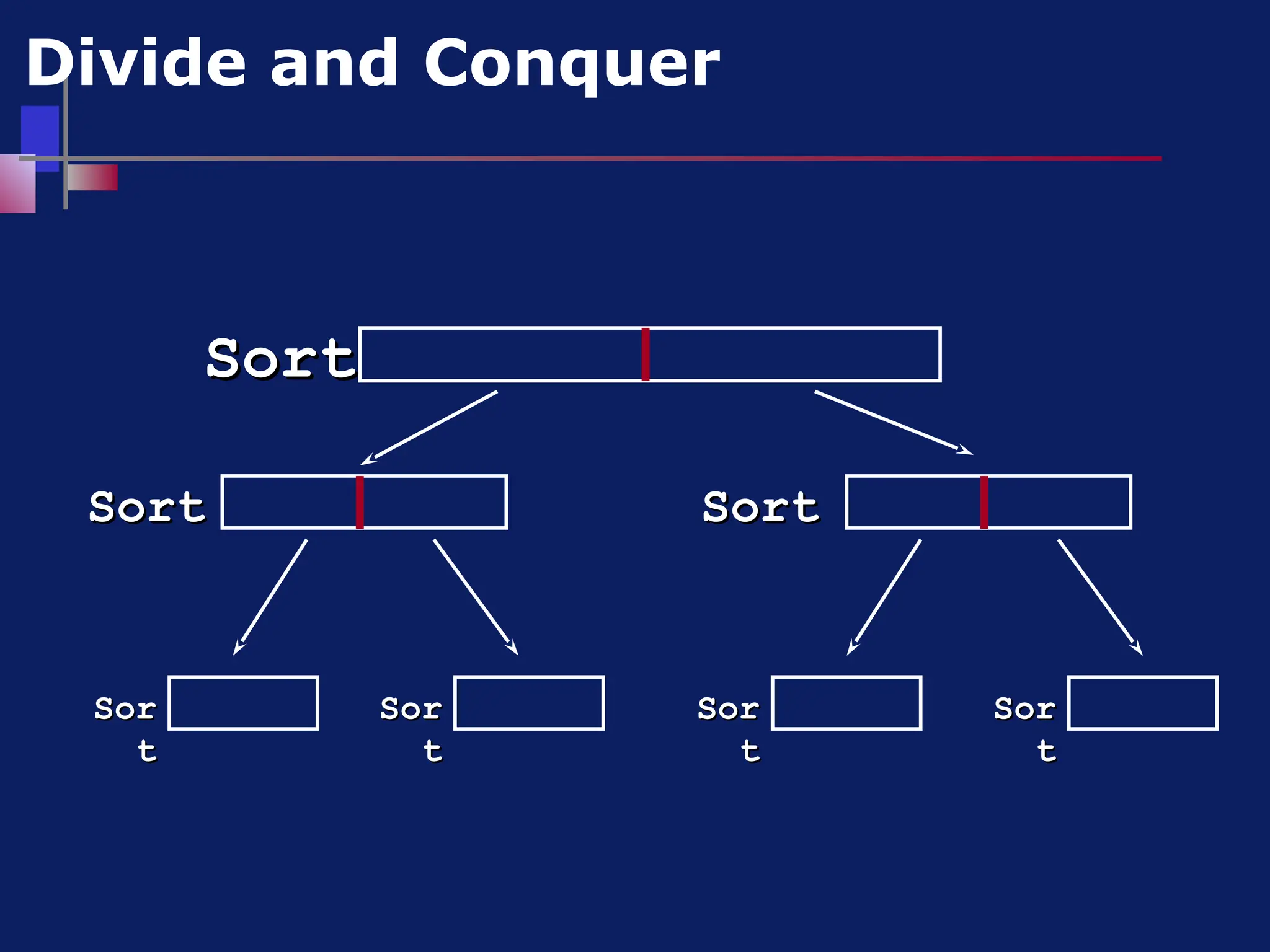
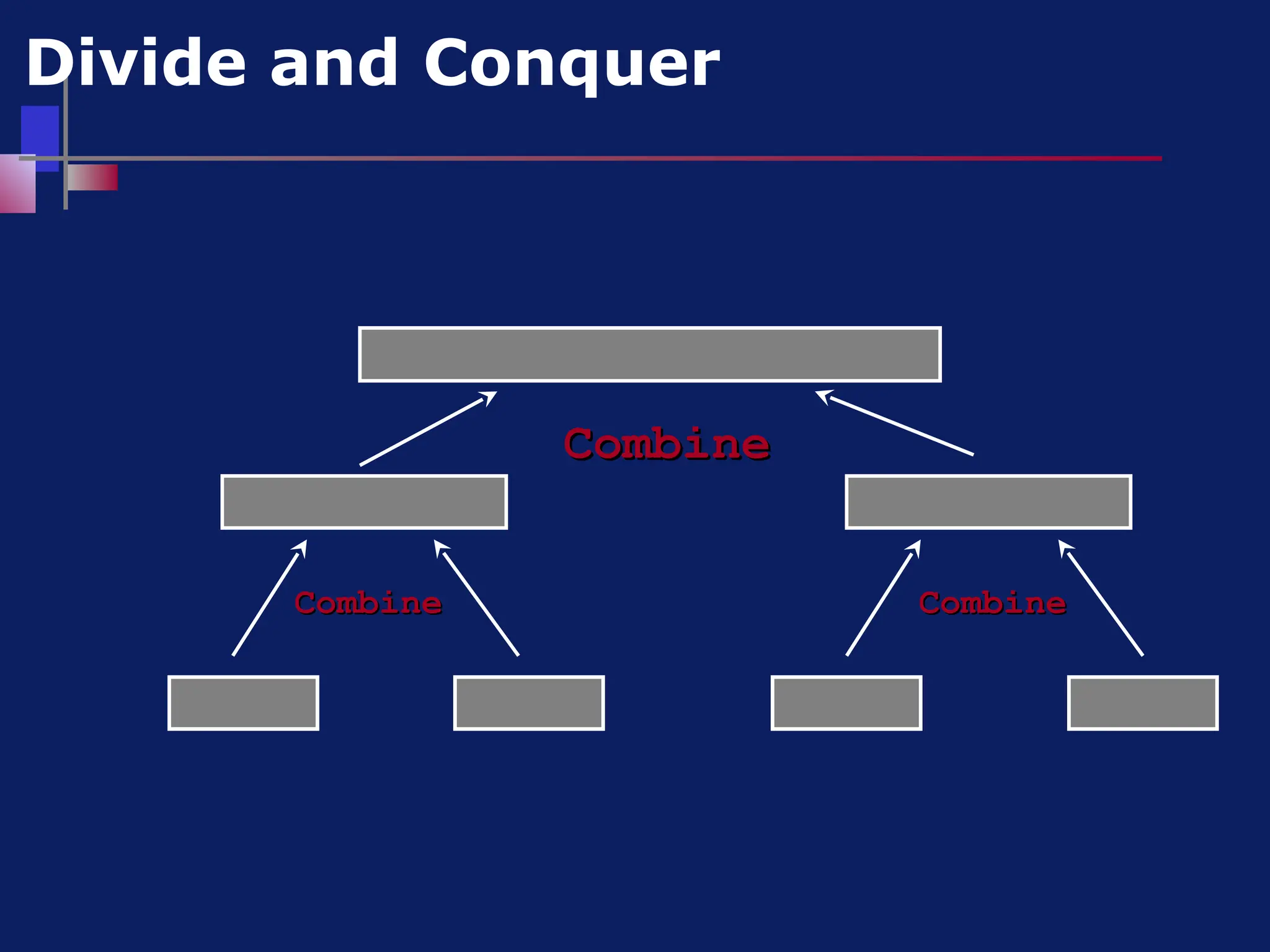
Divide and Conquer
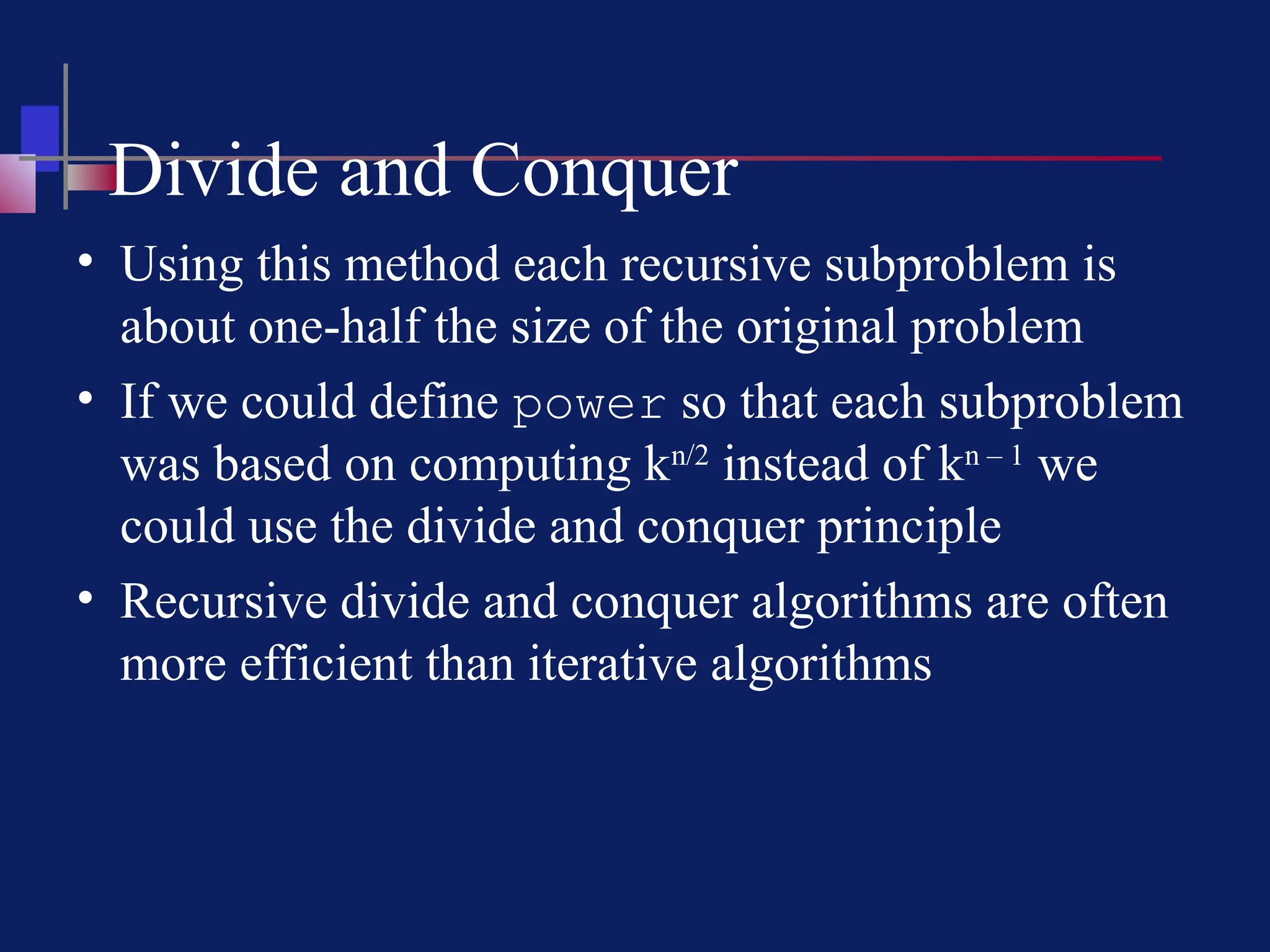
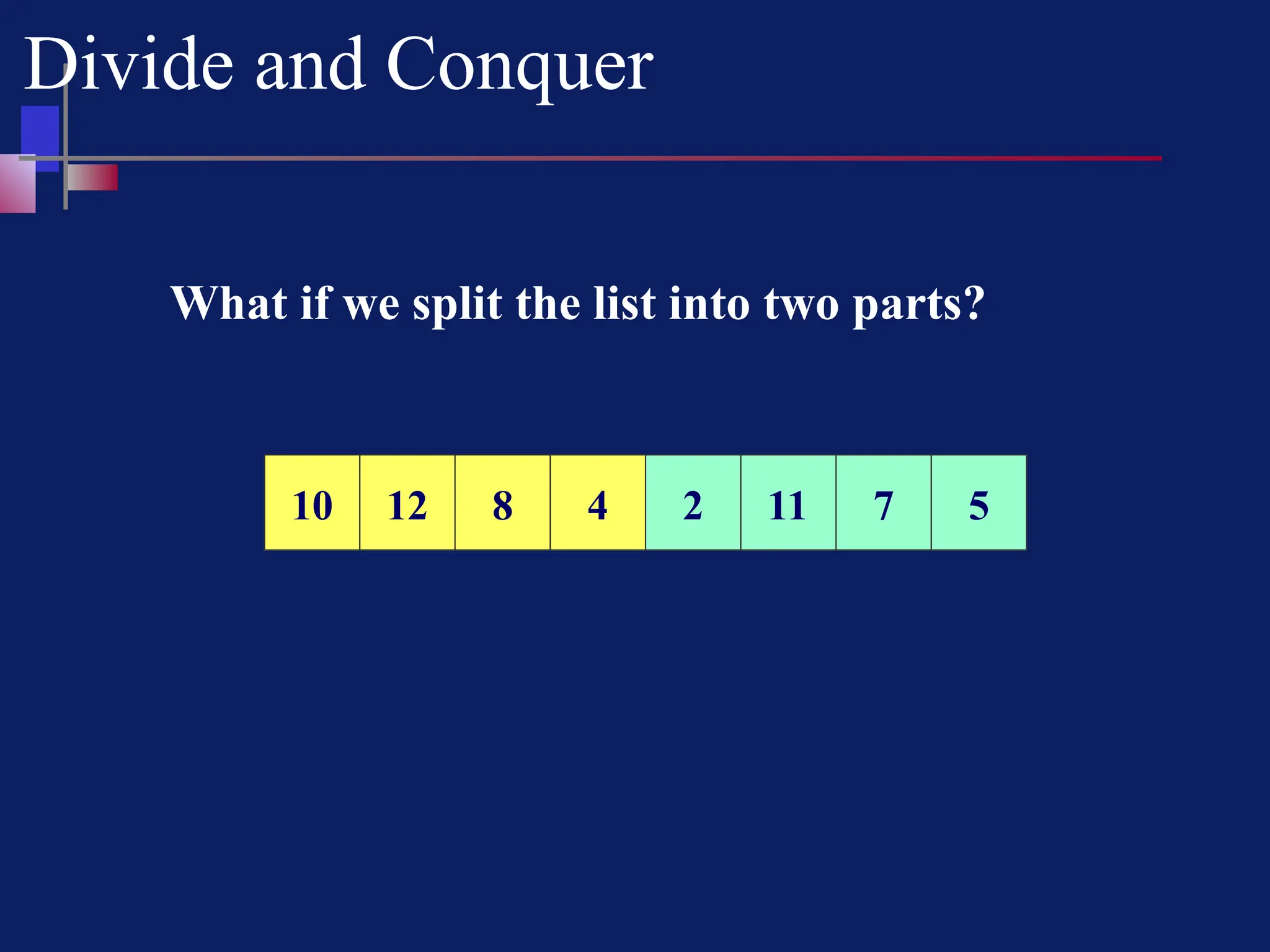
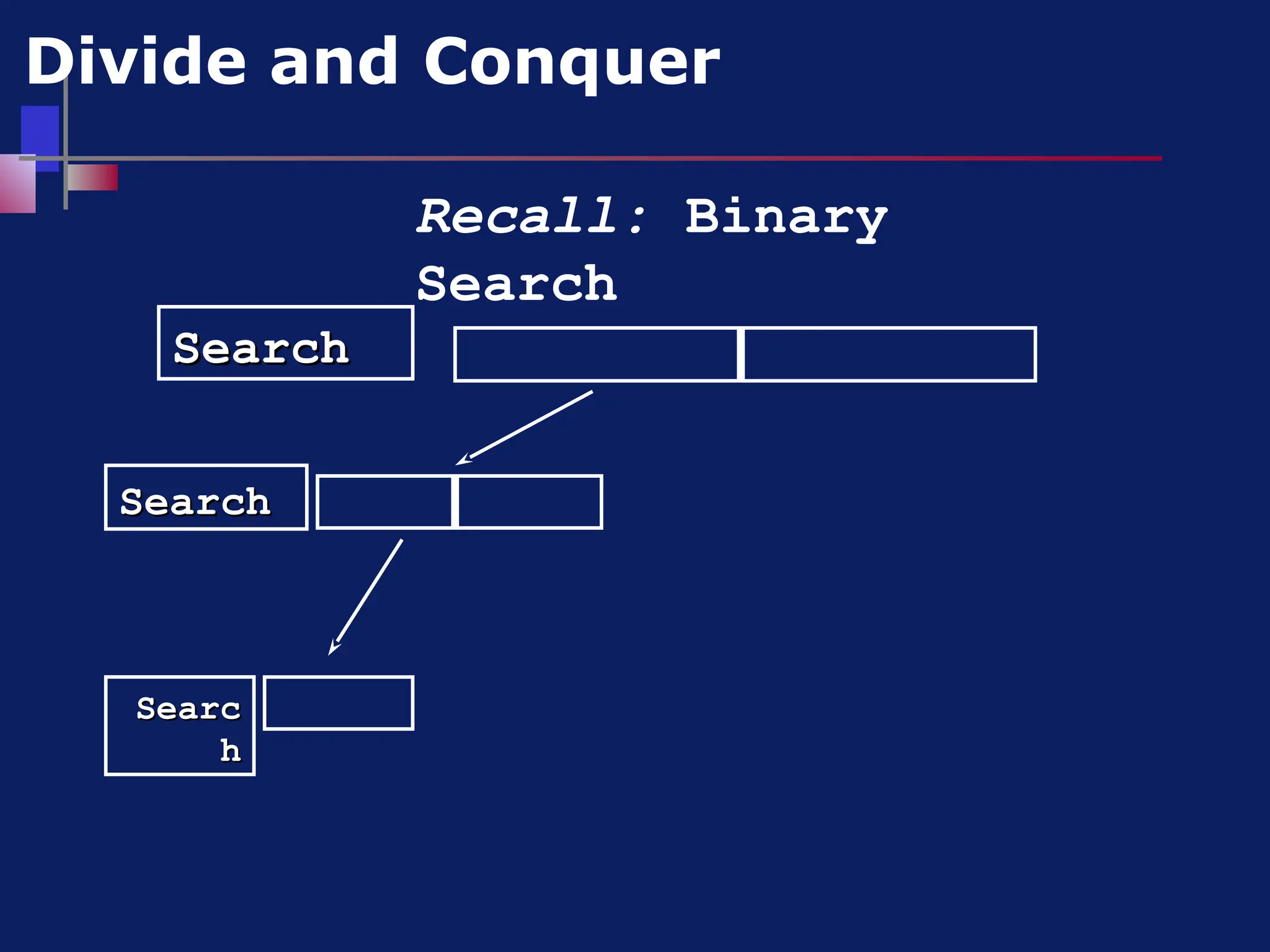
•Using this method each recursive subproblem is
about one-half the size of the original problem
• If we could define power so that each subproblem
was based on computing kn/2
instead of kn – 1
we
could use the divide and conquer principle
• Recursive divide and conquer algorithms are often
more efficient than iterative algorithms
3.
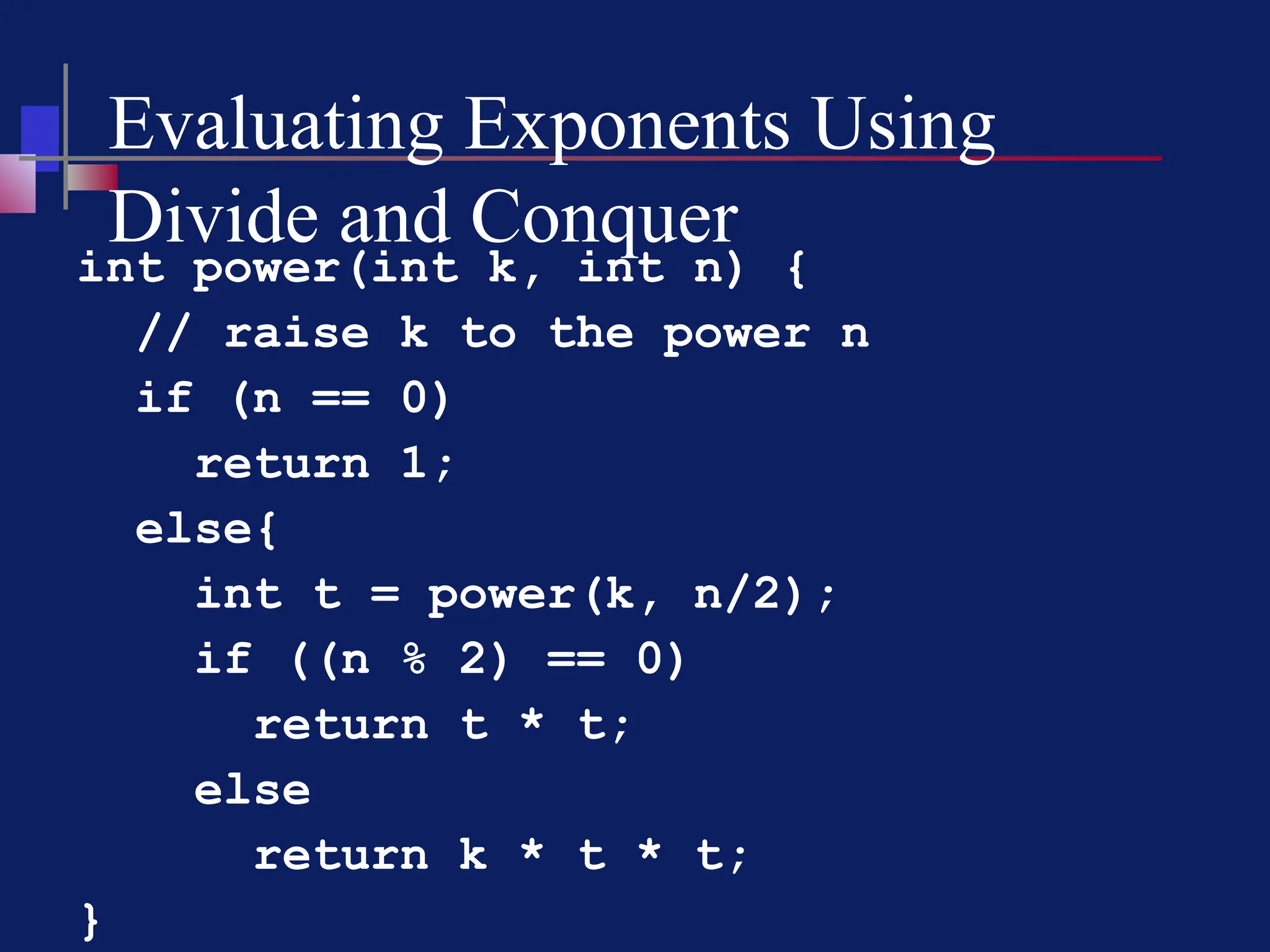
Evaluating Exponents Using
Divideand Conquer
int power(int k, int n) {
// raise k to the power n
if (n == 0)
return 1;
else{
int t = power(k, n/2);
if ((n % 2) == 0)
return t * t;
else
return k * t * t;
}
4.
Stacks
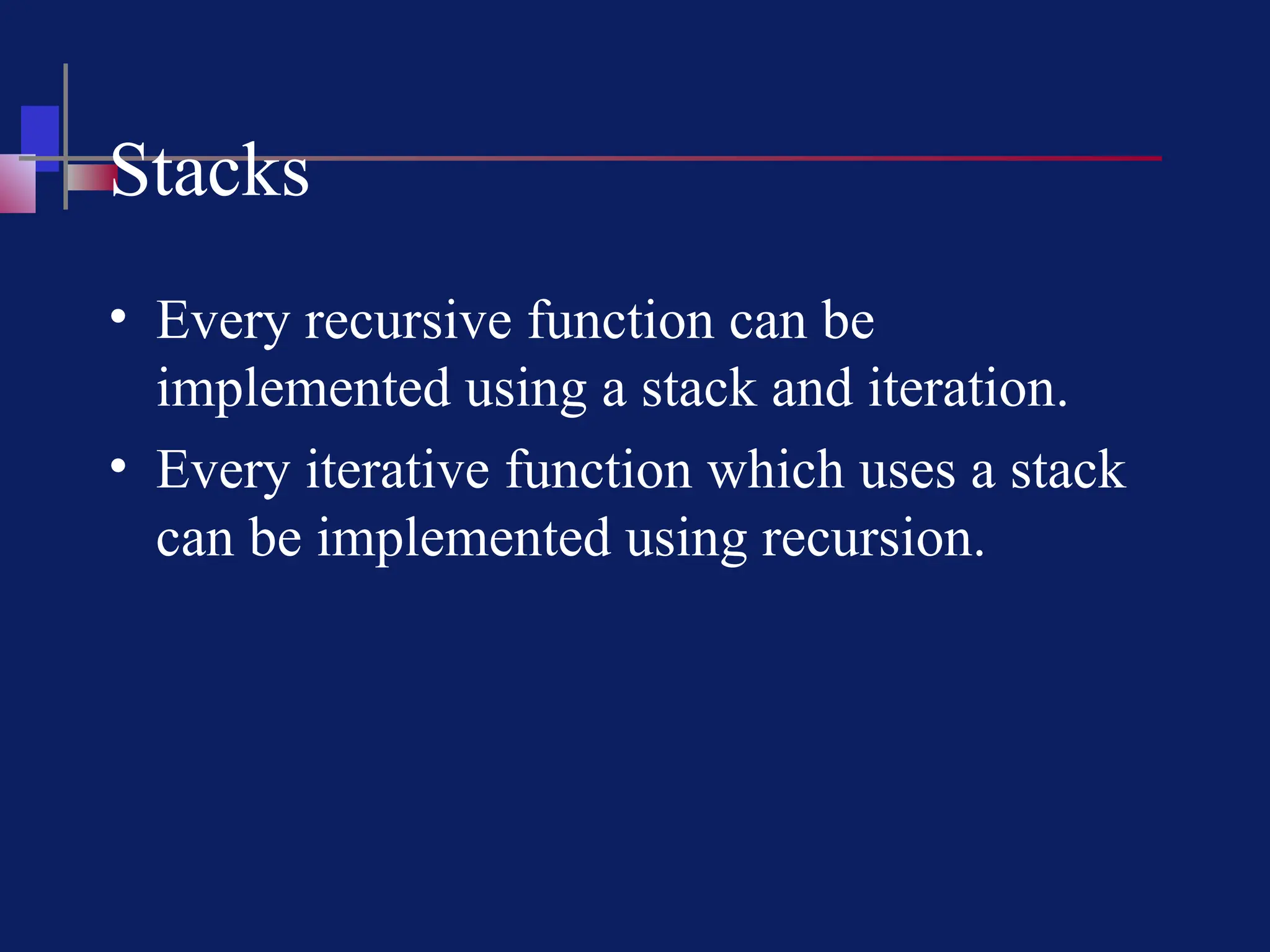
• Every recursivefunction can be
implemented using a stack and iteration.
• Every iterative function which uses a stack
can be implemented using recursion.
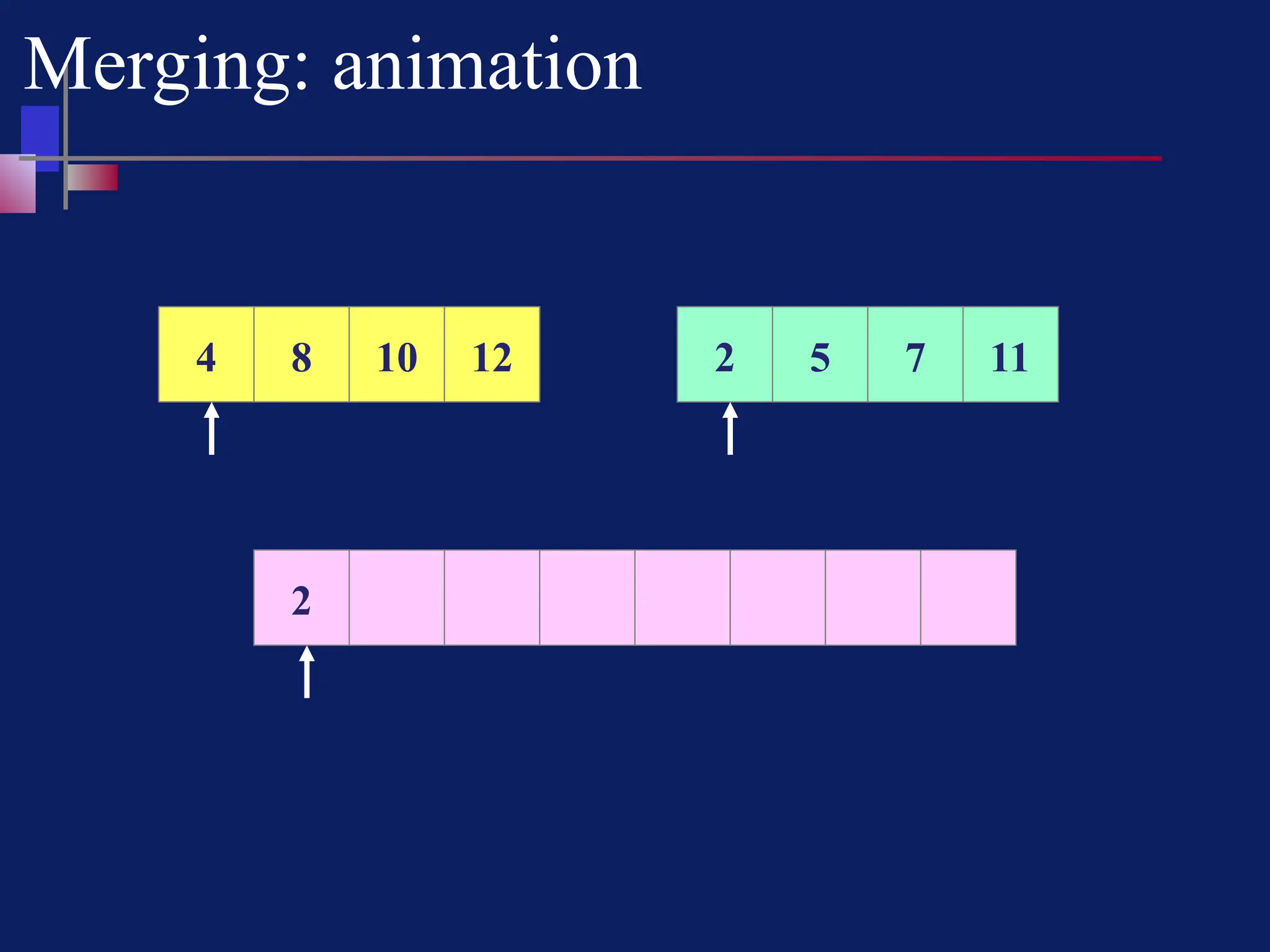
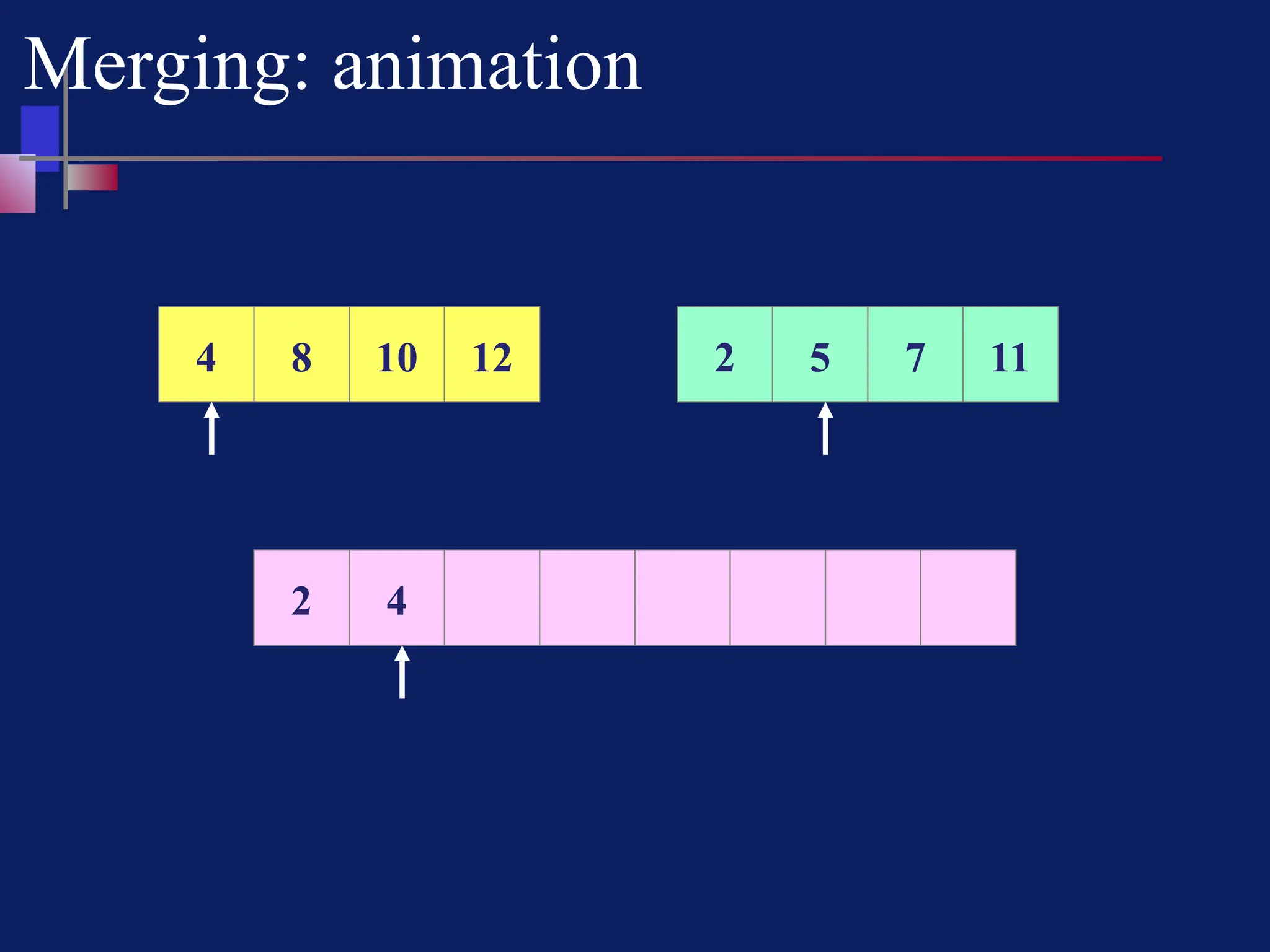
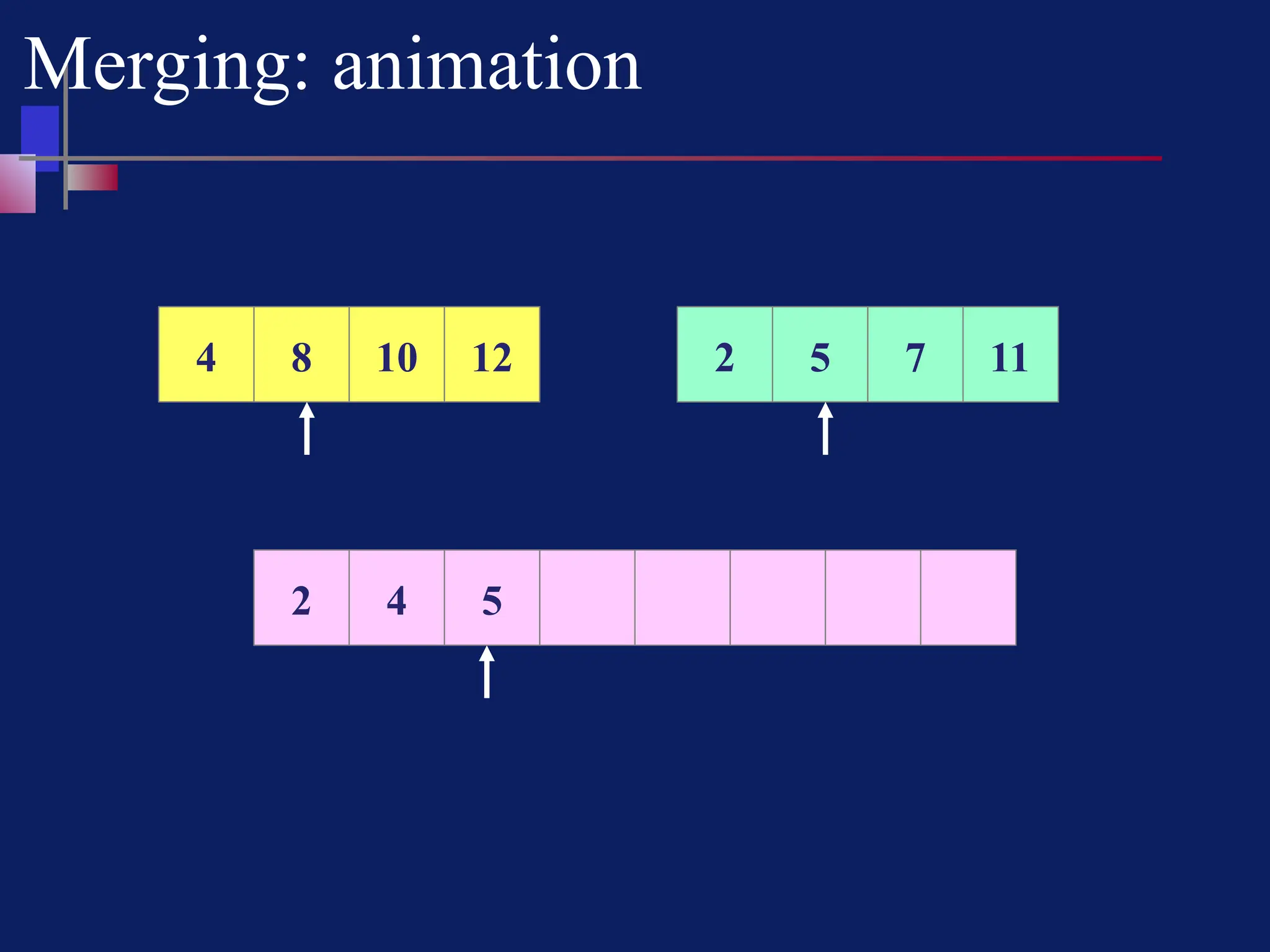
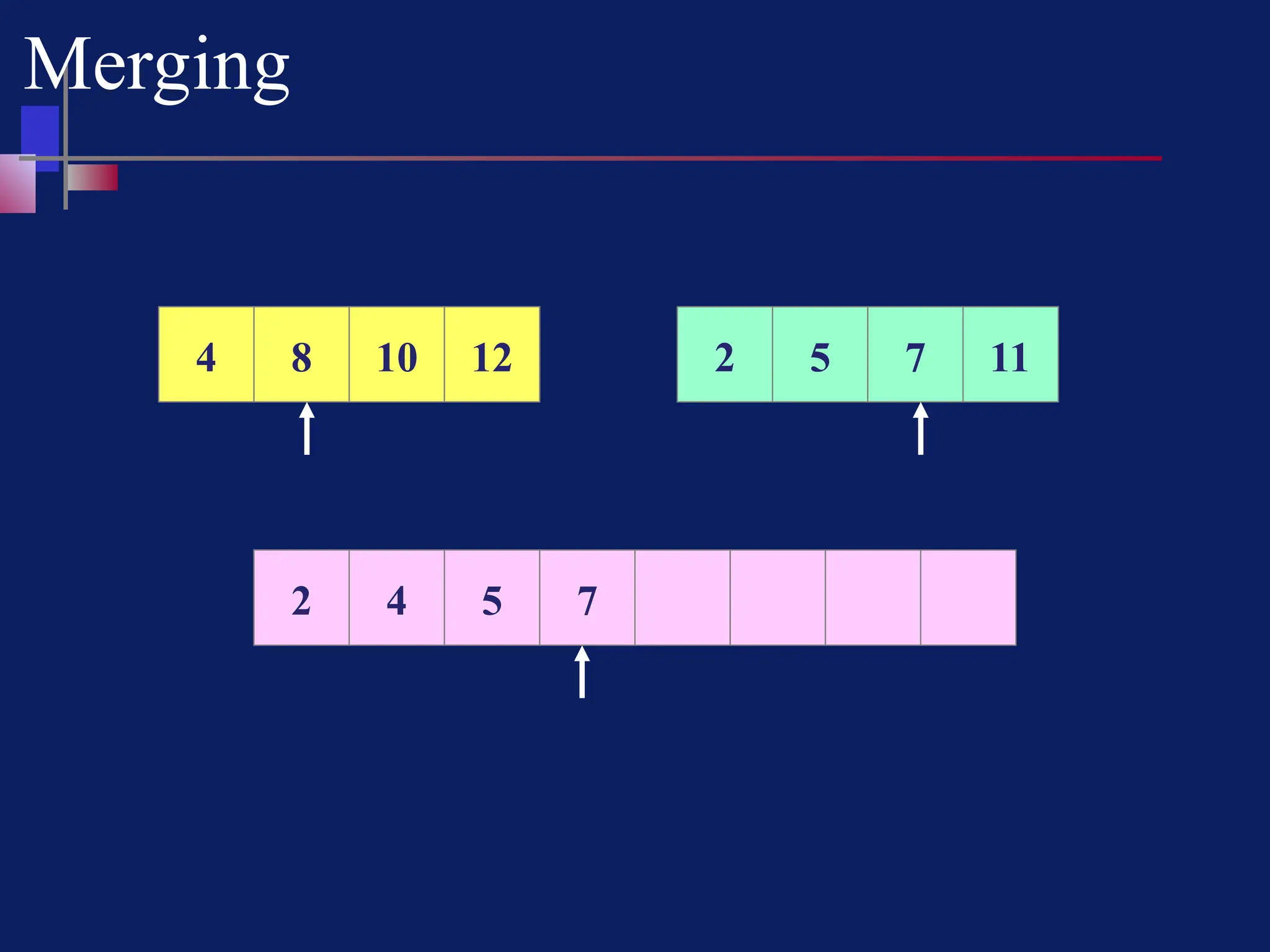
Mergesort
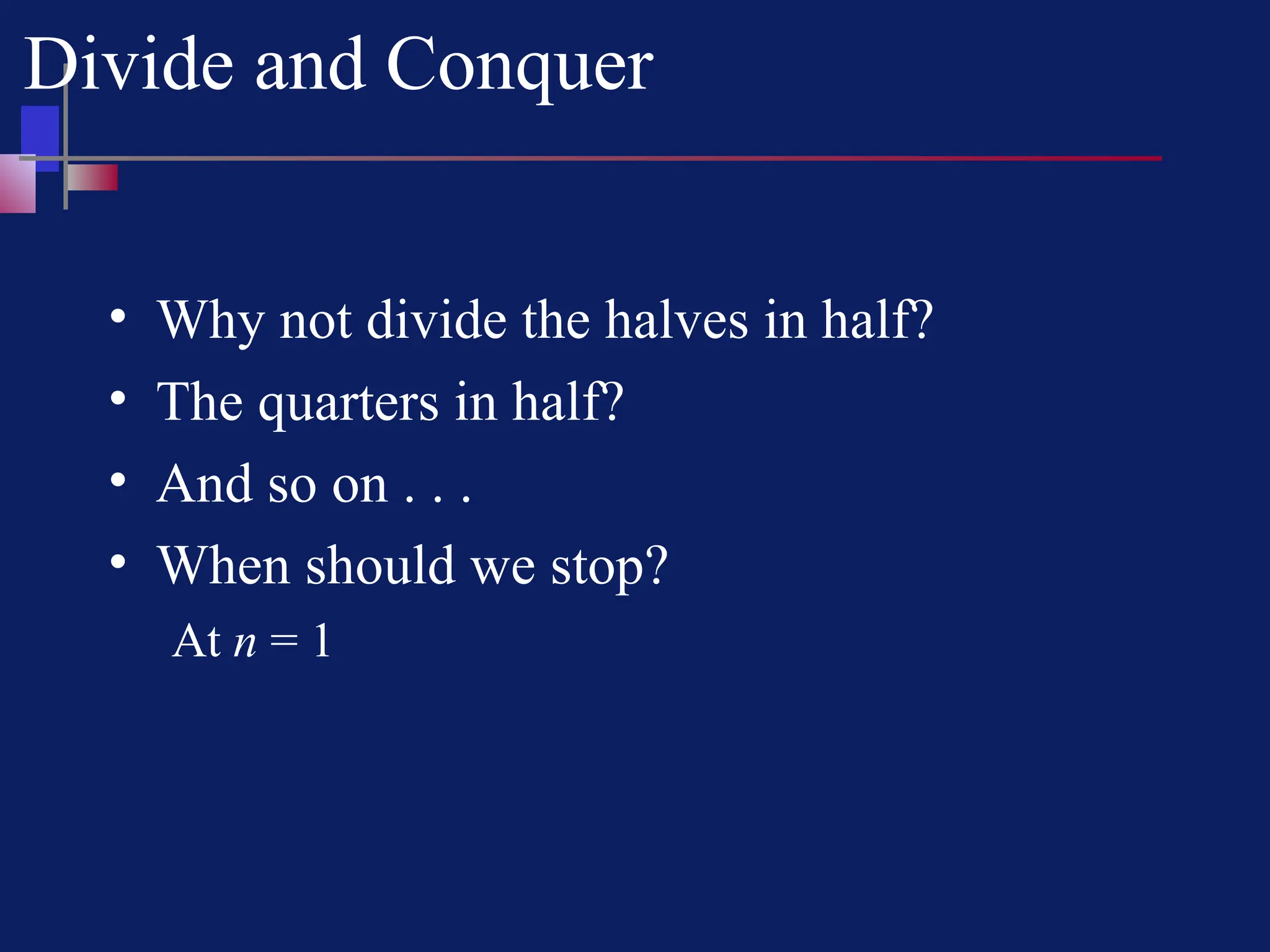
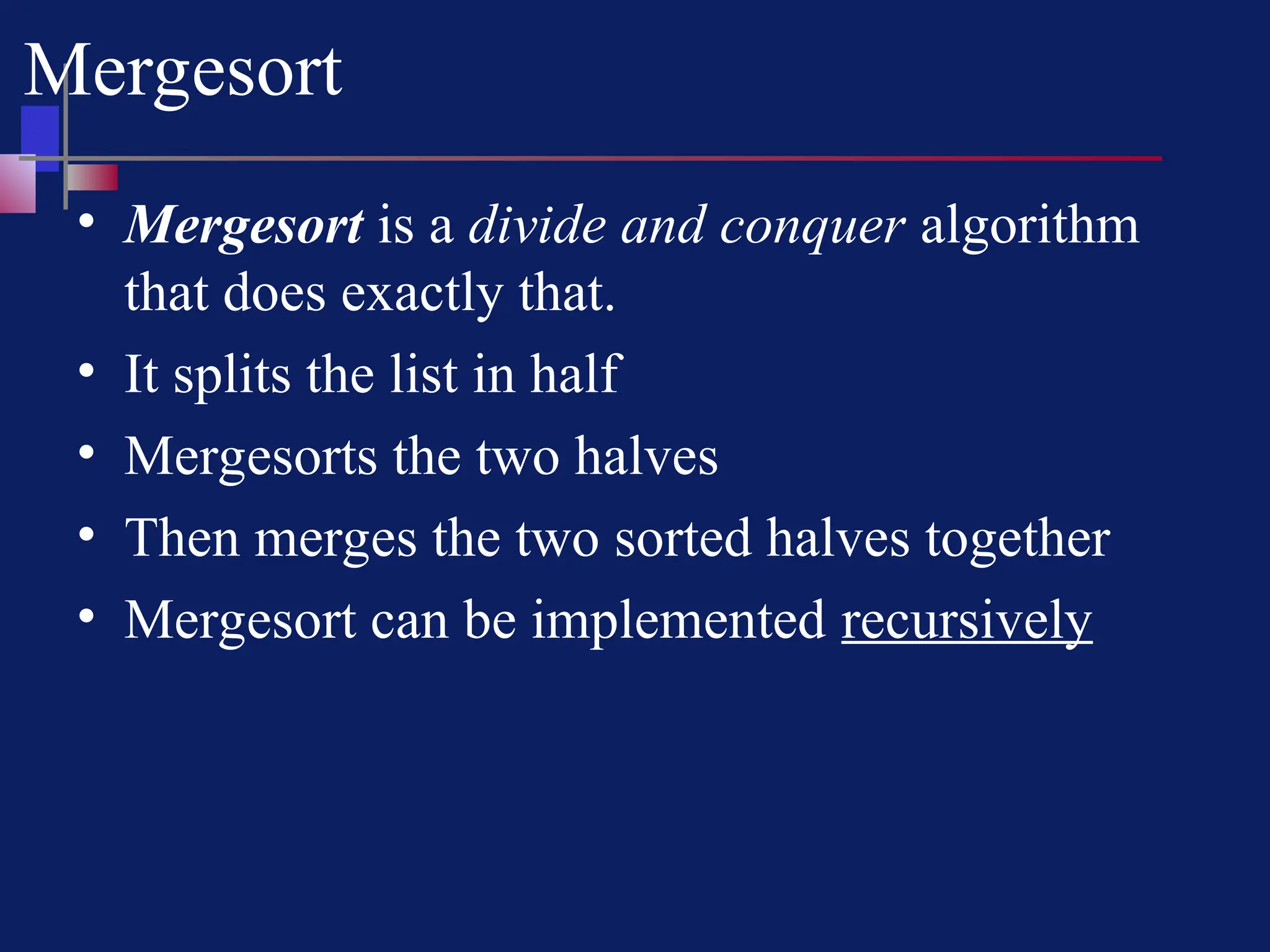
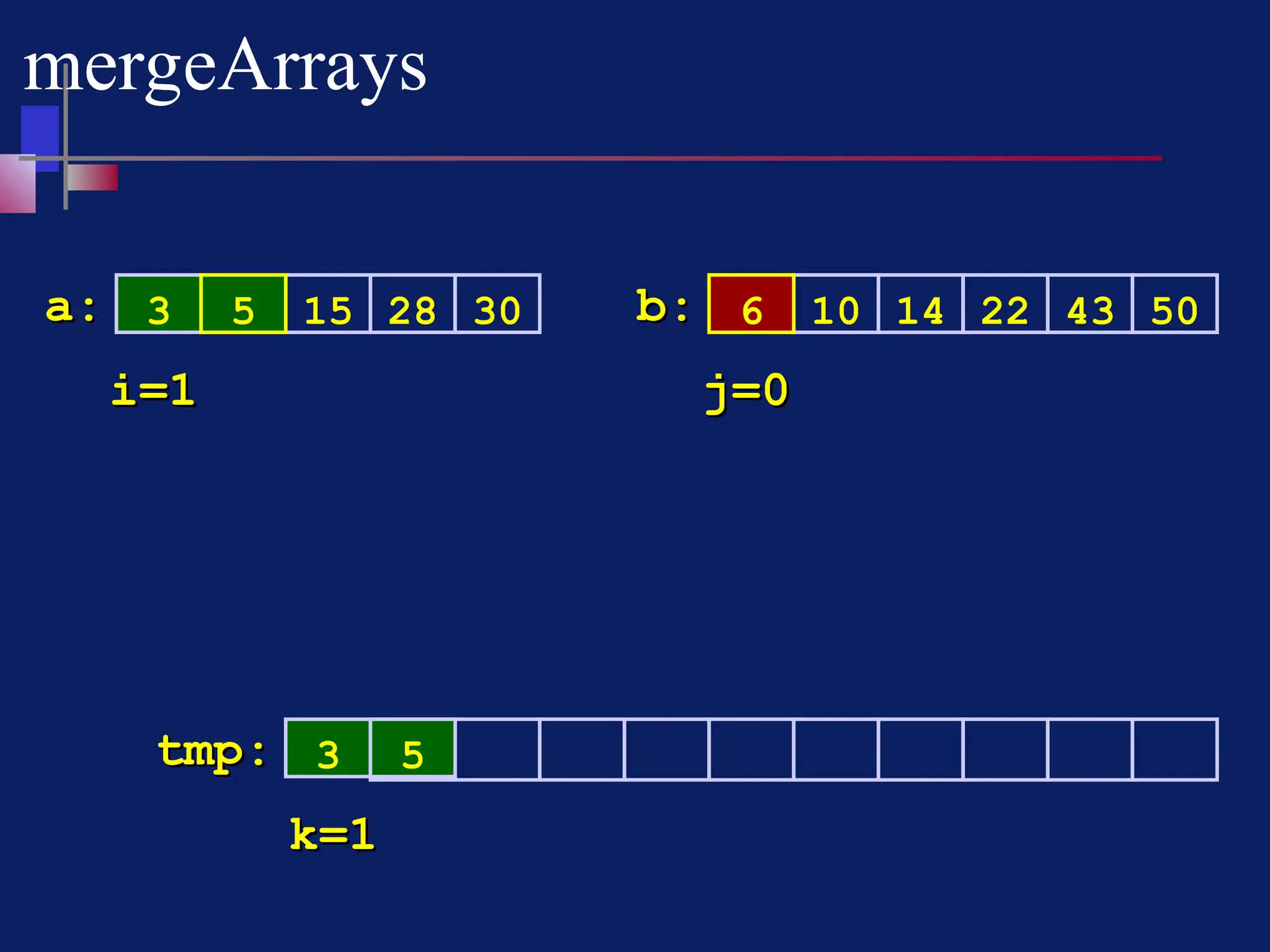
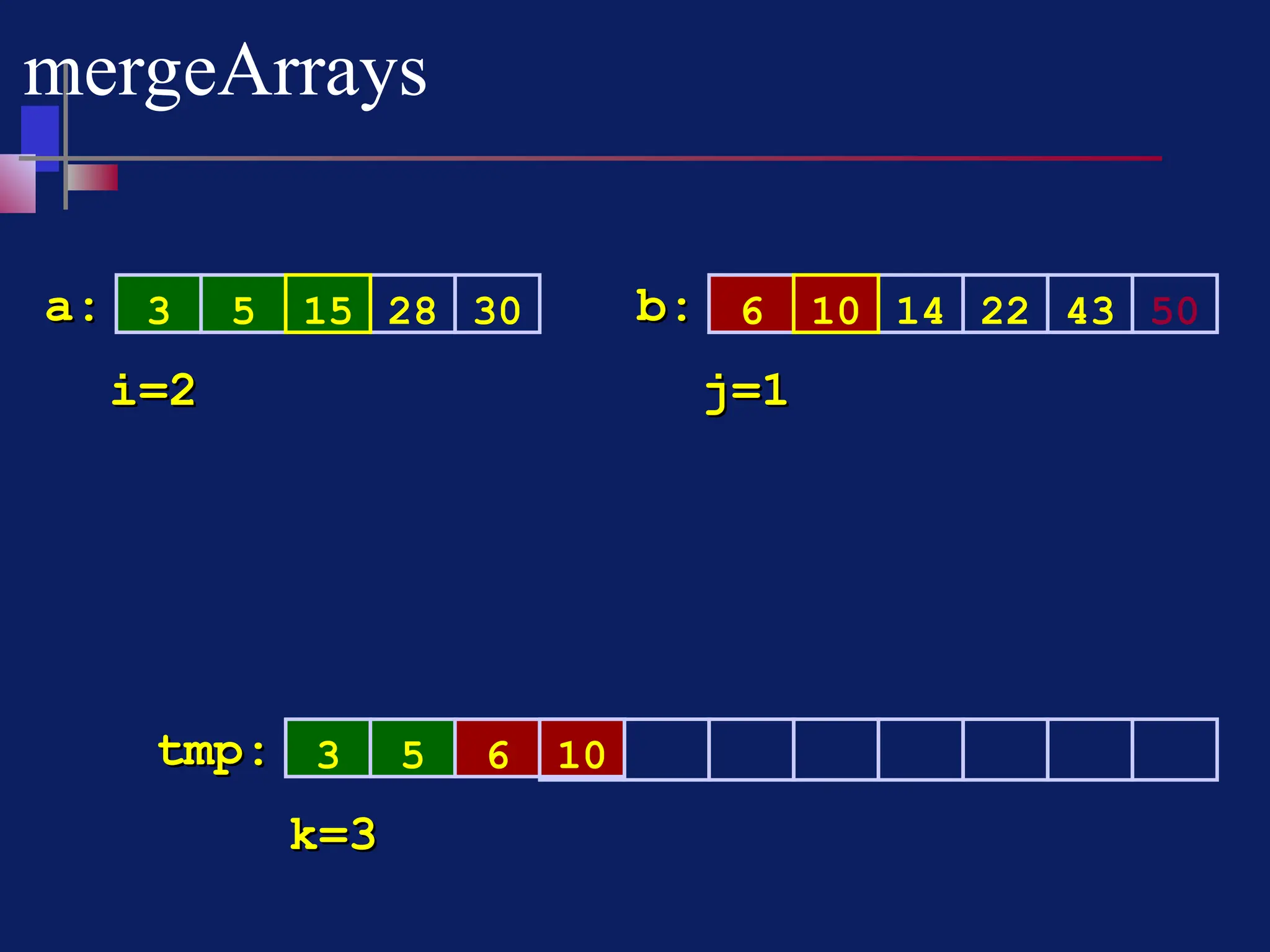
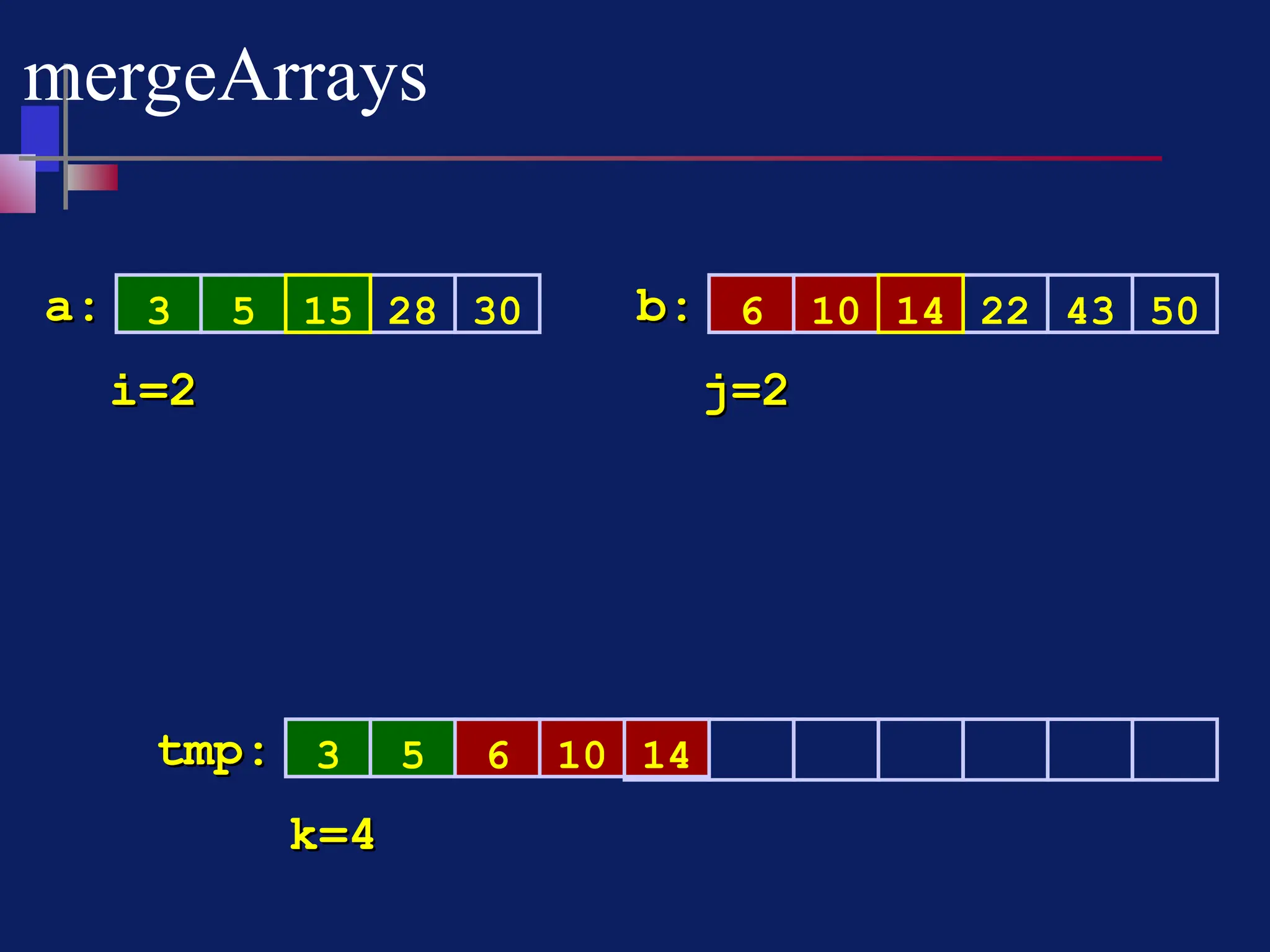
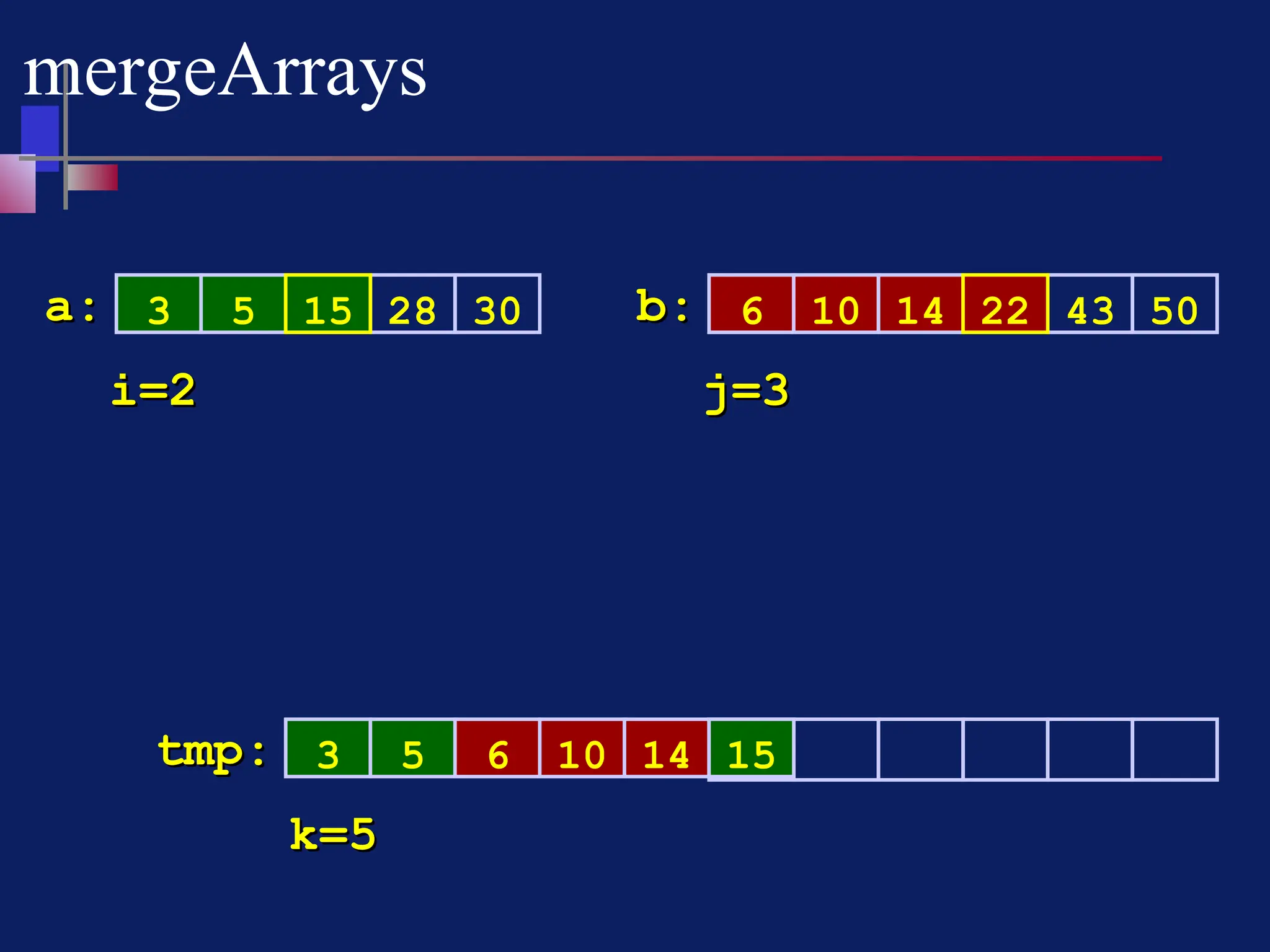
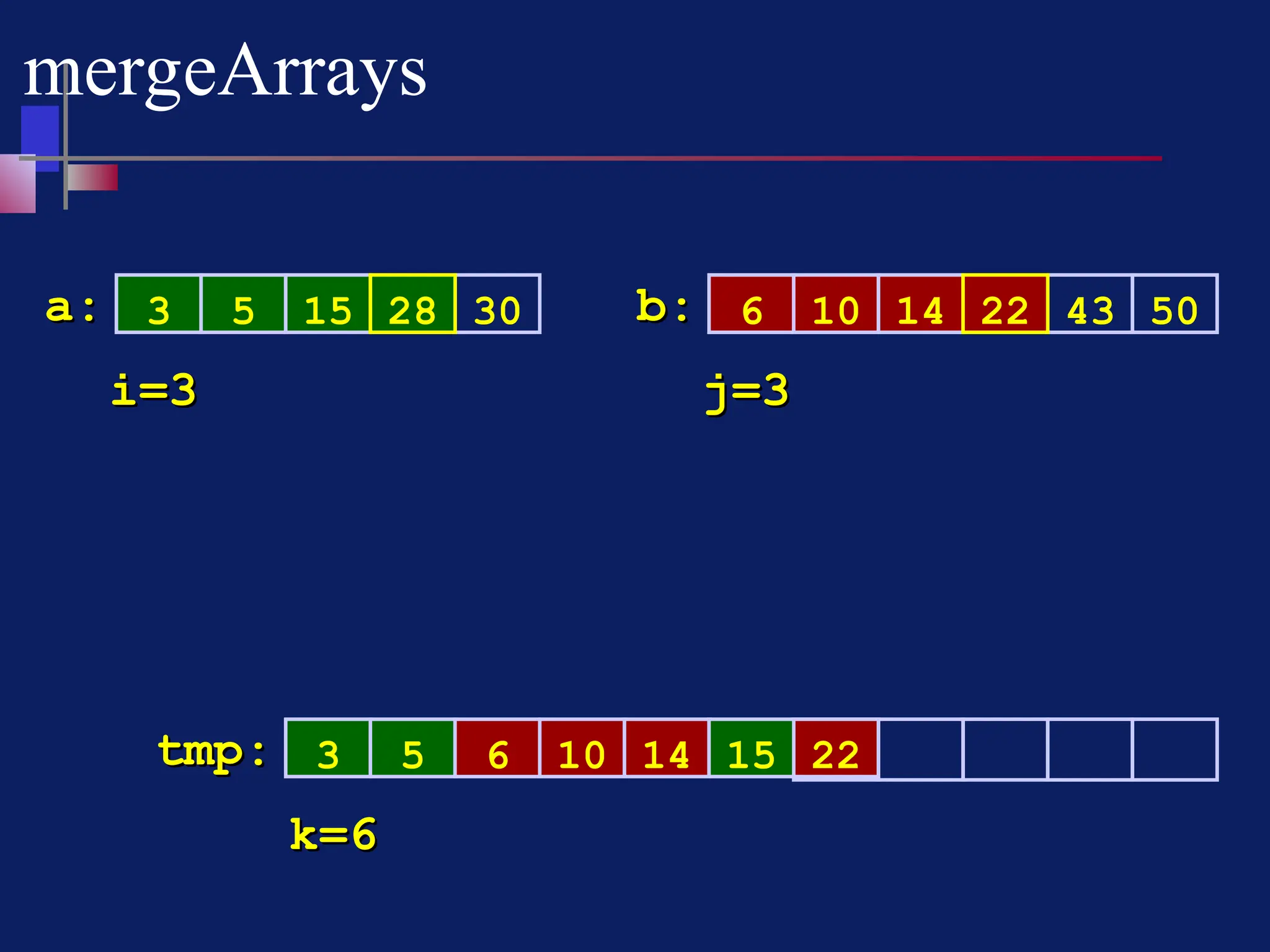
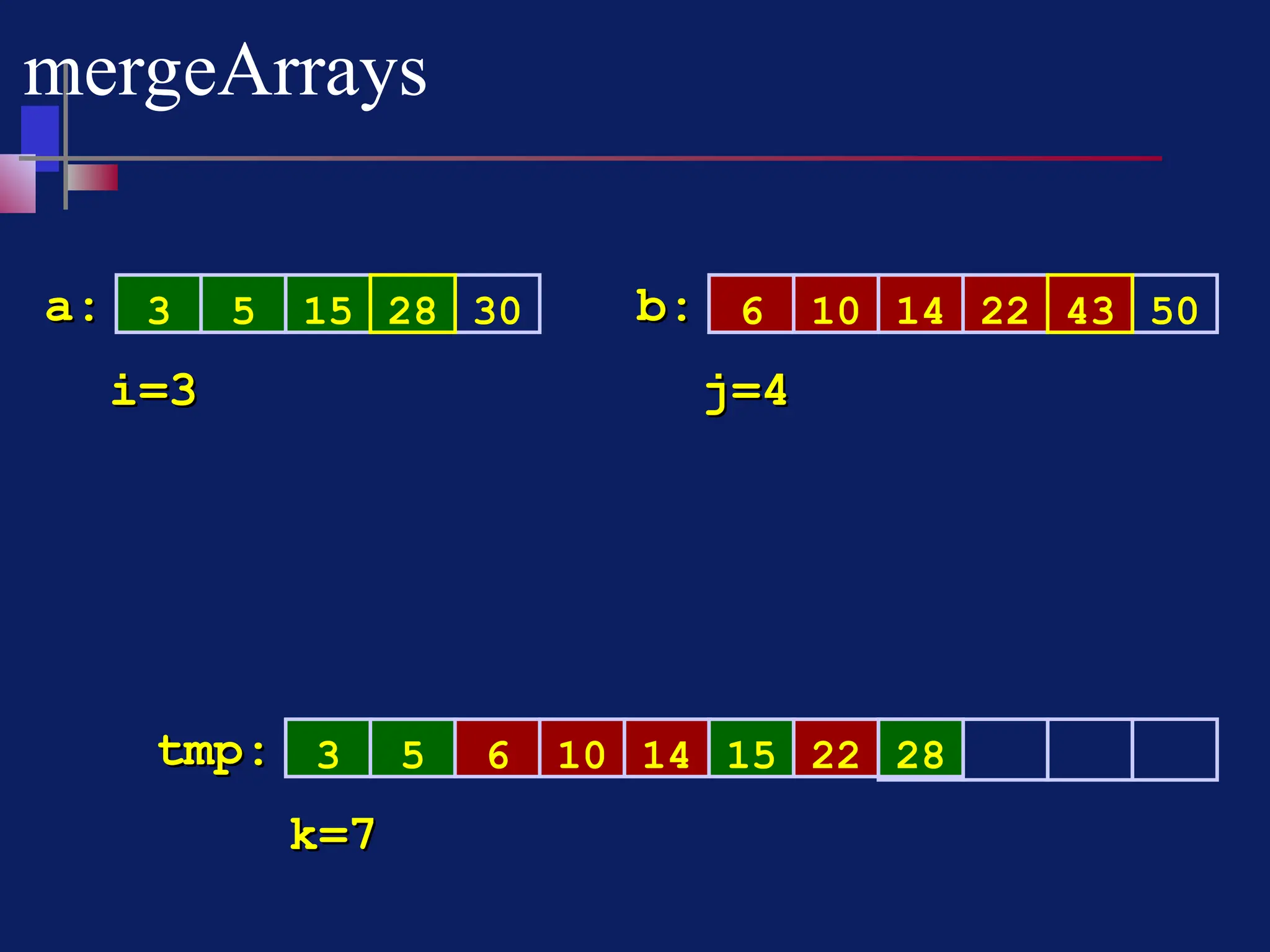
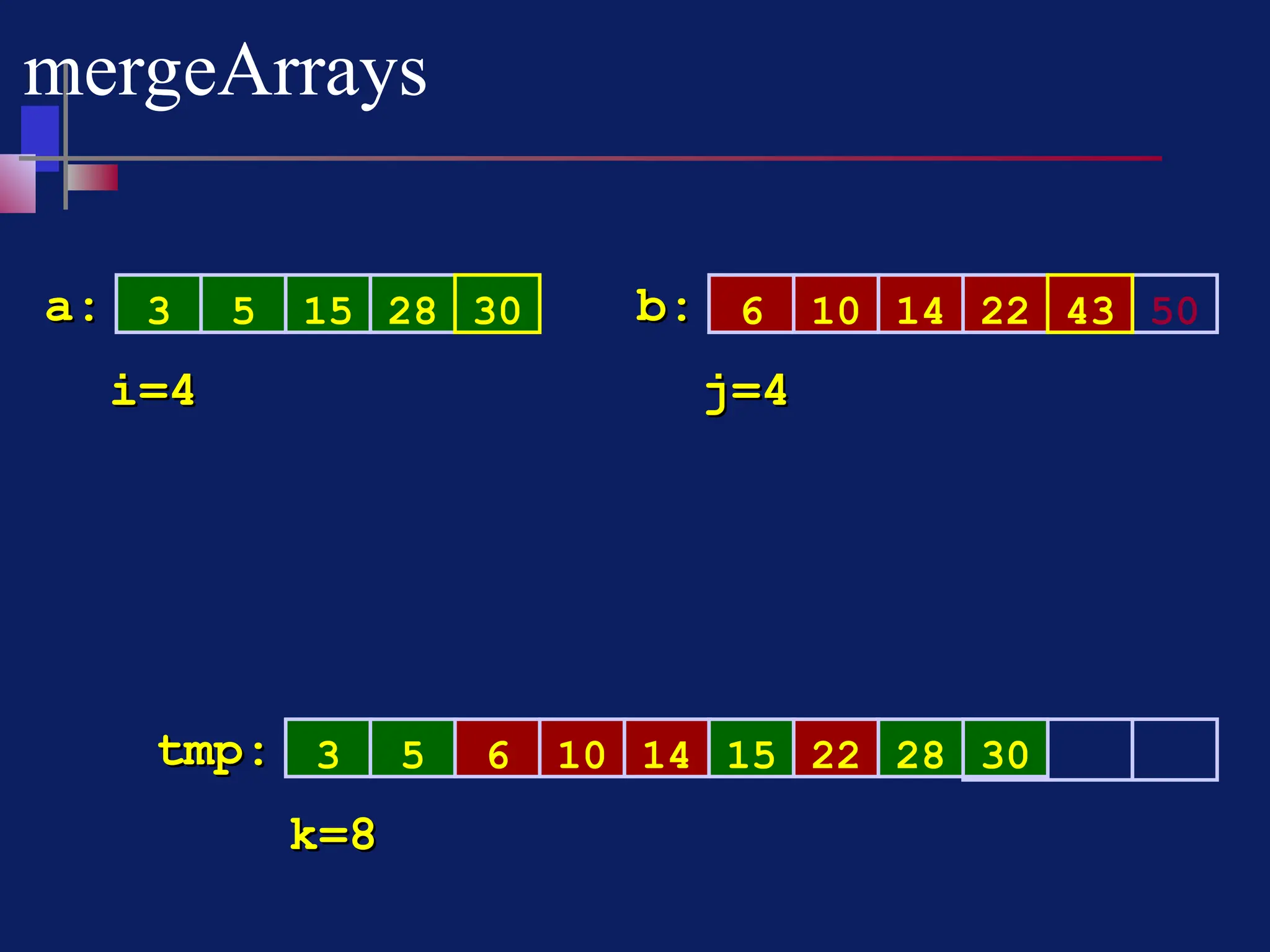
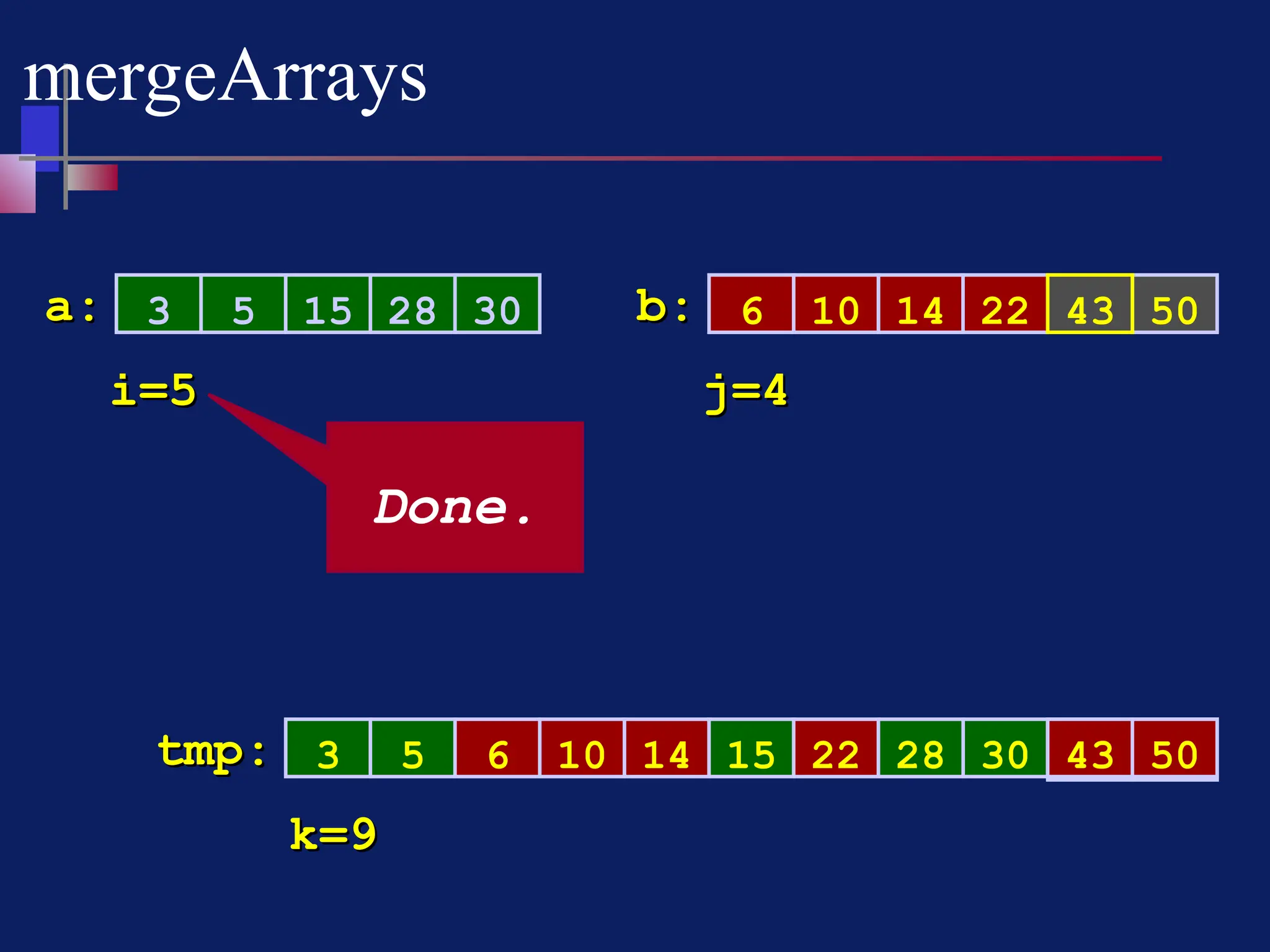
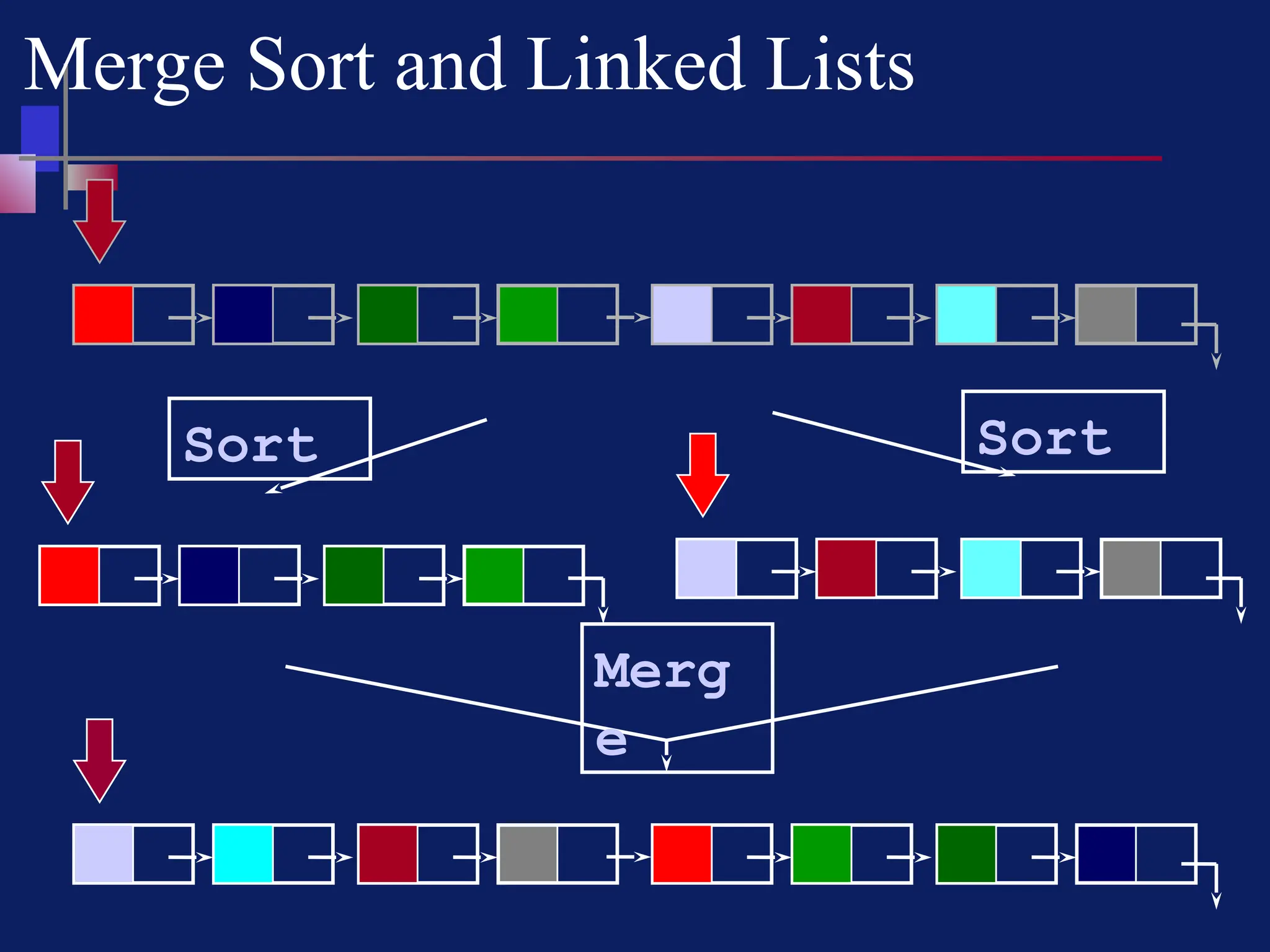
• Mergesort isa divide and conquer algorithm
that does exactly that.
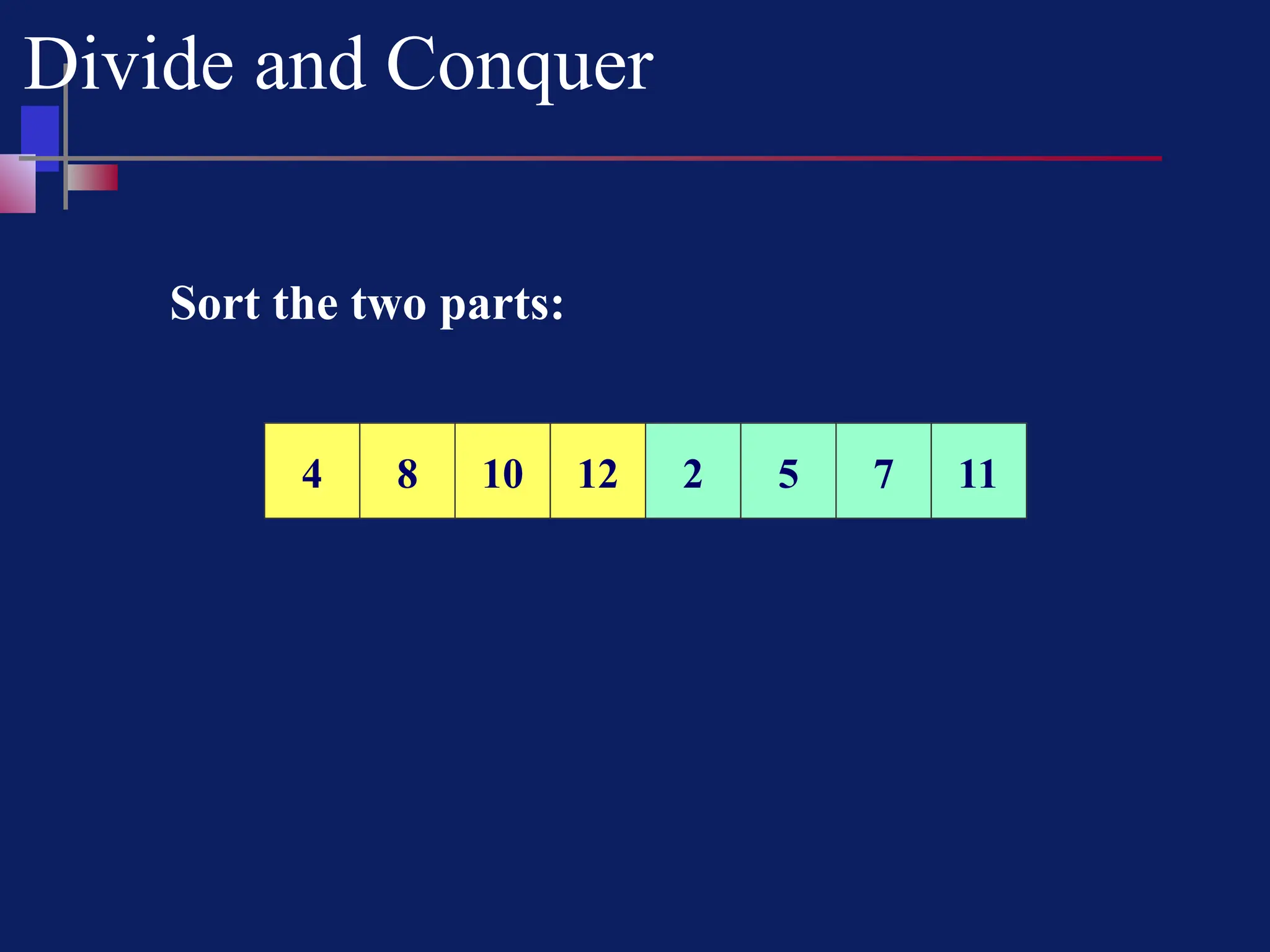
• It splits the list in half
• Mergesorts the two halves
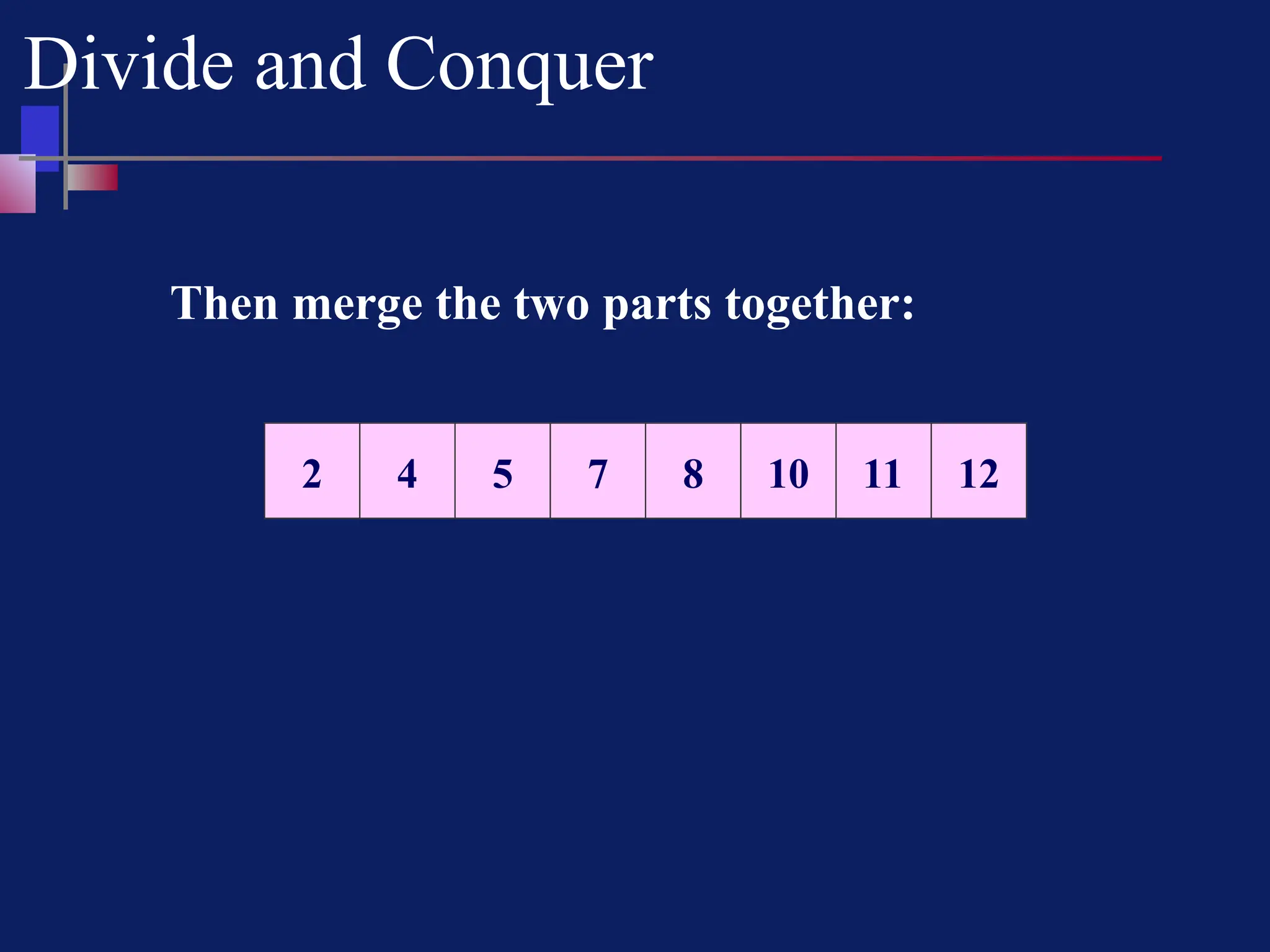
• Then merges the two sorted halves together
• Mergesort can be implemented recursively
16.
Mergesort
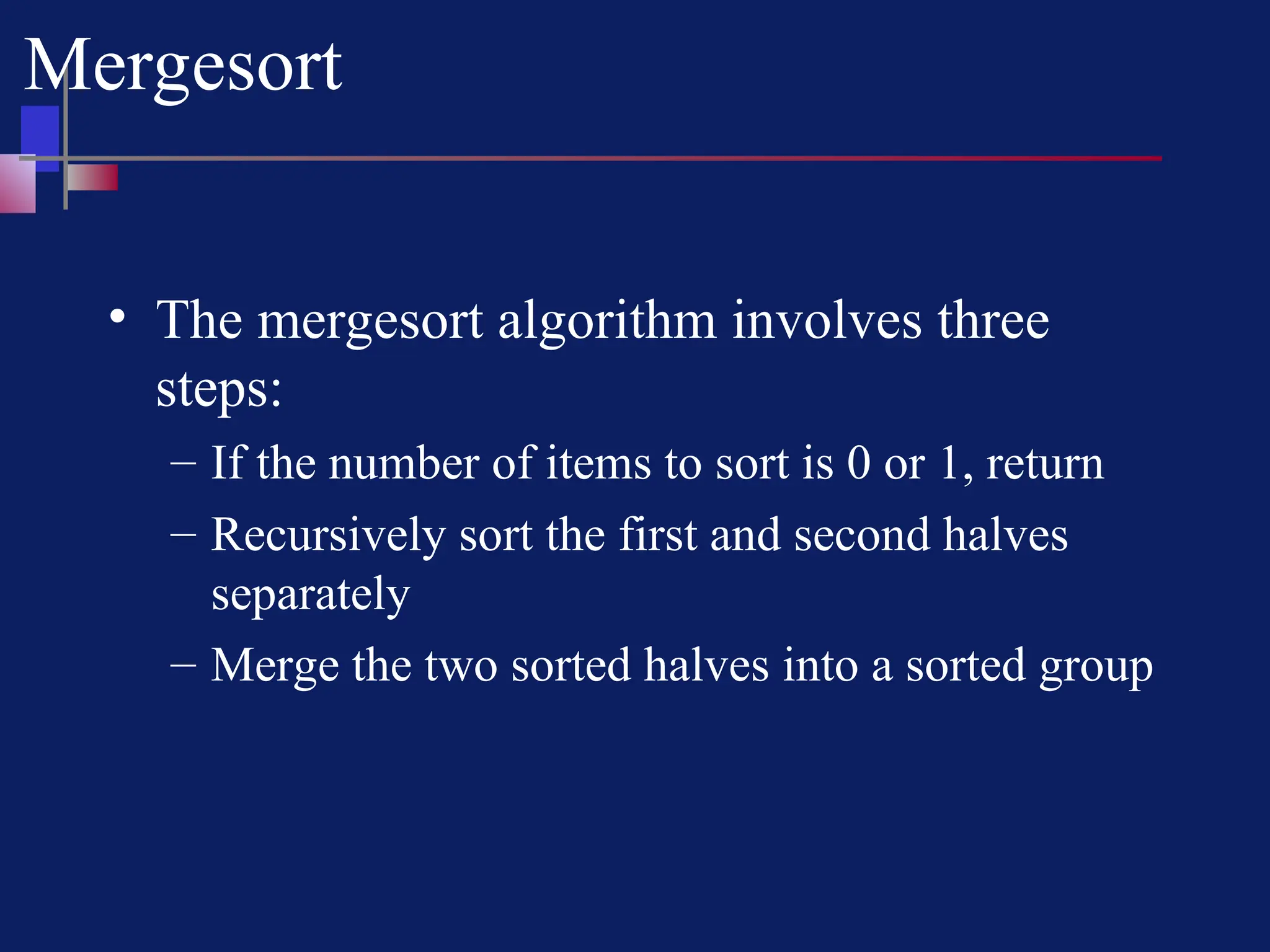
• The mergesortalgorithm involves three
steps:
– If the number of items to sort is 0 or 1, return
– Recursively sort the first and second halves
separately
– Merge the two sorted halves into a sorted group
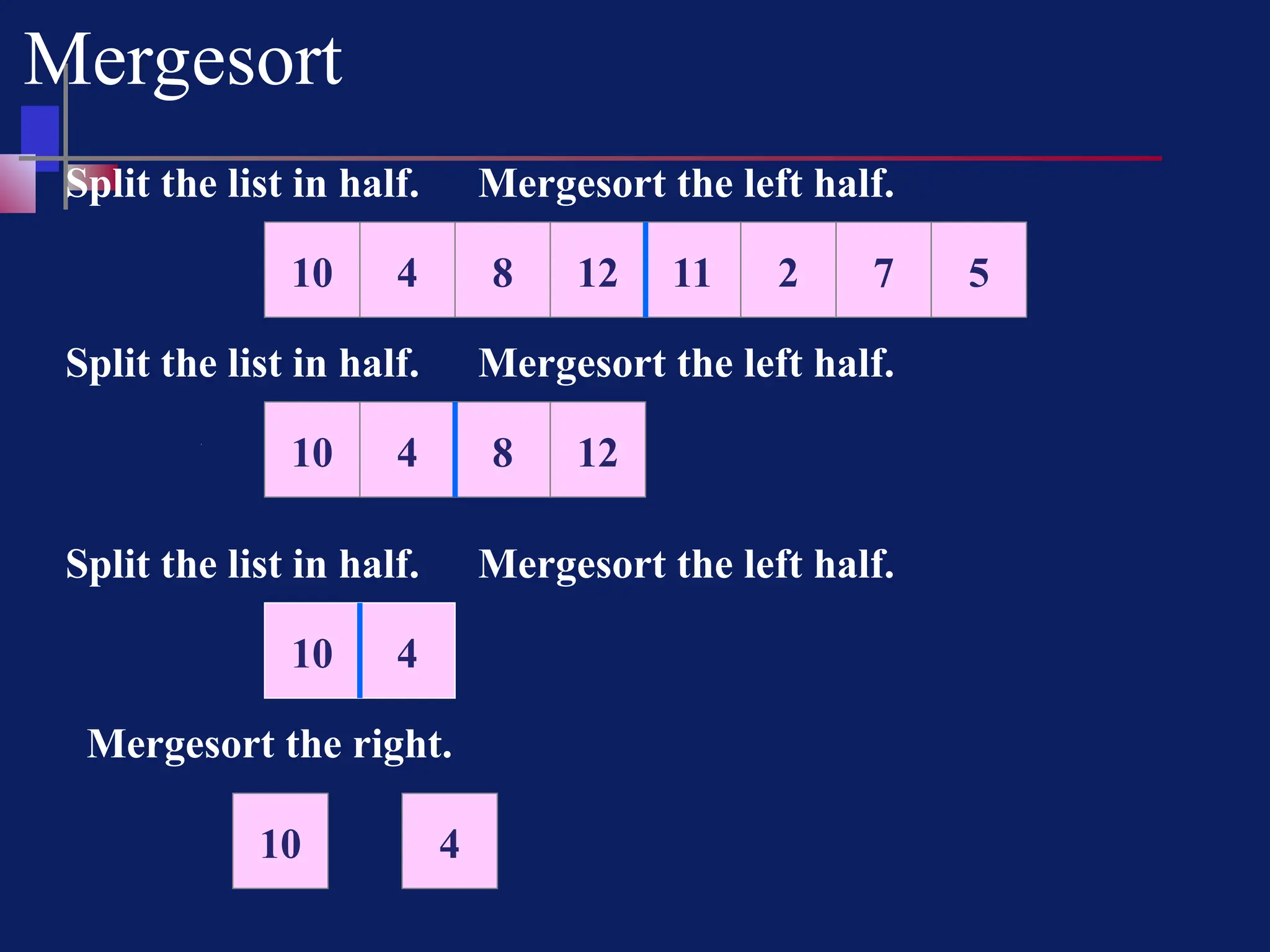
Mergesort
8 12 112 7 5
4
10
Split the list in half.
8 12
4
10
Mergesort the left half.
Split the list in half. Mergesort the left half.
4
10
Split the list in half. Mergesort the left half.
10
Mergesort the right.
4
22.
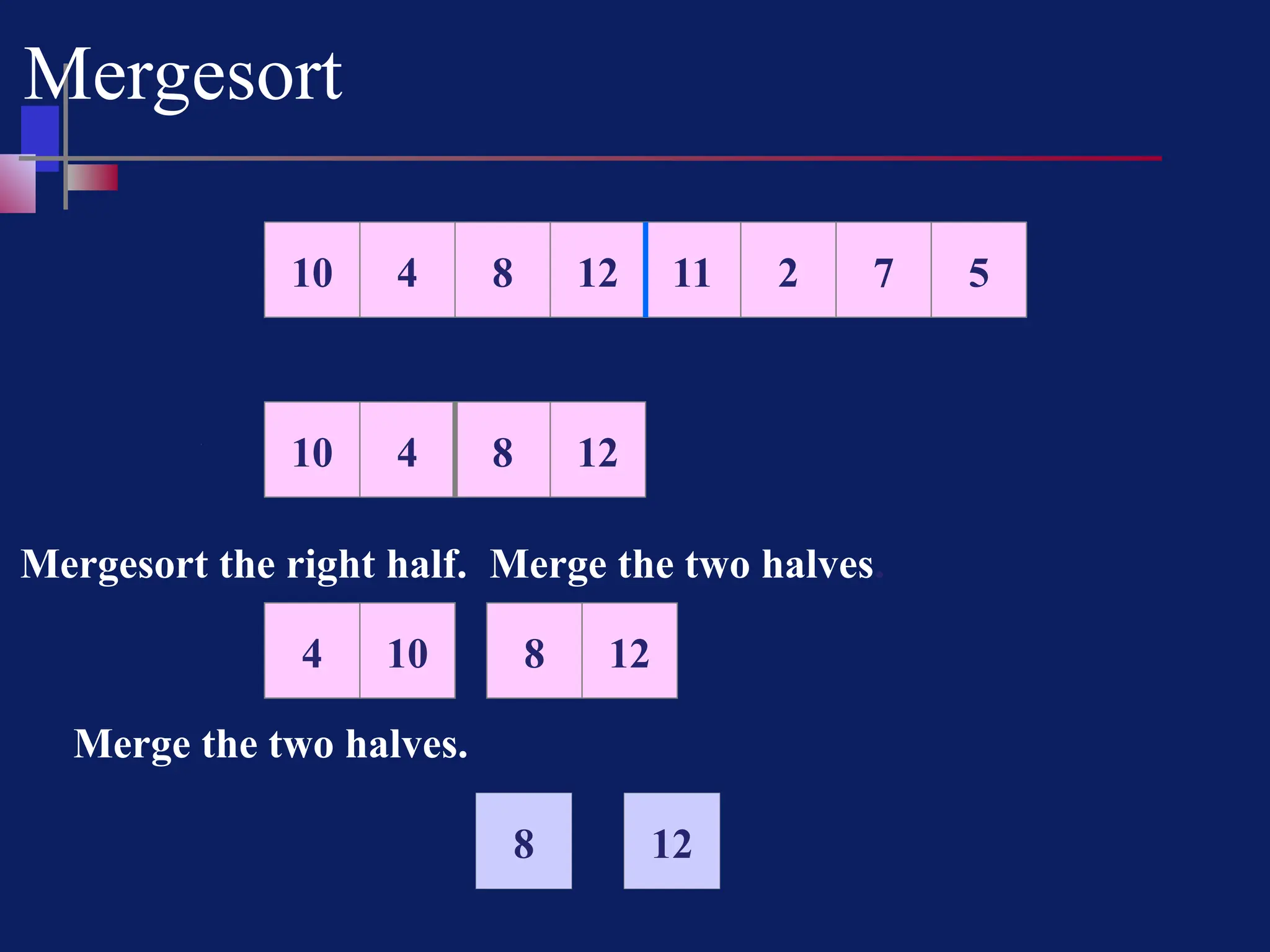
Mergesort
8 12 112 7 5
4
10
8 12
4
10
4
10
Mergesort the right half.
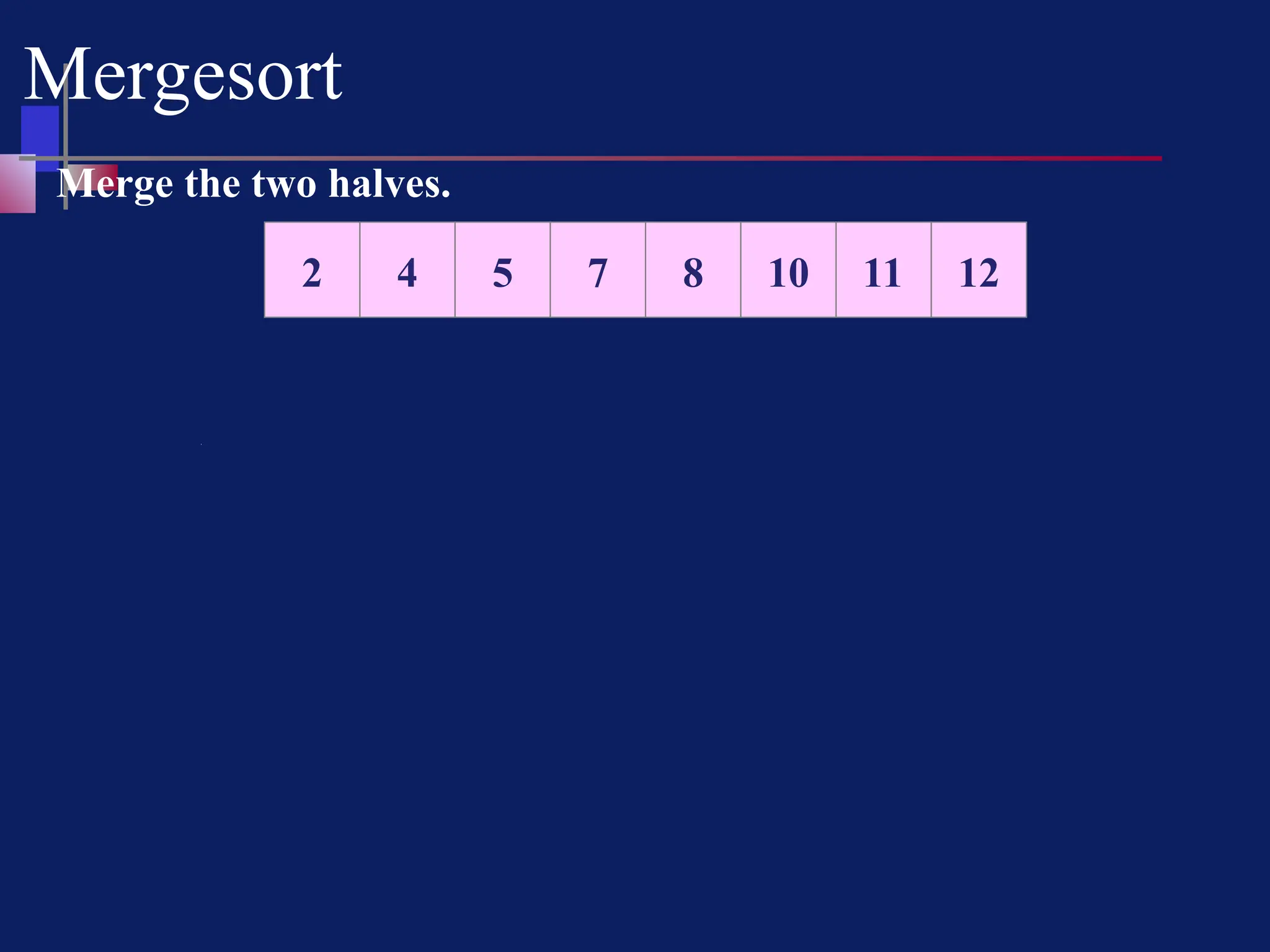
Merge the two halves.
10
4 8 12
12
8
Merge the two halves.
8
8 12
23.
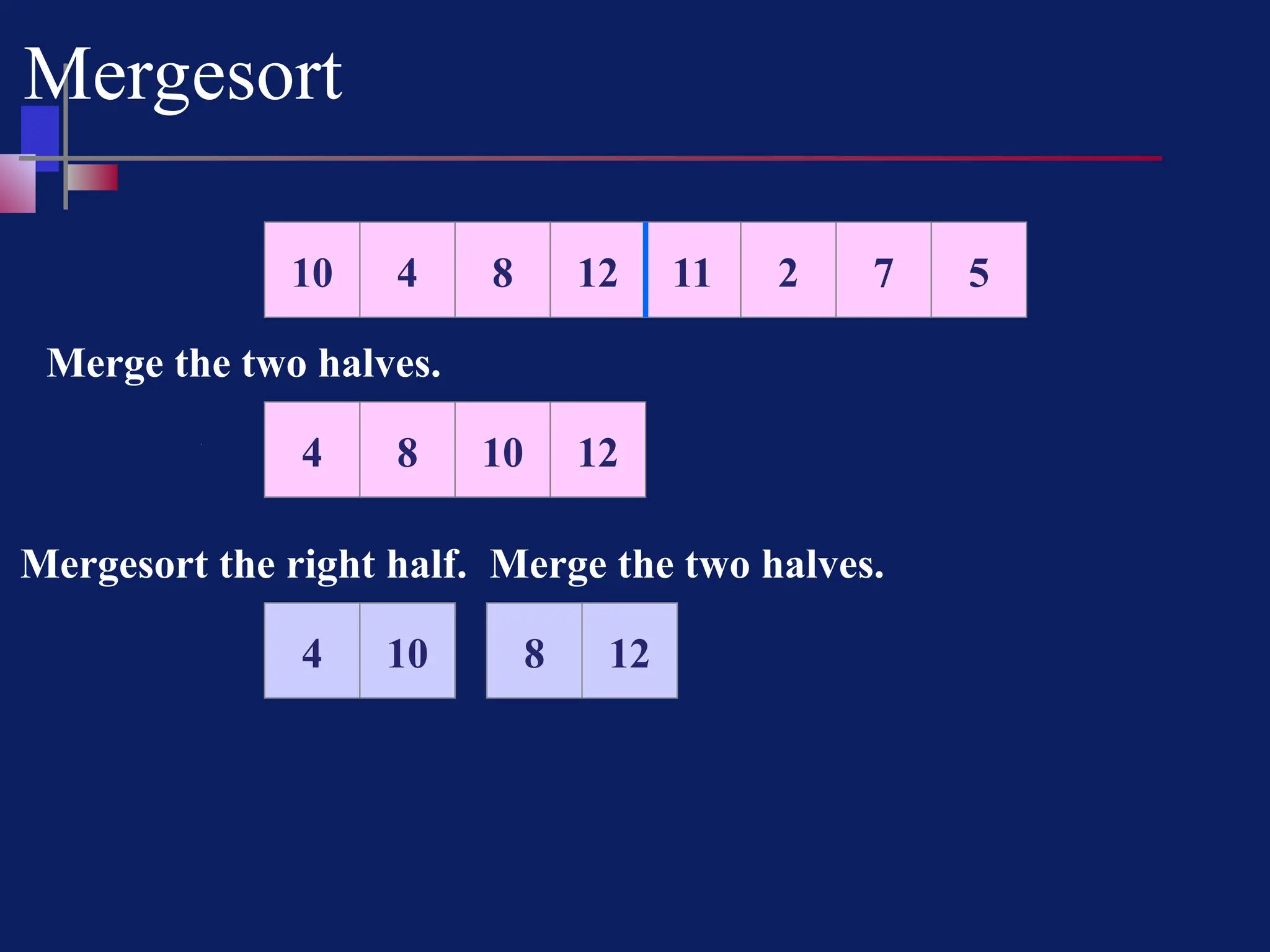
Mergesort
8 12 112 7 5
4
10
8 12
4
10
Merge the two halves.
4
10
Mergesort the right half. Merge the two halves.
10
4 8 12
10 12
8
4
10
4 8 12
24.
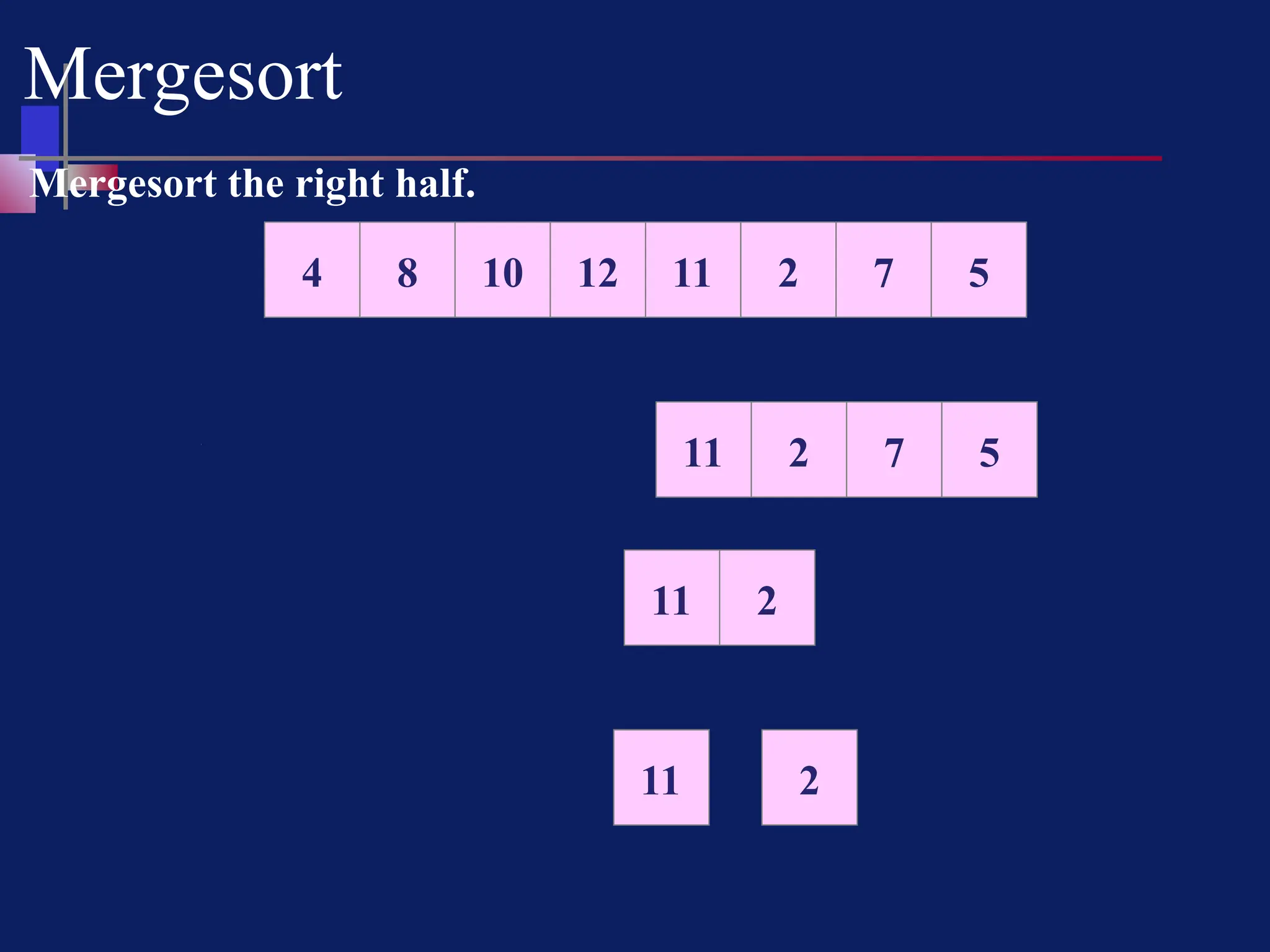
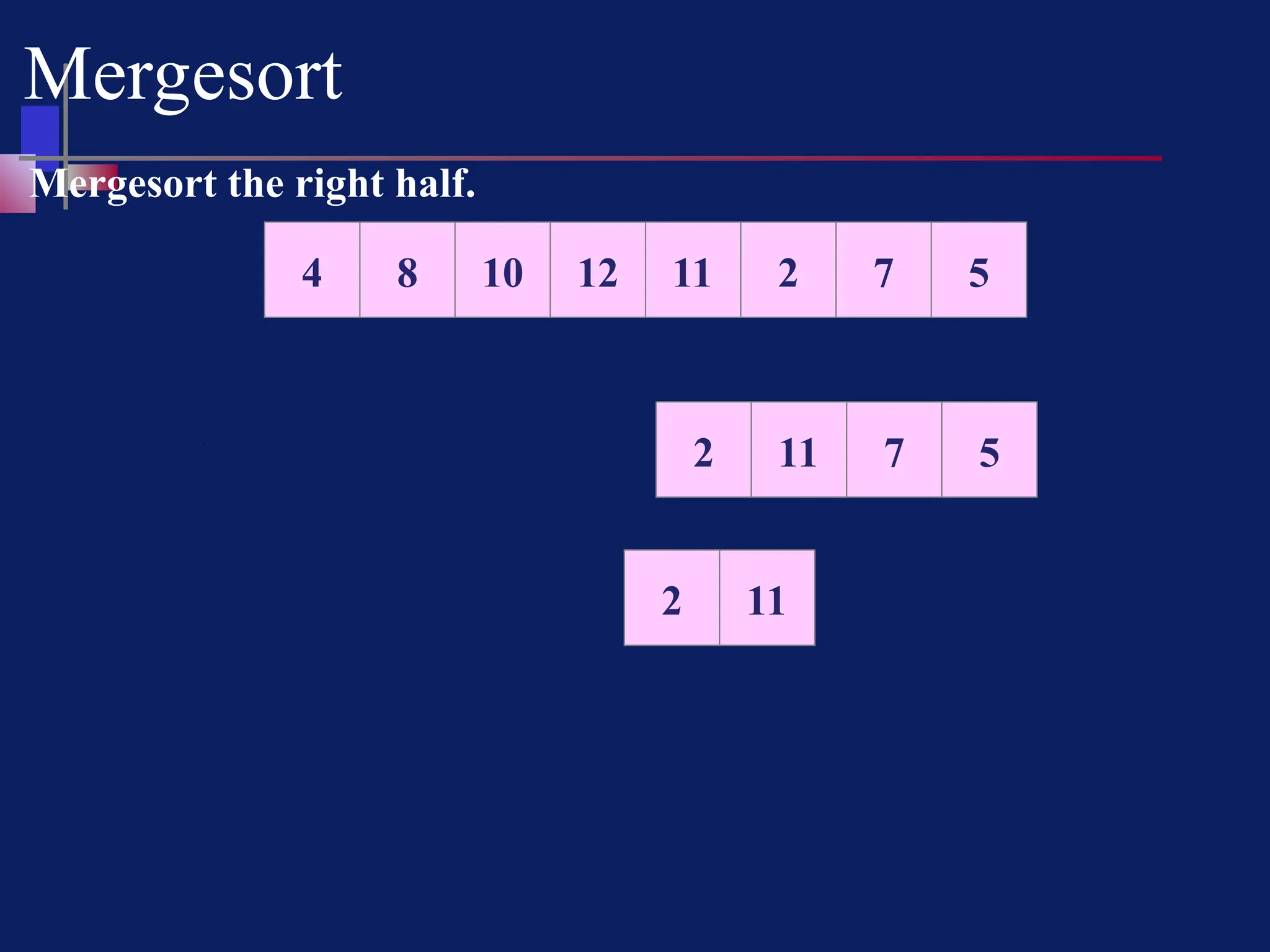
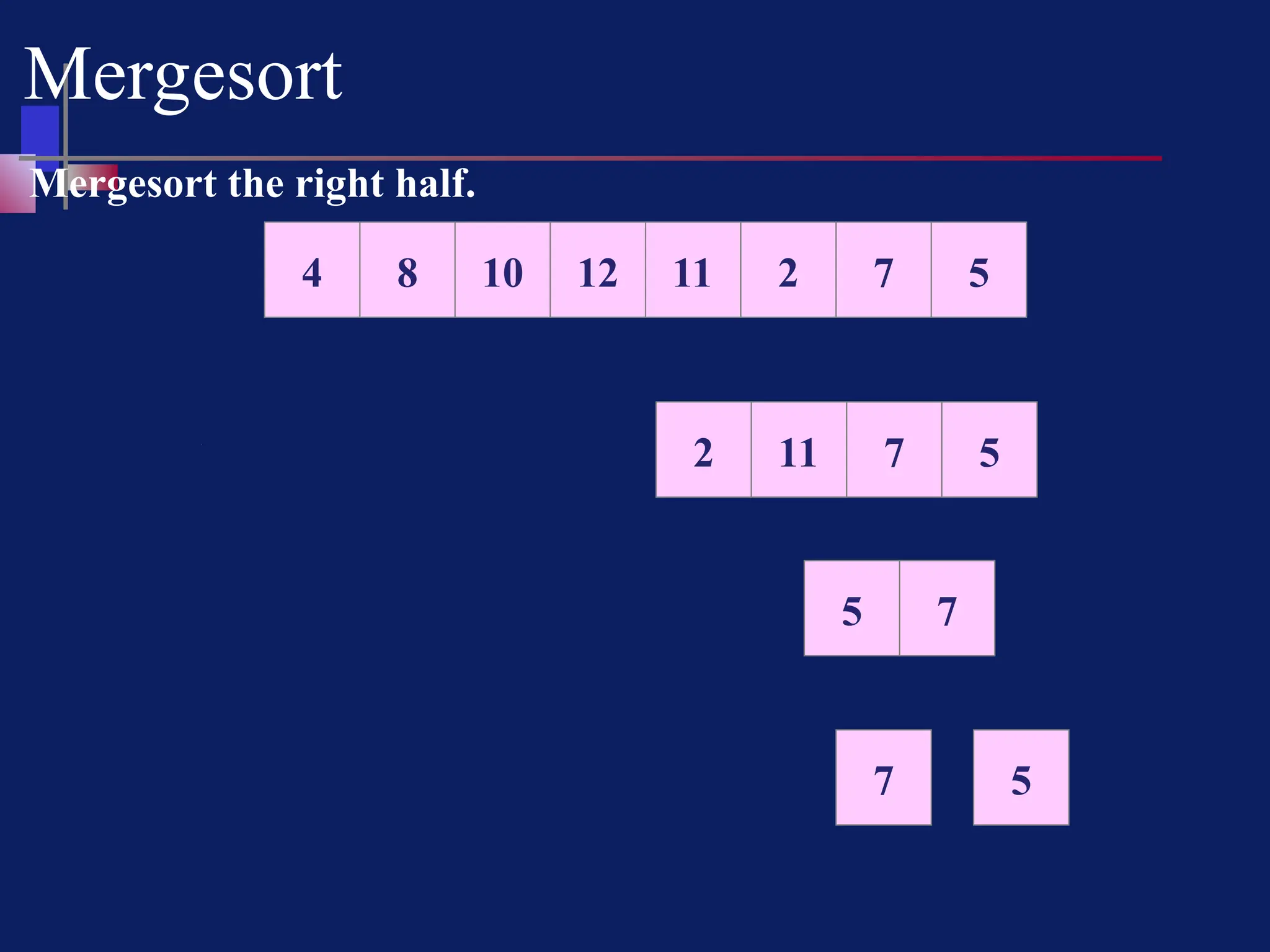
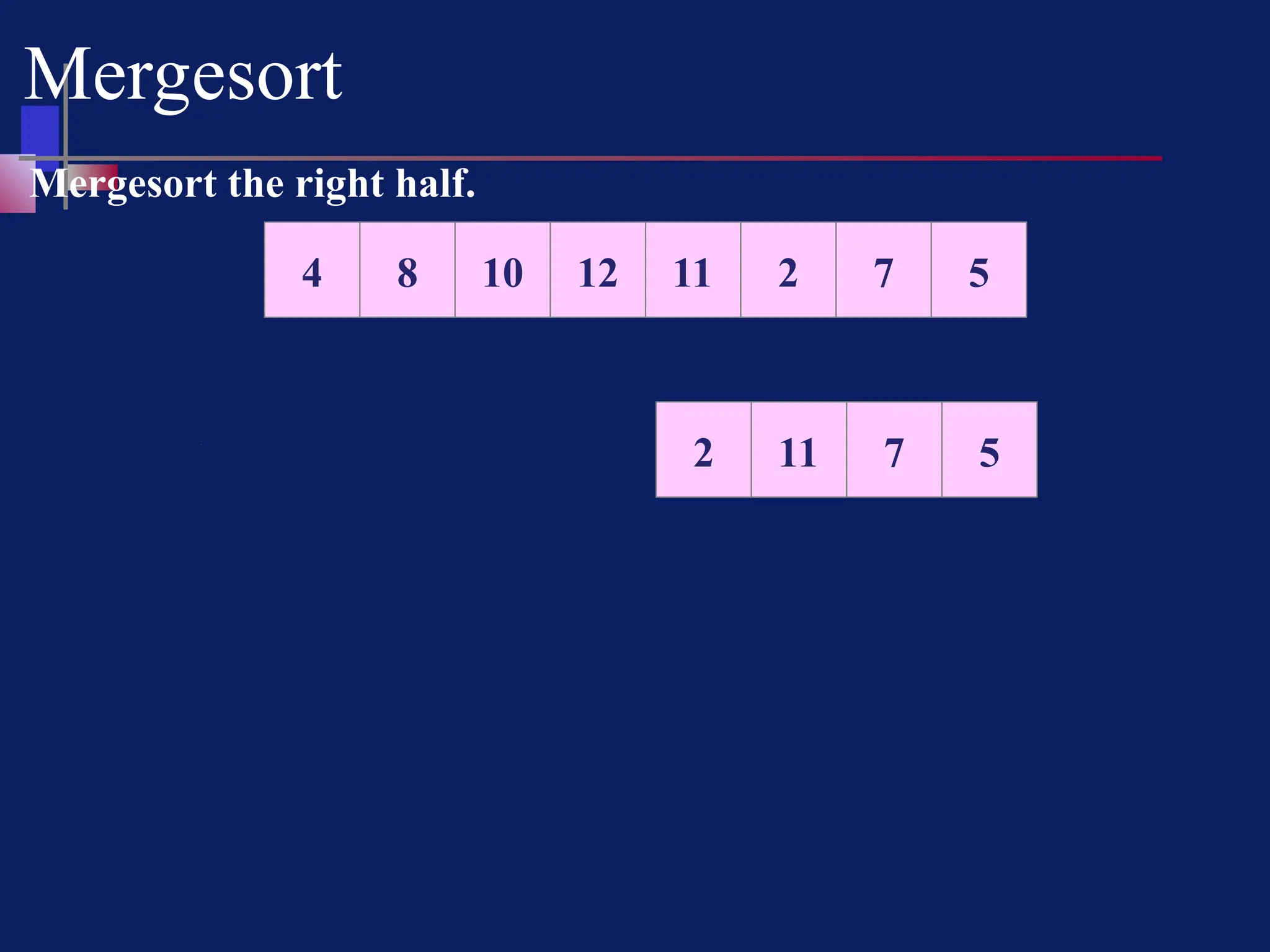
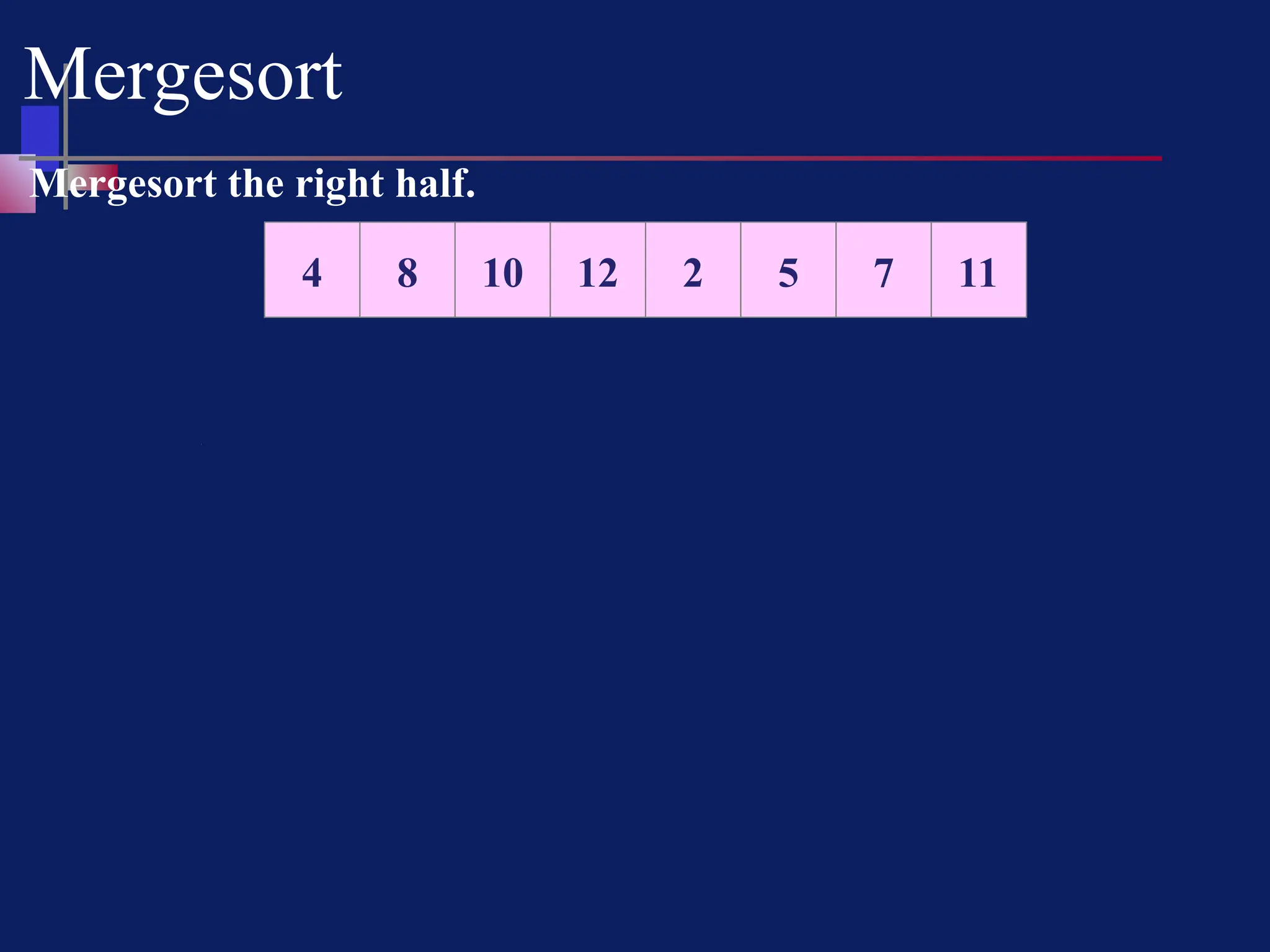
Mergesort
10 12 112 7 5
8
4
Mergesort the right half.
11 2 7 5
11 2
11 2
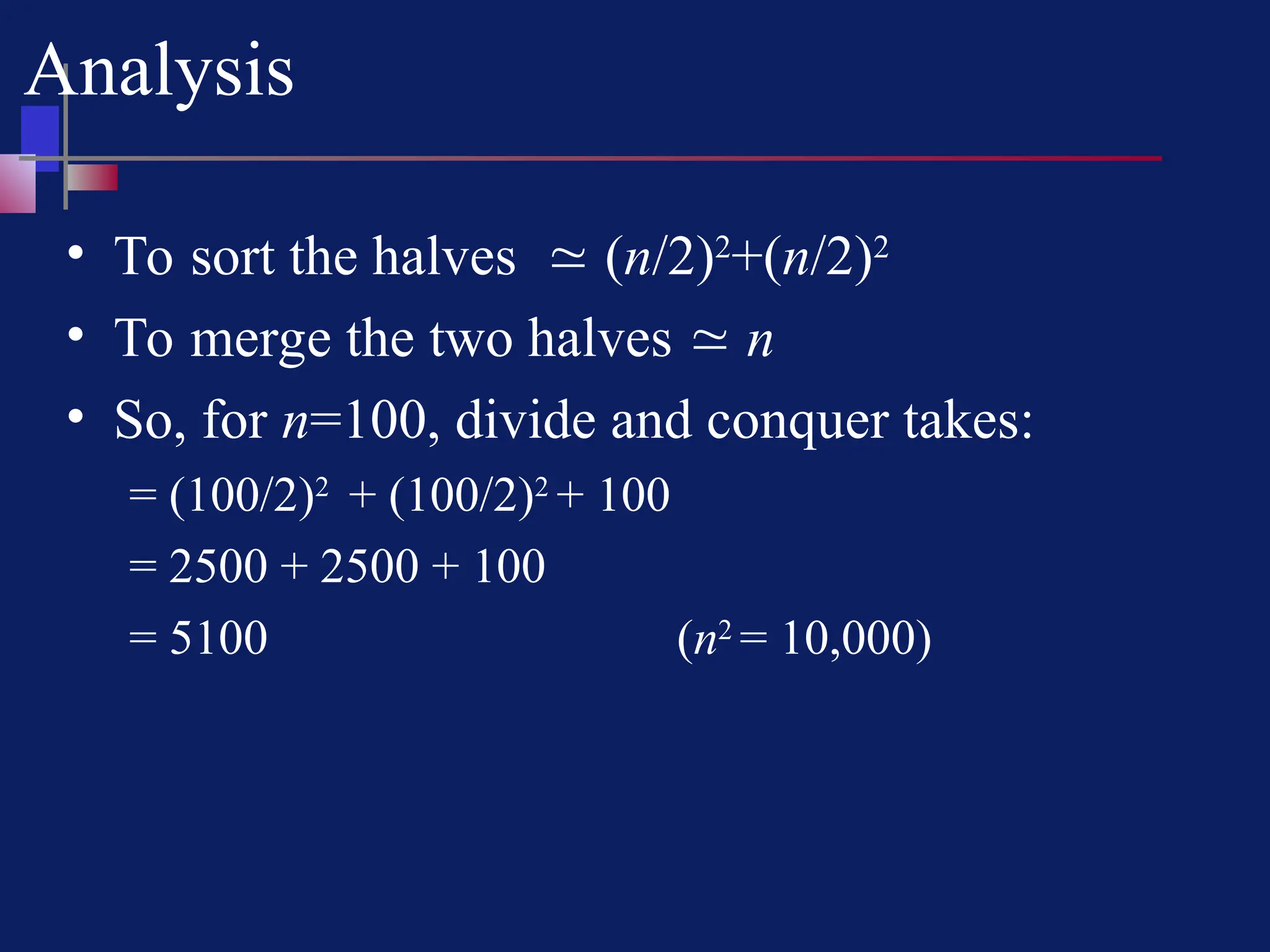
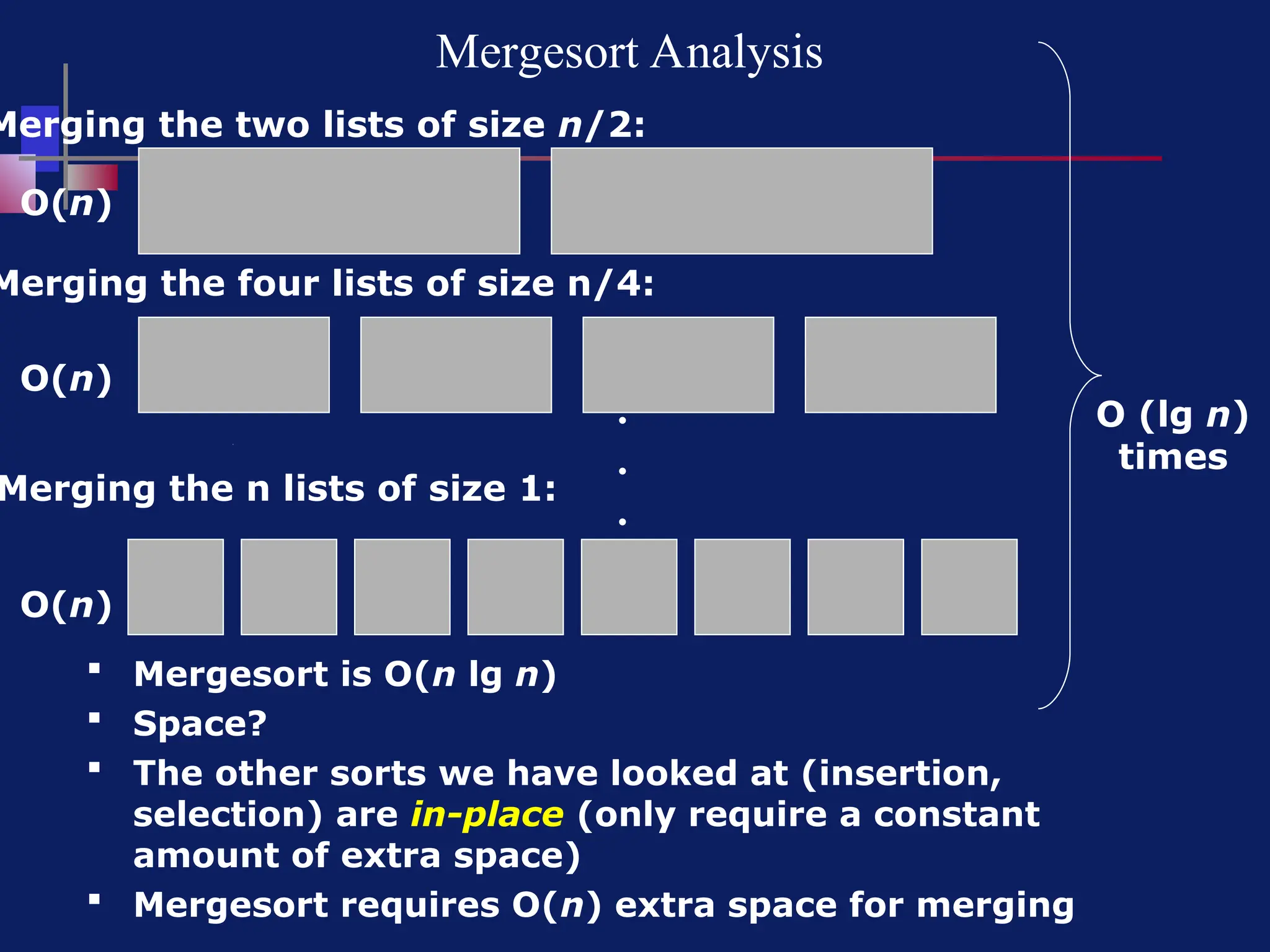
Mergesort Analysis
Merging thetwo lists of size n/2:
O(n)
Merging the four lists of size n/4:
O(n)
.
.
.
Merging the n lists of size 1:
O(n)
O (lg n)
times
Mergesort is O(n lg n)
Space?
The other sorts we have looked at (insertion,
selection) are in-place (only require a constant
amount of extra space)
Mergesort requires O(n) extra space for merging
46.
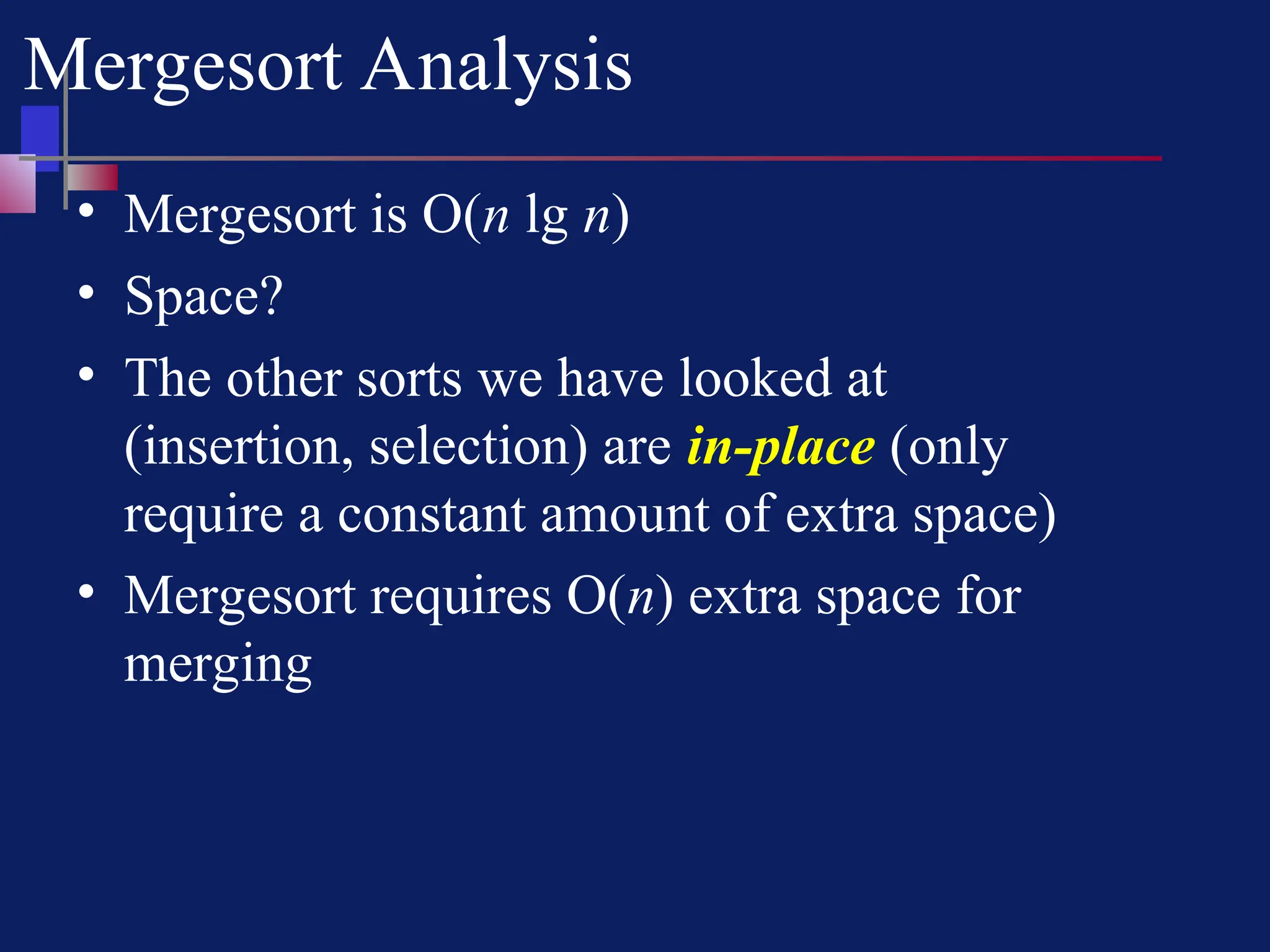
Mergesort Analysis
• Mergesortis O(n lg n)
• Space?
• The other sorts we have looked at
(insertion, selection) are in-place (only
require a constant amount of extra space)
• Mergesort requires O(n) extra space for
merging
47.
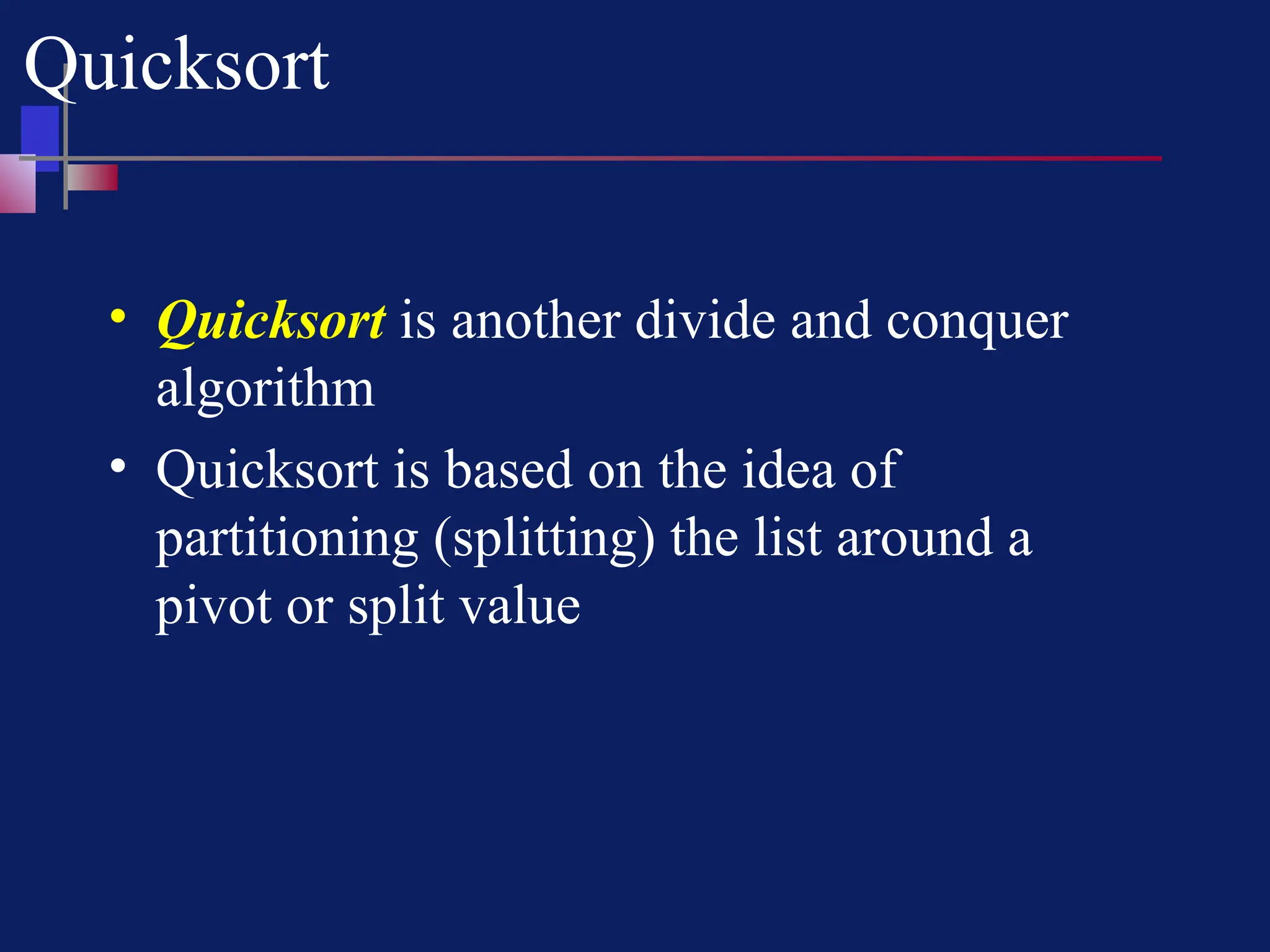
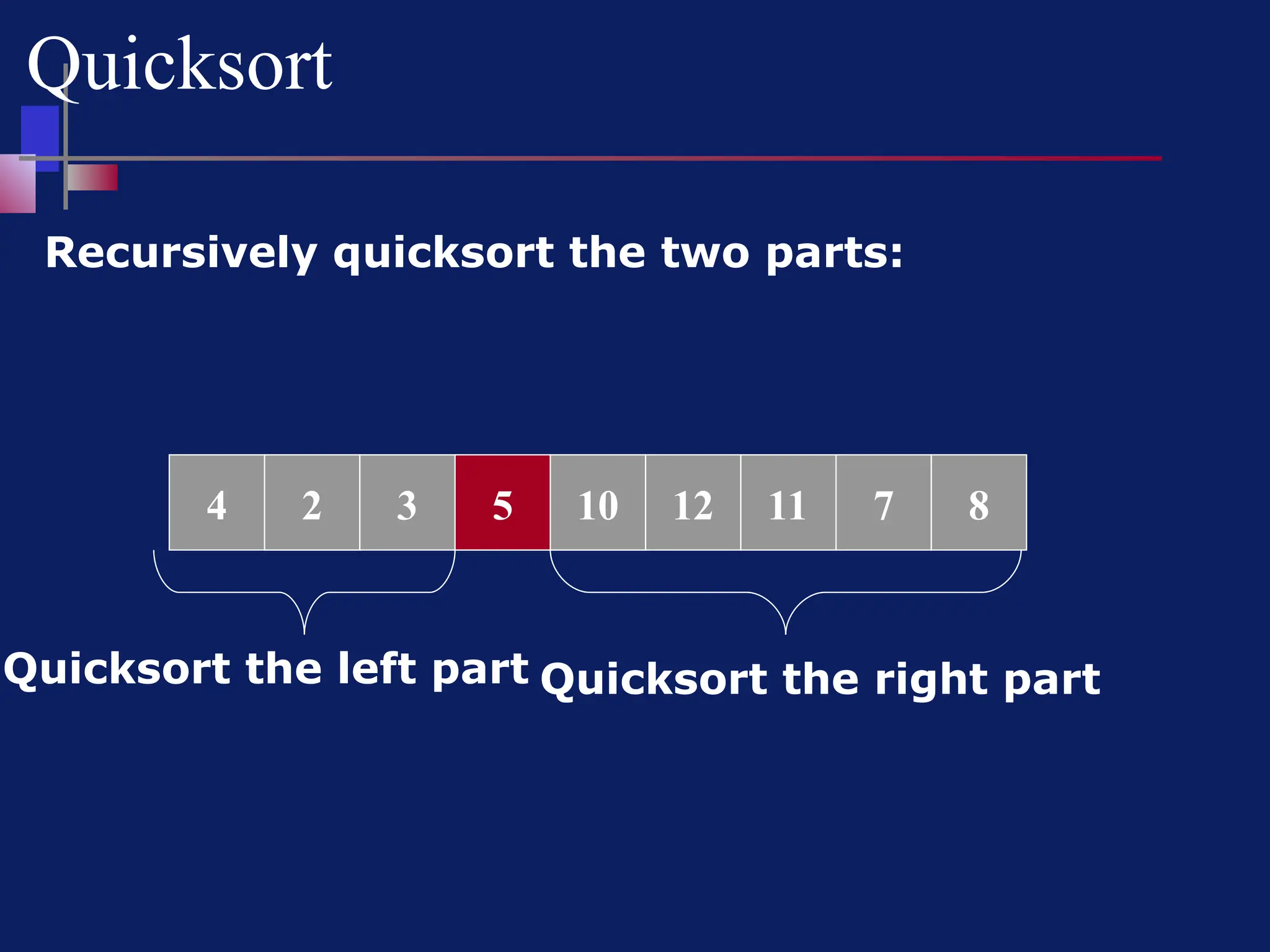
Quicksort
• Quicksort isanother divide and conquer
algorithm
• Quicksort is based on the idea of
partitioning (splitting) the list around a
pivot or split value
48.
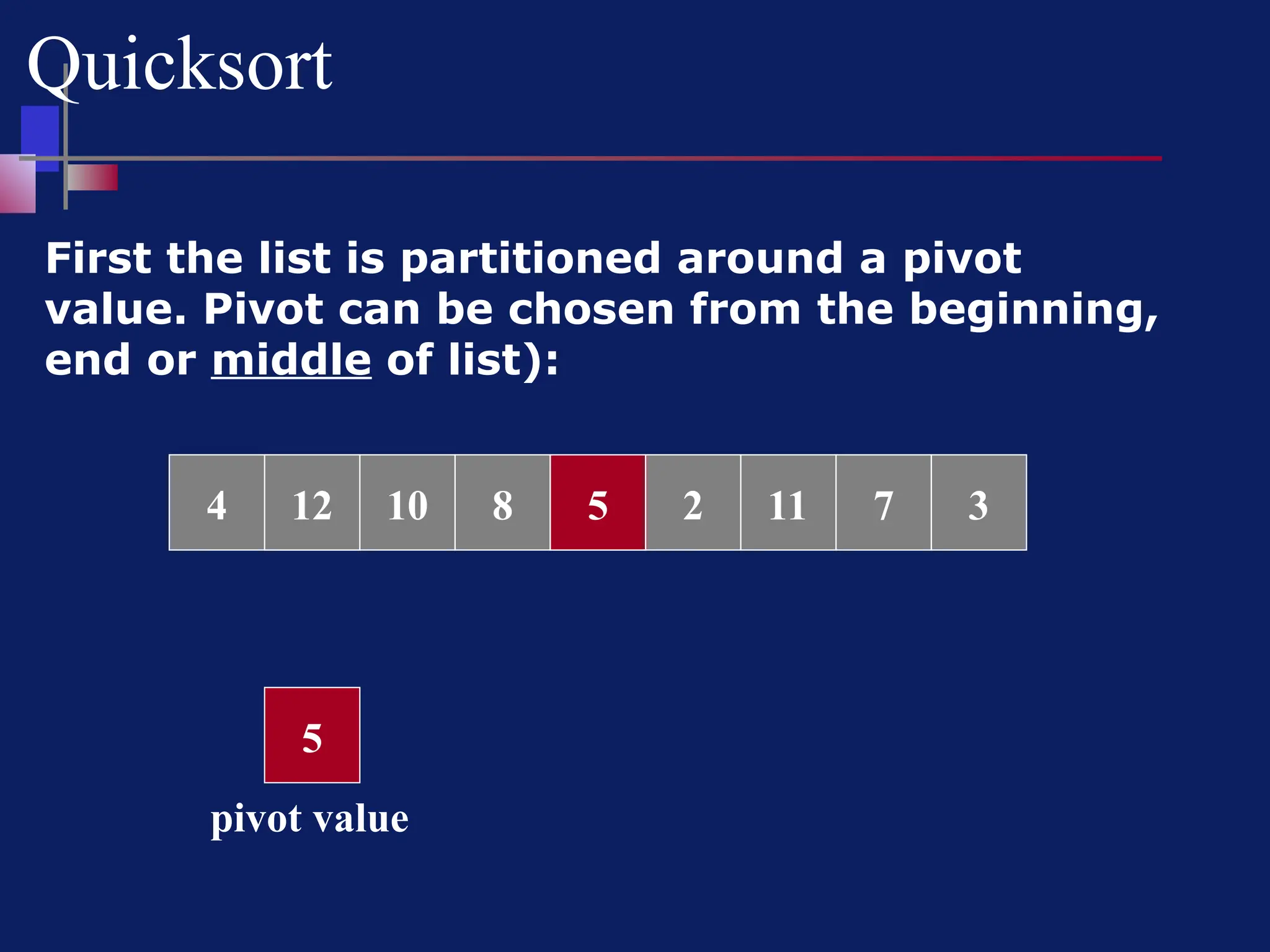
Quicksort
First the listis partitioned around a pivot
value. Pivot can be chosen from the beginning,
end or middle of list):
8 3
2 11 7
5
4 10
12
4 5
5
pivot value
49.
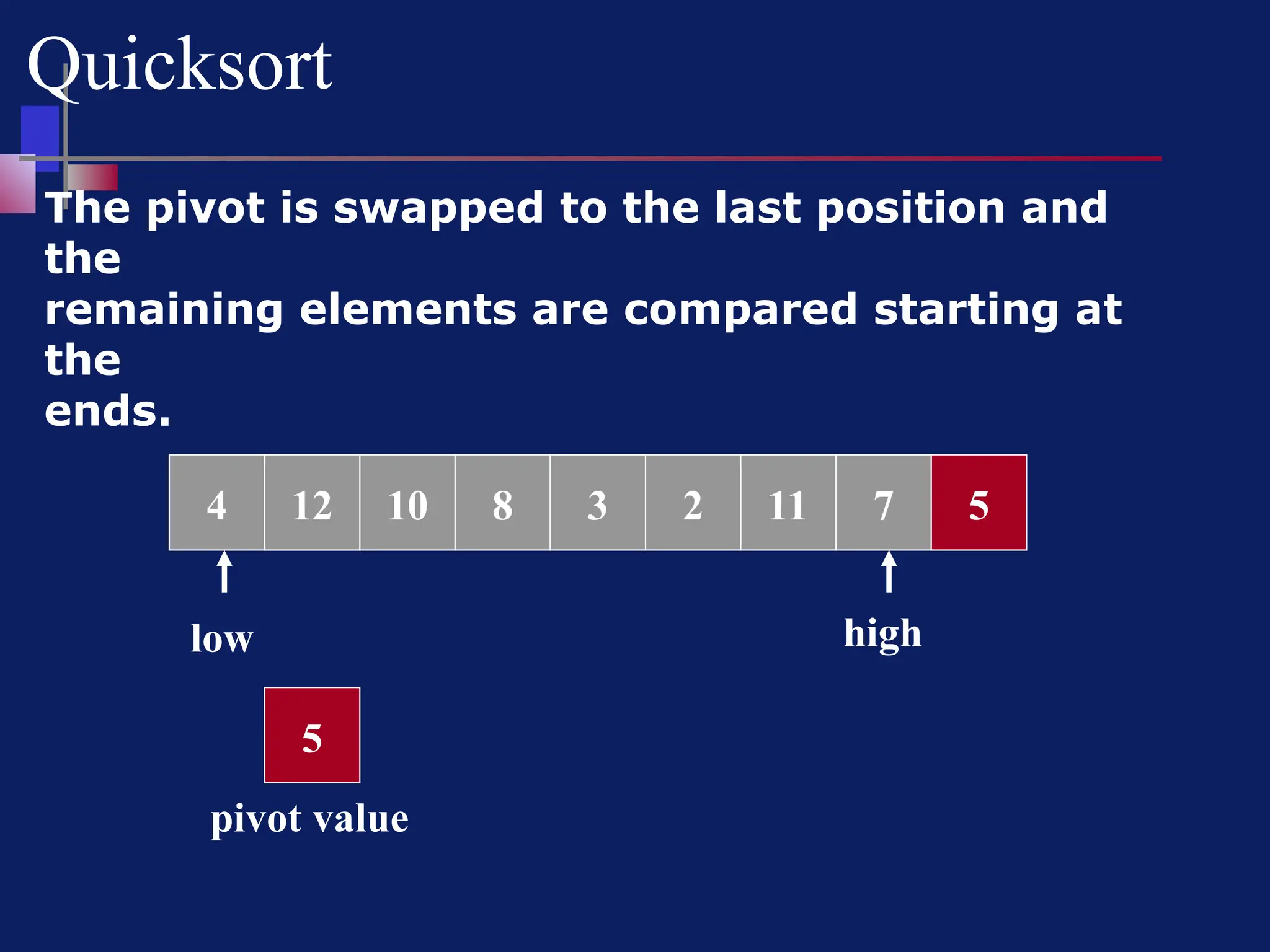
Quicksort
The pivot isswapped to the last position and
the
remaining elements are compared starting at
the
ends.
8 3 2 11 7 5
4 10
12
4 5
low high
5
pivot value
50.
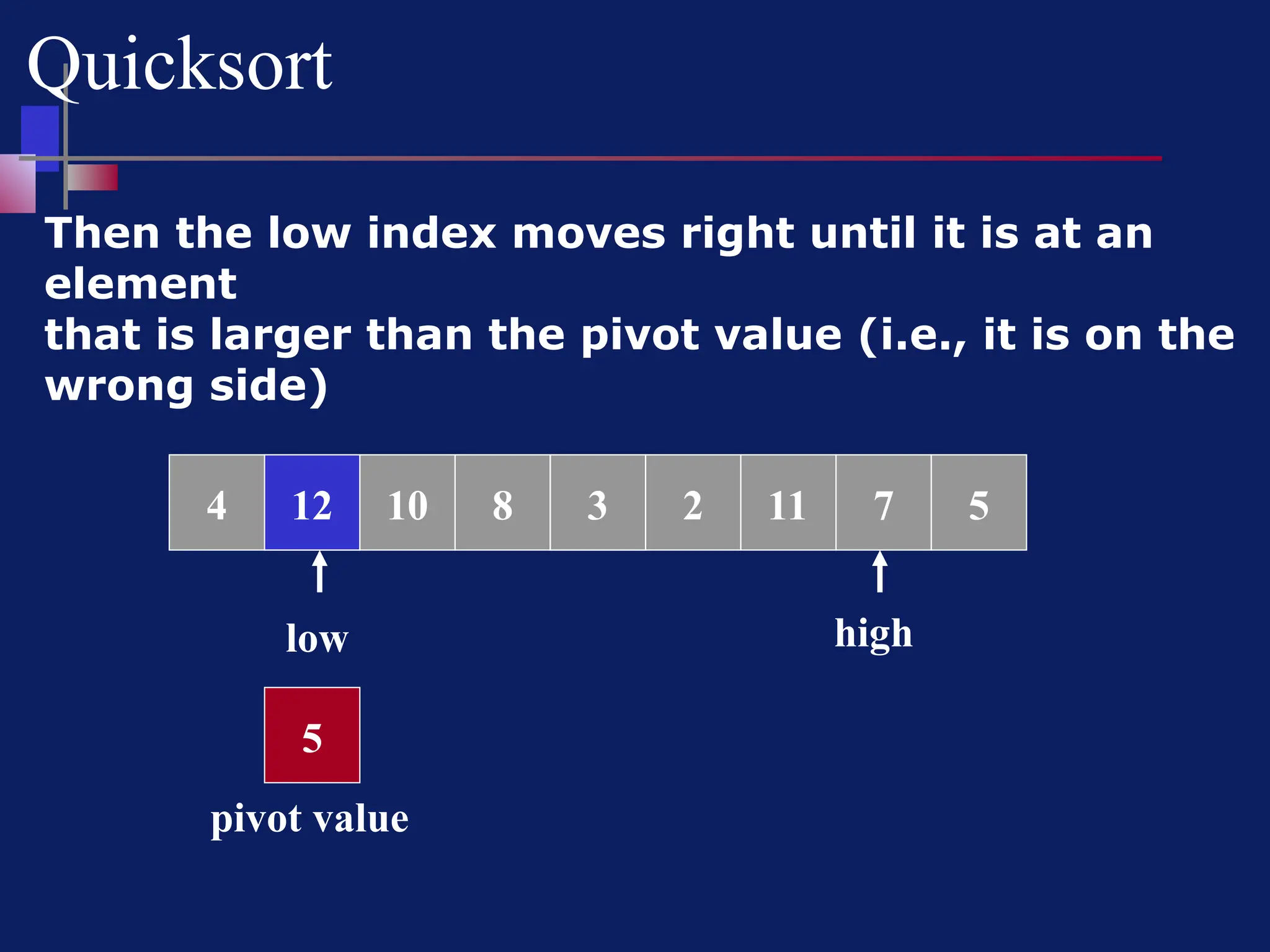
Quicksort
Then the lowindex moves right until it is at an
element
that is larger than the pivot value (i.e., it is on the
wrong side)
8 6 2 11 7 5
10
12
4 6
low high
5
pivot value
3
12
51.
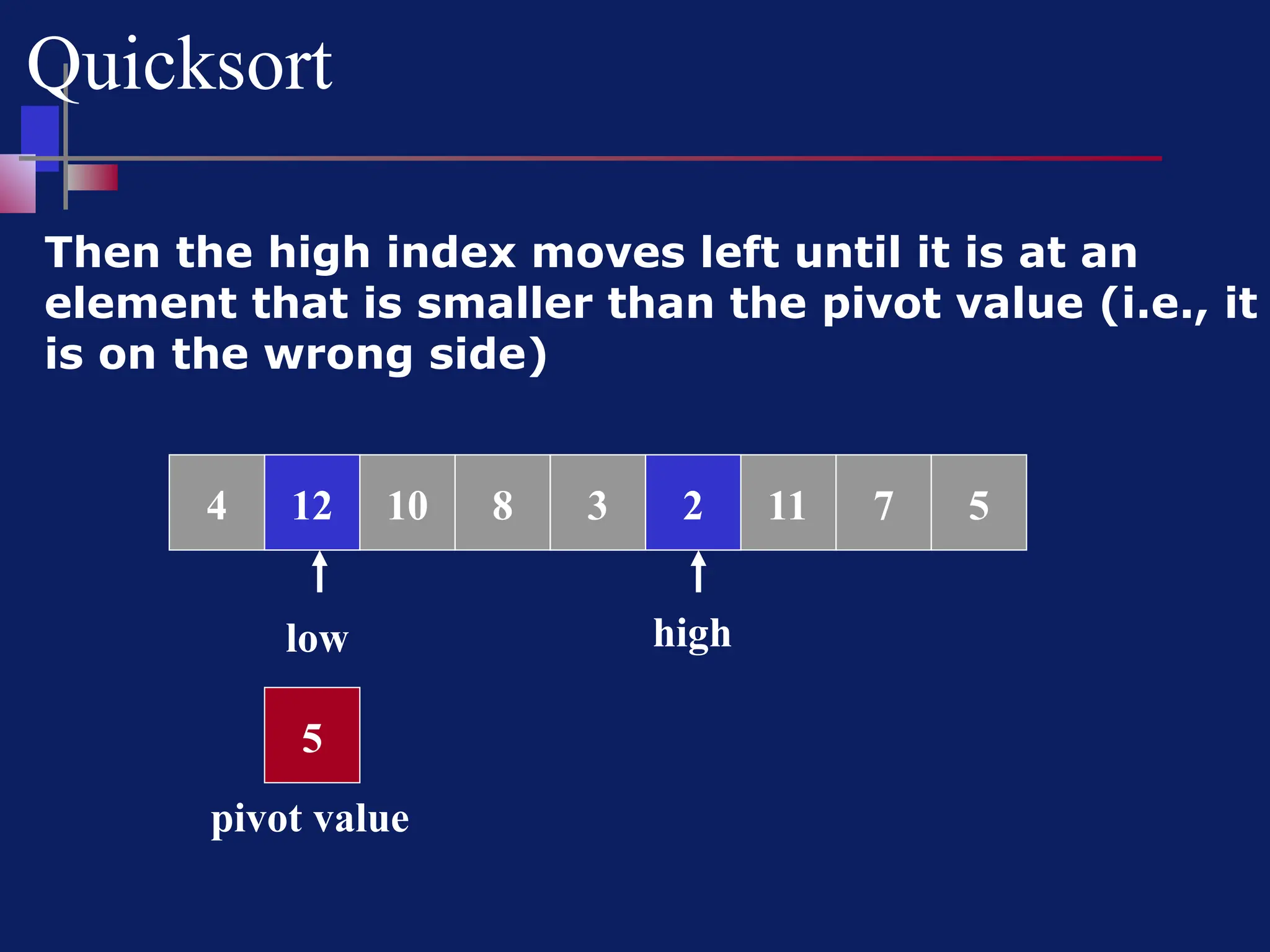
Quicksort
Then the highindex moves left until it is at an
element that is smaller than the pivot value (i.e., it
is on the wrong side)
8 6 2 11 7 5
4 10
12
4 6
low high
5
pivot value
3 2
52.
Quicksort
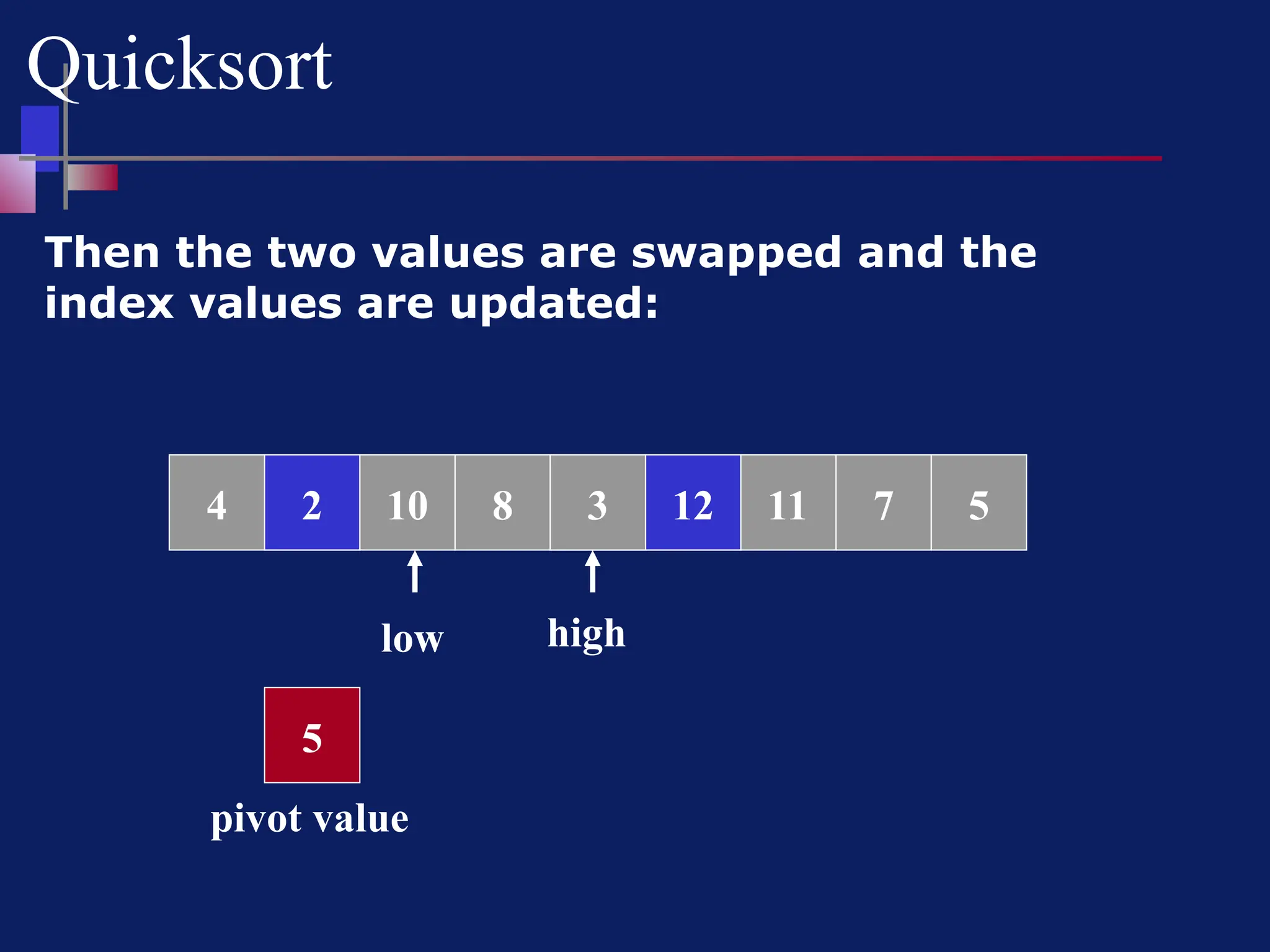
Then the twovalues are swapped and the
index values are updated:
8 6 2 11 7 5
4 10
12
4 6
low high
5
pivot value
3
2 12
53.
Quicksort
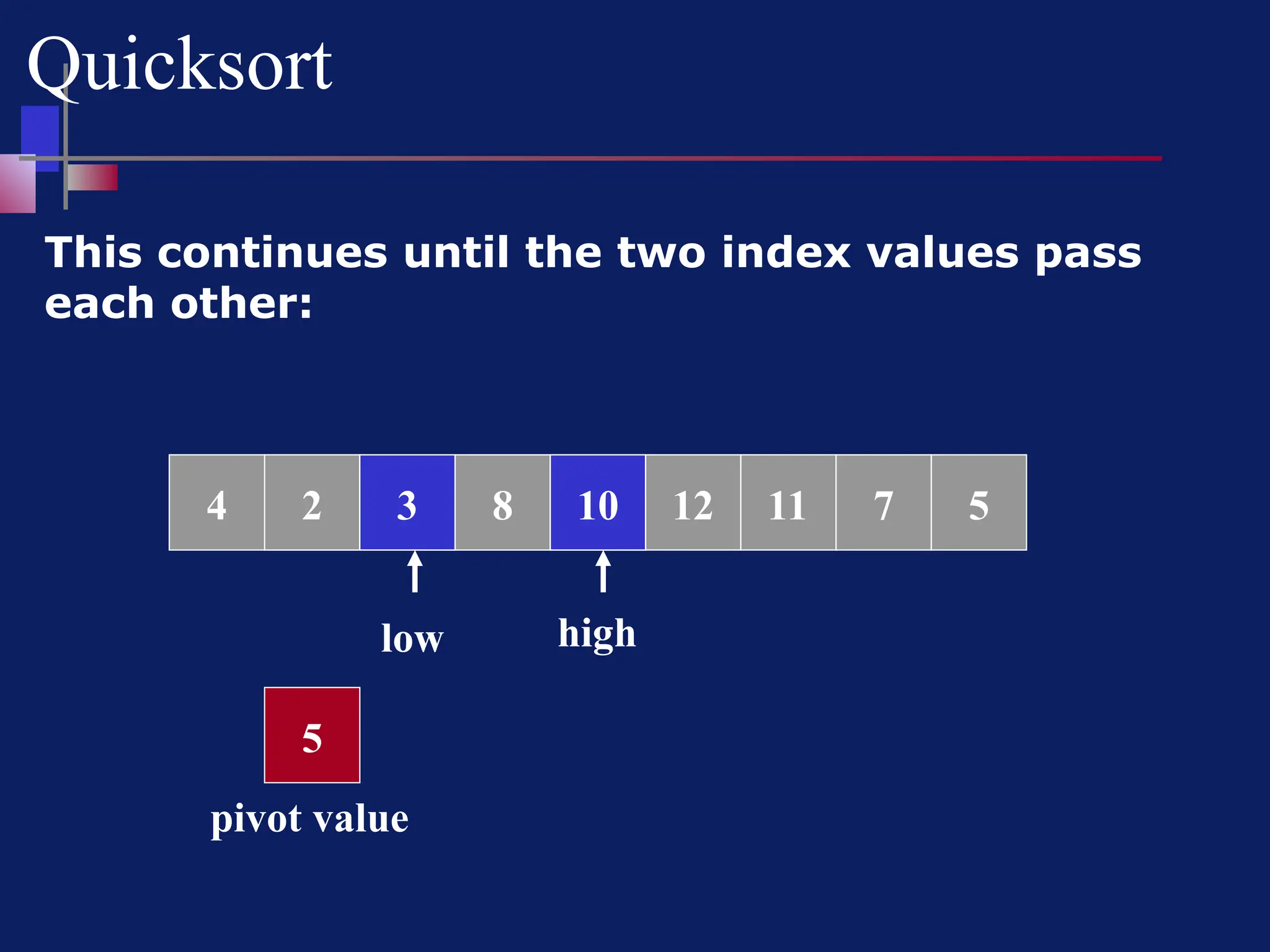
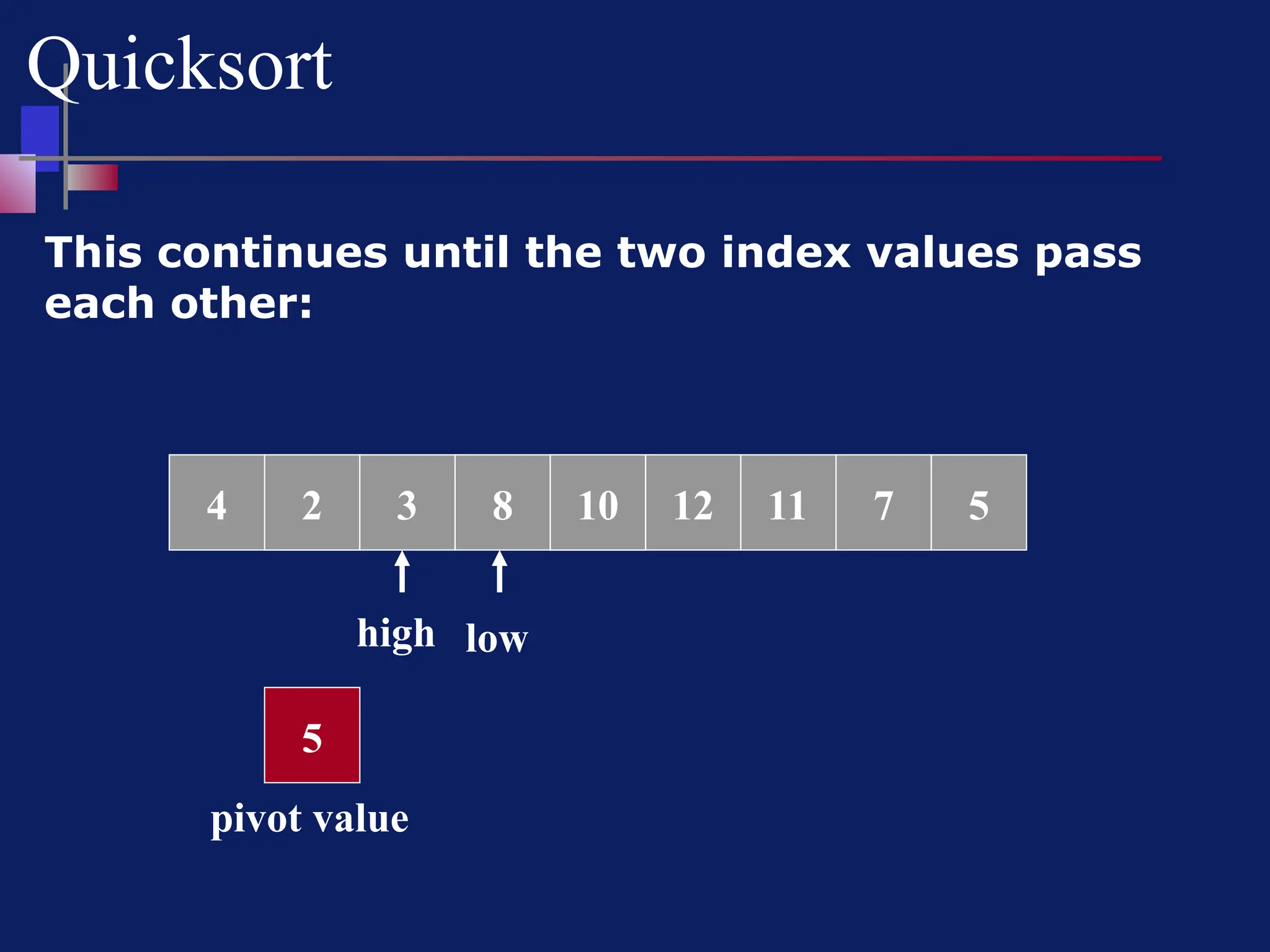
This continues untilthe two index values pass
each other:
8 6 12 11 7 5
4
2
4 6
low high
5
pivot value
3
10
3 10
void quickSort(int array[],int size)
{
int index;
if (size > 1)
{
index = partition(array, size);
quickSort(array, index);
quickSort(array+index+1, size - index-1);
}
}
Quicksort
58.
int partition(int array[],int size)
{
int k;
int mid = size/2;
int index = 0;
swap(array, array+mid);
for (k = 1; k < size; k++){
if (array[k] < array[0]){
index++;
swap(array+k, array+index);
}
}
swap(array, array+index);
return index;
}
Quicksort
![void mergeSort(float array[], int size)
{
int* tmpArrayPtr = new int[size];
if (tmpArrayPtr != NULL)
mergeSortRec(array, size, tmpArrayPtr);
else
{
cout << “Not enough memory to sort list.n”);
return;
}
delete [] tmpArrayPtr;
}
Mergesort](https://image.slidesharecdn.com/lec6divideandconquer-250316102124-cacf94ce/75/Lec-6-Divide-and-conquer-of-Data-Structures-Algortihms-30-2048.jpg)
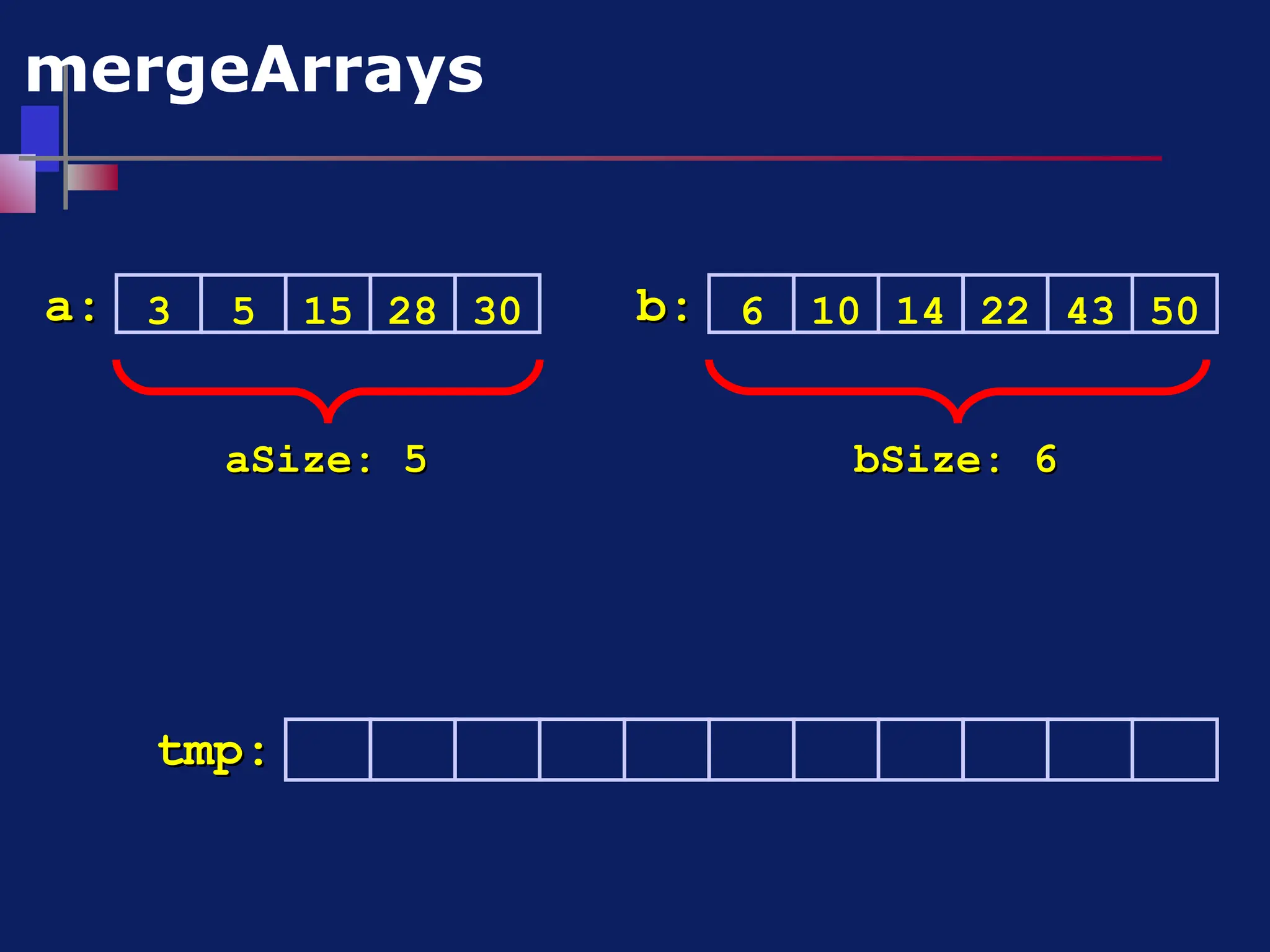
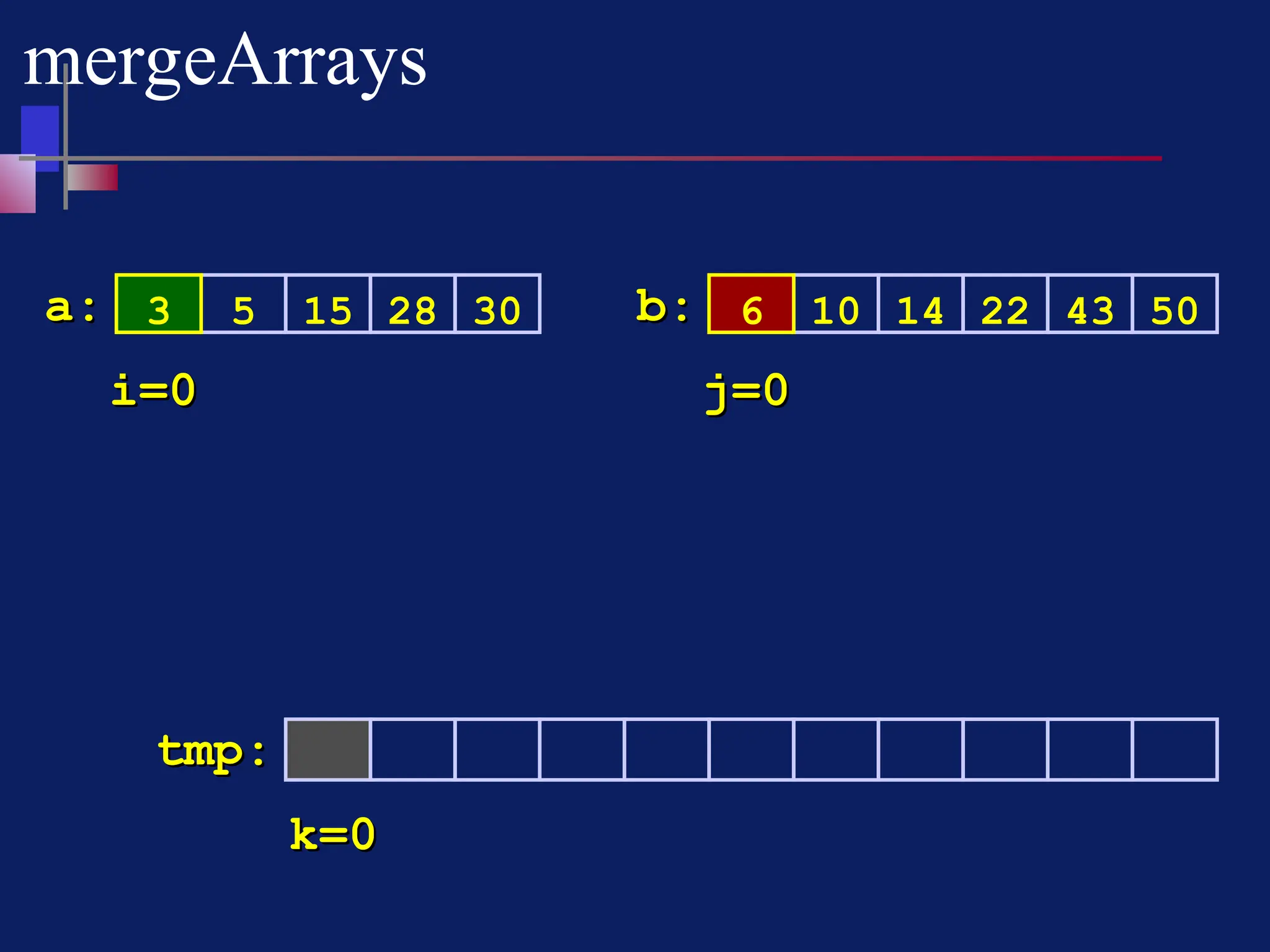
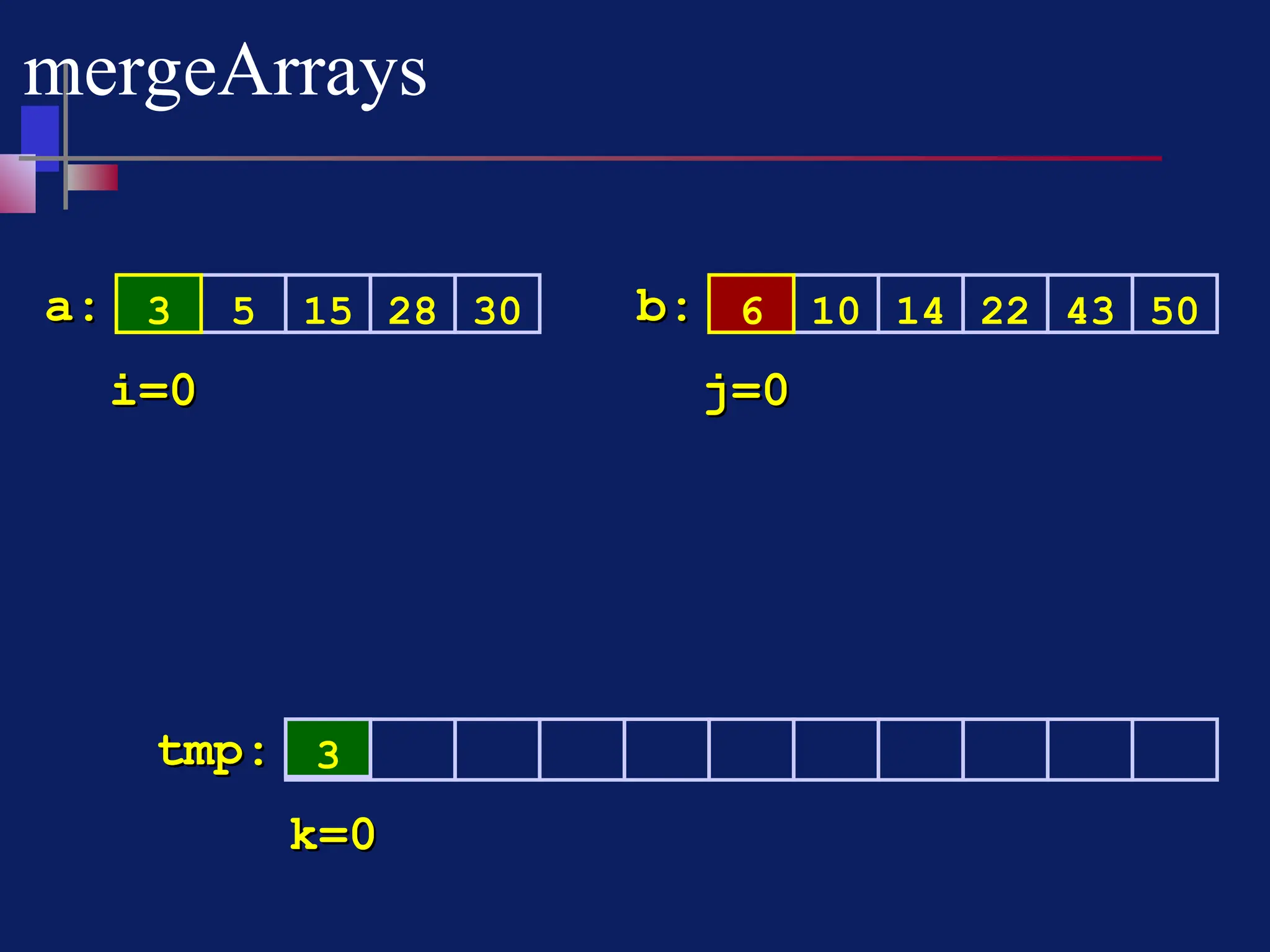
![void mergeSortRec(int array[],int size,int tmp[])
{
int i;
int mid = size/2;
if (size > 1){
mergeSortRec(array, mid, tmp);
mergeSortRec(array+mid, size-mid, tmp);
mergeArrays(array, mid, array+mid, size-mid,
tmp);
for (i = 0; i < size; i++)
array[i] = tmp[i];
}
}
Mergesort](https://image.slidesharecdn.com/lec6divideandconquer-250316102124-cacf94ce/75/Lec-6-Divide-and-conquer-of-Data-Structures-Algortihms-31-2048.jpg)

![void quickSort(int array[], int size)
{
int index;
if (size > 1)
{
index = partition(array, size);
quickSort(array, index);
quickSort(array+index+1, size - index-1);
}
}
Quicksort](https://image.slidesharecdn.com/lec6divideandconquer-250316102124-cacf94ce/75/Lec-6-Divide-and-conquer-of-Data-Structures-Algortihms-57-2048.jpg)
![int partition(int array[], int size)
{
int k;
int mid = size/2;
int index = 0;
swap(array, array+mid);
for (k = 1; k < size; k++){
if (array[k] < array[0]){
index++;
swap(array+k, array+index);
}
}
swap(array, array+index);
return index;
}
Quicksort](https://image.slidesharecdn.com/lec6divideandconquer-250316102124-cacf94ce/75/Lec-6-Divide-and-conquer-of-Data-Structures-Algortihms-58-2048.jpg)


![UNIT V Searching Sorting Hashing Techniques [Autosaved].pptx](https://cdn.slidesharecdn.com/ss_thumbnails/unitvsearchingsortinghashingtechniquesautosaved-241126054304-95a69c51-thumbnail.jpg?width=640&height=640&fit=bounds)

![UNIT V Searching Sorting Hashing Techniques [Autosaved].pptx](https://cdn.slidesharecdn.com/ss_thumbnails/unitvsearchingsortinghashingtechniquesautosaved-241014040608-74caa0f6-thumbnail.jpg?width=640&height=640&fit=bounds)


