











NAGINDAS 
KHANDWALA 
COLLEGE!!
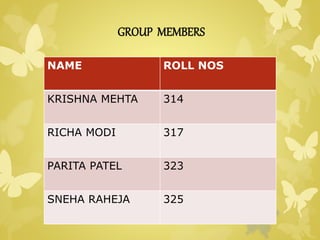
GROUP MEMBERS 
NAME ROLL NOS 
KRISHNA MEHTA 314 
RICHA MODI 317 
PARITA PATEL 323 
SNEHA RAHEJA 325
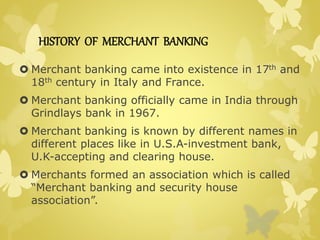
HISTORY OF MERCHANT BANKING 
 Merchant banking came into existence in 17th and 
18th century in Italy and France. 
 Merchant banking officially came in India through 
Grindlays bank in 1967. 
 Merchant banking is known by different names in 
different places like in U.S.A-investment bank, 
U.K-accepting and clearing house. 
 Merchants formed an association which is called 
“Merchant banking and security house 
association”.
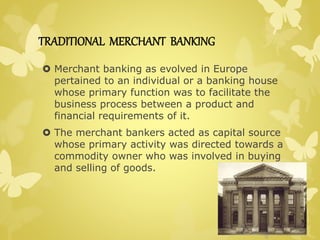
TRADITIONAL MERCHANT BANKING 
 Merchant banking as evolved in Europe 
pertained to an individual or a banking house 
whose primary function was to facilitate the 
business process between a product and 
financial requirements of it. 
 The merchant bankers acted as capital source 
whose primary activity was directed towards a 
commodity owner who was involved in buying 
and selling of goods.
MODERN MERCHANT BANKING 
 During 20th century merchant banks expanded 
their services. 
 They became increasingly involved in the actual 
running of the business for which the business 
was conducted. 
 Today merchant banks actually own and run 
business for their own account. 
 Modern skills include a management advisor, 
entrepreneur etc.
STATE BANK OF INDIA 
 State bank of India(SBI) is the nations largest bank. It was 
initially established as bank of Calcutta on 2nd June 1806. 
 The primary focus of SBI is on Indian clients. It mission was 
to become a professional merchant banker. 
 The services rendered by SBI are import finance for Indian 
corporate, foreign currency loans under various scheme.
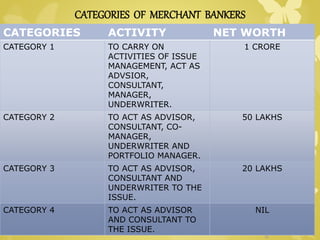
CATEGORIES OF MERCHANT BANKERS 
CATEGORIES ACTIVITY NET WORTH 
CATEGORY 1 TO CARRY ON 
ACTIVITIES OF ISSUE 
MANAGEMENT, ACT AS 
ADVSIOR, 
CONSULTANT, 
MANAGER, 
UNDERWRITER. 
1 CRORE 
CATEGORY 2 TO ACT AS ADVISOR, 
CONSULTANT, CO-MANAGER, 
UNDERWRITER AND 
PORTFOLIO MANAGER. 
50 LAKHS 
CATEGORY 3 TO ACT AS ADVISOR, 
CONSULTANT AND 
UNDERWRITER TO THE 
ISSUE. 
20 LAKHS 
CATEGORY 4 TO ACT AS ADVISOR 
AND CONSULTANT TO 
THE ISSUE. 
NIL
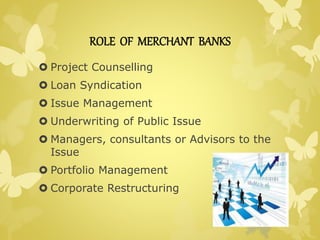
ROLE OF MERCHANT BANKS 
 Project Counselling 
 Loan Syndication 
 Issue Management 
 Underwriting of Public Issue 
 Managers, consultants or Advisors to the 
Issue 
 Portfolio Management 
 Corporate Restructuring
CORPORATE RESTRUCTURING 
 Corporate restructuring is the process of redesigning 
one or more aspects of a company. 
 It involves increasing or decreasing the layers of 
personnel between the top and the bottom of an 
organization, or reassigning roles and 
responsibilities.
CONTD… 
 The process of reorganizing a company 
may be implemented due to a number of 
different factors, such as positioning the 
company to be more competitive, survive 
a currently adverse economic climate, or 
poise the corporation to move in an 
entirely new direction. 
 Tata Motors acquisition of Jaguar Land 
Rover through Jaguar Land Rover Ltd. Is 
an example of Corporate Restructuring
MERCHANT BANK`S
CODE OF CONDUCT 
 A Merchant Bank shall make all efforts to protect the 
interests of investors 
 A Merchant Bank shall maintain high standards of integrity, 
dignity and fairness in the conduct of its business 
 A Merchant Bank shall fulfil its obligations in a prompt, 
ethical and professional manner.
CONTD… 
 A Merchant Bank shall always endeavour to 
render the best possible advice to the clients 
having regard to their needs 
 A Merchant Bank shall not make untrue 
statement or suppress any material fact in any 
documents, reports or information furnished to 
the Board. 
 Merchant Bank shall develop its own internal 
code of conduct for governing its internal 
operations
NORMS FOR REGISTRATION
NORMS FOR REGISTRATION 
An applicant should comply with the 
following norms: 
 The applicant should be a body corporate 
 The applicant should not carry on any 
business other than those connected with 
the securities market
CONTD… 
 The applicant should not have been 
involved in any securities scam or proved 
guilty for any offence 
 The applicant must have at least two 
employees with prior experience in 
merchant banking 
 The applicant should have a minimum net 
worth of Rs.5 cr
DIFFERENCE BETWEEN MERCHANT 
BANK AND COMMERCIAL BANK
MERCHANT 
BANK 
 They Serve mainly large 
companies and very 
wealthy individuals 
 Merchant banking focuses 
on investing a depositor’s 
assets in a finance portfolio 
and managing these 
investments 
 Merchant banks are 
commonly called as 
“Investment Banks” 
COMMERCIAL 
BANK 
 This is accessible to anyone 
for basic banking needs 
 A commercial bank can 
provide loans to individuals 
and small businesses 
 Typically referred to as 
“Banks”
MERCHANT 
BANK 
 Apart from raising funds 
by investing and 
managing the assets of 
wealthy clients, it also 
offers counsel and advice 
to large corporations 
 Advice used by 
corporation before 
merger and acquisition 
of, another corporation 
 Involves the provision of 
financial services and 
advice 
 Merchant banks were 
actually the original 
banks and were invented 
in the Middle Ages 
COMMERCIAL 
BANK 
 It raises funds by 
collecting deposits from 
groups of people as well 
as interest charged on 
loans 
 It purchases bonds from 
governments and 
corporate entities 
 Involves the provision of 
financial services 
 The use of Commercial 
banks by the average 
citizen is a relatively new 
phenomenon
Problems of MERCHANT BANKERS 
SEBI guidelines have authorized merchant 
bankers to undertake issue related 
activities only. 
SEBI guidelines stipulate a minimum net 
worth of Rs. 1 crore for authorization of 
merchant bankers. 
 Non co-operation of the issuing 
companies.
Current Scenario 
PNB aims profit of Rs.7,500 crore by 2013 
• The country’s second largest public sector lender Punjab 
National Bank aims to double its profit to Rs.7500 crore 
in the next four years. “The bank has set a target to 
expand total business to Rs. 10crore and earn net profit 
of Rs.7,500 crore by 2013,” said PNB Chairman and 
Managing Director K C Chakrabarty, who is charge of 
Deputy Governor of RBI. 
• The growth driver would be better asset liability 
management, thrust on recovery, focus on customers and 
financial inclusion, he has said.
CONTD… 
 Besides, the bank plans to open new line of 
businesses in the current fiscal including 
merchant banking subsidiary. 
 PNB investment services aims to provide 
investment consultancy and merchant banking 
services and would be operational in next three 
months. Currently, these operations are run by a 
division of a bank.
ICICI banks to oversee Mergers and Acquisitions 
• ICICI bank and its merchant banking arm, ICICI 
Securities (I-Sec), have entered into an agreement, 
whereby all mergers & acquisitions deals will be done 
out of ICICI bank. 
• The agreement goes on to define an mergers & 
acquisitions deals as one which involves change in 
management control. 
• This arrangement replaces the earlier practice of both 
I-Sec and ICICI bank working together on mergers & 
acquisitions deals.
CONTD… 
 “Since a prominent number of people, who wish 
to be advised on mergers & acquisitions, also 
looks for acquisition finance, it was decided that 
the business should be housed in the bank,” 
MD Madhabi Puri told ET. 
 “Now, if a corporate is seeking a sell mandate or 
a buy mandate, where the transfer of controlling 
interest take place, the deal will be done by 
ICICI Bank” ICICI Bank had initially entered 
investment banking space in 2006.
Association of Merchant Bankers 
• Association of Merchant Bankers in India is a Professional 
non-profit company setup to represent the industry. 
• It is expected to set code of ethics and facilitate dialogue 
between the industry and regulatory bodies. 
• Training and Awareness programmers are also expected from 
AMBI. 
• Because of lack of support from the members and non-initiative 
from SEBI/Government, AMBI is dormant at 
present.
Merchant Banking

Merchant Banking

  • 1.
  • 3.
    GROUP MEMBERS NAMEROLL NOS KRISHNA MEHTA 314 RICHA MODI 317 PARITA PATEL 323 SNEHA RAHEJA 325
  • 4.
    HISTORY OF MERCHANTBANKING  Merchant banking came into existence in 17th and 18th century in Italy and France.  Merchant banking officially came in India through Grindlays bank in 1967.  Merchant banking is known by different names in different places like in U.S.A-investment bank, U.K-accepting and clearing house.  Merchants formed an association which is called “Merchant banking and security house association”.
  • 5.
    TRADITIONAL MERCHANT BANKING  Merchant banking as evolved in Europe pertained to an individual or a banking house whose primary function was to facilitate the business process between a product and financial requirements of it.  The merchant bankers acted as capital source whose primary activity was directed towards a commodity owner who was involved in buying and selling of goods.
  • 6.
    MODERN MERCHANT BANKING  During 20th century merchant banks expanded their services.  They became increasingly involved in the actual running of the business for which the business was conducted.  Today merchant banks actually own and run business for their own account.  Modern skills include a management advisor, entrepreneur etc.
  • 7.
    STATE BANK OFINDIA  State bank of India(SBI) is the nations largest bank. It was initially established as bank of Calcutta on 2nd June 1806.  The primary focus of SBI is on Indian clients. It mission was to become a professional merchant banker.  The services rendered by SBI are import finance for Indian corporate, foreign currency loans under various scheme.
  • 8.
    CATEGORIES OF MERCHANTBANKERS CATEGORIES ACTIVITY NET WORTH CATEGORY 1 TO CARRY ON ACTIVITIES OF ISSUE MANAGEMENT, ACT AS ADVSIOR, CONSULTANT, MANAGER, UNDERWRITER. 1 CRORE CATEGORY 2 TO ACT AS ADVISOR, CONSULTANT, CO-MANAGER, UNDERWRITER AND PORTFOLIO MANAGER. 50 LAKHS CATEGORY 3 TO ACT AS ADVISOR, CONSULTANT AND UNDERWRITER TO THE ISSUE. 20 LAKHS CATEGORY 4 TO ACT AS ADVISOR AND CONSULTANT TO THE ISSUE. NIL
  • 9.
    ROLE OF MERCHANTBANKS  Project Counselling  Loan Syndication  Issue Management  Underwriting of Public Issue  Managers, consultants or Advisors to the Issue  Portfolio Management  Corporate Restructuring
  • 10.
    CORPORATE RESTRUCTURING Corporate restructuring is the process of redesigning one or more aspects of a company.  It involves increasing or decreasing the layers of personnel between the top and the bottom of an organization, or reassigning roles and responsibilities.
  • 11.
    CONTD…  Theprocess of reorganizing a company may be implemented due to a number of different factors, such as positioning the company to be more competitive, survive a currently adverse economic climate, or poise the corporation to move in an entirely new direction.  Tata Motors acquisition of Jaguar Land Rover through Jaguar Land Rover Ltd. Is an example of Corporate Restructuring
  • 12.
  • 13.
    CODE OF CONDUCT  A Merchant Bank shall make all efforts to protect the interests of investors  A Merchant Bank shall maintain high standards of integrity, dignity and fairness in the conduct of its business  A Merchant Bank shall fulfil its obligations in a prompt, ethical and professional manner.
  • 14.
    CONTD…  AMerchant Bank shall always endeavour to render the best possible advice to the clients having regard to their needs  A Merchant Bank shall not make untrue statement or suppress any material fact in any documents, reports or information furnished to the Board.  Merchant Bank shall develop its own internal code of conduct for governing its internal operations
  • 15.
  • 16.
    NORMS FOR REGISTRATION An applicant should comply with the following norms:  The applicant should be a body corporate  The applicant should not carry on any business other than those connected with the securities market
  • 17.
    CONTD…  Theapplicant should not have been involved in any securities scam or proved guilty for any offence  The applicant must have at least two employees with prior experience in merchant banking  The applicant should have a minimum net worth of Rs.5 cr
  • 18.
    DIFFERENCE BETWEEN MERCHANT BANK AND COMMERCIAL BANK
  • 19.
    MERCHANT BANK They Serve mainly large companies and very wealthy individuals  Merchant banking focuses on investing a depositor’s assets in a finance portfolio and managing these investments  Merchant banks are commonly called as “Investment Banks” COMMERCIAL BANK  This is accessible to anyone for basic banking needs  A commercial bank can provide loans to individuals and small businesses  Typically referred to as “Banks”
  • 20.
    MERCHANT BANK Apart from raising funds by investing and managing the assets of wealthy clients, it also offers counsel and advice to large corporations  Advice used by corporation before merger and acquisition of, another corporation  Involves the provision of financial services and advice  Merchant banks were actually the original banks and were invented in the Middle Ages COMMERCIAL BANK  It raises funds by collecting deposits from groups of people as well as interest charged on loans  It purchases bonds from governments and corporate entities  Involves the provision of financial services  The use of Commercial banks by the average citizen is a relatively new phenomenon
  • 22.
    Problems of MERCHANTBANKERS SEBI guidelines have authorized merchant bankers to undertake issue related activities only. SEBI guidelines stipulate a minimum net worth of Rs. 1 crore for authorization of merchant bankers.  Non co-operation of the issuing companies.
  • 23.
    Current Scenario PNBaims profit of Rs.7,500 crore by 2013 • The country’s second largest public sector lender Punjab National Bank aims to double its profit to Rs.7500 crore in the next four years. “The bank has set a target to expand total business to Rs. 10crore and earn net profit of Rs.7,500 crore by 2013,” said PNB Chairman and Managing Director K C Chakrabarty, who is charge of Deputy Governor of RBI. • The growth driver would be better asset liability management, thrust on recovery, focus on customers and financial inclusion, he has said.
  • 24.
    CONTD…  Besides,the bank plans to open new line of businesses in the current fiscal including merchant banking subsidiary.  PNB investment services aims to provide investment consultancy and merchant banking services and would be operational in next three months. Currently, these operations are run by a division of a bank.
  • 26.
    ICICI banks tooversee Mergers and Acquisitions • ICICI bank and its merchant banking arm, ICICI Securities (I-Sec), have entered into an agreement, whereby all mergers & acquisitions deals will be done out of ICICI bank. • The agreement goes on to define an mergers & acquisitions deals as one which involves change in management control. • This arrangement replaces the earlier practice of both I-Sec and ICICI bank working together on mergers & acquisitions deals.
  • 27.
    CONTD…  “Sincea prominent number of people, who wish to be advised on mergers & acquisitions, also looks for acquisition finance, it was decided that the business should be housed in the bank,” MD Madhabi Puri told ET.  “Now, if a corporate is seeking a sell mandate or a buy mandate, where the transfer of controlling interest take place, the deal will be done by ICICI Bank” ICICI Bank had initially entered investment banking space in 2006.
  • 28.
    Association of MerchantBankers • Association of Merchant Bankers in India is a Professional non-profit company setup to represent the industry. • It is expected to set code of ethics and facilitate dialogue between the industry and regulatory bodies. • Training and Awareness programmers are also expected from AMBI. • Because of lack of support from the members and non-initiative from SEBI/Government, AMBI is dormant at present.