Operationalizing These
Data to Inform
Medical Treatment
James Rae Scientific Day
May 9, 2014
Nancy Hansen Merbitz, PhD
Clinical Assistant Professor
Division of Rehabilitation Psychology and Neuropsychology
U-M Department of Physical Medicine and Rehabilitation
“Behavior is the Central Outcome
in Health Care”
- Robert M Kaplan, Chief Science Officer,
Agency for Healthcare Research and Quality
 In his 1994 article on outcomes in health research,
Kaplan cited the comic strip Ziggy.
 The Guru responds to Ziggy:
“The meaning of life, my boy,
is doin' stuff!! …
As opposed to death, which
is NOT doin' stuff!”
 Ziggy says:
‘”It's a more elementary theory than I had expected,
but one you can't argue with.”
In rehabilitation, we have always
understood that our outcomes are
behaviors (“doin’ stuff”).
According to the context and the
question, behavior may be a(n):
 Independent Variable
 “If the patient can practice frequently, his muscle strength will
improve.”
 Moderator or Mediator Variable
 “The relationship between stress and illness is mediated by
health-related behaviors.”
 Dependent Variable
 Resulting from illness: “The patient with hepatic
encephalopathy became delirious.”
 An outcome of treatment: “After ammonia
levels were reduced, the delirium resolved.”
 The rehabilitation unit is a goldmine of
behavioral data.
 Behavioral data can inform us about:
 the patient’s progress in therapies,
 the sensitivity of the human organism to changes in
lab values or medication regimens that are not usually
considered as having a clinical impact.
 and the pt’s response to medical intervention.
Behavioral data are contained in
our medical charts
 Most of it is in rough, narrative form – currently
difficult to extract.
 “Patient gave correct information about person,
place, time and circumstances.”
 “Patient completed 10 reps on the rickshaw.”
A rough (but important and
quantifiable) measure of patient
behavior during rehabilitation:
MINUTES OF THERAPY
COMPLETED
PER DAY
(i.e. “participation”).
Participation as a
Dependent Variable:
 The behavioral variable, “participation” (in
this case defined as minutes of therapy
completed per day), can be tracked to yield
information about:
 the clinical effects of a medical problem, as
indicated by worsening behavior, and/or
 the response to a medical intervention, as
indicated by improved behavior.
This can be viewed as an opportunity
for the application of
“pragmatic science” to medical practice.
Pragmatic science, using locally
available information in context,
tracking it over time
 Toward “a new epistomology of evidence-based
practice” - Don Berwick, 2005; 2009
 Founded the Institute for Healthcare Improvement
 Nationally/internationally renowned in bringing
methods of QI to healthcare settings large and small;
forming networks of learning collaboratives
 Berwick gives an unapologetic depiction of quality
improvement as a compelling science.
Berwick (2005) summarizes key elements of
pragmatic science (Brock, Nolan, & Nolan, 1998; Langley et al., 1996):
 Tracking effects over time, especially with graphs
 (rather than summarizing with statistics that do not retain the information
involved in sequences);
 Using local knowledge in measurement
 (rather than relegating measurement to people least familiar with the
subject matter and work);
 Integrating detailed process knowledge into the work of
interpretation
 (inviting observers to comment on what they notice rather than “blinding”
them to protect them against what they know);
 Using small samples and short experimental cycles to learn
quickly
 (rather than overpowering studies and delaying new
theories with samples larger than needed at the time).
In this case example
 We can see an opportunity to use data tracking to
look for possible relationships,
 with “minutes of therapy” serving as the
dependent (behavioral) variable.
 Minutes of therapy in this case seems to indicate
both
 the clinical manifestation of hyponatremia (in the
context of multiple co-morbidities increasing
vulnerability to fatigue and delirium),
 And the response to successful medical intervention.
hyponatremia
 Is described as the most common electrolyte
abnormality encountered in clinical practice.
Thompson. Hyponatraemia: new associations and new
treatments. Eur J Endocrinol. 2010 Jun;162 Suppl 1:S1-3
 Many causes, with a subset related to
medications.
Mr. C’s behavioral data
 seem to indicate that there was a clinical
effect of hyponatremia
 at levels often considered to be
“asymptomatic”.
“Asymptomatic hyponatremia”
 “Is asymptomatic hyponatremia really
asymptomatic?” Renneboog, et al., Am J Med, 2006
 “Mild chronic hyponatremia is associated with falls,
unsteadiness, and attention deficits”
Decaux, Am J Med, 2006
 “Mild chronic hyponatremia (SNa 128 ± 3 mmol/L)
was associated with similar but worse results on tests
of attention and balance compared to matched
normal controls with blood alcohol levels
of 0.6 g/L .” Hoorn et al., Clinical Kidney Journal, 2009
 There can be subtle effects at mild levels of
derangement.
 Symptoms can be more notable when drop in
sodium is rapid versus slow.
 In the rehab setting, we may get a clearer
picture of subtle symptoms because of close
observation in a demanding environment.
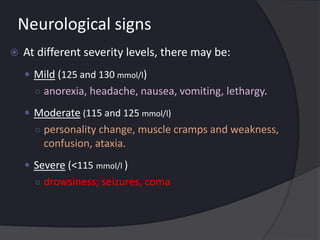
Neurological signs
 At different severity levels, there may be:
 Mild (125 and 130 mmol/l)
○ anorexia, headache, nausea, vomiting, lethargy.
 Moderate (115 and 125 mmol/l)
○ personality change, muscle cramps and weakness,
confusion, ataxia.
 Severe (<115 mmol/l )
○ drowsiness; seizures, coma
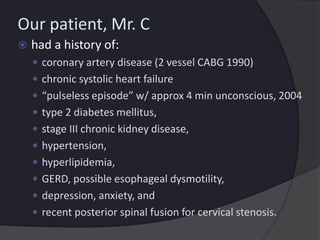
Our patient, Mr. C
 had a history of:
 coronary artery disease (2 vessel CABG 1990)
 chronic systolic heart failure
 “pulseless episode” w/ approx 4 min unconscious, 2004
 type 2 diabetes mellitus,
 stage III chronic kidney disease,
 hypertension,
 hyperlipidemia,
 GERD, possible esophageal dysmotility,
 depression, anxiety, and
 recent posterior spinal fusion for cervical stenosis.
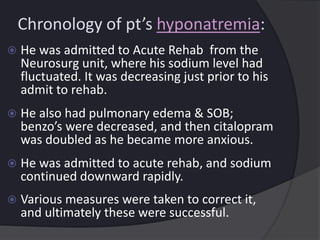
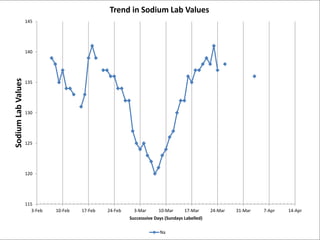
Chronology of pt’s hyponatremia:
 He was admitted to Acute Rehab from the
Neurosurg unit, where his sodium level had
fluctuated. It was decreasing just prior to his
admit to rehab.
 He also had pulmonary edema & SOB;
benzo’s were decreased, and then citalopram
was doubled as he became more anxious.
 He was admitted to acute rehab, and sodium
continued downward rapidly.
 Various measures were taken to correct it,
and ultimately these were successful.
115
120
125
130
135
140
145
115
120
125
130
135
140
145
3-Feb 10-Feb 17-Feb 24-Feb 3-Mar 10-Mar 17-Mar 24-Mar 31-Mar 7-Apr 14-Apr
SodiumLabValues
Successsive Days (Sundays Labelled)
Trend in Sodium Lab Values
Na
Chronology of pt’s participation:
 After his first weekend, he “ramped up” to full days
of therapy (180+ minutes) on Monday and Tuesday,
February 25 - 26.
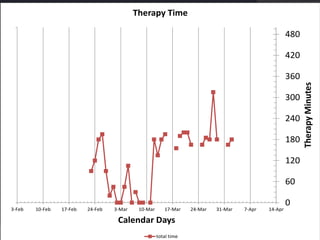
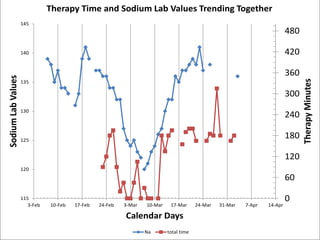
But notice that as his sodium went down,
and prior to onset of frank delirium:
 He appeared more lethargic, depressed and
anxious.
 His minutes of therapy dropped to zero.
 He was described as: “unmotivated”; “refusing
therapy”.
 Discharge to SAR was planned.
0
60
120
180
240
300
360
420
480
0
100
3-Feb 10-Feb 17-Feb 24-Feb 3-Mar 10-Mar 17-Mar 24-Mar 31-Mar 7-Apr 14-Apr
TherapyMinutes
Calendar Days
Therapy Time
total time
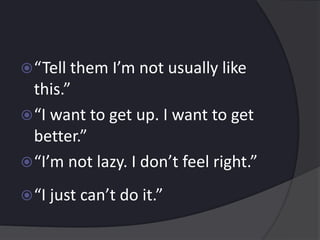
“Tell them I’m not usually like
this.”
“I want to get up. I want to get
better.”
“I’m not lazy. I don’t feel right.”
“I just can’t do it.”
0
60
120
180
240
300
360
420
480
115
120
125
130
135
140
145
3-Feb 10-Feb 17-Feb 24-Feb 3-Mar 10-Mar 17-Mar 24-Mar 31-Mar 7-Apr 14-Apr
TherapyMinutes
SodiumLabValues
Calendar Days
Therapy Time and Sodium Lab Values Trending Together
Na total time
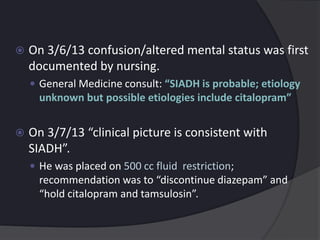
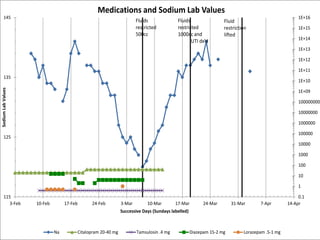
 On 3/6/13 confusion/altered mental status was first
documented by nursing.
 General Medicine consult: “SIADH is probable; etiology
unknown but possible etiologies include citalopram”
 On 3/7/13 “clinical picture is consistent with
SIADH”.
 He was placed on 500 cc fluid restriction;
recommendation was to “discontinue diazepam” and
“hold citalopram and tamsulosin”.
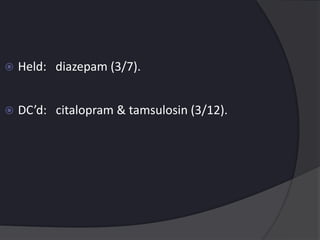
 Held: diazepam (3/7).
 DC’d: citalopram & tamsulosin (3/12).
0.1
1
10
100
1000
10000
100000
1000000
10000000
100000000
1E+09
1E+10
1E+11
1E+12
1E+13
1E+14
1E+15
1E+16
115
125
135
145
3-Feb 10-Feb 17-Feb 24-Feb 3-Mar 10-Mar 17-Mar 24-Mar 31-Mar 7-Apr 14-Apr
SodiumLabValues
Successive Days (Sundays labelled)
Medications and Sodium Lab Values
Na Citalopram 20-40 mg Tamsulosin .4 mg Diazepam 15-2 mg Lorazepam .5-1 mg
Fluids
restricted
500cc
Fluids
restricted
1000cc and
UTI dx'd
Fluid
restriction
lifted
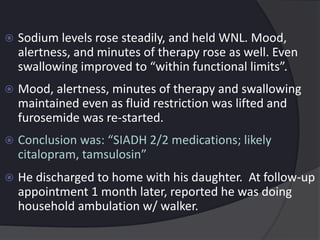
 Sodium levels rose steadily, and held WNL. Mood,
alertness, and minutes of therapy rose as well. Even
swallowing improved to “within functional limits”.
 Mood, alertness, minutes of therapy and swallowing
maintained even as fluid restriction was lifted and
furosemide was re-started.
 Conclusion was: “SIADH 2/2 medications; likely
citalopram, tamsulosin”
 He discharged to home with his daughter. At follow-up
appointment 1 month later, reported he was doing
household ambulation w/ walker.
Discussion
 Thank you
 nmerbitz@med.umich.edu

Behavioral data during rehab can inform medical treatment

  • 1.
    Operationalizing These Data toInform Medical Treatment
  • 2.
    James Rae ScientificDay May 9, 2014 Nancy Hansen Merbitz, PhD Clinical Assistant Professor Division of Rehabilitation Psychology and Neuropsychology U-M Department of Physical Medicine and Rehabilitation
  • 3.
    “Behavior is theCentral Outcome in Health Care” - Robert M Kaplan, Chief Science Officer, Agency for Healthcare Research and Quality
  • 4.
     In his1994 article on outcomes in health research, Kaplan cited the comic strip Ziggy.  The Guru responds to Ziggy: “The meaning of life, my boy, is doin' stuff!! … As opposed to death, which is NOT doin' stuff!”  Ziggy says: ‘”It's a more elementary theory than I had expected, but one you can't argue with.”
  • 5.
    In rehabilitation, wehave always understood that our outcomes are behaviors (“doin’ stuff”).
  • 6.
    According to thecontext and the question, behavior may be a(n):  Independent Variable  “If the patient can practice frequently, his muscle strength will improve.”  Moderator or Mediator Variable  “The relationship between stress and illness is mediated by health-related behaviors.”  Dependent Variable  Resulting from illness: “The patient with hepatic encephalopathy became delirious.”  An outcome of treatment: “After ammonia levels were reduced, the delirium resolved.”
  • 7.
     The rehabilitationunit is a goldmine of behavioral data.  Behavioral data can inform us about:  the patient’s progress in therapies,  the sensitivity of the human organism to changes in lab values or medication regimens that are not usually considered as having a clinical impact.  and the pt’s response to medical intervention.
  • 8.
    Behavioral data arecontained in our medical charts  Most of it is in rough, narrative form – currently difficult to extract.  “Patient gave correct information about person, place, time and circumstances.”  “Patient completed 10 reps on the rickshaw.”
  • 9.
    A rough (butimportant and quantifiable) measure of patient behavior during rehabilitation: MINUTES OF THERAPY COMPLETED PER DAY (i.e. “participation”).
  • 10.
    Participation as a DependentVariable:  The behavioral variable, “participation” (in this case defined as minutes of therapy completed per day), can be tracked to yield information about:  the clinical effects of a medical problem, as indicated by worsening behavior, and/or  the response to a medical intervention, as indicated by improved behavior.
  • 11.
    This can beviewed as an opportunity for the application of “pragmatic science” to medical practice.
  • 12.
    Pragmatic science, usinglocally available information in context, tracking it over time  Toward “a new epistomology of evidence-based practice” - Don Berwick, 2005; 2009  Founded the Institute for Healthcare Improvement  Nationally/internationally renowned in bringing methods of QI to healthcare settings large and small; forming networks of learning collaboratives  Berwick gives an unapologetic depiction of quality improvement as a compelling science.
  • 13.
    Berwick (2005) summarizeskey elements of pragmatic science (Brock, Nolan, & Nolan, 1998; Langley et al., 1996):  Tracking effects over time, especially with graphs  (rather than summarizing with statistics that do not retain the information involved in sequences);  Using local knowledge in measurement  (rather than relegating measurement to people least familiar with the subject matter and work);  Integrating detailed process knowledge into the work of interpretation  (inviting observers to comment on what they notice rather than “blinding” them to protect them against what they know);  Using small samples and short experimental cycles to learn quickly  (rather than overpowering studies and delaying new theories with samples larger than needed at the time).
  • 15.
    In this caseexample  We can see an opportunity to use data tracking to look for possible relationships,  with “minutes of therapy” serving as the dependent (behavioral) variable.  Minutes of therapy in this case seems to indicate both  the clinical manifestation of hyponatremia (in the context of multiple co-morbidities increasing vulnerability to fatigue and delirium),  And the response to successful medical intervention.
  • 16.
    hyponatremia  Is describedas the most common electrolyte abnormality encountered in clinical practice. Thompson. Hyponatraemia: new associations and new treatments. Eur J Endocrinol. 2010 Jun;162 Suppl 1:S1-3  Many causes, with a subset related to medications.
  • 17.
    Mr. C’s behavioraldata  seem to indicate that there was a clinical effect of hyponatremia  at levels often considered to be “asymptomatic”.
  • 18.
    “Asymptomatic hyponatremia”  “Isasymptomatic hyponatremia really asymptomatic?” Renneboog, et al., Am J Med, 2006  “Mild chronic hyponatremia is associated with falls, unsteadiness, and attention deficits” Decaux, Am J Med, 2006  “Mild chronic hyponatremia (SNa 128 ± 3 mmol/L) was associated with similar but worse results on tests of attention and balance compared to matched normal controls with blood alcohol levels of 0.6 g/L .” Hoorn et al., Clinical Kidney Journal, 2009
  • 19.
     There canbe subtle effects at mild levels of derangement.  Symptoms can be more notable when drop in sodium is rapid versus slow.  In the rehab setting, we may get a clearer picture of subtle symptoms because of close observation in a demanding environment.
  • 20.
    Neurological signs  Atdifferent severity levels, there may be:  Mild (125 and 130 mmol/l) ○ anorexia, headache, nausea, vomiting, lethargy.  Moderate (115 and 125 mmol/l) ○ personality change, muscle cramps and weakness, confusion, ataxia.  Severe (<115 mmol/l ) ○ drowsiness; seizures, coma
  • 21.
    Our patient, Mr.C  had a history of:  coronary artery disease (2 vessel CABG 1990)  chronic systolic heart failure  “pulseless episode” w/ approx 4 min unconscious, 2004  type 2 diabetes mellitus,  stage III chronic kidney disease,  hypertension,  hyperlipidemia,  GERD, possible esophageal dysmotility,  depression, anxiety, and  recent posterior spinal fusion for cervical stenosis.
  • 22.
    Chronology of pt’shyponatremia:  He was admitted to Acute Rehab from the Neurosurg unit, where his sodium level had fluctuated. It was decreasing just prior to his admit to rehab.  He also had pulmonary edema & SOB; benzo’s were decreased, and then citalopram was doubled as he became more anxious.  He was admitted to acute rehab, and sodium continued downward rapidly.  Various measures were taken to correct it, and ultimately these were successful.
  • 23.
    115 120 125 130 135 140 145 115 120 125 130 135 140 145 3-Feb 10-Feb 17-Feb24-Feb 3-Mar 10-Mar 17-Mar 24-Mar 31-Mar 7-Apr 14-Apr SodiumLabValues Successsive Days (Sundays Labelled) Trend in Sodium Lab Values Na
  • 24.
    Chronology of pt’sparticipation:  After his first weekend, he “ramped up” to full days of therapy (180+ minutes) on Monday and Tuesday, February 25 - 26.
  • 25.
    But notice thatas his sodium went down, and prior to onset of frank delirium:  He appeared more lethargic, depressed and anxious.  His minutes of therapy dropped to zero.  He was described as: “unmotivated”; “refusing therapy”.  Discharge to SAR was planned.
  • 26.
    0 60 120 180 240 300 360 420 480 0 100 3-Feb 10-Feb 17-Feb24-Feb 3-Mar 10-Mar 17-Mar 24-Mar 31-Mar 7-Apr 14-Apr TherapyMinutes Calendar Days Therapy Time total time
  • 27.
    “Tell them I’mnot usually like this.” “I want to get up. I want to get better.” “I’m not lazy. I don’t feel right.” “I just can’t do it.”
  • 28.
    0 60 120 180 240 300 360 420 480 115 120 125 130 135 140 145 3-Feb 10-Feb 17-Feb24-Feb 3-Mar 10-Mar 17-Mar 24-Mar 31-Mar 7-Apr 14-Apr TherapyMinutes SodiumLabValues Calendar Days Therapy Time and Sodium Lab Values Trending Together Na total time
  • 29.
     On 3/6/13confusion/altered mental status was first documented by nursing.  General Medicine consult: “SIADH is probable; etiology unknown but possible etiologies include citalopram”  On 3/7/13 “clinical picture is consistent with SIADH”.  He was placed on 500 cc fluid restriction; recommendation was to “discontinue diazepam” and “hold citalopram and tamsulosin”.
  • 30.
     Held: diazepam(3/7).  DC’d: citalopram & tamsulosin (3/12).
  • 31.
    0.1 1 10 100 1000 10000 100000 1000000 10000000 100000000 1E+09 1E+10 1E+11 1E+12 1E+13 1E+14 1E+15 1E+16 115 125 135 145 3-Feb 10-Feb 17-Feb24-Feb 3-Mar 10-Mar 17-Mar 24-Mar 31-Mar 7-Apr 14-Apr SodiumLabValues Successive Days (Sundays labelled) Medications and Sodium Lab Values Na Citalopram 20-40 mg Tamsulosin .4 mg Diazepam 15-2 mg Lorazepam .5-1 mg Fluids restricted 500cc Fluids restricted 1000cc and UTI dx'd Fluid restriction lifted
  • 32.
     Sodium levelsrose steadily, and held WNL. Mood, alertness, and minutes of therapy rose as well. Even swallowing improved to “within functional limits”.  Mood, alertness, minutes of therapy and swallowing maintained even as fluid restriction was lifted and furosemide was re-started.  Conclusion was: “SIADH 2/2 medications; likely citalopram, tamsulosin”  He discharged to home with his daughter. At follow-up appointment 1 month later, reported he was doing household ambulation w/ walker.
  • 33.
    Discussion  Thank you nmerbitz@med.umich.edu