MENSTRUAL CYCLE
Dept. of Zoology
● There are two type of reproductive cycles:
● Menstrual Cycle and Estrous cycle.
● Estrous cycle is reproductive cycle of female of non primates.
● Menstrual cycle is reproductive cycle of female of humans and old world
monkeys.
Reproductive Cycle
The Menstrual Cycle: An Overview
● The menstrual cycle is a complex process that occurs in the female body,
lasting an average of 28 days.
● It involves the release of hormones from the brain and ovaries, which leads
to the shedding of the uterine lining if fertilization does not occur.
● The first menstrual cycle, or first menstrual bleeding, in female humans is
known as Menarche.
● The time that marks the end of female menstrual cycles is menopause.
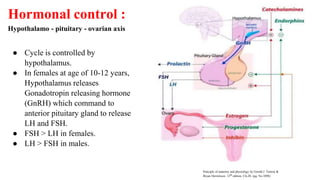
Hormonal control :
Hypothalamo - pituitary - ovarian axis
● Cycle is controlled by
hypothalamus.
● In females at age of 10-12 years,
Hypothalamus releases
Gonadotropin releasing hormone
(GnRH) which command to
anterior pituitary gland to release
LH and FSH.
● FSH > LH in females.
● LH > FSH in males.
Principle of anatomy and physiology by Gerald J. Tortora &
Bryan Derrickson. 12th edition, Ch-28- (pg. No.1098)
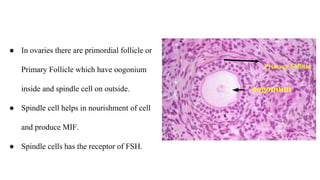
● In ovaries there are primordial follicle or
Primary Follicle which have oogonium
inside and spindle cell on outside.
● Spindle cell helps in nourishment of cell
and produce MIF.
● Spindle cells has the receptor of FSH.
oogonium
Primary Follicle
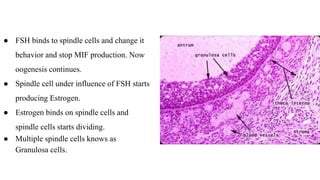
● FSH binds to spindle cells and change it
behavior and stop MIF production. Now
oogenesis continues.
● Spindle cell under influence of FSH starts
producing Estrogen.
● Estrogen binds on spindle cells and
spindle cells starts dividing.
● Multiple spindle cells knows as
Granulosa cells.
● As FSH leads to release of estrogen so at is beginning of female reproduction cycle
known as Menarche event
● Now, menstrual cycle begin and Menstrual cycle runs for 28 day but also for 35 - 42
days in rare case)
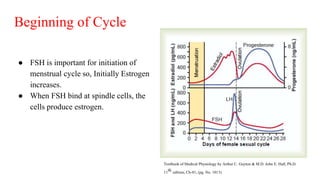
Beginning of Cycle
● FSH is important for initiation of
menstrual cycle so, Initially Estrogen
increases.
● When FSH bind at spindle cells, the
cells produce estrogen.
Textbook of Medical Physiology by Arthur C. Guyton & M.D. John E. Hall, Ph.D.
11
th edition, Ch-81, (pg. No. 1013)
0-4 Days Ovarian Cycle
● In both ovaries 4 to 5 follicle are present, but 8 to 10 follicle start
developing simultaneously.
● Out of 8-10 follicle ,Single dominant follicle is selected and rest
will degenerate.
● FSH is responsible for selecting dominant follicle.
● Estrogen level start to rise as follicular development occurs.
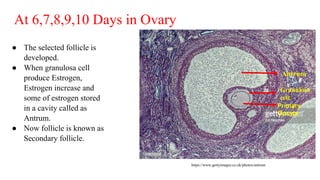
At 6,7,8,9,10 Days in Ovary
● The selected follicle is
developed.
● When granulosa cell
produce Estrogen,
Estrogen increase and
some of estrogen stored
in a cavity called as
Antrum.
● Now follicle is known as
Secondary follicle.
https://www.gettyimages.co.uk/photos/antrum
Antrum
Primary
Oocyte
Granulosa
cell
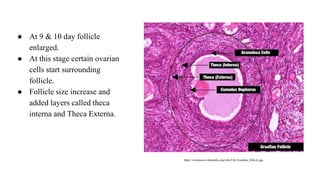
● At 9 & 10 day follicle
enlarged.
● At this stage certain ovarian
cells start surrounding
follicle.
● Follicle size increase and
added layers called theca
interna and Theca Externa.
https://commons.wikimedia.org/wiki/File:Graafian_follicle.jpg
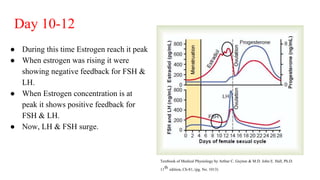
Day 10-12
● During this time Estrogen reach it peak
● When estrogen was rising it were
showing negative feedback for FSH &
LH.
● When Estrogen concentration is at
peak it shows positive feedback for
FSH & LH.
● Now, LH & FSH surge.
Textbook of Medical Physiology by Arthur C. Guyton & M.D. John E. Hall, Ph.D.
11
th edition, Ch-81, (pg. No. 1013)
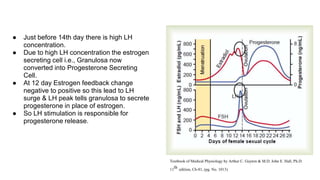
● Just before 14th day there is high LH
concentration.
● Due to high LH concentration the estrogen
secreting cell i.e., Granulosa now
converted into Progesterone Secreting
Cell.
● At 12 day Estrogen feedback change
negative to positive so this lead to LH
surge & LH peak tells granulosa to secrete
progesterone in place of estrogen.
● So LH stimulation is responsible for
progesterone release.
Textbook of Medical Physiology by Arthur C. Guyton & M.D. John E. Hall, Ph.D.
11
th edition, Ch-81, (pg. No. 1013)
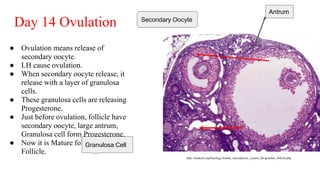
Day 14 Ovulation
● Ovulation means release of
secondary oocyte.
● LH cause ovulation.
● When secondary oocyte release, it
release with a layer of granulosa
cells.
● These granulosa cells are releasing
Progesterone.
● Just before ovulation, follicle have
secondary oocyte, large antrum,
Granulosa cell form Progesterone.
● Now it is Mature follicle or Graafian
Follicle.
http://medcell.org/histology/female_reproductive_system_lab/graafian_follicle.php
Antrum
Granulosa Cell
Secondary Oocyte
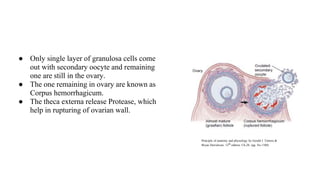
● Only single layer of granulosa cells come
out with secondary oocyte and remaining
one are still in the ovary.
● The one remaining in ovary are known as
Corpus hemorrhagicum.
● The theca externa release Protease, which
help in rupturing of ovarian wall.
Principle of anatomy and physiology by Gerald J. Tortora &
Bryan Derrickson. 12th edition, Ch-28- (pg. No.1100)
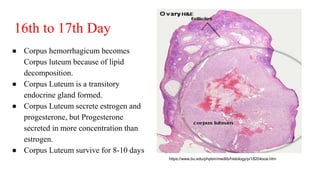
16th to 17th Day
● Corpus hemorrhagicum becomes
Corpus luteum because of lipid
decomposition.
● Corpus Luteum is a transitory
endocrine gland formed.
● Corpus Luteum secrete estrogen and
progesterone, but Progesterone
secreted in more concentration than
estrogen.
● Corpus Luteum survive for 8-10 days
https://www.bu.edu/phpbin/medlib/histology/p/18204ooa.htm
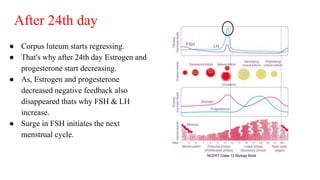
After 24th day
● Corpus luteum starts regressing.
● That's why after 24th day Estrogen and
progesterone start decreasing.
● As, Estrogen and progesterone
decreased negative feedback also
disappeared thats why FSH & LH
increase.
● Surge in FSH initiates the next
menstrual cycle.
NCERT Class 12 Biology Book
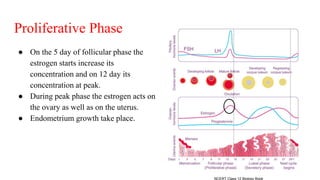
Proliferative Phase
● On the 5 day of follicular phase the
estrogen starts increase its
concentration and on 12 day its
concentration at peak.
● During peak phase the estrogen acts on
the ovary as well as on the uterus.
● Endometrium growth take place.
NCERT Class 12 Biology Book
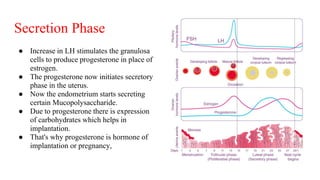
Secretion Phase
● Increase in LH stimulates the granulosa
cells to produce progesterone in place of
estrogen.
● The progesterone now initiates secretory
phase in the uterus.
● Now the endometrium starts secreting
certain Mucopolysaccharide.
● Due to progesterone there is expression
of carbohydrates which helps in
implantation.
● That's why progesterone is hormone of
implantation or pregnancy,
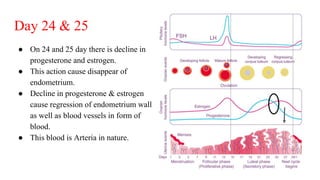
Day 24 & 25
● On 24 and 25 day there is decline in
progesterone and estrogen.
● This action cause disappear of
endometrium.
● Decline in progesterone & estrogen
cause regression of endometrium wall
as well as blood vessels in form of
blood.
● This blood is Arteria in nature.
Reference
● Principle of anatomy and physiology by Gerald J. Tortora & Bryan Derrickson. 12th
edition, Ch-28- (pg. No.1097), (pg. No.1140), (pg. No.1141).
● Textbook of Medical Physiology by Arthur C. Guyton & M.D. John E. Hall, Ph.D.
11th edition, Ch-81, (pg. No. 1012), (pg. No.1013), (pg. No.1014), (pg. No.1015).
Thank you

Menstrual cycle.pptx

  • 1.
  • 2.
    ● There aretwo type of reproductive cycles: ● Menstrual Cycle and Estrous cycle. ● Estrous cycle is reproductive cycle of female of non primates. ● Menstrual cycle is reproductive cycle of female of humans and old world monkeys. Reproductive Cycle
  • 3.
    The Menstrual Cycle:An Overview ● The menstrual cycle is a complex process that occurs in the female body, lasting an average of 28 days. ● It involves the release of hormones from the brain and ovaries, which leads to the shedding of the uterine lining if fertilization does not occur. ● The first menstrual cycle, or first menstrual bleeding, in female humans is known as Menarche. ● The time that marks the end of female menstrual cycles is menopause.
  • 4.
    Hormonal control : Hypothalamo- pituitary - ovarian axis ● Cycle is controlled by hypothalamus. ● In females at age of 10-12 years, Hypothalamus releases Gonadotropin releasing hormone (GnRH) which command to anterior pituitary gland to release LH and FSH. ● FSH > LH in females. ● LH > FSH in males. Principle of anatomy and physiology by Gerald J. Tortora & Bryan Derrickson. 12th edition, Ch-28- (pg. No.1098)
  • 5.
    ● In ovariesthere are primordial follicle or Primary Follicle which have oogonium inside and spindle cell on outside. ● Spindle cell helps in nourishment of cell and produce MIF. ● Spindle cells has the receptor of FSH. oogonium Primary Follicle
  • 6.
    ● FSH bindsto spindle cells and change it behavior and stop MIF production. Now oogenesis continues. ● Spindle cell under influence of FSH starts producing Estrogen. ● Estrogen binds on spindle cells and spindle cells starts dividing. ● Multiple spindle cells knows as Granulosa cells.
  • 7.
    ● As FSHleads to release of estrogen so at is beginning of female reproduction cycle known as Menarche event ● Now, menstrual cycle begin and Menstrual cycle runs for 28 day but also for 35 - 42 days in rare case)
  • 8.
    Beginning of Cycle ●FSH is important for initiation of menstrual cycle so, Initially Estrogen increases. ● When FSH bind at spindle cells, the cells produce estrogen. Textbook of Medical Physiology by Arthur C. Guyton & M.D. John E. Hall, Ph.D. 11 th edition, Ch-81, (pg. No. 1013)
  • 9.
    0-4 Days OvarianCycle ● In both ovaries 4 to 5 follicle are present, but 8 to 10 follicle start developing simultaneously. ● Out of 8-10 follicle ,Single dominant follicle is selected and rest will degenerate. ● FSH is responsible for selecting dominant follicle. ● Estrogen level start to rise as follicular development occurs.
  • 10.
    At 6,7,8,9,10 Daysin Ovary ● The selected follicle is developed. ● When granulosa cell produce Estrogen, Estrogen increase and some of estrogen stored in a cavity called as Antrum. ● Now follicle is known as Secondary follicle. https://www.gettyimages.co.uk/photos/antrum Antrum Primary Oocyte Granulosa cell
  • 11.
    ● At 9& 10 day follicle enlarged. ● At this stage certain ovarian cells start surrounding follicle. ● Follicle size increase and added layers called theca interna and Theca Externa. https://commons.wikimedia.org/wiki/File:Graafian_follicle.jpg
  • 12.
    Day 10-12 ● Duringthis time Estrogen reach it peak ● When estrogen was rising it were showing negative feedback for FSH & LH. ● When Estrogen concentration is at peak it shows positive feedback for FSH & LH. ● Now, LH & FSH surge. Textbook of Medical Physiology by Arthur C. Guyton & M.D. John E. Hall, Ph.D. 11 th edition, Ch-81, (pg. No. 1013)
  • 13.
    ● Just before14th day there is high LH concentration. ● Due to high LH concentration the estrogen secreting cell i.e., Granulosa now converted into Progesterone Secreting Cell. ● At 12 day Estrogen feedback change negative to positive so this lead to LH surge & LH peak tells granulosa to secrete progesterone in place of estrogen. ● So LH stimulation is responsible for progesterone release. Textbook of Medical Physiology by Arthur C. Guyton & M.D. John E. Hall, Ph.D. 11 th edition, Ch-81, (pg. No. 1013)
  • 14.
    Day 14 Ovulation ●Ovulation means release of secondary oocyte. ● LH cause ovulation. ● When secondary oocyte release, it release with a layer of granulosa cells. ● These granulosa cells are releasing Progesterone. ● Just before ovulation, follicle have secondary oocyte, large antrum, Granulosa cell form Progesterone. ● Now it is Mature follicle or Graafian Follicle. http://medcell.org/histology/female_reproductive_system_lab/graafian_follicle.php Antrum Granulosa Cell Secondary Oocyte
  • 15.
    ● Only singlelayer of granulosa cells come out with secondary oocyte and remaining one are still in the ovary. ● The one remaining in ovary are known as Corpus hemorrhagicum. ● The theca externa release Protease, which help in rupturing of ovarian wall. Principle of anatomy and physiology by Gerald J. Tortora & Bryan Derrickson. 12th edition, Ch-28- (pg. No.1100)
  • 16.
    16th to 17thDay ● Corpus hemorrhagicum becomes Corpus luteum because of lipid decomposition. ● Corpus Luteum is a transitory endocrine gland formed. ● Corpus Luteum secrete estrogen and progesterone, but Progesterone secreted in more concentration than estrogen. ● Corpus Luteum survive for 8-10 days https://www.bu.edu/phpbin/medlib/histology/p/18204ooa.htm
  • 17.
    After 24th day ●Corpus luteum starts regressing. ● That's why after 24th day Estrogen and progesterone start decreasing. ● As, Estrogen and progesterone decreased negative feedback also disappeared thats why FSH & LH increase. ● Surge in FSH initiates the next menstrual cycle. NCERT Class 12 Biology Book
  • 18.
    Proliferative Phase ● Onthe 5 day of follicular phase the estrogen starts increase its concentration and on 12 day its concentration at peak. ● During peak phase the estrogen acts on the ovary as well as on the uterus. ● Endometrium growth take place. NCERT Class 12 Biology Book
  • 19.
    Secretion Phase ● Increasein LH stimulates the granulosa cells to produce progesterone in place of estrogen. ● The progesterone now initiates secretory phase in the uterus. ● Now the endometrium starts secreting certain Mucopolysaccharide. ● Due to progesterone there is expression of carbohydrates which helps in implantation. ● That's why progesterone is hormone of implantation or pregnancy,
  • 20.
    Day 24 &25 ● On 24 and 25 day there is decline in progesterone and estrogen. ● This action cause disappear of endometrium. ● Decline in progesterone & estrogen cause regression of endometrium wall as well as blood vessels in form of blood. ● This blood is Arteria in nature.
  • 21.
    Reference ● Principle ofanatomy and physiology by Gerald J. Tortora & Bryan Derrickson. 12th edition, Ch-28- (pg. No.1097), (pg. No.1140), (pg. No.1141). ● Textbook of Medical Physiology by Arthur C. Guyton & M.D. John E. Hall, Ph.D. 11th edition, Ch-81, (pg. No. 1012), (pg. No.1013), (pg. No.1014), (pg. No.1015).
  • 22.