After this presentation, participants shall be able to:
 
 Define Menopause and its transitional stages.
 
 Identify risk factors related to Menopause.
 
 Enumerate its signs and symptoms.
 Identify treatments and its management related to
nursing.
After this presentation, participants shall be able to:
 
 Define Menopause and its transitional stages.
 
 Identify risk factors related to Menopause.
 
 Enumerate its signs and symptoms.
 Identify treatments and its management related to
nursing.
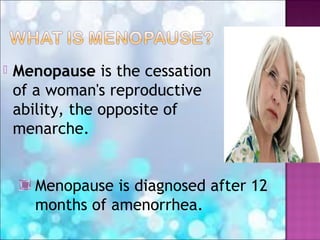
 Menopause is the cessation
of a woman's reproductive
ability, the opposite of
menarche.
Menopause is diagnosed after 12
months of amenorrhea.
 varies greatly from person to person.
 menstrual periods are gradually becoming
more erratic
 timing of the start of the flow usually
becomes more and more difficult to predict
 duration of the flow may be considerably
shorter or longer than normal
 heavier or lighter
 Age
 Surgery/ Operations
 Diseases/ Disorders
 Smoking
 Racial/ ethnic factors
 Twins
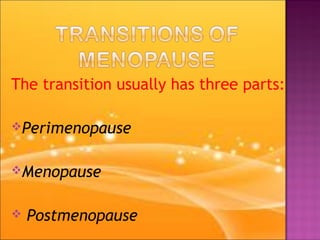
The transition usually has three parts:
Perimenopause
Menopause
 Postmenopause
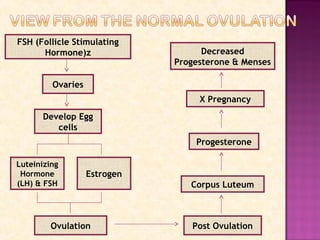
FSH (Follicle Stimulating
Hormone)z
Ovaries
Develop Egg
cells
Estrogen
Luteinizing
Hormone
(LH) & FSH
Ovulation Post Ovulation
Corpus Luteum
Progesterone
X Pregnancy
Decreased
Progesterone & Menses
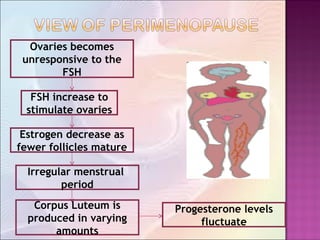
Ovaries becomes
unresponsive to the
FSH
FSH increase to
stimulate ovaries
Estrogen decrease as
fewer follicles mature
Irregular menstrual
period
Corpus Luteum is
produced in varying
amounts
Progesterone levels
fluctuate
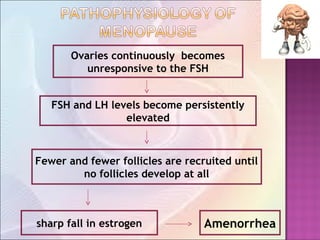
Ovaries continuously becomes
unresponsive to the FSH
Fewer and fewer follicles are recruited until
no follicles develop at all
FSH and LH levels become persistently
elevated
sharp fall in estrogen Amenorrhea
GENERAL
 Hot flashes (aka hot flushes)
 night sweats
 cold flashes
 increased risk of atherosclerosis
 Migraine
 Rapid heartbeat
 Dysfunctional bleeding as part of menstruation.
 Ovaries
 Fallopian tubes
 Uterus
 Vagina
 Vulva
 Breast fat
 Bladder and urethra
 Depression and/or anxiety
 Fatigue
 Irritability
 Memory loss, and problems with
concentration
 Mood disturbance
 Sleep disturbances, poor or light sleep,
insomnia, and daytime sleepiness
 Osteoporosis
 Heart Diseases
 Urinary Incontinence
 Weight Gain
 Sexual function
 An increase in serum follicle-stimulating
hormone (FSH) and decreases in estradiol
and inhibin.
 FSH levels are higher than luteinizing
hormone (LH) levels, and both rise to even
higher values than those seen in the surge
during the menstrual cycle.
 The FSH rise precedes the LH rise
 No specific changes in thyroid functio
 Hormone Therapy
 Vaginal Estrogen
 Low-Dose Anti Depressant
 Gabapentin (Neurontin)
 Medication to prevent or treat
Osteoporesis
 Complementary and alternative
medicine
Herbal preparations
Acupuncture
Hypnosis
Yoga
 Encouraged regular exercise.
 Encourage family members to give
emotional support to prevent depression.
 Encouraged to take healthy and balance
diet.
 Encourage to practice relaxation
techniques and get enough sleep.
Health Education
 Instruct to get enough calcium, Vitamin
D or minerals and supplements if
recommended by the Doctor.
 Instruct to quit smoking.
 Instruct to wear light and comfortable
clothes.
Health Education
 The 2012 hormone therapy position statement of the North American
Menopause Society. Menopause.
 
 Lobo R. Menopause and care of the mature woman. In: Lentz GM,
Lobo RA, Gershenson DM, Katz VL, eds.Comprehensive
Gynecology. 6th ed. Philadelphia, PA: Mosby Elsevier.
 American College of Obstetricians and Gynecologists Committee on
Gynecologic Practice. ACOG Committee Opinion No. 420, November
2008: hormone therapy and heart disease. Obstet Gynecol. 
 The 2012 hormone therapy position statement of the North American
Menopause Society. Menopause.
 
 Lobo R. Menopause and care of the mature woman. In: Lentz GM,
Lobo RA, Gershenson DM, Katz VL, eds.Comprehensive
Gynecology. 6th ed. Philadelphia, PA: Mosby Elsevier.
 American College of Obstetricians and Gynecologists Committee on
Gynecologic Practice. ACOG Committee Opinion No. 420, November
2008: hormone therapy and heart disease. Obstet Gynecol. 
Menopause
is a natural
biological
process.
It is not a
disease to be
treated.
Let us all
remember….

Menopause

  • 2.
    After this presentation,participants shall be able to:    Define Menopause and its transitional stages.    Identify risk factors related to Menopause.    Enumerate its signs and symptoms.  Identify treatments and its management related to nursing. After this presentation, participants shall be able to:    Define Menopause and its transitional stages.    Identify risk factors related to Menopause.    Enumerate its signs and symptoms.  Identify treatments and its management related to nursing.
  • 3.
     Menopause isthe cessation of a woman's reproductive ability, the opposite of menarche. Menopause is diagnosed after 12 months of amenorrhea.
  • 4.
     varies greatlyfrom person to person.  menstrual periods are gradually becoming more erratic  timing of the start of the flow usually becomes more and more difficult to predict  duration of the flow may be considerably shorter or longer than normal  heavier or lighter
  • 5.
     Age  Surgery/Operations  Diseases/ Disorders  Smoking  Racial/ ethnic factors  Twins
  • 6.
    The transition usuallyhas three parts: Perimenopause Menopause  Postmenopause
  • 7.
    FSH (Follicle Stimulating Hormone)z Ovaries DevelopEgg cells Estrogen Luteinizing Hormone (LH) & FSH Ovulation Post Ovulation Corpus Luteum Progesterone X Pregnancy Decreased Progesterone & Menses
  • 8.
    Ovaries becomes unresponsive tothe FSH FSH increase to stimulate ovaries Estrogen decrease as fewer follicles mature Irregular menstrual period Corpus Luteum is produced in varying amounts Progesterone levels fluctuate
  • 9.
    Ovaries continuously becomes unresponsiveto the FSH Fewer and fewer follicles are recruited until no follicles develop at all FSH and LH levels become persistently elevated sharp fall in estrogen Amenorrhea
  • 10.
    GENERAL  Hot flashes(aka hot flushes)  night sweats  cold flashes  increased risk of atherosclerosis  Migraine  Rapid heartbeat  Dysfunctional bleeding as part of menstruation.
  • 11.
     Ovaries  Fallopiantubes  Uterus  Vagina  Vulva  Breast fat  Bladder and urethra
  • 12.
     Depression and/oranxiety  Fatigue  Irritability  Memory loss, and problems with concentration  Mood disturbance  Sleep disturbances, poor or light sleep, insomnia, and daytime sleepiness
  • 13.
     Osteoporosis  HeartDiseases  Urinary Incontinence  Weight Gain  Sexual function
  • 14.
     An increasein serum follicle-stimulating hormone (FSH) and decreases in estradiol and inhibin.  FSH levels are higher than luteinizing hormone (LH) levels, and both rise to even higher values than those seen in the surge during the menstrual cycle.  The FSH rise precedes the LH rise  No specific changes in thyroid functio
  • 15.
     Hormone Therapy Vaginal Estrogen  Low-Dose Anti Depressant  Gabapentin (Neurontin)  Medication to prevent or treat Osteoporesis
  • 16.
     Complementary andalternative medicine Herbal preparations Acupuncture Hypnosis Yoga
  • 17.
     Encouraged regularexercise.  Encourage family members to give emotional support to prevent depression.  Encouraged to take healthy and balance diet.  Encourage to practice relaxation techniques and get enough sleep. Health Education
  • 18.
     Instruct toget enough calcium, Vitamin D or minerals and supplements if recommended by the Doctor.  Instruct to quit smoking.  Instruct to wear light and comfortable clothes. Health Education
  • 19.
     The 2012hormone therapy position statement of the North American Menopause Society. Menopause.    Lobo R. Menopause and care of the mature woman. In: Lentz GM, Lobo RA, Gershenson DM, Katz VL, eds.Comprehensive Gynecology. 6th ed. Philadelphia, PA: Mosby Elsevier.  American College of Obstetricians and Gynecologists Committee on Gynecologic Practice. ACOG Committee Opinion No. 420, November 2008: hormone therapy and heart disease. Obstet Gynecol.   The 2012 hormone therapy position statement of the North American Menopause Society. Menopause.    Lobo R. Menopause and care of the mature woman. In: Lentz GM, Lobo RA, Gershenson DM, Katz VL, eds.Comprehensive Gynecology. 6th ed. Philadelphia, PA: Mosby Elsevier.  American College of Obstetricians and Gynecologists Committee on Gynecologic Practice. ACOG Committee Opinion No. 420, November 2008: hormone therapy and heart disease. Obstet Gynecol. 
  • 20.
    Menopause is a natural biological process. Itis not a disease to be treated. Let us all remember….