Chapter 7
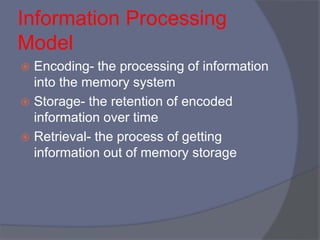
Information Processing
Model
 Encoding- the processing of information
into the memory system
 Storage- the retention of encoded
information over time
 Retrieval- the process of getting
information out of memory storage
Encoding: Getting Information
In
 Automatically processing- unconscious
encoding of everyday information such
as space, time, frequency and well-
learned word meanings
 What did you have for dinner last night?
Encoding: Getting Information
In
 Effortful processing- encoding that
requires attention and conscious effort
 Rehearsal- repetition of information
 Spacing effect- spread rehearsal over time
 Serial position effect- the tendency to recall
best the last and first word on a list
Encoding Effectively
 Encoding Meaning- making connections
between new information and what we
already know
 Visual Encoding- we may struggle to
remember formulas, dates, and
definitions, yet we easily remember
visual images
Storage
 Unless our working memory rehearses
or meaningfully encode sensory info, it
quickly disappears
 Typically, we can store about 7 bits of
information in our short term memory
Long Term Memory
 Memories that are permanently stored
 Flashbulb memories- a clear memory of
an emotionally significant moment or
event
 Implicit memories- retaining learned
skills or conditioning
 Explicit memories- memories or facts
and personal events that you can
consciously retrieve
Retrieval
 Recall- memory demonstrated by
retrieving information learned earlier
 Fill in the blank
 Recognition- memory demonstrated by
identifying items previously learned
 Multiple choice
Retrieval
 Retrieval clues- any stimulus linked to a
specific memory (place, event, feeling)
○ Read page 190
 Déjà vu- eerie sense that “I’ve
experienced this before”. Cues from the
current situation may unconsciously
trigger retrieval of an earlier experience.
○ Read page 191

Memory notes

  • 1.
  • 2.
    Information Processing Model  Encoding-the processing of information into the memory system  Storage- the retention of encoded information over time  Retrieval- the process of getting information out of memory storage
  • 3.
    Encoding: Getting Information In Automatically processing- unconscious encoding of everyday information such as space, time, frequency and well- learned word meanings  What did you have for dinner last night?
  • 4.
    Encoding: Getting Information In Effortful processing- encoding that requires attention and conscious effort  Rehearsal- repetition of information  Spacing effect- spread rehearsal over time  Serial position effect- the tendency to recall best the last and first word on a list
  • 5.
    Encoding Effectively  EncodingMeaning- making connections between new information and what we already know  Visual Encoding- we may struggle to remember formulas, dates, and definitions, yet we easily remember visual images
  • 6.
    Storage  Unless ourworking memory rehearses or meaningfully encode sensory info, it quickly disappears  Typically, we can store about 7 bits of information in our short term memory
  • 7.
    Long Term Memory Memories that are permanently stored  Flashbulb memories- a clear memory of an emotionally significant moment or event  Implicit memories- retaining learned skills or conditioning  Explicit memories- memories or facts and personal events that you can consciously retrieve
  • 8.
    Retrieval  Recall- memorydemonstrated by retrieving information learned earlier  Fill in the blank  Recognition- memory demonstrated by identifying items previously learned  Multiple choice
  • 9.
    Retrieval  Retrieval clues-any stimulus linked to a specific memory (place, event, feeling) ○ Read page 190  Déjà vu- eerie sense that “I’ve experienced this before”. Cues from the current situation may unconsciously trigger retrieval of an earlier experience. ○ Read page 191