Merge Sort
ACP
Merge Sort 2
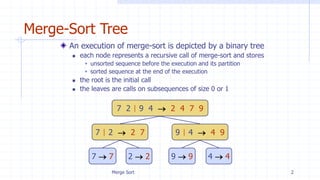
Merge-Sort Tree
An execution of merge-sort is depicted by a binary tree
 each node represents a recursive call of merge-sort and stores
 unsorted sequence before the execution and its partition
 sorted sequence at the end of the execution
 the root is the initial call
 the leaves are calls on subsequences of size 0 or 1
7 2  9 4  2 4 7 9
7  2  2 7 9  4  4 9
7  7 2  2 9  9 4  4
Merge Sort 3
Execution Example
Partition
7 2 9 4  2 4 7 9 3 8 6 1  1 3 8 6
7 2  2 7 9 4  4 9 3 8  3 8 6 1  1 6
7  7 2  2 9  9 4  4 3  3 8  8 6  6 1  1
7 2 9 4  3 8 6 1  1 2 3 4 6 7 8 9
Merge Sort 4
Execution Example (cont.)
Recursive call, partition
7 2  9 4  2 4 7 9 3 8 6 1  1 3 8 6
7 2  2 7 9 4  4 9 3 8  3 8 6 1  1 6
7  7 2  2 9  9 4  4 3  3 8  8 6  6 1  1
7 2 9 4  3 8 6 1  1 2 3 4 6 7 8 9
Merge Sort 5
Execution Example (cont.)
Recursive call, partition
7 2  9 4  2 4 7 9 3 8 6 1  1 3 8 6
7  2  2 7 9 4  4 9 3 8  3 8 6 1  1 6
7  7 2  2 9  9 4  4 3  3 8  8 6  6 1  1
7 2 9 4  3 8 6 1  1 2 3 4 6 7 8 9
Merge Sort 6
Execution Example (cont.)
Recursive call, base case
7 2  9 4  2 4 7 9 3 8 6 1  1 3 8 6
7  2  2 7 9 4  4 9 3 8  3 8 6 1  1 6
7  7 2  2 9  9 4  4 3  3 8  8 6  6 1  1
7 2 9 4  3 8 6 1  1 2 3 4 6 7 8 9
Merge Sort 7
Execution Example (cont.)
Recursive call, base case
7 2  9 4  2 4 7 9 3 8 6 1  1 3 8 6
7  2  2 7 9 4  4 9 3 8  3 8 6 1  1 6
7  7 2  2 9  9 4  4 3  3 8  8 6  6 1  1
7 2 9 4  3 8 6 1  1 2 3 4 6 7 8 9
Merge Sort 8
Execution Example (cont.)
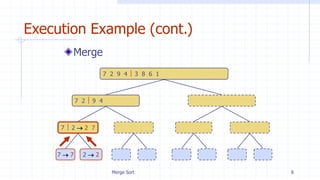
Merge
7 2  9 4  2 4 7 9 3 8 6 1  1 3 8 6
7  2  2 7 9 4  4 9 3 8  3 8 6 1  1 6
7  7 2  2 9  9 4  4 3  3 8  8 6  6 1  1
7 2 9 4  3 8 6 1  1 2 3 4 6 7 8 9
Merge Sort 9
Execution Example (cont.)
Recursive call, …, base case, merge
7 2  9 4  2 4 7 9 3 8 6 1  1 3 8 6
7  2  2 7 9 4  4 9 3 8  3 8 6 1  1 6
7  7 2  2 3  3 8  8 6  6 1  1
7 2 9 4  3 8 6 1  1 2 3 4 6 7 8 9
9  9 4  4
Merge Sort 10
Execution Example (cont.)
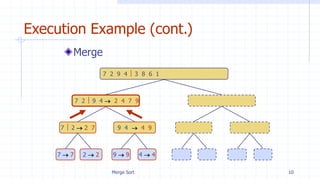
Merge
7 2  9 4  2 4 7 9 3 8 6 1  1 3 8 6
7  2  2 7 9 4  4 9 3 8  3 8 6 1  1 6
7  7 2  2 9  9 4  4 3  3 8  8 6  6 1  1
7 2 9 4  3 8 6 1  1 2 3 4 6 7 8 9
Merge Sort 11
Execution Example (cont.)
Recursive call, …, merge, merge
7 2  9 4  2 4 7 9 3 8 6 1  1 3 6 8
7  2  2 7 9 4  4 9 3 8  3 8 6 1  1 6
7  7 2  2 9  9 4  4 3  3 8  8 6  6 1  1
7 2 9 4  3 8 6 1  1 2 3 4 6 7 8 9
Merge Sort 12
Execution Example (cont.)
Merge
7 2  9 4  2 4 7 9 3 8 6 1  1 3 6 8
7  2  2 7 9 4  4 9 3 8  3 8 6 1  1 6
7  7 2  2 9  9 4  4 3  3 8  8 6  6 1  1
7 2 9 4  3 8 6 1  1 2 3 4 6 7 8 9
Merge Sort 13
#include<stdio.h>
void mergesort(int a[],int i,int j);
void merge(int a[],int i1,int j1,int i2,int j2);
int main()
{
int a[30],n,i;
printf("Enter no of elements:");
scanf("%d",&n);
printf("Enter array elements:");
for(i=0;i<n;i++)
scanf("%d",&a[i]);
mergesort(a,0,n-1);
printf("nSorted array is :");
for(i=0;i<n;i++)
printf("%d ",a[i]);
return 0;
}
void mergesort(int a[],int i,int j)
{
int mid;
if(i<j)
{
mid=(i+j)/2;
mergesort(a,i,mid); //left recursion
mergesort(a,mid+1,j); //right recursion
merge(a,i,mid,mid+1,j); //merging of two sorted sub-
arrays
}
}
void merge(int a[],int i1,int j1,int i2,int j2)
{
int temp[50]; //array used for merging
int i,j,k;
i=i1; //beginning of the first list
j=i2; //beginning of the second list
k=0;
while(i<=j1 && j<=j2) //while elements in both lists
{
if(a[i]<a[j])
temp[k++]=a[i++];
else
temp[k++]=a[j++];
}
while(i<=j1) //copy remaining elements of the first list
temp[k++]=a[i++];
while(j<=j2) //copy remaining elements of the second list
temp[k++]=a[j++];
//Transfer elements from temp[] back to a[]
for(i=i1,j=0;i<=j2;i++,j++)
a[i]=temp[j];
}
Merge sort

Merge sort

  • 1.
  • 2.
    Merge Sort 2 Merge-SortTree An execution of merge-sort is depicted by a binary tree  each node represents a recursive call of merge-sort and stores  unsorted sequence before the execution and its partition  sorted sequence at the end of the execution  the root is the initial call  the leaves are calls on subsequences of size 0 or 1 7 2  9 4  2 4 7 9 7  2  2 7 9  4  4 9 7  7 2  2 9  9 4  4
  • 3.
    Merge Sort 3 ExecutionExample Partition 7 2 9 4  2 4 7 9 3 8 6 1  1 3 8 6 7 2  2 7 9 4  4 9 3 8  3 8 6 1  1 6 7  7 2  2 9  9 4  4 3  3 8  8 6  6 1  1 7 2 9 4  3 8 6 1  1 2 3 4 6 7 8 9
  • 4.
    Merge Sort 4 ExecutionExample (cont.) Recursive call, partition 7 2  9 4  2 4 7 9 3 8 6 1  1 3 8 6 7 2  2 7 9 4  4 9 3 8  3 8 6 1  1 6 7  7 2  2 9  9 4  4 3  3 8  8 6  6 1  1 7 2 9 4  3 8 6 1  1 2 3 4 6 7 8 9
  • 5.
    Merge Sort 5 ExecutionExample (cont.) Recursive call, partition 7 2  9 4  2 4 7 9 3 8 6 1  1 3 8 6 7  2  2 7 9 4  4 9 3 8  3 8 6 1  1 6 7  7 2  2 9  9 4  4 3  3 8  8 6  6 1  1 7 2 9 4  3 8 6 1  1 2 3 4 6 7 8 9
  • 6.
    Merge Sort 6 ExecutionExample (cont.) Recursive call, base case 7 2  9 4  2 4 7 9 3 8 6 1  1 3 8 6 7  2  2 7 9 4  4 9 3 8  3 8 6 1  1 6 7  7 2  2 9  9 4  4 3  3 8  8 6  6 1  1 7 2 9 4  3 8 6 1  1 2 3 4 6 7 8 9
  • 7.
    Merge Sort 7 ExecutionExample (cont.) Recursive call, base case 7 2  9 4  2 4 7 9 3 8 6 1  1 3 8 6 7  2  2 7 9 4  4 9 3 8  3 8 6 1  1 6 7  7 2  2 9  9 4  4 3  3 8  8 6  6 1  1 7 2 9 4  3 8 6 1  1 2 3 4 6 7 8 9
  • 8.
    Merge Sort 8 ExecutionExample (cont.) Merge 7 2  9 4  2 4 7 9 3 8 6 1  1 3 8 6 7  2  2 7 9 4  4 9 3 8  3 8 6 1  1 6 7  7 2  2 9  9 4  4 3  3 8  8 6  6 1  1 7 2 9 4  3 8 6 1  1 2 3 4 6 7 8 9
  • 9.
    Merge Sort 9 ExecutionExample (cont.) Recursive call, …, base case, merge 7 2  9 4  2 4 7 9 3 8 6 1  1 3 8 6 7  2  2 7 9 4  4 9 3 8  3 8 6 1  1 6 7  7 2  2 3  3 8  8 6  6 1  1 7 2 9 4  3 8 6 1  1 2 3 4 6 7 8 9 9  9 4  4
  • 10.
    Merge Sort 10 ExecutionExample (cont.) Merge 7 2  9 4  2 4 7 9 3 8 6 1  1 3 8 6 7  2  2 7 9 4  4 9 3 8  3 8 6 1  1 6 7  7 2  2 9  9 4  4 3  3 8  8 6  6 1  1 7 2 9 4  3 8 6 1  1 2 3 4 6 7 8 9
  • 11.
    Merge Sort 11 ExecutionExample (cont.) Recursive call, …, merge, merge 7 2  9 4  2 4 7 9 3 8 6 1  1 3 6 8 7  2  2 7 9 4  4 9 3 8  3 8 6 1  1 6 7  7 2  2 9  9 4  4 3  3 8  8 6  6 1  1 7 2 9 4  3 8 6 1  1 2 3 4 6 7 8 9
  • 12.
    Merge Sort 12 ExecutionExample (cont.) Merge 7 2  9 4  2 4 7 9 3 8 6 1  1 3 6 8 7  2  2 7 9 4  4 9 3 8  3 8 6 1  1 6 7  7 2  2 9  9 4  4 3  3 8  8 6  6 1  1 7 2 9 4  3 8 6 1  1 2 3 4 6 7 8 9
  • 13.
  • 14.
    #include<stdio.h> void mergesort(int a[],inti,int j); void merge(int a[],int i1,int j1,int i2,int j2); int main() { int a[30],n,i; printf("Enter no of elements:"); scanf("%d",&n); printf("Enter array elements:"); for(i=0;i<n;i++) scanf("%d",&a[i]); mergesort(a,0,n-1); printf("nSorted array is :"); for(i=0;i<n;i++) printf("%d ",a[i]); return 0; } void mergesort(int a[],int i,int j) { int mid; if(i<j) { mid=(i+j)/2; mergesort(a,i,mid); //left recursion mergesort(a,mid+1,j); //right recursion merge(a,i,mid,mid+1,j); //merging of two sorted sub- arrays } }
  • 15.
    void merge(int a[],inti1,int j1,int i2,int j2) { int temp[50]; //array used for merging int i,j,k; i=i1; //beginning of the first list j=i2; //beginning of the second list k=0; while(i<=j1 && j<=j2) //while elements in both lists { if(a[i]<a[j]) temp[k++]=a[i++]; else temp[k++]=a[j++]; } while(i<=j1) //copy remaining elements of the first list temp[k++]=a[i++]; while(j<=j2) //copy remaining elements of the second list temp[k++]=a[j++]; //Transfer elements from temp[] back to a[] for(i=i1,j=0;i<=j2;i++,j++) a[i]=temp[j]; }