Example :-
When customer goes to a fruit vendor….
Need of Datatypes in programming
vendor: what do u want sir/madam.
Customer: I want apple. How much does it costs?
Vendor: How many do u want sir/madam.
Customer : Answers according to his/her requirement.which
is a variable x( which changes every time).
Vendor : Now he calculates the rate(c.p + profit) and sells the
apples.
In order to do this calculation in programming we need a thing
that can hold a value (a number like 5 or 20 etc)
That’s where we need
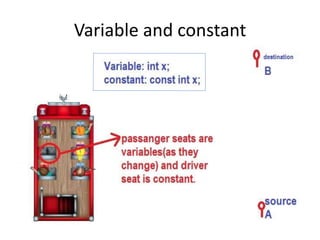
Variable and constant
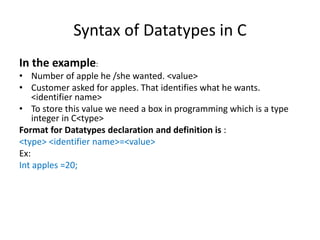
Syntax of Datatypes in C
In the example:
• Number of apple he /she wanted. <value>
• Customer asked for apples. That identifies what he wants.
<identifier name>
• To store this value we need a box in programming which is a type
integer in C<type>
Format for Datatypes declaration and definition is :
<type> <identifier name>=<value>
Ex:
Int apples =20;
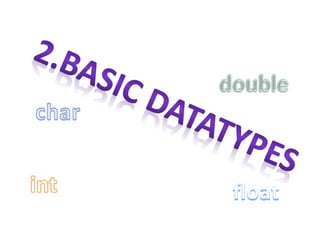
Types of Datatypes
Datatype Use to hold Example
int for integer range numbers -5
float for decimal range numbers 99.99
char for character numbers A
double for more precision decimal numbers 99.999999
* Long <datatype> for hold big numbers 34,333
* short <datatype> for value inside 32,768 8987
signed <datatype> **for only positive numbers 88
Unsigned<datatype> **for positive and negative numbers -96
•Except char Datatype.
•In char we have -128 t0 127 range for unsigned char and 0 to 255 for signed char
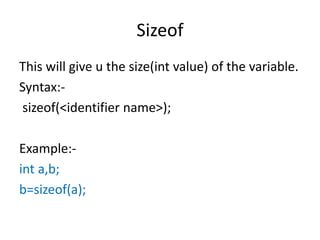
Sizeof
This will give u the size(int value) of the variable.
Syntax:-
sizeof(<identifier name>);
Example:-
int a,b;
b=sizeof(a);
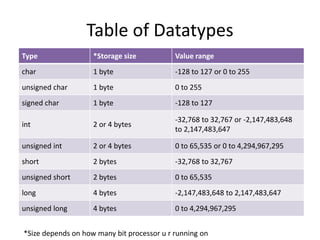
Table of Datatypes
Type *Storage size Value range
char 1 byte -128 to 127 or 0 to 255
unsigned char 1 byte 0 to 255
signed char 1 byte -128 to 127
int 2 or 4 bytes
-32,768 to 32,767 or -2,147,483,648
to 2,147,483,647
unsigned int 2 or 4 bytes 0 to 65,535 or 0 to 4,294,967,295
short 2 bytes -32,768 to 32,767
unsigned short 2 bytes 0 to 65,535
long 4 bytes -2,147,483,648 to 2,147,483,647
unsigned long 4 bytes 0 to 4,294,967,295
*Size depends on how many bit processor u r running on
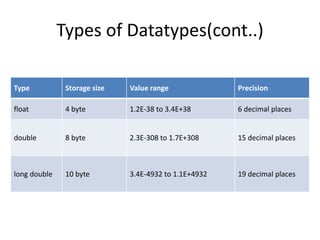
Types of Datatypes(cont..)
Type Storage size Value range Precision
float 4 byte 1.2E-38 to 3.4E+38 6 decimal places
double 8 byte 2.3E-308 to 1.7E+308 15 decimal places
long double 10 byte 3.4E-4932 to 1.1E+4932 19 decimal places
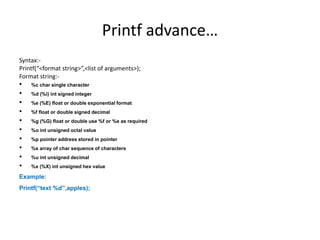
Printf advance…
Syntax:-
Printf(“<format string>”,<list of arguments>);
Format string:-
• %c char single character
• %d (%i) int signed integer
• %e (%E) float or double exponential format
• %f float or double signed decimal
• %g (%G) float or double use %f or %e as required
• %o int unsigned octal value
• %p pointer address stored in pointer
• %s array of char sequence of characters
• %u int unsigned decimal
• %x (%X) int unsigned hex value
Example:
Printf(“text %d”,apples);
Additional links
Website:-http://Sandeepedu65.blogspot.in
Youtube :-https://www.youtube.com/watch?v=_t0L462p930
Contact me:-
Email id:-ramsandeep1234@gmail.com

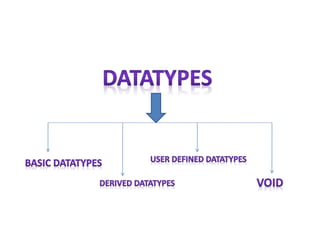
Datatypes

  • 4.
    Example :- When customergoes to a fruit vendor….
  • 5.
    Need of Datatypesin programming vendor: what do u want sir/madam. Customer: I want apple. How much does it costs? Vendor: How many do u want sir/madam. Customer : Answers according to his/her requirement.which is a variable x( which changes every time). Vendor : Now he calculates the rate(c.p + profit) and sells the apples. In order to do this calculation in programming we need a thing that can hold a value (a number like 5 or 20 etc) That’s where we need
  • 6.
  • 7.
    Syntax of Datatypesin C In the example: • Number of apple he /she wanted. <value> • Customer asked for apples. That identifies what he wants. <identifier name> • To store this value we need a box in programming which is a type integer in C<type> Format for Datatypes declaration and definition is : <type> <identifier name>=<value> Ex: Int apples =20;
  • 8.
    Types of Datatypes DatatypeUse to hold Example int for integer range numbers -5 float for decimal range numbers 99.99 char for character numbers A double for more precision decimal numbers 99.999999 * Long <datatype> for hold big numbers 34,333 * short <datatype> for value inside 32,768 8987 signed <datatype> **for only positive numbers 88 Unsigned<datatype> **for positive and negative numbers -96 •Except char Datatype. •In char we have -128 t0 127 range for unsigned char and 0 to 255 for signed char
  • 9.
    Sizeof This will giveu the size(int value) of the variable. Syntax:- sizeof(<identifier name>); Example:- int a,b; b=sizeof(a);
  • 10.
    Table of Datatypes Type*Storage size Value range char 1 byte -128 to 127 or 0 to 255 unsigned char 1 byte 0 to 255 signed char 1 byte -128 to 127 int 2 or 4 bytes -32,768 to 32,767 or -2,147,483,648 to 2,147,483,647 unsigned int 2 or 4 bytes 0 to 65,535 or 0 to 4,294,967,295 short 2 bytes -32,768 to 32,767 unsigned short 2 bytes 0 to 65,535 long 4 bytes -2,147,483,648 to 2,147,483,647 unsigned long 4 bytes 0 to 4,294,967,295 *Size depends on how many bit processor u r running on
  • 11.
    Types of Datatypes(cont..) TypeStorage size Value range Precision float 4 byte 1.2E-38 to 3.4E+38 6 decimal places double 8 byte 2.3E-308 to 1.7E+308 15 decimal places long double 10 byte 3.4E-4932 to 1.1E+4932 19 decimal places
  • 12.
    Printf advance… Syntax:- Printf(“<format string>”,<listof arguments>); Format string:- • %c char single character • %d (%i) int signed integer • %e (%E) float or double exponential format • %f float or double signed decimal • %g (%G) float or double use %f or %e as required • %o int unsigned octal value • %p pointer address stored in pointer • %s array of char sequence of characters • %u int unsigned decimal • %x (%X) int unsigned hex value Example: Printf(“text %d”,apples);
  • 15.