Unit I:
Digital Logic Families
By
Dr. Anup Vibhute
Dr. D Y Patil Institute of Technology, Pimpri, Pune
Contents:
• Syllabus
• Logic families- Introduction
• Classification of Families
• Characteristics of Logic Families
• TTL families
• CMOS families
• Interfacing of TTL-CMOS
Syllabus:
Classification and Characteristics of digital Logic Families: -Speed, power
dissipation, figure of merit, fan in, fan out, current, voltage, noise immunity,
operating temperatures and power supply requirements.
TTL logic. Operation of TTL NAND gate, active pull up, wired AND, open
collector output, unconnected inputs. Tri-State logic.
CMOS logic: CMOS inverter, NAND, NOR gates, unconnected inputs, wired
logic, open drain output.
Interfacing CMOS and TTL and Data sheet specifications
Course Outcome:
CO1: Classify and characterize the digital logic families
• CO1.1 Classify the various Logic families on the basis of components
• CO1.2 Characterize the Logic families for various parameters.
Introduction:
Data sheet specifications
LOGIC FAMILY
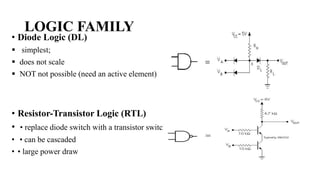
• Diode Logic (DL)
 simplest;
 does not scale
 NOT not possible (need an active element)
• Resistor-Transistor Logic (RTL)
• • replace diode switch with a transistor switch
• • can be cascaded
• • large power draw
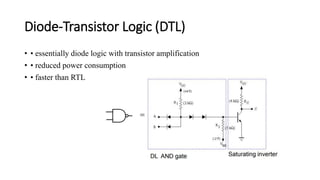
Diode-Transistor Logic (DTL)
• • essentially diode logic with transistor amplification
• • reduced power consumption
• • faster than RTL
ECL Emitter-Coupled Logic (ECL)
Based on BJT, but removes problems of delay time by preventing the transistors
from saturating
Very fast operation - propagation delays of 1ns or less
 High power consumption, perhaps 60 mW/gate • Logic levels. “0”: –1.7V. “1”: –
0.8V
Such strange logic levels require extra effort when interfacing to TTL/CMOS
logic families. • low noise immunity of about 0.2-0.25 V
Used in some high speed specialist applications, but now largely replaced by high
speed CMOS
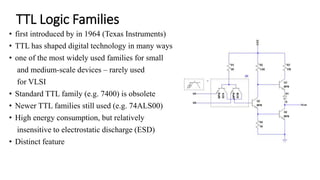
TTL Logic Families
• first introduced by in 1964 (Texas Instruments)
• TTL has shaped digital technology in many ways
• one of the most widely used families for small
and medium-scale devices – rarely used
for VLSI
• Standard TTL family (e.g. 7400) is obsolete
• Newer TTL families still used (e.g. 74ALS00)
• High energy consumption, but relatively
insensitive to electrostatic discharge (ESD)
• Distinct feature
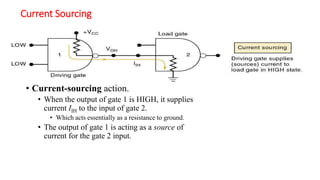
Current Sourcing
• Current-sourcing action.
• When the output of gate 1 is HIGH, it supplies
current IIH to the input of gate 2.
• Which acts essentially as a resistance to ground.
• The output of gate 1 is acting as a source of
current for the gate 2 input.
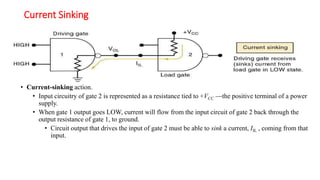
Current Sinking
• Current-sinking action.
• Input circuitry of gate 2 is represented as a resistance tied to +VCC —the positive terminal of a power
supply.
• When gate 1 output goes LOW, current will flow from the input circuit of gate 2 back through the
output resistance of gate 1, to ground.
• Circuit output that drives the input of gate 2 must be able to sink a current, IIL , coming from that
input.
Transistor- Transistor Logic (TTL)
• It depends upon the transistor to perform basic logic operations hence named
Transistor-Transistor Logic (TTL)
• Most popular family and widely used in digital ICs.
• TTL uses transistors which are operating in saturated mode.
• It is fastest in saturated logic family, i.e. TTL is faster than RTL, DTL, I2L, DCTL,
HTL
• It is a logic family implemented with bipolar process technology that combines or
integrates NPN transistors, PN junction diodes and diffused resistors in a single
monolithic structure to get the desired logic function.
• The merits of TTL circuit are
1. Good speed
2. Low cost
3. Wide range of circuits
4. Availability in SSI and MSI
Transistor- Transistor Logic (TTL)
• Demerits are:
1. Tight Vcc Tolerance
2. Relatively high power consumption
3. Moderate packing density
4. Generation of noise spikes
5. Susceptibility to power transients
• TTL logic family have several subfamilies such as
• Standard TTL,
• High speed TTL,
• Low power TTL,
• Low power Schottky TTL,
• Advanced Schottky TTL,
• Advanced Low power Schottky TTL and
• Fast (F)TTL
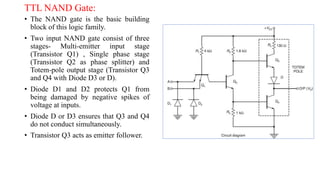
TTL NAND Gate:
• The NAND gate is the basic building
block of this logic family.
• Two input NAND gate consist of three
stages- Multi-emitter input stage
(Transistor Q1) , Single phase stage
(Transistor Q2 as phase splitter) and
Totem-pole output stage (Transistor Q3
and Q4 with Diode D3 or D).
• Diode D1 and D2 protects Q1 from
being damaged by negative spikes of
voltage at inputs.
• Diode D or D3 ensures that Q3 and Q4
do not conduct simultaneously.
• Transistor Q3 acts as emitter follower.
TTL NAND Gate:
A B Vo Q1 Q2 Q3 Q4
0 (L) 0 (L) 1 (H) ON OFF ON OFF
0 1 1 ON OFF ON OFF
1 0 1 ON OFF ON OFF
1 1 0 OFF ON OFF ON
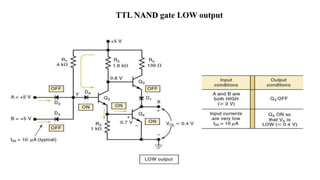
TTL NAND gate LOW output
Q4 is performing a current-sinking action—
deriving its current from the input
current (IIL) of the load gate.
Q4 is often called the current-sinking
transistor or pull-down transistor because
it brings the output voltage down to its LOW
state.
TTL NAND gate LOW output..Cont
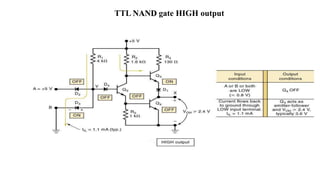
TTL NAND gate HIGH output
• A TTL output acts as a current source in the HIGH state.
Transistor Q3 is supplying the input current
(IIH) required
by Q1 of the load gate.
Q3 is often called the current-sourcing or pull-
up transistor.
In more modern TTL series,
the pull-up circuit is made
up of two transistors.
TTL NAND gate HIGH output…..Cont.
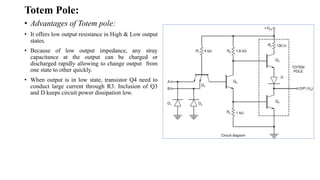
Totem Pole:
• Transistor Q3 & Q4 constitutes the
Totem-pole arrangement at the output
of NAND gate.
• At any time, only one of the transistors
is conducting, i.e., both cannot be
turned ON or OFF simultaneously and
its is ensured by diode D or D3.
Totem Pole:
• Advantages of Totem pole:
• It offers low output resistance in High & Low output
states.
• Because of low output impedance, any stray
capacitance at the output can be charged or
discharged rapidly allowing to change output from
one state to other quickly.
• When output is in low state, transistor Q4 need to
conduct large current through R3. Inclusion of Q3
and D keeps circuit power dissipation low.
Totem Pole:
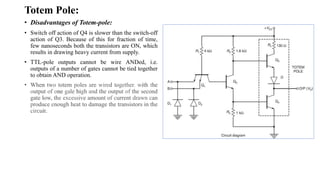
• Disadvantages of Totem-pole:
• Switch off action of Q4 is slower than the switch-off
action of Q3. Because of this for fraction of time,
few nanoseconds both the transistors are ON, which
results in drawing heavy current from supply.
• TTL-pole outputs cannot be wire ANDed, i.e.
outputs of a number of gates cannot be tied together
to obtain AND operation.
• When two totem poles are wired together. with the
output of one gale high and the output of the second
gate low, the excessive amount of current drawn can
produce enough heat to damage the transistors in the
circuit.
Wired AND operation:
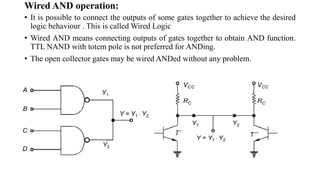
• It is possible to connect the outputs of some gates together to achieve the desired
logic behaviour . This is called Wired Logic
• Wired AND means connecting outputs of gates together to obtain AND function.
TTL NAND with totem pole is not preferred for ANDing.
• The open collector gates may be wired ANDed without any problem.
Wired AND operation:
• AND gate operation can be achieved
by using additional NAND gates as
shown in figure b
• The same logic can be performed
simply tying out the outputs of
NAND gates as shown in figure a.
Open Collector Gate:
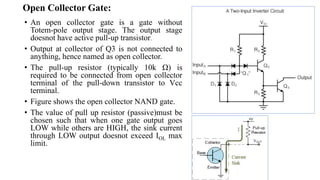
• An open collector gate is a gate without
Totem-pole output stage. The output stage
doesnot have active pull-up transistor.
• Output at collector of Q3 is not connected to
anything, hence named as open collector.
• The pull-up resistor (typically 10k Ω) is
required to be connected from open collector
terminal of the pull-down transistor to Vcc
terminal.
• Figure shows the open collector NAND gate.
• The value of pull up resistor (passive)must be
chosen such that when one gate output goes
LOW while others are HIGH, the sink current
through LOW output doesnot exceed IOL max
limit.
Open Collector Gate:
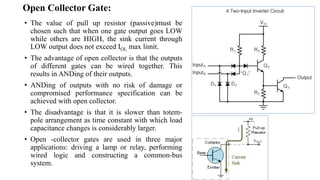
• The value of pull up resistor (passive)must be
chosen such that when one gate output goes LOW
while others are HIGH, the sink current through
LOW output does not exceed IOL max limit.
• The advantage of open collector is that the outputs
of different gates can be wired together. This
results in ANDing of their outputs.
• ANDing of outputs with no risk of damage or
compromised performance specification can be
achieved with open collector.
• The disadvantage is that it is slower than totem-
pole arrangement as time constant with which load
capacitance changes is considerably larger.
• Open -collector gates are used in three major
applications: driving a lamp or relay, performing
wired logic and constructing a common-bus
system.

Unit I.pptx

  • 1.
    Unit I: Digital LogicFamilies By Dr. Anup Vibhute Dr. D Y Patil Institute of Technology, Pimpri, Pune
  • 2.
    Contents: • Syllabus • Logicfamilies- Introduction • Classification of Families • Characteristics of Logic Families • TTL families • CMOS families • Interfacing of TTL-CMOS
  • 3.
    Syllabus: Classification and Characteristicsof digital Logic Families: -Speed, power dissipation, figure of merit, fan in, fan out, current, voltage, noise immunity, operating temperatures and power supply requirements. TTL logic. Operation of TTL NAND gate, active pull up, wired AND, open collector output, unconnected inputs. Tri-State logic. CMOS logic: CMOS inverter, NAND, NOR gates, unconnected inputs, wired logic, open drain output. Interfacing CMOS and TTL and Data sheet specifications Course Outcome: CO1: Classify and characterize the digital logic families • CO1.1 Classify the various Logic families on the basis of components • CO1.2 Characterize the Logic families for various parameters.
  • 4.
  • 5.
  • 6.
    LOGIC FAMILY • DiodeLogic (DL)  simplest;  does not scale  NOT not possible (need an active element) • Resistor-Transistor Logic (RTL) • • replace diode switch with a transistor switch • • can be cascaded • • large power draw
  • 7.
    Diode-Transistor Logic (DTL) •• essentially diode logic with transistor amplification • • reduced power consumption • • faster than RTL
  • 8.
    ECL Emitter-Coupled Logic(ECL) Based on BJT, but removes problems of delay time by preventing the transistors from saturating Very fast operation - propagation delays of 1ns or less  High power consumption, perhaps 60 mW/gate • Logic levels. “0”: –1.7V. “1”: – 0.8V Such strange logic levels require extra effort when interfacing to TTL/CMOS logic families. • low noise immunity of about 0.2-0.25 V Used in some high speed specialist applications, but now largely replaced by high speed CMOS
  • 9.
    TTL Logic Families •first introduced by in 1964 (Texas Instruments) • TTL has shaped digital technology in many ways • one of the most widely used families for small and medium-scale devices – rarely used for VLSI • Standard TTL family (e.g. 7400) is obsolete • Newer TTL families still used (e.g. 74ALS00) • High energy consumption, but relatively insensitive to electrostatic discharge (ESD) • Distinct feature
  • 10.
    Current Sourcing • Current-sourcingaction. • When the output of gate 1 is HIGH, it supplies current IIH to the input of gate 2. • Which acts essentially as a resistance to ground. • The output of gate 1 is acting as a source of current for the gate 2 input.
  • 11.
    Current Sinking • Current-sinkingaction. • Input circuitry of gate 2 is represented as a resistance tied to +VCC —the positive terminal of a power supply. • When gate 1 output goes LOW, current will flow from the input circuit of gate 2 back through the output resistance of gate 1, to ground. • Circuit output that drives the input of gate 2 must be able to sink a current, IIL , coming from that input.
  • 12.
    Transistor- Transistor Logic(TTL) • It depends upon the transistor to perform basic logic operations hence named Transistor-Transistor Logic (TTL) • Most popular family and widely used in digital ICs. • TTL uses transistors which are operating in saturated mode. • It is fastest in saturated logic family, i.e. TTL is faster than RTL, DTL, I2L, DCTL, HTL • It is a logic family implemented with bipolar process technology that combines or integrates NPN transistors, PN junction diodes and diffused resistors in a single monolithic structure to get the desired logic function. • The merits of TTL circuit are 1. Good speed 2. Low cost 3. Wide range of circuits 4. Availability in SSI and MSI
  • 13.
    Transistor- Transistor Logic(TTL) • Demerits are: 1. Tight Vcc Tolerance 2. Relatively high power consumption 3. Moderate packing density 4. Generation of noise spikes 5. Susceptibility to power transients • TTL logic family have several subfamilies such as • Standard TTL, • High speed TTL, • Low power TTL, • Low power Schottky TTL, • Advanced Schottky TTL, • Advanced Low power Schottky TTL and • Fast (F)TTL
  • 14.
    TTL NAND Gate: •The NAND gate is the basic building block of this logic family. • Two input NAND gate consist of three stages- Multi-emitter input stage (Transistor Q1) , Single phase stage (Transistor Q2 as phase splitter) and Totem-pole output stage (Transistor Q3 and Q4 with Diode D3 or D). • Diode D1 and D2 protects Q1 from being damaged by negative spikes of voltage at inputs. • Diode D or D3 ensures that Q3 and Q4 do not conduct simultaneously. • Transistor Q3 acts as emitter follower.
  • 15.
    TTL NAND Gate: AB Vo Q1 Q2 Q3 Q4 0 (L) 0 (L) 1 (H) ON OFF ON OFF 0 1 1 ON OFF ON OFF 1 0 1 ON OFF ON OFF 1 1 0 OFF ON OFF ON
  • 16.
    TTL NAND gateLOW output
  • 17.
    Q4 is performinga current-sinking action— deriving its current from the input current (IIL) of the load gate. Q4 is often called the current-sinking transistor or pull-down transistor because it brings the output voltage down to its LOW state. TTL NAND gate LOW output..Cont
  • 18.
    TTL NAND gateHIGH output
  • 19.
    • A TTLoutput acts as a current source in the HIGH state. Transistor Q3 is supplying the input current (IIH) required by Q1 of the load gate. Q3 is often called the current-sourcing or pull- up transistor. In more modern TTL series, the pull-up circuit is made up of two transistors. TTL NAND gate HIGH output…..Cont.
  • 20.
    Totem Pole: • TransistorQ3 & Q4 constitutes the Totem-pole arrangement at the output of NAND gate. • At any time, only one of the transistors is conducting, i.e., both cannot be turned ON or OFF simultaneously and its is ensured by diode D or D3.
  • 21.
    Totem Pole: • Advantagesof Totem pole: • It offers low output resistance in High & Low output states. • Because of low output impedance, any stray capacitance at the output can be charged or discharged rapidly allowing to change output from one state to other quickly. • When output is in low state, transistor Q4 need to conduct large current through R3. Inclusion of Q3 and D keeps circuit power dissipation low.
  • 22.
    Totem Pole: • Disadvantagesof Totem-pole: • Switch off action of Q4 is slower than the switch-off action of Q3. Because of this for fraction of time, few nanoseconds both the transistors are ON, which results in drawing heavy current from supply. • TTL-pole outputs cannot be wire ANDed, i.e. outputs of a number of gates cannot be tied together to obtain AND operation. • When two totem poles are wired together. with the output of one gale high and the output of the second gate low, the excessive amount of current drawn can produce enough heat to damage the transistors in the circuit.
  • 23.
    Wired AND operation: •It is possible to connect the outputs of some gates together to achieve the desired logic behaviour . This is called Wired Logic • Wired AND means connecting outputs of gates together to obtain AND function. TTL NAND with totem pole is not preferred for ANDing. • The open collector gates may be wired ANDed without any problem.
  • 24.
    Wired AND operation: •AND gate operation can be achieved by using additional NAND gates as shown in figure b • The same logic can be performed simply tying out the outputs of NAND gates as shown in figure a.
  • 25.
    Open Collector Gate: •An open collector gate is a gate without Totem-pole output stage. The output stage doesnot have active pull-up transistor. • Output at collector of Q3 is not connected to anything, hence named as open collector. • The pull-up resistor (typically 10k Ω) is required to be connected from open collector terminal of the pull-down transistor to Vcc terminal. • Figure shows the open collector NAND gate. • The value of pull up resistor (passive)must be chosen such that when one gate output goes LOW while others are HIGH, the sink current through LOW output doesnot exceed IOL max limit.
  • 26.
    Open Collector Gate: •The value of pull up resistor (passive)must be chosen such that when one gate output goes LOW while others are HIGH, the sink current through LOW output does not exceed IOL max limit. • The advantage of open collector is that the outputs of different gates can be wired together. This results in ANDing of their outputs. • ANDing of outputs with no risk of damage or compromised performance specification can be achieved with open collector. • The disadvantage is that it is slower than totem- pole arrangement as time constant with which load capacitance changes is considerably larger. • Open -collector gates are used in three major applications: driving a lamp or relay, performing wired logic and constructing a common-bus system.