Memory System Design
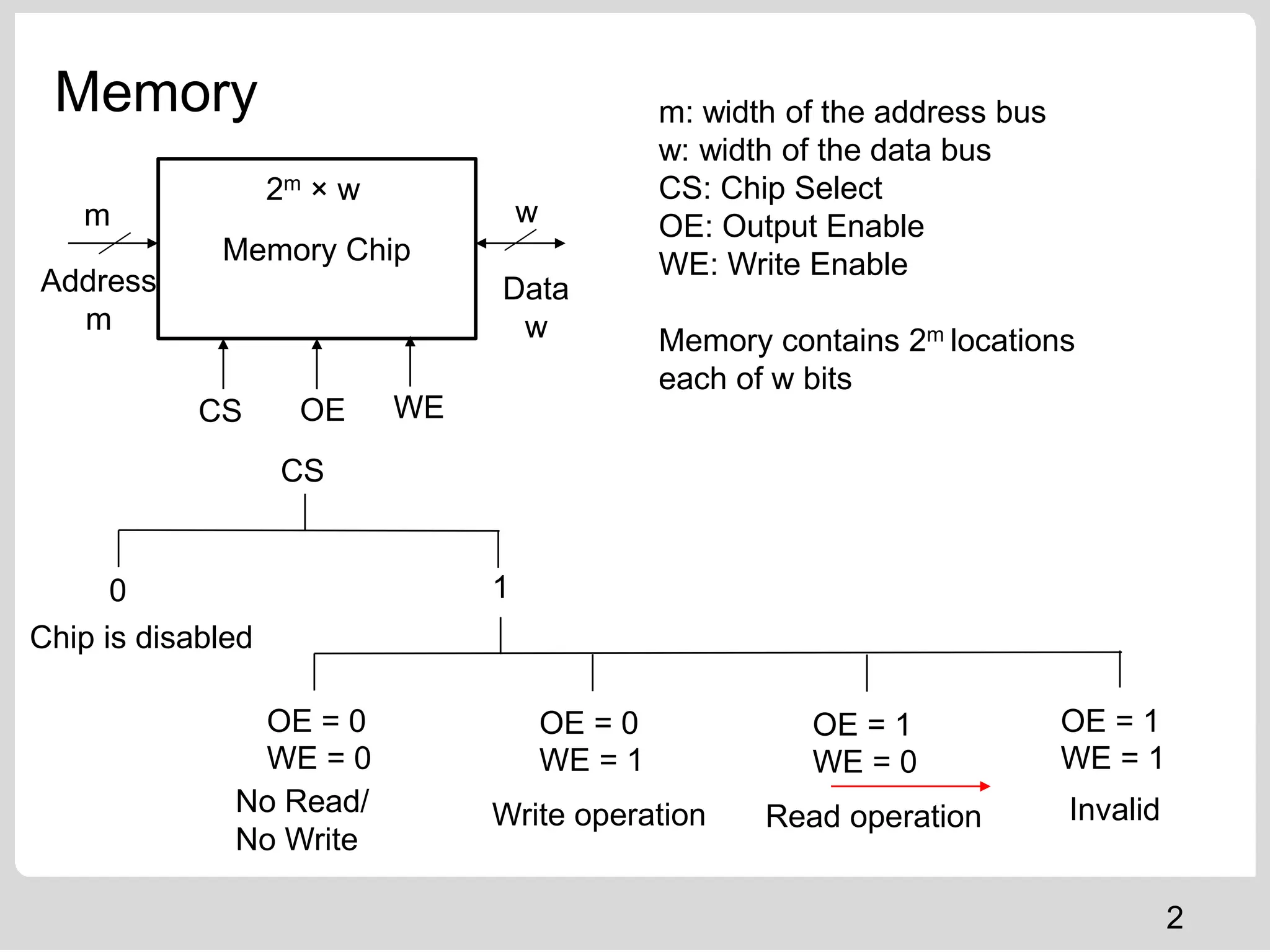
Memory
2
Memory Chip
m w
2m × w
m: width of the address bus
w: width of the data bus
CS: Chip Select
OE: Output Enable
WE: Write Enable
Memory contains 2m locations
each of w bits
CS OE WE
CS
0
Chip is disabled
1
OE = 0
WE = 0
No Read/
No Write
OE = 0
WE = 1
Write operation
OE = 1
WE = 0
Read operation
OE = 1
WE = 1
Invalid
Address
m
Data
w
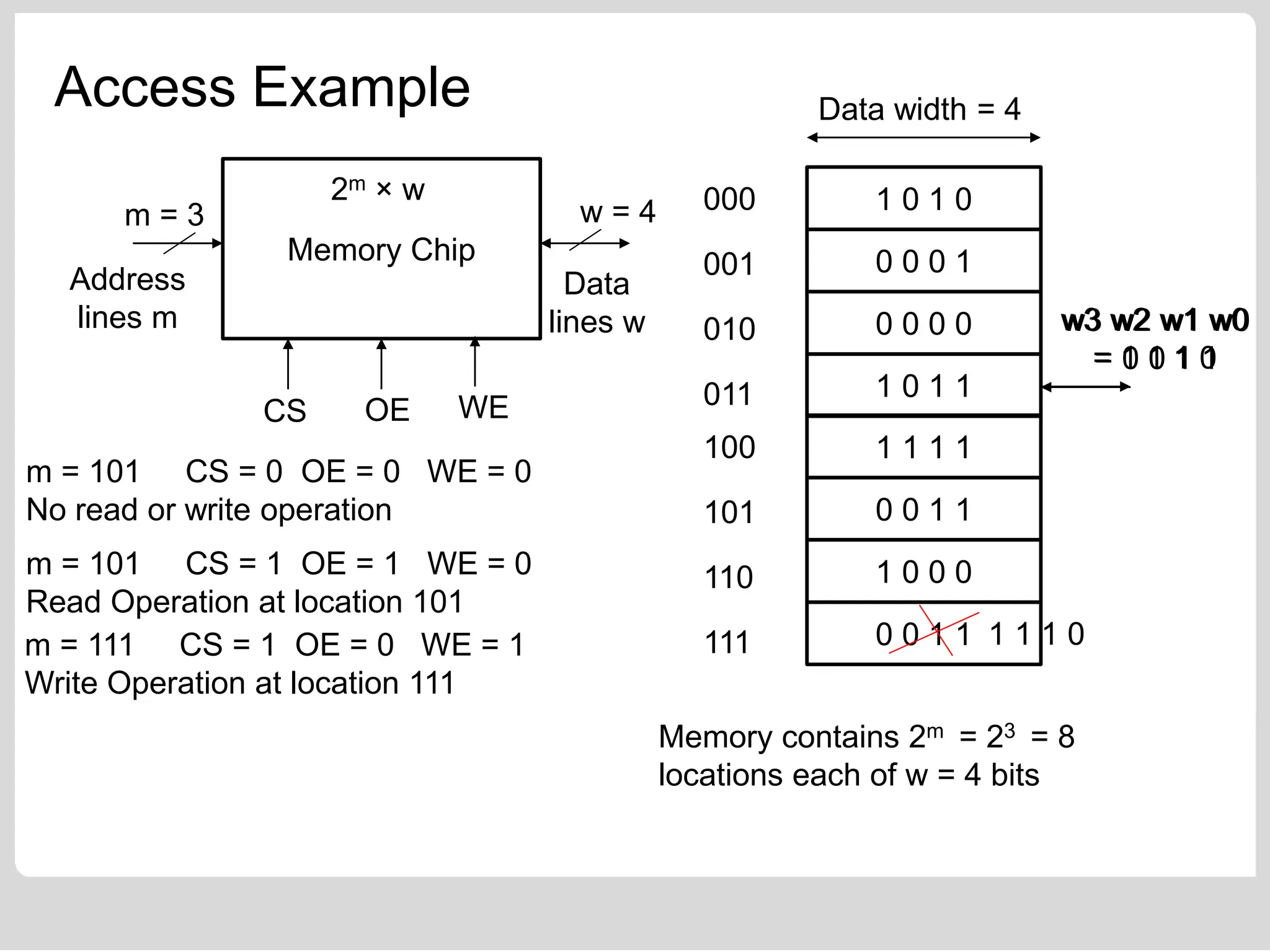
Access Example
Memory Chip
m = 3 w = 4
2m × w
CS OE WE
1 0 1 0
Memory contains 2m = 23 = 8
locations each of w = 4 bits
Data width = 4
000
0 0 0 1
0 0 0 0
1 0 1 1
001
010
011
1 1 1 1
100
0 0 1 1
1 0 0 0
0 0 1 1
101
110
111
m = 101 CS = 0 OE = 0 WE = 0
No read or write operation
Address
lines m
Data
lines w
m = 101 CS = 1 OE = 1 WE = 0
Read Operation at location 101
w3 w2 w1 w0
= 0 0 1 1
w3 w2 w1 w0
= 1 1 1 0
m = 111 CS = 1 OE = 0 WE = 1
Write Operation at location 111
1 1 1 0
Microprocessor
Microprocessor
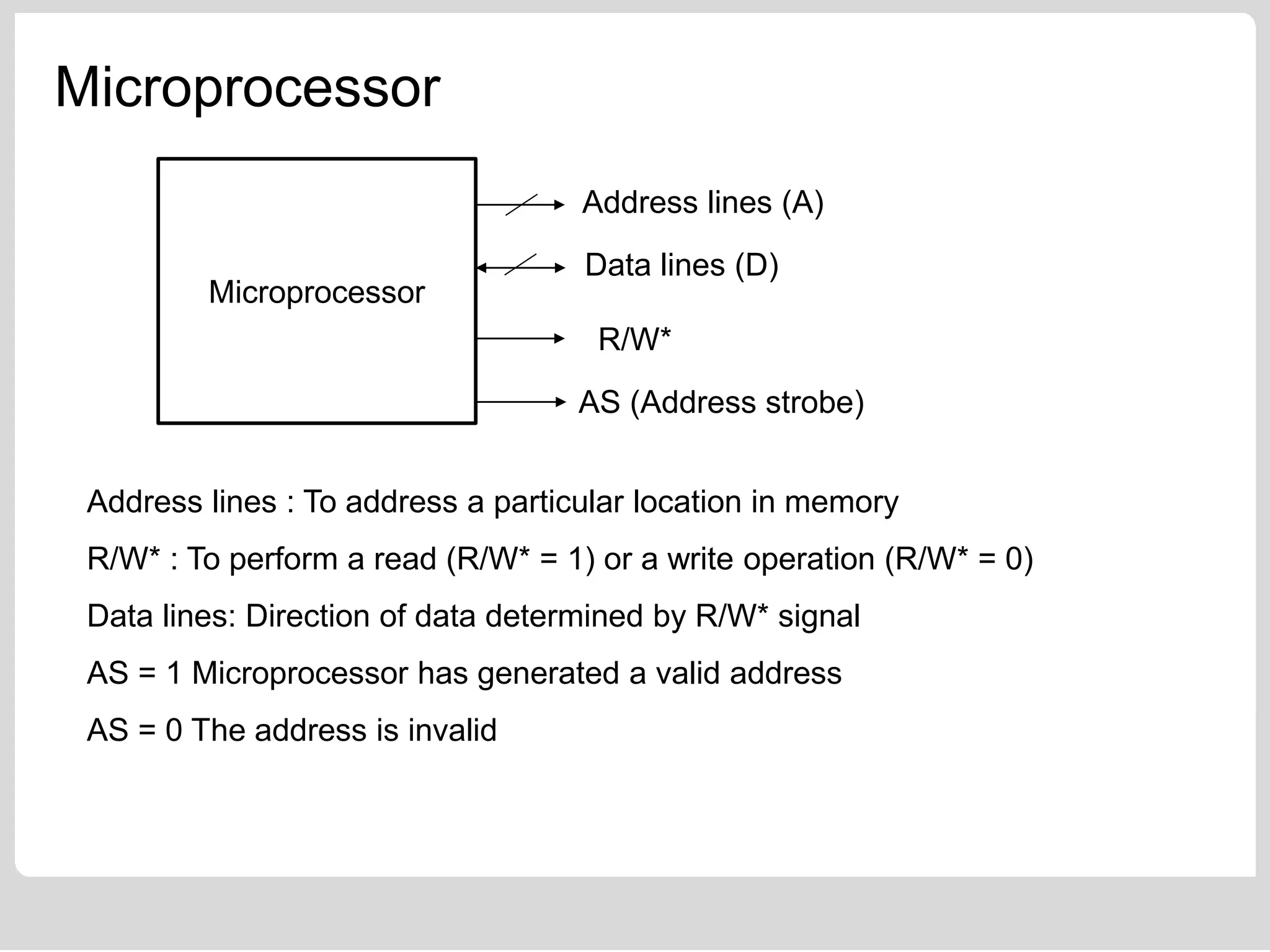
Address lines (A)
Data lines (D)
R/W*
AS (Address strobe)
Address lines : To address a particular location in memory
R/W* : To perform a read (R/W* = 1) or a write operation (R/W* = 0)
Data lines: Direction of data determined by R/W* signal
AS = 1 Microprocessor has generated a valid address
AS = 0 The address is invalid
Microprocessor (Instruction Fetch)
Microprocessor
Address-lines (A)
Data lines (D)
R/W*
AS
Instruction Fetch
Read Operation (AS = 1, R/W* = 1)
Address-lines = [MAR] which is loaded with PC address
Data-lines = Content of memory at location specified by address
Microprocessor (Instruction Decode)
Microprocessor
Address-lines (A)
Data lines (D)
R/W*
AS
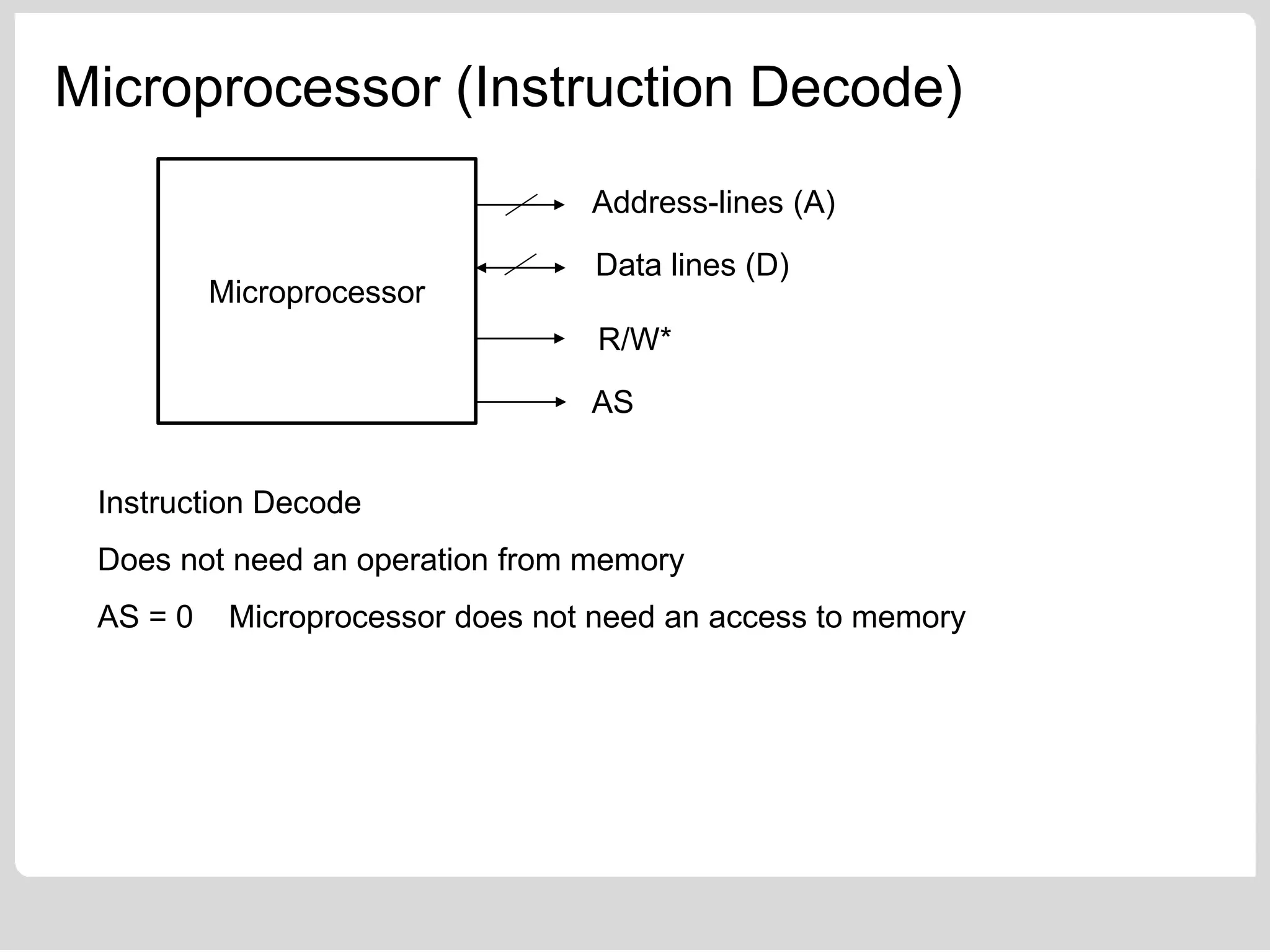
Instruction Decode
Does not need an operation from memory
AS = 0 Microprocessor does not need an access to memory
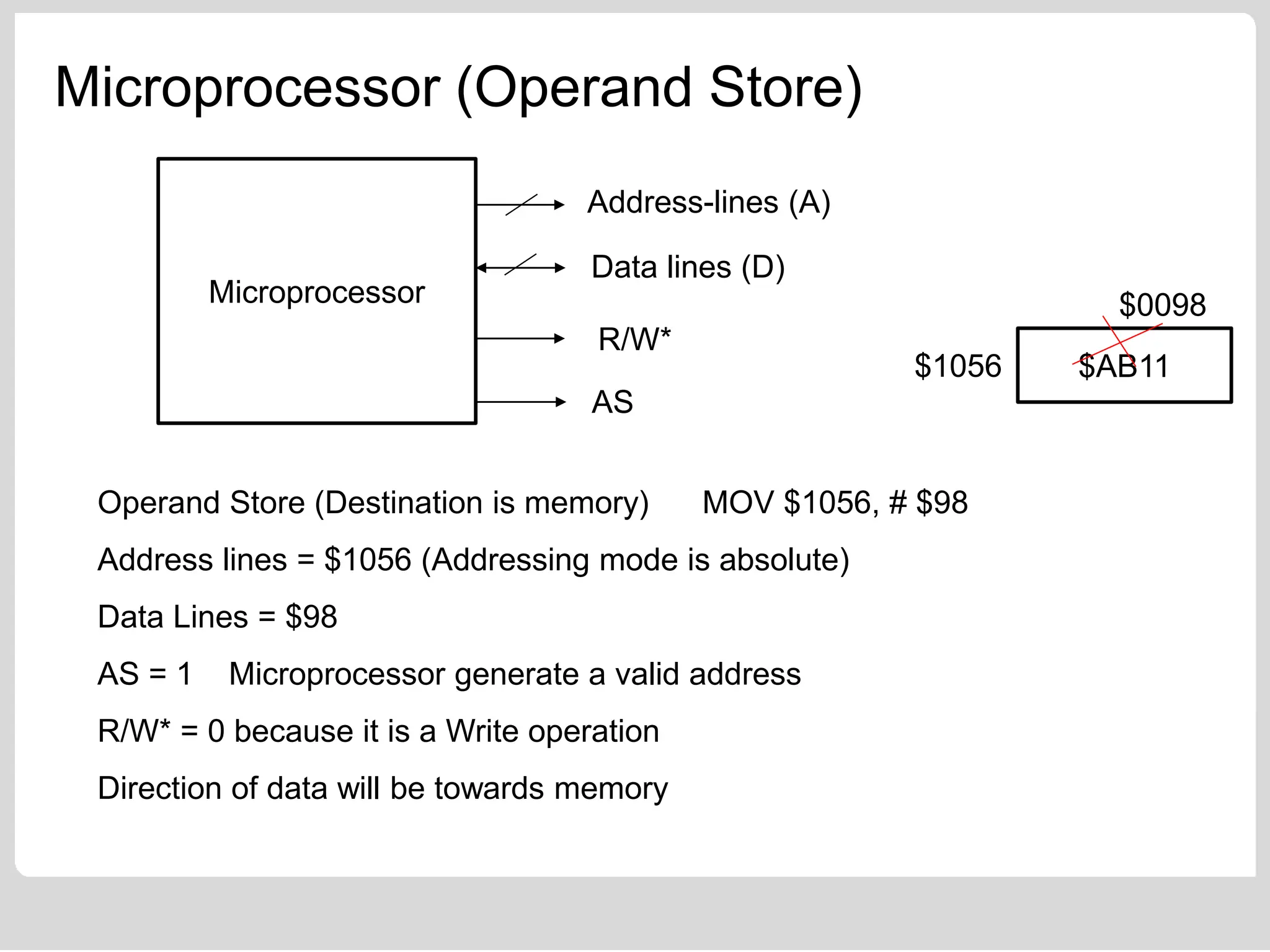
Microprocessor (Operand Store)
Microprocessor
Address-lines (A)
Data lines (D)
R/W*
AS
Operand Store (Destination is memory) MOV $1056, # $98
Address lines = $1056 (Addressing mode is absolute)
Data Lines = $98
AS = 1 Microprocessor generate a valid address
R/W* = 0 because it is a Write operation
Direction of data will be towards memory
$AB11
$1056
$0098
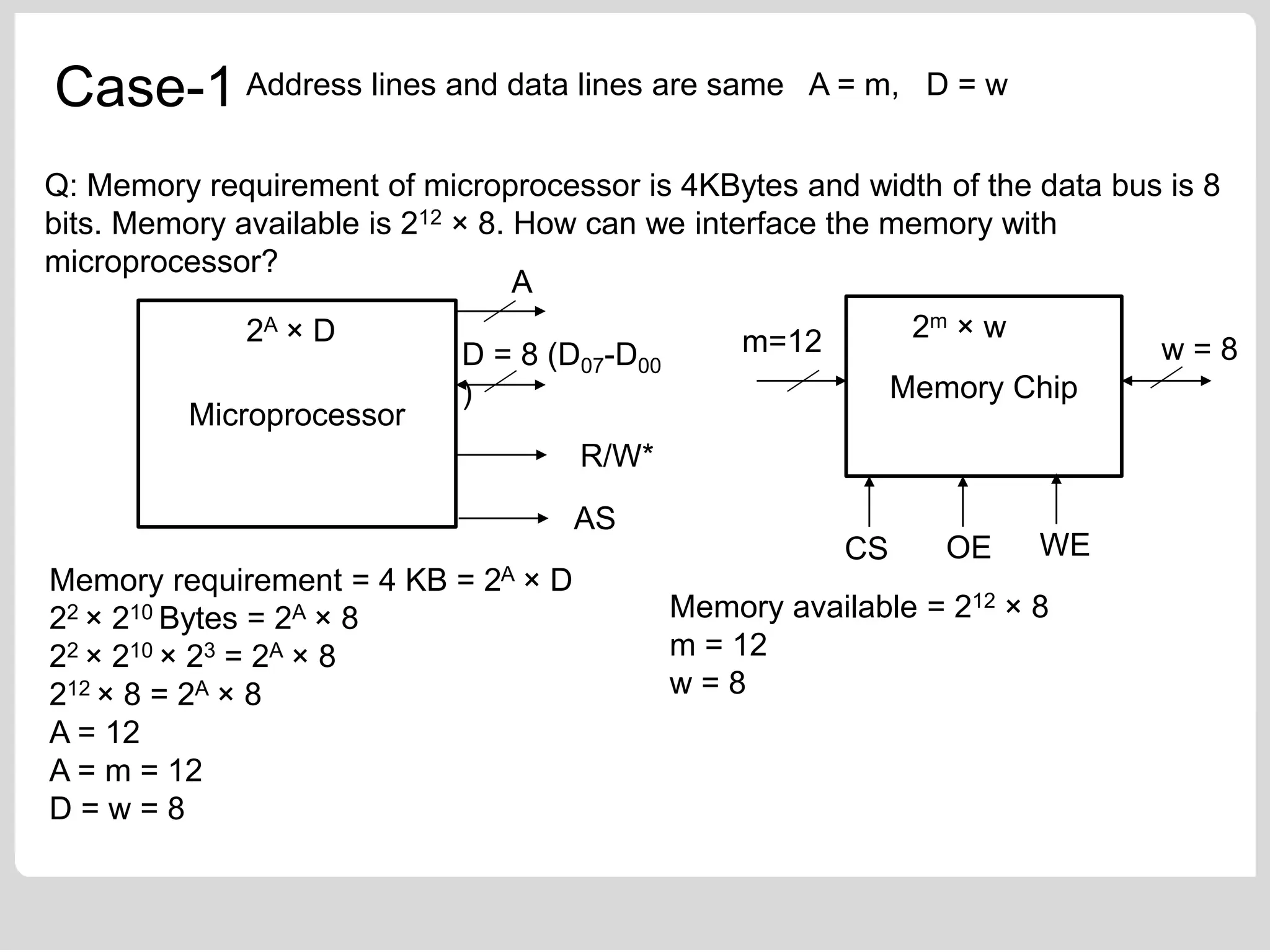
Case-1 Address lines and data lines are same A = m, D = w
Q: Memory requirement of microprocessor is 4KBytes and width of the data bus is 8
bits. Memory available is 212 × 8. How can we interface the memory with
microprocessor?
Memory Chip
m=12 w = 8
2m × w
CS OE WE
Memory requirement = 4 KB = 2A × D
22 × 210 Bytes = 2A × 8
22 × 210 × 23 = 2A × 8
212 × 8 = 2A × 8
A = 12
A = m = 12
D = w = 8
Microprocessor
A
D = 8 (D07-D00
)
2A × D
R/W*
AS
Memory available = 212 × 8
m = 12
w = 8
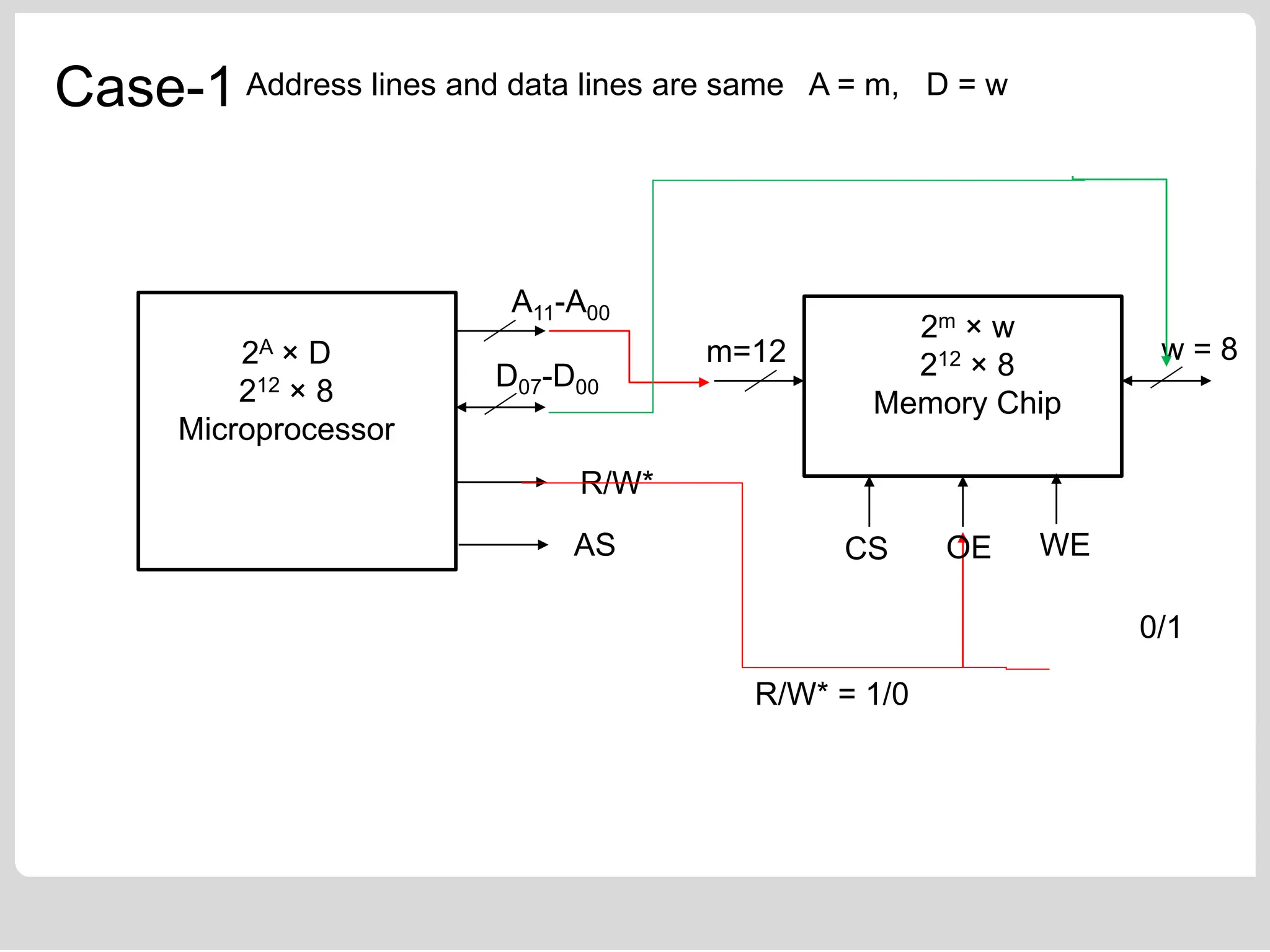
Case-1 Address lines and data lines are same A = m, D = w
A11-A00
D07-D00
2A × D
212 × 8
Microprocessor
R/W*
AS
w = 8
m=12
2m × w
212 × 8
Memory Chip
CS OE WE
R/W* = 1/0
0/1
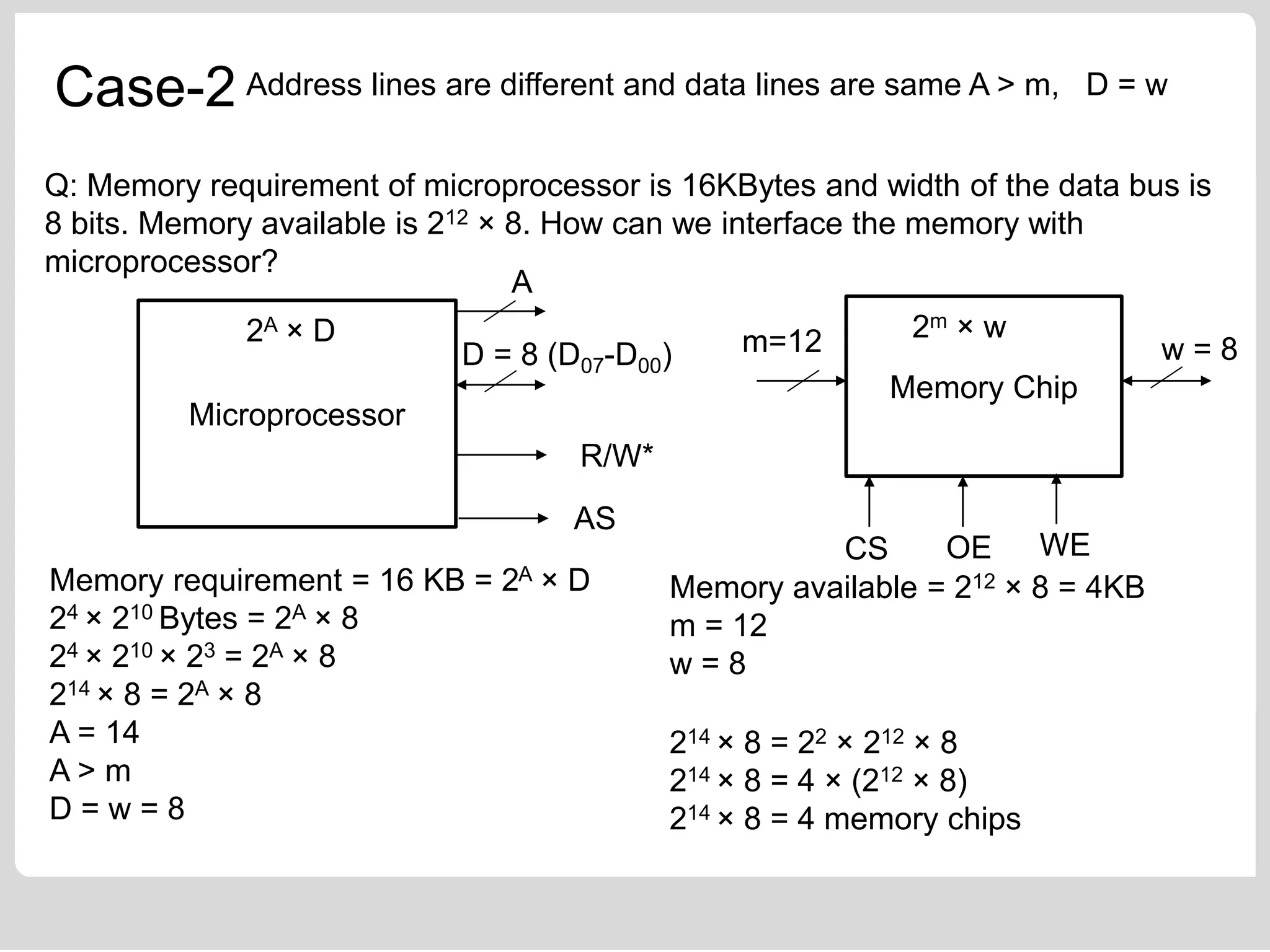
Case-2 Address lines are different and data lines are same A > m, D = w
Q: Memory requirement of microprocessor is 16KBytes and width of the data bus is
8 bits. Memory available is 212 × 8. How can we interface the memory with
microprocessor?
Memory requirement = 16 KB = 2A × D
24 × 210 Bytes = 2A × 8
24 × 210 × 23 = 2A × 8
214 × 8 = 2A × 8
A = 14
A > m
D = w = 8
Memory available = 212 × 8 = 4KB
m = 12
w = 8
Memory Chip
m=12 w = 8
2m × w
CS OE WE
Microprocessor
A
D = 8 (D07-D00)
2A × D
R/W*
AS
214 × 8 = 22 × 212 × 8
214 × 8 = 4 × (212 × 8)
214 × 8 = 4 memory chips
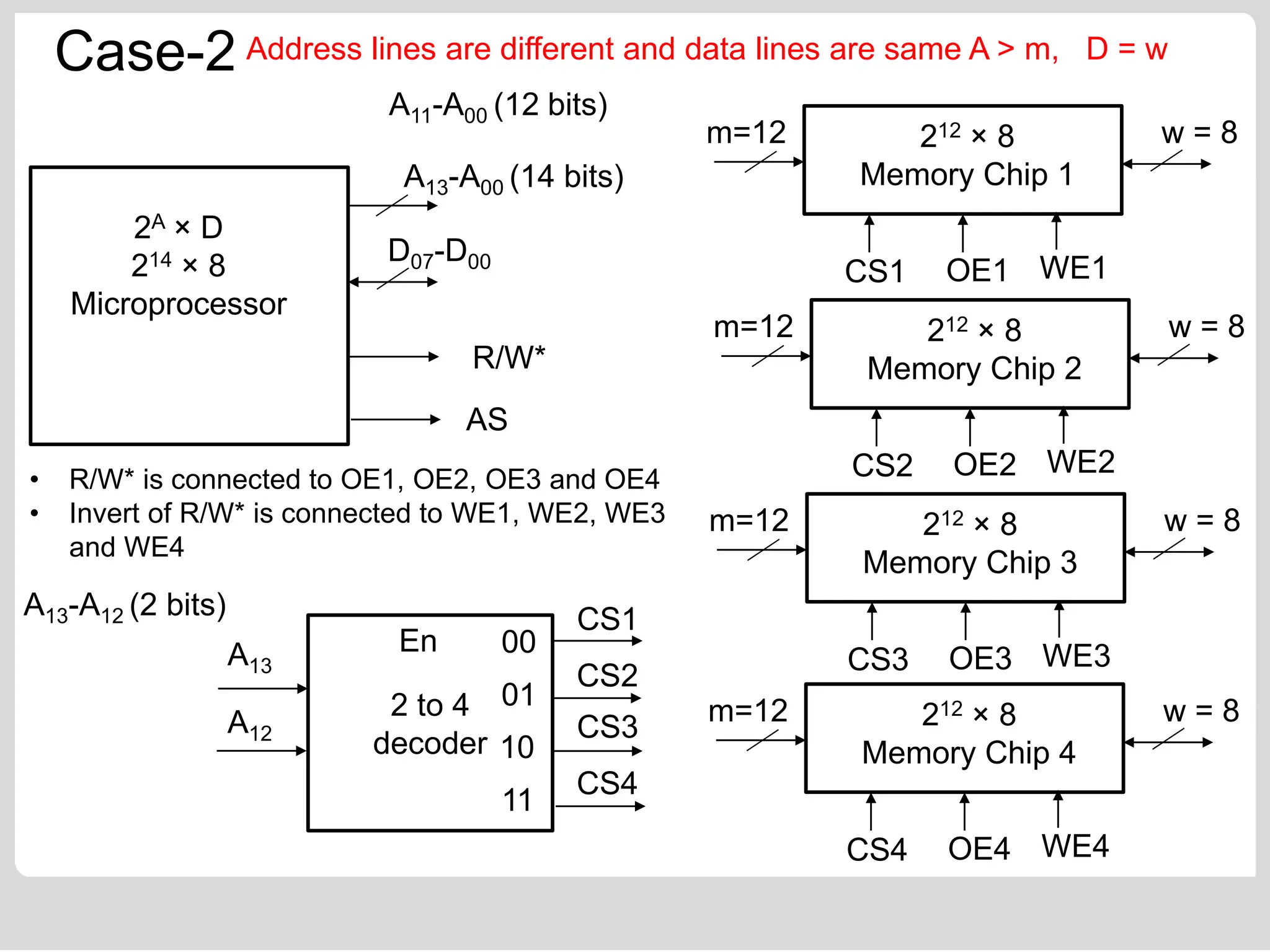
Case-2 Address lines are different and data lines are same A > m, D = w
A13-A00 (14 bits)
D07-D00
2A × D
214 × 8
Microprocessor
R/W*
AS
w = 8
m=12 212 × 8
Memory Chip 1
CS1 OE1 WE1
w = 8
m=12 212 × 8
Memory Chip 2
CS2 OE2 WE2
w = 8
m=12 212 × 8
Memory Chip 3
CS3 OE3 WE3
w = 8
m=12 212 × 8
Memory Chip 4
CS4 OE4 WE4
• R/W* is connected to OE1, OE2, OE3 and OE4
• Invert of R/W* is connected to WE1, WE2, WE3
and WE4
A11-A00 (12 bits)
A13-A12 (2 bits)
2 to 4
decoder
A13
A12
En 00
01
10
11
CS1
CS2
CS3
CS4
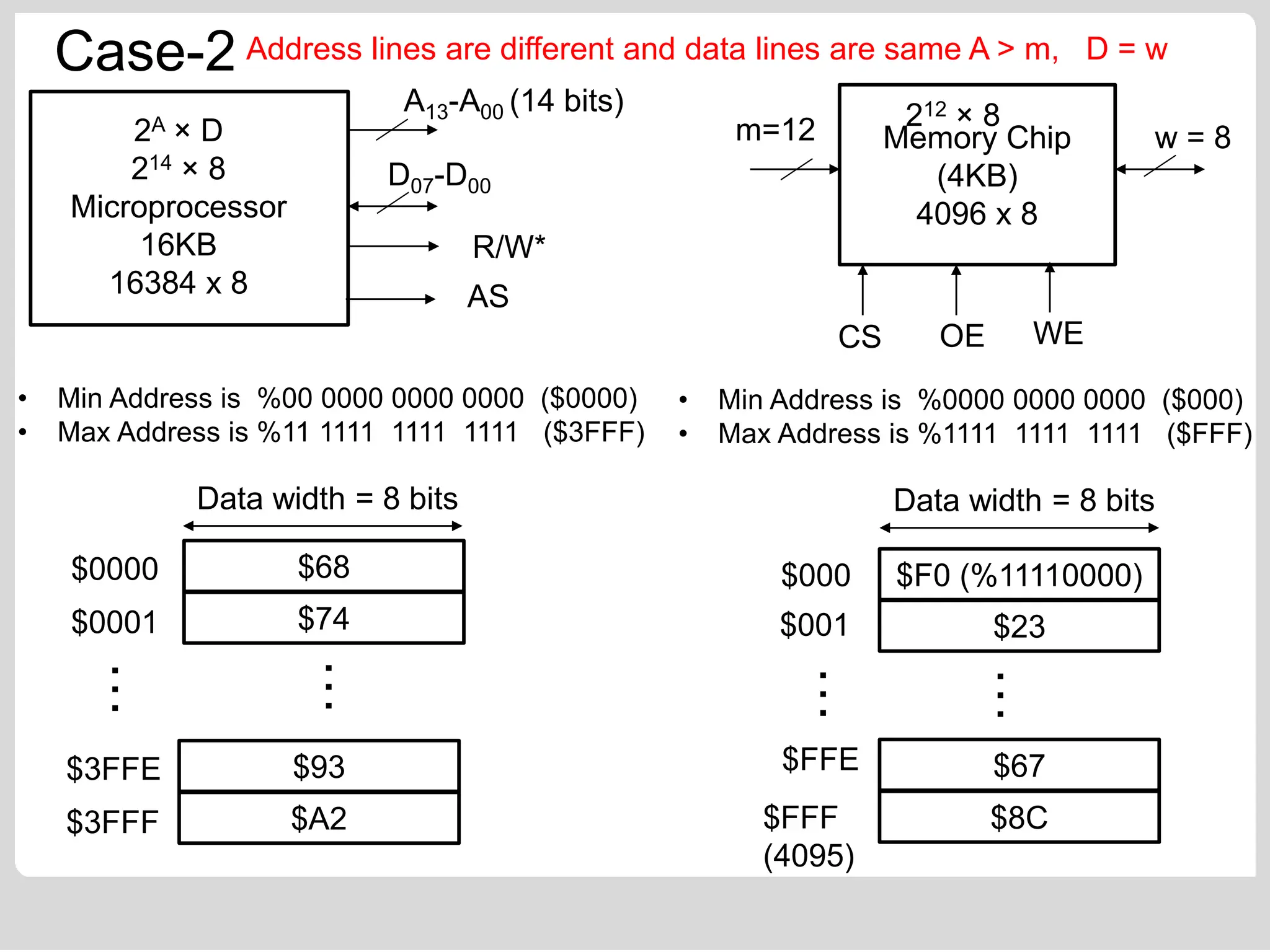
Case-2 Address lines are different and data lines are same A > m, D = w
A13-A00 (14 bits)
D07-D00
2A × D
214 × 8
Microprocessor
16KB
16384 x 8
R/W*
AS
Memory Chip
(4KB)
4096 x 8
m=12 w = 8
212 × 8
CS OE WE
• Min Address is %0000 0000 0000 ($000)
• Max Address is %1111 1111 1111 ($FFF)
$F0 (%11110000)
Data width = 8 bits
$000
$23
$001
$67
$8C
$FFE
$FFF
(4095)
…
• Min Address is %00 0000 0000 0000 ($0000)
• Max Address is %11 1111 1111 1111 ($3FFF)
…
$68
$0000
…
$74
$0001
…
$93
$3FFE
$A2
$3FFF
Data width = 8 bits
Case-2
Memory Logical
address Space
212 × 8
$000
$FFF
…
Address lines are different and data lines are same A > m, D = w
$0000
$3FFF
…
Microprocessor Logical
address Space
214 × 8
requires 4 mem chips
Memory Chip 1
$0000
$0FFF
…
$1000
$1FFF
…
$2000
$2FFF
…
$3000
$3FFF
…
Memory Chip 2
Memory Chip 3
Memory Chip 4
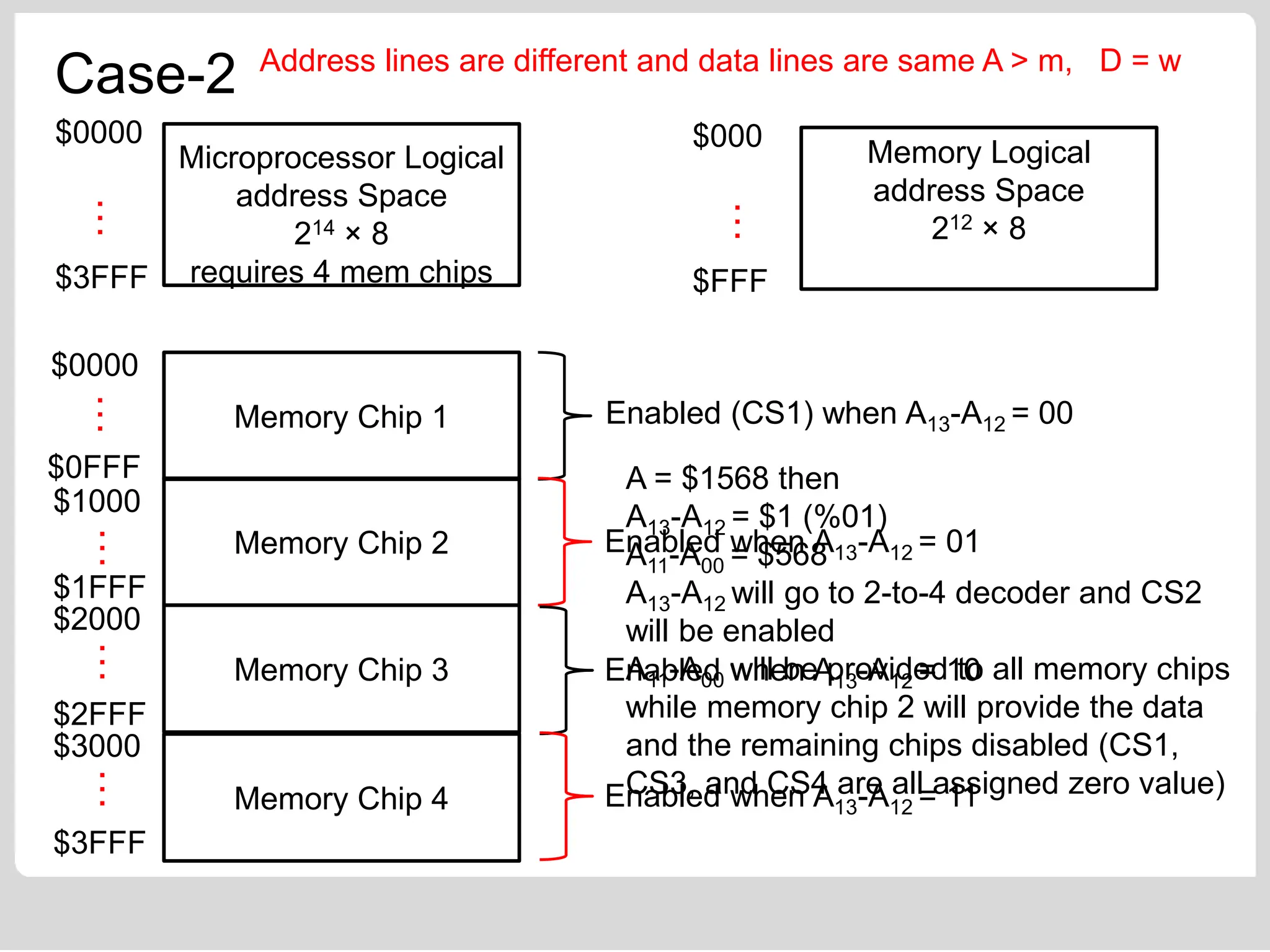
Enabled (CS1) when A13-A12 = 00
Enabled when A13-A12 = 01
Enabled when A13-A12 = 10
Enabled when A13-A12 = 11
A = $1568 then
A13-A12 = $1 (%01)
A11-A00 = $568
A13-A12 will go to 2-to-4 decoder and CS2
will be enabled
A11-A00 will be provided to all memory chips
while memory chip 2 will provide the data
and the remaining chips disabled (CS1,
CS3, and CS4 are all assigned zero value)
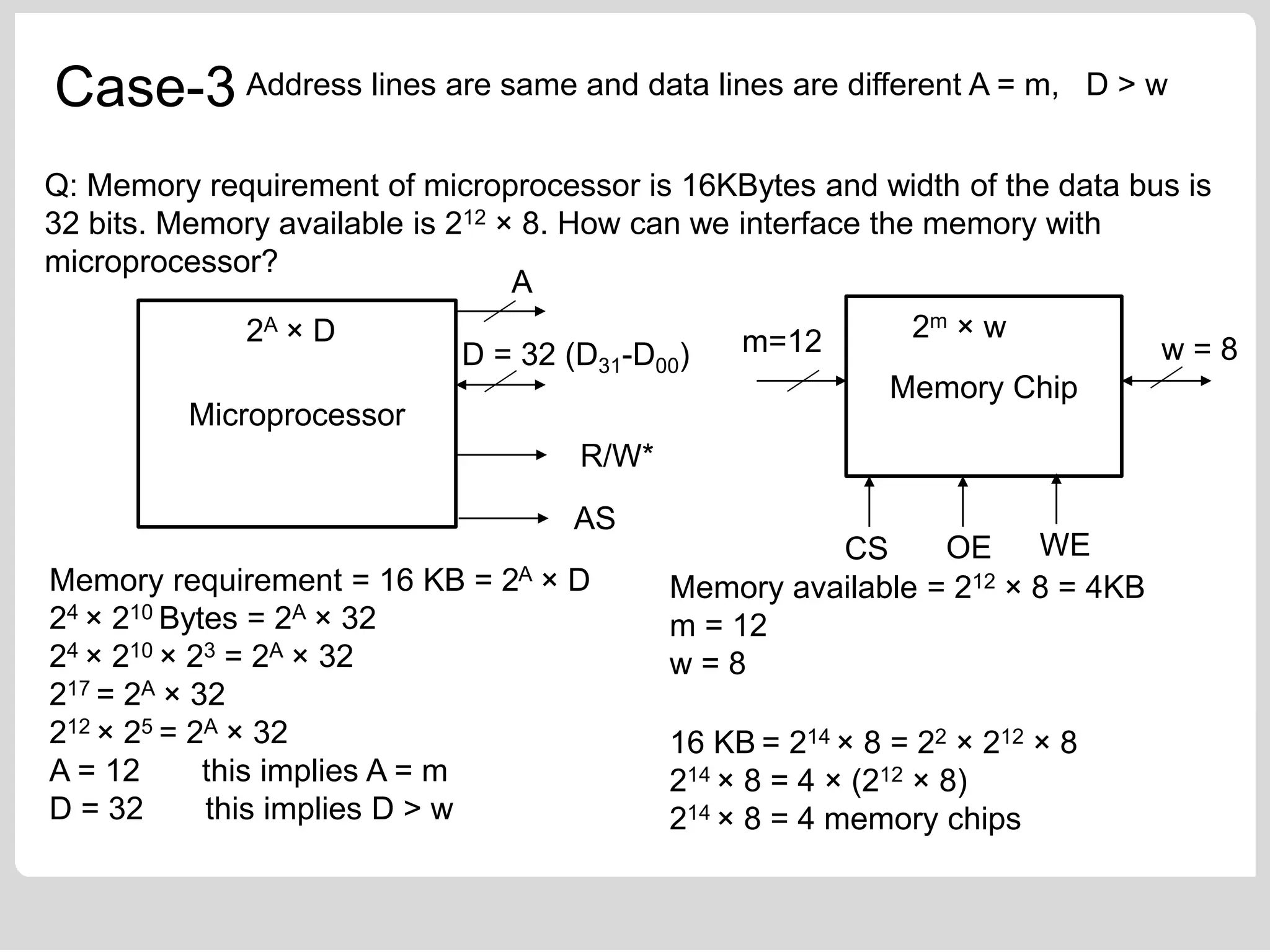
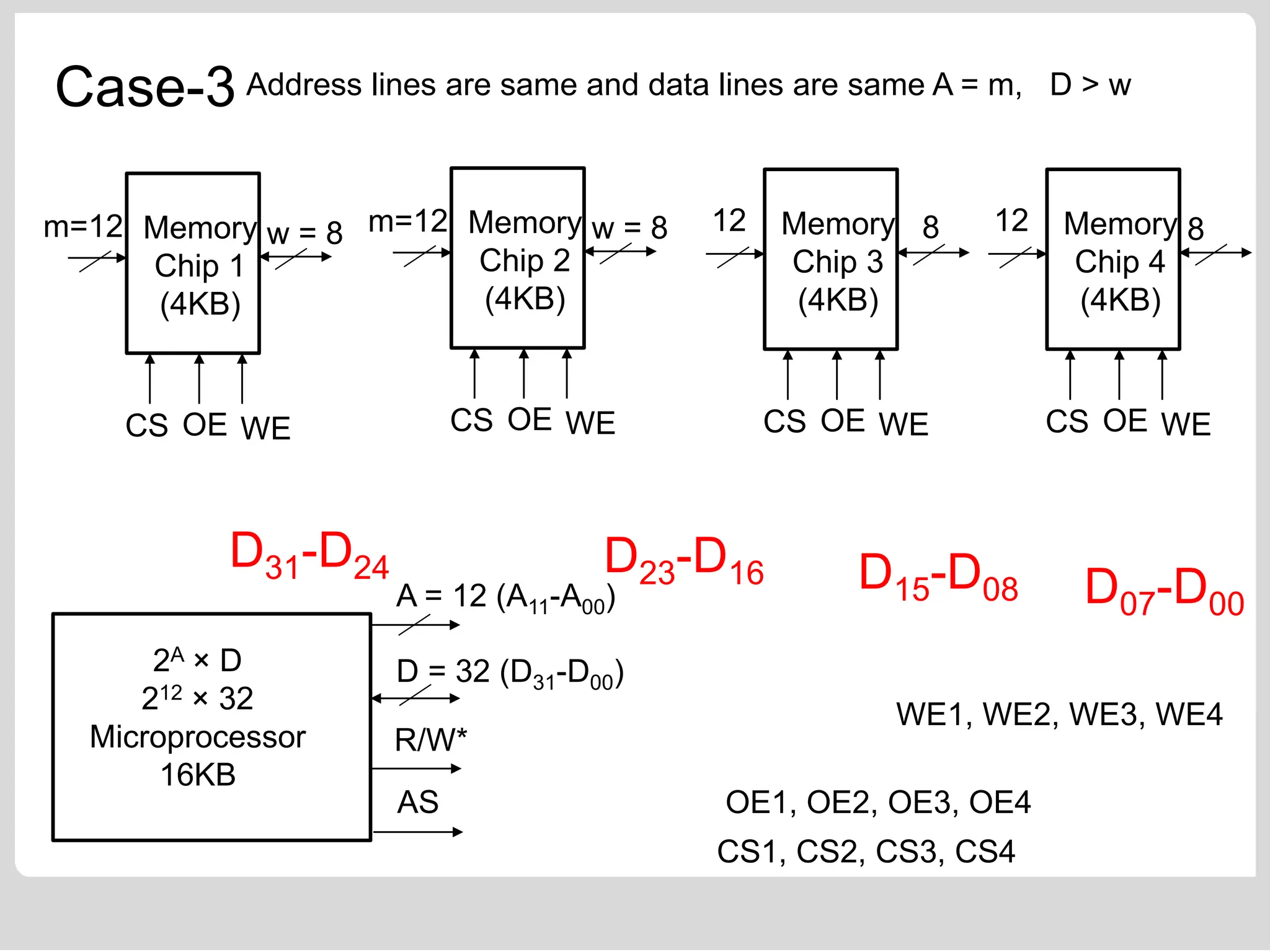
Case-3 Address lines are same and data lines are different A = m, D > w
Q: Memory requirement of microprocessor is 16KBytes and width of the data bus is
32 bits. Memory available is 212 × 8. How can we interface the memory with
microprocessor?
Memory requirement = 16 KB = 2A × D
24 × 210 Bytes = 2A × 32
24 × 210 × 23 = 2A × 32
217 = 2A × 32
212 × 25 = 2A × 32
A = 12 this implies A = m
D = 32 this implies D > w
Memory available = 212 × 8 = 4KB
m = 12
w = 8
Memory Chip
m=12 w = 8
2m × w
CS OE WE
Microprocessor
A
D = 32 (D31-D00)
2A × D
R/W*
AS
16 KB = 214 × 8 = 22 × 212 × 8
214 × 8 = 4 × (212 × 8)
214 × 8 = 4 memory chips
Case-3 Address lines are same and data lines are same A = m, D > w
A = 12 (A11-A00)
D = 32 (D31-D00)
R/W*
AS
2A × D
212 × 32
Microprocessor
16KB
m=12 w = 8
CS OE WE
Memory
Chip 2
(4KB)
m=12 w = 8
CS OE WE
Memory
Chip 1
(4KB)
12 8
CS OE WE
Memory
Chip 4
(4KB)
12 8
CS OE WE
Memory
Chip 3
(4KB)
CS1, CS2, CS3, CS4
OE1, OE2, OE3, OE4
WE1, WE2, WE3, WE4
D31-D24 D23-D16 D15-D08 D07-D00
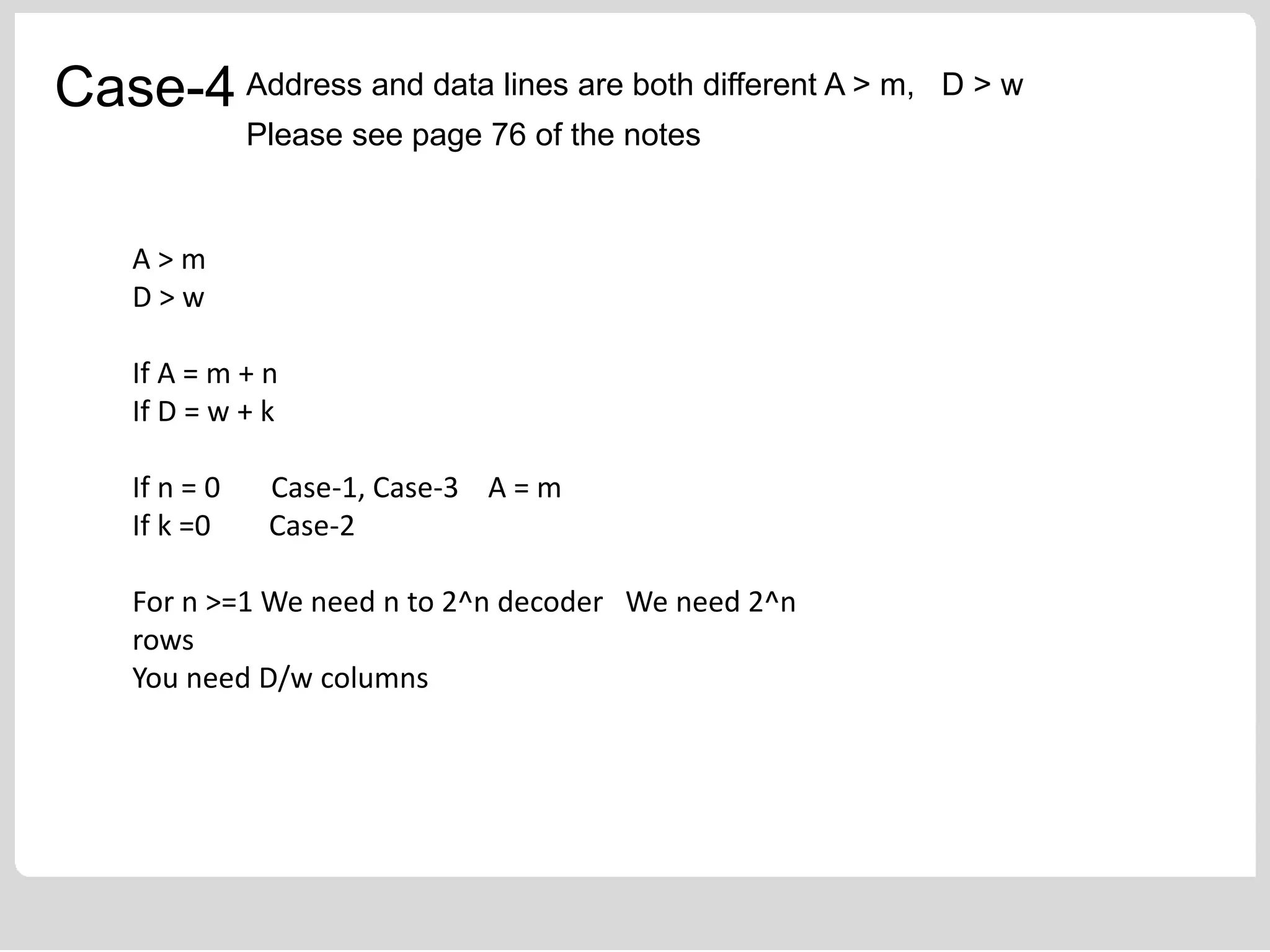
Case-4 Address and data lines are both different A > m, D > w
Please see page 76 of the notes
A > m
D > w
If A = m + n
If D = w + k
If n = 0 Case-1, Case-3 A = m
If k =0 Case-2
For n >=1 We need n to 2^n decoder We need 2^n
rows
You need D/w columns

Memory Design of embedded system engineering.pptx

  • 1.
  • 2.
    Memory 2 Memory Chip m w 2m× w m: width of the address bus w: width of the data bus CS: Chip Select OE: Output Enable WE: Write Enable Memory contains 2m locations each of w bits CS OE WE CS 0 Chip is disabled 1 OE = 0 WE = 0 No Read/ No Write OE = 0 WE = 1 Write operation OE = 1 WE = 0 Read operation OE = 1 WE = 1 Invalid Address m Data w
  • 3.
    Access Example Memory Chip m= 3 w = 4 2m × w CS OE WE 1 0 1 0 Memory contains 2m = 23 = 8 locations each of w = 4 bits Data width = 4 000 0 0 0 1 0 0 0 0 1 0 1 1 001 010 011 1 1 1 1 100 0 0 1 1 1 0 0 0 0 0 1 1 101 110 111 m = 101 CS = 0 OE = 0 WE = 0 No read or write operation Address lines m Data lines w m = 101 CS = 1 OE = 1 WE = 0 Read Operation at location 101 w3 w2 w1 w0 = 0 0 1 1 w3 w2 w1 w0 = 1 1 1 0 m = 111 CS = 1 OE = 0 WE = 1 Write Operation at location 111 1 1 1 0
  • 4.
    Microprocessor Microprocessor Address lines (A) Datalines (D) R/W* AS (Address strobe) Address lines : To address a particular location in memory R/W* : To perform a read (R/W* = 1) or a write operation (R/W* = 0) Data lines: Direction of data determined by R/W* signal AS = 1 Microprocessor has generated a valid address AS = 0 The address is invalid
  • 5.
    Microprocessor (Instruction Fetch) Microprocessor Address-lines(A) Data lines (D) R/W* AS Instruction Fetch Read Operation (AS = 1, R/W* = 1) Address-lines = [MAR] which is loaded with PC address Data-lines = Content of memory at location specified by address
  • 6.
    Microprocessor (Instruction Decode) Microprocessor Address-lines(A) Data lines (D) R/W* AS Instruction Decode Does not need an operation from memory AS = 0 Microprocessor does not need an access to memory
  • 7.
    Microprocessor (Operand Store) Microprocessor Address-lines(A) Data lines (D) R/W* AS Operand Store (Destination is memory) MOV $1056, # $98 Address lines = $1056 (Addressing mode is absolute) Data Lines = $98 AS = 1 Microprocessor generate a valid address R/W* = 0 because it is a Write operation Direction of data will be towards memory $AB11 $1056 $0098
  • 8.
    Case-1 Address linesand data lines are same A = m, D = w Q: Memory requirement of microprocessor is 4KBytes and width of the data bus is 8 bits. Memory available is 212 × 8. How can we interface the memory with microprocessor? Memory Chip m=12 w = 8 2m × w CS OE WE Memory requirement = 4 KB = 2A × D 22 × 210 Bytes = 2A × 8 22 × 210 × 23 = 2A × 8 212 × 8 = 2A × 8 A = 12 A = m = 12 D = w = 8 Microprocessor A D = 8 (D07-D00 ) 2A × D R/W* AS Memory available = 212 × 8 m = 12 w = 8
  • 9.
    Case-1 Address linesand data lines are same A = m, D = w A11-A00 D07-D00 2A × D 212 × 8 Microprocessor R/W* AS w = 8 m=12 2m × w 212 × 8 Memory Chip CS OE WE R/W* = 1/0 0/1
  • 10.
    Case-2 Address linesare different and data lines are same A > m, D = w Q: Memory requirement of microprocessor is 16KBytes and width of the data bus is 8 bits. Memory available is 212 × 8. How can we interface the memory with microprocessor? Memory requirement = 16 KB = 2A × D 24 × 210 Bytes = 2A × 8 24 × 210 × 23 = 2A × 8 214 × 8 = 2A × 8 A = 14 A > m D = w = 8 Memory available = 212 × 8 = 4KB m = 12 w = 8 Memory Chip m=12 w = 8 2m × w CS OE WE Microprocessor A D = 8 (D07-D00) 2A × D R/W* AS 214 × 8 = 22 × 212 × 8 214 × 8 = 4 × (212 × 8) 214 × 8 = 4 memory chips
  • 11.
    Case-2 Address linesare different and data lines are same A > m, D = w A13-A00 (14 bits) D07-D00 2A × D 214 × 8 Microprocessor R/W* AS w = 8 m=12 212 × 8 Memory Chip 1 CS1 OE1 WE1 w = 8 m=12 212 × 8 Memory Chip 2 CS2 OE2 WE2 w = 8 m=12 212 × 8 Memory Chip 3 CS3 OE3 WE3 w = 8 m=12 212 × 8 Memory Chip 4 CS4 OE4 WE4 • R/W* is connected to OE1, OE2, OE3 and OE4 • Invert of R/W* is connected to WE1, WE2, WE3 and WE4 A11-A00 (12 bits) A13-A12 (2 bits) 2 to 4 decoder A13 A12 En 00 01 10 11 CS1 CS2 CS3 CS4
  • 12.
    Case-2 Address linesare different and data lines are same A > m, D = w A13-A00 (14 bits) D07-D00 2A × D 214 × 8 Microprocessor 16KB 16384 x 8 R/W* AS Memory Chip (4KB) 4096 x 8 m=12 w = 8 212 × 8 CS OE WE • Min Address is %0000 0000 0000 ($000) • Max Address is %1111 1111 1111 ($FFF) $F0 (%11110000) Data width = 8 bits $000 $23 $001 $67 $8C $FFE $FFF (4095) … • Min Address is %00 0000 0000 0000 ($0000) • Max Address is %11 1111 1111 1111 ($3FFF) … $68 $0000 … $74 $0001 … $93 $3FFE $A2 $3FFF Data width = 8 bits
  • 13.
    Case-2 Memory Logical address Space 212× 8 $000 $FFF … Address lines are different and data lines are same A > m, D = w $0000 $3FFF … Microprocessor Logical address Space 214 × 8 requires 4 mem chips Memory Chip 1 $0000 $0FFF … $1000 $1FFF … $2000 $2FFF … $3000 $3FFF … Memory Chip 2 Memory Chip 3 Memory Chip 4 Enabled (CS1) when A13-A12 = 00 Enabled when A13-A12 = 01 Enabled when A13-A12 = 10 Enabled when A13-A12 = 11 A = $1568 then A13-A12 = $1 (%01) A11-A00 = $568 A13-A12 will go to 2-to-4 decoder and CS2 will be enabled A11-A00 will be provided to all memory chips while memory chip 2 will provide the data and the remaining chips disabled (CS1, CS3, and CS4 are all assigned zero value)
  • 14.
    Case-3 Address linesare same and data lines are different A = m, D > w Q: Memory requirement of microprocessor is 16KBytes and width of the data bus is 32 bits. Memory available is 212 × 8. How can we interface the memory with microprocessor? Memory requirement = 16 KB = 2A × D 24 × 210 Bytes = 2A × 32 24 × 210 × 23 = 2A × 32 217 = 2A × 32 212 × 25 = 2A × 32 A = 12 this implies A = m D = 32 this implies D > w Memory available = 212 × 8 = 4KB m = 12 w = 8 Memory Chip m=12 w = 8 2m × w CS OE WE Microprocessor A D = 32 (D31-D00) 2A × D R/W* AS 16 KB = 214 × 8 = 22 × 212 × 8 214 × 8 = 4 × (212 × 8) 214 × 8 = 4 memory chips
  • 15.
    Case-3 Address linesare same and data lines are same A = m, D > w A = 12 (A11-A00) D = 32 (D31-D00) R/W* AS 2A × D 212 × 32 Microprocessor 16KB m=12 w = 8 CS OE WE Memory Chip 2 (4KB) m=12 w = 8 CS OE WE Memory Chip 1 (4KB) 12 8 CS OE WE Memory Chip 4 (4KB) 12 8 CS OE WE Memory Chip 3 (4KB) CS1, CS2, CS3, CS4 OE1, OE2, OE3, OE4 WE1, WE2, WE3, WE4 D31-D24 D23-D16 D15-D08 D07-D00
  • 16.
    Case-4 Address anddata lines are both different A > m, D > w Please see page 76 of the notes A > m D > w If A = m + n If D = w + k If n = 0 Case-1, Case-3 A = m If k =0 Case-2 For n >=1 We need n to 2^n decoder We need 2^n rows You need D/w columns