Program Name : Computer Engineering Group
Program Code : CO/CM/IF/CW
Semester
Course Title
Course Code
: Fifth
: Operating System
: 22516
6.2 Access methods
Swapping
A process must be in memory to be executed. A process, however, can be
swapped temporarily out of memory to a backing store and then brought
back into memory for continued execution (Figure). Swapping makes it
possible for the total physical address space of all processes to exceed the
real physical memory of the system, thus increasing the degree of
multiprogramming in a system.
8.2.1 Standard Swapping
Standard swapping involves moving processes between main memory and a
backing store. The backing store is commonly a fast disk. It must be large enough
to accommodate copies of all memory images for all users, and it must provide
direct access to these memory images. The system maintains a ready queue
consisting of all processes whose memory images are on the backing store or in
memory and are ready to run. Whenever the CPU scheduler decides to execute a
process, it calls the dispatcher. The dispatcher checks to see whether the next
process in the queue is in memory. If it is not, and if there is no free memory
region, the dispatcher swaps out a process currently in memory and swaps in the
desired process. It then reloads registers and transfers control to the selected
process.
What is Memory Management?
Memory Management is the process of controlling and coordinating
computer memory, assigning portions known as blocks to various running
programs to optimize the overall performance of the system.
It is the most important function of an operating system that manages primary
memory. It helps processes to move back and forward between the main
memory and execution disk. It helps OS to keep track of every memory
location, irrespective of whether it is allocated to some process or it remains
free.
Memory Management Techniques
Here, are some most crucial memory management techniques:
Single Contiguous Allocation
It is the easiest memory management technique. In this method, all types of computer's
memory except a small portion which is reserved for the OS is available for one
application. For example, MS-DOS operating system allocates memory in this way. An
embedded system also runs on a single application.
Partitioned Allocation
It divides primary memory into various memory partitions, which is mostly contiguous
areas of memory. Every partition stores all the information for a specific task or job. This
method consists of allotting a partition to a job when it starts & unallocate when it ends.
Paged Memory Management
This method divides the computer's main memory into fixed-size units known as page
frames. This hardware memory management unit maps pages into frames which should
be allocated on a page basis.
Segmented Memory Management
Segmented memory is the only memory management method that does not provide
the user's program with a linear and contiguous address space.
Segments need hardware support in the form of a segment table. It contains the
physical address of the section in memory, size, and other data like access protection
bits and status.
What is Memory allocation?
Memory allocation is a process by which computer programs are assigned
memory or space.
Here, main memory is divided into two types of partitions
Low Memory - Operating system resides in this type of memory.
High Memory- User processes are held in high memory.
Partition Allocation
Memory is divided into different blocks or partitions. Each process is allocated
according to the requirement. Partition allocation is an ideal method to avoid
internal fragmentation.
Below are the various partition allocation schemes :
First Fit: In this type fit, the partition is allocated, which is the first sufficient
block from the beginning of the main memory.
Best Fit: It allocates the process to the partition that is the first smallest
partition among the free partitions.
Worst Fit: It allocates the process to the partition, which is the largest sufficient
freely available partition in the main memory.
Next Fit: It is mostly similar to the first Fit, but this Fit, searches for the first
sufficient partition from the last allocation point.
What is Paging?
Paging is a storage mechanism that allows OS to retrieve processes from
the secondary storage into the main memory in the form of pages. In the
Paging method, the main memory is divided into small fixed-size blocks of
physical memory, which is called frames. The size of a frame should be
kept the same as that of a page to have maximum utilization of the main
memory and to avoid external fragmentation. Paging is used for faster
access to data, and it is a logical concept.
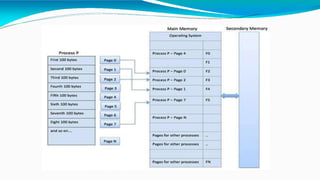
Paging is a memory management technique in which process address space
is broken into blocks of the same size called pages (size is power of 2,
between 512 bytes and 8192 bytes). The size of the process is measured in
the number of pages.
Similarly, main memory is divided into small fixed-sized blocks of (physical)
memory called frames and the size of a frame is kept the same as that of a
page to have optimum utilization of the main memory and to avoid external
fragmentation.
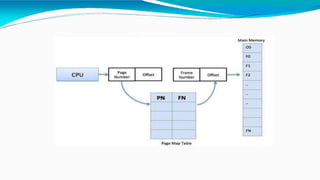
Address Translation
Page address is called logical address and represented by page number and
the offset.
Logical Address = Page number + page offset
Frame address is called physical address and represented by a frame
number and the offset.
Physical Address = Frame number + page offset
A data structure called page map table is used to keep track of the relation
between a page of a process to a frame in physical memory.
When the system allocates a frame to any page, it translates this logical address
into a physical address and create entry into the page table to be used
throughout execution of the program.
When a process is to be executed, its corresponding pages are loaded into any
available memory frames. Suppose you have a program of 8Kb but your memory
can accommodate only 5Kb at a given point in time, then the paging concept will
come into picture. When a computer runs out of RAM, the operating system
(OS) will move idle or unwanted pages of memory to secondary memory to free
up RAM for other processes and brings them back when needed by the program.
This process continues during the whole execution of the program where the OS
keeps removing idle pages from the main memory and write them onto the
secondary memory and bring them back when required by the program.
Segmentation
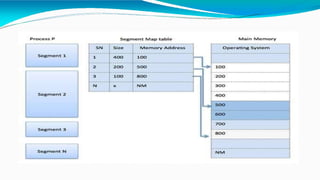
Segmentation is a memory management technique in which each job is divided into
several segments of different sizes, one for each module that contains pieces that
perform related functions. Each segment is actually a different logical address space
of the program.
When a process is to be executed, its corresponding segmentation are loaded into
non-contiguous memory though every segment is loaded into a contiguous block of
available memory.
Segmentation memory management works very similar to paging but here segments
are of variable-length where as in paging pages are of fixed size.
A program segment contains the program's main function, utility functions, data
structures, and so on. The operating system maintains a segment map table for
every process and a list of free memory blocks along with segment numbers, their
size and corresponding memory locations in main memory. For each segment, the
table stores the starting address of the segment and the length of the segment. A
reference to a memory location includes a value that identifies a segment and an
unit5_os (1).pptx
unit5_os (1).pptx
unit5_os (1).pptx

unit5_os (1).pptx

  • 1.
    Program Name :Computer Engineering Group Program Code : CO/CM/IF/CW Semester Course Title Course Code : Fifth : Operating System : 22516 6.2 Access methods
  • 2.
    Swapping A process mustbe in memory to be executed. A process, however, can be swapped temporarily out of memory to a backing store and then brought back into memory for continued execution (Figure). Swapping makes it possible for the total physical address space of all processes to exceed the real physical memory of the system, thus increasing the degree of multiprogramming in a system.
  • 3.
    8.2.1 Standard Swapping Standardswapping involves moving processes between main memory and a backing store. The backing store is commonly a fast disk. It must be large enough to accommodate copies of all memory images for all users, and it must provide direct access to these memory images. The system maintains a ready queue consisting of all processes whose memory images are on the backing store or in memory and are ready to run. Whenever the CPU scheduler decides to execute a process, it calls the dispatcher. The dispatcher checks to see whether the next process in the queue is in memory. If it is not, and if there is no free memory region, the dispatcher swaps out a process currently in memory and swaps in the desired process. It then reloads registers and transfers control to the selected process.
  • 5.
    What is MemoryManagement? Memory Management is the process of controlling and coordinating computer memory, assigning portions known as blocks to various running programs to optimize the overall performance of the system. It is the most important function of an operating system that manages primary memory. It helps processes to move back and forward between the main memory and execution disk. It helps OS to keep track of every memory location, irrespective of whether it is allocated to some process or it remains free.
  • 6.
    Memory Management Techniques Here,are some most crucial memory management techniques: Single Contiguous Allocation It is the easiest memory management technique. In this method, all types of computer's memory except a small portion which is reserved for the OS is available for one application. For example, MS-DOS operating system allocates memory in this way. An embedded system also runs on a single application. Partitioned Allocation It divides primary memory into various memory partitions, which is mostly contiguous areas of memory. Every partition stores all the information for a specific task or job. This method consists of allotting a partition to a job when it starts & unallocate when it ends. Paged Memory Management This method divides the computer's main memory into fixed-size units known as page frames. This hardware memory management unit maps pages into frames which should be allocated on a page basis.
  • 7.
    Segmented Memory Management Segmentedmemory is the only memory management method that does not provide the user's program with a linear and contiguous address space. Segments need hardware support in the form of a segment table. It contains the physical address of the section in memory, size, and other data like access protection bits and status.
  • 8.
    What is Memoryallocation? Memory allocation is a process by which computer programs are assigned memory or space. Here, main memory is divided into two types of partitions Low Memory - Operating system resides in this type of memory. High Memory- User processes are held in high memory. Partition Allocation Memory is divided into different blocks or partitions. Each process is allocated according to the requirement. Partition allocation is an ideal method to avoid internal fragmentation.
  • 9.
    Below are thevarious partition allocation schemes : First Fit: In this type fit, the partition is allocated, which is the first sufficient block from the beginning of the main memory. Best Fit: It allocates the process to the partition that is the first smallest partition among the free partitions. Worst Fit: It allocates the process to the partition, which is the largest sufficient freely available partition in the main memory. Next Fit: It is mostly similar to the first Fit, but this Fit, searches for the first sufficient partition from the last allocation point.
  • 10.
    What is Paging? Pagingis a storage mechanism that allows OS to retrieve processes from the secondary storage into the main memory in the form of pages. In the Paging method, the main memory is divided into small fixed-size blocks of physical memory, which is called frames. The size of a frame should be kept the same as that of a page to have maximum utilization of the main memory and to avoid external fragmentation. Paging is used for faster access to data, and it is a logical concept.
  • 11.
    Paging is amemory management technique in which process address space is broken into blocks of the same size called pages (size is power of 2, between 512 bytes and 8192 bytes). The size of the process is measured in the number of pages. Similarly, main memory is divided into small fixed-sized blocks of (physical) memory called frames and the size of a frame is kept the same as that of a page to have optimum utilization of the main memory and to avoid external fragmentation.
  • 13.
    Address Translation Page addressis called logical address and represented by page number and the offset. Logical Address = Page number + page offset Frame address is called physical address and represented by a frame number and the offset. Physical Address = Frame number + page offset A data structure called page map table is used to keep track of the relation between a page of a process to a frame in physical memory.
  • 15.
    When the systemallocates a frame to any page, it translates this logical address into a physical address and create entry into the page table to be used throughout execution of the program. When a process is to be executed, its corresponding pages are loaded into any available memory frames. Suppose you have a program of 8Kb but your memory can accommodate only 5Kb at a given point in time, then the paging concept will come into picture. When a computer runs out of RAM, the operating system (OS) will move idle or unwanted pages of memory to secondary memory to free up RAM for other processes and brings them back when needed by the program. This process continues during the whole execution of the program where the OS keeps removing idle pages from the main memory and write them onto the secondary memory and bring them back when required by the program.
  • 16.
    Segmentation Segmentation is amemory management technique in which each job is divided into several segments of different sizes, one for each module that contains pieces that perform related functions. Each segment is actually a different logical address space of the program. When a process is to be executed, its corresponding segmentation are loaded into non-contiguous memory though every segment is loaded into a contiguous block of available memory. Segmentation memory management works very similar to paging but here segments are of variable-length where as in paging pages are of fixed size. A program segment contains the program's main function, utility functions, data structures, and so on. The operating system maintains a segment map table for every process and a list of free memory blocks along with segment numbers, their size and corresponding memory locations in main memory. For each segment, the table stores the starting address of the segment and the length of the segment. A reference to a memory location includes a value that identifies a segment and an