Professor Simon Judd
MBRs: the low down
www.cranfield.
Bibliography
2000
2003
2006
2011
2014
aeration
primary
sedimentation
secondary
clarifier
screened
sewage
settled sewage
final
effluent
raw/primary
sludge
PRIMARY
TREATMENT
SECONDARY TREATMENT
(activated sludge)
TERTIARY
TREATMENT
(disinfection)
cell
separation
Conventional sewage treatment
clarified, largely disinfected product provided
small footprint plant
low sludge yield (0.35 – 0.6 Kg DS/Kg BOD)
bulking problems become less relevant
hydraulic and solids retention time are uncoupled
intensive biotreatment provided, esp. nitrification
Cl2
waste activated
sludge
return activated sludge
MBR process configurations
Air
In
Out
Membrane
Out
Bioreactor
Recirculated stream
Air
In
Pump
Bioreactor
Membrane
immersed/submerged MBRsidestream MBR
Really expensive Expensive? ?
MBR process configurations
MBR technology
Immersed
Flat sheet
Hollow
fibre
Sidestream
Multitube/multichannel
Pumped
Classical
Low
energy
Aerated
Lift Injection
Municipal MunicipalIndustrial
memb-
rane
Industriall
MBR operational parameters
• Key parameters are
• operating flux
flux = permeate flow / membrane area
• transmembrane pressure (TMP)
• permeability
• permeability = flux / TMP
• membrane module aeration or crossflow velocity
• Specific aeration demand = aeration rate / membrane area
• These are all inter-related and impact on cleaning
OPERATIONDESIGN
Clogging
membrane
channels
aerator
ports
Fouling
reversible irreversible
Biomass characteristics
Bulk characteristics
• viscosity/rheology
• hydrophobicity
Feed characteristics
Membrane module characteristics
Configuration
• geometry
• dimensions
Pore
• size
• shape
Surface characteristics
• porosity
• charge/hydrophobicity
Floc characteristics
• size
• structure
EPS
• free
• bound
Retention time
• Hydraulic
• Solids
Hydraulics
• flux
• TMP
• Crossflow
Cleaning
• physical
• chemical
Aeration
• design (port size)
• mean flow rate
• pulse rate
Hydraulics, hydrodynamics & fouling/clogging
• All interlinked:
• increasing flux increases fouling/clogging
• increasing crossflow (promoting turbulence)
increases flux – but increases energy demand
• Fouling also determined by:
• biomass characteristics
• This is in turn influenced by
• feedwater quality
• retention times (hydraulic and solids)
• Key design parameter is
• critical/ sustainable flux
• There is a limit to how far the design flux can be
pushed
Membrane
process types
Reverse osmosis ULTRAFILTRATION
Nanofiltration MICROFILTRATION
Depth
filtration
(to >1mm)
10-10 10-9 10-8 10-7 10-6 10-5
Scale in metres
Free
atoms
200 20,000 500,000
Approximate Molecular Weight in Daltons
Small
organic
monomers
Sugars
Herbicides
PesticidesDissolved
salts
Endotoxins/
pyrogens
Viruses
Colloids:
Albumen protein
Colloidal silica
Bacteria (to ~40µm)
Crypto-
sporidia
Red
blood
cells
Porous membrane
filtration processes
Dense membrane
processes
Electrodialysis
Material structure
May be isotropic, but often
anisotropic (symmetry in one
direction)
Membrane material
Membrane pore size trends
• The seven PES membranes are offered exclusively
as FS and are all 150 kDa rated (~0.03 µm)
• The two PE FS membranes are 0.4 µm and
hydrophilicised (by chemical oxidation)
• The PP membranes are offered exclusively as HF
and have various pore sizes
• The PVDF membranes cover a pore sizes of 0.01-0.4
µm and a range of HF diameters
• Ceramic FS membranes are offered predominantly in
the 0.1-0.5 µm range
MBR membrane products – 70 off.Immersed (iMBR) Sidestream (sMBR)
Flat sheet Hollow fibre Multi-tube/multi-channel, polymer
A3/MaxFlowDE Asahi Kasei - Microza JP Berghof - HyPerm-AE; HyperFluxDE
Alfa Laval - Hollow SheetSE CrefluxCN Pentair – CompactUS
Beijing IWHR - GyroreactorCN DehongCN MEMOS - MEMCROSSDE
BenenvCN Econity - KSMBRKR Xylem/PCI MembranesUS
Brightwater/Anua - MembrightIRL/PuraM® Evoqua - MemPulseUS
CerafloSG FeitianCN Multi-tube/multi-channel, ceramic
Ecologix - EcoPlateTN GE - ZeeWeed US Likuid NanotekSP
Huber - VRMDE H-Filtration - MRCN Veolia Water Systems – CeramemFR
ItNDE HinaCN SuntarCN
KorED, NeofilKR HinadaCN LiqTechDK
Kubota - ES/EKJP Hyflux - PorocepSG
Kubota - SPJP JiamiaoCN Flat sheet
Lantian PeierCN Jie FuCN ROCHEM - Bio-FILTUS
LiqTechDK KaiHongCN NovasepFR
Martin - siClaroDE KejiCN
MegaVisionCN Koch Membrane Systems - PURONUS Hollow fibre
MeidenJP Kolon - CleanfilKR
Polymem - IMMEMFR
Mann+Humme/MICRODYN-NADIR – BIO-CELDE Litree - LH3CN
newterra – MicroClearCA MEMOS - MEMSUBDE Flat disc
Pure Envitech Co., Ltd. – ENVISKR
Origin WaterCN Grundfos - BioBoosterDK
Pure Envitech Co., Ltd. – SBMKR United Envirotech/Memstar - SMMSG
QUA - EnviQUS MicronaCN
SINAPCN Mitsubishi Rayon - STERAPORE 5000JP
SupratecDE MohuaCN
Toray - MEMBRAYJP MotianCN
VinaCN Motimo - FP AIVCN
Ovivo - OVTM PhilosKR
Porous Fibers S.L. - Micronet SP
QiangshengCN
Sumitomo - Poreflon JP
Superstring MBR Tech. Co.Ltd - SuperUFCN
ZenaCZ
Flat sheet MBR membrane panels:
• all vertically-oriented
• almost all rectangular in shape
• 1-1.5 m in height
• 0.4-1 m in width
• separated by 6-9 mm
• single permeate extraction point
Membrane module dimensions:
FS panels
FS stacks/cassettes/units
Alternative FS configurations
HF modules and
cassettes
Hollow fibre MBR membranes are almost all:
•vertically-oriented
•outside diameter 0.4-2.8mm
•predominantly PVDF
•around 2 m high
MBR system suppliers
FS
• Ovivo
• ADI
• Busse
• Kruger
• Smith and Loveless
• Sanitherm
• Wigen
• Hitachi
• Memcon
HF
• Layne
• Aquabio
• Berghof
• Dynatec
• Triqua
• Wehrle
MT
Process components
Process components
Category Component(s) ID Description/purpose
Tanks Raw water T1 Storage tank for inlet wastewater
Primary sedimentation T2 Removal of gross, settleable solids
Equalisation (EQ) T3 Equalisation of flow
Anoxic (Ax) T4 Denitrification
Aeration (Ae) T5 Nitrification and biological oxidation
Membrane T6 Membrane separation
Treated water T7 Storage of permeate water
Sludge T8 Storage of wasted sludge
Chemicals storage T9,10
Pumps Settled sludge transfer P1 Submerged, settled sludge to sludge storage
tank
Feed P2 EQ tank through rotary screen
Permeate P3 Self-priming, membrane suction filtration
Sludge return/discharge P4 Submerged, sludge recirculation and excess
Sludge transfer P5 WAS to dewatering
Chemicals P6,7 Cleaning chemicals transfer to membrane, x2
Blower Process B1 Biological process aeration
Membrane B2 Membrane scouring
Mixer EQ tank mixer X1 High speed, equalisation tank
Ax tank mixer X2 Low speed, anoxic tank
Screen Rotary screen S1 Fine screening of feed
Membrane Membrane module M1 FS membrane plus frame with built-in aerator
Diffusers Fine bubble diffuser D1 Process aeration
Coarse bubble diffuser D2 Membrane aeration
Aeration
AIR
Nitrate-enriched sludge
Feed Treated
water
fine bubble
AIR
coarse bubble
Membrane cleaning, UF/MF
Chemical
ACIDS
Hydrochloric/sulphuric
Citric/Oxalic
BASE
Causticsoda
OXIDANT
Hypochlorite
Hydrogen peroxide
Physical
BACKFLUSHING
• withair
• without air
RELAXATION
CHEMICALLY
ENHANCED
BACKWASH
CEB
CIP
Fouling and cleaning
Flocculant solids normally
readily removed by
physical cleaning
Solutes and colloidal
matter more tenacious
Fouling exacerbated by:
• high fluxes
• low shear
• infrequent cleaning
backflushY Y
Bioreactor Clarification Membrane
Feed Effluent
backflush
Bioreactor Membrane
Feed Effluent
CAS with polishing:
MBR:
Removal data for 29 pharmas
Concentration data for 7 metals
Capital cost
Young et al, 2012
• MBR CAPEX lower
for enhanced
nutrient removal
and water reuse
applications
• Result is the same
for cold climates,
warm climates,
with primary
clarification, and
for plants with
high peaking
factors
TSS < 20
BOD < 20
NH3-N < 1
Temp
12°C
Peak 2X
Case 1 &
TN < 10
TSS < 10
BOD < 10
NH3-N < 1
TN < 10
TP < 0.2
Temp 12°C
Peak 2X
Case 3
with
Primary
Clarifier
Case 3
with
Tmin 25°C
Case 3
with
Peak 4X
Case 1 Case 2 Case 3 Case 4 Case 5 Case 6
by kind permission of GE
CAPEX, MBR vs. CAS, Germany
Brepols et al, 2010
CAPEX, MBR vs oxidation ditch
Itokawa et al, 2014 (Japanese Sewage Works Agency)
0
200
400
600
800
1,000
1,200
1,400
1,600
1,800
2,000
0 2,000 4,000 6,000 8,000 10,000 12,000 14,000
Design capacity [m3
/d]
Constructioncost[103
JPY/(m3
/d)]
MBR (whole plant)
MBR (wastewater treatment)
OD plant
OD plant with sand filtration
Specific energy demand, Germany
Brepols et al, 2010
Specific energy demand, Japan
Itokawa et al, 2014 (Japanese Sewage Works Agency)
0
1
2
3
4
5
6
7
8
9
10
0 10 20 30 40 50 60 70 80 90 100
Inflow/capacity ratio [%]
Specificenergyconsumption[kWh/m3
]
Moryama
intermittent
operation
Moryama plant, JSWA
Itokawa et al, 2011*
• System configuration
• UCT process with FS membrane units submerged in the aerobic tank.
• Several energy saving measures incorporated.
*Original figure taken from “Guidelines for Introducing Membrane, Technology in Sewage Works: The 2nd Edition”, MLIT, 2011.
Membrane units for
large-scale MBRs.
Siphon
filtration
Air-lift pumps for
internal circulation.
Low speed mixers.
HF FS
Specific energy demand, Ovivo
0.00
0.50
1.00
1.50
2.00
2.50
0 20 40 60 80 100 120
SEDkWh/m3
% design flow
Specific energy demand, Spain
Gabarrón et al, 2014
HF
FS
Operating cost
Young et al, 2013
• MBR OPEX is
higher for all
cases
• Differences mostly
attributed to
power, chemical,
and membrane
replacement
• Membrane
replacement is
responsible for a
relatively small
portion of the NPV
TSS < 20
BOD < 20
NH3-N < 1
Temp
12°C
Peak 2X
Case 1 &
TN < 10
TSS < 10
BOD < 10
NH3-N < 1
TN < 10
TP < 0.2
Temp 12°C
Peak 2X
Case 3
with
Primary
Clarifier
Case 3
with
Tmin 25°C
Case 3
with
Peak 4X
Case 1 Case 2 Case 3 Case 4 Case 5 Case 6
by kind permission of GE
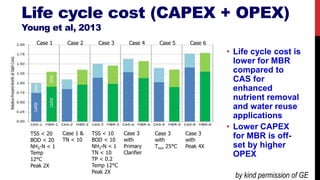
Life cycle cost (CAPEX + OPEX)
Young et al, 2013
• Life cycle cost is
lower for MBR
compared to
CAS for
enhanced
nutrient removal
and water reuse
applications
• Lower CAPEX
for MBR is off-
set by higher
OPEX
TSS < 20
BOD < 20
NH3-N < 1
Temp
12°C
Peak 2X
Case 1 &
TN < 10
TSS < 10
BOD < 10
NH3-N < 1
TN < 10
TP < 0.2
Temp 12°C
Peak 2X
Case 3
with
Primary
Clarifier
Case 3
with
Tmin 25°C
Case 3
with
Peak 4X
Case 1 Case 2 Case 3 Case 4 Case 5 Case 6
by kind permission of GE
CAPEX & OPEX comparison
Costs: summary
• MBR can be more cost-effective than CAS
depending on design and treated water quality
required.
• MBR is more cost-effective than CAS when tertiary
treatment with membranes is required.
• Cost breakdown, based on same effluent WQ for
published studies:
• OPEX higher for MBR
• this isn’t always necessarily the case
• CAPEX lower for MBR
• Lower life cycle costs
• CAS usually more cost-effective than MBR if
tertiary treatment is not required, depending on
design
• Critical membrane life for cost neutrality for NPV
analysis
4
3GE Water & Process
Technologies
The MBR Survey (186 responses)
• Q1What is the main technical problem that prevents
MBRs working as they should?
16%
16%
12%
11%
10%
8%
8%
6%
5%
4% 4% Screening/pre-treatment
Membrane surface fouling
Operator knowledge
Energy demand
Membrane/aerator clogging
Sludge/mixed liquor quality
Membrane chemical cleaning
Overloading/under-design
Uneven aeration
Other/Comments
Automation/control, or software
The MBR Survey (186 responses)
• Q1What is the main technical problem that prevents
MBRs working as they should?
16%
10%
6%16%
4%8%
11%
12%
8%
5%4%
Screening/pre-treatment
Membrane/aerator clogging
Overloading/under-design
Membrane surface fouling
Automation/control, or software
Membrane chemical cleaning
Energy demand
The MBR Survey, Q1
0%
5%
10%
15%
20%
25%
Mar-10 Feb-12 Feb-15
The MBR Survey, Q2
• Q2 How will
MBR technology
develop in the
future?
48
32
27
17
16
14
13
13
10
10
9
9
8
8
8
6
6
6
5
5
0 5 10 15 20 25 30 35 40 45 50
energy/power
cost
fouling
membrane materials
automation & control
potable/drinking
robustness
awareness/perception/acceptance
nutrient
pretreatment/screening/clogging
Survey of 214 plants (Ovivo)
• Electrical 6
• Membrane CIP 12
• Mechanical piping/design 14
• Fine screening 14
• Control valves 26
• Instrumentation 27
• Ancillary equipment 103
• Process condition 111
• Integration and controls 187
possibly membranes related
An academic’s view
• Word cloud of keywords of all published MBR wastewater papers,
1990-2009
• Analysis of the SCOPUS database using Wordle
• Common/generic words excluded
Past, present ..
THAT WAS THEN: PORLOCK
First municipal MBR (1997)
• 1.9 MLD
Manual aerator flushing
No separate membrane tank
• coarse-bubble aeration only
Up to 14 years membrane
life
>2 kWh/m3 (MBR only)
THIS IS NOW
Bigger plants:
• 9 MBRs of >100 MLD peak
daily flow capacity
Better plants
• Improved membranes and
membrane technology
• Effective pretreatment
• More efficient membrane air
scouring
• Smarter, more holistic design
• <0.5 kWh/m3
… and future?
• Further improvements/cost reductions in design and operation:
• Aeration efficiencies improving
• Continued smart design and operation
• automation, real time data capture and processing
• Cinder blocks and ceramic membranes
• Direct potable reuse
• Technically possible and already happening in some places
• Game changers:
• Complete standardisation (as in RO and other crossflow systems)
• Complete energy and resource recovery
• immersed anaerobic MBRs with nutrient removal
Find out more (for free) at www.thembrsite.com

Simon Judd: MBR Low Down

  • 1.
    Professor Simon Judd MBRs:the low down www.cranfield.
  • 2.
  • 4.
    aeration primary sedimentation secondary clarifier screened sewage settled sewage final effluent raw/primary sludge PRIMARY TREATMENT SECONDARY TREATMENT (activatedsludge) TERTIARY TREATMENT (disinfection) cell separation Conventional sewage treatment clarified, largely disinfected product provided small footprint plant low sludge yield (0.35 – 0.6 Kg DS/Kg BOD) bulking problems become less relevant hydraulic and solids retention time are uncoupled intensive biotreatment provided, esp. nitrification Cl2 waste activated sludge return activated sludge
  • 5.
    MBR process configurations Air In Out Membrane Out Bioreactor Recirculatedstream Air In Pump Bioreactor Membrane immersed/submerged MBRsidestream MBR Really expensive Expensive? ?
  • 6.
    MBR process configurations MBRtechnology Immersed Flat sheet Hollow fibre Sidestream Multitube/multichannel Pumped Classical Low energy Aerated Lift Injection Municipal MunicipalIndustrial memb- rane Industriall
  • 7.
    MBR operational parameters •Key parameters are • operating flux flux = permeate flow / membrane area • transmembrane pressure (TMP) • permeability • permeability = flux / TMP • membrane module aeration or crossflow velocity • Specific aeration demand = aeration rate / membrane area • These are all inter-related and impact on cleaning
  • 8.
    OPERATIONDESIGN Clogging membrane channels aerator ports Fouling reversible irreversible Biomass characteristics Bulkcharacteristics • viscosity/rheology • hydrophobicity Feed characteristics Membrane module characteristics Configuration • geometry • dimensions Pore • size • shape Surface characteristics • porosity • charge/hydrophobicity Floc characteristics • size • structure EPS • free • bound Retention time • Hydraulic • Solids Hydraulics • flux • TMP • Crossflow Cleaning • physical • chemical Aeration • design (port size) • mean flow rate • pulse rate
  • 9.
    Hydraulics, hydrodynamics &fouling/clogging • All interlinked: • increasing flux increases fouling/clogging • increasing crossflow (promoting turbulence) increases flux – but increases energy demand • Fouling also determined by: • biomass characteristics • This is in turn influenced by • feedwater quality • retention times (hydraulic and solids) • Key design parameter is • critical/ sustainable flux • There is a limit to how far the design flux can be pushed
  • 11.
    Membrane process types Reverse osmosisULTRAFILTRATION Nanofiltration MICROFILTRATION Depth filtration (to >1mm) 10-10 10-9 10-8 10-7 10-6 10-5 Scale in metres Free atoms 200 20,000 500,000 Approximate Molecular Weight in Daltons Small organic monomers Sugars Herbicides PesticidesDissolved salts Endotoxins/ pyrogens Viruses Colloids: Albumen protein Colloidal silica Bacteria (to ~40µm) Crypto- sporidia Red blood cells Porous membrane filtration processes Dense membrane processes Electrodialysis
  • 12.
    Material structure May beisotropic, but often anisotropic (symmetry in one direction)
  • 13.
  • 14.
    Membrane pore sizetrends • The seven PES membranes are offered exclusively as FS and are all 150 kDa rated (~0.03 µm) • The two PE FS membranes are 0.4 µm and hydrophilicised (by chemical oxidation) • The PP membranes are offered exclusively as HF and have various pore sizes • The PVDF membranes cover a pore sizes of 0.01-0.4 µm and a range of HF diameters • Ceramic FS membranes are offered predominantly in the 0.1-0.5 µm range
  • 15.
    MBR membrane products– 70 off.Immersed (iMBR) Sidestream (sMBR) Flat sheet Hollow fibre Multi-tube/multi-channel, polymer A3/MaxFlowDE Asahi Kasei - Microza JP Berghof - HyPerm-AE; HyperFluxDE Alfa Laval - Hollow SheetSE CrefluxCN Pentair – CompactUS Beijing IWHR - GyroreactorCN DehongCN MEMOS - MEMCROSSDE BenenvCN Econity - KSMBRKR Xylem/PCI MembranesUS Brightwater/Anua - MembrightIRL/PuraM® Evoqua - MemPulseUS CerafloSG FeitianCN Multi-tube/multi-channel, ceramic Ecologix - EcoPlateTN GE - ZeeWeed US Likuid NanotekSP Huber - VRMDE H-Filtration - MRCN Veolia Water Systems – CeramemFR ItNDE HinaCN SuntarCN KorED, NeofilKR HinadaCN LiqTechDK Kubota - ES/EKJP Hyflux - PorocepSG Kubota - SPJP JiamiaoCN Flat sheet Lantian PeierCN Jie FuCN ROCHEM - Bio-FILTUS LiqTechDK KaiHongCN NovasepFR Martin - siClaroDE KejiCN MegaVisionCN Koch Membrane Systems - PURONUS Hollow fibre MeidenJP Kolon - CleanfilKR Polymem - IMMEMFR Mann+Humme/MICRODYN-NADIR – BIO-CELDE Litree - LH3CN newterra – MicroClearCA MEMOS - MEMSUBDE Flat disc Pure Envitech Co., Ltd. – ENVISKR Origin WaterCN Grundfos - BioBoosterDK Pure Envitech Co., Ltd. – SBMKR United Envirotech/Memstar - SMMSG QUA - EnviQUS MicronaCN SINAPCN Mitsubishi Rayon - STERAPORE 5000JP SupratecDE MohuaCN Toray - MEMBRAYJP MotianCN VinaCN Motimo - FP AIVCN Ovivo - OVTM PhilosKR Porous Fibers S.L. - Micronet SP QiangshengCN Sumitomo - Poreflon JP Superstring MBR Tech. Co.Ltd - SuperUFCN ZenaCZ
  • 16.
    Flat sheet MBRmembrane panels: • all vertically-oriented • almost all rectangular in shape • 1-1.5 m in height • 0.4-1 m in width • separated by 6-9 mm • single permeate extraction point Membrane module dimensions: FS panels
  • 17.
  • 18.
  • 19.
    HF modules and cassettes Hollowfibre MBR membranes are almost all: •vertically-oriented •outside diameter 0.4-2.8mm •predominantly PVDF •around 2 m high
  • 20.
    MBR system suppliers FS •Ovivo • ADI • Busse • Kruger • Smith and Loveless • Sanitherm • Wigen • Hitachi • Memcon HF • Layne • Aquabio • Berghof • Dynatec • Triqua • Wehrle MT
  • 22.
  • 23.
    Process components Category Component(s)ID Description/purpose Tanks Raw water T1 Storage tank for inlet wastewater Primary sedimentation T2 Removal of gross, settleable solids Equalisation (EQ) T3 Equalisation of flow Anoxic (Ax) T4 Denitrification Aeration (Ae) T5 Nitrification and biological oxidation Membrane T6 Membrane separation Treated water T7 Storage of permeate water Sludge T8 Storage of wasted sludge Chemicals storage T9,10 Pumps Settled sludge transfer P1 Submerged, settled sludge to sludge storage tank Feed P2 EQ tank through rotary screen Permeate P3 Self-priming, membrane suction filtration Sludge return/discharge P4 Submerged, sludge recirculation and excess Sludge transfer P5 WAS to dewatering Chemicals P6,7 Cleaning chemicals transfer to membrane, x2 Blower Process B1 Biological process aeration Membrane B2 Membrane scouring Mixer EQ tank mixer X1 High speed, equalisation tank Ax tank mixer X2 Low speed, anoxic tank Screen Rotary screen S1 Fine screening of feed Membrane Membrane module M1 FS membrane plus frame with built-in aerator Diffusers Fine bubble diffuser D1 Process aeration Coarse bubble diffuser D2 Membrane aeration
  • 24.
  • 25.
    Membrane cleaning, UF/MF Chemical ACIDS Hydrochloric/sulphuric Citric/Oxalic BASE Causticsoda OXIDANT Hypochlorite Hydrogenperoxide Physical BACKFLUSHING • withair • without air RELAXATION CHEMICALLY ENHANCED BACKWASH CEB CIP
  • 26.
    Fouling and cleaning Flocculantsolids normally readily removed by physical cleaning Solutes and colloidal matter more tenacious Fouling exacerbated by: • high fluxes • low shear • infrequent cleaning
  • 28.
    backflushY Y Bioreactor ClarificationMembrane Feed Effluent backflush Bioreactor Membrane Feed Effluent CAS with polishing: MBR:
  • 29.
    Removal data for29 pharmas
  • 30.
  • 32.
    Capital cost Young etal, 2012 • MBR CAPEX lower for enhanced nutrient removal and water reuse applications • Result is the same for cold climates, warm climates, with primary clarification, and for plants with high peaking factors TSS < 20 BOD < 20 NH3-N < 1 Temp 12°C Peak 2X Case 1 & TN < 10 TSS < 10 BOD < 10 NH3-N < 1 TN < 10 TP < 0.2 Temp 12°C Peak 2X Case 3 with Primary Clarifier Case 3 with Tmin 25°C Case 3 with Peak 4X Case 1 Case 2 Case 3 Case 4 Case 5 Case 6 by kind permission of GE
  • 33.
    CAPEX, MBR vs.CAS, Germany Brepols et al, 2010
  • 34.
    CAPEX, MBR vsoxidation ditch Itokawa et al, 2014 (Japanese Sewage Works Agency) 0 200 400 600 800 1,000 1,200 1,400 1,600 1,800 2,000 0 2,000 4,000 6,000 8,000 10,000 12,000 14,000 Design capacity [m3 /d] Constructioncost[103 JPY/(m3 /d)] MBR (whole plant) MBR (wastewater treatment) OD plant OD plant with sand filtration
  • 35.
    Specific energy demand,Germany Brepols et al, 2010
  • 36.
    Specific energy demand,Japan Itokawa et al, 2014 (Japanese Sewage Works Agency) 0 1 2 3 4 5 6 7 8 9 10 0 10 20 30 40 50 60 70 80 90 100 Inflow/capacity ratio [%] Specificenergyconsumption[kWh/m3 ] Moryama intermittent operation
  • 37.
    Moryama plant, JSWA Itokawaet al, 2011* • System configuration • UCT process with FS membrane units submerged in the aerobic tank. • Several energy saving measures incorporated. *Original figure taken from “Guidelines for Introducing Membrane, Technology in Sewage Works: The 2nd Edition”, MLIT, 2011. Membrane units for large-scale MBRs. Siphon filtration Air-lift pumps for internal circulation. Low speed mixers.
  • 38.
    HF FS Specific energydemand, Ovivo
  • 39.
    0.00 0.50 1.00 1.50 2.00 2.50 0 20 4060 80 100 120 SEDkWh/m3 % design flow Specific energy demand, Spain Gabarrón et al, 2014 HF FS
  • 40.
    Operating cost Young etal, 2013 • MBR OPEX is higher for all cases • Differences mostly attributed to power, chemical, and membrane replacement • Membrane replacement is responsible for a relatively small portion of the NPV TSS < 20 BOD < 20 NH3-N < 1 Temp 12°C Peak 2X Case 1 & TN < 10 TSS < 10 BOD < 10 NH3-N < 1 TN < 10 TP < 0.2 Temp 12°C Peak 2X Case 3 with Primary Clarifier Case 3 with Tmin 25°C Case 3 with Peak 4X Case 1 Case 2 Case 3 Case 4 Case 5 Case 6 by kind permission of GE
  • 41.
    Life cycle cost(CAPEX + OPEX) Young et al, 2013 • Life cycle cost is lower for MBR compared to CAS for enhanced nutrient removal and water reuse applications • Lower CAPEX for MBR is off- set by higher OPEX TSS < 20 BOD < 20 NH3-N < 1 Temp 12°C Peak 2X Case 1 & TN < 10 TSS < 10 BOD < 10 NH3-N < 1 TN < 10 TP < 0.2 Temp 12°C Peak 2X Case 3 with Primary Clarifier Case 3 with Tmin 25°C Case 3 with Peak 4X Case 1 Case 2 Case 3 Case 4 Case 5 Case 6 by kind permission of GE
  • 42.
    CAPEX & OPEXcomparison
  • 43.
    Costs: summary • MBRcan be more cost-effective than CAS depending on design and treated water quality required. • MBR is more cost-effective than CAS when tertiary treatment with membranes is required. • Cost breakdown, based on same effluent WQ for published studies: • OPEX higher for MBR • this isn’t always necessarily the case • CAPEX lower for MBR • Lower life cycle costs • CAS usually more cost-effective than MBR if tertiary treatment is not required, depending on design • Critical membrane life for cost neutrality for NPV analysis 4 3GE Water & Process Technologies
  • 45.
    The MBR Survey(186 responses) • Q1What is the main technical problem that prevents MBRs working as they should? 16% 16% 12% 11% 10% 8% 8% 6% 5% 4% 4% Screening/pre-treatment Membrane surface fouling Operator knowledge Energy demand Membrane/aerator clogging Sludge/mixed liquor quality Membrane chemical cleaning Overloading/under-design Uneven aeration Other/Comments Automation/control, or software
  • 46.
    The MBR Survey(186 responses) • Q1What is the main technical problem that prevents MBRs working as they should? 16% 10% 6%16% 4%8% 11% 12% 8% 5%4% Screening/pre-treatment Membrane/aerator clogging Overloading/under-design Membrane surface fouling Automation/control, or software Membrane chemical cleaning Energy demand
  • 47.
    The MBR Survey,Q1 0% 5% 10% 15% 20% 25% Mar-10 Feb-12 Feb-15
  • 48.
    The MBR Survey,Q2 • Q2 How will MBR technology develop in the future? 48 32 27 17 16 14 13 13 10 10 9 9 8 8 8 6 6 6 5 5 0 5 10 15 20 25 30 35 40 45 50 energy/power cost fouling membrane materials automation & control potable/drinking robustness awareness/perception/acceptance nutrient pretreatment/screening/clogging
  • 49.
    Survey of 214plants (Ovivo) • Electrical 6 • Membrane CIP 12 • Mechanical piping/design 14 • Fine screening 14 • Control valves 26 • Instrumentation 27 • Ancillary equipment 103 • Process condition 111 • Integration and controls 187 possibly membranes related
  • 50.
    An academic’s view •Word cloud of keywords of all published MBR wastewater papers, 1990-2009 • Analysis of the SCOPUS database using Wordle • Common/generic words excluded
  • 52.
    Past, present .. THATWAS THEN: PORLOCK First municipal MBR (1997) • 1.9 MLD Manual aerator flushing No separate membrane tank • coarse-bubble aeration only Up to 14 years membrane life >2 kWh/m3 (MBR only) THIS IS NOW Bigger plants: • 9 MBRs of >100 MLD peak daily flow capacity Better plants • Improved membranes and membrane technology • Effective pretreatment • More efficient membrane air scouring • Smarter, more holistic design • <0.5 kWh/m3
  • 53.
    … and future? •Further improvements/cost reductions in design and operation: • Aeration efficiencies improving • Continued smart design and operation • automation, real time data capture and processing • Cinder blocks and ceramic membranes • Direct potable reuse • Technically possible and already happening in some places • Game changers: • Complete standardisation (as in RO and other crossflow systems) • Complete energy and resource recovery • immersed anaerobic MBRs with nutrient removal Find out more (for free) at www.thembrsite.com