By
DHARSHANA RAJAGOPAL - 102116013
HARIPRASANTH D - 102116022
HARISHWAR R - 102116024
SERIN SARAH TOPNO - 102116048
CLPE14
New Separation Processes
WASTEWATER TREATMENT
USING MEMBRANE BIOREACTORS
Presented on: 2nd November 2019
Conventional Wastewater Treatment Technique
2
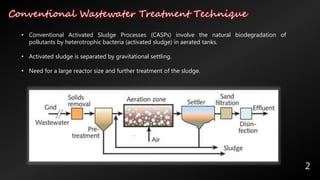
• Conventional Activated Sludge Processes (CASPs) involve the natural biodegradation of
pollutants by heterotrophic bacteria (activated sludge) in aerated tanks.
• Activated sludge is separated by gravitational settling.
• Need for a large reactor size and further treatment of the sludge.
Membrane Bioreactor (MBR)
3
• Improvement of CASP – replacement of gravity settler with a membrane module.
• Can be operated at higher Mixed Liquor Suspended Solids (MLSS) concentrations compared to
conventional settlement separation systems, thus reducing the reactor volume to achieve the
same loading rate.
4
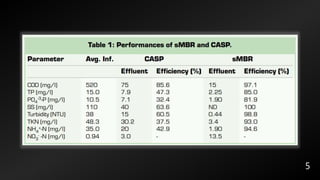
5
Membrane Separation – an overview
6
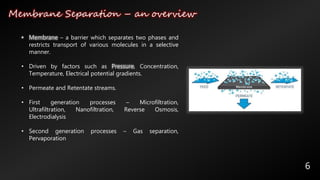
• Membrane – a barrier which separates two phases and
restricts transport of various molecules in a selective
manner.
• Driven by factors such as Pressure, Concentration,
Temperature, Electrical potential gradients.
• Permeate and Retentate streams.
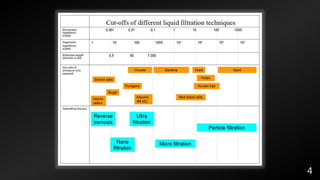
• First generation processes – Microfiltration,
Ultrafiltration, Nanofiltration, Reverse Osmosis,
Electrodialysis
• Second generation processes – Gas separation,
Pervaporation
History of MBRs
7
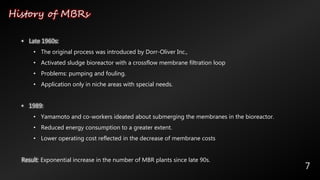
• Late 1960s:
• The original process was introduced by Dorr-Oliver Inc.,
• Activated sludge bioreactor with a crossflow membrane filtration loop
• Problems: pumping and fouling.
• Application only in niche areas with special needs.
• 1989:
• Yamamoto and co-workers ideated about submerging the membranes in the bioreactor.
• Reduced energy consumption to a greater extent.
• Lower operating cost reflected in the decrease of membrane costs
Result: Exponential increase in the number of MBR plants since late 90s.
Further improvements
8
• While early MBRs were operated at solid retention times (SRT) as high as 100 days with MLSS up to 30
g/l, the recent trend is to apply lower solid retention times (around 10–20 days), resulting in more
manageable MLSS levels (10 to 15 g/l).
• Reduced operation and maintenance costs.
• There is now a range of MBR systems commercially available, most of which use submerged
membranes although some external modules are available; these external systems also use two-phase
flow for fouling control. Typical hydraulic retention times (HRT) range between 3 and 10 hours.
• Anaerobic membrane bioreactor (AnMBR):
Sludge is treated anaerobically by mesophilic bacteria which release methane as a byproduct.
The biogas can later be combusted to generate heat or electricity.
AnMBR is considered to be a sustainable alternative for sewage treatment because the energy that
can be generated by the methane combustion can exceed the energy required for maintaining the
process.
Pretreatment
9
• Purpose: To avoid unwanted solids in the waste stream, which enters the membrane tank.
• Fine screening is an essential pre-treatment step.
• This minimizes an accumulation of solids and protects the membrane from damaging debris and
particles, extends the membrane life, reduces operating costs and guarantees a higher sludge quality
as well as a trouble free operation.
Pretreatment – Fine Screening
10
• In Wastewater Screening, Fine screens have clear openings less than 6 mm.
• They consisted of perforated plates, wire cloth, wedge wire elements that have smaller openings.
They are also used to remove the fine solids present in the primary effluent.
• Fine screens are classified as:
• Static (fixed) wedge wire screen
• Rotary drum screen
• Step type screen
Process configurations
11
Internal/submerged :
Membranes are immersed in and integral to the biological
reactor.
The filtration element is installed in either the main
bioreactor vessel or in a separate tank.
The membranes can be flat sheet or tubular or
combination of both, and can incorporate an online
backwash system which reduces membrane surface
fouling by pumping membrane permeate back through
the membrane.
Process configurations
12
External / side stream :
Membranes are a separate unit process requiring an
intermediate pumping step. The filtration elements are installed
externally to the reactor, often in a plant room.
The biomass is either pumped directly through a number of
membrane modules in series and back to the bioreactor, or the
biomass is pumped to a bank of modules, from which a second
pump circulates the biomass through the modules in series.
Cleaning and soaking of the membranes can be undertaken in
place with use of an installed cleaning tank, pump and pipe
work.
Advantages and disadvantages
13
Advantages
 High quality effluent
 Lower sludge production
 High loading rate capability
 No further polishing required for
disinfections or clarifications
 Higher nitrogen removal rate
Disadvantages
ˣ Membrane surface fouling
ˣ Membrane surface clogging
ˣ High capital cost
ˣ High running cost
ˣ Process complexity
References:
14
• Hasar, Halil & Kınacı, Cumali. (2004). Comparison of a sMBR and a CASP system for wastewater
reclamation and re-use. Filtration & Separation - FILTR SEP. 41. 34-34. 10.1016/S0015-
1882(04)00111-9.
• Pandey, Aditi & Singh, Ravi. (2014). Industrial Waste Water Treatment by Membrane Bioreactor
System. Elixir Chemical Engineering. 70. 23772-23777
• https://www.ovivowater.com/brand/dorr-oliver/
• https://www.ncbi.nlm.nih.gov/pmc/articles/PMC4931528/
• https://www.thembrsite.com/membrane-bioreactor-operation-and-maintenance-fouling-
clogging-and-cleaning/
• https://www.berghofmembranes.com/applications/mbr/
• https://www.slideshare.net/vaibhav_nautiyal/membrane-bioreactor-technology-an-overview
• https://www.slideshare.net/asayedessie/membrane-biorective-for-wastewater?qid
• https://engineeringcivil.org/articles/environmental-engineering/wastewater-screening-
classification-screens-complete-list-wastewater-treatment/
Thank you!

Wastewater treatment using membrane bioreactors

  • 1.
    By DHARSHANA RAJAGOPAL -102116013 HARIPRASANTH D - 102116022 HARISHWAR R - 102116024 SERIN SARAH TOPNO - 102116048 CLPE14 New Separation Processes WASTEWATER TREATMENT USING MEMBRANE BIOREACTORS Presented on: 2nd November 2019
  • 2.
    Conventional Wastewater TreatmentTechnique 2 • Conventional Activated Sludge Processes (CASPs) involve the natural biodegradation of pollutants by heterotrophic bacteria (activated sludge) in aerated tanks. • Activated sludge is separated by gravitational settling. • Need for a large reactor size and further treatment of the sludge.
  • 3.
    Membrane Bioreactor (MBR) 3 •Improvement of CASP – replacement of gravity settler with a membrane module. • Can be operated at higher Mixed Liquor Suspended Solids (MLSS) concentrations compared to conventional settlement separation systems, thus reducing the reactor volume to achieve the same loading rate.
  • 4.
  • 5.
  • 6.
    Membrane Separation –an overview 6 • Membrane – a barrier which separates two phases and restricts transport of various molecules in a selective manner. • Driven by factors such as Pressure, Concentration, Temperature, Electrical potential gradients. • Permeate and Retentate streams. • First generation processes – Microfiltration, Ultrafiltration, Nanofiltration, Reverse Osmosis, Electrodialysis • Second generation processes – Gas separation, Pervaporation
  • 7.
    History of MBRs 7 •Late 1960s: • The original process was introduced by Dorr-Oliver Inc., • Activated sludge bioreactor with a crossflow membrane filtration loop • Problems: pumping and fouling. • Application only in niche areas with special needs. • 1989: • Yamamoto and co-workers ideated about submerging the membranes in the bioreactor. • Reduced energy consumption to a greater extent. • Lower operating cost reflected in the decrease of membrane costs Result: Exponential increase in the number of MBR plants since late 90s.
  • 8.
    Further improvements 8 • Whileearly MBRs were operated at solid retention times (SRT) as high as 100 days with MLSS up to 30 g/l, the recent trend is to apply lower solid retention times (around 10–20 days), resulting in more manageable MLSS levels (10 to 15 g/l). • Reduced operation and maintenance costs. • There is now a range of MBR systems commercially available, most of which use submerged membranes although some external modules are available; these external systems also use two-phase flow for fouling control. Typical hydraulic retention times (HRT) range between 3 and 10 hours. • Anaerobic membrane bioreactor (AnMBR): Sludge is treated anaerobically by mesophilic bacteria which release methane as a byproduct. The biogas can later be combusted to generate heat or electricity. AnMBR is considered to be a sustainable alternative for sewage treatment because the energy that can be generated by the methane combustion can exceed the energy required for maintaining the process.
  • 9.
    Pretreatment 9 • Purpose: Toavoid unwanted solids in the waste stream, which enters the membrane tank. • Fine screening is an essential pre-treatment step. • This minimizes an accumulation of solids and protects the membrane from damaging debris and particles, extends the membrane life, reduces operating costs and guarantees a higher sludge quality as well as a trouble free operation.
  • 10.
    Pretreatment – FineScreening 10 • In Wastewater Screening, Fine screens have clear openings less than 6 mm. • They consisted of perforated plates, wire cloth, wedge wire elements that have smaller openings. They are also used to remove the fine solids present in the primary effluent. • Fine screens are classified as: • Static (fixed) wedge wire screen • Rotary drum screen • Step type screen
  • 11.
    Process configurations 11 Internal/submerged : Membranesare immersed in and integral to the biological reactor. The filtration element is installed in either the main bioreactor vessel or in a separate tank. The membranes can be flat sheet or tubular or combination of both, and can incorporate an online backwash system which reduces membrane surface fouling by pumping membrane permeate back through the membrane.
  • 12.
    Process configurations 12 External /side stream : Membranes are a separate unit process requiring an intermediate pumping step. The filtration elements are installed externally to the reactor, often in a plant room. The biomass is either pumped directly through a number of membrane modules in series and back to the bioreactor, or the biomass is pumped to a bank of modules, from which a second pump circulates the biomass through the modules in series. Cleaning and soaking of the membranes can be undertaken in place with use of an installed cleaning tank, pump and pipe work.
  • 13.
    Advantages and disadvantages 13 Advantages High quality effluent  Lower sludge production  High loading rate capability  No further polishing required for disinfections or clarifications  Higher nitrogen removal rate Disadvantages ˣ Membrane surface fouling ˣ Membrane surface clogging ˣ High capital cost ˣ High running cost ˣ Process complexity
  • 14.
    References: 14 • Hasar, Halil& Kınacı, Cumali. (2004). Comparison of a sMBR and a CASP system for wastewater reclamation and re-use. Filtration & Separation - FILTR SEP. 41. 34-34. 10.1016/S0015- 1882(04)00111-9. • Pandey, Aditi & Singh, Ravi. (2014). Industrial Waste Water Treatment by Membrane Bioreactor System. Elixir Chemical Engineering. 70. 23772-23777 • https://www.ovivowater.com/brand/dorr-oliver/ • https://www.ncbi.nlm.nih.gov/pmc/articles/PMC4931528/ • https://www.thembrsite.com/membrane-bioreactor-operation-and-maintenance-fouling- clogging-and-cleaning/ • https://www.berghofmembranes.com/applications/mbr/ • https://www.slideshare.net/vaibhav_nautiyal/membrane-bioreactor-technology-an-overview • https://www.slideshare.net/asayedessie/membrane-biorective-for-wastewater?qid • https://engineeringcivil.org/articles/environmental-engineering/wastewater-screening- classification-screens-complete-list-wastewater-treatment/
  • 15.