Central Problem:
Is Melanoma indeed an old
Person’s Disease?
Sub-Problems:
•What is Melanoma?
•Causes of Melanoma
•Risk Factors of Melanoma
•Identification and Prevention of
Melanoma
Observations
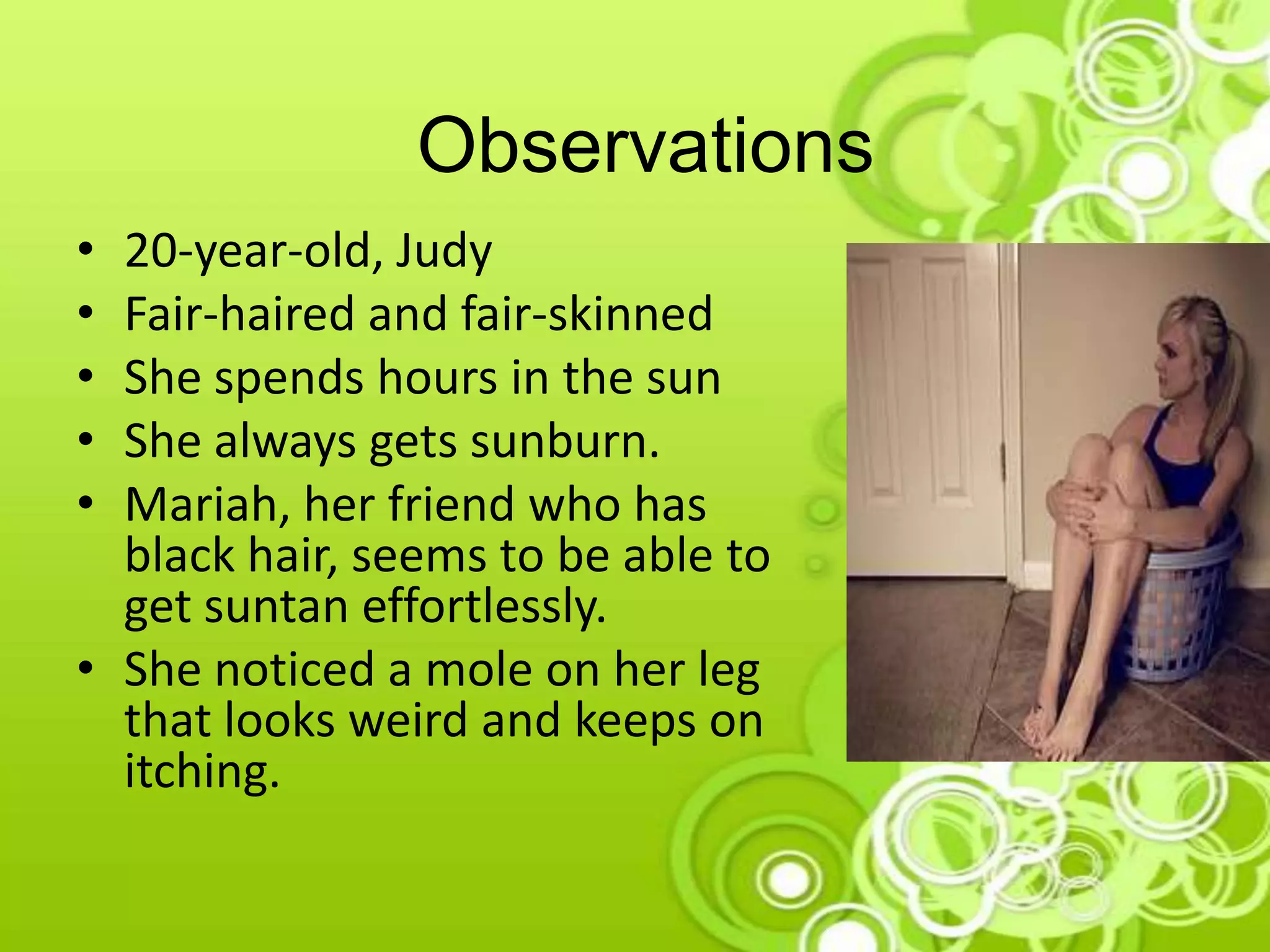
• 20-year-old, Judy
• Fair-haired and fair-skinned
• She spends hours in the sun
• She always gets sunburn.
• Mariah, her friend who has
black hair, seems to be able to
get suntan effortlessly.
• She noticed a mole on her leg
that looks weird and keeps on
itching.
What do we know?
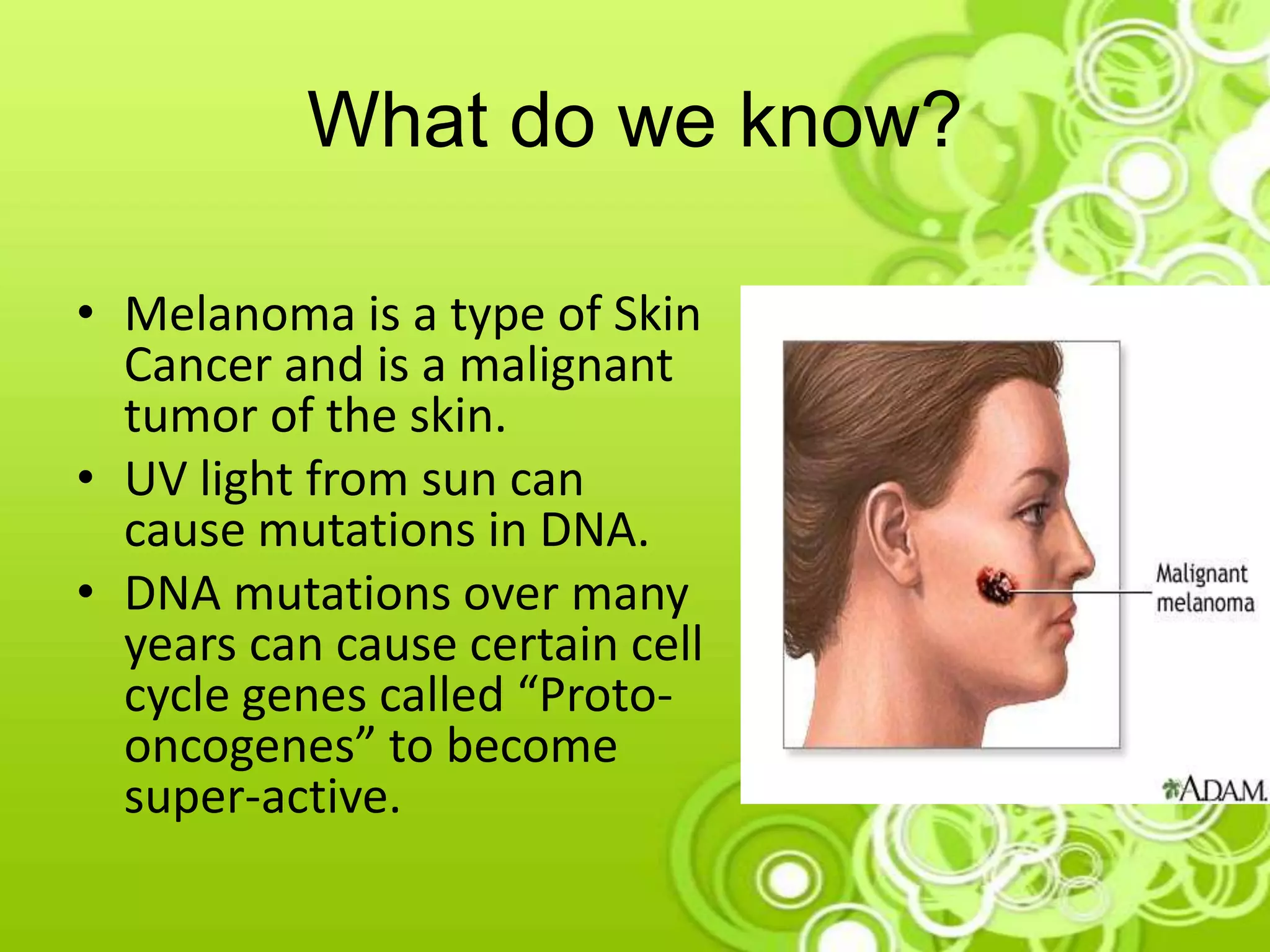
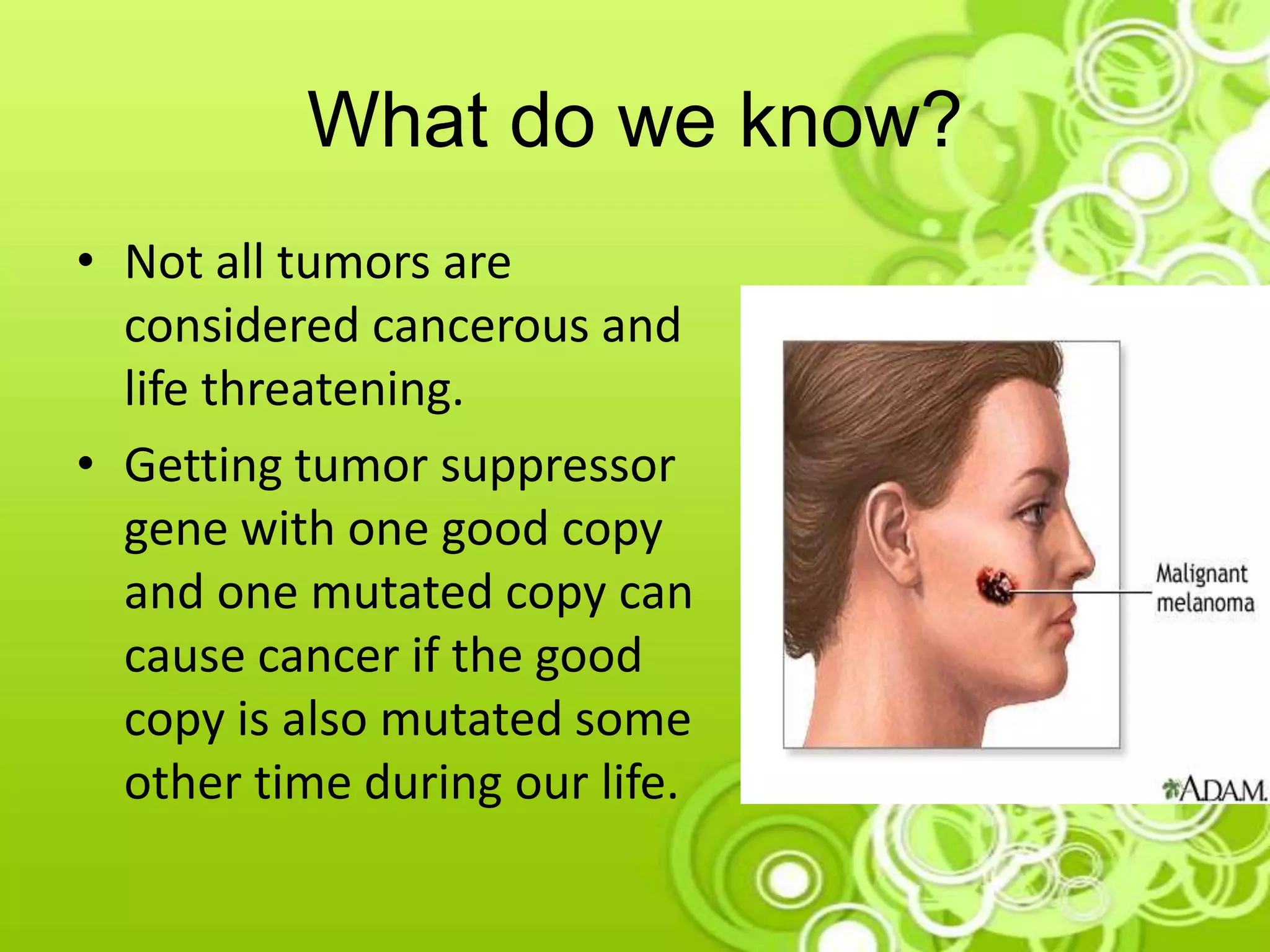
• Melanoma is a type of Skin
Cancer and is a malignant
tumor of the skin.
• UV light from sun can
cause mutations in DNA.
• DNA mutations over many
years can cause certain cell
cycle genes called “Proto-
oncogenes” to become
super-active.
What do we know?
• Not all tumors are
considered cancerous and
life threatening.
• Getting tumor suppressor
gene with one good copy
and one mutated copy can
cause cancer if the good
copy is also mutated some
other time during our life.
What do we need to know?
• Symptoms of Melanoma
• Causes of Melanoma
• Dangers of Melanoma
• Prevention
Definition of Terms
1. Melanoma- a malignant tumor of the melanocytes
2. Dysplastic Nevis- a mole whose appearance is different
from that of common moles. Dysplastic nevi are generally
larger than ordinary moles and have irregular and
indistinct borders.
3. Melanocytes are melanin-producing cells located in the
bottom layer (the stratum basale) of the skin's epidermis
4. Melanin- a pigment produced by the Melanocytes which
gives skin its color and also acts as a sunscreen to protect
against ultraviolet radiation.
5. Cancer- known medically as a malignant neoplasm, is a
large group of different diseases, all involving unregulated
cell growth.
Definition of Terms
6. Ultraviolet Rays-are invisible rays that are part of the
energy that comes from the sun.
7. Sunburn is a burn to living tissue, such as skin, which is
produced by overexposure to ultraviolet (UV)
radiation, commonly from the sun's rays.
8. Tumor- also called as neoplasm, means that cells have
divided and piled up on one another in a single mass.
Maybe a benign tumor or malignant tumor.
9. Malignancy- is the tendency of a medical condition,
especially tumors, to become progressively worse and
to potentially result in death.
10. Tan- is a pale, tawny shade of brown.
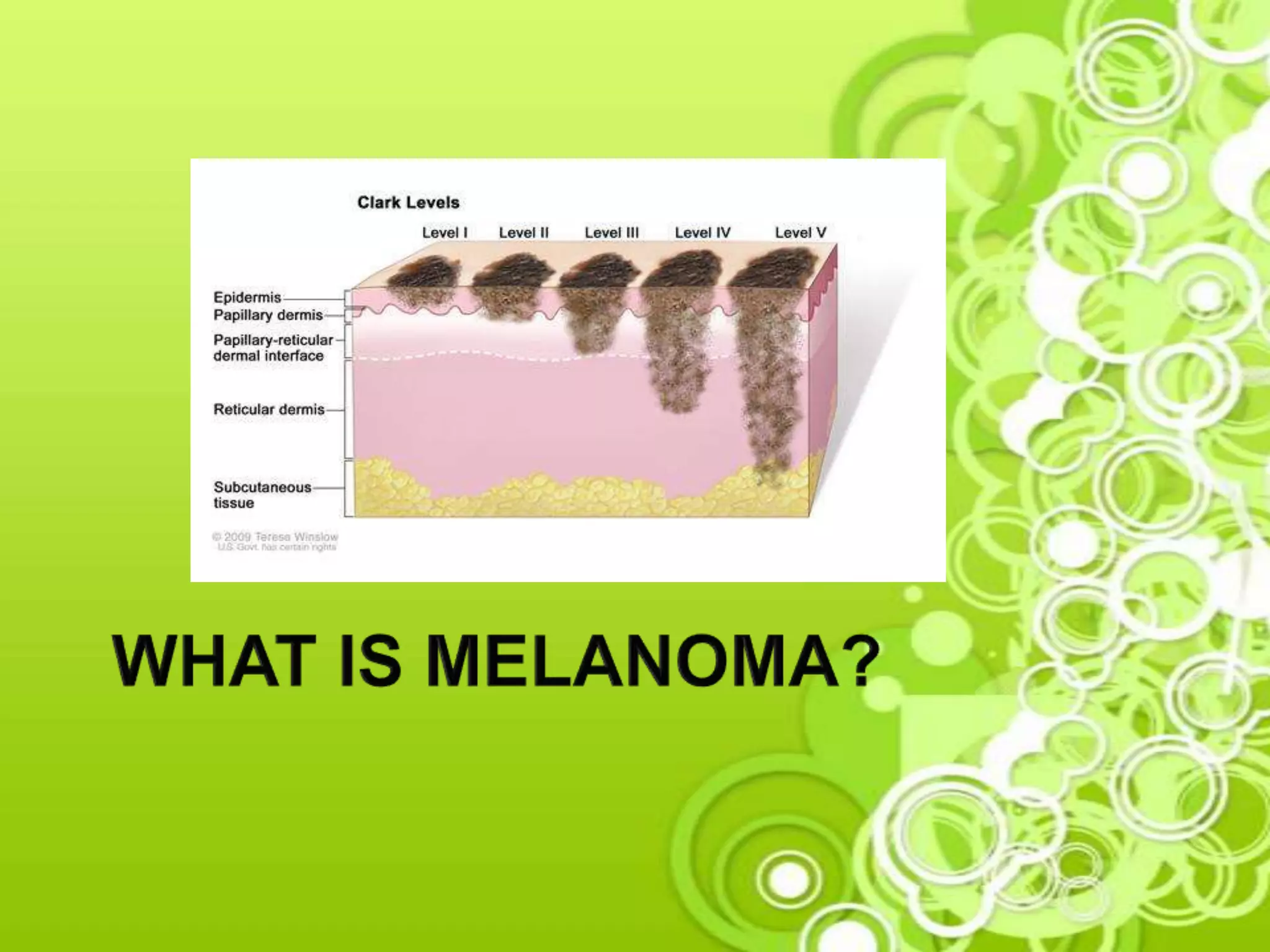
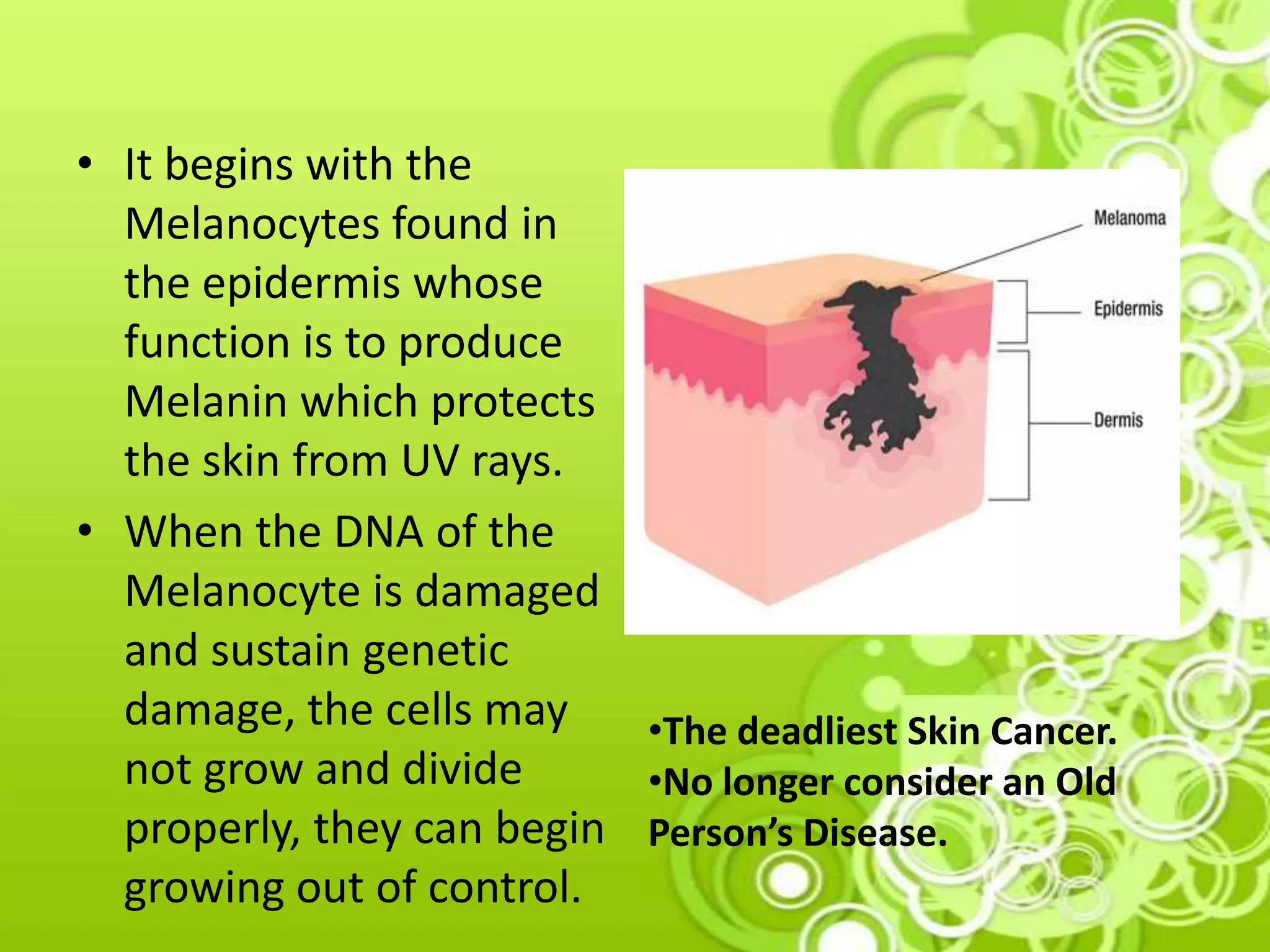
• It begins with the
Melanocytes found in
the epidermis whose
function is to produce
Melanin which protects
the skin from UV rays.
• When the DNA of the
Melanocyte is damaged
and sustain genetic
damage, the cells may
not grow and divide
properly, they can begin
growing out of control.
•The deadliest Skin Cancer.
•No longer consider an Old
Person’s Disease.
CAUSES OF MELANOMA
Causes of Melanoma
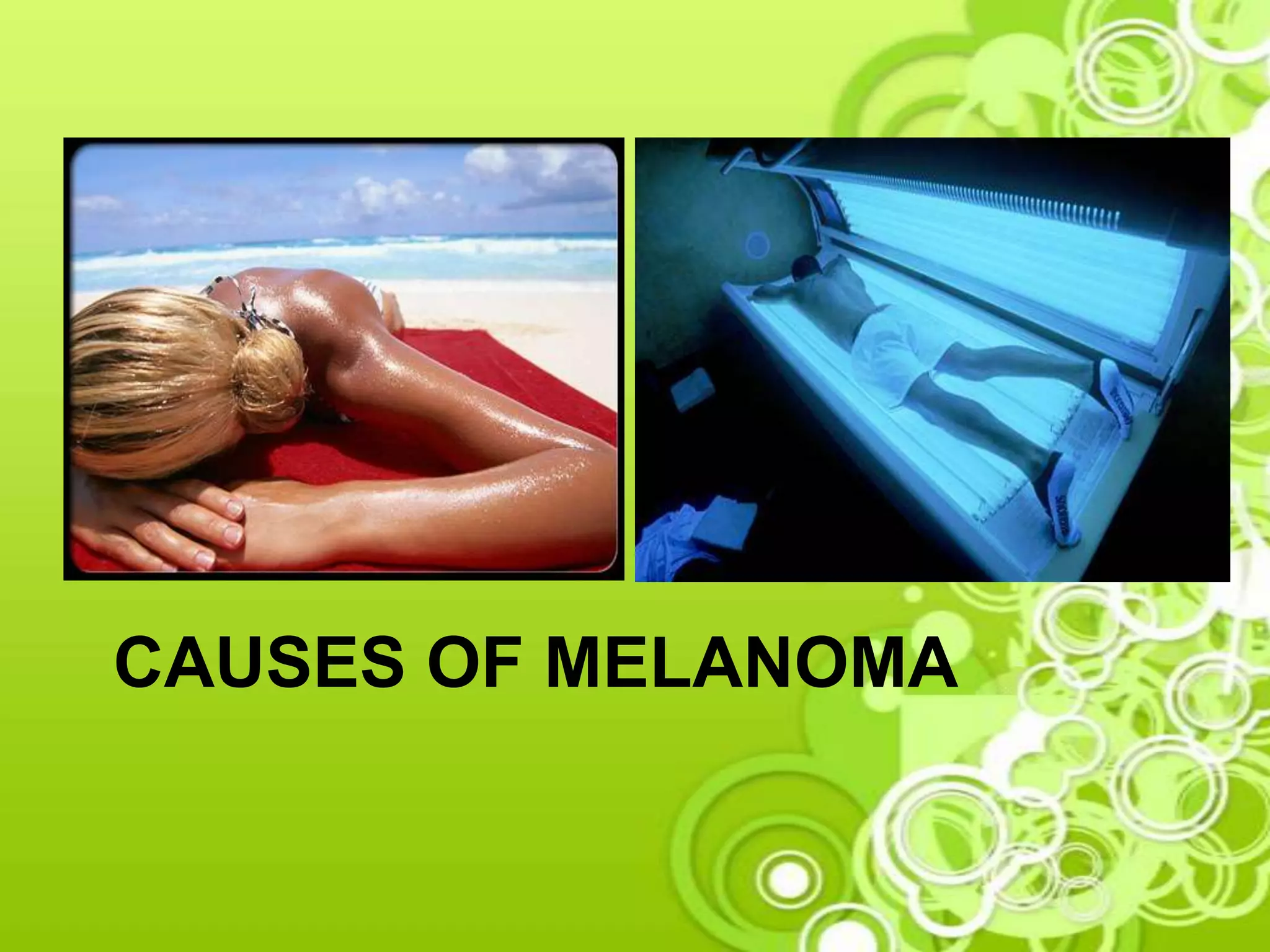
• Exposure to Ultraviolet Rays from natural
(Sunlight) or artificial (tanning beds) sources.
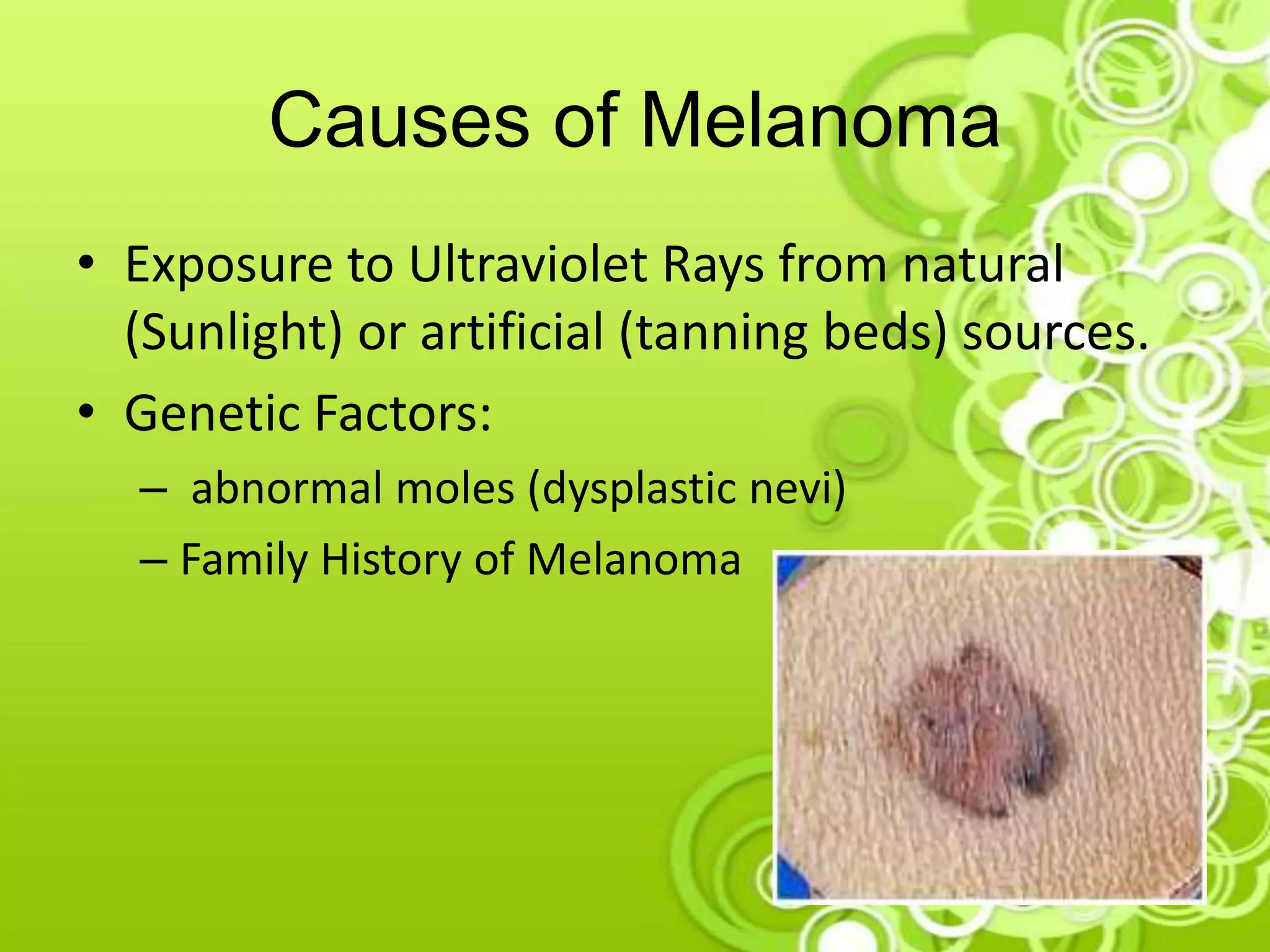
• Genetic Factors:
– abnormal moles (dysplastic nevi)
– Family History of Melanoma
RISK FACTORS OF
MELANOMA
Risk Factors of Melanoma
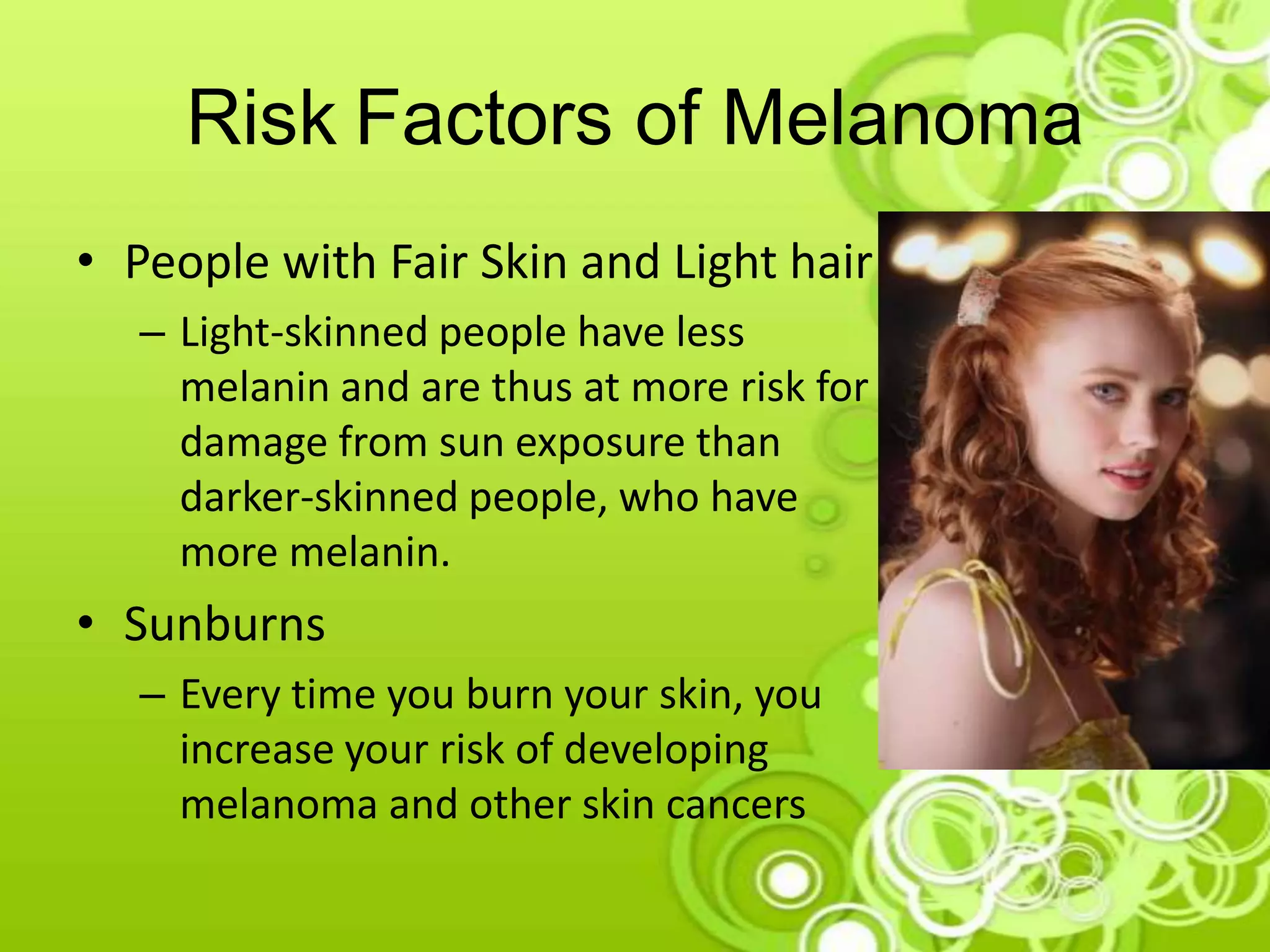
• People with Fair Skin and Light hair
– Light-skinned people have less
melanin and are thus at more risk for
damage from sun exposure than
darker-skinned people, who have
more melanin.
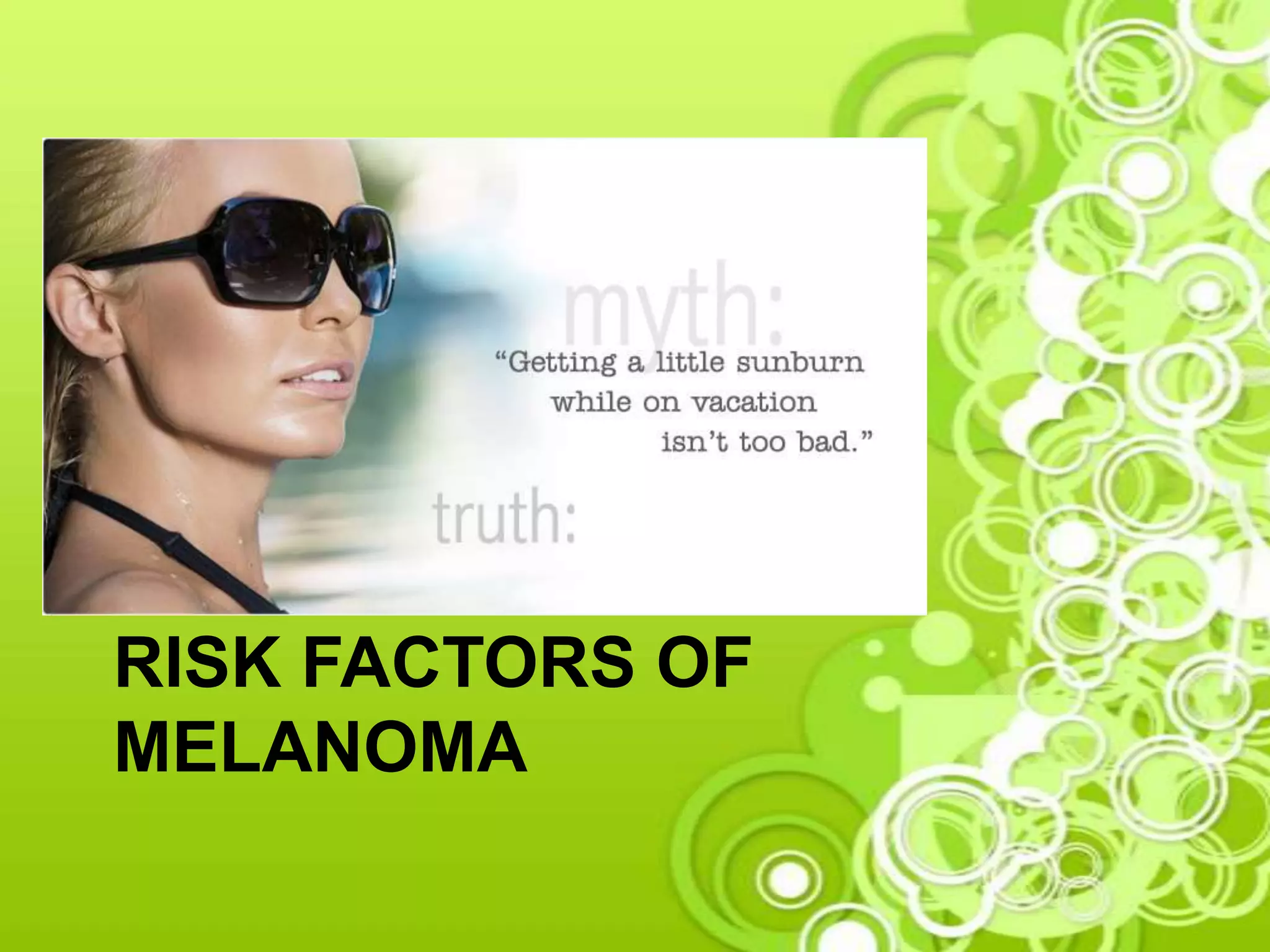
• Sunburns
– Every time you burn your skin, you
increase your risk of developing
melanoma and other skin cancers
Risk Factors of Melanoma
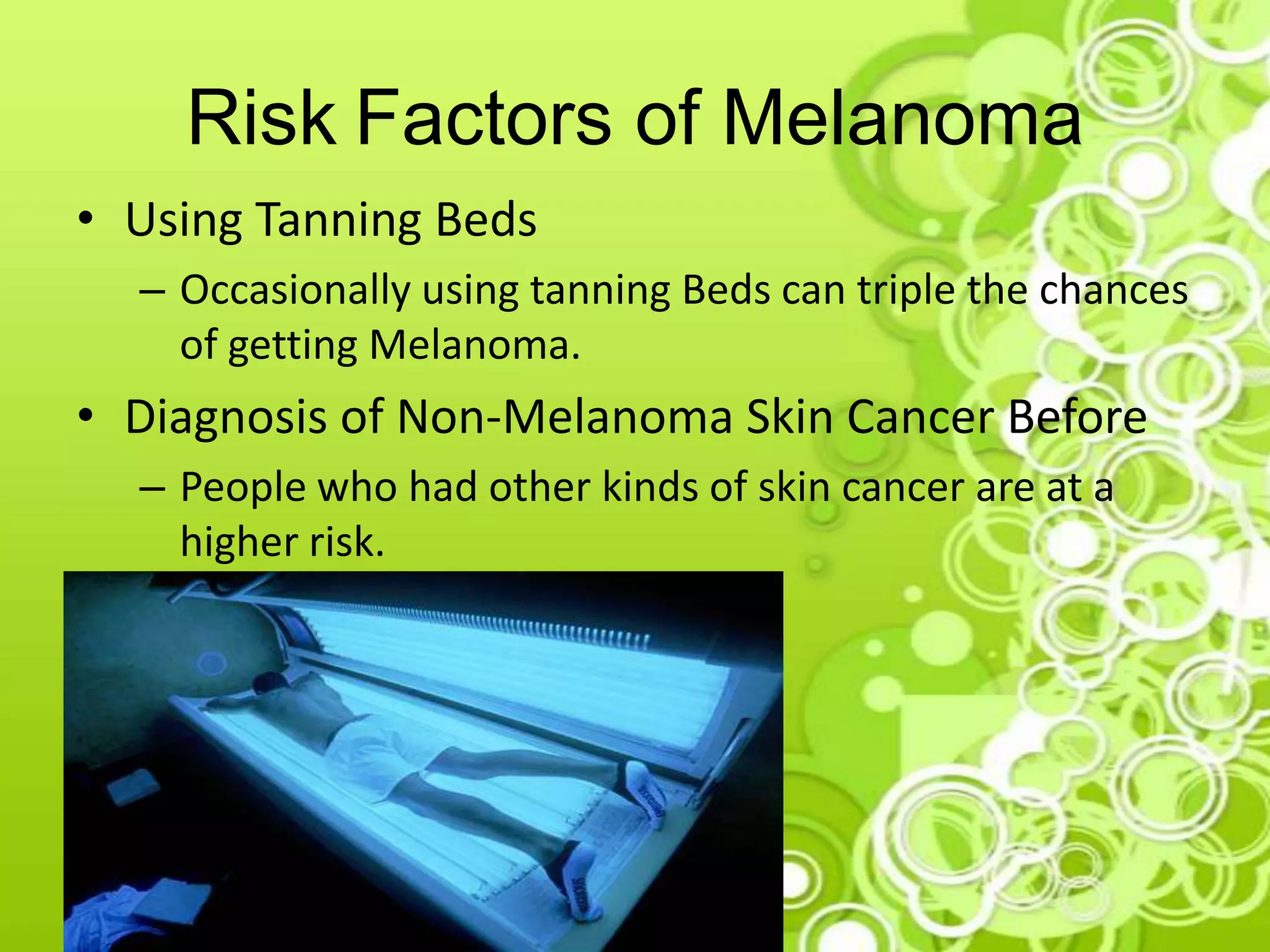
• Using Tanning Beds
– Occasionally using tanning Beds can triple the chances
of getting Melanoma.
• Diagnosis of Non-Melanoma Skin Cancer Before
– People who had other kinds of skin cancer are at a
higher risk.
IDENTIFICATION AND
PREVENTION OF MELANOMA
Identifying Melanoma
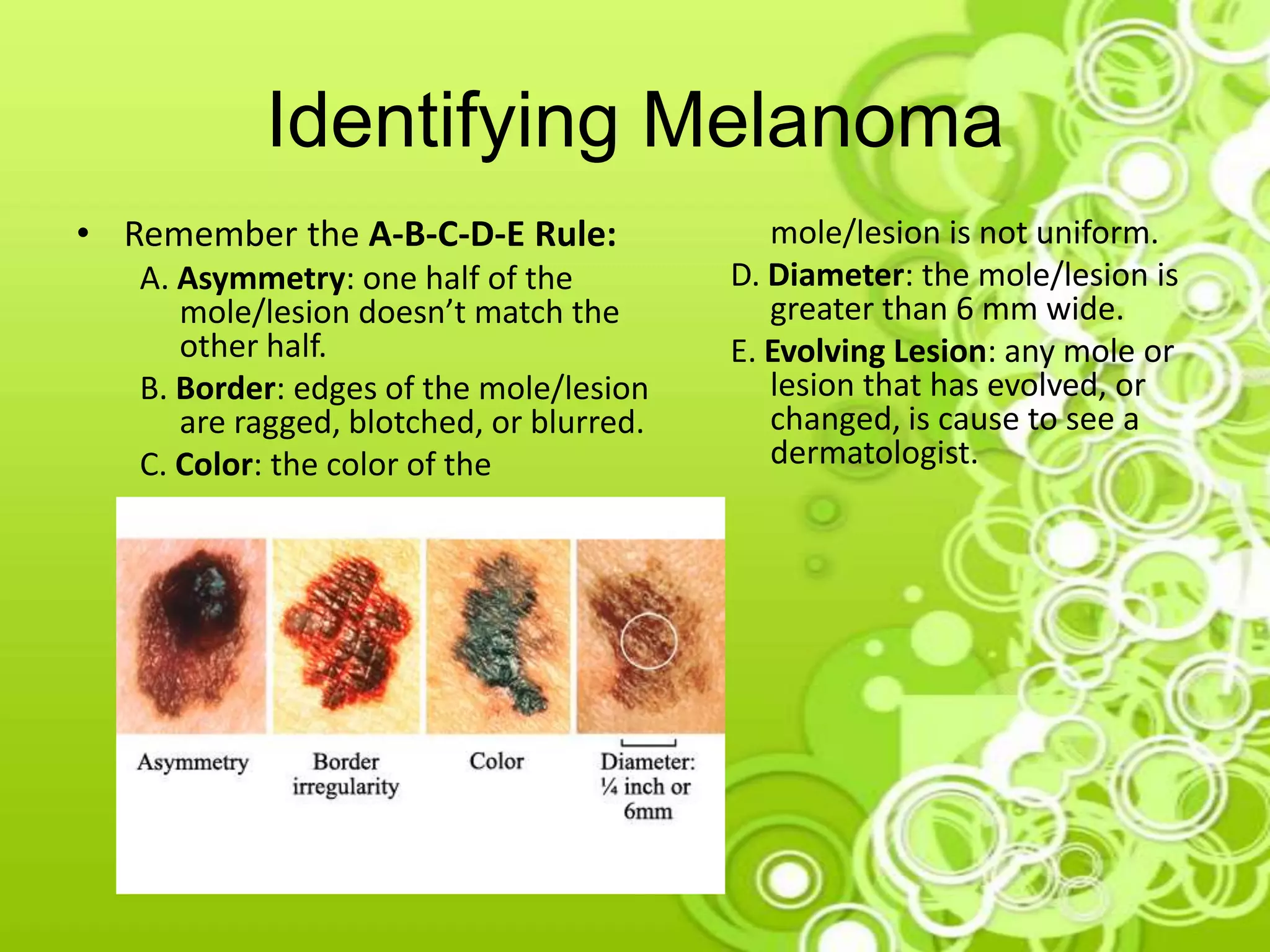
• Remember the A-B-C-D-E Rule:
A. Asymmetry: one half of the
mole/lesion doesn’t match the
other half.
B. Border: edges of the mole/lesion
are ragged, blotched, or blurred.
C. Color: the color of the
mole/lesion is not uniform.
D. Diameter: the mole/lesion is
greater than 6 mm wide.
E. Evolving Lesion: any mole or
lesion that has evolved, or
changed, is cause to see a
dermatologist.
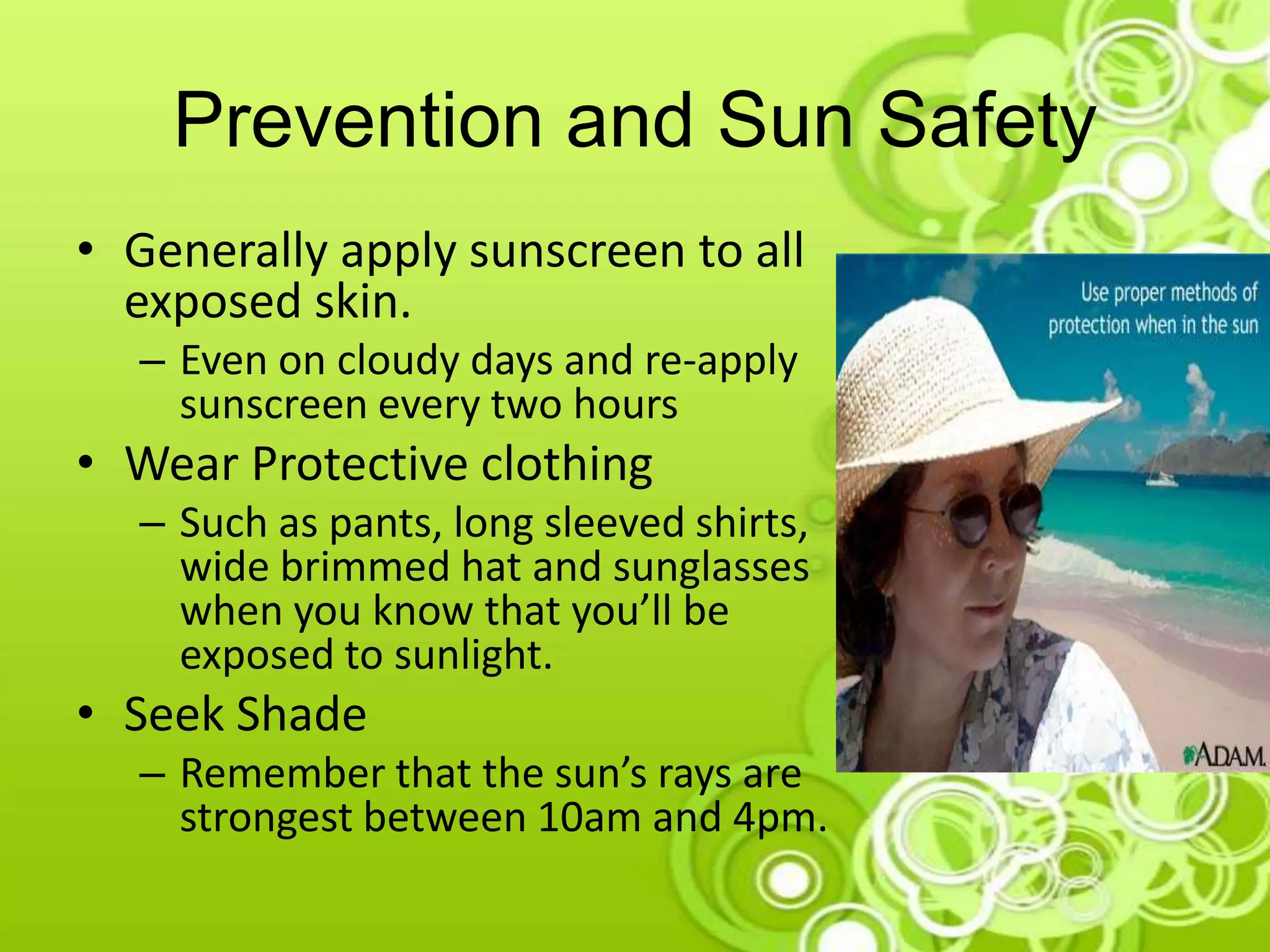
Prevention and Sun Safety
• Generally apply sunscreen to all
exposed skin.
– Even on cloudy days and re-apply
sunscreen every two hours
• Wear Protective clothing
– Such as pants, long sleeved shirts,
wide brimmed hat and sunglasses
when you know that you’ll be
exposed to sunlight.
• Seek Shade
– Remember that the sun’s rays are
strongest between 10am and 4pm.
Prevention and Sun Safety
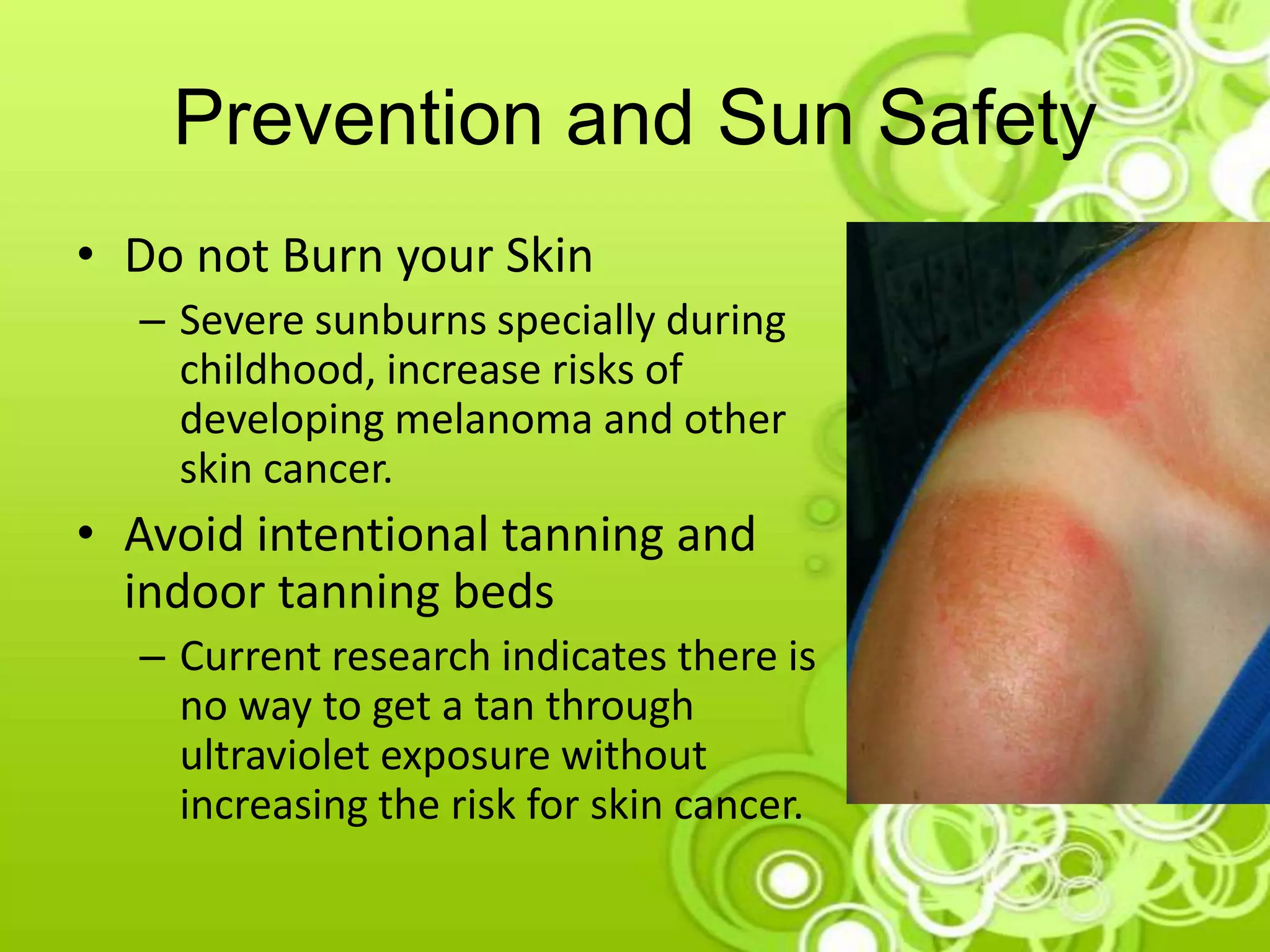
• Do not Burn your Skin
– Severe sunburns specially during
childhood, increase risks of
developing melanoma and other
skin cancer.
• Avoid intentional tanning and
indoor tanning beds
– Current research indicates there is
no way to get a tan through
ultraviolet exposure without
increasing the risk for skin cancer.
Conclusion
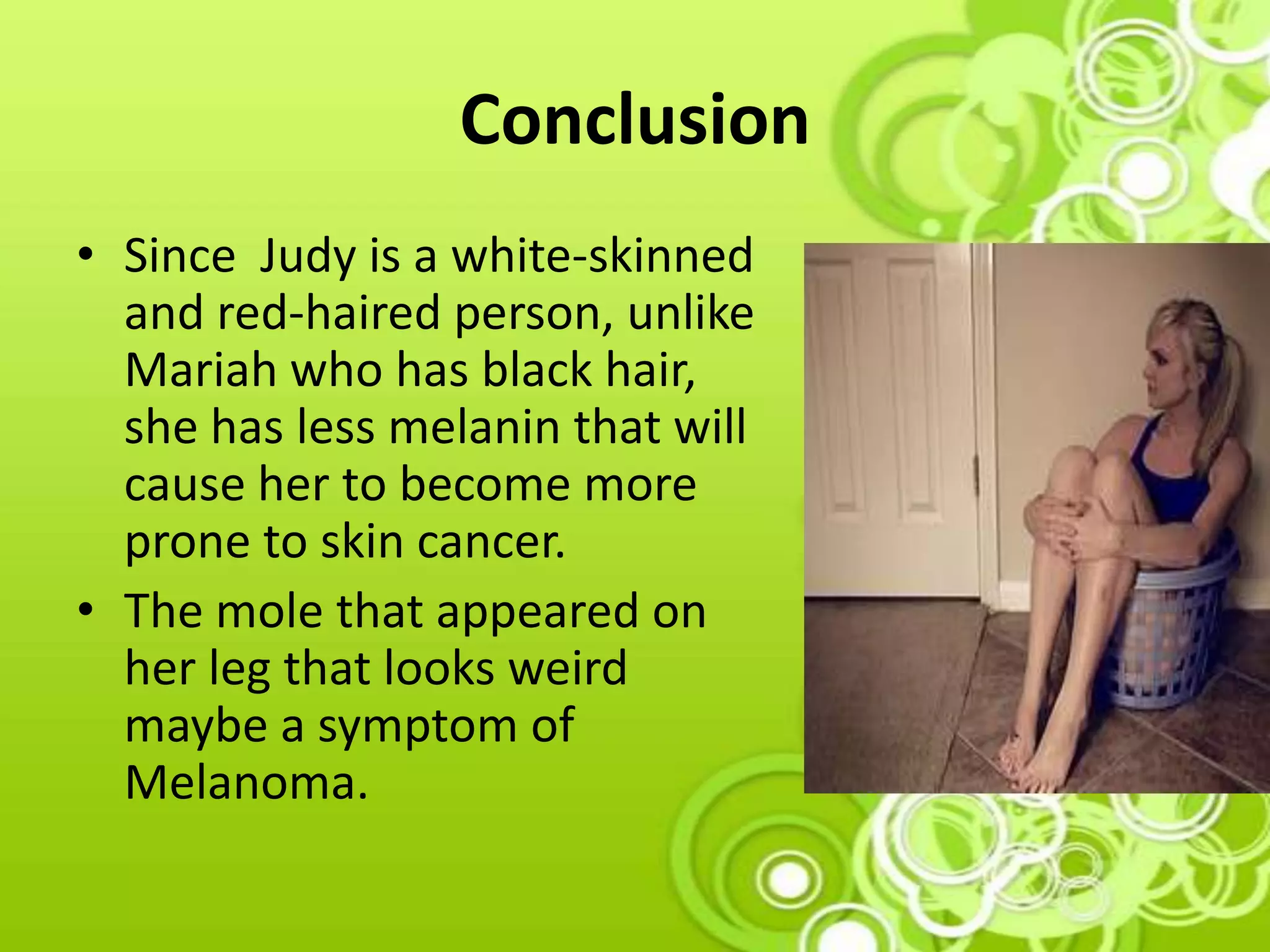
• Since Judy is a white-skinned
and red-haired person, unlike
Mariah who has black hair,
she has less melanin that will
cause her to become more
prone to skin cancer.
• The mole that appeared on
her leg that looks weird
maybe a symptom of
Melanoma.
Conclusion
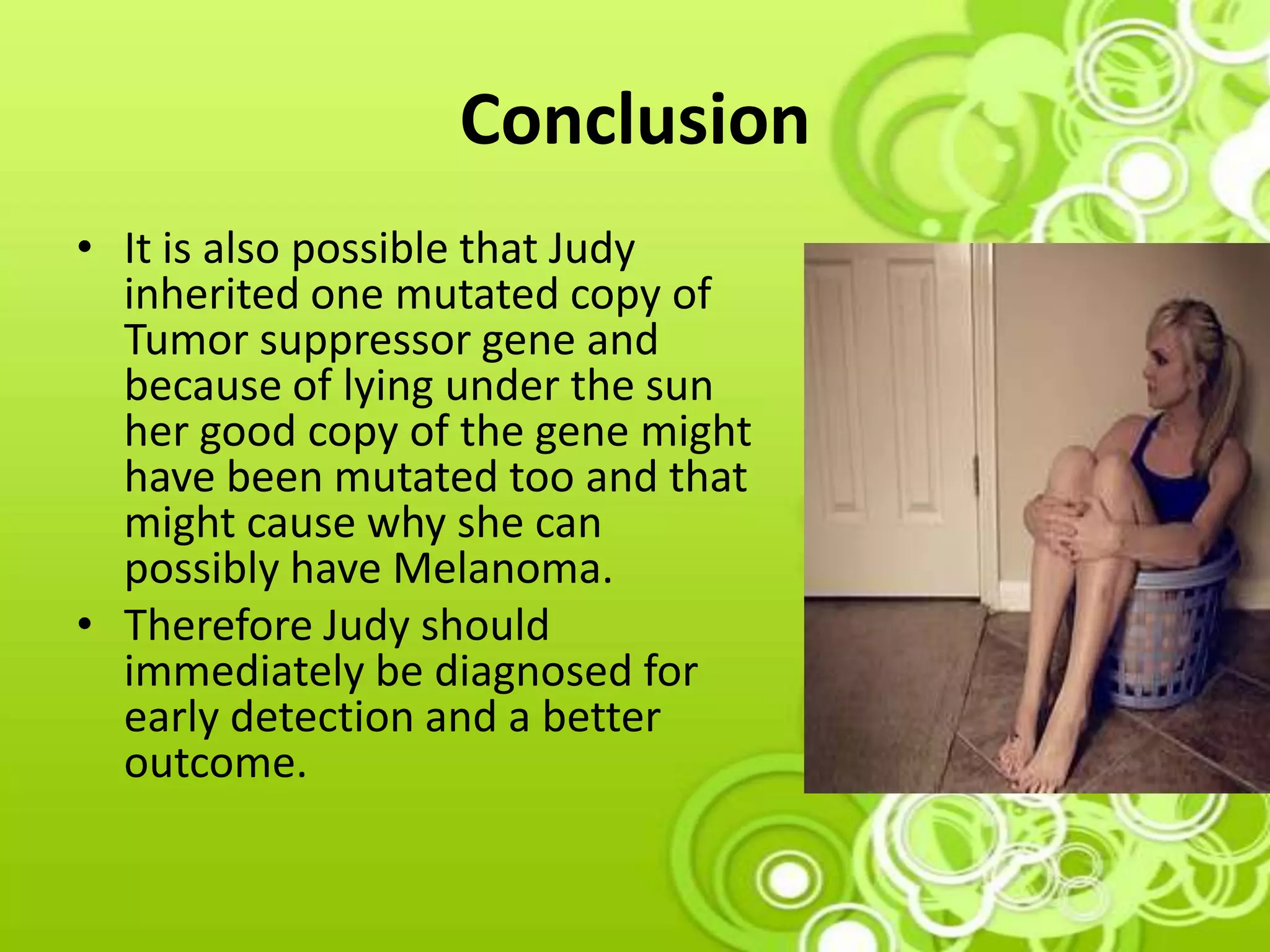
• It is also possible that Judy
inherited one mutated copy of
Tumor suppressor gene and
because of lying under the sun
her good copy of the gene might
have been mutated too and that
might cause why she can
possibly have Melanoma.
• Therefore Judy should
immediately be diagnosed for
early detection and a better
outcome.
Conclusion
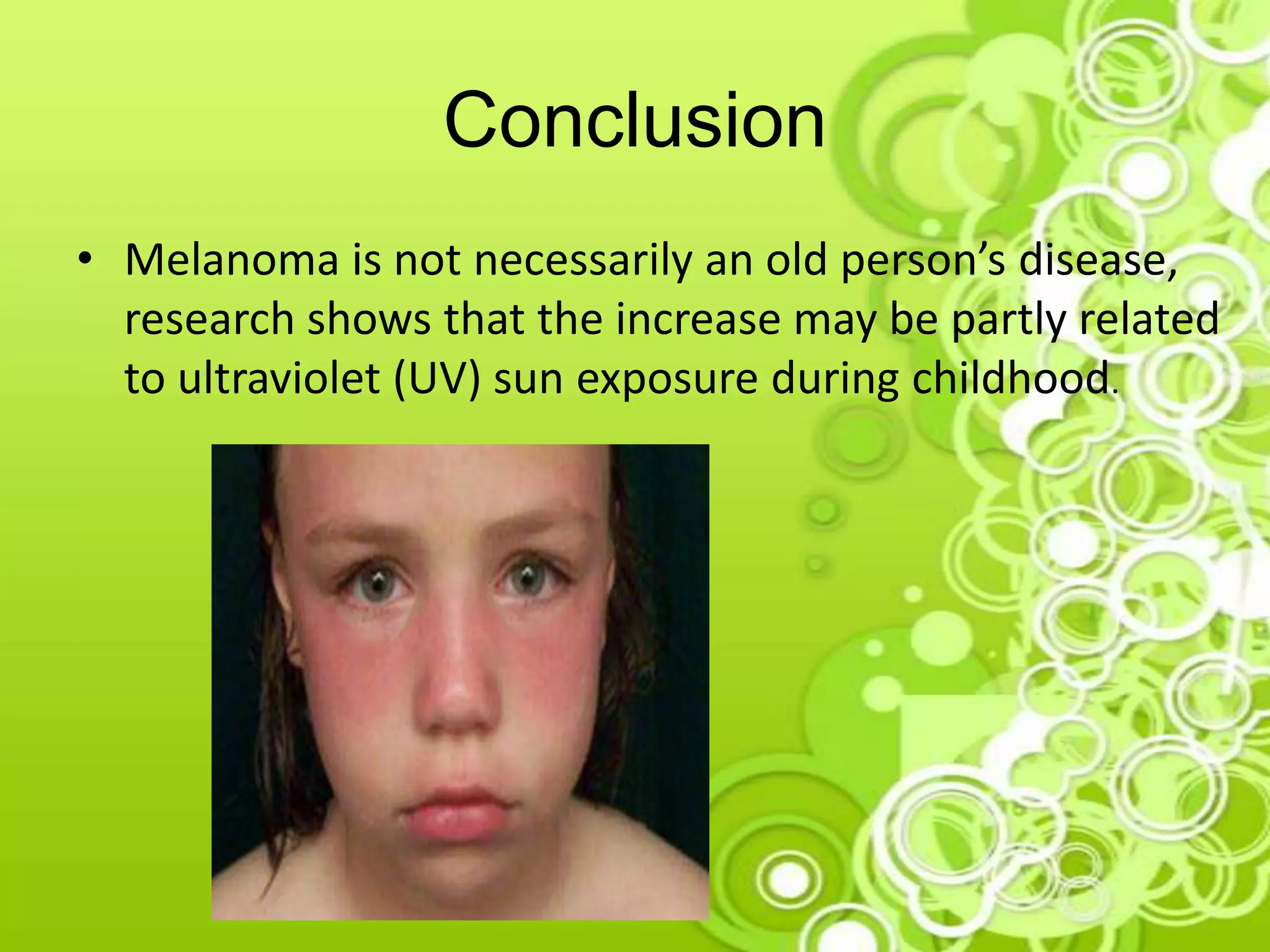
• Melanoma is not necessarily an old person’s disease,
research shows that the increase may be partly related
to ultraviolet (UV) sun exposure during childhood.
Conclusion
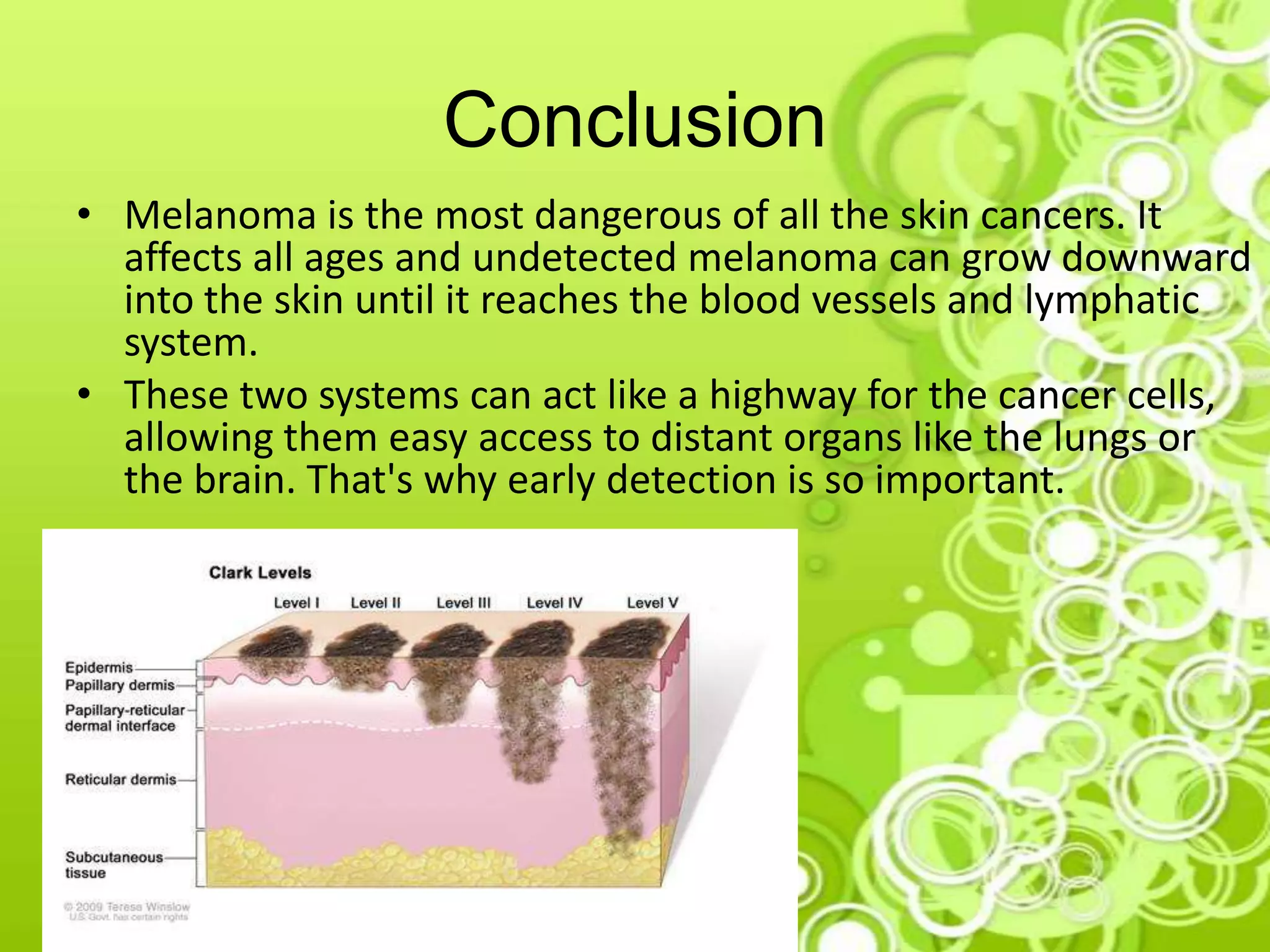
• Melanoma is the most dangerous of all the skin cancers. It
affects all ages and undetected melanoma can grow downward
into the skin until it reaches the blood vessels and lymphatic
system.
• These two systems can act like a highway for the cancer cells,
allowing them easy access to distant organs like the lungs or
the brain. That's why early detection is so important.
References/Sources
• Title: Protecting yourself against the Deadliest
Skin Cancer: Melanoma
– By: Joel Wiszniak, MD
– http://www.lef.org
• Title: Melanoma Risk Factors
– By: Melanoma Research foundation
– http://www.melanoma.org
References/Sources
• Title: Melanoma
– By: KidsHealth Editorial Staff
– http://kidshealth.org
• Other sources:
– Wikipedia
– Web definitions
– Merriam Webster Dictionary

Melanoma Case Study

  • 1.
    Central Problem: Is Melanomaindeed an old Person’s Disease? Sub-Problems: •What is Melanoma? •Causes of Melanoma •Risk Factors of Melanoma •Identification and Prevention of Melanoma
  • 2.
    Observations • 20-year-old, Judy •Fair-haired and fair-skinned • She spends hours in the sun • She always gets sunburn. • Mariah, her friend who has black hair, seems to be able to get suntan effortlessly. • She noticed a mole on her leg that looks weird and keeps on itching.
  • 3.
    What do weknow? • Melanoma is a type of Skin Cancer and is a malignant tumor of the skin. • UV light from sun can cause mutations in DNA. • DNA mutations over many years can cause certain cell cycle genes called “Proto- oncogenes” to become super-active.
  • 4.
    What do weknow? • Not all tumors are considered cancerous and life threatening. • Getting tumor suppressor gene with one good copy and one mutated copy can cause cancer if the good copy is also mutated some other time during our life.
  • 5.
    What do weneed to know? • Symptoms of Melanoma • Causes of Melanoma • Dangers of Melanoma • Prevention
  • 6.
    Definition of Terms 1.Melanoma- a malignant tumor of the melanocytes 2. Dysplastic Nevis- a mole whose appearance is different from that of common moles. Dysplastic nevi are generally larger than ordinary moles and have irregular and indistinct borders. 3. Melanocytes are melanin-producing cells located in the bottom layer (the stratum basale) of the skin's epidermis 4. Melanin- a pigment produced by the Melanocytes which gives skin its color and also acts as a sunscreen to protect against ultraviolet radiation. 5. Cancer- known medically as a malignant neoplasm, is a large group of different diseases, all involving unregulated cell growth.
  • 7.
    Definition of Terms 6.Ultraviolet Rays-are invisible rays that are part of the energy that comes from the sun. 7. Sunburn is a burn to living tissue, such as skin, which is produced by overexposure to ultraviolet (UV) radiation, commonly from the sun's rays. 8. Tumor- also called as neoplasm, means that cells have divided and piled up on one another in a single mass. Maybe a benign tumor or malignant tumor. 9. Malignancy- is the tendency of a medical condition, especially tumors, to become progressively worse and to potentially result in death. 10. Tan- is a pale, tawny shade of brown.
  • 9.
    • It beginswith the Melanocytes found in the epidermis whose function is to produce Melanin which protects the skin from UV rays. • When the DNA of the Melanocyte is damaged and sustain genetic damage, the cells may not grow and divide properly, they can begin growing out of control. •The deadliest Skin Cancer. •No longer consider an Old Person’s Disease.
  • 10.
  • 11.
    Causes of Melanoma •Exposure to Ultraviolet Rays from natural (Sunlight) or artificial (tanning beds) sources. • Genetic Factors: – abnormal moles (dysplastic nevi) – Family History of Melanoma
  • 12.
  • 13.
    Risk Factors ofMelanoma • People with Fair Skin and Light hair – Light-skinned people have less melanin and are thus at more risk for damage from sun exposure than darker-skinned people, who have more melanin. • Sunburns – Every time you burn your skin, you increase your risk of developing melanoma and other skin cancers
  • 14.
    Risk Factors ofMelanoma • Using Tanning Beds – Occasionally using tanning Beds can triple the chances of getting Melanoma. • Diagnosis of Non-Melanoma Skin Cancer Before – People who had other kinds of skin cancer are at a higher risk.
  • 15.
  • 16.
    Identifying Melanoma • Rememberthe A-B-C-D-E Rule: A. Asymmetry: one half of the mole/lesion doesn’t match the other half. B. Border: edges of the mole/lesion are ragged, blotched, or blurred. C. Color: the color of the mole/lesion is not uniform. D. Diameter: the mole/lesion is greater than 6 mm wide. E. Evolving Lesion: any mole or lesion that has evolved, or changed, is cause to see a dermatologist.
  • 17.
    Prevention and SunSafety • Generally apply sunscreen to all exposed skin. – Even on cloudy days and re-apply sunscreen every two hours • Wear Protective clothing – Such as pants, long sleeved shirts, wide brimmed hat and sunglasses when you know that you’ll be exposed to sunlight. • Seek Shade – Remember that the sun’s rays are strongest between 10am and 4pm.
  • 18.
    Prevention and SunSafety • Do not Burn your Skin – Severe sunburns specially during childhood, increase risks of developing melanoma and other skin cancer. • Avoid intentional tanning and indoor tanning beds – Current research indicates there is no way to get a tan through ultraviolet exposure without increasing the risk for skin cancer.
  • 19.
    Conclusion • Since Judyis a white-skinned and red-haired person, unlike Mariah who has black hair, she has less melanin that will cause her to become more prone to skin cancer. • The mole that appeared on her leg that looks weird maybe a symptom of Melanoma.
  • 20.
    Conclusion • It isalso possible that Judy inherited one mutated copy of Tumor suppressor gene and because of lying under the sun her good copy of the gene might have been mutated too and that might cause why she can possibly have Melanoma. • Therefore Judy should immediately be diagnosed for early detection and a better outcome.
  • 21.
    Conclusion • Melanoma isnot necessarily an old person’s disease, research shows that the increase may be partly related to ultraviolet (UV) sun exposure during childhood.
  • 22.
    Conclusion • Melanoma isthe most dangerous of all the skin cancers. It affects all ages and undetected melanoma can grow downward into the skin until it reaches the blood vessels and lymphatic system. • These two systems can act like a highway for the cancer cells, allowing them easy access to distant organs like the lungs or the brain. That's why early detection is so important.
  • 23.
    References/Sources • Title: Protectingyourself against the Deadliest Skin Cancer: Melanoma – By: Joel Wiszniak, MD – http://www.lef.org • Title: Melanoma Risk Factors – By: Melanoma Research foundation – http://www.melanoma.org
  • 24.
    References/Sources • Title: Melanoma –By: KidsHealth Editorial Staff – http://kidshealth.org • Other sources: – Wikipedia – Web definitions – Merriam Webster Dictionary