The Awesomest Calculus PowerPoint EVER!!! By Meghan Almaas
Derivative Problem Jessica has a pool in her backyard and she likes to go swimming when it gets warm outside.  However, due to a rare skin condition that prevents her from coming in contact with cold water, Jessica will only swim in her pool when the water is the warmest.
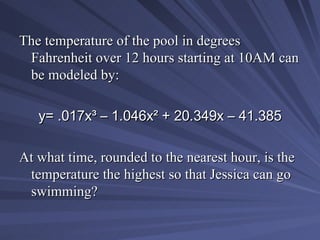
The temperature of the pool in degrees Fahrenheit over 12 hours starting at 10AM can be modeled by: y= .017x ³  – 1.046x ²  + 20.349x – 41.385 At what time, rounded to the nearest hour, is the temperature the highest so that Jessica can go swimming?
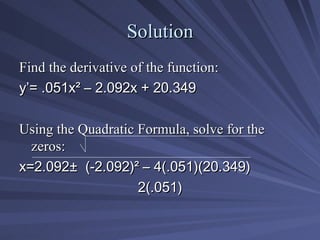
Solution Find the derivative of the function: y’= .051x ²  – 2.092x + 20.349 Using the Quadratic Formula, solve for the zeros: x=2.092 ±  (-2.092)² – 4(.051)(20.349) 2(.051)
The values of x are  25.163  and  15.857.  Because  25.163  is outside the designated interval, you can eliminate that option. Now you must double check that  16  (nearest hour to  15.857 ) is truly a maximum!!
A maximum at  16  would require the derivative to change signs from positive to negative.  Therefore, use  15  and  17  as points around  16  to discover if the sign changes. y’(15)=.444 (positive) y’(17)= -.476 (negative) With a change from + to –,  16  is the time when the pool is the warmest.  Because  16  is  6  hours after  10AM , it can be converted to  4PM .
Integral Problem Sarah is in Hawaii with some friends and she wants to ride a zip line.  However, one of her friends Cheyanne is too afraid to go on the zip line.  She wants to take a picture of Sarah exactly half way between the ends of the zip line for her photography class.  Her camera has a timer that can start as soon as Sarah starts her ride.  In order to take a picture at the exact moment that Sarah has traveled half the distance, Cheyanne needs to know the time Sarah will reach it so she can set the timer.
The velocity of Sarah on the zip line can be modeled by   v(t)=sint + t on the interval  [0,6]  where  t=6  represents  60  sec. Using this information, find the time in seconds that Cheyanne should set her camera timer to capture Sarah at the moment she’s traveled half the distance of the zip line.
Solution Find the total distance of the zip line over the interval by integrating the velocity: (sint+t)dt =  (-cost+ ½ t ²)] (-cos6+½(6²)) – (-cos0) = 18.04 6 6 0 0
Using the total distance, solve for  t  when the distance is half through integration: (sint+t)dt = 18.04/2  (-cost +  ½t²)] = 9.02 (-cost + ½t²) – (-cos0) = 9.02 -cost + ½t² - 1 = 9.02 0 t t 0
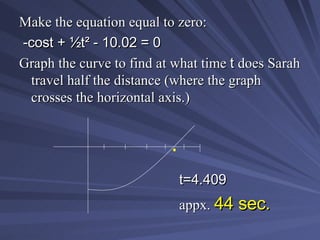
Make the equation equal to zero: -cost +  ½t² - 10.02 = 0 Graph the curve to find at what time  t  does Sarah travel half the distance (where the graph crosses the horizontal axis.) t=4.409 appx.  44 sec. .

Meghan's Calculus Powerpoint

  • 1.
    The Awesomest CalculusPowerPoint EVER!!! By Meghan Almaas
  • 2.
    Derivative Problem Jessicahas a pool in her backyard and she likes to go swimming when it gets warm outside. However, due to a rare skin condition that prevents her from coming in contact with cold water, Jessica will only swim in her pool when the water is the warmest.
  • 3.
    The temperature ofthe pool in degrees Fahrenheit over 12 hours starting at 10AM can be modeled by: y= .017x ³ – 1.046x ² + 20.349x – 41.385 At what time, rounded to the nearest hour, is the temperature the highest so that Jessica can go swimming?
  • 4.
    Solution Find thederivative of the function: y’= .051x ² – 2.092x + 20.349 Using the Quadratic Formula, solve for the zeros: x=2.092 ± (-2.092)² – 4(.051)(20.349) 2(.051)
  • 5.
    The values ofx are 25.163 and 15.857. Because 25.163 is outside the designated interval, you can eliminate that option. Now you must double check that 16 (nearest hour to 15.857 ) is truly a maximum!!
  • 6.
    A maximum at 16 would require the derivative to change signs from positive to negative. Therefore, use 15 and 17 as points around 16 to discover if the sign changes. y’(15)=.444 (positive) y’(17)= -.476 (negative) With a change from + to –, 16 is the time when the pool is the warmest. Because 16 is 6 hours after 10AM , it can be converted to 4PM .
  • 7.
    Integral Problem Sarahis in Hawaii with some friends and she wants to ride a zip line. However, one of her friends Cheyanne is too afraid to go on the zip line. She wants to take a picture of Sarah exactly half way between the ends of the zip line for her photography class. Her camera has a timer that can start as soon as Sarah starts her ride. In order to take a picture at the exact moment that Sarah has traveled half the distance, Cheyanne needs to know the time Sarah will reach it so she can set the timer.
  • 8.
    The velocity ofSarah on the zip line can be modeled by v(t)=sint + t on the interval [0,6] where t=6 represents 60 sec. Using this information, find the time in seconds that Cheyanne should set her camera timer to capture Sarah at the moment she’s traveled half the distance of the zip line.
  • 9.
    Solution Find thetotal distance of the zip line over the interval by integrating the velocity: (sint+t)dt = (-cost+ ½ t ²)] (-cos6+½(6²)) – (-cos0) = 18.04 6 6 0 0
  • 10.
    Using the totaldistance, solve for t when the distance is half through integration: (sint+t)dt = 18.04/2 (-cost + ½t²)] = 9.02 (-cost + ½t²) – (-cos0) = 9.02 -cost + ½t² - 1 = 9.02 0 t t 0
  • 11.
    Make the equationequal to zero: -cost + ½t² - 10.02 = 0 Graph the curve to find at what time t does Sarah travel half the distance (where the graph crosses the horizontal axis.) t=4.409 appx. 44 sec. .