Megan De Souza  United States Peace Corps  American History  Ann Albright  OSU/OKC
Peace Corps  “to promote world peace and friendship through a Peace Corps, which shall make available to interested countries and areas men and women of the United States qualified for service abroad and willing to serve, under conditions of hardship if necessary, to help peoples of such countries and areas in meeting their needs for trained manpower.
The Act President Kennedy hands pen to Sargent Shriver  1 st  director of the Peace Corps  He signed the Act permanently establishing the agency on Sept 1 st , 1961
The Peace Corps was designed to encourage understanding between Americans and other cultures of the world  Peace Corps volunteers help underdeveloped nations in areas such as farming, healthcare, and construction  Peace Corps was very popular in the 1960’s with college graduates whose ideas reflected commitment to peace and international goodwill
The Kennedy Years, 1961-63 Kennedy elevated the Peace Corps from a weapon in the US, to a worldwide humanitarian mission in which he asked  “ to those people in the huts and villages of half the globe struggling to break the bonds of mass misery, we pledge our best efforts to help them help themselves, for whatever period is required-not because the Communists may be doing it, not because we seek their votes, but because its right.
Kennedy  Kennedys famous line “ask not what your country can do for you-ask what you can do for your country .
The Act  Would promote world peace and friendship  The Goals  Help interested countries meet their needs for trained manpower To help promote a better understanding of the American people on the part of the peoples served And a better understanding of other peoples on the part of the American people
Some countries that were interested in the Peace Corps coming to them were  Poland, Czech, Roamania  Bulgaria, Asia, Nigeria Philippines, China, Russia  Cuba, Ghana,
Volunteers The 1 st  volunteers there were about three hundred These volunteers were not the brightest or the best educated  Most of them were less interested in politics  Almost one out of three volunteers was at least five sometimes thirty years past college
Oaths  Congress insisted that volunteers take loyalty oaths and that the Peace Corps provide them with instruction to educated them on the tactics and menace of communism  Peace Corps Handbook stated  “you must be prepared for communist attempts to provoke you or hold you back from the work you were sent to do
1965-Peace Corps vs War Corps  May 1965 the people of Santo Domingo, capital of Dominican Republic attempted to reinstate exiled President Juan Bosch  President Johnson called the marines to assist the right-wing military leaders in preventing “another Cuba” It lasted four months cost the Dominican Republic 2,850 lives and US 28 lives  Rather than evacuate Peace Corps volunteers stayed and literally dodged bullets and they cared for their Dominican friends
` This commitment proved that the Peace Corps idea worked  The American kids had something different to offer  Many volunteers thought that Johnsons decision to intervene was a mistake  They were shocked and ashamed to be giving medical help to Dominicans who had been wounded by American soldiers
The Vietnam Era  The Peace Corps planted a flag in its 50 th  country and reached a peak enrollment of 15,556 volunteers  1965 the war began to cast a shadow over the Peace Corps’ halo  Antiwar activist were encouraging students not to join the Peace Corps as a show of protest
Volunteers affected by the war  In Thailand and Philippines the volunteers were reminded of the war almost every day by the roar of the B-52 bombers flying in and out of American military installations  In Tanzania president J. Nyerere ordered the Peace Corps to leave his country In Ethiopia students ridiculed volunteers and accused them for secretly working for the CIA  Some were even pelted with rocks and provoked into fist fights
Draft Dodgers Nixon predicted that the program would become an easy out for draft dodgers  The Peace Corps did not keep records of how many men signed up to avoid going to Vietnam  Dramatic shift in ratio of male to female volunteers between 1965 and 1970 from 55-45 to 70-30 The volunteers acknowledged that avoiding the draft was their main reason for joining the Corps
Peace Corps Act  Stated that volunteers would not be exempt from their military obligation  Selective Service Director Lewis Hershey deemed this to be am occupation that served the national interest  Therefore a volunteers military obligation would be deferred  But whether or not they were granted was left up to the draft board
The Committee of Returned Volunteers  Confessions of an Imperialist Lackey  “ We went abroad to help Asians, Africans, and Latin Americans develop their resources and become free people.  Once abroad, we discovered that we were part of the US worldwide pacification program.  We found the US projects in these countries are designed to achieve political control and economic exploitation: to build an Empire for the US. As volunteers we were part of that strategy; we were the Marines in velvet gloves.
Committee of Returned Volunteers  Founded in 1966  First national organization of Peace Corps alumni-was a forum for discussion of US policies toward the third world  Some people thought it would be okay to have an association but nobody was going to make a political statement because we might embarrass the government  The story of the CRV illustrates how the Vietnam War helped rob many volunteers and the Peace Corps itself of its innocence  The CRV was full of idealists who felt committed and somewhat betrayed
President Kennedy greets Peace Corps Volunteers August 1962
The Beginning  S ince the Peace Corps began in 1961, more than 170,000 Peace Corps Volunteers have served in 137 countries.  Of these dedicated men and women, 264 have sacrificed not only their energies and time, but also their lives while pursuing the Peace Corps mission.
August 1962 President Kennedy greets Peace Corps Volunteers
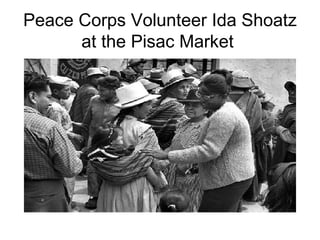
Peace Corps Volunteer Ida Shoatz at the Pisac Market
1 st  Director of Peace Corps R. Sargent Shriver leads Peace Corps Volunteers
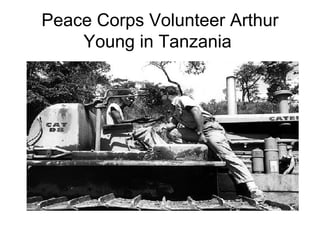
Peace Corps Volunteer Arthur Young in Tanzania
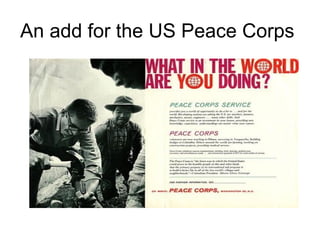
An add for the US Peace Corps
The Bush Years 1989- present  Events around the world were suddenly making the Peace Corps very popular  Moscow, Poland, and Hungary asked the Peace Corps for teachers and business advisors  When Uganda began relaxing their socialist policies they invited the Corps as their initial efforts to better relations with the US
Popular Peace Corps  When Namibia achieved its independence from South Africa in 1988 the Corps readied a program for the new country  Operations in Nicaragua and Panama were resumed when friendly governments came to power , and when Laos showed sufficient cooperation with the US drug interdiction efforts  Countries realized there are good feelings here about the Peace Corps
Conclusion  Perhaps now more than any other time since its founding, the Peace Corps has a chance to really make a difference  Internationalized volunteer service is probably the most idealistic outgrowth of the Peace Corps  Written in early 1961, Sargent Shriver said “we should hope that our citizens will find themselves working alongside citizens of the host country and also volunteers from other lands”
Essay Question  When was the Peace Corps Act Signed? What did this Act State? What were draft dodgers? What were some of the downfalls for the volunteers of the Peace Corps during the Vietnam War? What was JFK’s purpose of the Peace Corps? What was Kennedys famous words? What countries were interested in the Peace Corps and why?
Reference  What Can You Do For Your Country (An Oral History Of The Peace Corps By: Karen Schwarz  The Bold Experiment JFK”s Peace Corps Gerard T. Rice http://www.jfklibrary.org/Historical+Resources/JFK+in+History/Peace+Corps.htm

Megan De Souza

  • 1.
    Megan De Souza United States Peace Corps American History Ann Albright OSU/OKC
  • 2.
    Peace Corps “to promote world peace and friendship through a Peace Corps, which shall make available to interested countries and areas men and women of the United States qualified for service abroad and willing to serve, under conditions of hardship if necessary, to help peoples of such countries and areas in meeting their needs for trained manpower.
  • 3.
    The Act PresidentKennedy hands pen to Sargent Shriver 1 st director of the Peace Corps He signed the Act permanently establishing the agency on Sept 1 st , 1961
  • 4.
    The Peace Corpswas designed to encourage understanding between Americans and other cultures of the world Peace Corps volunteers help underdeveloped nations in areas such as farming, healthcare, and construction Peace Corps was very popular in the 1960’s with college graduates whose ideas reflected commitment to peace and international goodwill
  • 5.
    The Kennedy Years,1961-63 Kennedy elevated the Peace Corps from a weapon in the US, to a worldwide humanitarian mission in which he asked “ to those people in the huts and villages of half the globe struggling to break the bonds of mass misery, we pledge our best efforts to help them help themselves, for whatever period is required-not because the Communists may be doing it, not because we seek their votes, but because its right.
  • 6.
    Kennedy Kennedysfamous line “ask not what your country can do for you-ask what you can do for your country .
  • 7.
    The Act Would promote world peace and friendship The Goals Help interested countries meet their needs for trained manpower To help promote a better understanding of the American people on the part of the peoples served And a better understanding of other peoples on the part of the American people
  • 8.
    Some countries thatwere interested in the Peace Corps coming to them were Poland, Czech, Roamania Bulgaria, Asia, Nigeria Philippines, China, Russia Cuba, Ghana,
  • 9.
    Volunteers The 1st volunteers there were about three hundred These volunteers were not the brightest or the best educated Most of them were less interested in politics Almost one out of three volunteers was at least five sometimes thirty years past college
  • 10.
    Oaths Congressinsisted that volunteers take loyalty oaths and that the Peace Corps provide them with instruction to educated them on the tactics and menace of communism Peace Corps Handbook stated “you must be prepared for communist attempts to provoke you or hold you back from the work you were sent to do
  • 11.
    1965-Peace Corps vsWar Corps May 1965 the people of Santo Domingo, capital of Dominican Republic attempted to reinstate exiled President Juan Bosch President Johnson called the marines to assist the right-wing military leaders in preventing “another Cuba” It lasted four months cost the Dominican Republic 2,850 lives and US 28 lives Rather than evacuate Peace Corps volunteers stayed and literally dodged bullets and they cared for their Dominican friends
  • 12.
    ` This commitmentproved that the Peace Corps idea worked The American kids had something different to offer Many volunteers thought that Johnsons decision to intervene was a mistake They were shocked and ashamed to be giving medical help to Dominicans who had been wounded by American soldiers
  • 13.
    The Vietnam Era The Peace Corps planted a flag in its 50 th country and reached a peak enrollment of 15,556 volunteers 1965 the war began to cast a shadow over the Peace Corps’ halo Antiwar activist were encouraging students not to join the Peace Corps as a show of protest
  • 14.
    Volunteers affected bythe war In Thailand and Philippines the volunteers were reminded of the war almost every day by the roar of the B-52 bombers flying in and out of American military installations In Tanzania president J. Nyerere ordered the Peace Corps to leave his country In Ethiopia students ridiculed volunteers and accused them for secretly working for the CIA Some were even pelted with rocks and provoked into fist fights
  • 15.
    Draft Dodgers Nixonpredicted that the program would become an easy out for draft dodgers The Peace Corps did not keep records of how many men signed up to avoid going to Vietnam Dramatic shift in ratio of male to female volunteers between 1965 and 1970 from 55-45 to 70-30 The volunteers acknowledged that avoiding the draft was their main reason for joining the Corps
  • 16.
    Peace Corps Act Stated that volunteers would not be exempt from their military obligation Selective Service Director Lewis Hershey deemed this to be am occupation that served the national interest Therefore a volunteers military obligation would be deferred But whether or not they were granted was left up to the draft board
  • 17.
    The Committee ofReturned Volunteers Confessions of an Imperialist Lackey “ We went abroad to help Asians, Africans, and Latin Americans develop their resources and become free people. Once abroad, we discovered that we were part of the US worldwide pacification program. We found the US projects in these countries are designed to achieve political control and economic exploitation: to build an Empire for the US. As volunteers we were part of that strategy; we were the Marines in velvet gloves.
  • 18.
    Committee of ReturnedVolunteers Founded in 1966 First national organization of Peace Corps alumni-was a forum for discussion of US policies toward the third world Some people thought it would be okay to have an association but nobody was going to make a political statement because we might embarrass the government The story of the CRV illustrates how the Vietnam War helped rob many volunteers and the Peace Corps itself of its innocence The CRV was full of idealists who felt committed and somewhat betrayed
  • 19.
    President Kennedy greetsPeace Corps Volunteers August 1962
  • 20.
    The Beginning S ince the Peace Corps began in 1961, more than 170,000 Peace Corps Volunteers have served in 137 countries.  Of these dedicated men and women, 264 have sacrificed not only their energies and time, but also their lives while pursuing the Peace Corps mission.
  • 21.
    August 1962 PresidentKennedy greets Peace Corps Volunteers
  • 22.
    Peace Corps VolunteerIda Shoatz at the Pisac Market
  • 23.
    1 st Director of Peace Corps R. Sargent Shriver leads Peace Corps Volunteers
  • 24.
    Peace Corps VolunteerArthur Young in Tanzania
  • 25.
    An add forthe US Peace Corps
  • 26.
    The Bush Years1989- present Events around the world were suddenly making the Peace Corps very popular Moscow, Poland, and Hungary asked the Peace Corps for teachers and business advisors When Uganda began relaxing their socialist policies they invited the Corps as their initial efforts to better relations with the US
  • 27.
    Popular Peace Corps When Namibia achieved its independence from South Africa in 1988 the Corps readied a program for the new country Operations in Nicaragua and Panama were resumed when friendly governments came to power , and when Laos showed sufficient cooperation with the US drug interdiction efforts Countries realized there are good feelings here about the Peace Corps
  • 28.
    Conclusion Perhapsnow more than any other time since its founding, the Peace Corps has a chance to really make a difference Internationalized volunteer service is probably the most idealistic outgrowth of the Peace Corps Written in early 1961, Sargent Shriver said “we should hope that our citizens will find themselves working alongside citizens of the host country and also volunteers from other lands”
  • 29.
    Essay Question When was the Peace Corps Act Signed? What did this Act State? What were draft dodgers? What were some of the downfalls for the volunteers of the Peace Corps during the Vietnam War? What was JFK’s purpose of the Peace Corps? What was Kennedys famous words? What countries were interested in the Peace Corps and why?
  • 30.
    Reference WhatCan You Do For Your Country (An Oral History Of The Peace Corps By: Karen Schwarz The Bold Experiment JFK”s Peace Corps Gerard T. Rice http://www.jfklibrary.org/Historical+Resources/JFK+in+History/Peace+Corps.htm