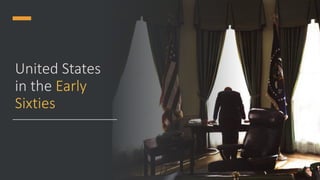
United States
in the Early
Sixties
Content Standards
• 11.8.5 - Describe the increased powers of the presidency in response to the Great Depression, World War II,
and the Cold War
• 11.9.2 - Understand the role of military alliances, including NATO and SEATO, in deterring communist
aggression and maintaining security during the Cold War
• 11.9.3 - Trace the origins and geopolitical consequences (foreign and domestic) of the Cold War and
containment policy including the…
• Bay of Pigs invasion and the Cuban Missile Crisis
• Atomic testing in the American West, the “mutual assured destruction” doctrine, and disarmament policies
• 11.10.6 - Analyze the passage and effects of civil rights and voting rights legislation (e.g., 1964 Civil Rights
Act, Voting Rights Act of 1965) and the Twenty-Fourth Amendment, with an emphasis on equality of access
to education and to the political process.
• 11.10.7 - Analyze the women’s rights movement from the era of Elizabeth Stanton and Susan Anthony and
the passage of the Nineteenth Amendment to the movement launched in the 1960s, including differing
perspectives on the roles of women.
Lecture Hook
• This lecture will focus on the United States during the early 1960’s.
• The Sixties was a time packed with many events and issues, both occurring abroad and at home.
• The JFK Administration brought a new wave of optimism to Americans in hopes of a brighter future.
• The Bay of Pigs Invasion and the Cuban Missile Crisis teaches us how dangerous Mutually Assured
Destruction was.
• The Civil Rights Movement demonstrates the struggle many people went through to bring civil rights across
the nation.
• The Feminine Mystique answered the “problem with no name”, sparking a new wave of feminism.
• These events defined the early 1960’s and will be discussed in greater detail throughout the lecture.
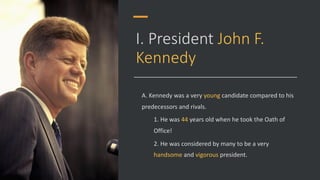
I. President John F.
Kennedy
A. Kennedy was a very young candidate compared to his
predecessors and rivals.
1. He was 44 years old when he took the Oath of
Office!
2. He was considered by many to be a very
handsome and vigorous president.
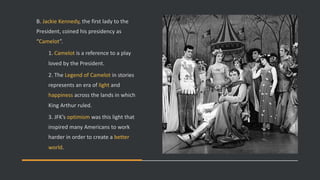
B. Jackie Kennedy, the first lady to the
President, coined his presidency as
“Camelot”.
1. Camelot is a reference to a play
loved by the President.
2. The Legend of Camelot in stories
represents an era of light and
happiness across the lands in which
King Arthur ruled.
3. JFK’s optimism was this light that
inspired many Americans to work
harder in order to create a better
world.
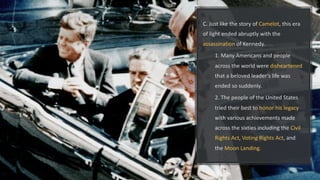
C. Just like the story of Camelot, this era
of light ended abruptly with the
assassination of Kennedy.
1. Many Americans and people
across the world were disheartened
that a beloved leader’s life was
ended so suddenly.
2. The people of the United States
tried their best to honor his legacy
with various achievements made
across the sixties including the Civil
Rights Act, Voting Rights Act, and
the Moon Landing.
II. Bay of Pigs and the
Cuban Missile Crisis
A. Even though Kennedy brought a new era of optimism,
the United States and its allies was still actively engaged
against the Soviet Union in the Cold War.
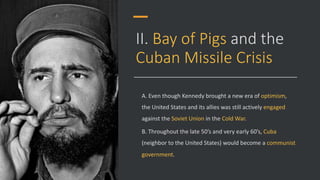
B. Throughout the late 50’s and very early 60’s, Cuba
(neighbor to the United States) would become a communist
government.
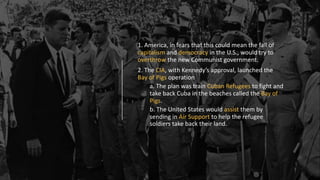
1. America, in fears that this could mean the fall of
capitalism and democracy in the U.S., would try to
overthrow the new Communist government.
2. The CIA, with Kennedy’s approval, launched the
Bay of Pigs operation
a. The plan was train Cuban Refugees to fight and
take back Cuba in the beaches called the Bay of
Pigs.
b. The United States would assist them by
sending in Air Support to help the refugee
soldiers take back their land.
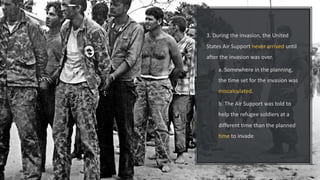
3. During the invasion, the United
States Air Support never arrived until
after the invasion was over.
a. Somewhere in the planning,
the time set for the invasion was
miscalculated.
b. The Air Support was told to
help the refugee soldiers at a
different time than the planned
time to invade.
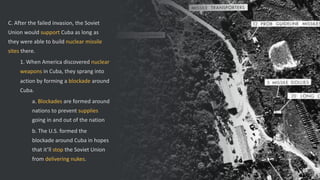
C. After the failed invasion, the Soviet
Union would support Cuba as long as
they were able to build nuclear missile
sites there.
1. When America discovered nuclear
weapons in Cuba, they sprang into
action by forming a blockade around
Cuba.
a. Blockades are formed around
nations to prevent supplies
going in and out of the nation
b. The U.S. formed the
blockade around Cuba in hopes
that it’ll stop the Soviet Union
from delivering nukes.
2. The Soviet Union responded by sending armed troops to go through the barricade and deliver
supplies to Cuba
a. This Cuban Missile Crisis almost led to nuclear war with both sides ready to fire nukes at their
enemy.
b. Right before the Soviet ships were about to break through, they turned around.
3. After almost starting a nuclear war, the United States and the Soviet Union met to form a treaty.
a. The Soviet Union would move their nukes away from Cuba if the United States did the same
with Turkey.
b. That’s right, the Soviet Union wasn’t the first to set up nuclear missile silos right next to their
enemy, the U.S. had nuclear missile sites installed in Turkey right next to the U.S.S.R.
Analyze
In 6-10 sentences, answer the
following questions:
Do you think Kennedy’s move
to form a blockade around
Cuba was the right move?
Why or why not? Could have
there been an alternate
solution to the Cuban Missile
Crisis? If so, what is that
solution?
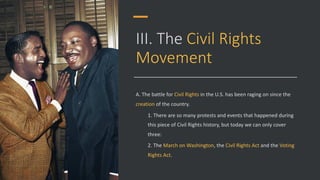
III. The Civil Rights
Movement
A. The battle for Civil Rights in the U.S. has been raging on since the
creation of the country.
1. There are so many protests and events that happened during
this piece of Civil Rights history, but today we can only cover
three:
2. The March on Washington, the Civil Rights Act and the Voting
Rights Act.
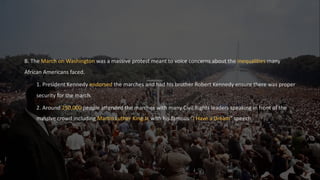
B. The March on Washington was a massive protest meant to voice concerns about the inequalities many
African Americans faced.
1. President Kennedy endorsed the marches and had his brother Robert Kennedy ensure there was proper
security for the march.
2. Around 250,000 people attended the marches with many Civil Rights leaders speaking in front of the
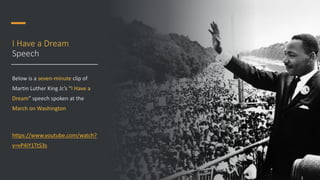
massive crowd including Martin Luther King Jr. with his famous “I Have a Dream” speech.
I Have a Dream
Speech
Below is a seven-minute clip of
Martin Luther King Jr.’s “I Have a
Dream” speech spoken at the
March on Washington
https://www.youtube.com/watch?
v=vP4iY1TtS3s
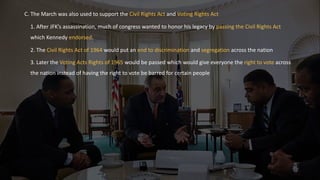
C. The March was also used to support the Civil Rights Act and Voting Rights Act
1. After JFK’s assassination, much of congress wanted to honor his legacy by passing the Civil Rights Act
which Kennedy endorsed.
2. The Civil Rights Act of 1964 would put an end to discrimination and segregation across the nation
3. Later the Voting Acts Rights of 1965 would be passed which would give everyone the right to vote across
the nation instead of having the right to vote be barred for certain people
Journal
Entry
In 5-8 sentences, answer the
following questions:
Write down a time in your life
where you felt dissatisfied
with your life. What did you
think made you dissatisfied?
Did you overcome it, and if so
how? If you didn’t, what can
you do to overcome it?
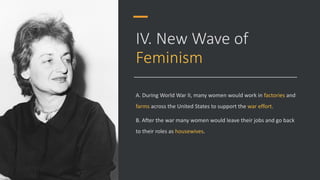
IV. New Wave of
Feminism
A. During World War II, many women would work in factories and
farms across the United States to support the war effort.
B. After the war many women would leave their jobs and go back
to their roles as housewives.
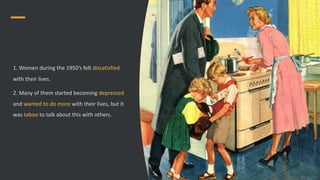
1. Women during the 1950’s felt dissatisfied
with their lives.
2. Many of them started becoming depressed
and wanted to do more with their lives, but it
was taboo to talk about this with others.
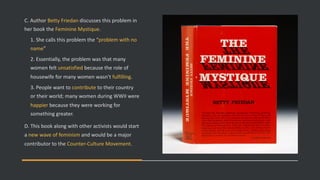
C. Author Betty Friedan discusses this problem in
her book the Feminine Mystique.
1. She calls this problem the “problem with no
name”
2. Essentially, the problem was that many
women felt unsatisfied because the role of
housewife for many women wasn’t fulfilling.
3. People want to contribute to their country
or their world; many women during WWII were
happier because they were working for
something greater.
D. This book along with other activists would start
a new wave of feminism and would be a major
contributor to the Counter-Culture Movement.
Summarize
In 6-10 sentences, try and
summarize as much of the
unit as you can:
Be sure to discuss the
Kennedy Administration, Bay
of Pigs Invasion, Cuban
Missile Crisis, Civil Rights
Movement, and the Feminine
Mystique.

EDSC 304 Lecture slides

  • 1.
    United States in theEarly Sixties
  • 2.
    Content Standards • 11.8.5- Describe the increased powers of the presidency in response to the Great Depression, World War II, and the Cold War • 11.9.2 - Understand the role of military alliances, including NATO and SEATO, in deterring communist aggression and maintaining security during the Cold War • 11.9.3 - Trace the origins and geopolitical consequences (foreign and domestic) of the Cold War and containment policy including the… • Bay of Pigs invasion and the Cuban Missile Crisis • Atomic testing in the American West, the “mutual assured destruction” doctrine, and disarmament policies • 11.10.6 - Analyze the passage and effects of civil rights and voting rights legislation (e.g., 1964 Civil Rights Act, Voting Rights Act of 1965) and the Twenty-Fourth Amendment, with an emphasis on equality of access to education and to the political process. • 11.10.7 - Analyze the women’s rights movement from the era of Elizabeth Stanton and Susan Anthony and the passage of the Nineteenth Amendment to the movement launched in the 1960s, including differing perspectives on the roles of women.
  • 3.
    Lecture Hook • Thislecture will focus on the United States during the early 1960’s. • The Sixties was a time packed with many events and issues, both occurring abroad and at home. • The JFK Administration brought a new wave of optimism to Americans in hopes of a brighter future. • The Bay of Pigs Invasion and the Cuban Missile Crisis teaches us how dangerous Mutually Assured Destruction was. • The Civil Rights Movement demonstrates the struggle many people went through to bring civil rights across the nation. • The Feminine Mystique answered the “problem with no name”, sparking a new wave of feminism. • These events defined the early 1960’s and will be discussed in greater detail throughout the lecture.
  • 4.
    I. President JohnF. Kennedy A. Kennedy was a very young candidate compared to his predecessors and rivals. 1. He was 44 years old when he took the Oath of Office! 2. He was considered by many to be a very handsome and vigorous president.
  • 5.
    B. Jackie Kennedy,the first lady to the President, coined his presidency as “Camelot”. 1. Camelot is a reference to a play loved by the President. 2. The Legend of Camelot in stories represents an era of light and happiness across the lands in which King Arthur ruled. 3. JFK’s optimism was this light that inspired many Americans to work harder in order to create a better world.
  • 6.
    C. Just likethe story of Camelot, this era of light ended abruptly with the assassination of Kennedy. 1. Many Americans and people across the world were disheartened that a beloved leader’s life was ended so suddenly. 2. The people of the United States tried their best to honor his legacy with various achievements made across the sixties including the Civil Rights Act, Voting Rights Act, and the Moon Landing.
  • 7.
    II. Bay ofPigs and the Cuban Missile Crisis A. Even though Kennedy brought a new era of optimism, the United States and its allies was still actively engaged against the Soviet Union in the Cold War. B. Throughout the late 50’s and very early 60’s, Cuba (neighbor to the United States) would become a communist government.
  • 8.
    1. America, infears that this could mean the fall of capitalism and democracy in the U.S., would try to overthrow the new Communist government. 2. The CIA, with Kennedy’s approval, launched the Bay of Pigs operation a. The plan was train Cuban Refugees to fight and take back Cuba in the beaches called the Bay of Pigs. b. The United States would assist them by sending in Air Support to help the refugee soldiers take back their land.
  • 9.
    3. During theinvasion, the United States Air Support never arrived until after the invasion was over. a. Somewhere in the planning, the time set for the invasion was miscalculated. b. The Air Support was told to help the refugee soldiers at a different time than the planned time to invade.
  • 10.
    C. After thefailed invasion, the Soviet Union would support Cuba as long as they were able to build nuclear missile sites there. 1. When America discovered nuclear weapons in Cuba, they sprang into action by forming a blockade around Cuba. a. Blockades are formed around nations to prevent supplies going in and out of the nation b. The U.S. formed the blockade around Cuba in hopes that it’ll stop the Soviet Union from delivering nukes.
  • 11.
    2. The SovietUnion responded by sending armed troops to go through the barricade and deliver supplies to Cuba a. This Cuban Missile Crisis almost led to nuclear war with both sides ready to fire nukes at their enemy. b. Right before the Soviet ships were about to break through, they turned around. 3. After almost starting a nuclear war, the United States and the Soviet Union met to form a treaty. a. The Soviet Union would move their nukes away from Cuba if the United States did the same with Turkey. b. That’s right, the Soviet Union wasn’t the first to set up nuclear missile silos right next to their enemy, the U.S. had nuclear missile sites installed in Turkey right next to the U.S.S.R.
  • 12.
    Analyze In 6-10 sentences,answer the following questions: Do you think Kennedy’s move to form a blockade around Cuba was the right move? Why or why not? Could have there been an alternate solution to the Cuban Missile Crisis? If so, what is that solution?
  • 13.
    III. The CivilRights Movement A. The battle for Civil Rights in the U.S. has been raging on since the creation of the country. 1. There are so many protests and events that happened during this piece of Civil Rights history, but today we can only cover three: 2. The March on Washington, the Civil Rights Act and the Voting Rights Act.
  • 14.
    B. The Marchon Washington was a massive protest meant to voice concerns about the inequalities many African Americans faced. 1. President Kennedy endorsed the marches and had his brother Robert Kennedy ensure there was proper security for the march. 2. Around 250,000 people attended the marches with many Civil Rights leaders speaking in front of the massive crowd including Martin Luther King Jr. with his famous “I Have a Dream” speech.
  • 15.
    I Have aDream Speech Below is a seven-minute clip of Martin Luther King Jr.’s “I Have a Dream” speech spoken at the March on Washington https://www.youtube.com/watch? v=vP4iY1TtS3s
  • 16.
    C. The Marchwas also used to support the Civil Rights Act and Voting Rights Act 1. After JFK’s assassination, much of congress wanted to honor his legacy by passing the Civil Rights Act which Kennedy endorsed. 2. The Civil Rights Act of 1964 would put an end to discrimination and segregation across the nation 3. Later the Voting Acts Rights of 1965 would be passed which would give everyone the right to vote across the nation instead of having the right to vote be barred for certain people
  • 17.
    Journal Entry In 5-8 sentences,answer the following questions: Write down a time in your life where you felt dissatisfied with your life. What did you think made you dissatisfied? Did you overcome it, and if so how? If you didn’t, what can you do to overcome it?
  • 18.
    IV. New Waveof Feminism A. During World War II, many women would work in factories and farms across the United States to support the war effort. B. After the war many women would leave their jobs and go back to their roles as housewives.
  • 19.
    1. Women duringthe 1950’s felt dissatisfied with their lives. 2. Many of them started becoming depressed and wanted to do more with their lives, but it was taboo to talk about this with others.
  • 20.
    C. Author BettyFriedan discusses this problem in her book the Feminine Mystique. 1. She calls this problem the “problem with no name” 2. Essentially, the problem was that many women felt unsatisfied because the role of housewife for many women wasn’t fulfilling. 3. People want to contribute to their country or their world; many women during WWII were happier because they were working for something greater. D. This book along with other activists would start a new wave of feminism and would be a major contributor to the Counter-Culture Movement.
  • 21.
    Summarize In 6-10 sentences,try and summarize as much of the unit as you can: Be sure to discuss the Kennedy Administration, Bay of Pigs Invasion, Cuban Missile Crisis, Civil Rights Movement, and the Feminine Mystique.