Climate Change and Local Government in
New Zealand
Laura McKim, Strategic Planning, Greater Wellington Regional Council
Nigel Taptiklis, Senior Policy Advisor, Wellington City Council 1
Climate change and local government - today’s session
• Background – what does local government do?
• Legislative context – laws that guide us
• NZ case studies – how it plays out in practice
• Policy responses
• Where to next? – accelerating a societal response
- broader resilience context
• Wrap up
2
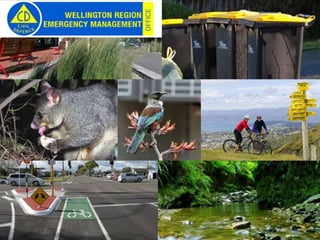
Councils have
multiple
roles…
3
4
Regional Councils
• Manage resources – sustainable management of
freshwater, air, soil, coastal waters, discharges to land
- Regional Policy Statement, Regional Plans, consents
• River control, flood protection and soil conservation
•Regional land transport planning and contracting
public transport services
• Harbour navigation and safety, oil spills and other
marine pollution
•24-hr environmental incident response
5
Territorial Authorities (City & District Councils)
• District Plans –rules governing the use of land
• Controlling the effects of land use, noise, and the
effects of activities on the surface of lakes and rivers
• Local infrastructure, including water, sewerage,
stormwater, roads, cycle ways
• Environmental safety and health, building control,
public health inspections and other environmental health
matters
• Bylaws- special laws that apply in that district only e.g.
liquor-free zones, air quality control
6
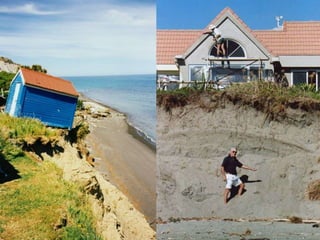
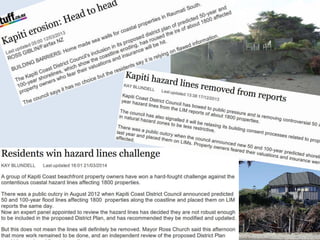
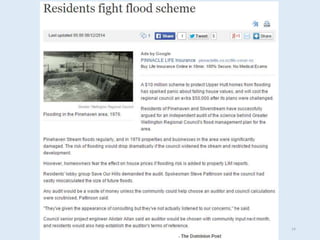
•Increased frequency and intensity of
flood damage to settlements and
infrastructure
•Increasing risks to coastal infrastructure
and low-lying ecosystems from continuing
sea level rise
-Storm surge, erosion and inundation
•Increased frequency of drought, placing
pressure on water resources and
increasing the risk of wild fire
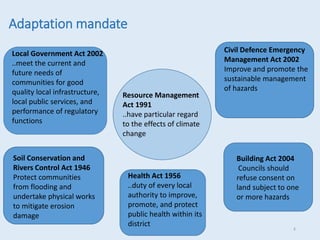
Adaptation mandate
Resource Management
Act 1991
..have particular regard
to the effects of climate
change
Local Government Act 2002
..meet the current and
future needs of
communities for good
quality local infrastructure,
local public services, and
performance of regulatory
functions
Soil Conservation and
Rivers Control Act 1946
Protect communities
from flooding and
undertake physical works
to mitigate erosion
damage
Civil Defence Emergency
Management Act 2002
Improve and promote the
sustainable management
of hazards
Building Act 2004
Councils should
refuse consent on
land subject to one
or more hazards
Health Act 1956
..duty of every local
authority to improve,
promote, and protect
public health within its
district
8
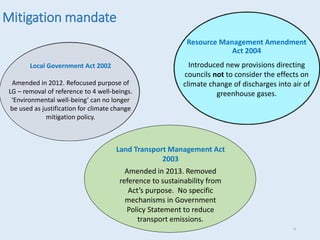
Mitigation mandate
Local Government Act 2002
Original purpose: To enable democratic
decision-making and action by, and on
behalf of, communities; and to promote
the social, economic, environmental,
and cultural well-being of communities,
in the present and in the future
Resource Management Act 1991
Resource consent authorities must
have regard to any actual and potential
effects on the environment of allowing
the activity.
Local Government Act 2002
Amended in 2012. Refocused purpose of
LG – removal of reference to 4 well-beings.
‘Environmental well-being’ can no longer
be used as justification for climate change
mitigation policy.
9
Resource Management Amendment
Act 2004
Introduced new provisions directing
councils not to consider the effects on
climate change of discharges into air of
greenhouse gases.
Land Transport Management Act
2003
Amended in 2013. Removed
reference to sustainability from
Act’s purpose. No specific
mechanisms in Government
Policy Statement to reduce
transport emissions.
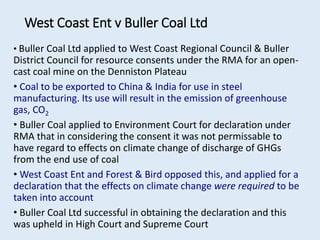
• Buller Coal Ltd applied to West Coast Regional Council & Buller
District Council for resource consents under the RMA for an open-
cast coal mine on the Denniston Plateau
• Coal to be exported to China & India for use in steel
manufacturing. Its use will result in the emission of greenhouse
gas, CO2
• Buller Coal applied to Environment Court for declaration under
RMA that in considering the consent it was not permissable to
have regard to effects on climate change of discharge of GHGs
from the end use of coal
• West Coast Ent and Forest & Bird opposed this, and applied for a
declaration that the effects on climate change were required to be
taken into account
• Buller Coal Ltd successful in obtaining the declaration and this
was upheld in High Court and Supreme Court
West Coast Ent v Buller Coal Ltd
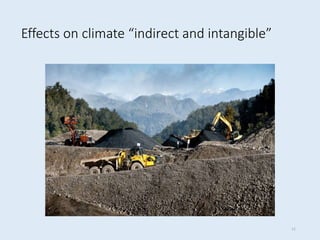
Effects on climate “indirect and intangible”
11
12
13
14
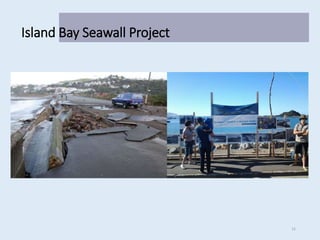
Island Bay Seawall Project
15
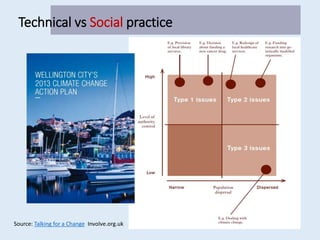
Source: Talking for a Change Involve.org.uk
Technical vs Social practice
Real and Tangible
• Severe southerly storm June 2013 – failure of 50m section of
the Island Bay seawall
• Project Aims:
• Develop a long-term solution for managing storm and wave hazards in
Island Bay
• Explore range of options and develop recommended option
• Options: Repair, re-fortify, don’t build back (soft engineering),
hybrid.
– but non-threatening on a city scale
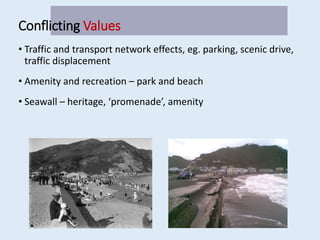
Conflicting Values
• Traffic and transport network effects, eg. parking, scenic drive,
traffic displacement
• Amenity and recreation – park and beach
• Seawall – heritage, ‘promenade’, amenity
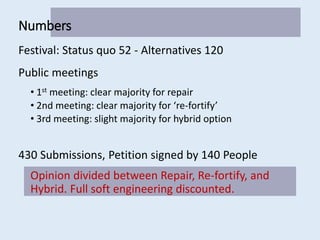
Numbers
Festival: Status quo 52 - Alternatives 120
Public meetings
• 1st meeting: clear majority for repair
• 2nd meeting: clear majority for ‘re-fortify’
• 3rd meeting: slight majority for hybrid option
430 Submissions, Petition signed by 140 People
Opinion divided between Repair, Re-fortify, and
Hybrid. Full soft engineering discounted.
20
• What is best for long term social/community resilience?
• How do we build physical resilience and council/community
cohesion?
http://wellington.govt.nz/~/media/your-council/meetings/Committees/Environment-
Committee/2014/12/Minutesunconfirmed.pdf
Update
21
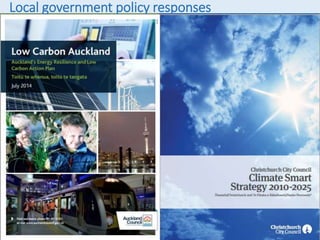
Local government policy responses
Break
22
Where to next?
Accelerating the societal
response to climate change
Nigel Taptiklis
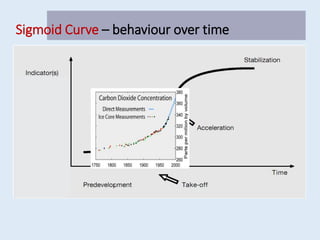
Sigmoid Curve – behaviour over time
A Super Wicked Problem
• Time is running out
• Those seeking to solve the problem are also causing it
• Multiple framesfor understanding, and frame determines approach
and ‘solution’
WANTED: NEW THINKING
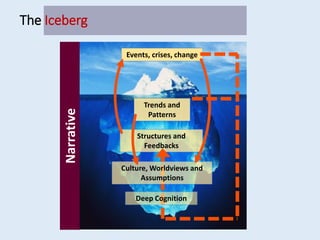
Narrative
Events, crises, change
Trends and
Patterns
Structures and
Feedbacks
Culture, Worldviews and
Assumptions
Deep Cognition
The Iceberg
Innovation begins with powerful questions
“If I had an hour to solve a problem and my life
depended on the solution, I would spend the first 55
minutes determining the proper question to ask, for
once I know the proper question, I could solve the
problem in less than five minutes.”
- Albert Einstein
Reframe - Opportunity Analysis
• How do we accelerate our response?
• How do we shine the spotlight on ourselves?
• How can we use the diversity available to us to address
root causes?
“Where can I get a good hamburger on the road?”
- Ray Kroc, McDonald’s founder
What is Rapid Social Innovation?
Social Innovation is often an effort of mental creativity
which involves fluency and flexibility from a wide range
of disciplines. The act of social innovation in a sector is
mostly connected with diverse disciplines within the
society.
innovate
Make changes in something established, especially
by introducing new methods, ideas, or products.
introduce (something new, especially a product).
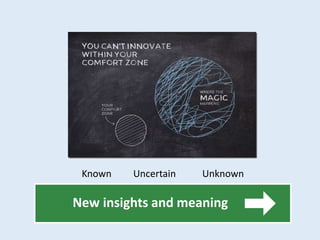
Known Uncertain Unknown
New insights and meaning
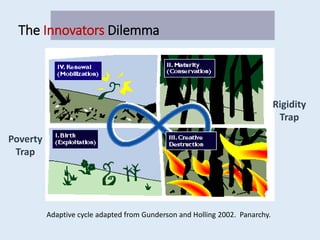
Poverty
Trap
Rigidity
Trap
Adaptive cycle adapted from Gunderson and Holling 2002. Panarchy.
The Innovators Dilemma
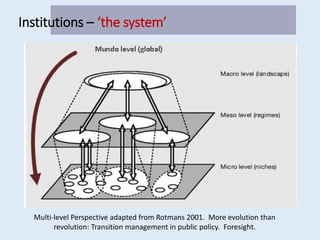
Multi-level Perspective adapted from Rotmans 2001. More evolution than
revolution: Transition management in public policy. Foresight.
Institutions – ‘the system’
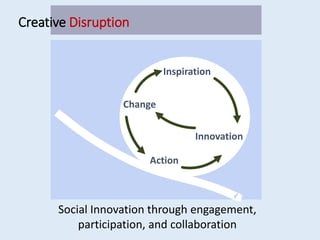
Creative Disruption
Inspiration
Change
Action
Innovation
Social Innovation through engagement,
participation, and collaboration
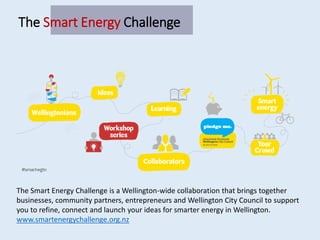
The Smart Energy Challenge is a Wellington-wide collaboration that brings together
businesses, community partners, entrepreneurs and Wellington City Council to support
you to refine, connect and launch your ideas for smarter energy in Wellington.
www.smartenergychallenge.org.nz
The Smart Energy Challenge
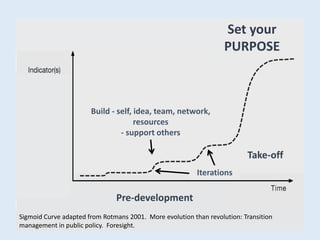
Build - self, idea, team, network,
resources
- support others
Iterations
Take-off
Pre-development
Set your
PURPOSE
Sigmoid Curve adapted from Rotmans 2001. More evolution than revolution: Transition
management in public policy. Foresight.
Purpose
Take-home messages
• Mitigation – NZ appears to be going against international
trends by restricting local government’s role in GHG emission
reductions
• Adaptation – local government has a key role, but without
strong mitigation action, adapting to climate change will
become increasingly challenging and potentially prohibitively
expensive for councils
• Councils are already exposed to risks and challenges in
attempting to do adaptation planning
• Better coordination of legislation could help
• Catalysing social learning and innovation can help increase
engagement and navigate complexity
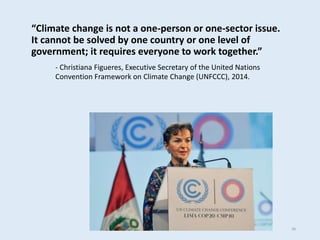
“Climate change is not a one-person or one-sector issue.
It cannot be solved by one country or one level of
government; it requires everyone to work together.”
- Christiana Figueres, Executive Secretary of the United Nations
Convention Framework on Climate Change (UNFCCC), 2014.
38

Change and nz_s_future_jan_22

  • 1.
    Climate Change andLocal Government in New Zealand Laura McKim, Strategic Planning, Greater Wellington Regional Council Nigel Taptiklis, Senior Policy Advisor, Wellington City Council 1
  • 2.
    Climate change andlocal government - today’s session • Background – what does local government do? • Legislative context – laws that guide us • NZ case studies – how it plays out in practice • Policy responses • Where to next? – accelerating a societal response - broader resilience context • Wrap up 2
  • 3.
  • 4.
  • 5.
    Regional Councils • Manageresources – sustainable management of freshwater, air, soil, coastal waters, discharges to land - Regional Policy Statement, Regional Plans, consents • River control, flood protection and soil conservation •Regional land transport planning and contracting public transport services • Harbour navigation and safety, oil spills and other marine pollution •24-hr environmental incident response 5
  • 6.
    Territorial Authorities (City& District Councils) • District Plans –rules governing the use of land • Controlling the effects of land use, noise, and the effects of activities on the surface of lakes and rivers • Local infrastructure, including water, sewerage, stormwater, roads, cycle ways • Environmental safety and health, building control, public health inspections and other environmental health matters • Bylaws- special laws that apply in that district only e.g. liquor-free zones, air quality control 6
  • 7.
    •Increased frequency andintensity of flood damage to settlements and infrastructure •Increasing risks to coastal infrastructure and low-lying ecosystems from continuing sea level rise -Storm surge, erosion and inundation •Increased frequency of drought, placing pressure on water resources and increasing the risk of wild fire
  • 8.
    Adaptation mandate Resource Management Act1991 ..have particular regard to the effects of climate change Local Government Act 2002 ..meet the current and future needs of communities for good quality local infrastructure, local public services, and performance of regulatory functions Soil Conservation and Rivers Control Act 1946 Protect communities from flooding and undertake physical works to mitigate erosion damage Civil Defence Emergency Management Act 2002 Improve and promote the sustainable management of hazards Building Act 2004 Councils should refuse consent on land subject to one or more hazards Health Act 1956 ..duty of every local authority to improve, promote, and protect public health within its district 8
  • 9.
    Mitigation mandate Local GovernmentAct 2002 Original purpose: To enable democratic decision-making and action by, and on behalf of, communities; and to promote the social, economic, environmental, and cultural well-being of communities, in the present and in the future Resource Management Act 1991 Resource consent authorities must have regard to any actual and potential effects on the environment of allowing the activity. Local Government Act 2002 Amended in 2012. Refocused purpose of LG – removal of reference to 4 well-beings. ‘Environmental well-being’ can no longer be used as justification for climate change mitigation policy. 9 Resource Management Amendment Act 2004 Introduced new provisions directing councils not to consider the effects on climate change of discharges into air of greenhouse gases. Land Transport Management Act 2003 Amended in 2013. Removed reference to sustainability from Act’s purpose. No specific mechanisms in Government Policy Statement to reduce transport emissions.
  • 10.
    • Buller CoalLtd applied to West Coast Regional Council & Buller District Council for resource consents under the RMA for an open- cast coal mine on the Denniston Plateau • Coal to be exported to China & India for use in steel manufacturing. Its use will result in the emission of greenhouse gas, CO2 • Buller Coal applied to Environment Court for declaration under RMA that in considering the consent it was not permissable to have regard to effects on climate change of discharge of GHGs from the end use of coal • West Coast Ent and Forest & Bird opposed this, and applied for a declaration that the effects on climate change were required to be taken into account • Buller Coal Ltd successful in obtaining the declaration and this was upheld in High Court and Supreme Court West Coast Ent v Buller Coal Ltd
  • 11.
    Effects on climate“indirect and intangible” 11
  • 12.
  • 13.
  • 14.
  • 15.
  • 16.
    Source: Talking fora Change Involve.org.uk Technical vs Social practice
  • 17.
    Real and Tangible •Severe southerly storm June 2013 – failure of 50m section of the Island Bay seawall • Project Aims: • Develop a long-term solution for managing storm and wave hazards in Island Bay • Explore range of options and develop recommended option • Options: Repair, re-fortify, don’t build back (soft engineering), hybrid. – but non-threatening on a city scale
  • 18.
    Conflicting Values • Trafficand transport network effects, eg. parking, scenic drive, traffic displacement • Amenity and recreation – park and beach • Seawall – heritage, ‘promenade’, amenity
  • 19.
    Numbers Festival: Status quo52 - Alternatives 120 Public meetings • 1st meeting: clear majority for repair • 2nd meeting: clear majority for ‘re-fortify’ • 3rd meeting: slight majority for hybrid option 430 Submissions, Petition signed by 140 People Opinion divided between Repair, Re-fortify, and Hybrid. Full soft engineering discounted.
  • 20.
    20 • What isbest for long term social/community resilience? • How do we build physical resilience and council/community cohesion? http://wellington.govt.nz/~/media/your-council/meetings/Committees/Environment- Committee/2014/12/Minutesunconfirmed.pdf Update
  • 21.
  • 22.
  • 23.
    Where to next? Acceleratingthe societal response to climate change Nigel Taptiklis
  • 24.
    Sigmoid Curve –behaviour over time
  • 25.
    A Super WickedProblem • Time is running out • Those seeking to solve the problem are also causing it • Multiple framesfor understanding, and frame determines approach and ‘solution’ WANTED: NEW THINKING
  • 26.
    Narrative Events, crises, change Trendsand Patterns Structures and Feedbacks Culture, Worldviews and Assumptions Deep Cognition The Iceberg
  • 27.
    Innovation begins withpowerful questions “If I had an hour to solve a problem and my life depended on the solution, I would spend the first 55 minutes determining the proper question to ask, for once I know the proper question, I could solve the problem in less than five minutes.” - Albert Einstein
  • 28.
    Reframe - OpportunityAnalysis • How do we accelerate our response? • How do we shine the spotlight on ourselves? • How can we use the diversity available to us to address root causes? “Where can I get a good hamburger on the road?” - Ray Kroc, McDonald’s founder
  • 29.
    What is RapidSocial Innovation? Social Innovation is often an effort of mental creativity which involves fluency and flexibility from a wide range of disciplines. The act of social innovation in a sector is mostly connected with diverse disciplines within the society. innovate Make changes in something established, especially by introducing new methods, ideas, or products. introduce (something new, especially a product).
  • 30.
    Known Uncertain Unknown Newinsights and meaning
  • 31.
    Poverty Trap Rigidity Trap Adaptive cycle adaptedfrom Gunderson and Holling 2002. Panarchy. The Innovators Dilemma
  • 32.
    Multi-level Perspective adaptedfrom Rotmans 2001. More evolution than revolution: Transition management in public policy. Foresight. Institutions – ‘the system’
  • 33.
    Creative Disruption Inspiration Change Action Innovation Social Innovationthrough engagement, participation, and collaboration
  • 34.
    The Smart EnergyChallenge is a Wellington-wide collaboration that brings together businesses, community partners, entrepreneurs and Wellington City Council to support you to refine, connect and launch your ideas for smarter energy in Wellington. www.smartenergychallenge.org.nz The Smart Energy Challenge
  • 35.
    Build - self,idea, team, network, resources - support others Iterations Take-off Pre-development Set your PURPOSE Sigmoid Curve adapted from Rotmans 2001. More evolution than revolution: Transition management in public policy. Foresight.
  • 36.
  • 37.
    Take-home messages • Mitigation– NZ appears to be going against international trends by restricting local government’s role in GHG emission reductions • Adaptation – local government has a key role, but without strong mitigation action, adapting to climate change will become increasingly challenging and potentially prohibitively expensive for councils • Councils are already exposed to risks and challenges in attempting to do adaptation planning • Better coordination of legislation could help • Catalysing social learning and innovation can help increase engagement and navigate complexity
  • 38.
    “Climate change isnot a one-person or one-sector issue. It cannot be solved by one country or one level of government; it requires everyone to work together.” - Christiana Figueres, Executive Secretary of the United Nations Convention Framework on Climate Change (UNFCCC), 2014. 38