Christianity and
identity in Ireland
 Medieval Ireland 795-1450
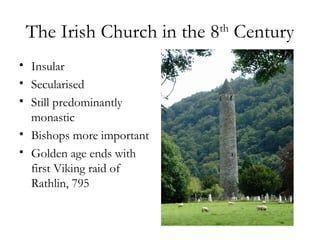
The Irish Church in the 8 Century
                           th


• Insular
• Secularised
• Still predominantly
  monastic
• Bishops more important
• Golden age ends with
  first Viking raid of
  Rathlin, 795
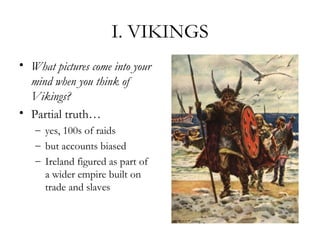
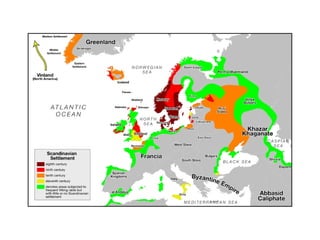
I. VIKINGS
• What pictures come into your
  mind when you think of
  Vikings?
• Partial truth…
   – yes, 100s of raids
   – but accounts biased
   – Ireland figured as part of
     a wider empire built on
     trade and slaves
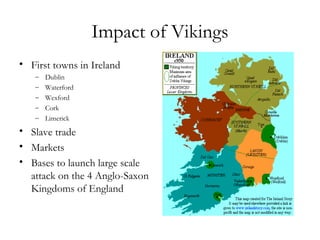
Impact of Vikings
• First towns in Ireland
   –   Dublin
   –   Waterford
   –   Wexford
   –   Cork
   –   Limerick
• Slave trade
• Markets
• Bases to launch large scale
  attack on the 4 Anglo-Saxon
  Kingdoms of England
Viking Legacy?
•   Here for 300 years
•   Established first towns and markets
•   Established first permanent territorial dioceses
•   Irish were just as vicious,
    – sacking of Clonmacnois, 833
• In another story they are raiders that came for a
  while and were defeated and succumb to the
  allure of “Irishness” – but the evidence does not
  support this
Irish Church in 9 10 Centuries     th-       th
                                        • Some Spiritual vibrancy in
                                          the old ways
                                              – Céli Dé of Tallaght, Finglas and
                                                Armagh
                                        • Fresh wave of Peregrinatio
                                              – Eriugena and Carolingian
                                                Empire
                                              – Irish/Scottish monks and
                                                Ottonian Rennaissance
                                        • Schöttenkloster
                                              – Benedictine, not old Irish rules
                                        • Pilgrimage of Gaelic and
                                          Norse kings to Rome
                                        • Stopped in 1060s, why?

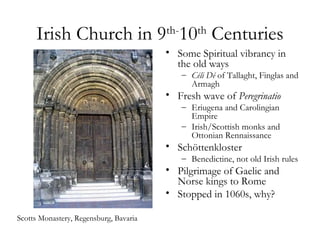
Scotts Monastery, Regensburg, Bavaria
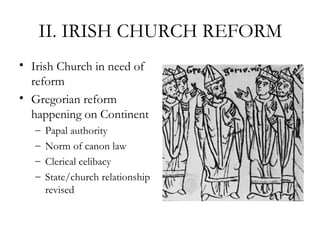
II. IRISH CHURCH REFORM
• Irish Church in need of
  reform
• Gregorian reform
  happening on Continent
   –   Papal authority
   –   Norm of canon law
   –   Clerical celibacy
   –   State/church relationship
       revised
II. IRISH CHURCH REFORM
• Irish make contact with Canterbury
   –   Lanfranc 1070-1089
   –   St Anselm 1093-1109
   –   6 Irish Bishops consecrated
   –    4 Dublin, 1 Waterford and 1 Limerick, what do you notice?
• Their letters identify problems
   – Simony
   – Misadministration of sacraments
   – Poorly educated clergy
   – Defective law of marriage (Anselm: “it is reported that men exchange
     their wives as freely and publicly as a man might change his horse”)
   – Too many bishops, poor in quality (tribal pawns, not educated)
• Councils of Cashel (1107) and Rathbreasil (1112)
   – Attended by lay rulers, bishops, abbots, Papal Legates
   – discuss same issues but at the top of the agenda establishment of
     territorial dioceses structure
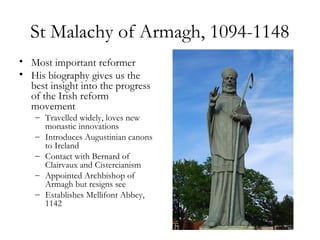
St Malachy of Armagh, 1094-1148
• Most important reformer
• His biography gives us the
  best insight into the progress
  of the Irish reform
  movement
   – Travelled widely, loves new
     monastic innovations
   – Introduces Augustinian canons
     to Ireland
   – Contact with Bernard of
     Clairvaux and Cistercianism
   – Appointed Archbishop of
     Armagh but resigns see
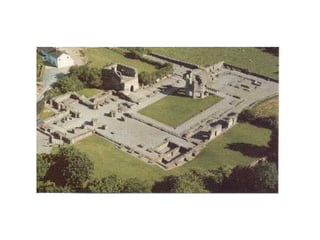
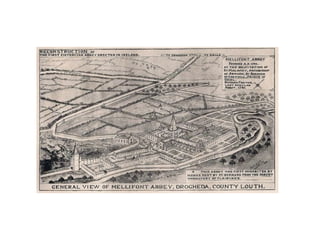
   – Establishes Mellifont Abbey,
     1142
• Most importantly, Malachy laboured to establish an
  island-wide territorial diocesan structure
• Dies in Clairvaux, 1148, on way to petition Pope
• Pope sends lawyer John Paparo to address Irish
  Concerns

• Synod of Kells-Mellifont, 1152
   –   Old Norse diocese incorporated
   –   Break with Canterbury
   –   See of Patrick at Armagh established as Arch-diocese
   –   4 ecclesial provinces, 38 dioceses – structure exists to this day
• Reform executed by passionate men like St Laurence
  O’Toole, Bishop of Dublin 1162-1180
• Old problems persisted
• Yet: REFORM WAS HAPPENING!!
III. NORMAN CONQUEST &
              COLONY
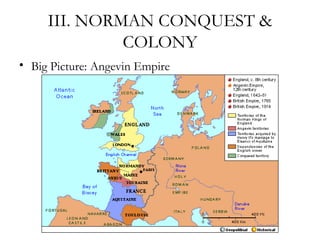
• Big Picture: Angevin Empire
Papal Bull Laudabiliter, 1155
Adrian, Bishop, servant of the servants of God, to his dearest son in Christ, the illustrious
   King of the English, greeting and apostolical benediction.
Your Majesty quite laudably and profitably considers how to extend the glory of your name
   on earth and increase the reward of eternal happiness in Heaven, when, as a Catholic
   Prince, you propose to extend the limits of the Church, to announce the truth of the
   Christian faith to ignorant and barbarous nations, and to root out the weeds of vice
   from the field of the Lord ; and the more effectually to accomplish this you implore the
   counsel and favour of the Apostolic See. In which matter we are confident that the
   higher your aim, and the greater the discretion with which you proceed, the happier,
   with God's help, will be your success; because those things that originate in the ardour
   of faith and the love of religion are always wont to arrive at a good issue and end.
Certainly Hibernia and all the islands upon which Christ the Sun of Justice has shone, and
   which have accepted the doctrines of the Christian faith, of right belong, as your
   Highness doth acknowledge, to blessed Peter and the Holy Roman Church. Wherefore
   we the more willingly sow in them a faithful plantation and a seed pleasing to God, in
   as much as we know by internal examination that it will be strictly required of us. You
   have signified to us, dearest son in Christ, that you desire to enter the island of
   Hibernia to subject that people to laws, and to root out there from the weeds of vice;
   also that you desire to pay from every house an annual pension ,of one penny to
   blessed Peter, and to preserve ,the rights of the churches of that land inviolate and
   whole.
Norman Invasion, 1067-72
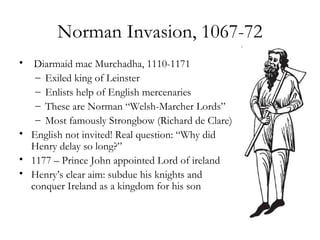
•  Diarmaid mac Murchadha, 1110-1171
   – Exiled king of Leinster
   – Enlists help of English mercenaries
   – These are Norman “Welsh-Marcher Lords”
   – Most famously Strongbow (Richard de Clare)
• English not invited! Real question: “Why did
  Henry delay so long?”
• 1177 – Prince John appointed Lord of ireland
• Henry’s clear aim: subdue his knights and
  conquer Ireland as a kingdom for his son
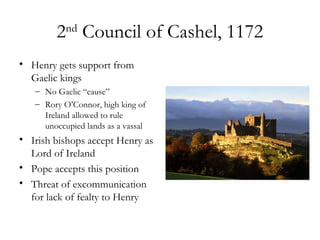
2 Council of Cashel, 1172
           nd


• Henry gets support from
  Gaelic kings
   – No Gaelic “cause”
   – Rory O’Connor, high king of
     Ireland allowed to rule
     unoccupied lands as a vassal
• Irish bishops accept Henry as
  Lord of Ireland
• Pope accepts this position
• Threat of excommunication
  for lack of fealty to Henry
English Colonisation in the 13th Century
• People
   – Not just rulers, 10s of thousands of emigrants from all classes
   – Leading aristocracy, the “Earls”
   – Replication of Norman feudal society on Irish soil
• Infrastructure
   – Market networks, walled towns, castles, village networks, modern farming
     methods, sea ports
   – “shiring” (32 counties)
• Law and Customs
   – “All the laws and customs which are observed in the realm of England
     should be observed in Ireland”
   – Parliament
   – Dublin Castle established by King John in 1204 as seat of English power
   – Not independent, dependent on England crown
   – A little England on Irish soil
English Colonisation in the 13th Century
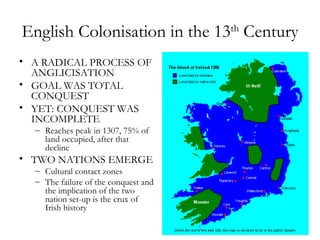
• A RADICAL PROCESS OF
  ANGLICISATION
• GOAL WAS TOTAL
  CONQUEST
• YET: CONQUEST WAS
  INCOMPLETE
  – Reaches peak in 1307, 75% of
    land occupied, after that
    decline
• TWO NATIONS EMERGE
  – Cultural contact zones
  – The failure of the conquest and
    the implication of the two
    nation set-up is the crux of
    Irish history
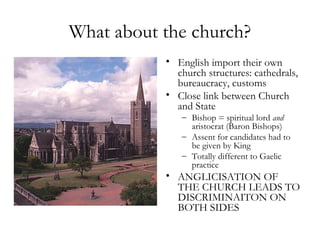
What about the church?
           • English import their own
             church structures: cathedrals,
             bureaucracy, customs
           • Close link between Church
             and State
              – Bishop = spiritual lord and
                aristocrat (Baron Bishops)
              – Assent for candidates had to
                be given by King
              – Totally different to Gaelic
                practice
           • ANGLICISATION OF
             THE CHURCH LEADS TO
             DISCRIMINAITON ON
             BOTH SIDES
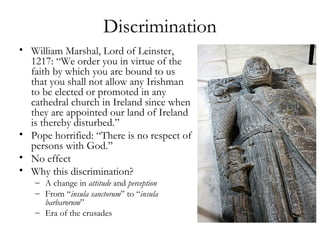
Discrimination
• William Marshal, Lord of Leinster,
  1217: “We order you in virtue of the
  faith by which you are bound to us
  that you shall not allow any Irishman
  to be elected or promoted in any
  cathedral church in Ireland since when
  they are appointed our land of Ireland
  is thereby disturbed.”
• Pope horrified: “There is no respect of
  persons with God.”
• No effect
• Why this discrimination?
   – A change in attitude and perception
   – From “insula sanctorum” to “insula
     barbarorum”
   – Era of the crusades
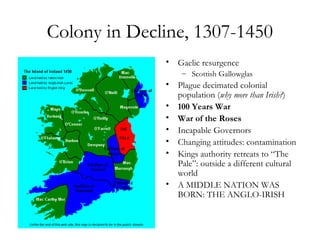
Colony in Decline, 1307-1450
              • Gaelic resurgence
                  – Scottish Gallowglas
              • Plague decimated colonial
                population (why more than Irish?)
              • 100 Years War
              • War of the Roses
              • Incapable Governors
              • Changing attitudes: contamination
              • Kings authority retreats to “The
                Pale”: outside a different cultural
                world
              • A MIDDLE NATION WAS
                BORN: THE ANGLO-IRISH
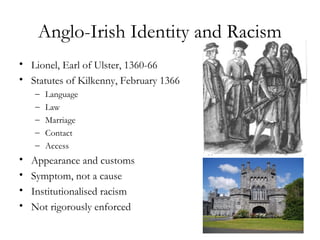
Anglo-Irish Identity and Racism
• Lionel, Earl of Ulster, 1360-66
• Statutes of Kilkenny, February 1366
    –   Language
    –   Law
    –   Marriage
    –   Contact
    –   Access
•   Appearance and customs
•   Symptom, not a cause
•   Institutionalised racism
•   Not rigorously enforced
IV. THE MENDICANT ORDER
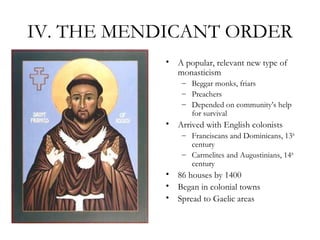
            • A popular, relevant new type of
              monasticism
                – Beggar monks, friars
                – Preachers
                – Depended on community’s help
                  for survival
            • Arrived with English colonists
                – Franciscans and Dominicans, 13th
                  century
                – Carmelites and Augustinians, 14th
                  century
            • 86 houses by 1400
            • Began in colonial towns
            • Spread to Gaelic areas
• Initially transcended cultural divide
• Racism crept in
   – 1291, 16 Franciscan friars killed in brawl
   – John Clyn: “each one took the side of their own nation”
   – Leaders in Rome outraged
   – General chapter meeting in Dublin 1324, discipline and new
     laws to address situation
   – Not adhered to
• Mendicants fell prey to the insipient suspicion,
  prejudice and racism that marred Medieval Ireland
• BUT: rejuvenation in 15th century
   – The “Observant Movement”
   – Over 90 new houses of friars built
   – Hospitable relations were established between Gaelic and
     Anglo-Irish
   – Strong link to Continent
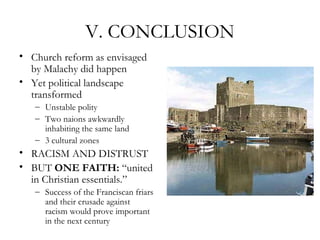
V. CONCLUSION
• Church reform as envisaged
  by Malachy did happen
• Yet political landscape
  transformed
   – Unstable polity
   – Two naions awkwardly
     inhabiting the same land
   – 3 cultural zones
• RACISM AND DISTRUST
• BUT ONE FAITH: “united
  in Christian essentials.”
   – Success of the Franciscan friars
     and their crusade against
     racism would prove important
     in the next century
Recommended Reading
• Art Cosgrove (ed.), A New History of Ireland. vol ii, Medieval Ireland,
  1169-1534. Oxford: University Press, 1987
• Robert Bartlett, The Making of Europe: Conquest, Colonisation and
  Cultural Change, 950-1350. London: Penguin, 1993
• John A. Watt, The Church in Medieval Ireland. Dublin: Gill &
  Macmillan, 1972
• Aubrey Gwynn, The Irish Church in the Eleventh and Twelth Centuries.
  Dublin: Four Courts Press, 1992
• Jocelyn Otway-Ruthven, A History of Medieval Ireland. London and
  New York, 1980
• Kenneth Nicholls, Gaelic and Gaelicised Ireland in the Middle Ages.
  Dublin, 1972

Medieval Ireland

  • 1.
    Christianity and identity inIreland Medieval Ireland 795-1450
  • 2.
    The Irish Churchin the 8 Century th • Insular • Secularised • Still predominantly monastic • Bishops more important • Golden age ends with first Viking raid of Rathlin, 795
  • 3.
    I. VIKINGS • Whatpictures come into your mind when you think of Vikings? • Partial truth… – yes, 100s of raids – but accounts biased – Ireland figured as part of a wider empire built on trade and slaves
  • 5.
    Impact of Vikings •First towns in Ireland – Dublin – Waterford – Wexford – Cork – Limerick • Slave trade • Markets • Bases to launch large scale attack on the 4 Anglo-Saxon Kingdoms of England
  • 6.
    Viking Legacy? • Here for 300 years • Established first towns and markets • Established first permanent territorial dioceses • Irish were just as vicious, – sacking of Clonmacnois, 833 • In another story they are raiders that came for a while and were defeated and succumb to the allure of “Irishness” – but the evidence does not support this
  • 7.
    Irish Church in9 10 Centuries th- th • Some Spiritual vibrancy in the old ways – Céli Dé of Tallaght, Finglas and Armagh • Fresh wave of Peregrinatio – Eriugena and Carolingian Empire – Irish/Scottish monks and Ottonian Rennaissance • Schöttenkloster – Benedictine, not old Irish rules • Pilgrimage of Gaelic and Norse kings to Rome • Stopped in 1060s, why? Scotts Monastery, Regensburg, Bavaria
  • 8.
    II. IRISH CHURCHREFORM • Irish Church in need of reform • Gregorian reform happening on Continent – Papal authority – Norm of canon law – Clerical celibacy – State/church relationship revised
  • 9.
    II. IRISH CHURCHREFORM • Irish make contact with Canterbury – Lanfranc 1070-1089 – St Anselm 1093-1109 – 6 Irish Bishops consecrated – 4 Dublin, 1 Waterford and 1 Limerick, what do you notice? • Their letters identify problems – Simony – Misadministration of sacraments – Poorly educated clergy – Defective law of marriage (Anselm: “it is reported that men exchange their wives as freely and publicly as a man might change his horse”) – Too many bishops, poor in quality (tribal pawns, not educated) • Councils of Cashel (1107) and Rathbreasil (1112) – Attended by lay rulers, bishops, abbots, Papal Legates – discuss same issues but at the top of the agenda establishment of territorial dioceses structure
  • 10.
    St Malachy ofArmagh, 1094-1148 • Most important reformer • His biography gives us the best insight into the progress of the Irish reform movement – Travelled widely, loves new monastic innovations – Introduces Augustinian canons to Ireland – Contact with Bernard of Clairvaux and Cistercianism – Appointed Archbishop of Armagh but resigns see – Establishes Mellifont Abbey, 1142
  • 13.
    • Most importantly,Malachy laboured to establish an island-wide territorial diocesan structure • Dies in Clairvaux, 1148, on way to petition Pope • Pope sends lawyer John Paparo to address Irish Concerns • Synod of Kells-Mellifont, 1152 – Old Norse diocese incorporated – Break with Canterbury – See of Patrick at Armagh established as Arch-diocese – 4 ecclesial provinces, 38 dioceses – structure exists to this day • Reform executed by passionate men like St Laurence O’Toole, Bishop of Dublin 1162-1180 • Old problems persisted • Yet: REFORM WAS HAPPENING!!
  • 14.
    III. NORMAN CONQUEST& COLONY • Big Picture: Angevin Empire
  • 15.
    Papal Bull Laudabiliter,1155 Adrian, Bishop, servant of the servants of God, to his dearest son in Christ, the illustrious King of the English, greeting and apostolical benediction. Your Majesty quite laudably and profitably considers how to extend the glory of your name on earth and increase the reward of eternal happiness in Heaven, when, as a Catholic Prince, you propose to extend the limits of the Church, to announce the truth of the Christian faith to ignorant and barbarous nations, and to root out the weeds of vice from the field of the Lord ; and the more effectually to accomplish this you implore the counsel and favour of the Apostolic See. In which matter we are confident that the higher your aim, and the greater the discretion with which you proceed, the happier, with God's help, will be your success; because those things that originate in the ardour of faith and the love of religion are always wont to arrive at a good issue and end. Certainly Hibernia and all the islands upon which Christ the Sun of Justice has shone, and which have accepted the doctrines of the Christian faith, of right belong, as your Highness doth acknowledge, to blessed Peter and the Holy Roman Church. Wherefore we the more willingly sow in them a faithful plantation and a seed pleasing to God, in as much as we know by internal examination that it will be strictly required of us. You have signified to us, dearest son in Christ, that you desire to enter the island of Hibernia to subject that people to laws, and to root out there from the weeds of vice; also that you desire to pay from every house an annual pension ,of one penny to blessed Peter, and to preserve ,the rights of the churches of that land inviolate and whole.
  • 16.
    Norman Invasion, 1067-72 • Diarmaid mac Murchadha, 1110-1171 – Exiled king of Leinster – Enlists help of English mercenaries – These are Norman “Welsh-Marcher Lords” – Most famously Strongbow (Richard de Clare) • English not invited! Real question: “Why did Henry delay so long?” • 1177 – Prince John appointed Lord of ireland • Henry’s clear aim: subdue his knights and conquer Ireland as a kingdom for his son
  • 17.
    2 Council ofCashel, 1172 nd • Henry gets support from Gaelic kings – No Gaelic “cause” – Rory O’Connor, high king of Ireland allowed to rule unoccupied lands as a vassal • Irish bishops accept Henry as Lord of Ireland • Pope accepts this position • Threat of excommunication for lack of fealty to Henry
  • 18.
    English Colonisation inthe 13th Century • People – Not just rulers, 10s of thousands of emigrants from all classes – Leading aristocracy, the “Earls” – Replication of Norman feudal society on Irish soil • Infrastructure – Market networks, walled towns, castles, village networks, modern farming methods, sea ports – “shiring” (32 counties) • Law and Customs – “All the laws and customs which are observed in the realm of England should be observed in Ireland” – Parliament – Dublin Castle established by King John in 1204 as seat of English power – Not independent, dependent on England crown – A little England on Irish soil
  • 19.
    English Colonisation inthe 13th Century • A RADICAL PROCESS OF ANGLICISATION • GOAL WAS TOTAL CONQUEST • YET: CONQUEST WAS INCOMPLETE – Reaches peak in 1307, 75% of land occupied, after that decline • TWO NATIONS EMERGE – Cultural contact zones – The failure of the conquest and the implication of the two nation set-up is the crux of Irish history
  • 20.
    What about thechurch? • English import their own church structures: cathedrals, bureaucracy, customs • Close link between Church and State – Bishop = spiritual lord and aristocrat (Baron Bishops) – Assent for candidates had to be given by King – Totally different to Gaelic practice • ANGLICISATION OF THE CHURCH LEADS TO DISCRIMINAITON ON BOTH SIDES
  • 21.
    Discrimination • William Marshal,Lord of Leinster, 1217: “We order you in virtue of the faith by which you are bound to us that you shall not allow any Irishman to be elected or promoted in any cathedral church in Ireland since when they are appointed our land of Ireland is thereby disturbed.” • Pope horrified: “There is no respect of persons with God.” • No effect • Why this discrimination? – A change in attitude and perception – From “insula sanctorum” to “insula barbarorum” – Era of the crusades
  • 22.
    Colony in Decline,1307-1450 • Gaelic resurgence – Scottish Gallowglas • Plague decimated colonial population (why more than Irish?) • 100 Years War • War of the Roses • Incapable Governors • Changing attitudes: contamination • Kings authority retreats to “The Pale”: outside a different cultural world • A MIDDLE NATION WAS BORN: THE ANGLO-IRISH
  • 23.
    Anglo-Irish Identity andRacism • Lionel, Earl of Ulster, 1360-66 • Statutes of Kilkenny, February 1366 – Language – Law – Marriage – Contact – Access • Appearance and customs • Symptom, not a cause • Institutionalised racism • Not rigorously enforced
  • 24.
    IV. THE MENDICANTORDER • A popular, relevant new type of monasticism – Beggar monks, friars – Preachers – Depended on community’s help for survival • Arrived with English colonists – Franciscans and Dominicans, 13th century – Carmelites and Augustinians, 14th century • 86 houses by 1400 • Began in colonial towns • Spread to Gaelic areas
  • 25.
    • Initially transcendedcultural divide • Racism crept in – 1291, 16 Franciscan friars killed in brawl – John Clyn: “each one took the side of their own nation” – Leaders in Rome outraged – General chapter meeting in Dublin 1324, discipline and new laws to address situation – Not adhered to • Mendicants fell prey to the insipient suspicion, prejudice and racism that marred Medieval Ireland • BUT: rejuvenation in 15th century – The “Observant Movement” – Over 90 new houses of friars built – Hospitable relations were established between Gaelic and Anglo-Irish – Strong link to Continent
  • 26.
    V. CONCLUSION • Churchreform as envisaged by Malachy did happen • Yet political landscape transformed – Unstable polity – Two naions awkwardly inhabiting the same land – 3 cultural zones • RACISM AND DISTRUST • BUT ONE FAITH: “united in Christian essentials.” – Success of the Franciscan friars and their crusade against racism would prove important in the next century
  • 27.
    Recommended Reading • ArtCosgrove (ed.), A New History of Ireland. vol ii, Medieval Ireland, 1169-1534. Oxford: University Press, 1987 • Robert Bartlett, The Making of Europe: Conquest, Colonisation and Cultural Change, 950-1350. London: Penguin, 1993 • John A. Watt, The Church in Medieval Ireland. Dublin: Gill & Macmillan, 1972 • Aubrey Gwynn, The Irish Church in the Eleventh and Twelth Centuries. Dublin: Four Courts Press, 1992 • Jocelyn Otway-Ruthven, A History of Medieval Ireland. London and New York, 1980 • Kenneth Nicholls, Gaelic and Gaelicised Ireland in the Middle Ages. Dublin, 1972