Lindsey Richards & Jordan Musser
• 596: Missionaries arrived in England and tried
 to convert the Anglo-Saxons to Christianity.
• 650: Most of England claims to be
 Christian, but many hold on to their pagan
 beliefs.
• The church affected every part of life.
• The church leaders were involved in politics through
  which they gained immense power over the people.
• The church imposed „taxes‟ or tithes on its members.
  • Because the church was under the power and law of God, its members
    followed its laws closely. Breaking a law could result in punishment or
    expulsion from the church.
  • Tithes were usually paid with goods instead of money, and they were
    used to fund the church and give to the poor.
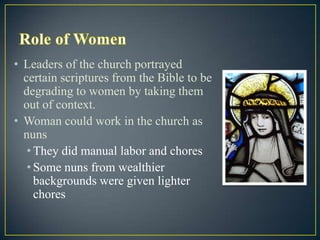
• Leaders of the church portrayed
  certain scriptures from the Bible to be
  degrading to women by taking them
  out of context.
• Woman could work in the church as
  nuns
   • They did manual labor and chores
   • Some nuns from wealthier
     backgrounds were given lighter
     chores
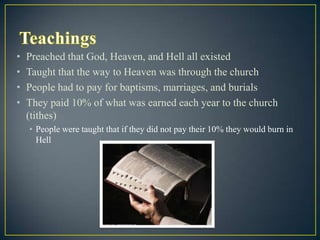
•   Preached that God, Heaven, and Hell all existed
•   Taught that the way to Heaven was through the church
•   People had to pay for baptisms, marriages, and burials
•   They paid 10% of what was earned each year to the church
    (tithes)
    • People were taught that if they did not pay their 10% they would burn in
      Hell
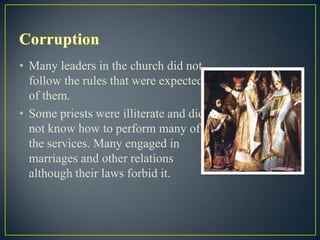
• Many leaders in the church did not
  follow the rules that were expected
  of them.
• Some priests were illiterate and did
  not know how to perform many of
  the services. Many engaged in
  marriages and other relations
  although their laws forbid it.
• One major conflict between the church and the government
  (1162):
  • King Henry II attempted to impose royal laws over the church. Thomas á
    Becket, archbishop of Canterbury, opposed these laws and was enraged
    that the king was forcing them upon him and the church. Some of his
    words or rage were taken literally, and he was murdered by four of the
    kings knights. He was murdered while praying in Canterbury Cathedral.
    The shocked community built a shrine in the church, to which many
    Roman Catholics were encouraged to make a pilgrimage.
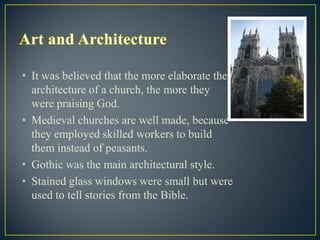
• It was believed that the more elaborate the
  architecture of a church, the more they
  were praising God.
• Medieval churches are well made, because
  they employed skilled workers to build
  them instead of peasants.
• Gothic was the main architectural style.
• Stained glass windows were small but were
  used to tell stories from the Bible.
• “The Church in Midieval Life.” http://library.thinkquest.org. Oracle
  Education Foundation, n.d. Web. 3 Nov. 2011.
  <http://library.thinkquest.org/10949/fief/lochurch.html>.
• Literature. Columbus, Ohio: Glencoe, 2004. Print. 3 Nov. 2011.
• “The Medieval Church.” http://www.historylearningsite.co.uk.
  N.p., 2011. Web. 3 Nov. 2011.
  <http://www.historylearningsite.co.uk/medieval_church.htm>.
• “Middle Ages Religion.” http://www.middle-ages.org.uk. N.p., n.d.
  Web. 2 Nov. 2011. <http://www.middle-ages.org.uk/middle-ages-
  religion.htm>.

The medieval church

  • 1.
    Lindsey Richards &Jordan Musser
  • 2.
    • 596: Missionariesarrived in England and tried to convert the Anglo-Saxons to Christianity. • 650: Most of England claims to be Christian, but many hold on to their pagan beliefs. • The church affected every part of life.
  • 3.
    • The churchleaders were involved in politics through which they gained immense power over the people. • The church imposed „taxes‟ or tithes on its members. • Because the church was under the power and law of God, its members followed its laws closely. Breaking a law could result in punishment or expulsion from the church. • Tithes were usually paid with goods instead of money, and they were used to fund the church and give to the poor.
  • 4.
    • Leaders ofthe church portrayed certain scriptures from the Bible to be degrading to women by taking them out of context. • Woman could work in the church as nuns • They did manual labor and chores • Some nuns from wealthier backgrounds were given lighter chores
  • 5.
    Preached that God, Heaven, and Hell all existed • Taught that the way to Heaven was through the church • People had to pay for baptisms, marriages, and burials • They paid 10% of what was earned each year to the church (tithes) • People were taught that if they did not pay their 10% they would burn in Hell
  • 6.
    • Many leadersin the church did not follow the rules that were expected of them. • Some priests were illiterate and did not know how to perform many of the services. Many engaged in marriages and other relations although their laws forbid it.
  • 7.
    • One majorconflict between the church and the government (1162): • King Henry II attempted to impose royal laws over the church. Thomas á Becket, archbishop of Canterbury, opposed these laws and was enraged that the king was forcing them upon him and the church. Some of his words or rage were taken literally, and he was murdered by four of the kings knights. He was murdered while praying in Canterbury Cathedral. The shocked community built a shrine in the church, to which many Roman Catholics were encouraged to make a pilgrimage.
  • 8.
    • It wasbelieved that the more elaborate the architecture of a church, the more they were praising God. • Medieval churches are well made, because they employed skilled workers to build them instead of peasants. • Gothic was the main architectural style. • Stained glass windows were small but were used to tell stories from the Bible.
  • 9.
    • “The Churchin Midieval Life.” http://library.thinkquest.org. Oracle Education Foundation, n.d. Web. 3 Nov. 2011. <http://library.thinkquest.org/10949/fief/lochurch.html>. • Literature. Columbus, Ohio: Glencoe, 2004. Print. 3 Nov. 2011. • “The Medieval Church.” http://www.historylearningsite.co.uk. N.p., 2011. Web. 3 Nov. 2011. <http://www.historylearningsite.co.uk/medieval_church.htm>. • “Middle Ages Religion.” http://www.middle-ages.org.uk. N.p., n.d. Web. 2 Nov. 2011. <http://www.middle-ages.org.uk/middle-ages- religion.htm>.