Medication Adherence – How Pharmacies Can
Affect Change Through Gamification
Medication Non-Adherence Overview
2
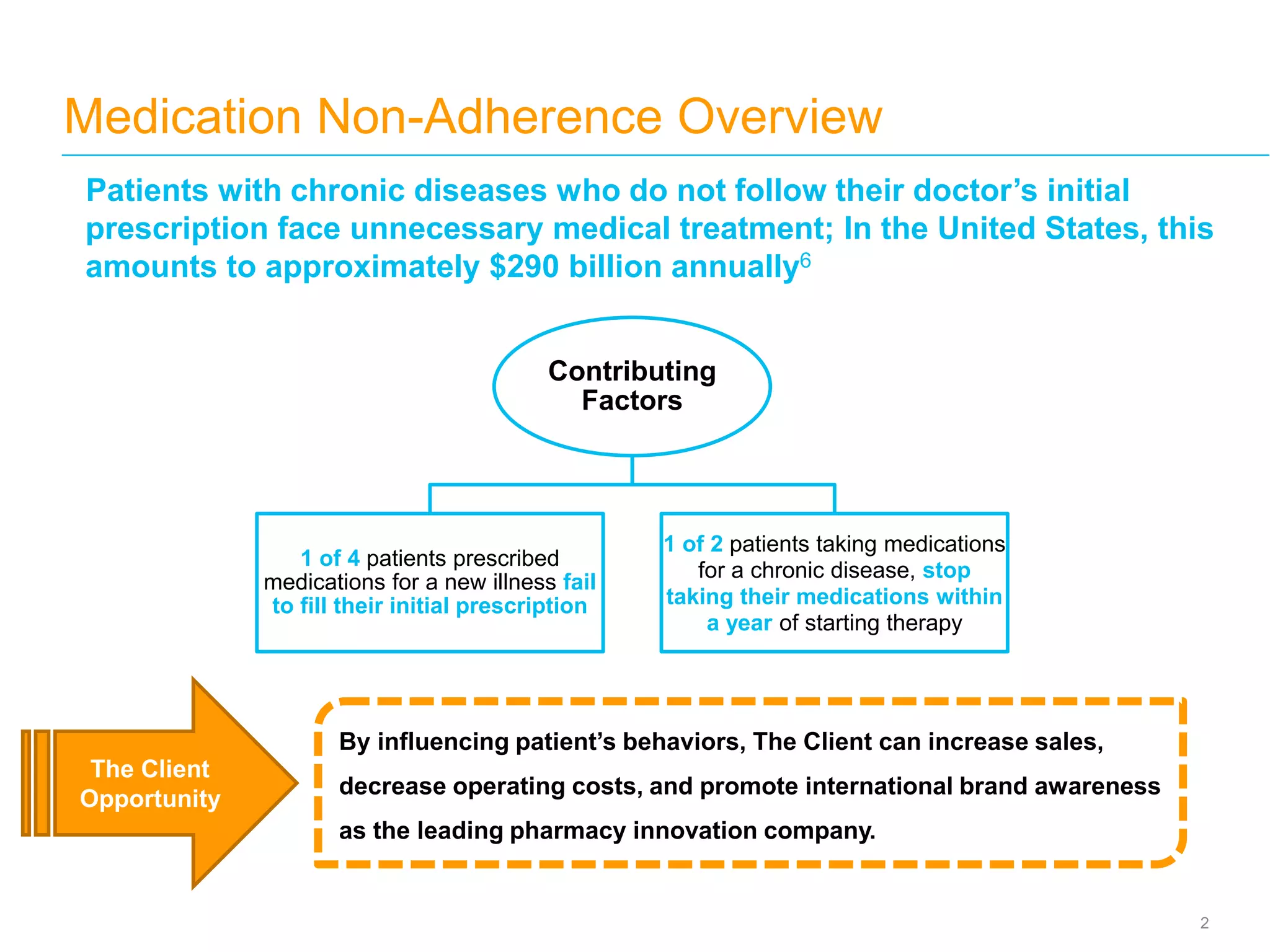
Patients with chronic diseases who do not follow their doctor’s initial
prescription face unnecessary medical treatment; In the United States, this
amounts to approximately $290 billion annually6
By influencing patient’s behaviors, The Client can increase sales,
decrease operating costs, and promote international brand awareness
as the leading pharmacy innovation company.
The Client
Opportunity
Contributing
Factors
1 of 4 patients prescribed
medications for a new illness fail
to fill their initial prescription
1 of 2 patients taking medications
for a chronic disease, stop
taking their medications within
a year of starting therapy
The Client – Adherence Program Current State
3
Cost effectiveness
Ineffective for non-
adherent members
Loss of potential
revenue
Top Issues with The Client’s current approach:
• High cost high touch
• Costly research which is
quickly outdated and
program changes are slow
to market
• Loss of prescription and
retails sales
• Current approach for
program expansion is not
self perpetuating
• Reactive approach
• One dimensional method for
customer engagement
• User experience is not
customized to the member
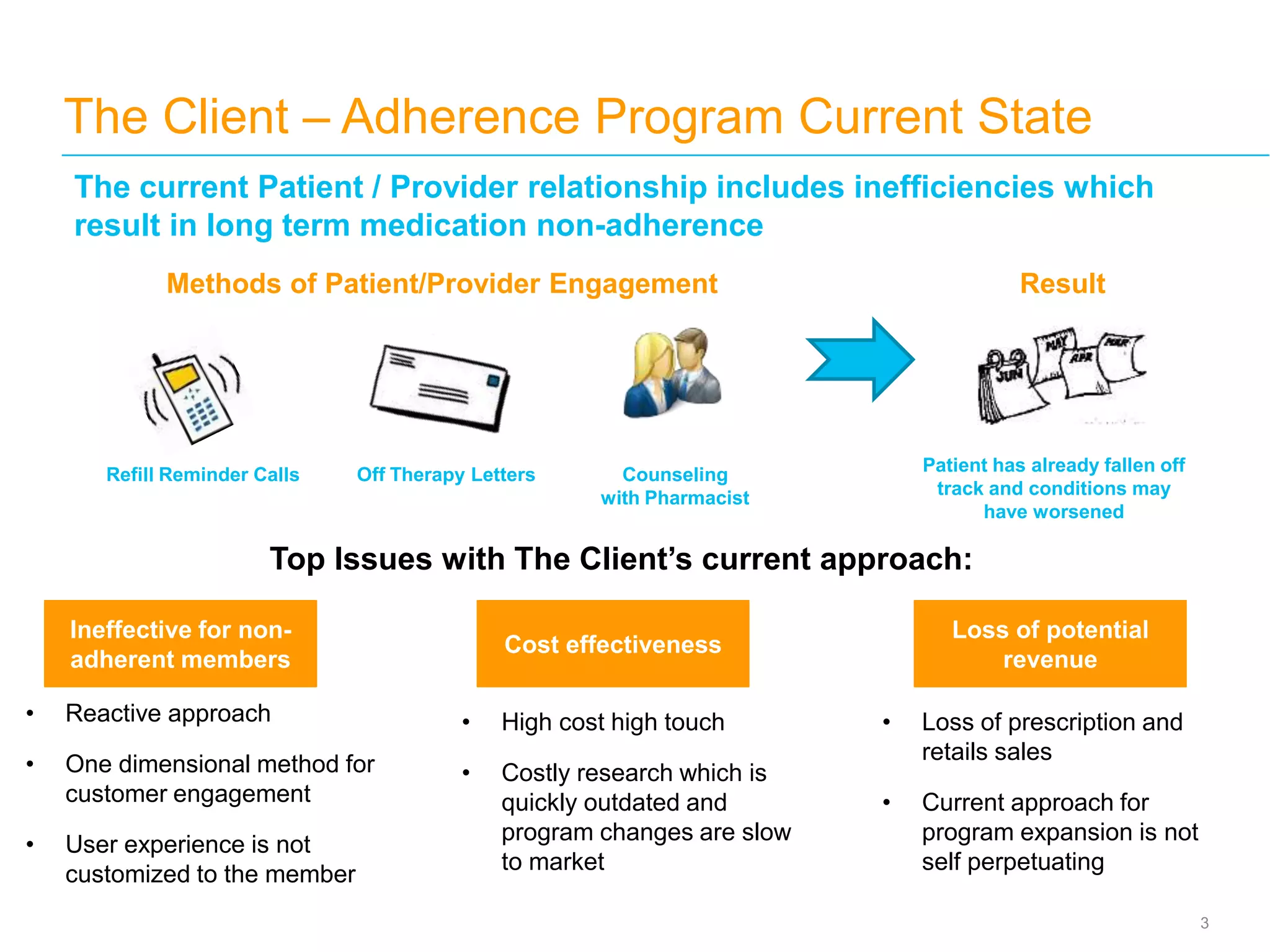
The current Patient / Provider relationship includes inefficiencies which
result in long term medication non-adherence
Refill Reminder Calls Off Therapy Letters Counseling
with Pharmacist
Patient has already fallen off
track and conditions may
have worsened
Methods of Patient/Provider Engagement Result
4
The Client – Adherence Research
Off-Therapy
Adherent
3.75% 19.2%Vs.
Impact of The Client Program on
Adherence
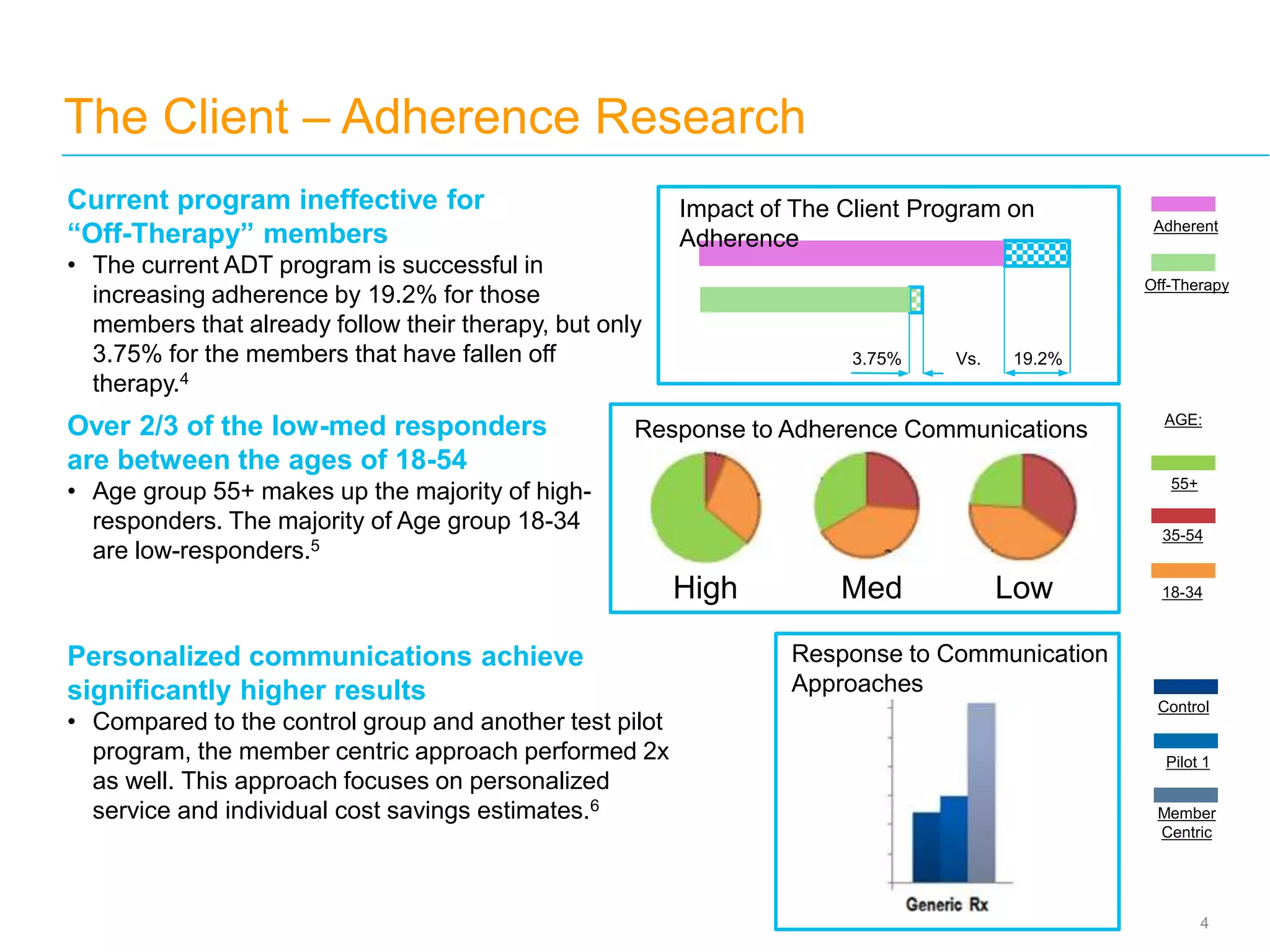
Current program ineffective for
“Off-Therapy” members
• The current ADT program is successful in
increasing adherence by 19.2% for those
members that already follow their therapy, but only
3.75% for the members that have fallen off
therapy.4
High Med Low
Response to Adherence Communications
AGE:
35-54
18-34
55+
Control
Pilot 1
Member
Centric
Response to Communication
Approaches
Over 2/3 of the low-med responders
are between the ages of 18-54
• Age group 55+ makes up the majority of high-
responders. The majority of Age group 18-34
are low-responders.5
Personalized communications achieve
significantly higher results
• Compared to the control group and another test pilot
program, the member centric approach performed 2x
as well. This approach focuses on personalized
service and individual cost savings estimates.6
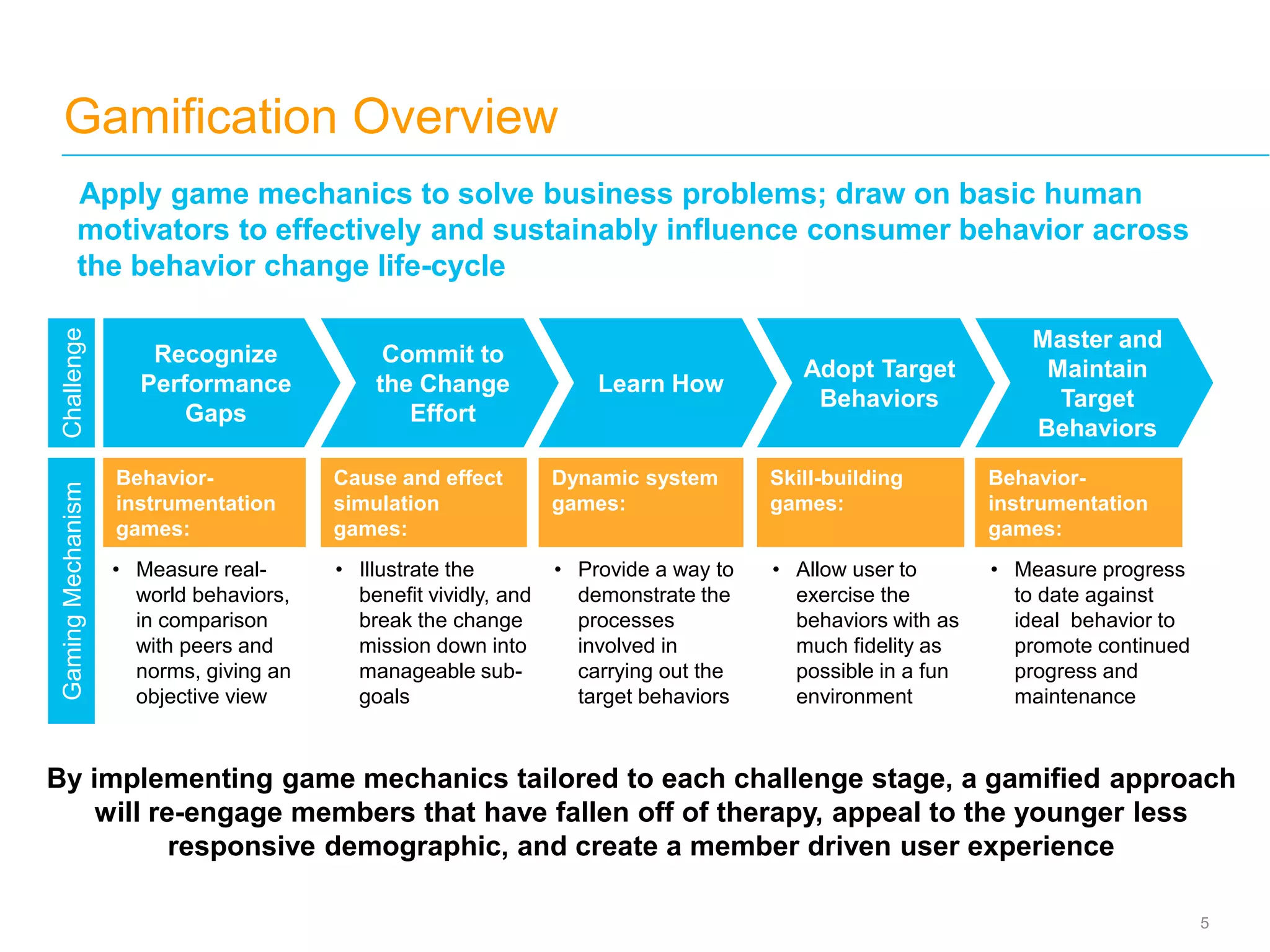
Gamification Overview
5
Commit to
the Change
Effort
Learn How
Adopt Target
Behaviors
Master and
Maintain
Target
Behaviors
Recognize
Performance
Gaps
Apply game mechanics to solve business problems; draw on basic human
motivators to effectively and sustainably influence consumer behavior across
the behavior change life-cycle
GamingMechanism
Behavior-
instrumentation
games:
Cause and effect
simulation
games:
Dynamic system
games:
Skill-building
games:
Behavior-
instrumentation
games:
• Measure real-
world behaviors,
in comparison
with peers and
norms, giving an
objective view
• Illustrate the
benefit vividly, and
break the change
mission down into
manageable sub-
goals
• Provide a way to
demonstrate the
processes
involved in
carrying out the
target behaviors
• Allow user to
exercise the
behaviors with as
much fidelity as
possible in a fun
environment
• Measure progress
to date against
ideal behavior to
promote continued
progress and
maintenance
Challenge
By implementing game mechanics tailored to each challenge stage, a gamified approach
will re-engage members that have fallen off of therapy, appeal to the younger less
responsive demographic, and create a member driven user experience
Rewards
Recognition
Feedback
Teamwork
Competition
. 80%
872
Recommended for
You:
Recent
Accomplishments:
Suggestions to
Improve Your
Health:
Notifications/
Feedback:
Adherence
Allstar
You’ve achieved
a level 4 prize!
New message
from your buddy
Top 5%
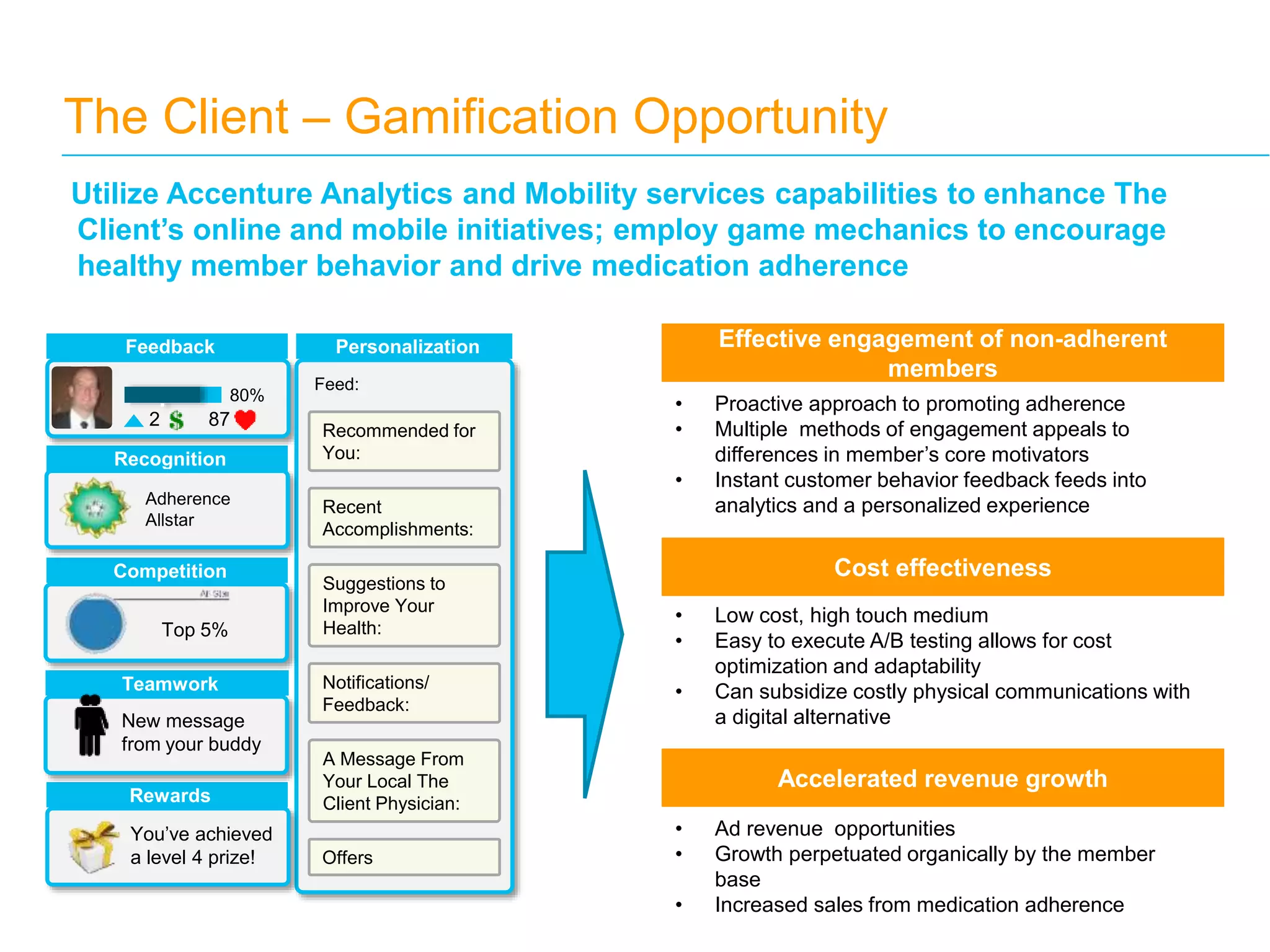
The Client – Gamification Opportunity
Utilize Accenture Analytics and Mobility services capabilities to enhance The
Client’s online and mobile initiatives; employ game mechanics to encourage
healthy member behavior and drive medication adherence
A Message From
Your Local The
Client Physician:
Personalization Effective engagement of non-adherent
members
Cost effectiveness
Accelerated revenue growth
• Proactive approach to promoting adherence
• Multiple methods of engagement appeals to
differences in member’s core motivators
• Instant customer behavior feedback feeds into
analytics and a personalized experience
• Low cost, high touch medium
• Easy to execute A/B testing allows for cost
optimization and adaptability
• Can subsidize costly physical communications with
a digital alternative
• Ad revenue opportunities
• Growth perpetuated organically by the member
base
• Increased sales from medication adherence
Offers
Feed:
Design Build Test Pilot Implement Monitor and
Improve
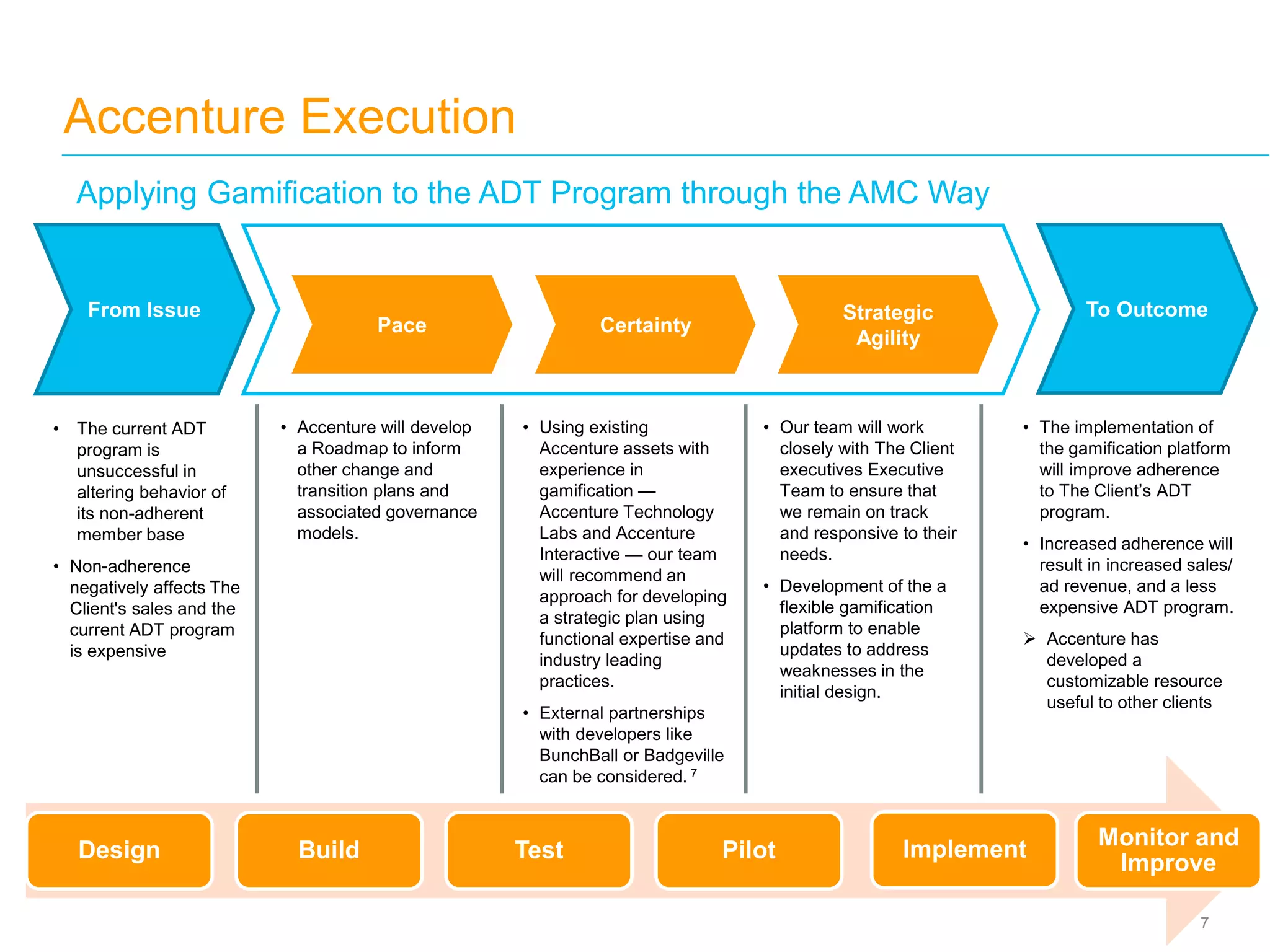
Accenture Execution
7
Applying Gamification to the ADT Program through the AMC Way
• The current ADT
program is
unsuccessful in
altering behavior of
its non-adherent
member base
• Non-adherence
negatively affects The
Client's sales and the
current ADT program
is expensive
• The implementation of
the gamification platform
will improve adherence
to The Client’s ADT
program.
• Increased adherence will
result in increased sales/
ad revenue, and a less
expensive ADT program.
 Accenture has
developed a
customizable resource
useful to other clients
To OutcomeFrom Issue
Pace Certainty
Strategic
Agility
• Accenture will develop
a Roadmap to inform
other change and
transition plans and
associated governance
models.
• Our team will work
closely with The Client
executives Executive
Team to ensure that
we remain on track
and responsive to their
needs.
• Development of the a
flexible gamification
platform to enable
updates to address
weaknesses in the
initial design.
• Using existing
Accenture assets with
experience in
gamification —
Accenture Technology
Labs and Accenture
Interactive — our team
will recommend an
approach for developing
a strategic plan using
functional expertise and
industry leading
practices.
• External partnerships
with developers like
BunchBall or Badgeville
can be considered. 7
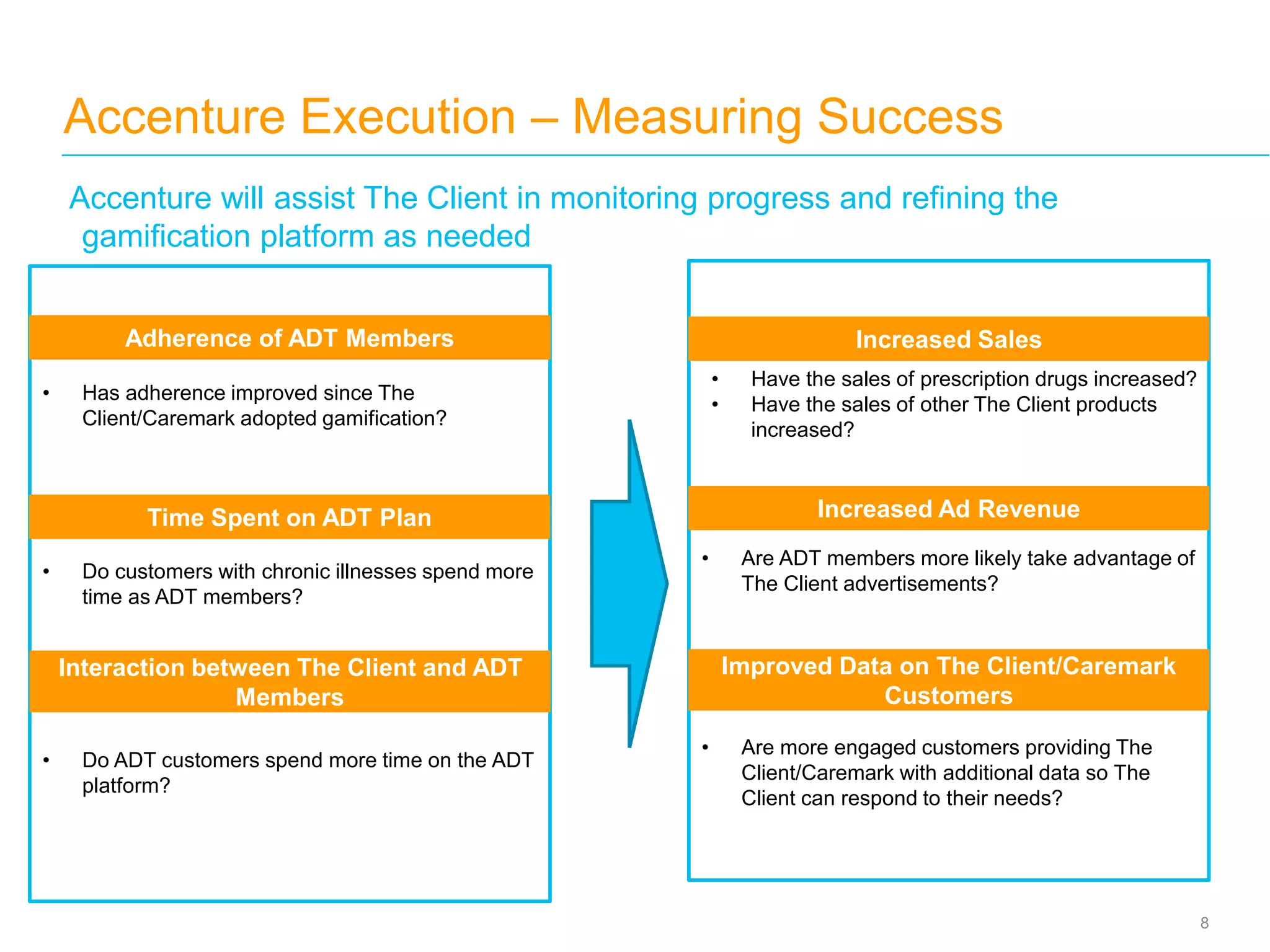
Accenture Execution – Measuring Success
8
Accenture will assist The Client in monitoring progress and refining the
gamification platform as needed
Increased Sales
Improved Adherence
of ADT Members
• Has adherence improved since The
Client/Caremark adopted gamification?
Adherence of ADT Members
Increased Ad Revenue
• Have the sales of prescription drugs increased?
• Have the sales of other The Client products
increased?
• Are ADT members more likely take advantage of
The Client advertisements?
Time Spent on ADT Plan
Interaction between The Client and ADT
Members
Improved Data on The Client/Caremark
Customers
• Do customers with chronic illnesses spend more
time as ADT members?
• Do ADT customers spend more time on the ADT
platform?
• Are more engaged customers providing The
Client/Caremark with additional data so The
Client can respond to their needs?

Medication Adherence via Gamification

  • 1.
    Medication Adherence –How Pharmacies Can Affect Change Through Gamification
  • 2.
    Medication Non-Adherence Overview 2 Patientswith chronic diseases who do not follow their doctor’s initial prescription face unnecessary medical treatment; In the United States, this amounts to approximately $290 billion annually6 By influencing patient’s behaviors, The Client can increase sales, decrease operating costs, and promote international brand awareness as the leading pharmacy innovation company. The Client Opportunity Contributing Factors 1 of 4 patients prescribed medications for a new illness fail to fill their initial prescription 1 of 2 patients taking medications for a chronic disease, stop taking their medications within a year of starting therapy
  • 3.
    The Client –Adherence Program Current State 3 Cost effectiveness Ineffective for non- adherent members Loss of potential revenue Top Issues with The Client’s current approach: • High cost high touch • Costly research which is quickly outdated and program changes are slow to market • Loss of prescription and retails sales • Current approach for program expansion is not self perpetuating • Reactive approach • One dimensional method for customer engagement • User experience is not customized to the member The current Patient / Provider relationship includes inefficiencies which result in long term medication non-adherence Refill Reminder Calls Off Therapy Letters Counseling with Pharmacist Patient has already fallen off track and conditions may have worsened Methods of Patient/Provider Engagement Result
  • 4.
    4 The Client –Adherence Research Off-Therapy Adherent 3.75% 19.2%Vs. Impact of The Client Program on Adherence Current program ineffective for “Off-Therapy” members • The current ADT program is successful in increasing adherence by 19.2% for those members that already follow their therapy, but only 3.75% for the members that have fallen off therapy.4 High Med Low Response to Adherence Communications AGE: 35-54 18-34 55+ Control Pilot 1 Member Centric Response to Communication Approaches Over 2/3 of the low-med responders are between the ages of 18-54 • Age group 55+ makes up the majority of high- responders. The majority of Age group 18-34 are low-responders.5 Personalized communications achieve significantly higher results • Compared to the control group and another test pilot program, the member centric approach performed 2x as well. This approach focuses on personalized service and individual cost savings estimates.6
  • 5.
    Gamification Overview 5 Commit to theChange Effort Learn How Adopt Target Behaviors Master and Maintain Target Behaviors Recognize Performance Gaps Apply game mechanics to solve business problems; draw on basic human motivators to effectively and sustainably influence consumer behavior across the behavior change life-cycle GamingMechanism Behavior- instrumentation games: Cause and effect simulation games: Dynamic system games: Skill-building games: Behavior- instrumentation games: • Measure real- world behaviors, in comparison with peers and norms, giving an objective view • Illustrate the benefit vividly, and break the change mission down into manageable sub- goals • Provide a way to demonstrate the processes involved in carrying out the target behaviors • Allow user to exercise the behaviors with as much fidelity as possible in a fun environment • Measure progress to date against ideal behavior to promote continued progress and maintenance Challenge By implementing game mechanics tailored to each challenge stage, a gamified approach will re-engage members that have fallen off of therapy, appeal to the younger less responsive demographic, and create a member driven user experience
  • 6.
    Rewards Recognition Feedback Teamwork Competition . 80% 872 Recommended for You: Recent Accomplishments: Suggestionsto Improve Your Health: Notifications/ Feedback: Adherence Allstar You’ve achieved a level 4 prize! New message from your buddy Top 5% The Client – Gamification Opportunity Utilize Accenture Analytics and Mobility services capabilities to enhance The Client’s online and mobile initiatives; employ game mechanics to encourage healthy member behavior and drive medication adherence A Message From Your Local The Client Physician: Personalization Effective engagement of non-adherent members Cost effectiveness Accelerated revenue growth • Proactive approach to promoting adherence • Multiple methods of engagement appeals to differences in member’s core motivators • Instant customer behavior feedback feeds into analytics and a personalized experience • Low cost, high touch medium • Easy to execute A/B testing allows for cost optimization and adaptability • Can subsidize costly physical communications with a digital alternative • Ad revenue opportunities • Growth perpetuated organically by the member base • Increased sales from medication adherence Offers Feed:
  • 7.
    Design Build TestPilot Implement Monitor and Improve Accenture Execution 7 Applying Gamification to the ADT Program through the AMC Way • The current ADT program is unsuccessful in altering behavior of its non-adherent member base • Non-adherence negatively affects The Client's sales and the current ADT program is expensive • The implementation of the gamification platform will improve adherence to The Client’s ADT program. • Increased adherence will result in increased sales/ ad revenue, and a less expensive ADT program.  Accenture has developed a customizable resource useful to other clients To OutcomeFrom Issue Pace Certainty Strategic Agility • Accenture will develop a Roadmap to inform other change and transition plans and associated governance models. • Our team will work closely with The Client executives Executive Team to ensure that we remain on track and responsive to their needs. • Development of the a flexible gamification platform to enable updates to address weaknesses in the initial design. • Using existing Accenture assets with experience in gamification — Accenture Technology Labs and Accenture Interactive — our team will recommend an approach for developing a strategic plan using functional expertise and industry leading practices. • External partnerships with developers like BunchBall or Badgeville can be considered. 7
  • 8.
    Accenture Execution –Measuring Success 8 Accenture will assist The Client in monitoring progress and refining the gamification platform as needed Increased Sales Improved Adherence of ADT Members • Has adherence improved since The Client/Caremark adopted gamification? Adherence of ADT Members Increased Ad Revenue • Have the sales of prescription drugs increased? • Have the sales of other The Client products increased? • Are ADT members more likely take advantage of The Client advertisements? Time Spent on ADT Plan Interaction between The Client and ADT Members Improved Data on The Client/Caremark Customers • Do customers with chronic illnesses spend more time as ADT members? • Do ADT customers spend more time on the ADT platform? • Are more engaged customers providing The Client/Caremark with additional data so The Client can respond to their needs?

Editor's Notes

  • #3 **Image description** (source: Adherence to Medication PDF – by the New England Journal of Medicine – Lars Osterbeg, MD and Terrence Blaschke, MD, published 2005) Poor provider-patient communication Patient lack of knowledge (benefits/risks of treatment for their disease) Patient has poor understanding of the proper use of their meds (physician may prescribe overly complex regimen) Patients interaction with health care system – poor access/missed appointments/high medical costs Physician’s interaction with the health care system – poor knowledge of insurance coverage for different formularies (insurance codes, procedures, coverage, etc); and weak motivators to figure it out bc it is a hassle
  • #4 The Client supports two main initiatives to improve adherence only uses a prodding approach but does not address the scope of all customer motivators. (source: Maximizing Adherence white paper, published 2009 which used The Client Analytic Consulting, 2009 and Centers for Disease Control and Prevention, 2003 data) Ineffective program i. 40-50% = # of non-adherent participants who would become adherent with average outreach by average client ii. 2-5% = the additional number who become adherent as a result of The Client Caremarks’ adherence program *Reactive approach  In a 2009 whitepaper from The Client, the researchers identified that it is much more effective to prevent people from suffering a lapse in therapy to begin with, than it is to try to engage with them once they have fallen off therapy – they are currently planning to shift their program towards this and we have identify ways to do this which we will discuss later. High cost high touch *Proactive Pharmacy Care model Proactive messaging , including refill reminders Face to face counseling, including: Proactive first-fill counseling Consolidation counseling Lapsed prescription counseling *Mailings Welcome letter Off therapy letter Champion welcome letter RTM letter (return to medication?) Refill reminder IVR Call Costly research Most of The Client’s research is from between 2008 and 2010. Industry trends change frequently, so this information may be out of date and not helpful by the time they implement a new program
  • #6 Step 1: Think car mpg meters showing drivers how their behavior stacks up to the tested mpg Step 2: Think mint.com allowing users to alter a savings slider bar to see affects on their goals Step 3: Think solitaire teaching users to use “drag n drop” for the first time Step 4: Think Accenture “Value Pursuit Game” giving value coins for demonstrating AMC Way Step 5: Think LinkedIn reporting back to all users which percentile of viewed profiles they land in