Pharmacy Medication Adherence and
   Condition Monitoring Program


                Rx MEDAL
          Medication Adherence for Life


         © 2009 Pharmacy Solutions, LLC. All Rights Reserved.
Pharmacy Solutions,


To provide hospitals, patients, practitioners, payers, and
home health care professionals with products and
services with a proven process to reduce health care cost
and improve patient outcomes through condition
monitoring and medication adherence in chronic disease.

 Congestive Heart Failure
 Diabetes Mellitus
 Hypertension
 Chronic Obstructive Pulmonary Disease (COPD)
 Chronic Autoimmune Disorders (e.g. multiple
sclerosis)


                  © 2009 Pharmacy Solutions, LLC. All Rights Reserved.
Pharmacy Solutions,


Prevalence in the United                              Annual Cost ($345 Billion)
         States

        1.76%
                                                                          $39
                  10.70%                                  $78
                                                                                $218
  28.60%


   Diabetes                                                   Diabetes
   Hypertension                                               Hypertension
   Congestive Heart Failure                                   Congestive Heart Failure


                   © 2009 Pharmacy Solutions, LLC. All Rights Reserved.
Pharmacy Solutions,


ADHERENCE FACTS:

   The #1 problem in treating illness today is
    patients' failure to take prescription medications
    correctly, regardless of patient age.
   32 million Americans are taking three or more
    medications daily.
   Approximately 125,000 deaths occur annually in
    the United States because of non-adherence with
    cardiovascular medications.


                 © 2009 Pharmacy Solutions, LLC. All Rights Reserved.
Pharmacy Solutions,


The Evidence:

    Medication Adherence Rates are Low
    Averaging only 50 – 65%


The Result:

    Symptoms and Complications Worsen
    Utilization of Inpatient Medical Services Increases
    Total Health Care Costs Increase


                 © 2009 Pharmacy Solutions, LLC. All Rights Reserved.
Pharmacy Solutions,


*US patients take less of their medication than is prescribed.


               © 2009 Pharmacy Solutions, LLC. All Rights Reserved.
Pharmacy Solutions,


   A 2009 study1 found that the cost of drug-related
    morbidity, including poor adherence (not taking
    medication as prescribed by doctors) and
    suboptimal prescribing, drug administration, and
    diagnosis, is estimated to be as much as $289
    billion annually, about 13% of total health care
    expenditures.
                                                  1New England
                                                            Healthcare Institute, Thinking Outside the Pillbox:
          A System-wide Approach to Improving Patient Medication Adherence for Chronic Disease (August 2009)


                          © 2009 Pharmacy Solutions, LLC. All Rights Reserved.
Pharmacy Solutions,


The barriers to medication adherence are many:
    Cost
    Side effects
    Difficulty of managing multiple prescriptions
    Patients’ acceptance and/or understanding of their
     disease, forgetfulness, cultural and belief systems
    Imperfect drug regimens
    Patients’ ability to navigate the health care system
    Cognitive impairments, and
    Reduced sense of urgency due to asymptomatic
     conditions.


                  © 2009 Pharmacy Solutions, LLC. All Rights Reserved.
Pharmacy Solutions,


Adherence Management System:
     Patient in-home biometrics are saved to a database, with
      alerts and messages possible.
     Biometric data can be transmitted to the patient, doctor or
      other locations with ease.
     Medications are reviewed and evaluated for fulfillment and
      adherence with prescribed regimens.
     Motivational Interviewing principles are applied:
       Adherence intent is assessed and monitoring plans developed to
        achieve desired outcomes.

       Patient feedback and adherence coaching is provided as appropriate.


                      © 2009 Pharmacy Solutions, LLC. All Rights Reserved.
Pharmacy Solutions,


   A secure online database collects relevant data and gives clinicians
    the ability to assess patient adherence by monitoring the plan of care
    for the patient.

   Clinicians can access a condition scoring system, that provides a
    basic snapshot of the patient’s overall adherence .

   Biometric data and adherence scores provide clinicians with an
    evaluation tool and a basis for motivational interviewing and
    intervention.

   The web portal may be used to review patient care notes, biometric
    data, historical trends to assist in making adherence assessments.


                      © 2009 Pharmacy Solutions, LLC. All Rights Reserved.
Pharmacy Solutions,


    A condition scoring system has been developed for three major disease
     states and is adaptable to other chronic conditions:
    1. Congestive Heart Failure
    2. Diabetes Mellitus
    3. Hypertension
    4. COPD


    The condition scoring system is an indicator of adherence and is used to
     target areas of concerns and for improvement within each disease state.
     o   Numerical scoring based on the familiar 1-100 grading system. This
         system is easily recognized and understood.
    Motivational interviewing techniques are applied to improve scores and
     outcomes.
     o   Increasing adherence scores are associated with increased cost
         savings and reduced hospitalization risk.

                         © 2009 Pharmacy Solutions, LLC. All Rights Reserved.
Pharmacy Solutions,


   The unique adherence scoring system is calculated based
    upon individual biometric data, patient responses, and
    medication history.
   Each patient receives an individualized adherence plan
    targeted to achieve persistence and optimal outcomes.
   These scores can be used to trend adherence over time
    for each patient and trend adherence over time for
    patient populations.
   These trends are also compared against baselines and
    goals associated with optimal outcomes.


                  © 2009 Pharmacy Solutions, LLC. All Rights Reserved.
Pharmacy Solutions,


                      Motivational
                      Interviewing

Condition                                                           Adherence
Monitoring                                                           Scoring


                         Medication
                         Adherence


             © 2009 Pharmacy Solutions, LLC. All Rights Reserved.
Pharmacy Solutions,


   As adherence scores increase health care costs and hospitalization
    risk decrease1      Michael C. Sokol, MD, MS, Kimberly A. McGuigan, PhD, Robert R. Verbrugge, PhD,and Robert S. Epstein, MD, MS,
                                                 1

    Impact of Medication Adherence on Hospitalization Risk and Healthcare Cost, Medical Care • Volume 43, Number 6, June 2005


    Annual Healthcare Cost/Patient by                                                   Hospitalization Risk by Adherence
            Adherence Score                                                                           Score
$18,000      $16,498
                                                                                        44%
$16,000                 $13,077 $12,978                                                             39%
$14,000                                         $11,484
                                                                                                                36%
$12,000                                                                                                                     30%
                                                          $8,887                                                                    27%
$10,000
 $8,000
 $6,000
 $4,000
 $2,000
     $0
               0-19


                                                                                        0-19
                                                            80-100
                                                  60-79
                          20-39

                                     40-59


                                                                                                                                    80-100
                                                                                                    20-39


                                                                                                                40-59


                                                                                                                            60-79
                                  Diabetes                                                             Hypertension


                                             © 2009 Pharmacy Solutions, LLC. All Rights Reserved.
Pharmacy Solutions,


   In another study1 hospital re-admission rates for
    congestive heart failure patients dropped 57 percent
    through the use of wireless technology to monitor their
    weight and blood pressure.


            1MemorialCare Health System, Laguna Hills, CA,, A Study of Rehospitalization Rates for Congestive Heart Failure Patinents Receiving Remoted Patient
            Monitoring Technology, May, 2009.


                               © 2009 Pharmacy Solutions, LLC. All Rights Reserved.
Pharmacy Solutions,


 Glucometer
 Heart Rate and Blood pressure cuff
 Weight Scale
 Pulse Oximeter
 Fully integrated patient information systems and
 medication databases


               © 2009 Pharmacy Solutions, LLC. All Rights Reserved.
Pharmacy Solutions,


Patient takes real-                          Data is                         Feedback to
 time information                        transmitted to                      patient, physician,
 using blue tooth                          the secure                        case manager,
     devices                            online database                      caregiver


                      © 2009 Pharmacy Solutions, LLC. All Rights Reserved.
Pharmacy Solutions,


Phase I – Patient Enrollment:
    Identification of patients with specific disease (e.g. Diabetes, CHF, hypertension) and
    program assignment. Identification from Pharmacy Data Provided or Post Discharge
    Information. IVR or Call Center Calls for Enrollment and Initial Coaching and
    Compliance Assessment.
Phase II – Ongoing Patient Monitoring:
    Patient data and compliance scores are monitored according to the individual adherence
    plan assigned to the patient. Alerts, messages, and questionnaires are used to facilitate
    communication and direct appropriate actions or interventions. Based on the alert
    system, direct intervention is triggered by a adherence coach for further assessment and
    escalation as appropriate.
Phase III – Feedback and Reinforcement:
    On a monthly basis, patients receive feedback and motivational interviewing based on
    the results of their adherence scores. Adherence Intent and motivational interviewing is
    used to recognize, reinforce, problem solve, and educate.
Phase IV – Monthly Results Reporting:
    Adherence scores are tracked, trended, and reported. Hospitalization rates, home health
    visits, and other metrics are tracked.
                             © 2009 Pharmacy Solutions, LLC. All Rights Reserved.
Pharmacy Solutions,


© 2009 Pharmacy Solutions, LLC. All Rights Reserved.
Pharmacy Solutions,


© 2009 Pharmacy Solutions, LLC. All Rights Reserved.
Pharmacy Solutions,


   Adherence Assessment                          Customer Value

   Motivational Interviewing                     Optimal Patient Outcomes

   Condition Monitoring                          Reduced Health Care Costs

   Improved Adherence                            Return on Investment


                    © 2009 Pharmacy Solutions, LLC. All Rights Reserved.
Pharmacy Solutions,


Expected Adherence based on Program Results

      Claims cost data
      Hospital Admission/Re-admission Rates
      Objective data and statistical reporting
      Retention Rates
      Program Evaluation and Patient Satisfaction
      Documented Cost Savings through Improved Adherence


                   © 2009 Pharmacy Solutions, LLC. All Rights Reserved.
Pharmacy Solutions,


Transition, Implementation, and Ongoing Monitoring


      Admission and Data Interchange
      Equipment Set-Up and Validation
      Initial Adherence Coaching
      Ongoing monitoring and intervention
      Program Cost offset through Cost Savings


                  © 2009 Pharmacy Solutions, LLC. All Rights Reserved.
Pharmacy Solutions,


Customer Value
Improved Adherence
Optimal Clinical Outcomes
                                             } = ROI
    Care Planning and Real Time Monitoring
    Patient Coaching and Motivational Interviewing
    Medication Adherence
    Condition Monitoring
    Reduced Costs from Improved Adherence and Outcomes
    Reduced Hospital Readmissions


              © 2009 Pharmacy Solutions, LLC. All Rights Reserved.
Pharmacy Solutions,


   There are approximately 5.3 million people suffering from
    congestive heart failure (CHF) in the United States.
   The lifetime risk of developing heart failure at the age of 40 is
    20%
   Approximately 380,000 people above the age of 65 will be
    diagnosed with CHF annually


                       © 2009 Pharmacy Solutions, LLC. All Rights Reserved.
Pharmacy Solutions,


   A great cause for concern has been the increasing number of
    patients being hospitalized with CHF.
   The number of patients with CHF discharged from the hospital
    rose from 400,000 in 1979 to over 1 million in 2005.
   Within 4-6 months after discharge 47% of the patients are
    likely to be readmitted.
   The five year mortality rate for patients with CHF was 48%
    from 1996-2000.


                     © 2009 Pharmacy Solutions, LLC. All Rights Reserved.
Pharmacy Solutions,


   The estimated total of direct and indirect cost of heart failure
    in the United States for 2008 is $34.8 billion with the greatest
    share being hospitalizations.
   In the commercially insured, Medicare and Medicaid
    populations, the single largest health expenditure is inpatient
    utilization (nearly 33% in 2005) with 13.3% of all emergency
    department visits associated with a hospital admission.
   The average cost associated with a CHF hospitalization is
    $10,000.


                      © 2009 Pharmacy Solutions, LLC. All Rights Reserved.
Pharmacy Solutions,


   The estimated total of direct and indirect cost of heart failure
    in the United States for 2008 is $34.8 billion with the greatest
    share being hospitalizations.
   In the commercially insured, Medicare and Medicaid
    populations, the single largest health expenditure is inpatient
    utilization (nearly 33% in 2005) with 13.3% of all emergency
    department visits associated with a hospital admission.
   The average cost associated with a CHF hospitalization is
    $10,000.
   Approximately 14% of Medicare beneficiaries have heart
    failure, they account for 43% of Medicare spending


                      © 2009 Pharmacy Solutions, LLC. All Rights Reserved.
Pharmacy Solutions,


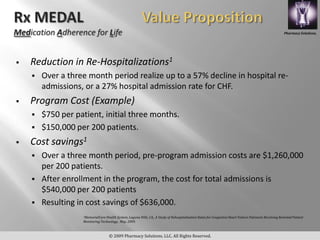
   Reduction in Re-Hospitalizations1
       Over a three month period realize up to a 57% decline in hospital re-
        admissions, or a 27% hospital admission rate for CHF.
   Program Cost (Example)
       $750 per patient, initial three months.
       $150,000 per 200 patients.
   Cost savings1
       Over a three month period, pre-program admission costs are $1,260,000
        per 200 patients.
       After enrollment in the program, the cost for total admissions is
        $540,000 per 200 patients
       Resulting in cost savings of $636,000.
                   1MemorialCare Health System, Laguna Hills, CA,, A Study of Rehospitalization Rates for Congestive Heart Failure Patinents Receiving Remoted Patient
                   Monitoring Technology, May, 2009.


                                    © 2009 Pharmacy Solutions, LLC. All Rights Reserved.
Pharmacy Solutions,


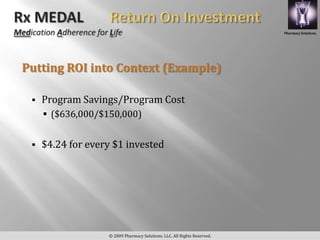
Putting ROI into Context (Example)

    Program Savings/Program Cost
      ($636,000/$150,000)


    $4.24 for every $1 invested


                   © 2009 Pharmacy Solutions, LLC. All Rights Reserved.
RX MEDAL Program Overview

Background          Services          Facility Cost               Facility Value            Patient Value      ROI


                                                                   • Decreased Re-
                                                                     Admission
                    •   Selection                                    Rates                    • Better         • Program
 •   CHF            •   Training         • Monthly                 • Better PR                  Outcomes         Cost
 •   Diabetes       •   Monitoring         Patient                 • Cost Savings             • Reduced Cost   • Program
 •   Hypertension   •   MI                 Management              • Payer                                       Savings
                                           Fee                                                • Quality of
 •   COPD           •   Assessment                                   Contracts                  Life           • $4 : $1
                    •   Reporting                                  • Decrease ED
                                                                     Visits


                                     © 2009 Pharmacy Solutions, LLC. All Rights Reserved.
Pharmacy Solutions,


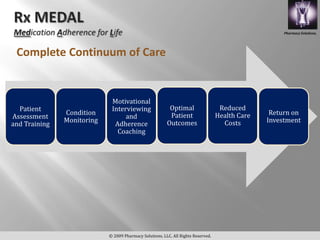
 Complete Continuum of Care


                             Motivational
  Patient                    Interviewing                 Optimal                   Reduced
               Condition                                  Patient                  Health Care    Return on
Assessment                        and
               Monitoring                                Outcomes                    Costs       Investment
and Training                  Adherence
                               Coaching


                            © 2009 Pharmacy Solutions, LLC. All Rights Reserved.
Pharmacy Solutions,


                                                                    Next Steps ?


Contact Pharmacy Solutions

http://pharmsolutions.org
info@pharmsolutions.org


             © 2009 Pharmacy Solutions, LLC. All Rights Reserved.

Rx Medal Presentation

  • 1.
    Pharmacy Medication Adherenceand Condition Monitoring Program Rx MEDAL Medication Adherence for Life © 2009 Pharmacy Solutions, LLC. All Rights Reserved.
  • 2.
    Pharmacy Solutions, To providehospitals, patients, practitioners, payers, and home health care professionals with products and services with a proven process to reduce health care cost and improve patient outcomes through condition monitoring and medication adherence in chronic disease.  Congestive Heart Failure  Diabetes Mellitus  Hypertension  Chronic Obstructive Pulmonary Disease (COPD)  Chronic Autoimmune Disorders (e.g. multiple sclerosis) © 2009 Pharmacy Solutions, LLC. All Rights Reserved.
  • 3.
    Pharmacy Solutions, Prevalence inthe United Annual Cost ($345 Billion) States 1.76% $39 10.70% $78 $218 28.60% Diabetes Diabetes Hypertension Hypertension Congestive Heart Failure Congestive Heart Failure © 2009 Pharmacy Solutions, LLC. All Rights Reserved.
  • 4.
    Pharmacy Solutions, ADHERENCE FACTS:  The #1 problem in treating illness today is patients' failure to take prescription medications correctly, regardless of patient age.  32 million Americans are taking three or more medications daily.  Approximately 125,000 deaths occur annually in the United States because of non-adherence with cardiovascular medications. © 2009 Pharmacy Solutions, LLC. All Rights Reserved.
  • 5.
    Pharmacy Solutions, The Evidence:  Medication Adherence Rates are Low  Averaging only 50 – 65% The Result:  Symptoms and Complications Worsen  Utilization of Inpatient Medical Services Increases  Total Health Care Costs Increase © 2009 Pharmacy Solutions, LLC. All Rights Reserved.
  • 6.
    Pharmacy Solutions, *US patientstake less of their medication than is prescribed. © 2009 Pharmacy Solutions, LLC. All Rights Reserved.
  • 7.
    Pharmacy Solutions,  A 2009 study1 found that the cost of drug-related morbidity, including poor adherence (not taking medication as prescribed by doctors) and suboptimal prescribing, drug administration, and diagnosis, is estimated to be as much as $289 billion annually, about 13% of total health care expenditures. 1New England Healthcare Institute, Thinking Outside the Pillbox: A System-wide Approach to Improving Patient Medication Adherence for Chronic Disease (August 2009) © 2009 Pharmacy Solutions, LLC. All Rights Reserved.
  • 8.
    Pharmacy Solutions, The barriersto medication adherence are many:  Cost  Side effects  Difficulty of managing multiple prescriptions  Patients’ acceptance and/or understanding of their disease, forgetfulness, cultural and belief systems  Imperfect drug regimens  Patients’ ability to navigate the health care system  Cognitive impairments, and  Reduced sense of urgency due to asymptomatic conditions. © 2009 Pharmacy Solutions, LLC. All Rights Reserved.
  • 9.
    Pharmacy Solutions, Adherence ManagementSystem:  Patient in-home biometrics are saved to a database, with alerts and messages possible.  Biometric data can be transmitted to the patient, doctor or other locations with ease.  Medications are reviewed and evaluated for fulfillment and adherence with prescribed regimens.  Motivational Interviewing principles are applied:  Adherence intent is assessed and monitoring plans developed to achieve desired outcomes.  Patient feedback and adherence coaching is provided as appropriate. © 2009 Pharmacy Solutions, LLC. All Rights Reserved.
  • 10.
    Pharmacy Solutions,  A secure online database collects relevant data and gives clinicians the ability to assess patient adherence by monitoring the plan of care for the patient.  Clinicians can access a condition scoring system, that provides a basic snapshot of the patient’s overall adherence .  Biometric data and adherence scores provide clinicians with an evaluation tool and a basis for motivational interviewing and intervention.  The web portal may be used to review patient care notes, biometric data, historical trends to assist in making adherence assessments. © 2009 Pharmacy Solutions, LLC. All Rights Reserved.
  • 11.
    Pharmacy Solutions,  A condition scoring system has been developed for three major disease states and is adaptable to other chronic conditions: 1. Congestive Heart Failure 2. Diabetes Mellitus 3. Hypertension 4. COPD  The condition scoring system is an indicator of adherence and is used to target areas of concerns and for improvement within each disease state. o Numerical scoring based on the familiar 1-100 grading system. This system is easily recognized and understood.  Motivational interviewing techniques are applied to improve scores and outcomes. o Increasing adherence scores are associated with increased cost savings and reduced hospitalization risk. © 2009 Pharmacy Solutions, LLC. All Rights Reserved.
  • 12.
    Pharmacy Solutions,  The unique adherence scoring system is calculated based upon individual biometric data, patient responses, and medication history.  Each patient receives an individualized adherence plan targeted to achieve persistence and optimal outcomes.  These scores can be used to trend adherence over time for each patient and trend adherence over time for patient populations.  These trends are also compared against baselines and goals associated with optimal outcomes. © 2009 Pharmacy Solutions, LLC. All Rights Reserved.
  • 13.
    Pharmacy Solutions, Motivational Interviewing Condition Adherence Monitoring Scoring Medication Adherence © 2009 Pharmacy Solutions, LLC. All Rights Reserved.
  • 14.
    Pharmacy Solutions,  As adherence scores increase health care costs and hospitalization risk decrease1 Michael C. Sokol, MD, MS, Kimberly A. McGuigan, PhD, Robert R. Verbrugge, PhD,and Robert S. Epstein, MD, MS, 1 Impact of Medication Adherence on Hospitalization Risk and Healthcare Cost, Medical Care • Volume 43, Number 6, June 2005 Annual Healthcare Cost/Patient by Hospitalization Risk by Adherence Adherence Score Score $18,000 $16,498 44% $16,000 $13,077 $12,978 39% $14,000 $11,484 36% $12,000 30% $8,887 27% $10,000 $8,000 $6,000 $4,000 $2,000 $0 0-19 0-19 80-100 60-79 20-39 40-59 80-100 20-39 40-59 60-79 Diabetes Hypertension © 2009 Pharmacy Solutions, LLC. All Rights Reserved.
  • 15.
    Pharmacy Solutions,  In another study1 hospital re-admission rates for congestive heart failure patients dropped 57 percent through the use of wireless technology to monitor their weight and blood pressure. 1MemorialCare Health System, Laguna Hills, CA,, A Study of Rehospitalization Rates for Congestive Heart Failure Patinents Receiving Remoted Patient Monitoring Technology, May, 2009. © 2009 Pharmacy Solutions, LLC. All Rights Reserved.
  • 16.
    Pharmacy Solutions,  Glucometer Heart Rate and Blood pressure cuff  Weight Scale  Pulse Oximeter  Fully integrated patient information systems and medication databases © 2009 Pharmacy Solutions, LLC. All Rights Reserved.
  • 17.
    Pharmacy Solutions, Patient takesreal- Data is Feedback to time information transmitted to patient, physician, using blue tooth the secure case manager, devices online database caregiver © 2009 Pharmacy Solutions, LLC. All Rights Reserved.
  • 18.
    Pharmacy Solutions, Phase I– Patient Enrollment: Identification of patients with specific disease (e.g. Diabetes, CHF, hypertension) and program assignment. Identification from Pharmacy Data Provided or Post Discharge Information. IVR or Call Center Calls for Enrollment and Initial Coaching and Compliance Assessment. Phase II – Ongoing Patient Monitoring: Patient data and compliance scores are monitored according to the individual adherence plan assigned to the patient. Alerts, messages, and questionnaires are used to facilitate communication and direct appropriate actions or interventions. Based on the alert system, direct intervention is triggered by a adherence coach for further assessment and escalation as appropriate. Phase III – Feedback and Reinforcement: On a monthly basis, patients receive feedback and motivational interviewing based on the results of their adherence scores. Adherence Intent and motivational interviewing is used to recognize, reinforce, problem solve, and educate. Phase IV – Monthly Results Reporting: Adherence scores are tracked, trended, and reported. Hospitalization rates, home health visits, and other metrics are tracked. © 2009 Pharmacy Solutions, LLC. All Rights Reserved.
  • 19.
    Pharmacy Solutions, © 2009Pharmacy Solutions, LLC. All Rights Reserved.
  • 20.
    Pharmacy Solutions, © 2009Pharmacy Solutions, LLC. All Rights Reserved.
  • 21.
    Pharmacy Solutions,  Adherence Assessment  Customer Value  Motivational Interviewing  Optimal Patient Outcomes  Condition Monitoring  Reduced Health Care Costs  Improved Adherence  Return on Investment © 2009 Pharmacy Solutions, LLC. All Rights Reserved.
  • 22.
    Pharmacy Solutions, Expected Adherencebased on Program Results  Claims cost data  Hospital Admission/Re-admission Rates  Objective data and statistical reporting  Retention Rates  Program Evaluation and Patient Satisfaction  Documented Cost Savings through Improved Adherence © 2009 Pharmacy Solutions, LLC. All Rights Reserved.
  • 23.
    Pharmacy Solutions, Transition, Implementation,and Ongoing Monitoring  Admission and Data Interchange  Equipment Set-Up and Validation  Initial Adherence Coaching  Ongoing monitoring and intervention  Program Cost offset through Cost Savings © 2009 Pharmacy Solutions, LLC. All Rights Reserved.
  • 24.
    Pharmacy Solutions, Customer Value ImprovedAdherence Optimal Clinical Outcomes } = ROI  Care Planning and Real Time Monitoring  Patient Coaching and Motivational Interviewing  Medication Adherence  Condition Monitoring  Reduced Costs from Improved Adherence and Outcomes  Reduced Hospital Readmissions © 2009 Pharmacy Solutions, LLC. All Rights Reserved.
  • 25.
    Pharmacy Solutions,  There are approximately 5.3 million people suffering from congestive heart failure (CHF) in the United States.  The lifetime risk of developing heart failure at the age of 40 is 20%  Approximately 380,000 people above the age of 65 will be diagnosed with CHF annually © 2009 Pharmacy Solutions, LLC. All Rights Reserved.
  • 26.
    Pharmacy Solutions,  A great cause for concern has been the increasing number of patients being hospitalized with CHF.  The number of patients with CHF discharged from the hospital rose from 400,000 in 1979 to over 1 million in 2005.  Within 4-6 months after discharge 47% of the patients are likely to be readmitted.  The five year mortality rate for patients with CHF was 48% from 1996-2000. © 2009 Pharmacy Solutions, LLC. All Rights Reserved.
  • 27.
    Pharmacy Solutions,  The estimated total of direct and indirect cost of heart failure in the United States for 2008 is $34.8 billion with the greatest share being hospitalizations.  In the commercially insured, Medicare and Medicaid populations, the single largest health expenditure is inpatient utilization (nearly 33% in 2005) with 13.3% of all emergency department visits associated with a hospital admission.  The average cost associated with a CHF hospitalization is $10,000. © 2009 Pharmacy Solutions, LLC. All Rights Reserved.
  • 28.
    Pharmacy Solutions,  The estimated total of direct and indirect cost of heart failure in the United States for 2008 is $34.8 billion with the greatest share being hospitalizations.  In the commercially insured, Medicare and Medicaid populations, the single largest health expenditure is inpatient utilization (nearly 33% in 2005) with 13.3% of all emergency department visits associated with a hospital admission.  The average cost associated with a CHF hospitalization is $10,000.  Approximately 14% of Medicare beneficiaries have heart failure, they account for 43% of Medicare spending © 2009 Pharmacy Solutions, LLC. All Rights Reserved.
  • 29.
    Pharmacy Solutions,  Reduction in Re-Hospitalizations1  Over a three month period realize up to a 57% decline in hospital re- admissions, or a 27% hospital admission rate for CHF.  Program Cost (Example)  $750 per patient, initial three months.  $150,000 per 200 patients.  Cost savings1  Over a three month period, pre-program admission costs are $1,260,000 per 200 patients.  After enrollment in the program, the cost for total admissions is $540,000 per 200 patients  Resulting in cost savings of $636,000. 1MemorialCare Health System, Laguna Hills, CA,, A Study of Rehospitalization Rates for Congestive Heart Failure Patinents Receiving Remoted Patient Monitoring Technology, May, 2009. © 2009 Pharmacy Solutions, LLC. All Rights Reserved.
  • 30.
    Pharmacy Solutions, Putting ROIinto Context (Example)  Program Savings/Program Cost  ($636,000/$150,000)  $4.24 for every $1 invested © 2009 Pharmacy Solutions, LLC. All Rights Reserved.
  • 31.
    RX MEDAL ProgramOverview Background Services Facility Cost Facility Value Patient Value ROI • Decreased Re- Admission • Selection Rates • Better • Program • CHF • Training • Monthly • Better PR Outcomes Cost • Diabetes • Monitoring Patient • Cost Savings • Reduced Cost • Program • Hypertension • MI Management • Payer Savings Fee • Quality of • COPD • Assessment Contracts Life • $4 : $1 • Reporting • Decrease ED Visits © 2009 Pharmacy Solutions, LLC. All Rights Reserved.
  • 32.
    Pharmacy Solutions, CompleteContinuum of Care Motivational Patient Interviewing Optimal Reduced Condition Patient Health Care Return on Assessment and Monitoring Outcomes Costs Investment and Training Adherence Coaching © 2009 Pharmacy Solutions, LLC. All Rights Reserved.
  • 33.
    Pharmacy Solutions, Next Steps ? Contact Pharmacy Solutions http://pharmsolutions.org info@pharmsolutions.org © 2009 Pharmacy Solutions, LLC. All Rights Reserved.