MedicalThe New England Renaissance A presentation by: Lauren Stroble, Stephanie Zandarski, and Michelle Szyszkiewicz
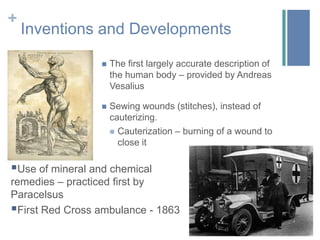
Inventions and DevelopmentsThe first largely accurate description of the human body – provided by Andreas VesaliusSewing wounds (stitches), instead of cauterizing.Cauterization – burning of a wound to close itUse of mineral and chemical remedies – practiced first by Paracelsus
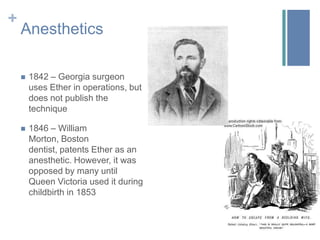
First Red Cross ambulance - 1863Anesthetics1842 – Georgia surgeon uses Ether in operations, but does not publish the technique1846 – William Morton, Boston dentist, patents Ether as an anesthetic. However, it was opposed by many until Queen Victoria used it during childbirth in 1853
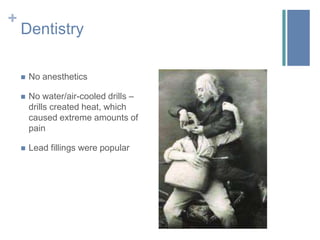
DentistryNo anestheticsNo water/air-cooled drills – drills created heat, which caused extreme amounts of painLead fillings were popular
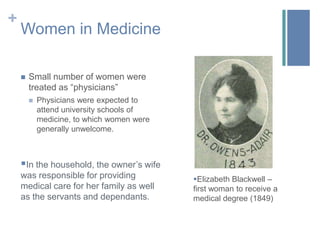
Women in MedicineSmall number of women were treated as “physicians” Physicians were expected to attend university schools of medicine, to which women were generally unwelcome.In the household, the owner’s wife was responsible for providing medical care for her family as well as the servants and dependants.
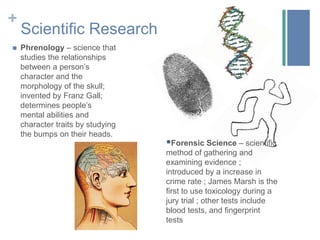
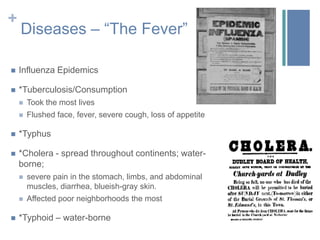
Elizabeth Blackwell – first woman to receive a medical degree (1849)Scientific ResearchPhrenology – science that studies the relationships between a person’s character and the morphology of the skull; invented by Franz Gall; determines people’s mental abilities and character traits by studying the bumps on their heads.Forensic Science – scientific method of gathering and examining evidence ; introduced by a increase in crime rate ; James Marsh is the first to use toxicology during a jury trial ; other tests include blood tests, and fingerprint testsDiseases – “The Fever”Influenza Epidemics*Tuberculosis/ConsumptionTook the most livesFlushed face, fever, severe cough, loss of appetite*Typhus*Cholera - spread throughout continents; water-borne;severe pain in the stomach, limbs, and abdominal muscles, diarrhea, blueish-gray skin.Affected poor neighborhoods the most*Typhoid – water-borne
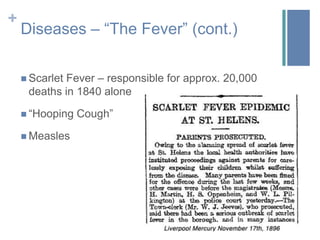
Diseases – “The Fever” (cont.)Scarlet Fever – responsible for approx. 20,000 deaths in 1840 alone“Hooping Cough”Measles
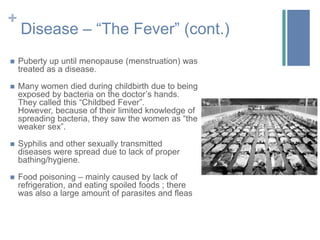
Disease – “The Fever” (cont.)Puberty up until menopause (menstruation) was treated as a disease.Many women died during childbirth due to being exposed by bacteria on the doctor’s hands. They called this “Childbed Fever”. However, because of their limited knowledge of spreading bacteria, they saw the women as “the weaker sex”.Syphilis and other sexually transmitted diseases were spread due to lack of proper bathing/hygiene.Food poisoning – mainly caused by lack of refrigeration, and eating spoiled foods ; there was also a large amount of parasites and fleas
THE END.
Medical slideshow

Medical slideshow

  • 1.
    MedicalThe New EnglandRenaissance A presentation by: Lauren Stroble, Stephanie Zandarski, and Michelle Szyszkiewicz
  • 2.
    Inventions and DevelopmentsThefirst largely accurate description of the human body – provided by Andreas VesaliusSewing wounds (stitches), instead of cauterizing.Cauterization – burning of a wound to close itUse of mineral and chemical remedies – practiced first by Paracelsus
  • 3.
    First Red Crossambulance - 1863Anesthetics1842 – Georgia surgeon uses Ether in operations, but does not publish the technique1846 – William Morton, Boston dentist, patents Ether as an anesthetic. However, it was opposed by many until Queen Victoria used it during childbirth in 1853
  • 4.
    DentistryNo anestheticsNo water/air-cooleddrills – drills created heat, which caused extreme amounts of painLead fillings were popular
  • 5.
    Women in MedicineSmallnumber of women were treated as “physicians” Physicians were expected to attend university schools of medicine, to which women were generally unwelcome.In the household, the owner’s wife was responsible for providing medical care for her family as well as the servants and dependants.
  • 6.
    Elizabeth Blackwell –first woman to receive a medical degree (1849)Scientific ResearchPhrenology – science that studies the relationships between a person’s character and the morphology of the skull; invented by Franz Gall; determines people’s mental abilities and character traits by studying the bumps on their heads.Forensic Science – scientific method of gathering and examining evidence ; introduced by a increase in crime rate ; James Marsh is the first to use toxicology during a jury trial ; other tests include blood tests, and fingerprint testsDiseases – “The Fever”Influenza Epidemics*Tuberculosis/ConsumptionTook the most livesFlushed face, fever, severe cough, loss of appetite*Typhus*Cholera - spread throughout continents; water-borne;severe pain in the stomach, limbs, and abdominal muscles, diarrhea, blueish-gray skin.Affected poor neighborhoods the most*Typhoid – water-borne
  • 7.
    Diseases – “TheFever” (cont.)Scarlet Fever – responsible for approx. 20,000 deaths in 1840 alone“Hooping Cough”Measles
  • 8.
    Disease – “TheFever” (cont.)Puberty up until menopause (menstruation) was treated as a disease.Many women died during childbirth due to being exposed by bacteria on the doctor’s hands. They called this “Childbed Fever”. However, because of their limited knowledge of spreading bacteria, they saw the women as “the weaker sex”.Syphilis and other sexually transmitted diseases were spread due to lack of proper bathing/hygiene.Food poisoning – mainly caused by lack of refrigeration, and eating spoiled foods ; there was also a large amount of parasites and fleas
  • 9.