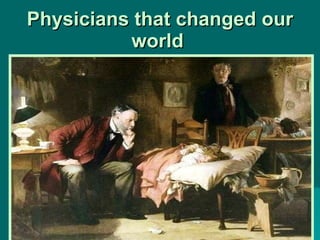
Physicians that changed our world
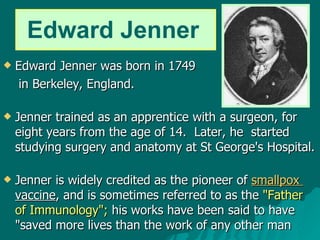
Edward Jenner   Edward Jenner was born in 1749  in Berkeley, England. Jenner trained as an apprentice with a surgeon, for eight years from the age of 14.  Later, he  started studying surgery and anatomy at   St George's Hospital. Jenner is widely credited as the pioneer of   smallpox   vaccine , and is sometimes referred to as the  "Father of Immunology";  his works have been said to have "saved more lives than the work of any other man
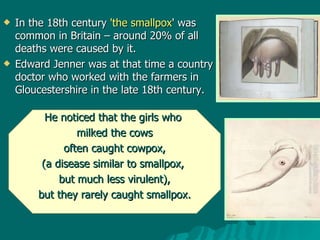
In the 18th century  'the smallpox ' was common in Britain – around 20% of all deaths were caused by it.  Edward Jenner was at that time a country doctor who worked with the farmers in Gloucestershire in the late 18th century.  He noticed that the girls who  milked the cows often caught cowpox,  (a disease similar to smallpox,  but much less virulent), but they rarely caught smallpox.
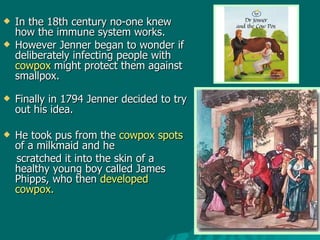
In the 18th century no-one knew how the immune system works.  However Jenner began to wonder if deliberately infecting people with  cowpox  might protect them against smallpox. Finally in 1794 Jenner decided to try out his idea.  He took pus from the  cowpox spots  of a milkmaid and he  scratched it into the skin of a healthy young boy called James Phipps, who then  developed cowpox.
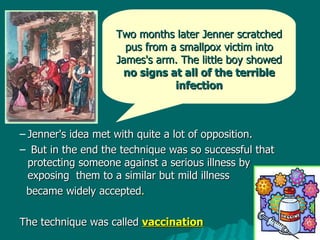
Jenner's idea met with quite a lot of opposition. But in the end the technique was so successful that protecting someone against a serious illness by exposing  them to a similar but mild illness  became widely accepted .  The technique was called  vaccination Two months later Jenner scratched pus from a smallpox victim into James's arm. The little boy showed  no signs at all of the terrible infection
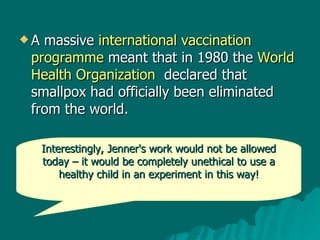
A massive  international vaccination programme  meant that in 1980 the  World Health Organization   declared that smallpox had officially been eliminated from the world.  Interestingly, Jenner's work would not be allowed today – it would be completely unethical to use a healthy child in an experiment in this way!
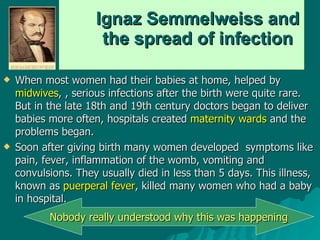
Ignaz Semmelweiss and  the spread of infection When most women had their babies at home, helped by  midwives , , serious infections after the birth were quite rare. But in the late 18th and 19th century doctors began to deliver babies more often, hospitals created  maternity wards  and the problems began.  Soon after giving birth many women developed  symptoms like pain, fever, inflammation of the womb, vomiting and convulsions. They usually died in less than 5 days. This illness, known as  puerperal fever , killed many women who had a baby in hospital.  Nobody really understood why this was happening
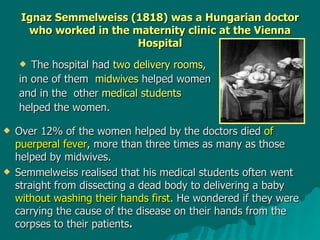
Ignaz Semmelweiss (1818) was a Hungarian doctor who worked in the maternity clinic at the Vienna Hospital The hospital had  two delivery rooms ,  in one of them  midwives  helped women  and in the  other  medical students   helped the women.  Over 12% of the women helped by the doctors died  of puerperal fever , more than three times as many as those helped by midwives.   Semmelweiss realised that his medical students often went straight from dissecting a dead body to delivering a baby  without washing their hands first . He wondered if they were carrying the cause of the disease on their hands from the corpses to their patients .
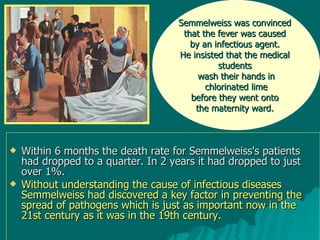
Within 6 months the death rate for Semmelweiss's patients had dropped to a quarter. In 2 years it had dropped to just over 1%. Without understanding the cause of infectious diseases Semmelweiss had discovered a key factor in preventing the spread of pathogens which is just as important now in the 21st century as it was in the 19th century. Semmelweiss was convinced  that the fever was caused  by an infectious agent.  He insisted that the medical  students  wash their hands in chlorinated lime  before they went onto  the maternity ward.
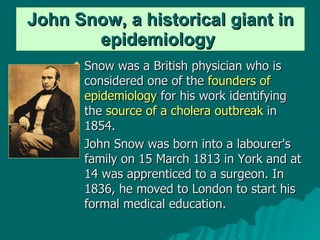
John Snow, a historical giant in   epidemiology   Snow was a British physician who is considered one of the  founders of epidemiology  for his work identifying the  source of a cholera outbreak  in 1854.  John Snow was born into a labourer's family on 15 March 1813 in York and at 14 was apprenticed to a surgeon. In 1836, he moved to London to start his formal medical education.
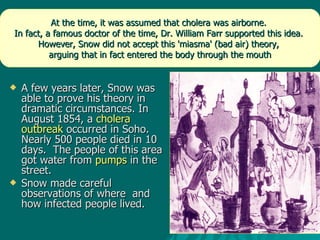
A few years later, Snow was able to prove his theory in dramatic circumstances. In August 1854, a  cholera outbreak  occurred in Soho.  Nearly 500 people died in 10 days.  The people of this area got water from  pumps  in the street.  Snow made careful observations of where  and how infected people lived.  At the time, it was assumed that cholera was airborne.  In fact, a famous doctor of the time, Dr. William Farr supported this idea.  However, Snow did not accept this 'miasma' (bad air) theory,  arguing that in fact entered the body through the mouth
 
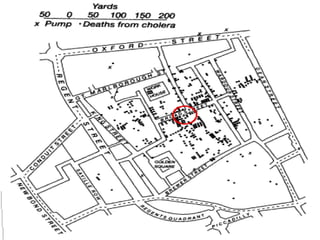
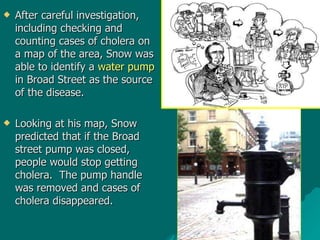
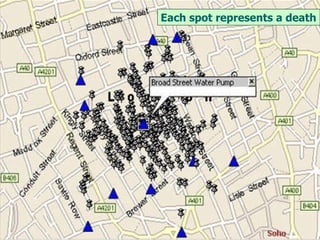
After careful investigation, including checking and counting cases of cholera on a map of the area, Snow was able to identify a  water pump  in Broad Street as the source of the disease.   Looking at his map, Snow predicted that if the Broad street pump was closed, people would stop getting cholera.  The pump handle was removed and cases of cholera disappeared.
Each spot represents a death
Dr Farr didn’t believe this theory  and carried on collecting data to support his own theory.  Finally, in 1866, Farr had to accept Snow’s theory when there was another outbreak of cholera in East London. Farr observed that all people who died had taken water from the Old Ford reservoir in East London. The bacterium that causes cholera was discovered in 1883.
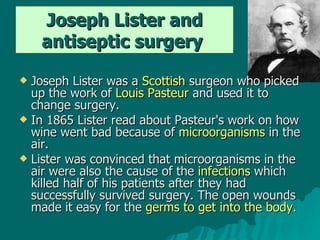
Joseph Lister and antiseptic surgery   Joseph Lister was a  Scottish  surgeon who picked up the work of  Louis Pasteur  and used it to change surgery.  In 1865 Lister read about Pasteur's work on how wine went bad because of  microorganisms  in the air.  Lister was convinced that microorganisms in the air were also the cause of the  infections  which killed half of his patients after they had successfully survived surgery. The open wounds made it easy for the  germs to get into the body.
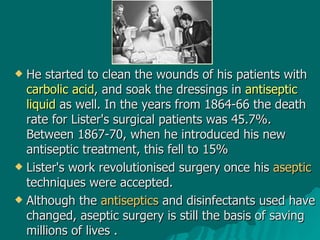
He started to clean the wounds of his patients with  carbolic acid , and soak the dressings in  antiseptic liquid  as well. In the years from 1864-66 the death rate for Lister's surgical patients was 45.7%. Between 1867-70, when he introduced his new antiseptic treatment, this fell to 15% Lister's work revolutionised surgery once his  aseptic  techniques were accepted.  Although the  antiseptics  and disinfectants used have changed, aseptic surgery is still the basis of saving millions of lives  .
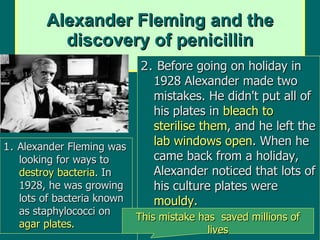
Alexander Fleming and the discovery of penicillin 1.  Alexander Fleming was looking for ways to  destroy bacteria . In 1928, he was growing lots of bacteria known as staphylococci on  agar plates. 2.  Before going on holiday in 1928 Alexander made two mistakes. He didn't put all of his plates in  bleach to sterilise them , and he left the  lab windows open . When he came back from a holiday, Alexander noticed that lots of his culture plates were  mouldy. This mistake has  saved millions of lives
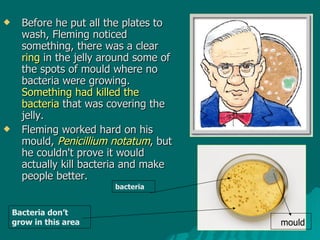
Before he put all the plates to   wash, Fleming noticed something, there was a clear  ring  in the jelly around some of the spots of mould where no bacteria were growing.  Something had killed the bacteria  that was covering the jelly.   Fleming worked hard on his mould,  Penicillium notatum , but he couldn't prove it would actually kill bacteria and make people better. bacteria mould Bacteria don’t grow in this area
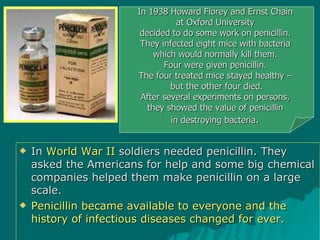
In  World War II  soldiers needed penicillin. They asked the Americans for help and some big chemical companies helped them make penicillin on a large scale.  Penicillin became available to everyone and the history of infectious diseases changed for ever. In 1938 Howard Florey and Ernst Chain  at Oxford University  decided to do some work on penicillin.  They infected eight mice with bacteria  which would normally kill them.  Four were given penicillin.  The four treated mice stayed healthy –  but the other four died. After several experiments on persons,  they showed the value of penicillin  in destroying bacteria .
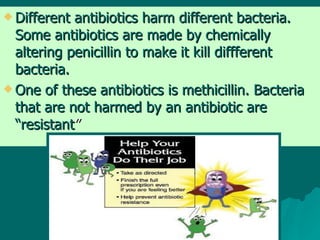
Different antibiotics harm different bacteria. Some antibiotics are made by chemically altering penicillin to make it kill diffferent bacteria.  One of these antibiotics is methicillin. Bacteria that are not harmed by an antibiotic are “resistant ”

Physicians that changed our world

  • 1.
  • 2.
    Edward Jenner Edward Jenner was born in 1749 in Berkeley, England. Jenner trained as an apprentice with a surgeon, for eight years from the age of 14. Later, he started studying surgery and anatomy at St George's Hospital. Jenner is widely credited as the pioneer of smallpox vaccine , and is sometimes referred to as the "Father of Immunology"; his works have been said to have "saved more lives than the work of any other man
  • 3.
    In the 18thcentury 'the smallpox ' was common in Britain – around 20% of all deaths were caused by it. Edward Jenner was at that time a country doctor who worked with the farmers in Gloucestershire in the late 18th century. He noticed that the girls who milked the cows often caught cowpox, (a disease similar to smallpox, but much less virulent), but they rarely caught smallpox.
  • 4.
    In the 18thcentury no-one knew how the immune system works. However Jenner began to wonder if deliberately infecting people with cowpox might protect them against smallpox. Finally in 1794 Jenner decided to try out his idea. He took pus from the cowpox spots of a milkmaid and he scratched it into the skin of a healthy young boy called James Phipps, who then developed cowpox.
  • 5.
    Jenner's idea metwith quite a lot of opposition. But in the end the technique was so successful that protecting someone against a serious illness by exposing them to a similar but mild illness became widely accepted . The technique was called vaccination Two months later Jenner scratched pus from a smallpox victim into James's arm. The little boy showed no signs at all of the terrible infection
  • 6.
    A massive international vaccination programme meant that in 1980 the World Health Organization  declared that smallpox had officially been eliminated from the world. Interestingly, Jenner's work would not be allowed today – it would be completely unethical to use a healthy child in an experiment in this way!
  • 7.
    Ignaz Semmelweiss and the spread of infection When most women had their babies at home, helped by midwives , , serious infections after the birth were quite rare. But in the late 18th and 19th century doctors began to deliver babies more often, hospitals created maternity wards and the problems began. Soon after giving birth many women developed symptoms like pain, fever, inflammation of the womb, vomiting and convulsions. They usually died in less than 5 days. This illness, known as puerperal fever , killed many women who had a baby in hospital. Nobody really understood why this was happening
  • 8.
    Ignaz Semmelweiss (1818)was a Hungarian doctor who worked in the maternity clinic at the Vienna Hospital The hospital had two delivery rooms , in one of them midwives helped women and in the other medical students helped the women. Over 12% of the women helped by the doctors died of puerperal fever , more than three times as many as those helped by midwives. Semmelweiss realised that his medical students often went straight from dissecting a dead body to delivering a baby without washing their hands first . He wondered if they were carrying the cause of the disease on their hands from the corpses to their patients .
  • 9.
    Within 6 monthsthe death rate for Semmelweiss's patients had dropped to a quarter. In 2 years it had dropped to just over 1%. Without understanding the cause of infectious diseases Semmelweiss had discovered a key factor in preventing the spread of pathogens which is just as important now in the 21st century as it was in the 19th century. Semmelweiss was convinced that the fever was caused by an infectious agent. He insisted that the medical students wash their hands in chlorinated lime before they went onto the maternity ward.
  • 10.
    John Snow, ahistorical giant in epidemiology Snow was a British physician who is considered one of the founders of epidemiology for his work identifying the source of a cholera outbreak in 1854. John Snow was born into a labourer's family on 15 March 1813 in York and at 14 was apprenticed to a surgeon. In 1836, he moved to London to start his formal medical education.
  • 11.
    A few yearslater, Snow was able to prove his theory in dramatic circumstances. In August 1854, a cholera outbreak occurred in Soho. Nearly 500 people died in 10 days. The people of this area got water from pumps in the street. Snow made careful observations of where and how infected people lived. At the time, it was assumed that cholera was airborne. In fact, a famous doctor of the time, Dr. William Farr supported this idea. However, Snow did not accept this 'miasma' (bad air) theory, arguing that in fact entered the body through the mouth
  • 12.
  • 13.
    After careful investigation,including checking and counting cases of cholera on a map of the area, Snow was able to identify a water pump in Broad Street as the source of the disease. Looking at his map, Snow predicted that if the Broad street pump was closed, people would stop getting cholera. The pump handle was removed and cases of cholera disappeared.
  • 14.
  • 15.
    Dr Farr didn’tbelieve this theory and carried on collecting data to support his own theory. Finally, in 1866, Farr had to accept Snow’s theory when there was another outbreak of cholera in East London. Farr observed that all people who died had taken water from the Old Ford reservoir in East London. The bacterium that causes cholera was discovered in 1883.
  • 16.
    Joseph Lister andantiseptic surgery Joseph Lister was a Scottish surgeon who picked up the work of Louis Pasteur and used it to change surgery. In 1865 Lister read about Pasteur's work on how wine went bad because of microorganisms in the air. Lister was convinced that microorganisms in the air were also the cause of the infections which killed half of his patients after they had successfully survived surgery. The open wounds made it easy for the germs to get into the body.
  • 17.
    He started toclean the wounds of his patients with carbolic acid , and soak the dressings in antiseptic liquid as well. In the years from 1864-66 the death rate for Lister's surgical patients was 45.7%. Between 1867-70, when he introduced his new antiseptic treatment, this fell to 15% Lister's work revolutionised surgery once his aseptic techniques were accepted. Although the antiseptics and disinfectants used have changed, aseptic surgery is still the basis of saving millions of lives .
  • 18.
    Alexander Fleming andthe discovery of penicillin 1. Alexander Fleming was looking for ways to destroy bacteria . In 1928, he was growing lots of bacteria known as staphylococci on agar plates. 2. Before going on holiday in 1928 Alexander made two mistakes. He didn't put all of his plates in bleach to sterilise them , and he left the lab windows open . When he came back from a holiday, Alexander noticed that lots of his culture plates were mouldy. This mistake has  saved millions of lives
  • 19.
    Before he putall the plates to wash, Fleming noticed something, there was a clear ring in the jelly around some of the spots of mould where no bacteria were growing. Something had killed the bacteria that was covering the jelly. Fleming worked hard on his mould, Penicillium notatum , but he couldn't prove it would actually kill bacteria and make people better. bacteria mould Bacteria don’t grow in this area
  • 20.
    In WorldWar II soldiers needed penicillin. They asked the Americans for help and some big chemical companies helped them make penicillin on a large scale. Penicillin became available to everyone and the history of infectious diseases changed for ever. In 1938 Howard Florey and Ernst Chain at Oxford University decided to do some work on penicillin. They infected eight mice with bacteria which would normally kill them. Four were given penicillin. The four treated mice stayed healthy – but the other four died. After several experiments on persons, they showed the value of penicillin in destroying bacteria .
  • 21.
    Different antibiotics harmdifferent bacteria. Some antibiotics are made by chemically altering penicillin to make it kill diffferent bacteria. One of these antibiotics is methicillin. Bacteria that are not harmed by an antibiotic are “resistant ”