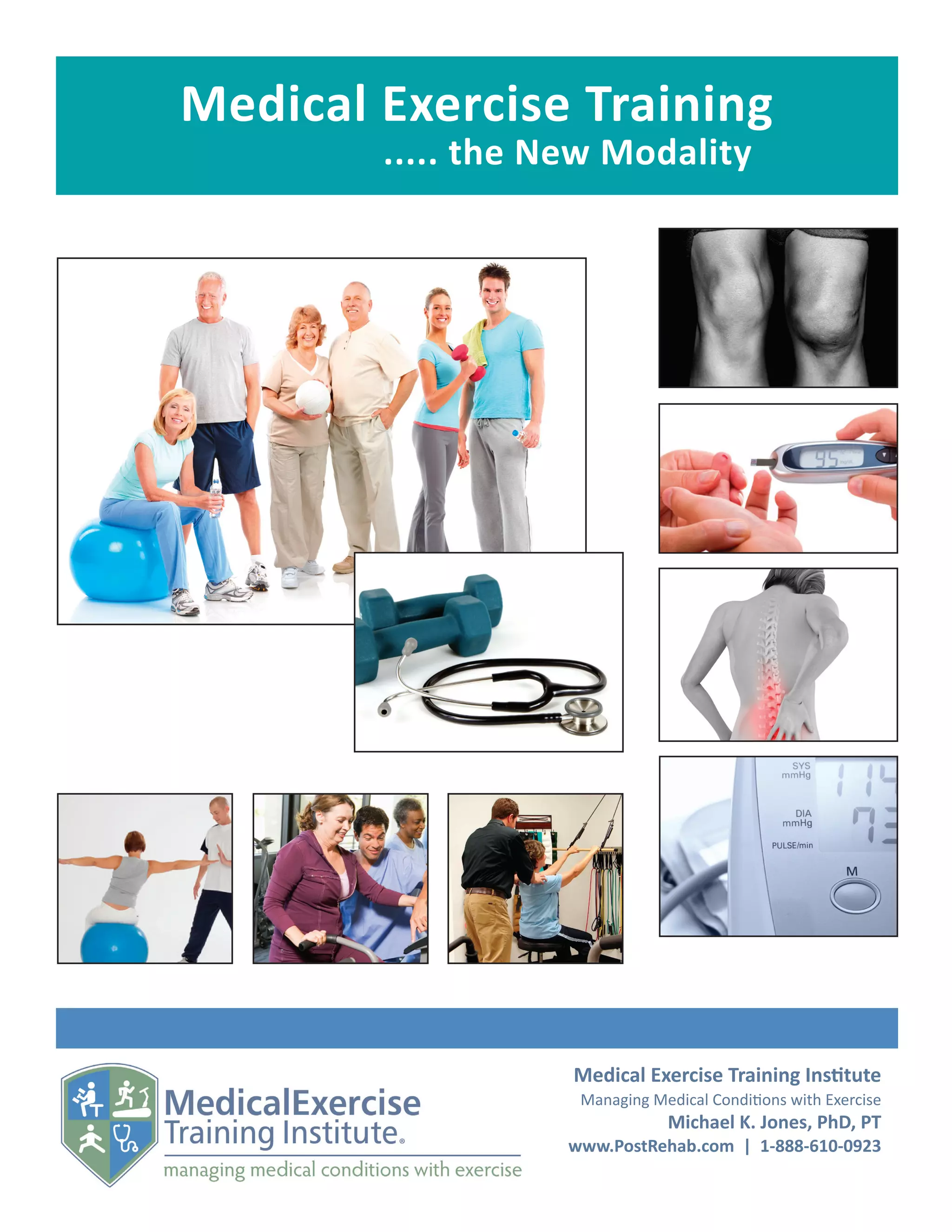
Medical Exercise Training 
..... the Ne w Modality 
Medical Exercise Training Institute 
Managing Medical Conditions with Exercise 
Michael K. Jones, PhD, PT 
www.PostRehab.com | 1-888-610-0923
Mandate for Change 
Changes in the health care and insurance industries have mandated the use of exercise as a strong component of the 
medical management of chronic diseases. Though there is much research to support the positive influence of exercise on 
medical conditions – the actual integration of exercise protocols and guidelines into health care management is limited. 
This paper will provide a model for the integration of Medical Exercise Training into the medical management of common 
chronic conditions. 
The statistics on the cost and occurrence of chronic disease are staggering. The American health care system is beginning 
to buckle under the costs and the numbers of individuals with chronic disorders and/or surgical procedures such as: 
1) diabetes (DM) 
2) hypertension (HTN) 
3) osteoarthritis (OA) 
4) total joint replacements (TJR) 
5) low back pain (LBP) [spinal surgery including laminectomy & fusion] 
Each of these conditions or procedures is positively impacted by exercise. These are only a few, but the most prevalent, of 
the chronic conditions that cost the health care system billions. 
Wasted Billions 
With costs in the billions, and rising, it’s obvious that something has to change. 
• Diabetes affects some 25.8 million Americans at a cost of $245 billion, of which, 43% of these costs 
are inpatient hospital care. Type II diabetics are easily managed with diet and exercise guidelines. 
• Hypertension affects 67 million Americans at a cost of $93.5 billion. Hypertension is another 
chronic condition that is managed with exercise and diet guidelines. 
Medical Exercise Training Institute | www.postrehab.com | 1.888.610.0923 
page 1
• Low Back Pain – 80% of Americans will experience low back pain (LBP) at some point in their lives. 
The total cost of care related to LBP is estimated at $100 billion for 2010. The most frequent 
surgical procedures to manage LBP are: 1) laminectomy and 2) spinal fusion. For these two proce-dures, 
we can add $2.3 billion and $13.3 billion respectively to overall cost of LBP. Again, in many 
instances, a well-structured progressive exercise program can control some of these costs of LBP 
and associated surgeries. 
• Osteoarthritis (OA) is another chronic disorder that can benefit from exercise. Annually, more than 
409,000 hospitalizations occur due to OA, and some 27 million Americans suffer with arthritis. The 
majority of those surveyed with OA report primary involvement in the spine, hip and/or knee. 
Total annual cost associated with the treatment of OA is estimated at $89.1 billion. This works out 
to roughly $4603/person receiving treatment. 
• Total hip and knee replacements are commonly performed for chronic OA. Loss of function is the 
primary reason for hip and knee arthroplasty. Estimates place the number of total hip and knee 
replacements annually at 450,000 and 720,000 respectively. The TJR client benefits tremendously 
from exercise using a structured protocol-based program. 
Traditional Philosophy in Healthcare 
The current standard treatment process for DM and HTN centers on drug therapy and diet modification. The research con-tains 
dozens of studies advocating the importance of cardiovascular and resistance training as part of the management for 
hypertension. The same is true for diabetes. Cardiovascular exercise and a simple resistance program significantly reduce 
blood pressure, blood glucose and A1c levels. 
The standard treatment of low back pain, spinal fusion, laminectomy and total joint replacements includes drug therapy 
and short bouts of physical therapy or chiropractic care. These modalities provide temporary pain relief and restoration of 
low-level function. The level of function restored is not adequate for most patients to return to their pre-injury or surgery 
functional level. A structured protocol-based approach to exercise is an effective benefit for these procedures. 
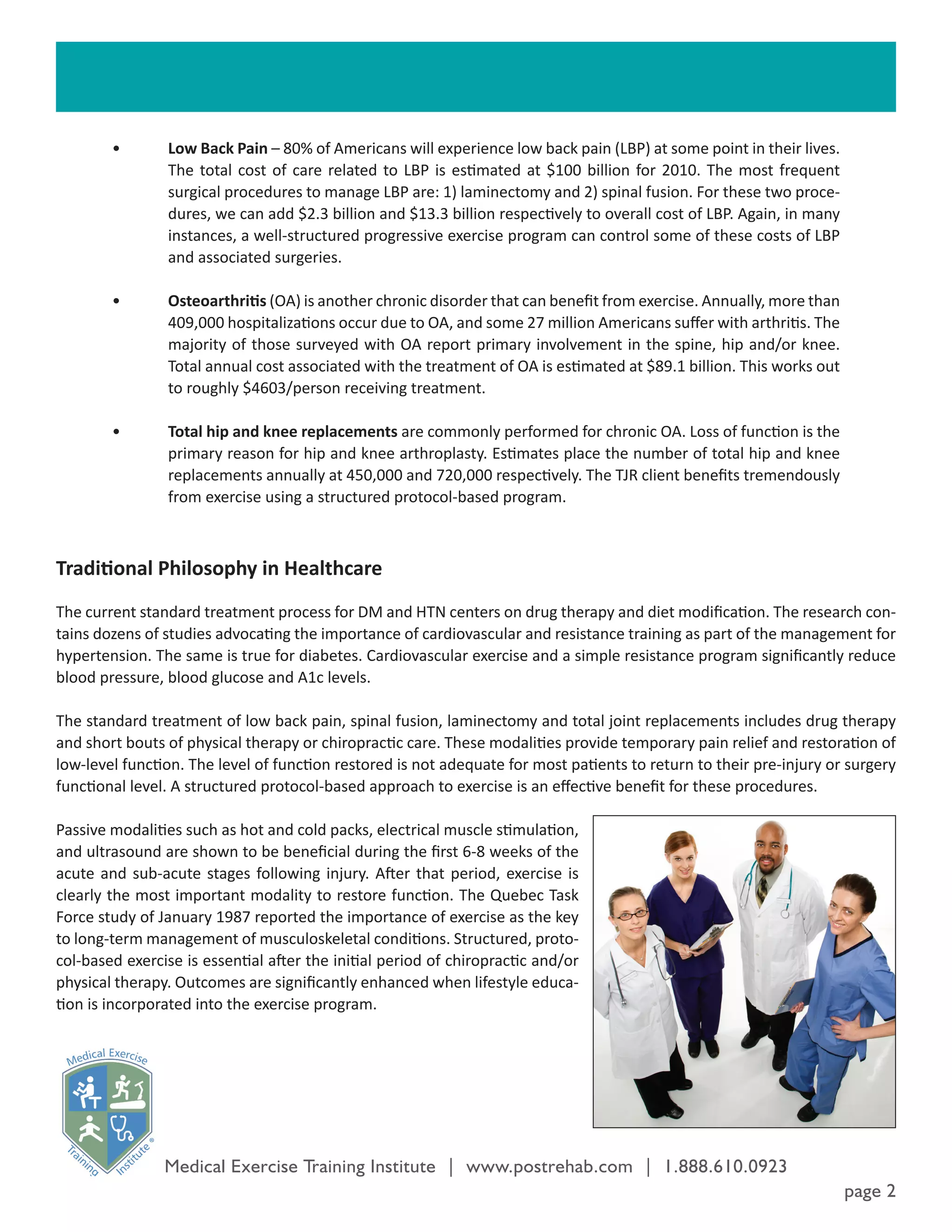
Passive modalities such as hot and cold packs, electrical muscle stimulation, 
and ultrasound are shown to be beneficial during the first 6-8 weeks of the 
acute and sub-acute stages following injury. After that period, exercise is 
clearly the most important modality to restore function. The Quebec Task 
Force study of January 1987 reported the importance of exercise as the key 
to long-term management of musculoskeletal conditions. Structured, proto-col- 
based exercise is essential after the initial period of chiropractic and/or 
physical therapy. Outcomes are significantly enhanced when lifestyle educa-tion 
is incorporated into the exercise program. 
Medical Exercise Training Institute | www.postrehab.com | 1.888.610.0923 
page 2
New Standards in Exercise 
Many patients are referred to fitness programs. Improvement with fitness programming is often measured in terms such 
as “feels better”, “more energy” or “better health”. One of the frustrations when referring individuals with medical condi-tions 
to fitness facilities is the ambiguity of outcome measures. Medical professionals need more specific information to 
determine if the fitness program is having a positive impact on the client’s condition. 
Medical Exercise Training (MET) protocols establish a new standard containing specific staged exercises and functional 
outcome measures or “FOMs” for the delivery of exercise programs. These FOMs serve as measurable parameters that 
are periodically re-assessed to determine exercise effectiveness. The functional outcome measures used in MET include: 
MET Functional Outcome Measures 
1. Glycosolated Hemoglobin (A1c) 
2. Blood Pressure 
3. Blood Glucose 
4. Bone Density 
5. Range of Motion 
6. Muscle Strength Testing 
7. Functional Assessment Scale 
8. Cholesterol Levels 
9. Pain Scale 
10. Anthropometric Measures 
11. Resting Heart Rate 
12. Body Mass Index 
Physicians, physical therapists, chiropractors and Medical Exercise Specialists (MES) all understand the FOMs. Therefore, 
FOMs are universal and easily interpreted. Incorporation of FOMs into medical exercise training programs assures the ex-ercise 
sessions are targeted toward improving the client’s function specific to the needs of their condition. The MES com-municates 
with the medical professional to obtain FOM values. FOMs are measured and reviewed throughout the client’s 
medical exercise training program. 
Utilizing FOMs as goals and yardsticks to measure progress is an essential concept in MET. The MET communication and 
documentation systems allow Medical Exercise Specialists to record and report the FOMs in a timely and effective manner. 
Every MET session is documented to ensure safety and program continuity. The use of FOMs and the MET communication/ 
documentation system is unique in the fitness arena and allows Medical Exercise Specialists to truly partner with medical 
professionals and insurance carriers to enhance the health and function of clients. 
Medical Exercise Training Institute | www.postrehab.com | 1.888.610.0923 
page 3
Fitness programming must adopt a new approach to include: 
• Specific functional outcome measures to gauge progress and effectiveness 
• Use a protocol-based approach containing specific exercise progressions and 
documentation/communication guidelines designed for individual medical conditions 
• Be finite and provide specific guidelines on frequency and duration 
• Engage clients in home exercise and lifestyle education 
These areas are not addressed by standard fitness programming. Fitness programs at best are partially effective and do not 
truly assist medical professionals with the management of medical conditions. 
The New Concept - Medical Exercise Training 
All the components listed above are incorporated into a relatively new concept known as “Medical Exercise Training”. 
Medical Exercise Training or MET is the development of safe and effective, structured, protocol-based exercise program-ming 
specific to the client’s medical condition. MET programs focus on exercise techniques to enhance strength, flexibility, 
cardiovascular endurance, balance, and stability as well as FOMs. Clients with cardiovascular, neurological, metabolic and 
musculoskeletal disorders benefit from MET services. MET is also able to manage surgical conditions including total joint 
replacements, spinal, knee and shoulder surgeries as well as pre-surgical training to enhance post-operative outcomes. 
Each MET protocol monitors specific “functional outcome measures” to determine the effectiveness of the exercise. 
MET is specific and directed toward resolving the client’s functional deficits that remain after discharge from physical 
therapy and/or chiropractic care. General fitness programs will not adequately address and manage the needs of medical-based 
clients. Fitness programs can be beneficial but the outcomes are limited and unpredictable. On the other hand, MET 
programs are specifically designed to improve functional outcome measures. MET programs are not designed to take the 
place of professional physical therapy or chiropractic services. These disciplines have 
well documented benefits for short-term management of pain and limited functional 
restoration – MET is the best long-term option. MET focuses on functional outcome 
Medical Exercise Training Institute | www.postrehab.com | 1.888.610.0923 
page 4
Medical Exercise Training is beneficial for the following conditions/procedures: 
Osteoarthritis Diabetes Hypertension 
Lumbar Disc Herniation Total Hip Replacement Total Knee Replacement 
Achilles Tendon Rupture Plantar Fasciitis Cervical Strain 
Laminectomy Spinal Fusion Osteoporosis 
Shoulder Impingement Rotator Cuff Tear Meniscal Tear 
Shoulder Dislocation Cerebrovascular Accident Carpal Tunnel Syndrome 
Rheumatoid Arthritis Parkinson’s Disease Lateral Epicondylitis 
Medial Epicondylitis Thoracic Outlet Syndrome IT Band Syndrome 
Tibial Plateau Fracture Closed Head Injury Ankle Fracture 
Ankle Sprain AC Joint Separation Bicipital Tendinitis 
PCL Rupture MCL Sprain LCL Sprain 
Spondylolethesis Ankylosing Spondylitis Brachial Plexus Strain 
ACL Rupture/Reconstruction Greater Trochanteric Bursitis Cervical Disc Herniation 
Piriformis Syndrome Patello-Femoral Syndrome Spinal Stenosis 
Lupus Erythematosus Frozen Shoulder Patella Tendon Rupture 
Cerebral Palsy Myocardial Infarct Obesity 
Patelloectomy Total Shoulder Replacement Cancer 
measures. 
MET does not use any physical therapy modalities such as ice, heat, EMS, traction, and/or joint mobilization/manipulation. 
The sole modality used in MET is “exercise”. Lifestyle management training is also incorporated into MET programs. Life-style 
management provides client education, defined wellness strategies and independent exercise guidelines to hasten 
functional improvement. MET also utilizes the services of registered dietitians to provide a full range of medical exercise 
services. 
“Exercise is the key to long-term management of most medical conditions”. Several studies in recent years support this 
statement. The most important of which, is the previously mentioned “Quebec Task Force” study. The study clearly sup-ports 
the focus on exercise to enhance function after the initial 6-8 weeks of physical therapy or chiropractic care. Other 
studies, further support exercise as a primary modality once the client has moved past the acute and sub-acute stages of 
treatment. 
Medical Exercise Training Institute | www.postrehab.com | 1.888.610.0923 
page 5
New Health Care Professional – Medical Exercise Specialist 
MET provides an economical option once physical therapy and chiropractic care are complete. MET promotes active par-ticipation 
by the client in the exercise and educational programs. The dependence on physical therapy modalities is not 
part of the MET model. MET services are provided by “Medical Exercise Specialists” (MES). 
The MES is not a “personal trainer”. The MES has extensive training in medical exercise management and a clear under-standing 
of his or her role. Each MES is trained in the management of medical conditions using a protocol-based approach 
to exercise. The MET protocols are the basis of every aspect of MET services. The protocols allow a standardized approach 
with measurable outcomes and specific exercise selection and progression. The MES is trained in assessment techniques 
and documentation procedures. The role of the Medical Exercise Specialist is to: 
The Role of the Medical Exercise Specialist 
• Deliver safe and effective exercise 
• Effectively communicate to report client progress to medical professionals 
• Provide recommendations on exercise to clients and medical professionals 
• Document client functional outcomes 
• Provide wellness and lifestyle education 
Medical Exercise Training Model 
The ideal MET client is 25 – 80 years of age with a “medically-stable” chronic medical condition that may range from obe-sity 
to a total joint replacement. The client has a referral from a physician or other medical professional. MET clients are 
usually seen 2 -3 times per week for 8 – 12 weeks. Each session consists of strength, cardiovascular, stability, balance and 
flexibility training specifically tailored to the client’s condition. 
Medical Exercise Training options include one-on-one training, small group training and/or MED-FIT educational classes. 
MET requires a “referral” from a medical professional to begin the program. The client’s program is developed based on 
the MET assessment conducted during the first session and the appropriate MET protocol. 
During the first session the MES completes a thorough medical history on the client followed by the “musculoskeletal 
screening”. The client is then put through a regional MED-FIT Assessment. Goals are also established for the client. The 
FOMs are part of the program goals. The results of the assessment and a summary of the MET program are communi-cated 
to the referral source and insurance carrier in a one-page assessment summary. Every 30 days a progress report is 
forwarded to the medical professional and insurance carrier to provide client status updates. Every MET session is docu-mented 
and recorded in the client’s file. The data gathered from the improvement in FOMs allows the MES to develop 
more effective guidelines and protocols. 
Medical Exercise Training Institute | www.postrehab.com | 1.888.610.0923 
page 6
Medical Exercise Specialists follow a protocol to progress their clients. These MET protocols are 
specific to clients’ medical condition and provide assessment and progression guidelines as well 
as MET criteria. The MET criteria minimizes the possibility of an “acute or subacute” 
client entering the program. MET protocols are available for 60 medical conditions. 
MET sessions are designed to not only to improve the client’s strength, flexibility, 
endurance, balance and stability related to their medical condition, it also provides 
lifestyle education. MET picks up where physical therapy and chiropractic care leave 
off. MET recognizes exercise plus education, produces positive functional outcomes 
for clients. 
Total Hip Replacement Flowchart 
Doesn’t meet criteria. 
Refer back to MD. 
Low Back Pain Post Rehab Flowchart 
Doesn’t meet criteria. 
Refer back to MD. 
Medical Exercise Training Options 
MET programs usually have duration of 30 – 90 days. Clients are recommended to participate 2-3 times per week. Based 
on their needs, clients can participate in one-on-one sessions, small group training and/or Med-Fit education classes. 
• One-on-One MET sessions are available for all conditions. Condition specific sessions are 
delivered in a private setting and are either 30 or 60 minutes in length. For those who 
want schedule flexibility and need more personalized attention, this is an ideal program. 
• Small group MET (SGMET) is the most economical option. SGMET is particularly useful 
in managing clients on a fixed income. SGMET is available for clients with similar condi-tions. 
SGMET sessions consist of 2 to 4 clients. 
• “MED-FIT” training classes are available for low back pain, diabetes & hypertension, 
osteoporosis and total joint replacements. The classes are the “lifestyle” component of 
MET services. These classes are delivered to groups of 8 to 10 participants. MED-FIT 
sessions consist of 45 minutes of condition-based exercise and 15 minutes of lecture on 
a point of importance related to the condition. 
Back School Total Joint Replacement Diabetes, Hypertenstion & Obesity 
Medical Exercise Training Institute | www.postrehab.com | 1.888.610.0923 
page 7 
Total Hip Replacement 
Protocol 
Referral to 
Physical 
Therapy 
Referral to Post 
Rehab Training 
Post Rehab Criteria: 
No Open Wounds 
Full Weight Bearing 
Minimal Pain (4 or <) 
DC’ed Physical Therapy 
Medical Clearance 
12 Weeks Post-Op 
Post Rehab Assessment: 
Medical History 
MS Screening 
Gait/Balance Assessment 
Check Active Hip ROM 
Lateral Step Up 
Leg Press Strength 
Leg Extension Strength 
Leg Curl Strength 
Hip Adduction Strength 
Hip Abduction Strength 
Hip Manual Muscle Testing 
Harris Hip Scale 
Precautions 
Phase I 
(Week 1 – 2) 
Strength 
Quad/Glut/Adductor Isometrics 
Leg Press 
Hip Bridging 
Multi-Directional Leg Raises 
Standing Terminal Knee Extension 
Balance Activities 
Endurance Training (Bike/Treadmill) 
Phase II 
(Week 3 – 4) 
Strength 
Continue with Phase I (Increase Intensity) 
Wall Squats 
Leg Extension 
Hip Adduction (do not cross midline) 
Hip Abduction (do not cross midline) 
Stationary Biking (Adjust seat to avoid excessive hip flex) 
(Lateral Step Up (3-4 inch step) 
Perform Harris Hip Scale Every 4 weeks 
Phase III 
(Week 5 – 6) 
Functional Strength 
Continue with Phase II (Increase Intensity) 
Unilateral Wall Squats 
Lateral Step Up (Increase to 4 inches) 
Watch for signs of Patello-Femoral Syndrome 
Phase IV 
(Week 7 – 8) 
Functional Conditioning 
Continue with Phase III (Increase Intensity) 
Lateral Step Up with Hand Held Weights 
Mini-Squats with Swiss Ball 
Circuit Training 
Perform Harris Hip Scale Every 4 weeks 
Obtain Medical 
Clearance from 
Operating Physician 
and 
Physical Therapist 
• Avoid combined hip flex > 90o, hip add X mid-line & int rotation 
• Avoid excessive mvt into hip flex, hip add or hip int rotation 
• Avoid sitting on low chairs or low seats 
Progression Guidelines: 
1) Each session must include hip abduction exercise 
2) Glut max is very important to gait 
3) Begin Leg Press with ¼ to ½ body weight 
4) Ultimate goal is unilateral leg press with equiv. of body weight 
5) Discomfort the next day determines exercise intensity 
Low Back Pain 
Protocol 
Referral to 
Physical 
Therapy 
Referral to Post 
Rehab Training 
Post Rehab Criteria: 
No Radicular Pain 
Full Lumbar ROM 
Full Motor Control of 
Lower Extremities 
Medical Clearance 
Specific Lumbar Diagnosis 
Post Rehab Assessment: 
Medical History 
MS Screening 
Oswestry Scale 
Spinal Stability Assessment 
Abdominal Strength 
Back Extensor Strength 
Wall Squat Endurance 
Leg Press Strength 
Leg Extension Strength 
Leg Curl Strength 
Rowing Strength 
Chest Press Strength 
Lateral Raise Strength 
Thomas Test 
Ober Test 
SLR Test 
Fabere Test 
Precautions 
Phase I 
Stretching of Lumbar/Trunk Muscles 
Chest Press 
Rowing 
Leg Extension 
Leg Curl 
Lumbar Stabilization Level 1 
Stationary Biking (recumbent) 
Lateral Raise 
Abdominal/Back Extension Strengthening 
Aquatic Training (if available) 
(Oswestry Scale every 2 weeks) 
Phase II 
Continue with Phase I (Increase Intensity) 
Lumbar Stabilization Level 2 
Rotary Torso (controlled) 
Back Extension 
(Oswestry Scale every 2 weeks) 
Phase III 
Continue with Phase II (Increase Intensity) 
Lumbar Stabilization Level 3 
Functional Training Activities (based on job site analysis) 
(Oswestry Scale every 2 weeks) 
Obtain Medical 
Clearance from 
Operating Physician 
and 
Physical Therapist 
• If radiating pain or numbness/tingling develop 
discontinue exercise 
• Avoid uncontrolled trunk rotation and flexion 
• Each session must have cardiovascular training, lower 
extremity strengthening and spinal stability training 
• Spinal stability training includes instruction in lifting, 
pushing, pulling and carrying 
• Decompress the spine by removing axial loading 
• Gluteal strengthening is vitally important 
Progression Guidelines: 
1) Discomfort or pain the night after exercise indicates exercise intensity is too high 
2) With each 10% increase in Spinal Stability score, increase exercise intensity 
3) Lower extremity strength will outpace trunk strength gains 
4) Low back pain is directly correlated to limited lower extremity strength 
5) Begin teaching lifting, pushing, pulling & carrying immediately. Do not allow progression if 
client is unable to find and maintain neutral.
All of the options above allow the client to receive the maximum benefit from MET. 
Upon discharge, the client is provided with a home program. The client may opt to perform the exercise independently or 
enter a medical membership program. The medical membership provides access to the MET facility and 30-day checkups 
with a Medical Exercise Specialist. 
Integration of Medical Exercise Management 
The importance of exercise is abundantly clear. Regretfully, the integration of exercise into medical management has been 
slow to occur. MET is designed to work in conjunction with medical professionals. The use of strength, cardiovascular, flex-ibility, 
balance and stability training positively impacts a wide range of medical conditions. The unique components of MET 
MET Components: 
1) Specific MET protocols & progression guidelines 
2) Utilization of functional outcome measures as yardsticks 
for program effectiveness 
3) Communication and documentation systems to assure 
optimum results for the client 
Medical Exercise Training Institute | www.postrehab.com | 1.888.610.0923 
include: 
The MET components make it perfect for partnering with medical professionals in the management of chronic disor-ders. 
MET will have an immediate impact on health care costs, patient outcomes and overall wellness. As you can sur-mise 
from this discussion, Medical Exercise Training is a key to long-term management of chronic medical conditions. MET 
can have a significant impact on the lives of those with chronic disease. Introducing MET to sufferers of chronic disease; 
medical professionals, employers and insurance carriers will make a tremendous difference in the outcomes of these dis-eases 
and produce huge savings. 
For more information on Medical Exercise Training, Certifications, Guidelines and Protocols, please contact: 
Dr. Michael K. Jones, PhD, PT 
22136 Westheimer Pkwy #349 
Katy TX 77450 
1.888.610.0923 
drmike@postrehab.com 
www.PostRehab.com 
page 8

Medical Exercise Training: The New Modality

  • 1.
    Medical Exercise Training ..... the Ne w Modality Medical Exercise Training Institute Managing Medical Conditions with Exercise Michael K. Jones, PhD, PT www.PostRehab.com | 1-888-610-0923
  • 2.
    Mandate for Change Changes in the health care and insurance industries have mandated the use of exercise as a strong component of the medical management of chronic diseases. Though there is much research to support the positive influence of exercise on medical conditions – the actual integration of exercise protocols and guidelines into health care management is limited. This paper will provide a model for the integration of Medical Exercise Training into the medical management of common chronic conditions. The statistics on the cost and occurrence of chronic disease are staggering. The American health care system is beginning to buckle under the costs and the numbers of individuals with chronic disorders and/or surgical procedures such as: 1) diabetes (DM) 2) hypertension (HTN) 3) osteoarthritis (OA) 4) total joint replacements (TJR) 5) low back pain (LBP) [spinal surgery including laminectomy & fusion] Each of these conditions or procedures is positively impacted by exercise. These are only a few, but the most prevalent, of the chronic conditions that cost the health care system billions. Wasted Billions With costs in the billions, and rising, it’s obvious that something has to change. • Diabetes affects some 25.8 million Americans at a cost of $245 billion, of which, 43% of these costs are inpatient hospital care. Type II diabetics are easily managed with diet and exercise guidelines. • Hypertension affects 67 million Americans at a cost of $93.5 billion. Hypertension is another chronic condition that is managed with exercise and diet guidelines. Medical Exercise Training Institute | www.postrehab.com | 1.888.610.0923 page 1
  • 3.
    • Low BackPain – 80% of Americans will experience low back pain (LBP) at some point in their lives. The total cost of care related to LBP is estimated at $100 billion for 2010. The most frequent surgical procedures to manage LBP are: 1) laminectomy and 2) spinal fusion. For these two proce-dures, we can add $2.3 billion and $13.3 billion respectively to overall cost of LBP. Again, in many instances, a well-structured progressive exercise program can control some of these costs of LBP and associated surgeries. • Osteoarthritis (OA) is another chronic disorder that can benefit from exercise. Annually, more than 409,000 hospitalizations occur due to OA, and some 27 million Americans suffer with arthritis. The majority of those surveyed with OA report primary involvement in the spine, hip and/or knee. Total annual cost associated with the treatment of OA is estimated at $89.1 billion. This works out to roughly $4603/person receiving treatment. • Total hip and knee replacements are commonly performed for chronic OA. Loss of function is the primary reason for hip and knee arthroplasty. Estimates place the number of total hip and knee replacements annually at 450,000 and 720,000 respectively. The TJR client benefits tremendously from exercise using a structured protocol-based program. Traditional Philosophy in Healthcare The current standard treatment process for DM and HTN centers on drug therapy and diet modification. The research con-tains dozens of studies advocating the importance of cardiovascular and resistance training as part of the management for hypertension. The same is true for diabetes. Cardiovascular exercise and a simple resistance program significantly reduce blood pressure, blood glucose and A1c levels. The standard treatment of low back pain, spinal fusion, laminectomy and total joint replacements includes drug therapy and short bouts of physical therapy or chiropractic care. These modalities provide temporary pain relief and restoration of low-level function. The level of function restored is not adequate for most patients to return to their pre-injury or surgery functional level. A structured protocol-based approach to exercise is an effective benefit for these procedures. Passive modalities such as hot and cold packs, electrical muscle stimulation, and ultrasound are shown to be beneficial during the first 6-8 weeks of the acute and sub-acute stages following injury. After that period, exercise is clearly the most important modality to restore function. The Quebec Task Force study of January 1987 reported the importance of exercise as the key to long-term management of musculoskeletal conditions. Structured, proto-col- based exercise is essential after the initial period of chiropractic and/or physical therapy. Outcomes are significantly enhanced when lifestyle educa-tion is incorporated into the exercise program. Medical Exercise Training Institute | www.postrehab.com | 1.888.610.0923 page 2
  • 4.
    New Standards inExercise Many patients are referred to fitness programs. Improvement with fitness programming is often measured in terms such as “feels better”, “more energy” or “better health”. One of the frustrations when referring individuals with medical condi-tions to fitness facilities is the ambiguity of outcome measures. Medical professionals need more specific information to determine if the fitness program is having a positive impact on the client’s condition. Medical Exercise Training (MET) protocols establish a new standard containing specific staged exercises and functional outcome measures or “FOMs” for the delivery of exercise programs. These FOMs serve as measurable parameters that are periodically re-assessed to determine exercise effectiveness. The functional outcome measures used in MET include: MET Functional Outcome Measures 1. Glycosolated Hemoglobin (A1c) 2. Blood Pressure 3. Blood Glucose 4. Bone Density 5. Range of Motion 6. Muscle Strength Testing 7. Functional Assessment Scale 8. Cholesterol Levels 9. Pain Scale 10. Anthropometric Measures 11. Resting Heart Rate 12. Body Mass Index Physicians, physical therapists, chiropractors and Medical Exercise Specialists (MES) all understand the FOMs. Therefore, FOMs are universal and easily interpreted. Incorporation of FOMs into medical exercise training programs assures the ex-ercise sessions are targeted toward improving the client’s function specific to the needs of their condition. The MES com-municates with the medical professional to obtain FOM values. FOMs are measured and reviewed throughout the client’s medical exercise training program. Utilizing FOMs as goals and yardsticks to measure progress is an essential concept in MET. The MET communication and documentation systems allow Medical Exercise Specialists to record and report the FOMs in a timely and effective manner. Every MET session is documented to ensure safety and program continuity. The use of FOMs and the MET communication/ documentation system is unique in the fitness arena and allows Medical Exercise Specialists to truly partner with medical professionals and insurance carriers to enhance the health and function of clients. Medical Exercise Training Institute | www.postrehab.com | 1.888.610.0923 page 3
  • 5.
    Fitness programming mustadopt a new approach to include: • Specific functional outcome measures to gauge progress and effectiveness • Use a protocol-based approach containing specific exercise progressions and documentation/communication guidelines designed for individual medical conditions • Be finite and provide specific guidelines on frequency and duration • Engage clients in home exercise and lifestyle education These areas are not addressed by standard fitness programming. Fitness programs at best are partially effective and do not truly assist medical professionals with the management of medical conditions. The New Concept - Medical Exercise Training All the components listed above are incorporated into a relatively new concept known as “Medical Exercise Training”. Medical Exercise Training or MET is the development of safe and effective, structured, protocol-based exercise program-ming specific to the client’s medical condition. MET programs focus on exercise techniques to enhance strength, flexibility, cardiovascular endurance, balance, and stability as well as FOMs. Clients with cardiovascular, neurological, metabolic and musculoskeletal disorders benefit from MET services. MET is also able to manage surgical conditions including total joint replacements, spinal, knee and shoulder surgeries as well as pre-surgical training to enhance post-operative outcomes. Each MET protocol monitors specific “functional outcome measures” to determine the effectiveness of the exercise. MET is specific and directed toward resolving the client’s functional deficits that remain after discharge from physical therapy and/or chiropractic care. General fitness programs will not adequately address and manage the needs of medical-based clients. Fitness programs can be beneficial but the outcomes are limited and unpredictable. On the other hand, MET programs are specifically designed to improve functional outcome measures. MET programs are not designed to take the place of professional physical therapy or chiropractic services. These disciplines have well documented benefits for short-term management of pain and limited functional restoration – MET is the best long-term option. MET focuses on functional outcome Medical Exercise Training Institute | www.postrehab.com | 1.888.610.0923 page 4
  • 6.
    Medical Exercise Trainingis beneficial for the following conditions/procedures: Osteoarthritis Diabetes Hypertension Lumbar Disc Herniation Total Hip Replacement Total Knee Replacement Achilles Tendon Rupture Plantar Fasciitis Cervical Strain Laminectomy Spinal Fusion Osteoporosis Shoulder Impingement Rotator Cuff Tear Meniscal Tear Shoulder Dislocation Cerebrovascular Accident Carpal Tunnel Syndrome Rheumatoid Arthritis Parkinson’s Disease Lateral Epicondylitis Medial Epicondylitis Thoracic Outlet Syndrome IT Band Syndrome Tibial Plateau Fracture Closed Head Injury Ankle Fracture Ankle Sprain AC Joint Separation Bicipital Tendinitis PCL Rupture MCL Sprain LCL Sprain Spondylolethesis Ankylosing Spondylitis Brachial Plexus Strain ACL Rupture/Reconstruction Greater Trochanteric Bursitis Cervical Disc Herniation Piriformis Syndrome Patello-Femoral Syndrome Spinal Stenosis Lupus Erythematosus Frozen Shoulder Patella Tendon Rupture Cerebral Palsy Myocardial Infarct Obesity Patelloectomy Total Shoulder Replacement Cancer measures. MET does not use any physical therapy modalities such as ice, heat, EMS, traction, and/or joint mobilization/manipulation. The sole modality used in MET is “exercise”. Lifestyle management training is also incorporated into MET programs. Life-style management provides client education, defined wellness strategies and independent exercise guidelines to hasten functional improvement. MET also utilizes the services of registered dietitians to provide a full range of medical exercise services. “Exercise is the key to long-term management of most medical conditions”. Several studies in recent years support this statement. The most important of which, is the previously mentioned “Quebec Task Force” study. The study clearly sup-ports the focus on exercise to enhance function after the initial 6-8 weeks of physical therapy or chiropractic care. Other studies, further support exercise as a primary modality once the client has moved past the acute and sub-acute stages of treatment. Medical Exercise Training Institute | www.postrehab.com | 1.888.610.0923 page 5
  • 7.
    New Health CareProfessional – Medical Exercise Specialist MET provides an economical option once physical therapy and chiropractic care are complete. MET promotes active par-ticipation by the client in the exercise and educational programs. The dependence on physical therapy modalities is not part of the MET model. MET services are provided by “Medical Exercise Specialists” (MES). The MES is not a “personal trainer”. The MES has extensive training in medical exercise management and a clear under-standing of his or her role. Each MES is trained in the management of medical conditions using a protocol-based approach to exercise. The MET protocols are the basis of every aspect of MET services. The protocols allow a standardized approach with measurable outcomes and specific exercise selection and progression. The MES is trained in assessment techniques and documentation procedures. The role of the Medical Exercise Specialist is to: The Role of the Medical Exercise Specialist • Deliver safe and effective exercise • Effectively communicate to report client progress to medical professionals • Provide recommendations on exercise to clients and medical professionals • Document client functional outcomes • Provide wellness and lifestyle education Medical Exercise Training Model The ideal MET client is 25 – 80 years of age with a “medically-stable” chronic medical condition that may range from obe-sity to a total joint replacement. The client has a referral from a physician or other medical professional. MET clients are usually seen 2 -3 times per week for 8 – 12 weeks. Each session consists of strength, cardiovascular, stability, balance and flexibility training specifically tailored to the client’s condition. Medical Exercise Training options include one-on-one training, small group training and/or MED-FIT educational classes. MET requires a “referral” from a medical professional to begin the program. The client’s program is developed based on the MET assessment conducted during the first session and the appropriate MET protocol. During the first session the MES completes a thorough medical history on the client followed by the “musculoskeletal screening”. The client is then put through a regional MED-FIT Assessment. Goals are also established for the client. The FOMs are part of the program goals. The results of the assessment and a summary of the MET program are communi-cated to the referral source and insurance carrier in a one-page assessment summary. Every 30 days a progress report is forwarded to the medical professional and insurance carrier to provide client status updates. Every MET session is docu-mented and recorded in the client’s file. The data gathered from the improvement in FOMs allows the MES to develop more effective guidelines and protocols. Medical Exercise Training Institute | www.postrehab.com | 1.888.610.0923 page 6
  • 8.
    Medical Exercise Specialistsfollow a protocol to progress their clients. These MET protocols are specific to clients’ medical condition and provide assessment and progression guidelines as well as MET criteria. The MET criteria minimizes the possibility of an “acute or subacute” client entering the program. MET protocols are available for 60 medical conditions. MET sessions are designed to not only to improve the client’s strength, flexibility, endurance, balance and stability related to their medical condition, it also provides lifestyle education. MET picks up where physical therapy and chiropractic care leave off. MET recognizes exercise plus education, produces positive functional outcomes for clients. Total Hip Replacement Flowchart Doesn’t meet criteria. Refer back to MD. Low Back Pain Post Rehab Flowchart Doesn’t meet criteria. Refer back to MD. Medical Exercise Training Options MET programs usually have duration of 30 – 90 days. Clients are recommended to participate 2-3 times per week. Based on their needs, clients can participate in one-on-one sessions, small group training and/or Med-Fit education classes. • One-on-One MET sessions are available for all conditions. Condition specific sessions are delivered in a private setting and are either 30 or 60 minutes in length. For those who want schedule flexibility and need more personalized attention, this is an ideal program. • Small group MET (SGMET) is the most economical option. SGMET is particularly useful in managing clients on a fixed income. SGMET is available for clients with similar condi-tions. SGMET sessions consist of 2 to 4 clients. • “MED-FIT” training classes are available for low back pain, diabetes & hypertension, osteoporosis and total joint replacements. The classes are the “lifestyle” component of MET services. These classes are delivered to groups of 8 to 10 participants. MED-FIT sessions consist of 45 minutes of condition-based exercise and 15 minutes of lecture on a point of importance related to the condition. Back School Total Joint Replacement Diabetes, Hypertenstion & Obesity Medical Exercise Training Institute | www.postrehab.com | 1.888.610.0923 page 7 Total Hip Replacement Protocol Referral to Physical Therapy Referral to Post Rehab Training Post Rehab Criteria: No Open Wounds Full Weight Bearing Minimal Pain (4 or <) DC’ed Physical Therapy Medical Clearance 12 Weeks Post-Op Post Rehab Assessment: Medical History MS Screening Gait/Balance Assessment Check Active Hip ROM Lateral Step Up Leg Press Strength Leg Extension Strength Leg Curl Strength Hip Adduction Strength Hip Abduction Strength Hip Manual Muscle Testing Harris Hip Scale Precautions Phase I (Week 1 – 2) Strength Quad/Glut/Adductor Isometrics Leg Press Hip Bridging Multi-Directional Leg Raises Standing Terminal Knee Extension Balance Activities Endurance Training (Bike/Treadmill) Phase II (Week 3 – 4) Strength Continue with Phase I (Increase Intensity) Wall Squats Leg Extension Hip Adduction (do not cross midline) Hip Abduction (do not cross midline) Stationary Biking (Adjust seat to avoid excessive hip flex) (Lateral Step Up (3-4 inch step) Perform Harris Hip Scale Every 4 weeks Phase III (Week 5 – 6) Functional Strength Continue with Phase II (Increase Intensity) Unilateral Wall Squats Lateral Step Up (Increase to 4 inches) Watch for signs of Patello-Femoral Syndrome Phase IV (Week 7 – 8) Functional Conditioning Continue with Phase III (Increase Intensity) Lateral Step Up with Hand Held Weights Mini-Squats with Swiss Ball Circuit Training Perform Harris Hip Scale Every 4 weeks Obtain Medical Clearance from Operating Physician and Physical Therapist • Avoid combined hip flex > 90o, hip add X mid-line & int rotation • Avoid excessive mvt into hip flex, hip add or hip int rotation • Avoid sitting on low chairs or low seats Progression Guidelines: 1) Each session must include hip abduction exercise 2) Glut max is very important to gait 3) Begin Leg Press with ¼ to ½ body weight 4) Ultimate goal is unilateral leg press with equiv. of body weight 5) Discomfort the next day determines exercise intensity Low Back Pain Protocol Referral to Physical Therapy Referral to Post Rehab Training Post Rehab Criteria: No Radicular Pain Full Lumbar ROM Full Motor Control of Lower Extremities Medical Clearance Specific Lumbar Diagnosis Post Rehab Assessment: Medical History MS Screening Oswestry Scale Spinal Stability Assessment Abdominal Strength Back Extensor Strength Wall Squat Endurance Leg Press Strength Leg Extension Strength Leg Curl Strength Rowing Strength Chest Press Strength Lateral Raise Strength Thomas Test Ober Test SLR Test Fabere Test Precautions Phase I Stretching of Lumbar/Trunk Muscles Chest Press Rowing Leg Extension Leg Curl Lumbar Stabilization Level 1 Stationary Biking (recumbent) Lateral Raise Abdominal/Back Extension Strengthening Aquatic Training (if available) (Oswestry Scale every 2 weeks) Phase II Continue with Phase I (Increase Intensity) Lumbar Stabilization Level 2 Rotary Torso (controlled) Back Extension (Oswestry Scale every 2 weeks) Phase III Continue with Phase II (Increase Intensity) Lumbar Stabilization Level 3 Functional Training Activities (based on job site analysis) (Oswestry Scale every 2 weeks) Obtain Medical Clearance from Operating Physician and Physical Therapist • If radiating pain or numbness/tingling develop discontinue exercise • Avoid uncontrolled trunk rotation and flexion • Each session must have cardiovascular training, lower extremity strengthening and spinal stability training • Spinal stability training includes instruction in lifting, pushing, pulling and carrying • Decompress the spine by removing axial loading • Gluteal strengthening is vitally important Progression Guidelines: 1) Discomfort or pain the night after exercise indicates exercise intensity is too high 2) With each 10% increase in Spinal Stability score, increase exercise intensity 3) Lower extremity strength will outpace trunk strength gains 4) Low back pain is directly correlated to limited lower extremity strength 5) Begin teaching lifting, pushing, pulling & carrying immediately. Do not allow progression if client is unable to find and maintain neutral.
  • 9.
    All of theoptions above allow the client to receive the maximum benefit from MET. Upon discharge, the client is provided with a home program. The client may opt to perform the exercise independently or enter a medical membership program. The medical membership provides access to the MET facility and 30-day checkups with a Medical Exercise Specialist. Integration of Medical Exercise Management The importance of exercise is abundantly clear. Regretfully, the integration of exercise into medical management has been slow to occur. MET is designed to work in conjunction with medical professionals. The use of strength, cardiovascular, flex-ibility, balance and stability training positively impacts a wide range of medical conditions. The unique components of MET MET Components: 1) Specific MET protocols & progression guidelines 2) Utilization of functional outcome measures as yardsticks for program effectiveness 3) Communication and documentation systems to assure optimum results for the client Medical Exercise Training Institute | www.postrehab.com | 1.888.610.0923 include: The MET components make it perfect for partnering with medical professionals in the management of chronic disor-ders. MET will have an immediate impact on health care costs, patient outcomes and overall wellness. As you can sur-mise from this discussion, Medical Exercise Training is a key to long-term management of chronic medical conditions. MET can have a significant impact on the lives of those with chronic disease. Introducing MET to sufferers of chronic disease; medical professionals, employers and insurance carriers will make a tremendous difference in the outcomes of these dis-eases and produce huge savings. For more information on Medical Exercise Training, Certifications, Guidelines and Protocols, please contact: Dr. Michael K. Jones, PhD, PT 22136 Westheimer Pkwy #349 Katy TX 77450 1.888.610.0923 drmike@postrehab.com www.PostRehab.com page 8