The Impact of  Public Relations   on the News  – and –  The Impact of the News  on  Public Relations [BIG Lecture] M. Larry Litwin, APR, Fellow PRSA Rowan University [email_address] www.larrylitwin.com © 2011
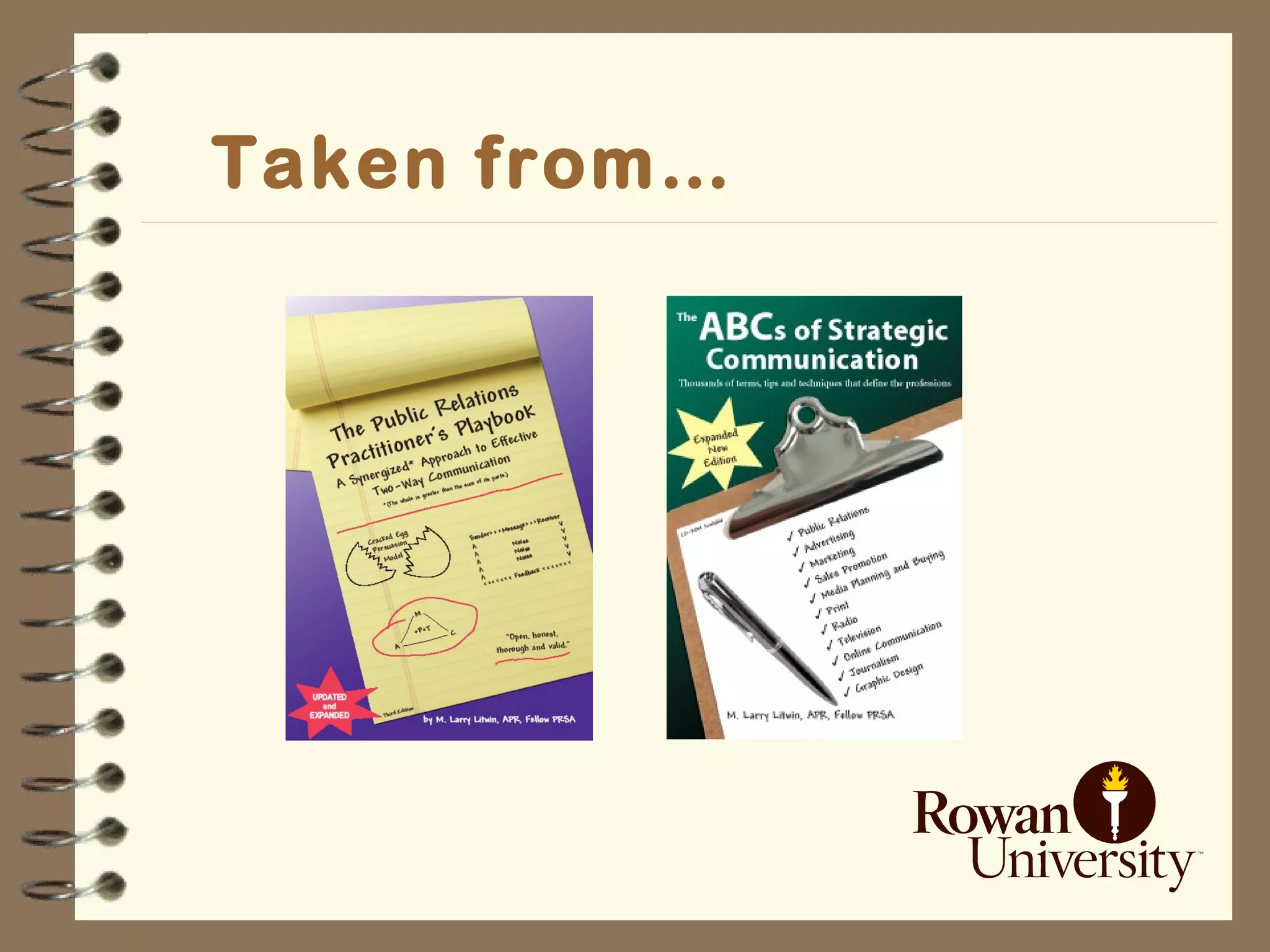
  Taken from… The Public Relations  Practitioner’s Playbook and   The ABCs
  Taken from…
 
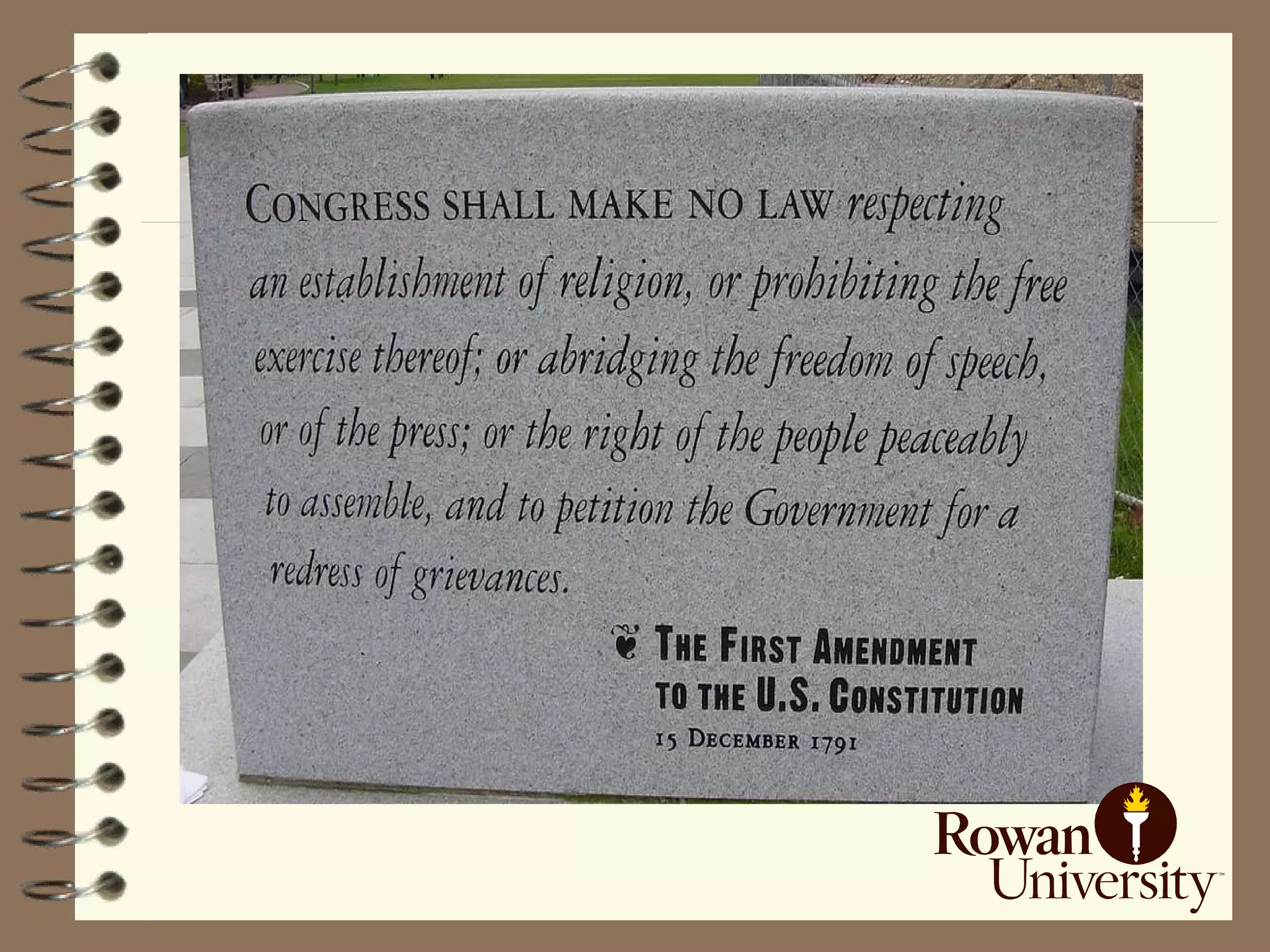
First Amendment C ongress shall make no law respecting an establishment of religion, or prohibiting the free exercise thereof; or abridging the freedom of speech, or of the press; or the right of the people peaceably to assemble, and to petition the government for a redress of grievances.
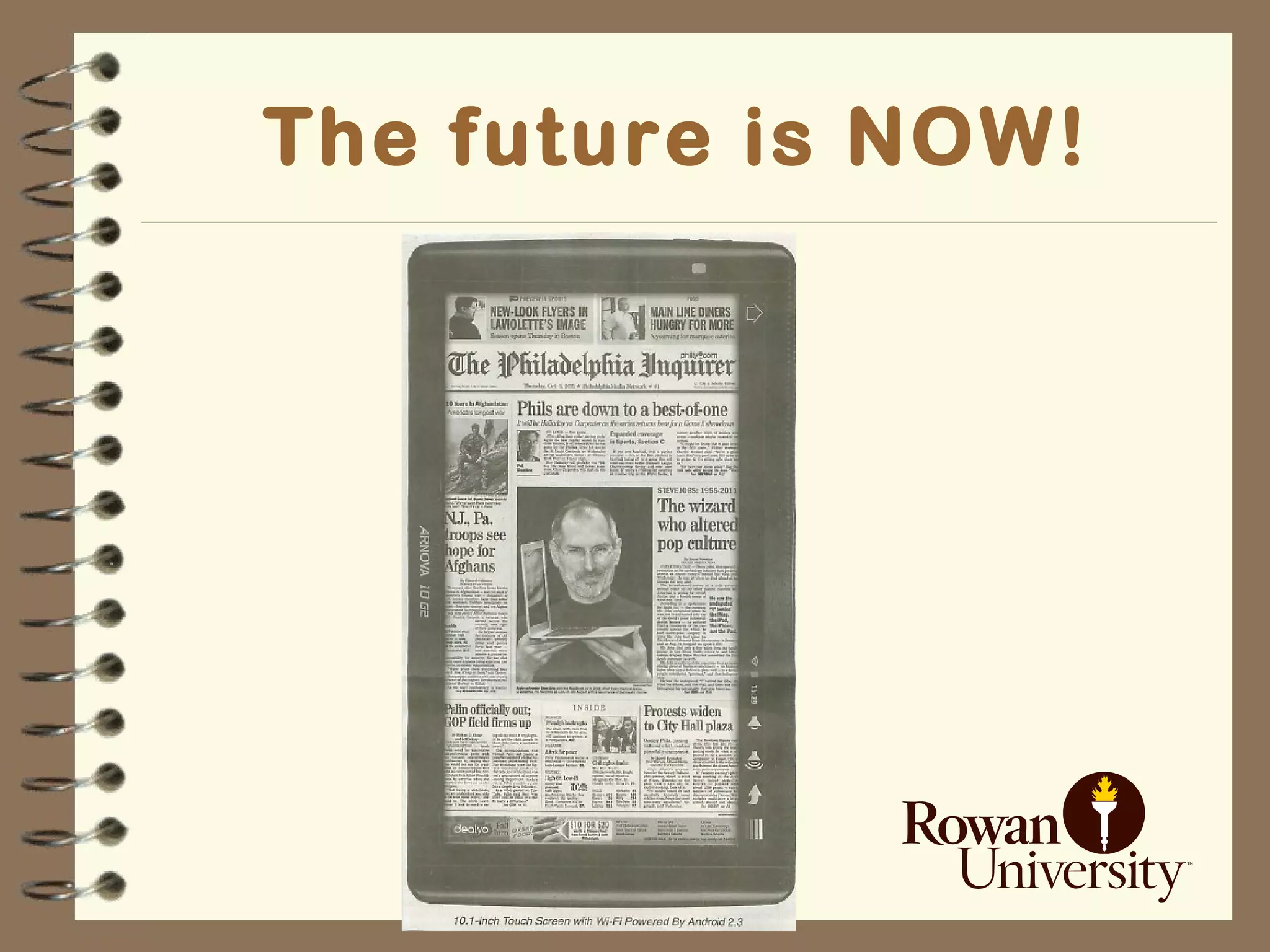
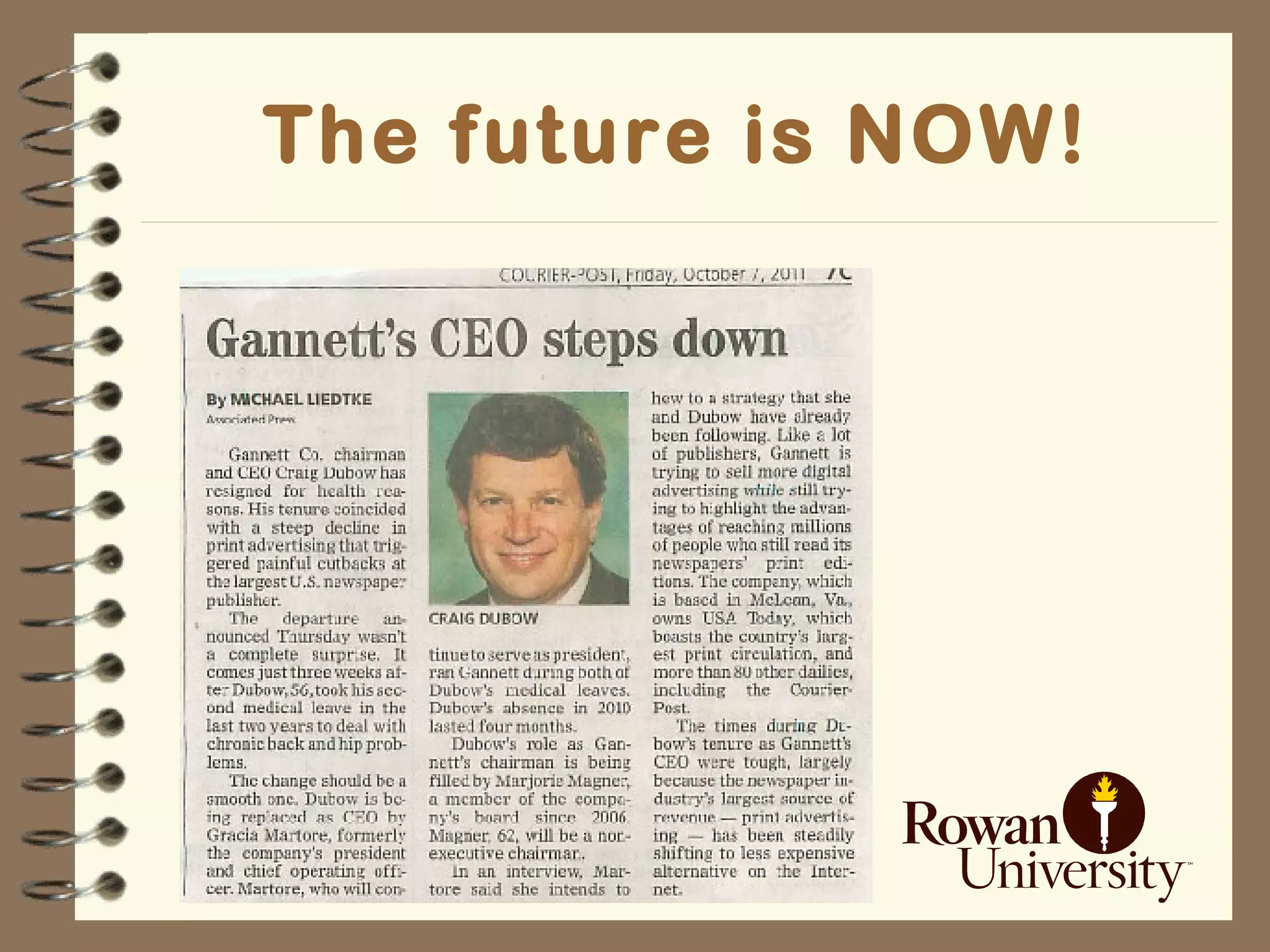
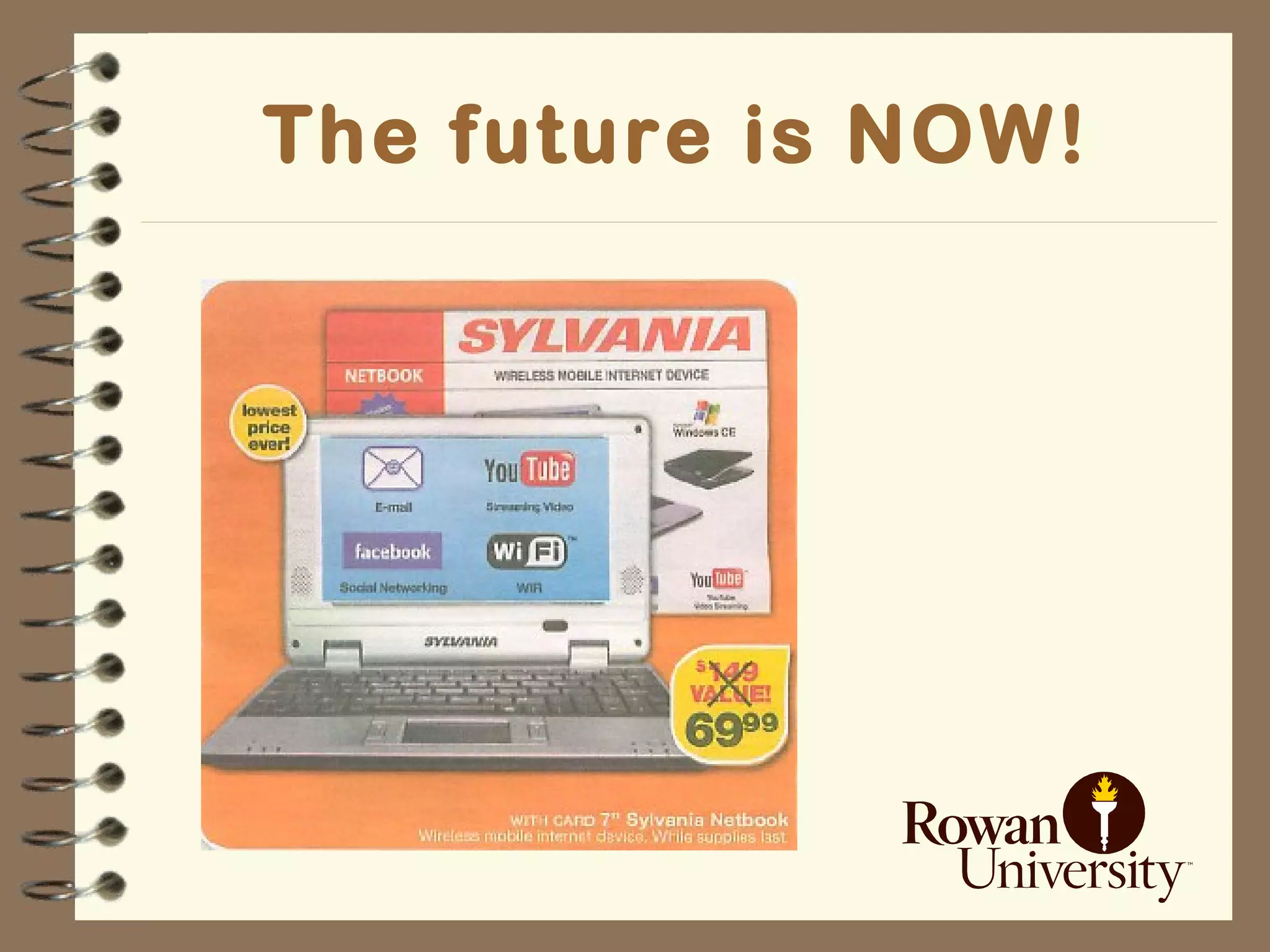
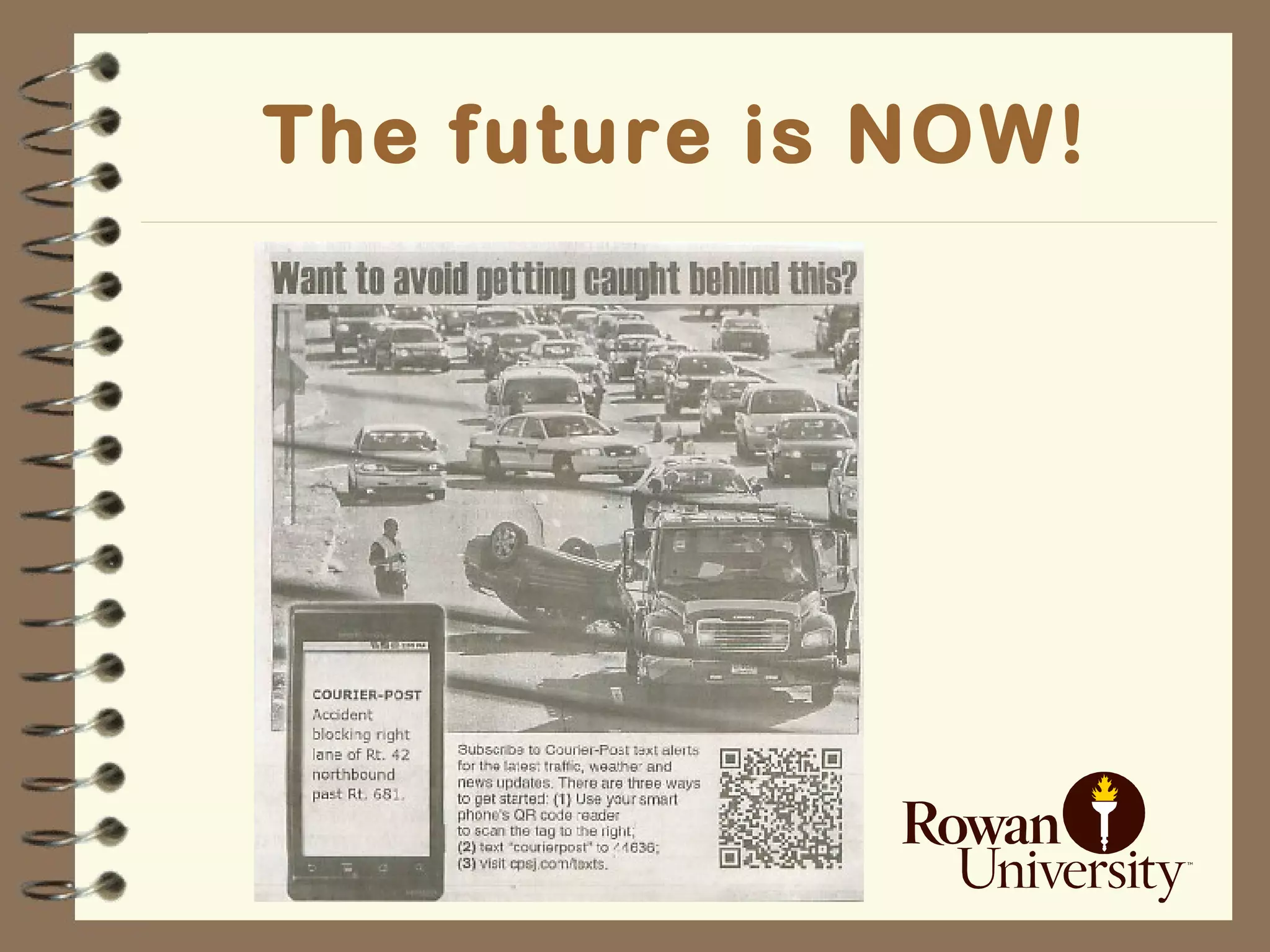
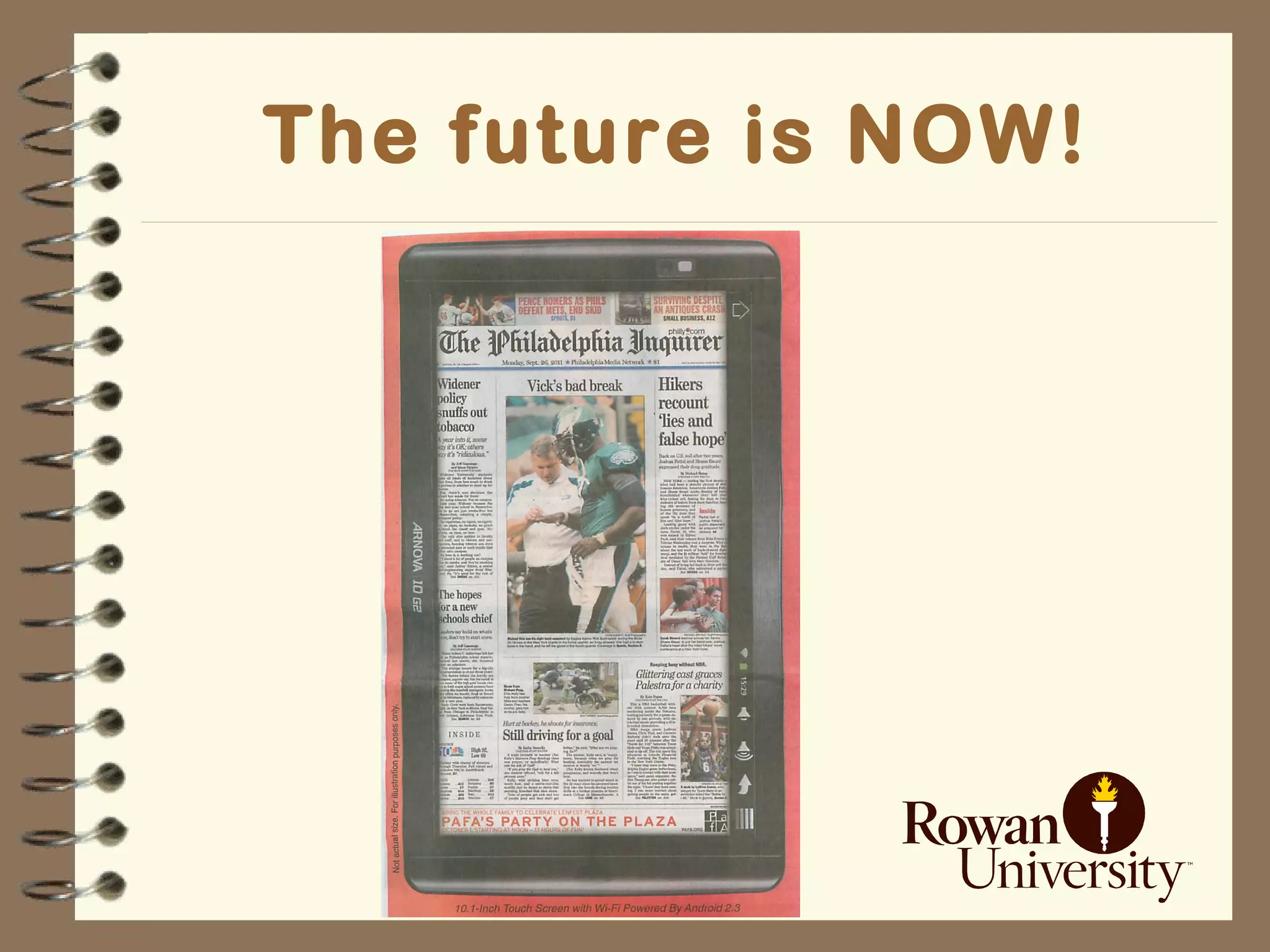
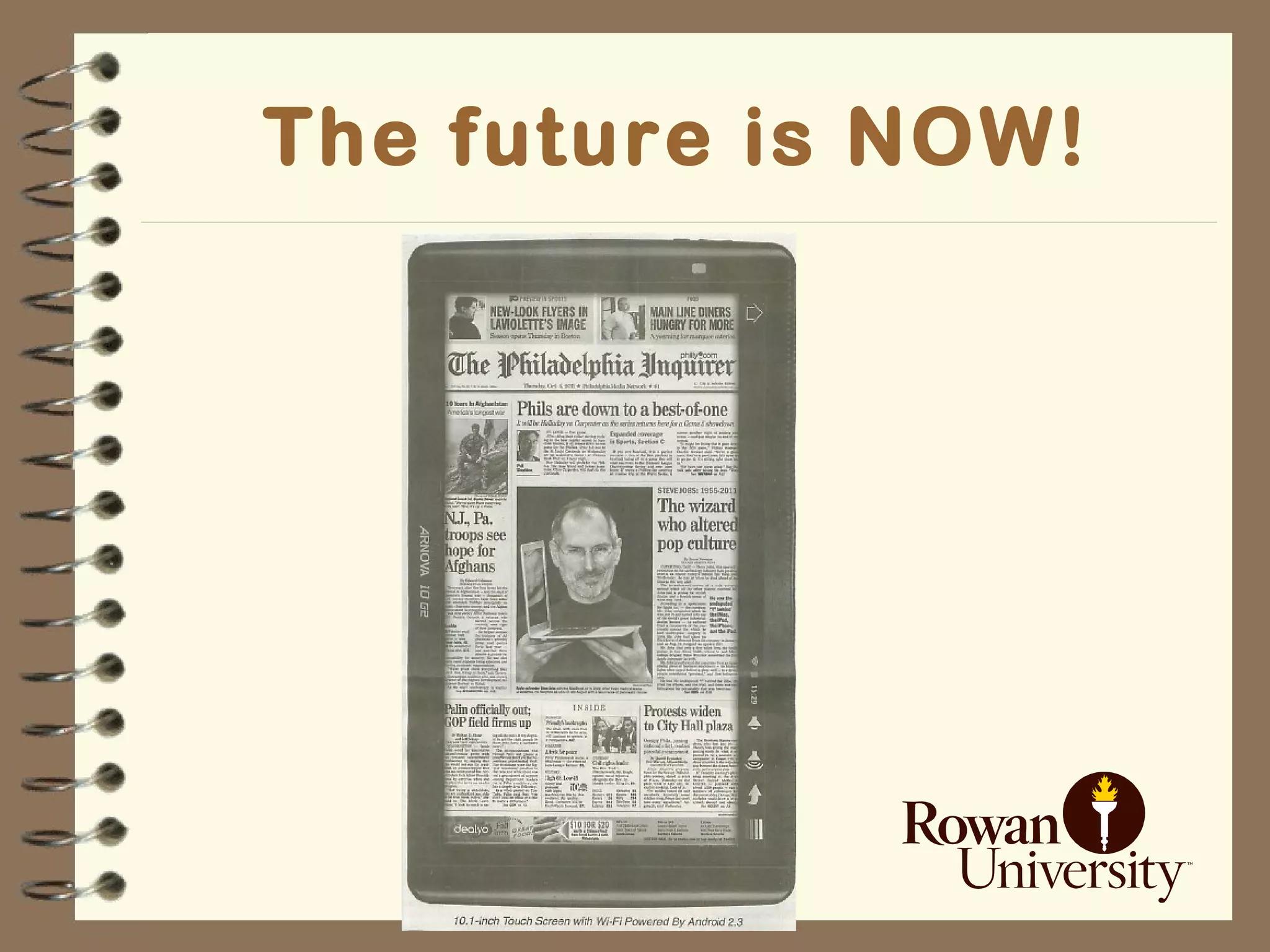
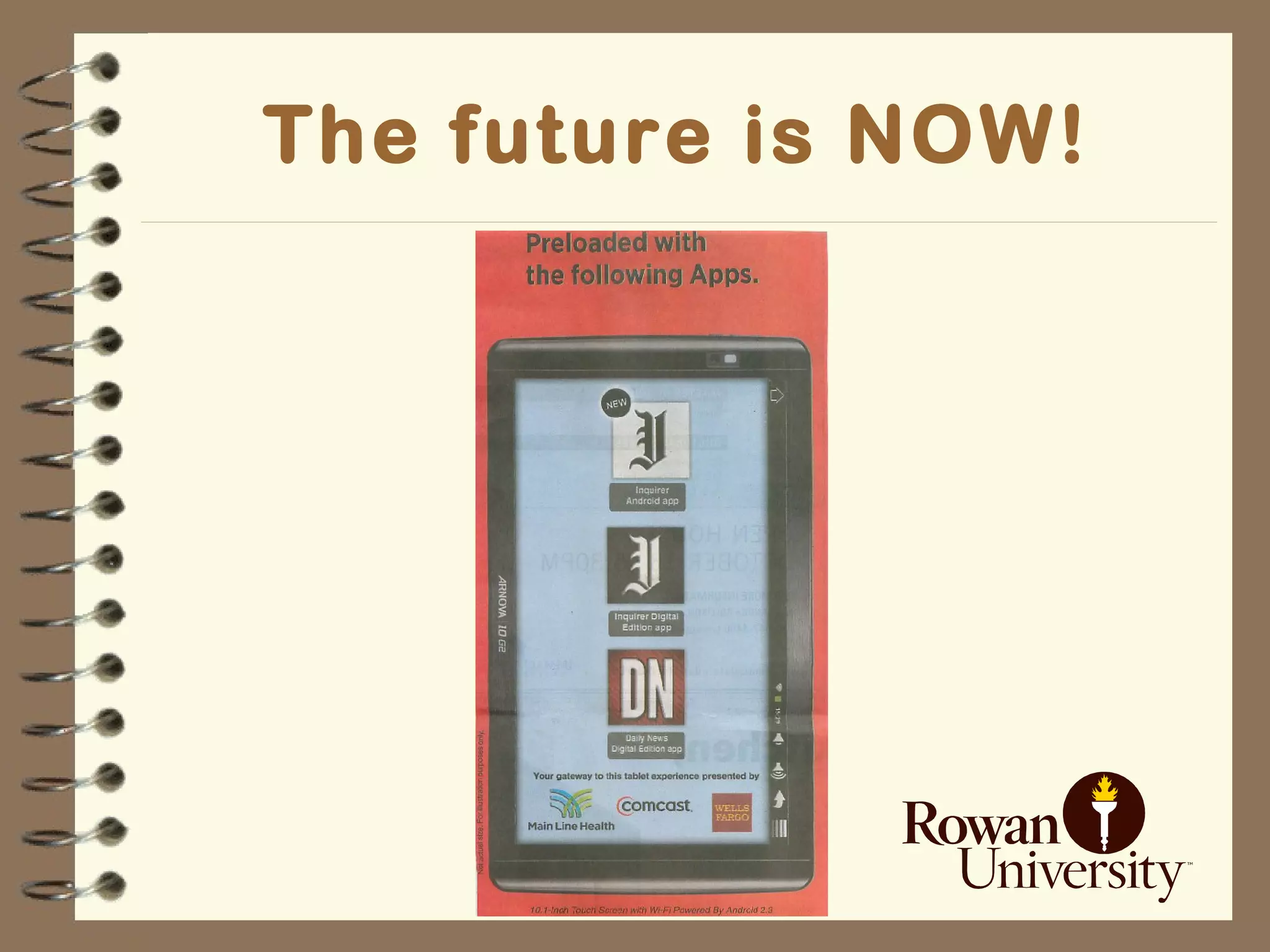
The future is NOW!
The future is NOW!
The future is NOW!
The future is NOW!
The future is NOW!
The future is NOW!
The future is NOW!
 
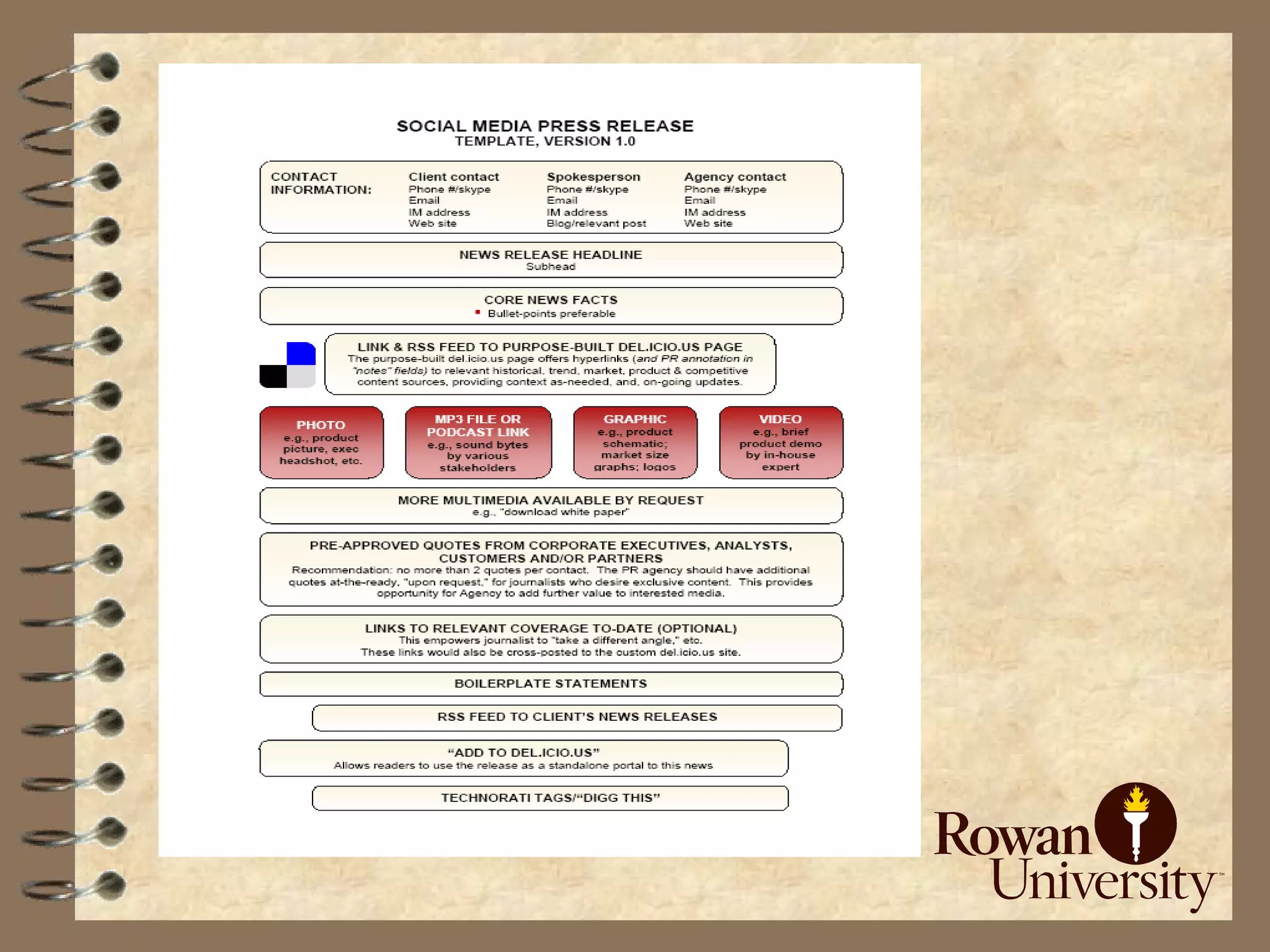
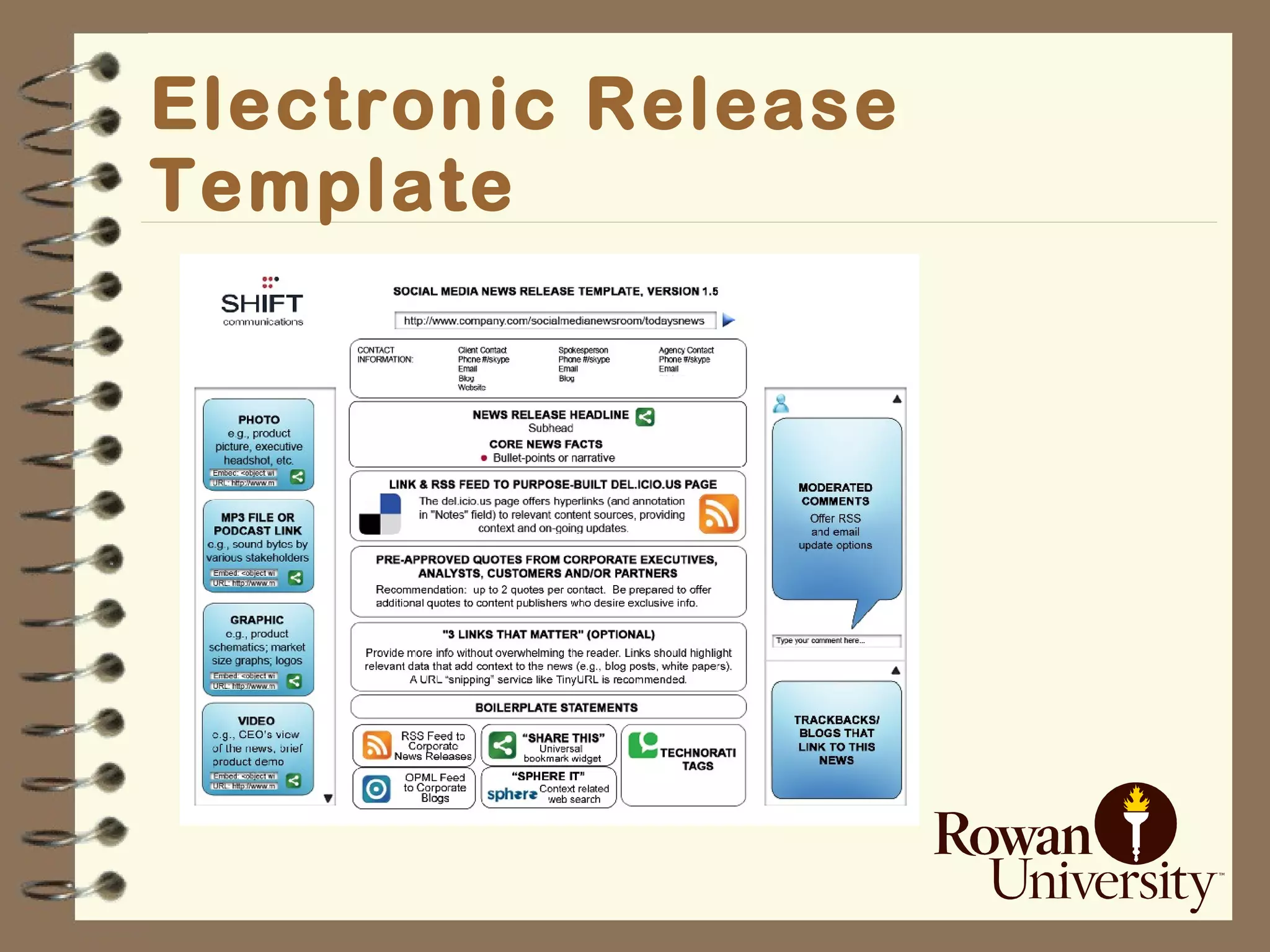
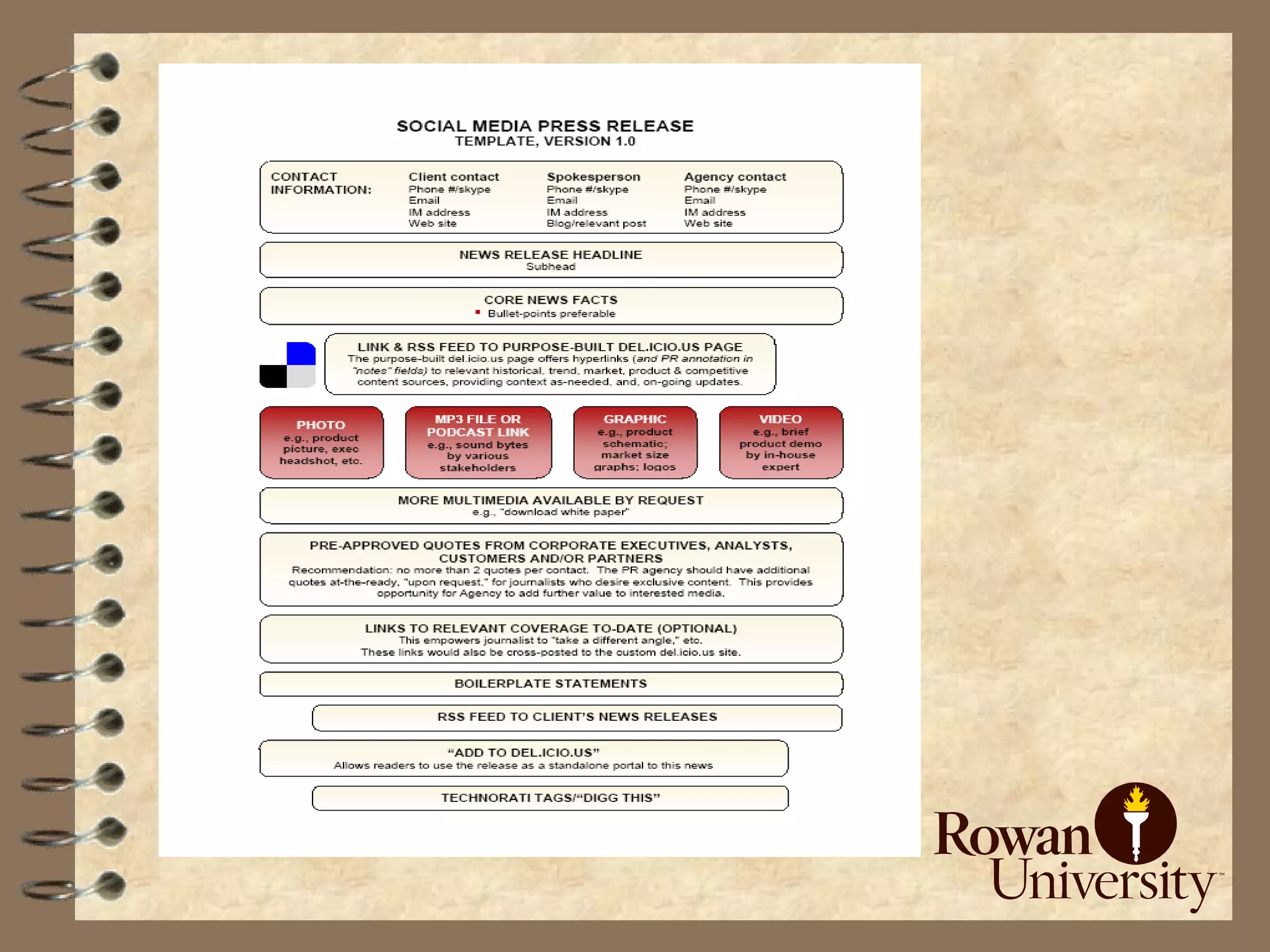
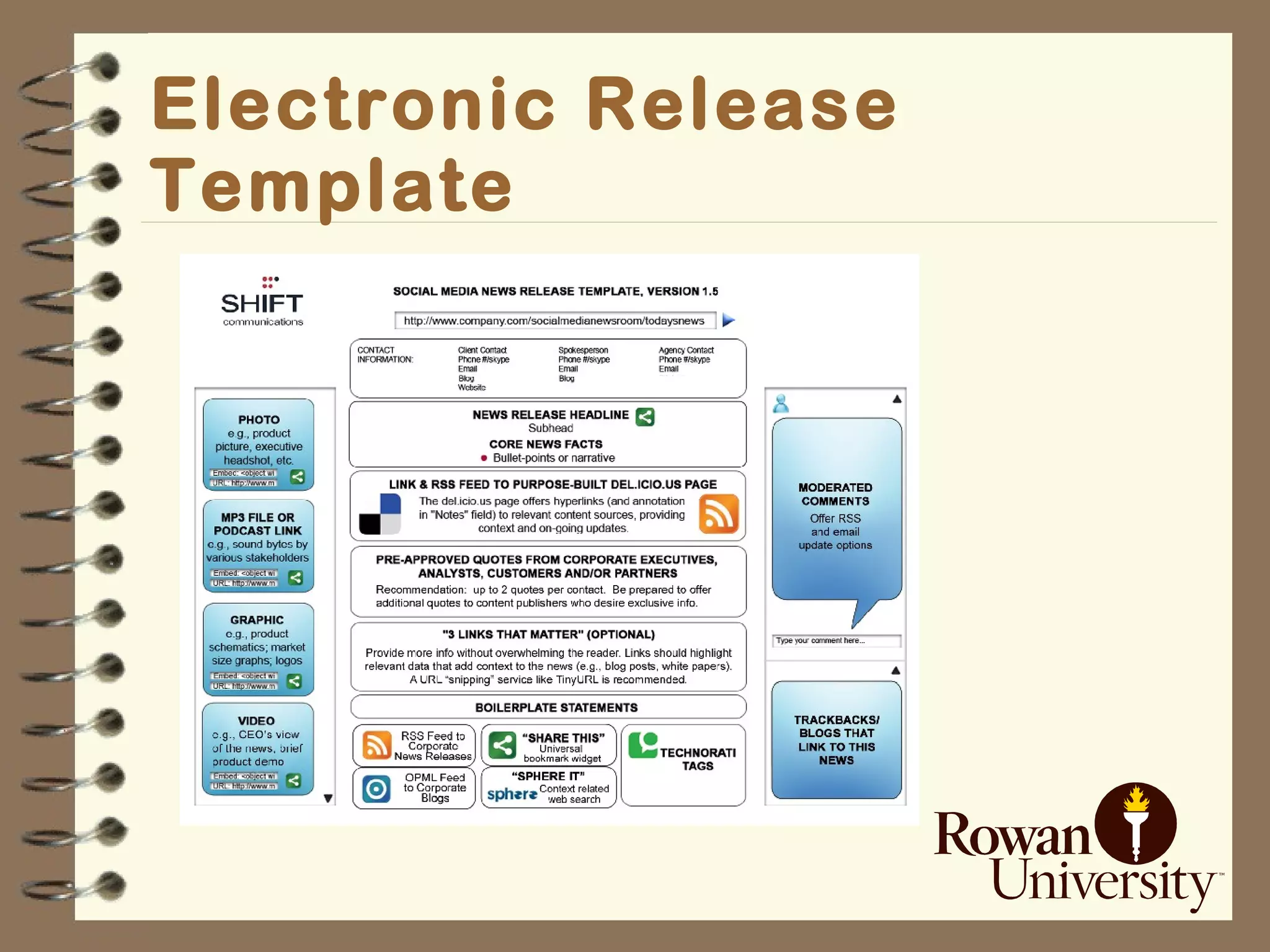
Electronic Release Template
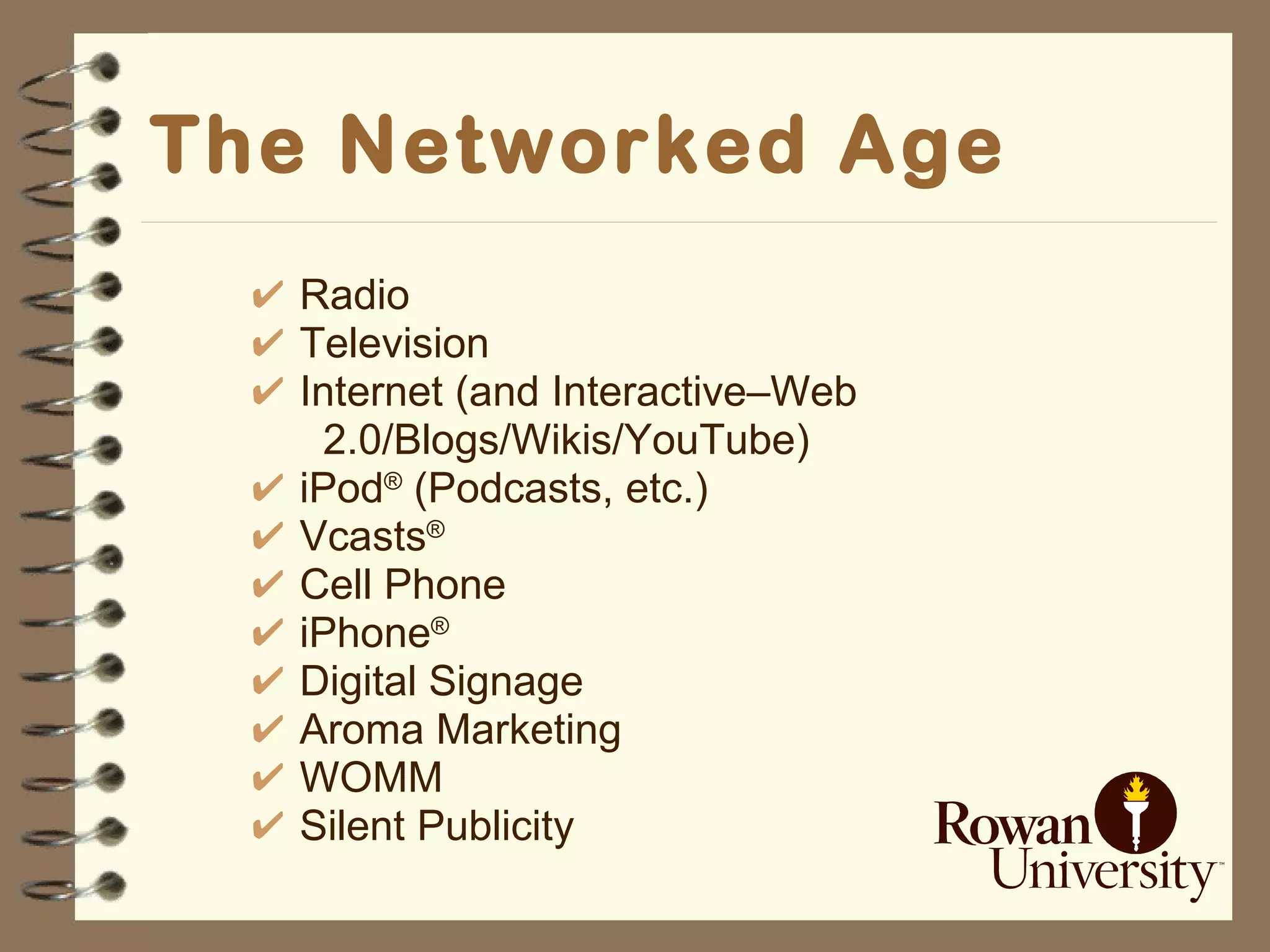
The Networked Age Radio Television Internet (and Interactive–Web  2.0/Blogs/Wikis/YouTube) iPod ®  (Podcasts, etc.) Vcasts ®   Cell Phone iPhone ®   Digital Signage Aroma Marketing WOMM Silent Publicity
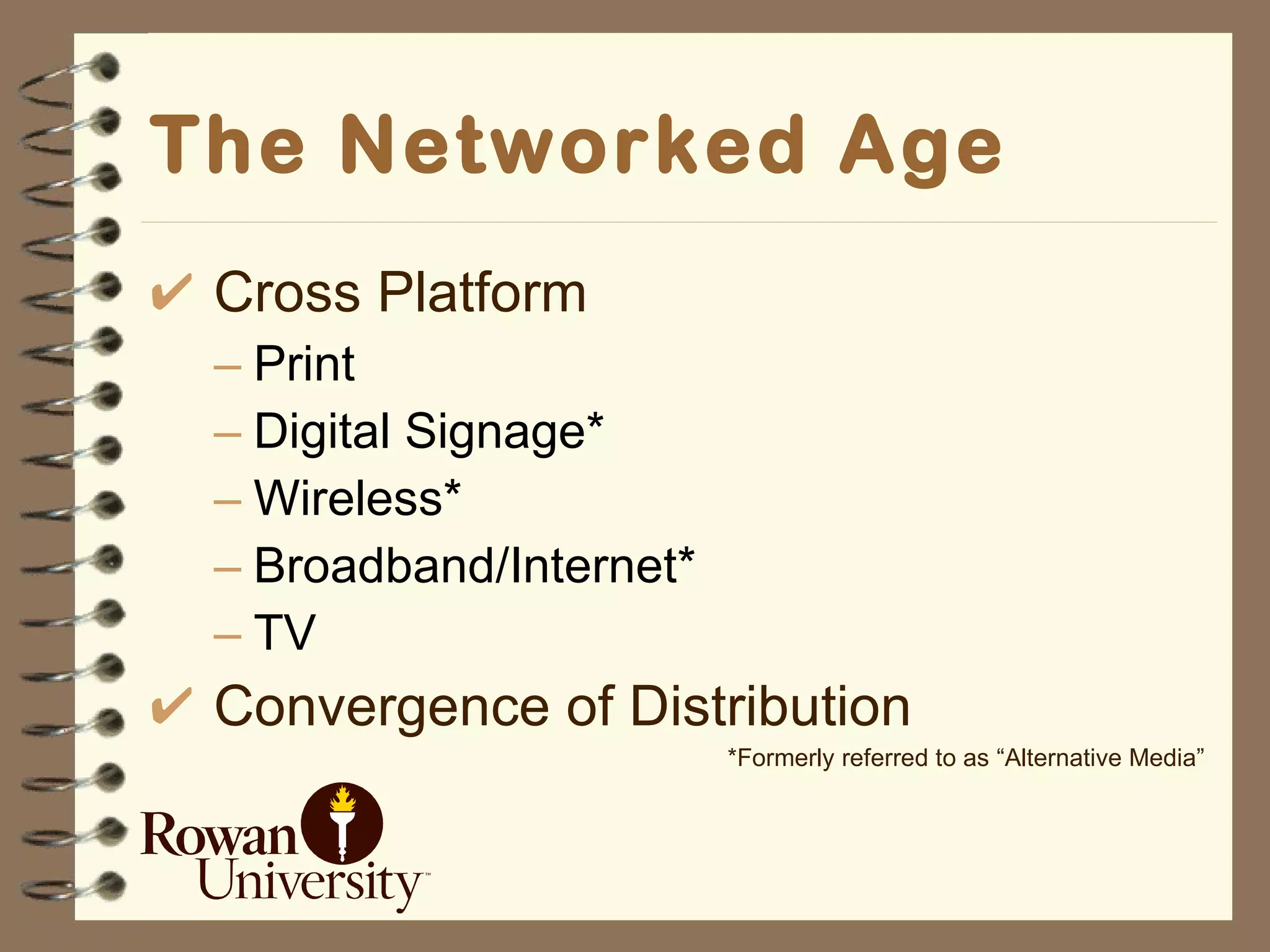
The Networked Age Cross Platform Print Digital Signage* Wireless* Broadband/Internet* TV Convergence of Distribution *Formerly referred to as “Alternative Media”
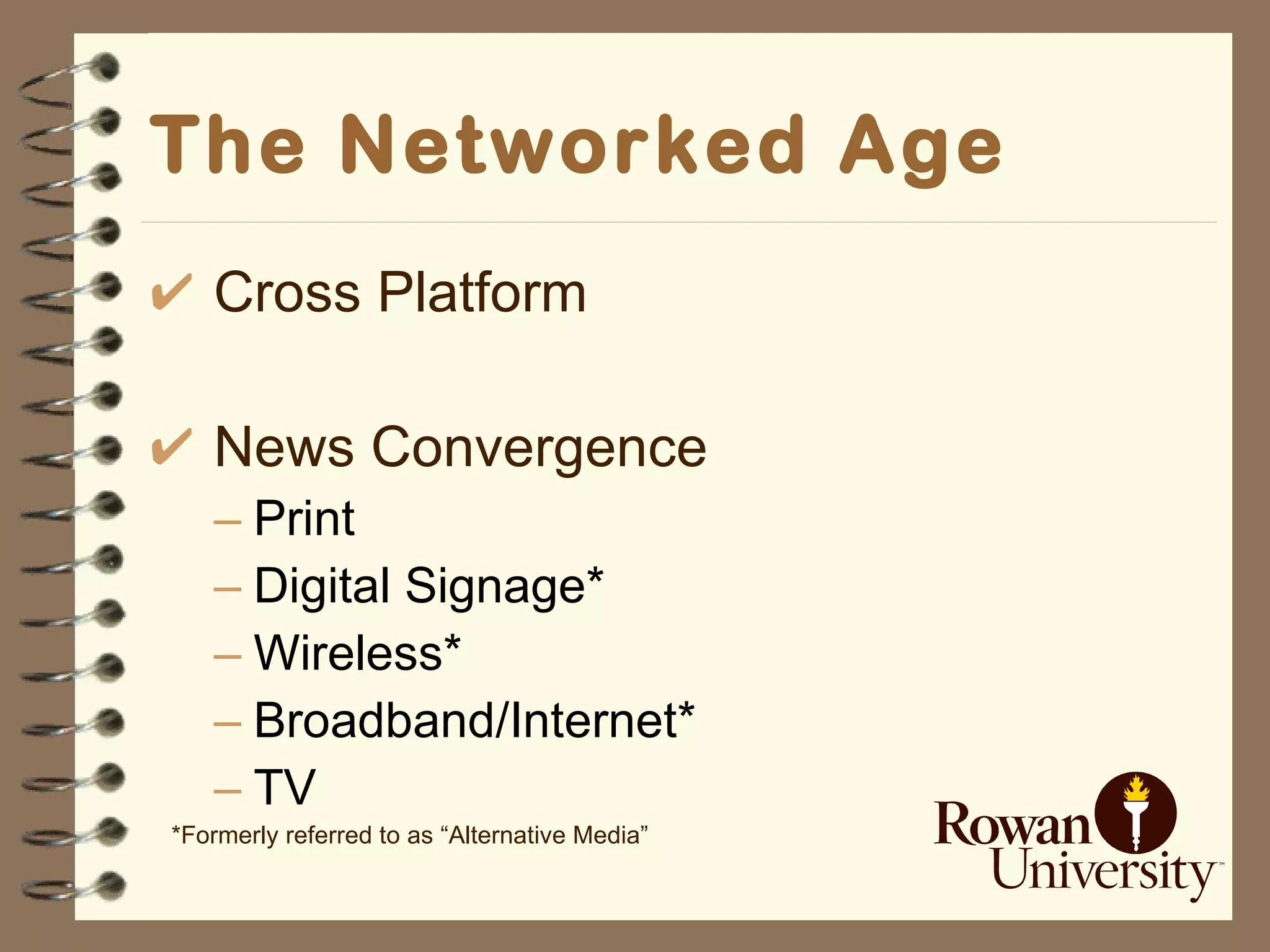
The Networked Age Cross Platform News Convergence Print Digital Signage* Wireless* Broadband/Internet* TV *Formerly referred to as “Alternative Media”
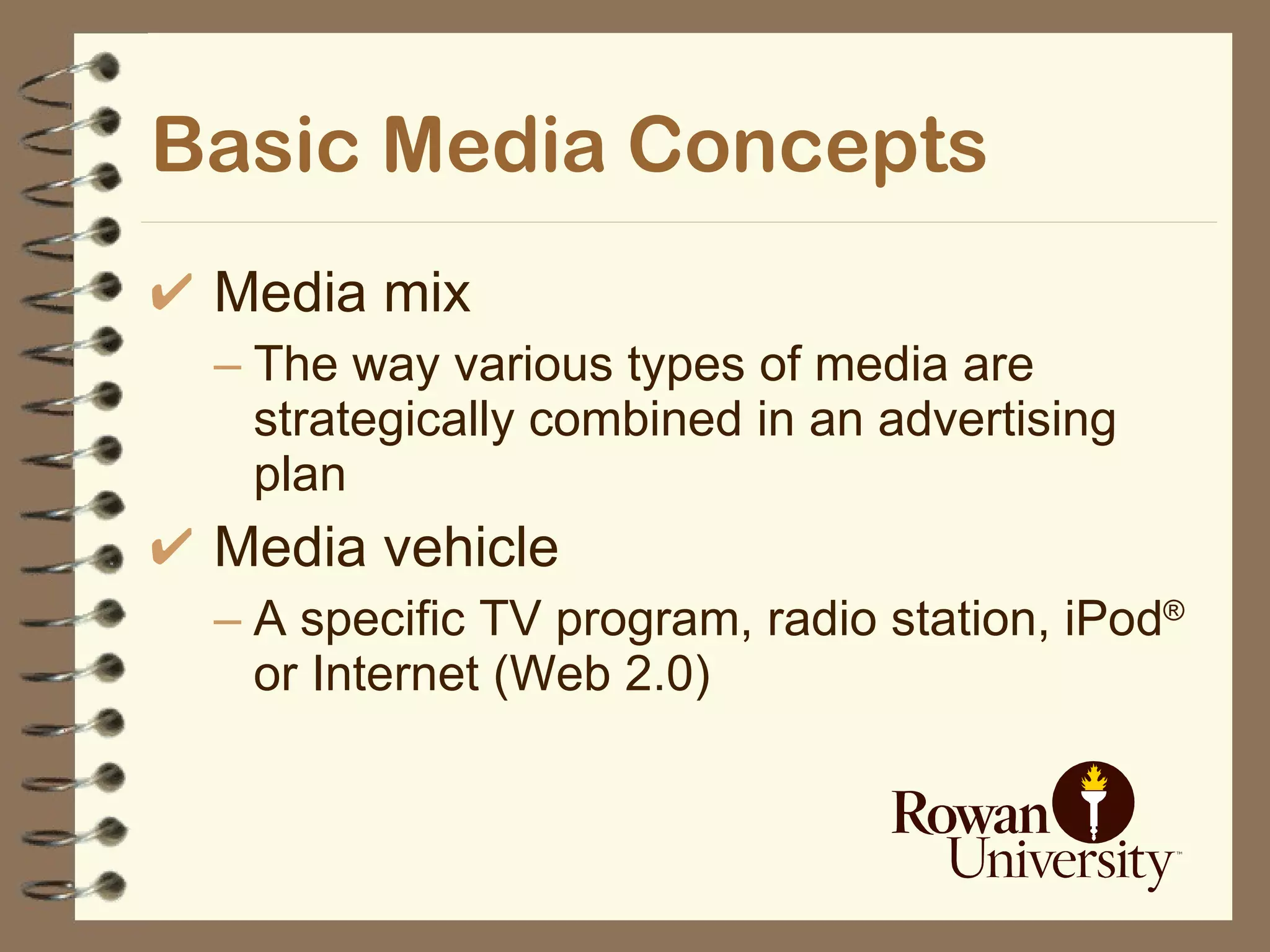
Basic Media Concepts Media mix The way various types of media are strategically combined in an advertising plan Media vehicle A specific TV program, radio station, iPod ®  or Internet (Web 2.0)
 
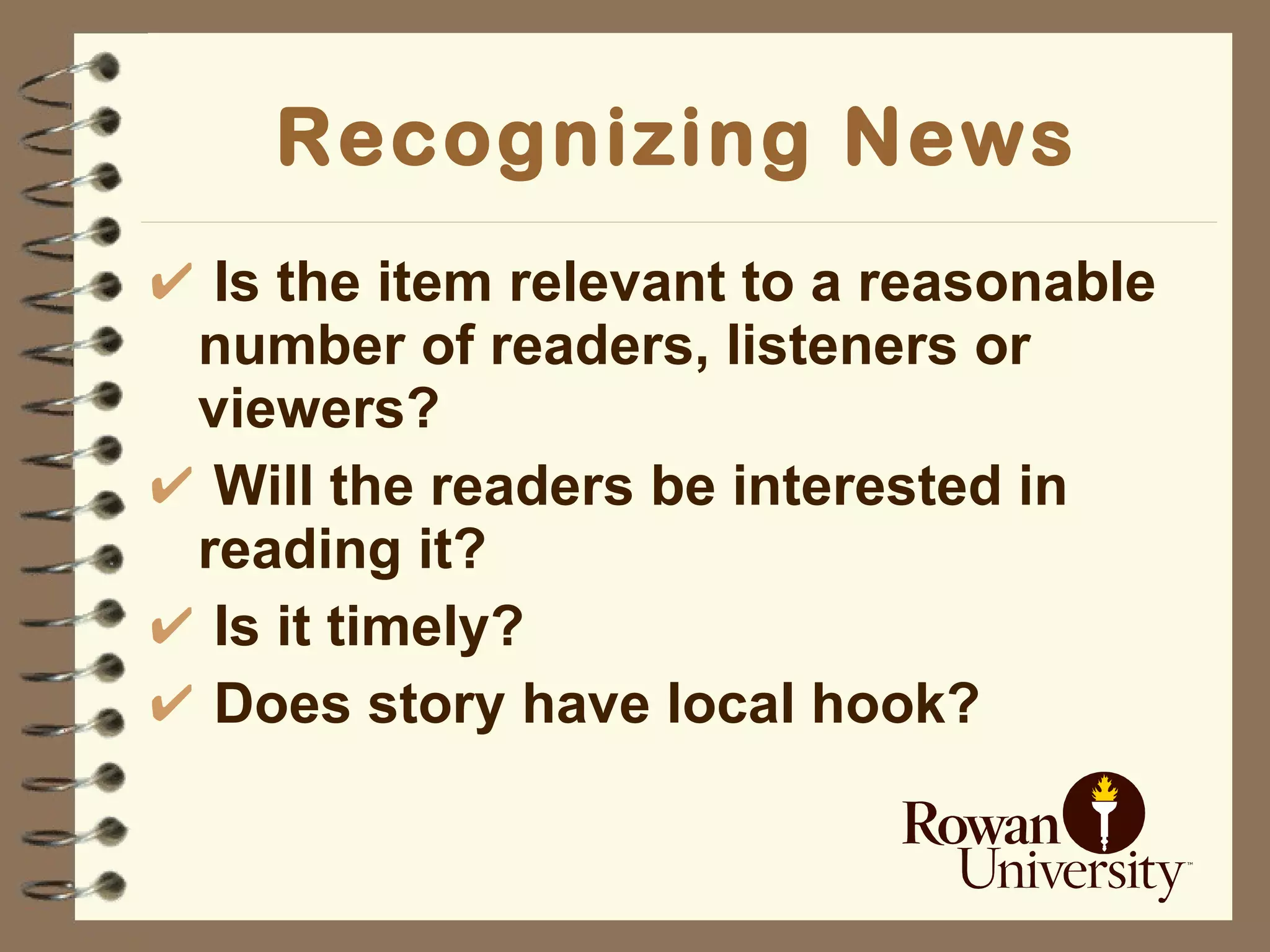
Recognizing News Is the item relevant to a reasonable  number of readers, listeners or viewers? Will the readers be interested in reading it? Is it timely? Does story have local hook?
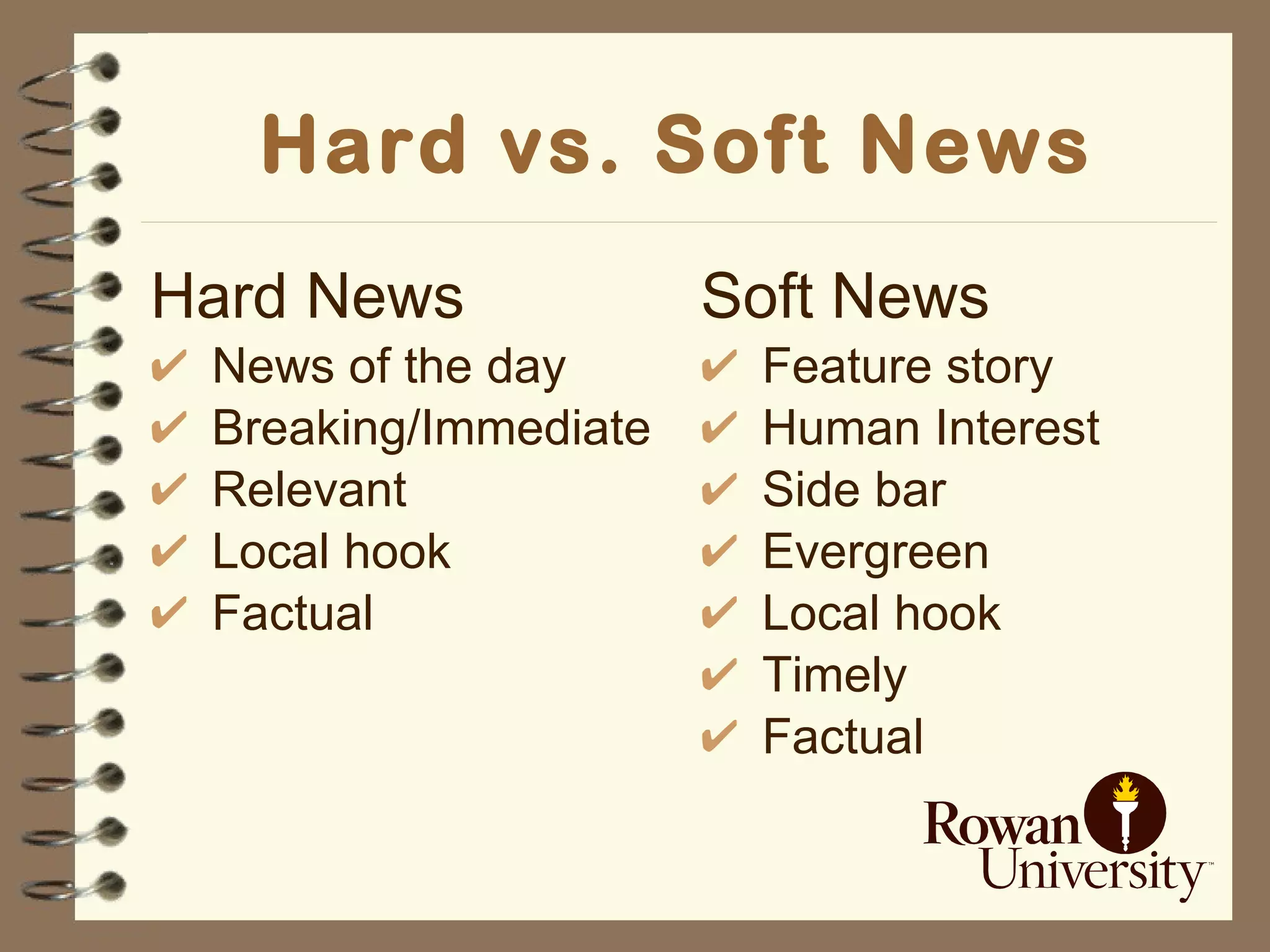
Hard vs. Soft News Hard News News of the day Breaking/Immediate Relevant  Local hook Factual Soft News Feature story Human Interest Side bar Evergreen Local hook Timely Factual
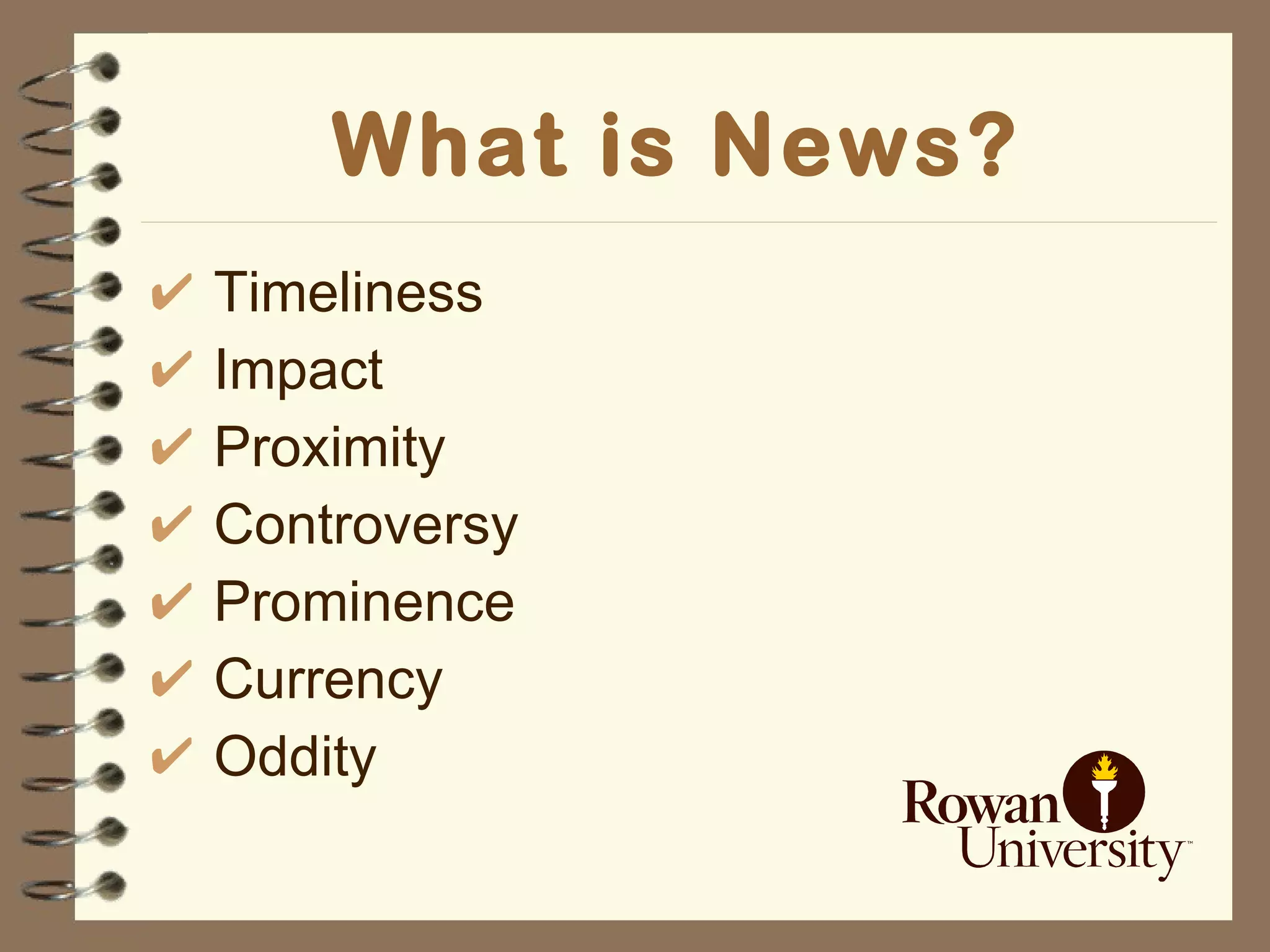
What is News? Timeliness Impact Proximity Controversy Prominence Currency Oddity
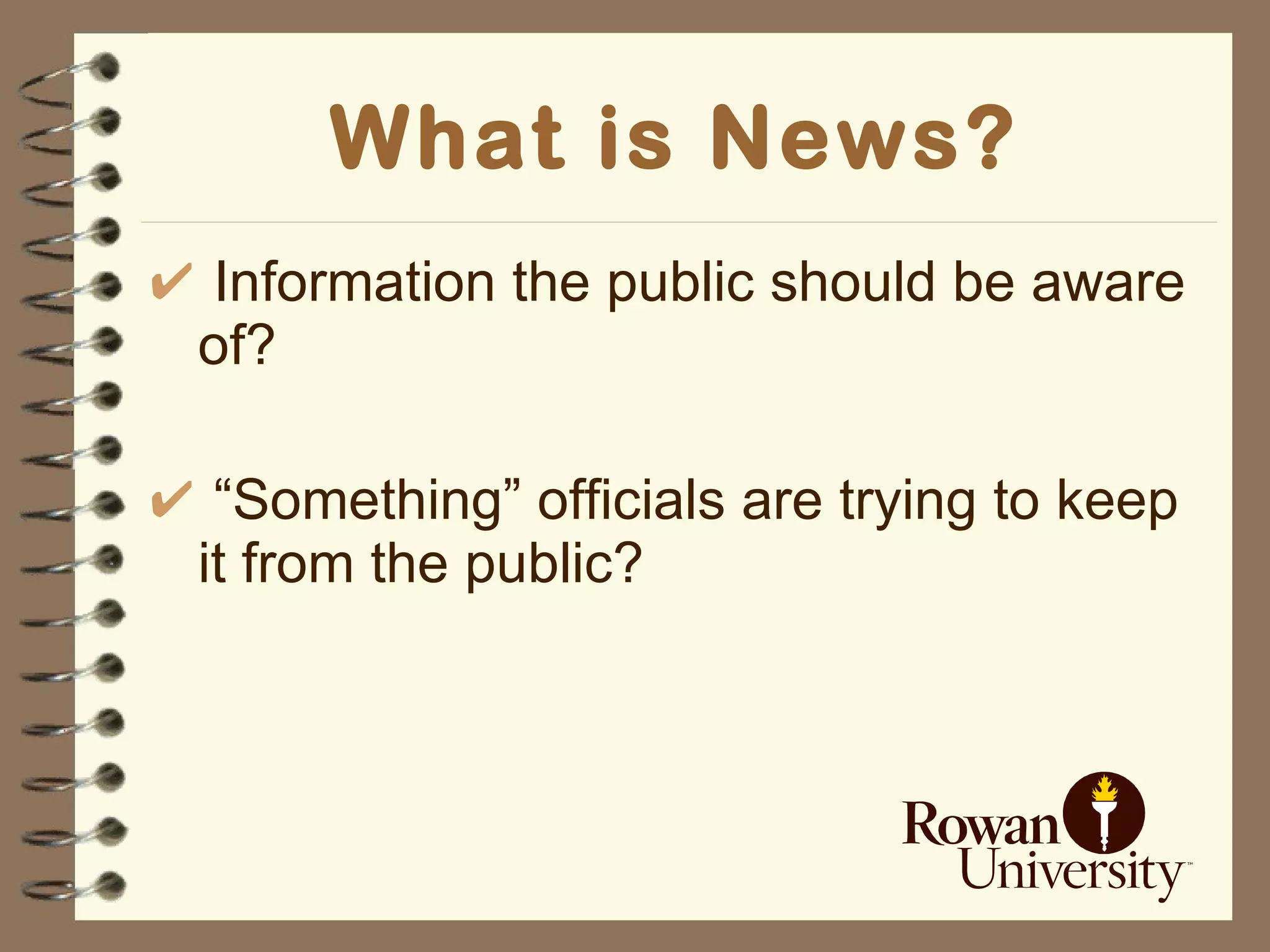
  What is News?   Information the public should be aware of? “ Something” officials are trying to keep it from the public?
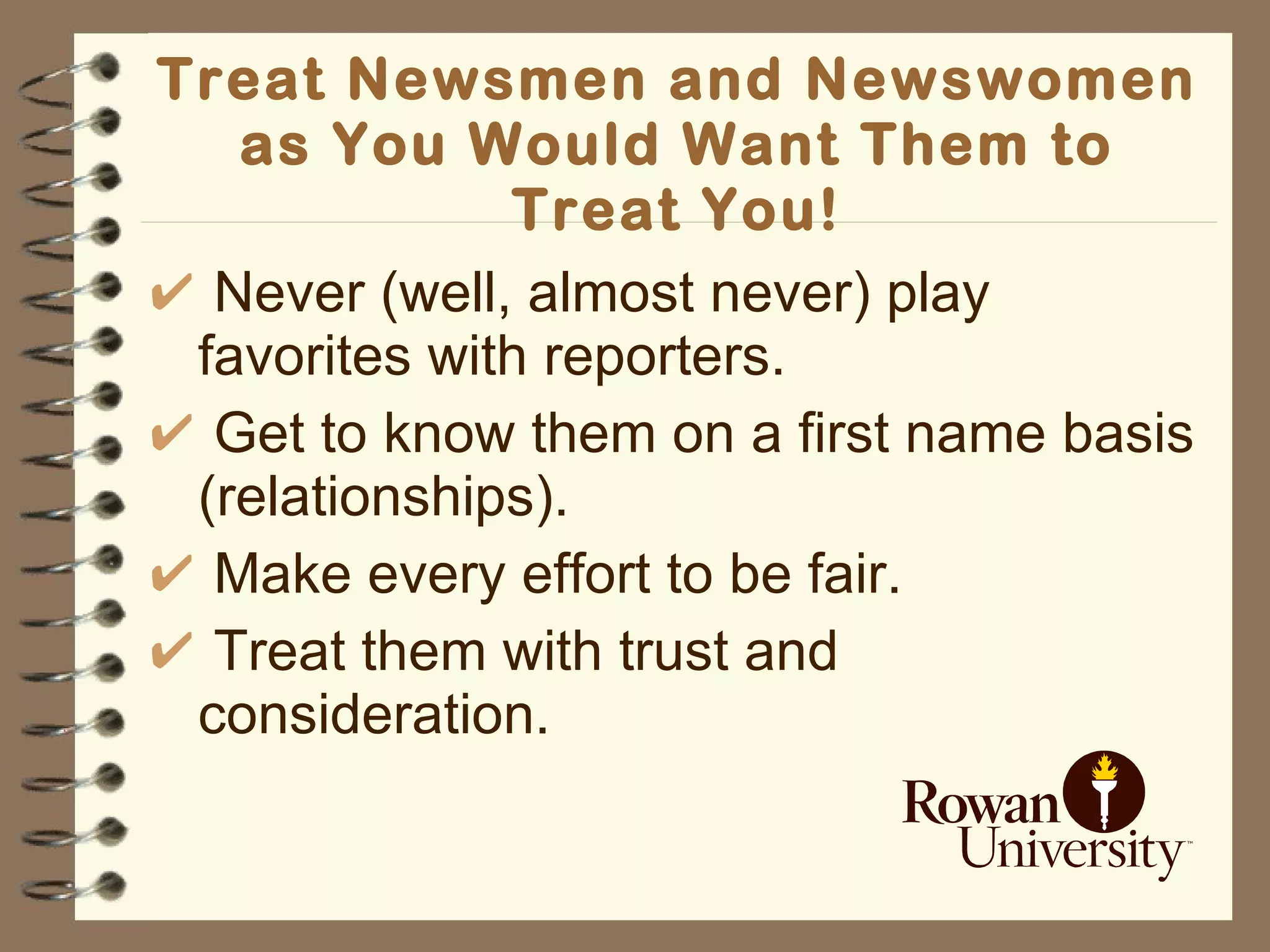
Treat Newsmen and Newswomen as You Would Want Them to Treat You! Never (well, almost never) play favorites with reporters. Get to know them on a first name basis (relationships). Make every effort to be fair. Treat them with trust and consideration.
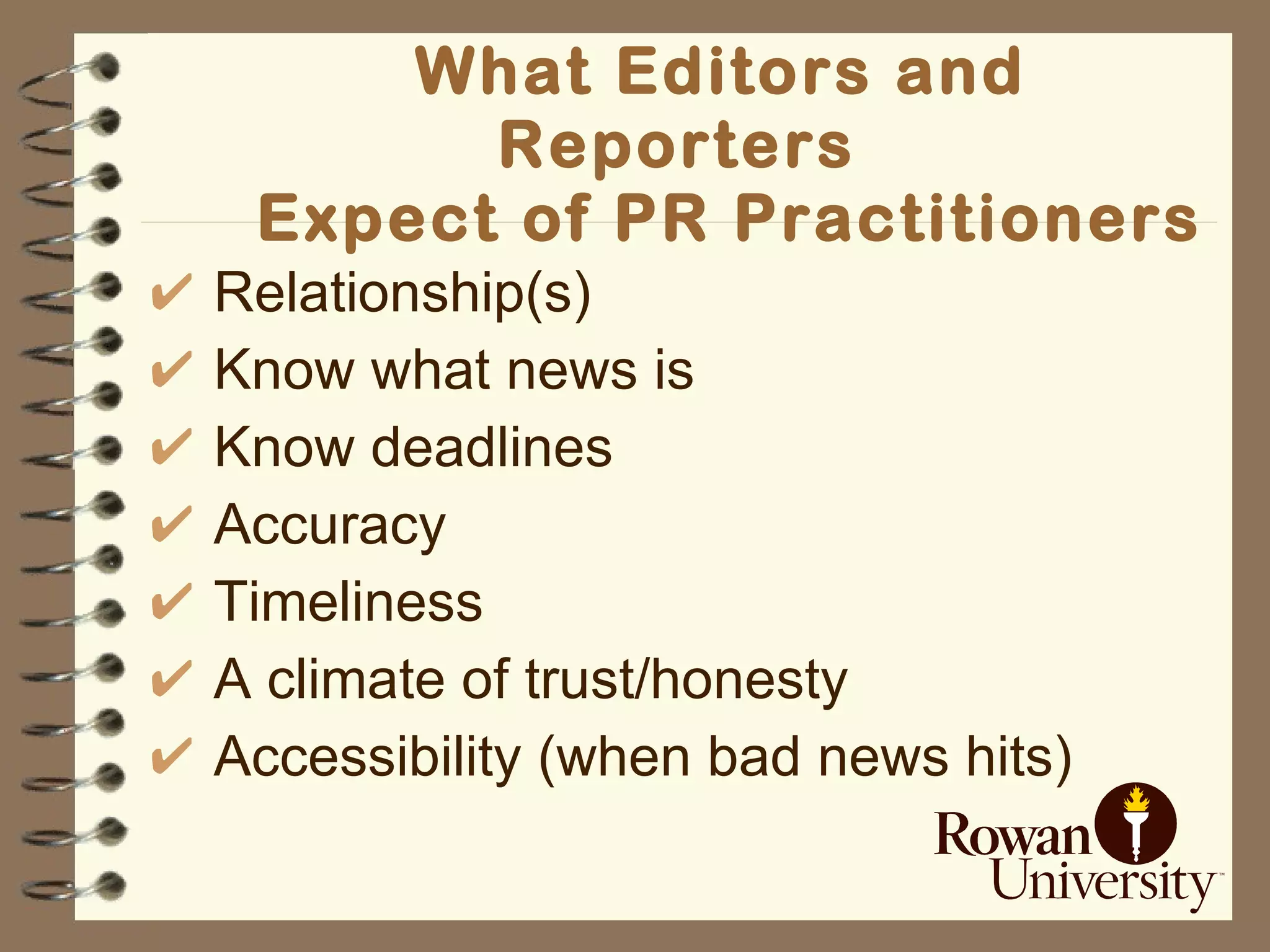
What Editors and Reporters   Expect of PR Practitioners Relationship(s)   Know what news is   Know deadlines   Accuracy   Timeliness   A  climate of trust/honesty Accessibility (when bad news hits)
Establish a Media Policy Truthful Factual Admit problems and mistakes Responsibility
Recent Examples Daily News Rowan  The   Whit KYW Newsradio – CBS
What’s the Difference? Off the Record Not for Attribution For Background Only PR Play 9-3 (Page 276) The Public Relations Practitioner’s Playbook
On the Record – Off the Record Know the rules. Be certain the reporter knows the rules. Avoid casual comments at all times. PR Play 9-3 (Page 276) The Public Relations Practitioner’s Playbook
Not for Attribution   Know the rules. Be certain the reporter knows the rules. Anonymous. (Be careful) PR Play 9-3 (Page 276) The Public Relations Practitioner’s Playbook
For Background Only   Know the rules. Be certain the reporter knows the rules. Avoid casual comments at all times. PR Play 9-3 (Page 276) The Public Relations Practitioner’s Playbook
Getting Coverage In Print and  On The Air Get to know your local media Develop relationships The “Beat” System Know how to “pitch” Supply information Tell the truth Rejection
Why Hold a News Conference? To announce item of significant impact. Major product announcement. To explain complex issues. To introduce a new chief executive. PR Play 9-5 (Page 270) The Public Relations Practitioner’s Playbook
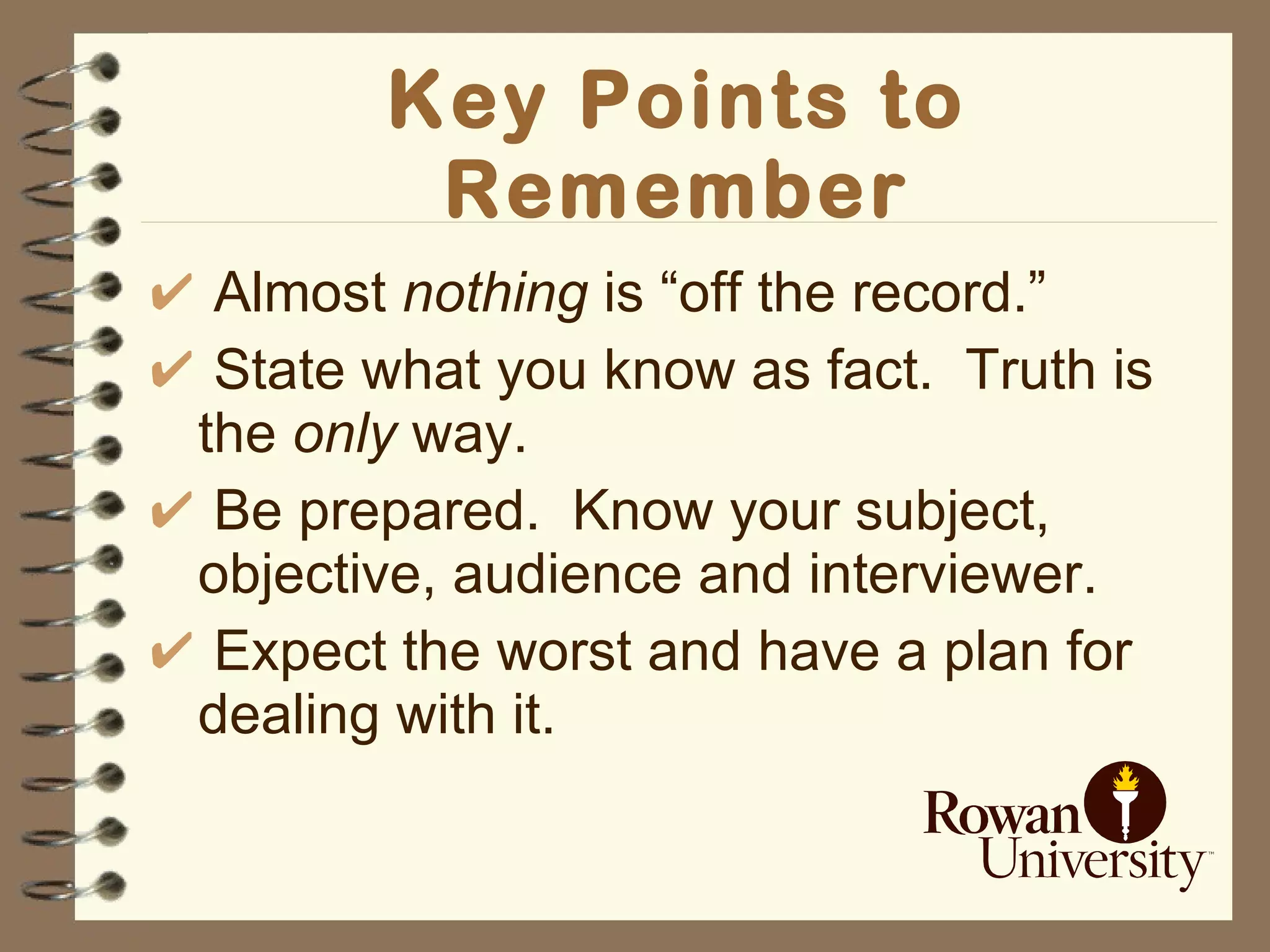
Key Points to Remember Almost  nothing  is “off the record.” State what you know as fact.  Truth is the  only  way. Be prepared.  Know your subject, objective, audience and interviewer. Expect the worst and have a plan for dealing with it.
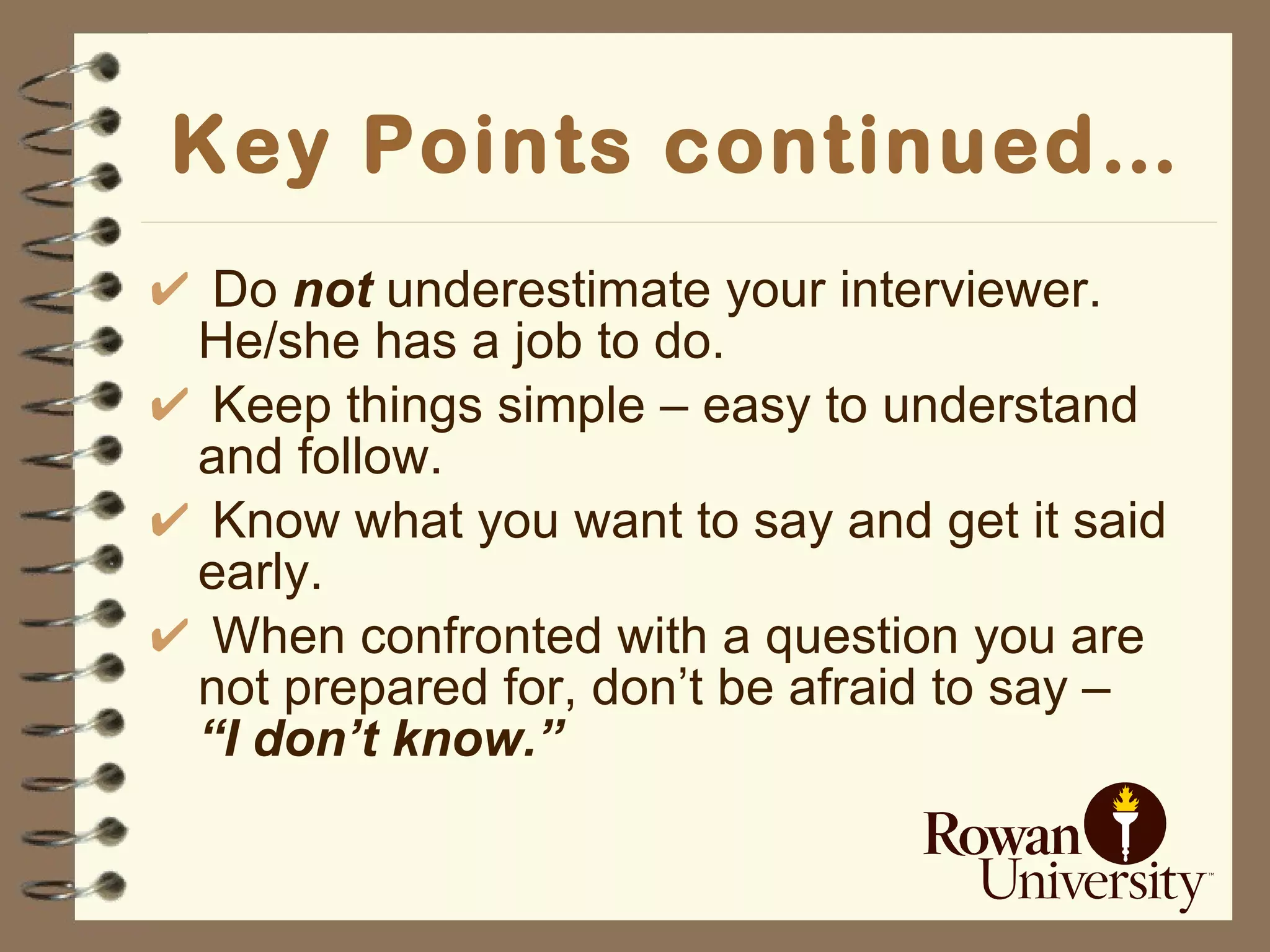
Key Points continued… Do  not  underestimate your interviewer.  He/she has a job to do. Keep things simple – easy to understand and follow. Know what you want to say and get it said early. When confronted with a question you are not prepared for, don’t be afraid to say –  “I don’t know.”
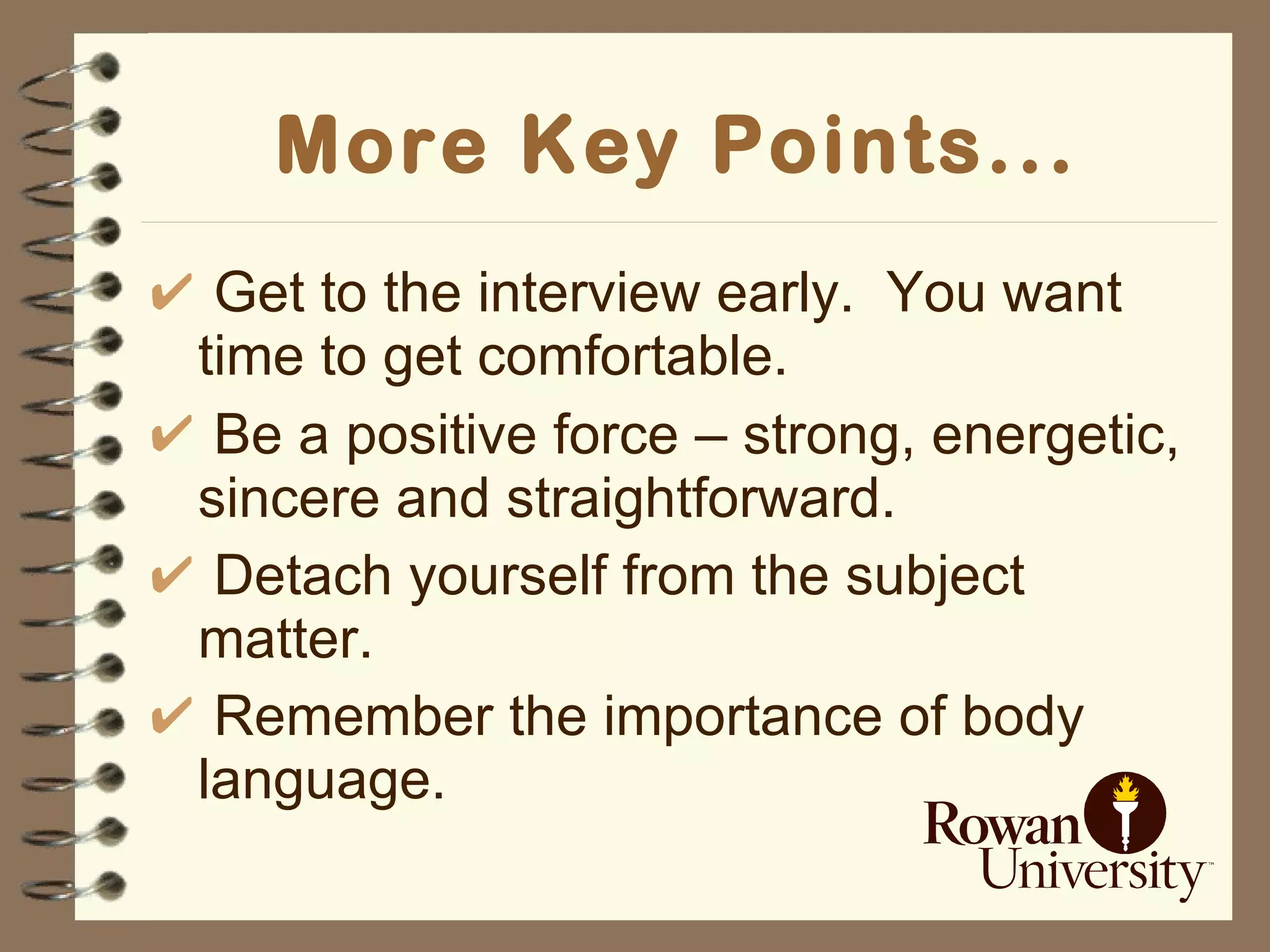
More Key Points... Get to the interview early.  You want time to get comfortable. Be a positive force  –  strong, energetic, sincere and straightforward. Detach yourself from the subject matter. Remember the importance of body language.
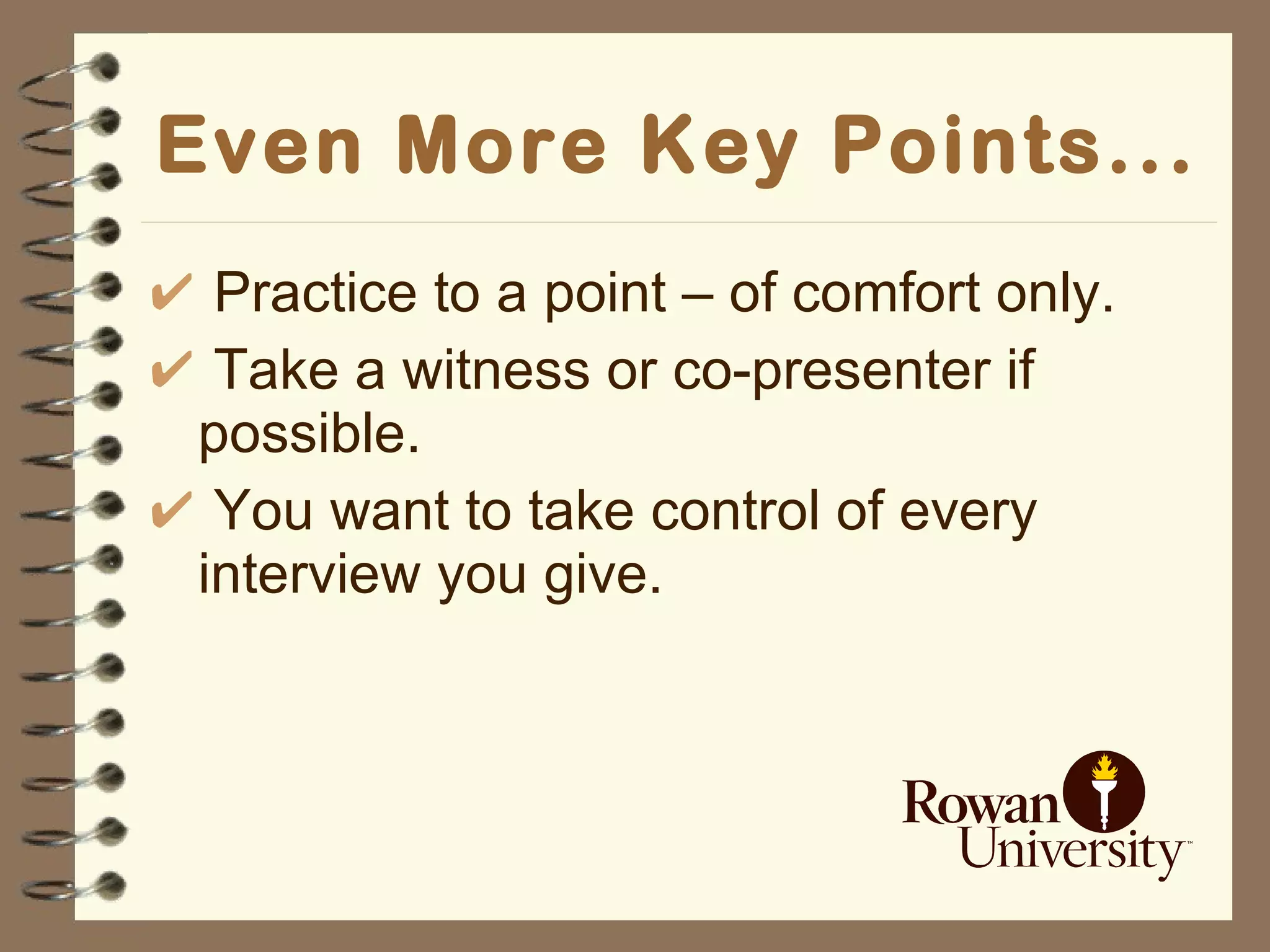
Even More Key Points... Practice to a point – of comfort only. Take a witness or co-presenter if possible. You want to take control of every interview you give.
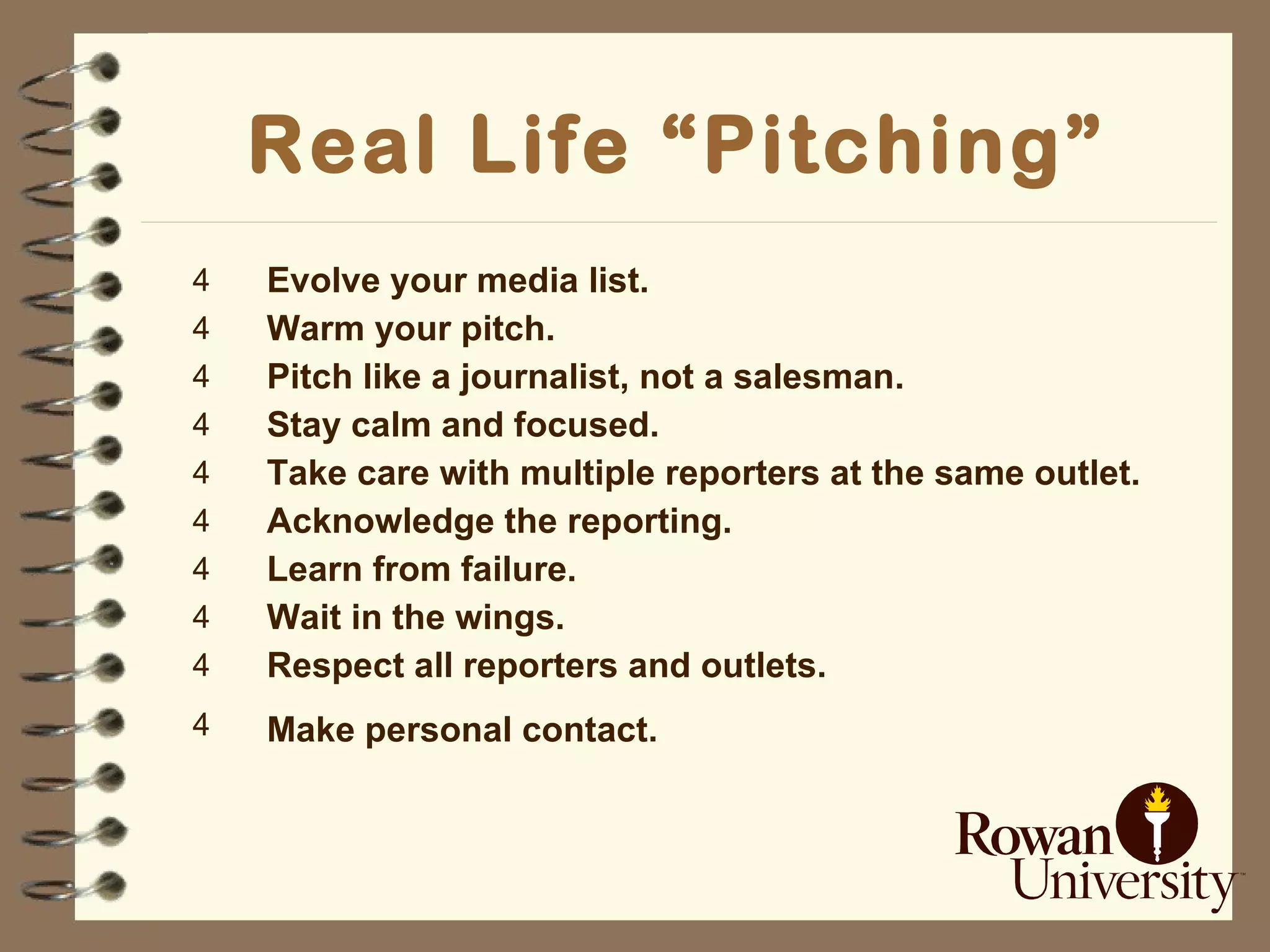
Real Life “Pitching” Evolve your media list.   Warm your pitch.   Pitch like a journalist, not a salesman.   Stay calm and focused.  Take care with multiple reporters at the same outlet. Acknowledge the reporting.   Learn from failure.  Wait in the wings.   Respect all reporters and outlets.  Make personal contact.
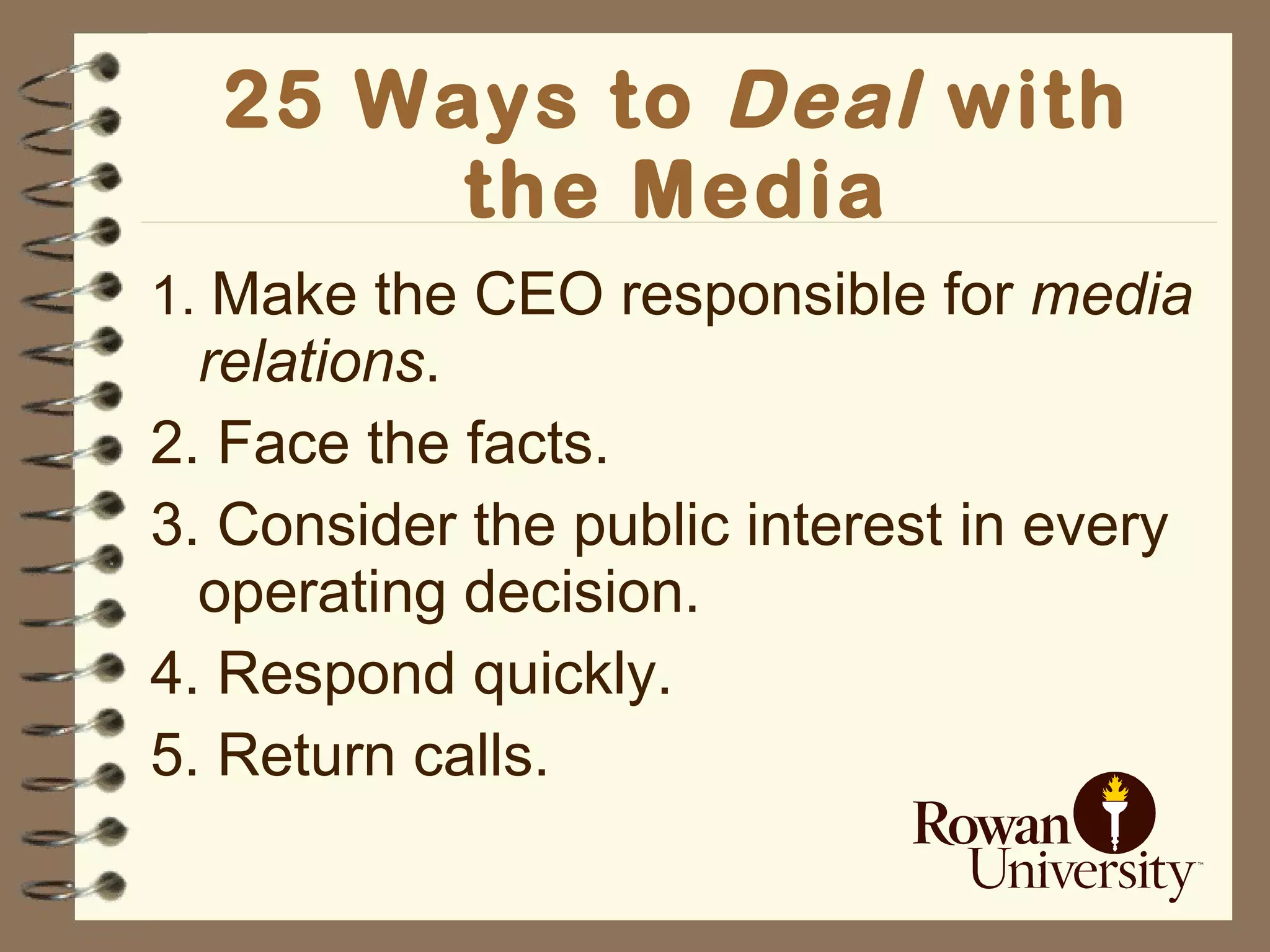
25 Ways to  Deal   with the Media 1.  Make the CEO responsible for  media relations . 2. Face the facts. 3. Consider the public interest in every operating decision. 4. Respond quickly. 5. Return calls.
25 Ways continued... 6. Know to whom you are talking. 7. Be a source before you are a subject. 8. If you want your views represented, you have to talk. 9. Be prepared. 10. Know your message.
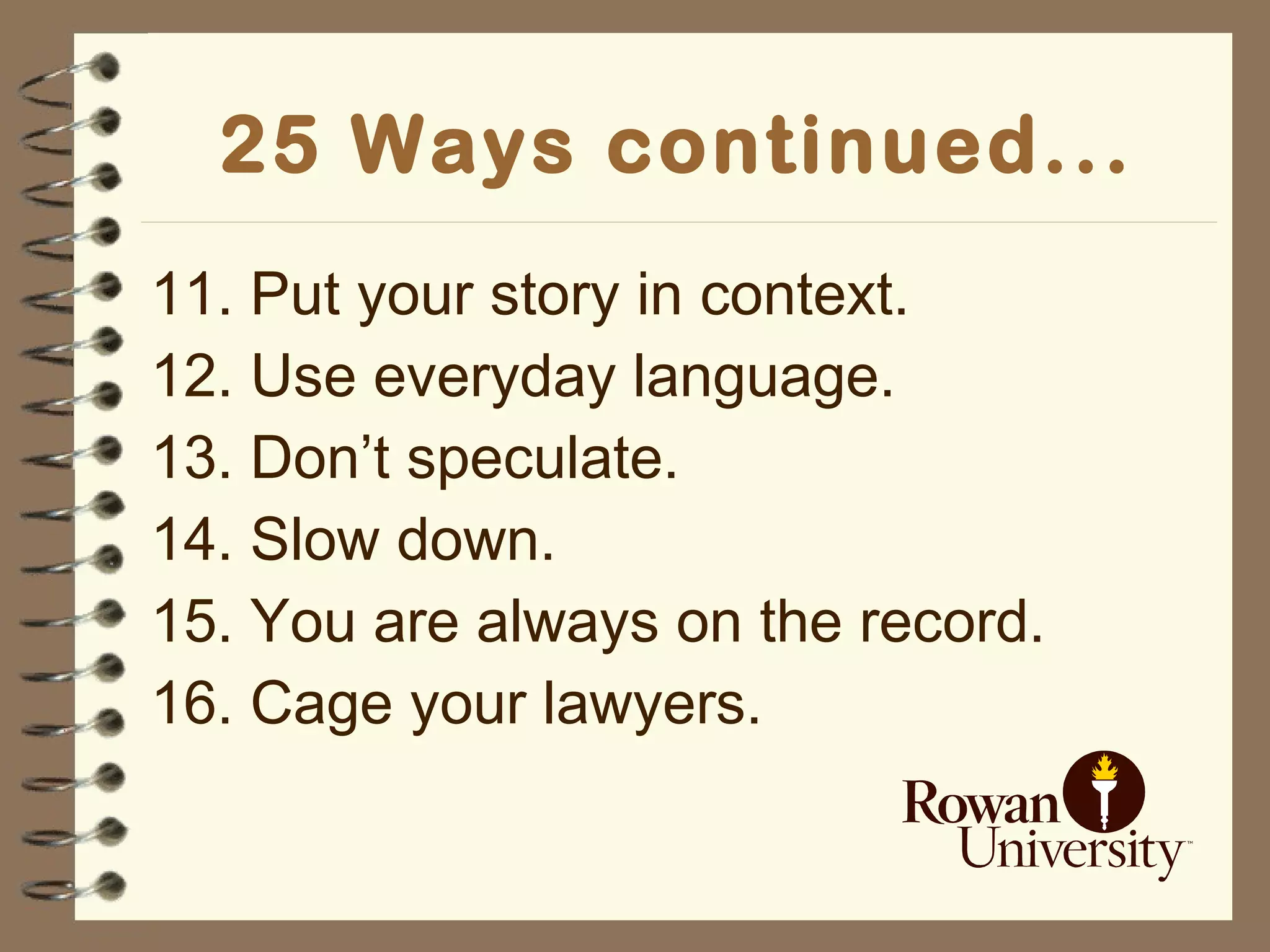
25 Ways continued... 11. Put your story in context. 12. Use everyday language. 13. Don’t speculate. 14. Slow down. 15. You are always on the record. 16. Cage your lawyers.
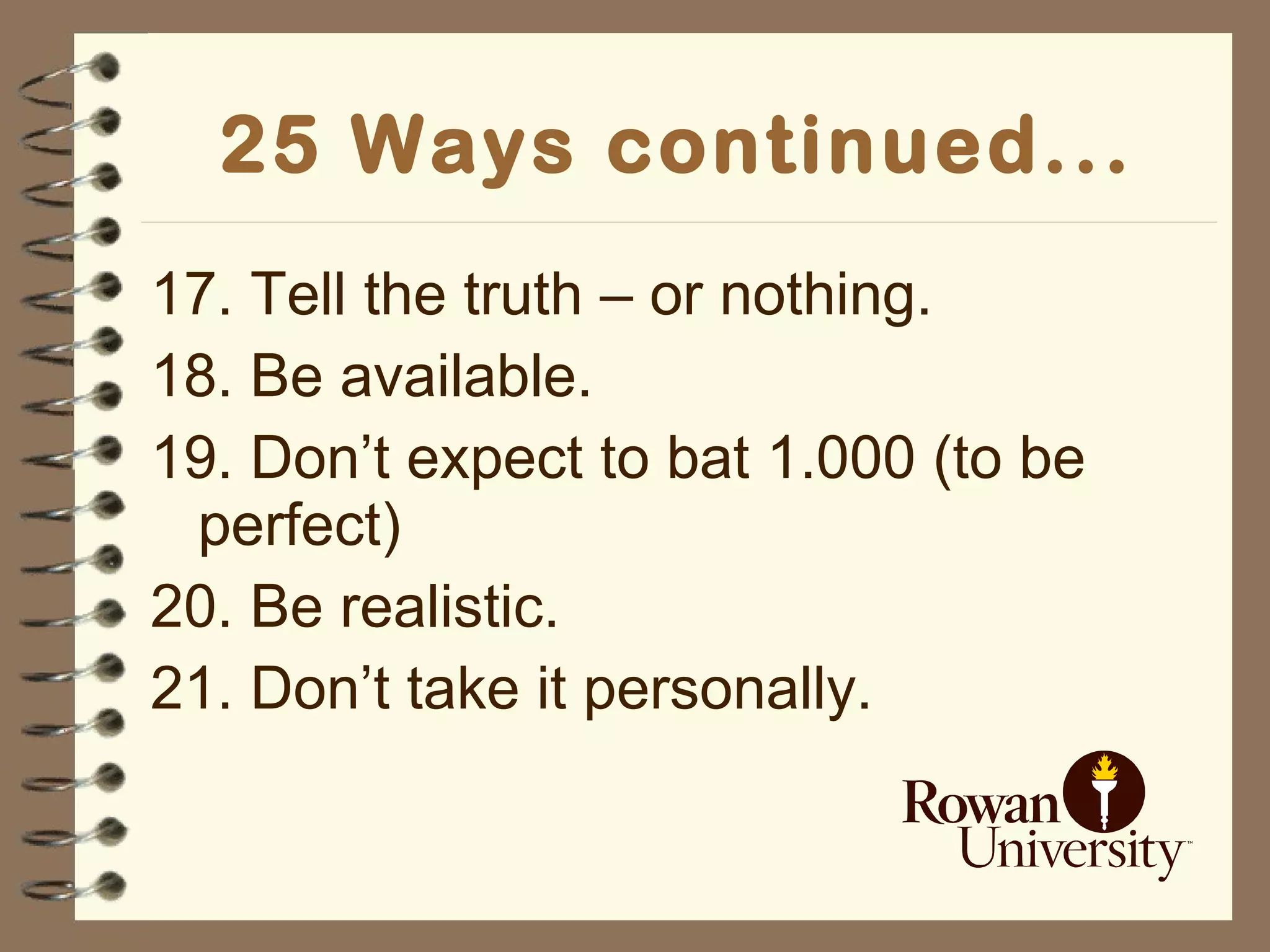
25 Ways continued... 17. Tell the truth – or nothing. 18. Be available. 19. Don’t expect to bat 1.000 (to be perfect) 20. Be realistic. 21. Don’t take it personally.
25 Ways continued... 22. Control what you can. 23. Know with whom you are dealing. 24. Avoid TV unless you feel you can speak candidly. 25. Be human. PR Play 9-10 (Page 277) The Public Relations Practitioner’s Playbook
News Judgment Impact Conflict Prominence Proximity Freshness Novelty
Some DOs of Media Relations Always be available. Give reporters your cell/home phone number. Compliment reporters. “ Covering” for reporters. Notification of cancellations. Put facts in perspective. Respond promptly.  Keep your own set of notes.
Some DON’Ts of  Media Relations Don’t expect releases to be published word for word. Don’t complain to an editor if a story isn’t published. Don’t ask to see a story before it’s printed. Don’t ask reporters for clippings. Don’t ask that photos be returned. (Scan and e-mail them.)
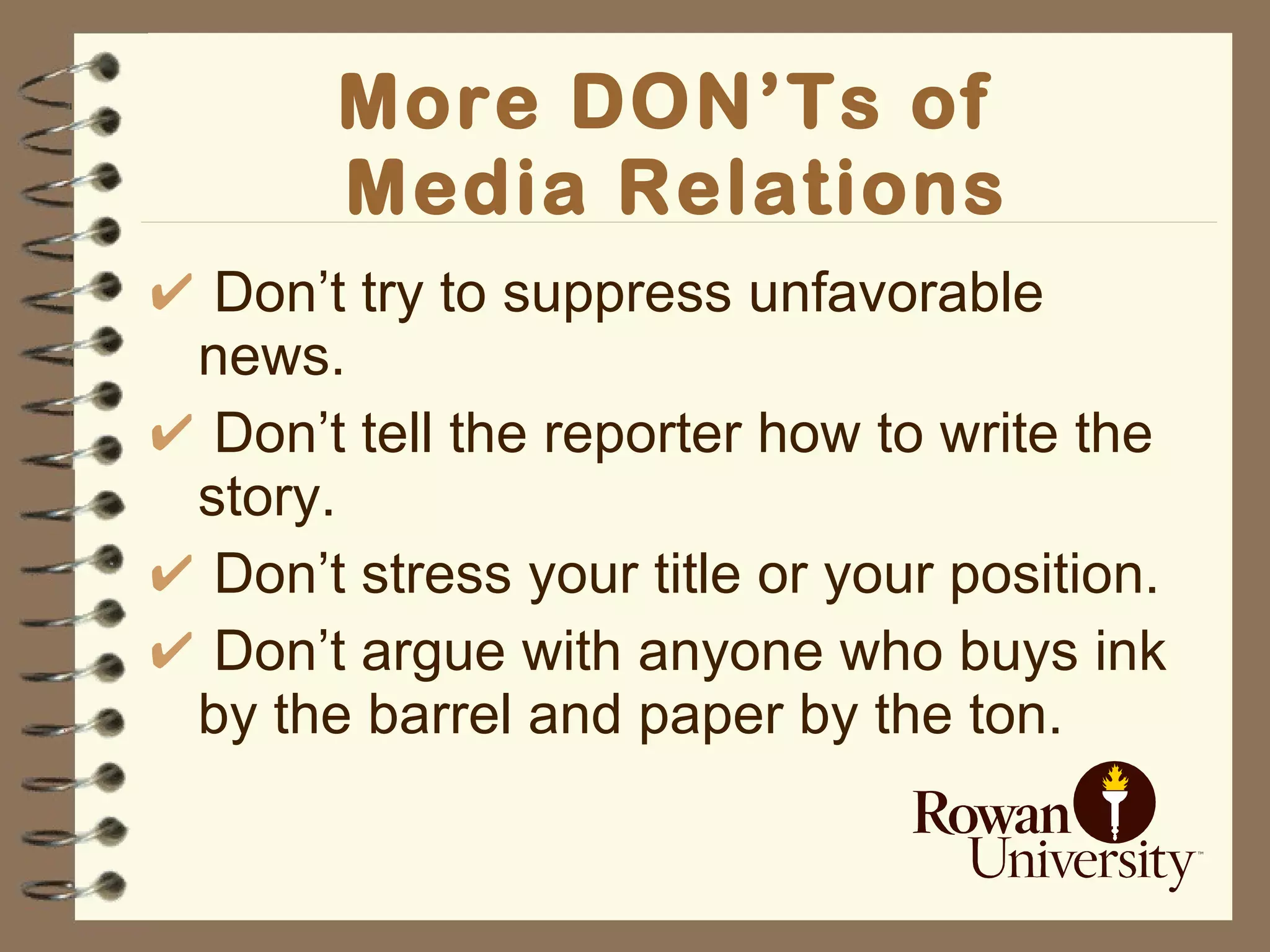
More DON’Ts of  Media Relations Don’t try to suppress unfavorable news. Don’t tell the reporter how to write the story. Don’t stress your title or your position.  Don’t argue with anyone who buys ink by the barrel and paper by the ton.
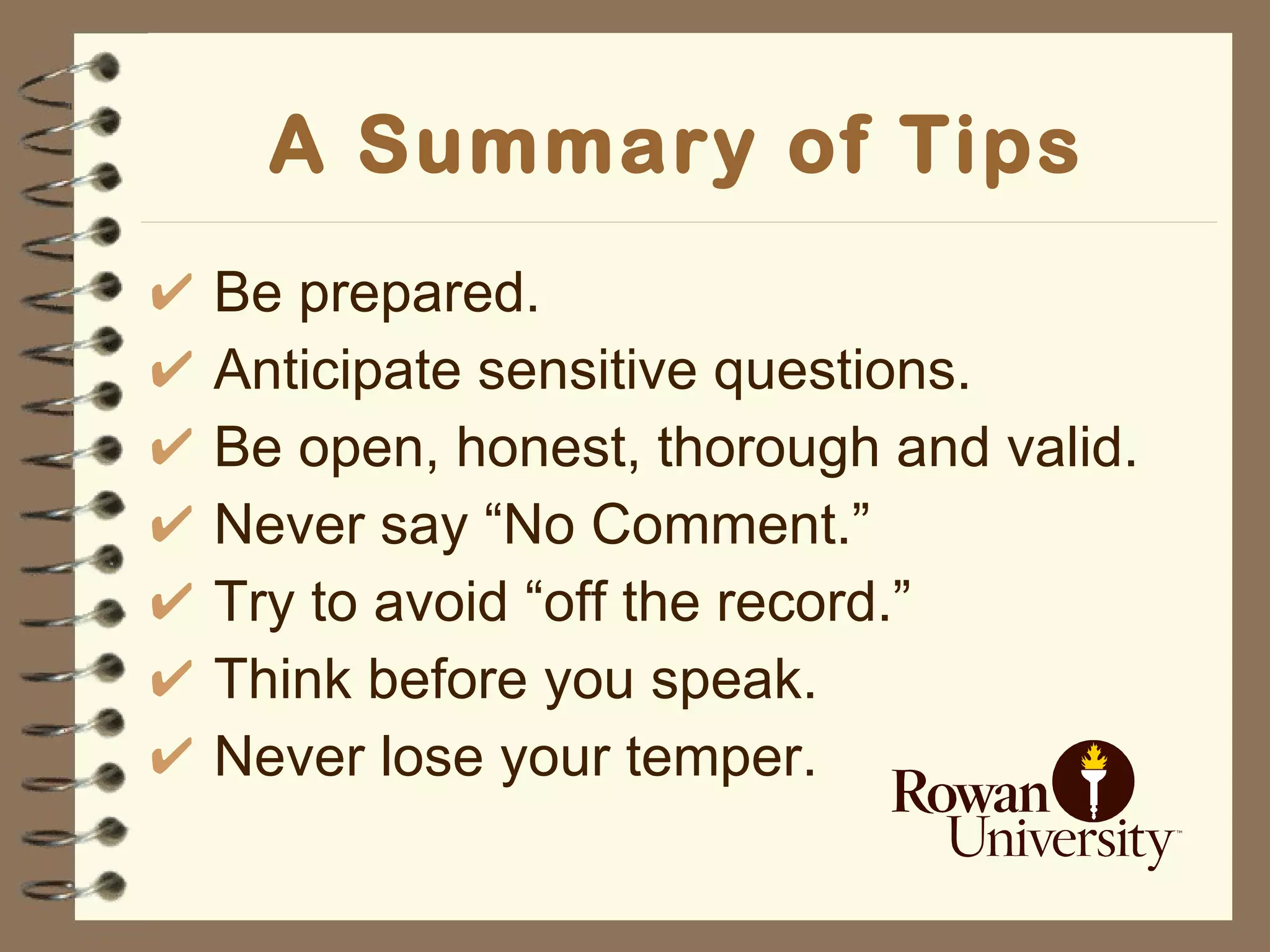
A Summary of Tips Be prepared. Anticipate sensitive questions. Be open, honest, thorough and valid. Never say “No Comment.” Try to avoid “off the record.” Think before you speak. Never lose your temper.
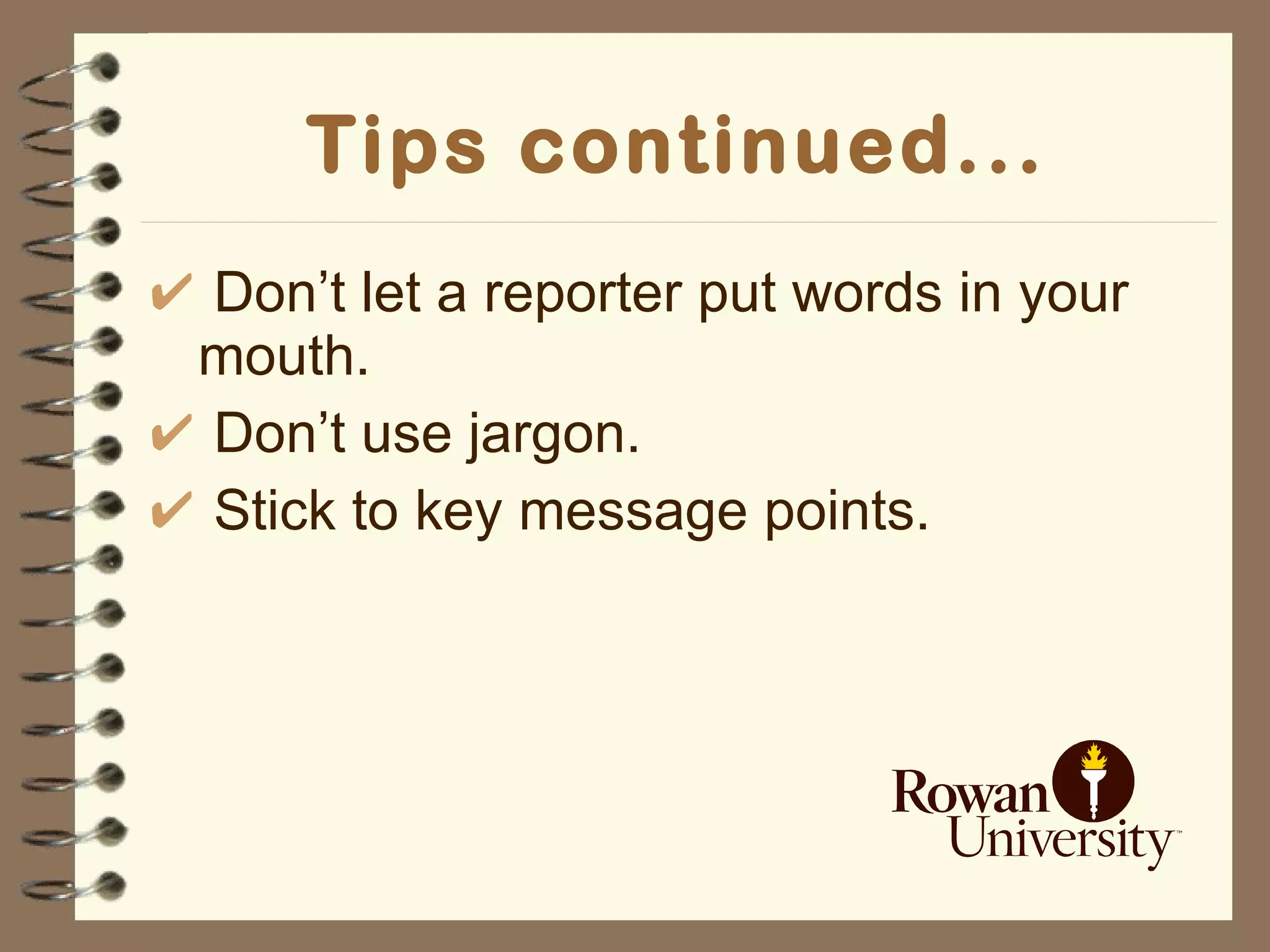
Tips continued... Don’t let a reporter put words in your mouth. Don’t use jargon. Stick to key message points.
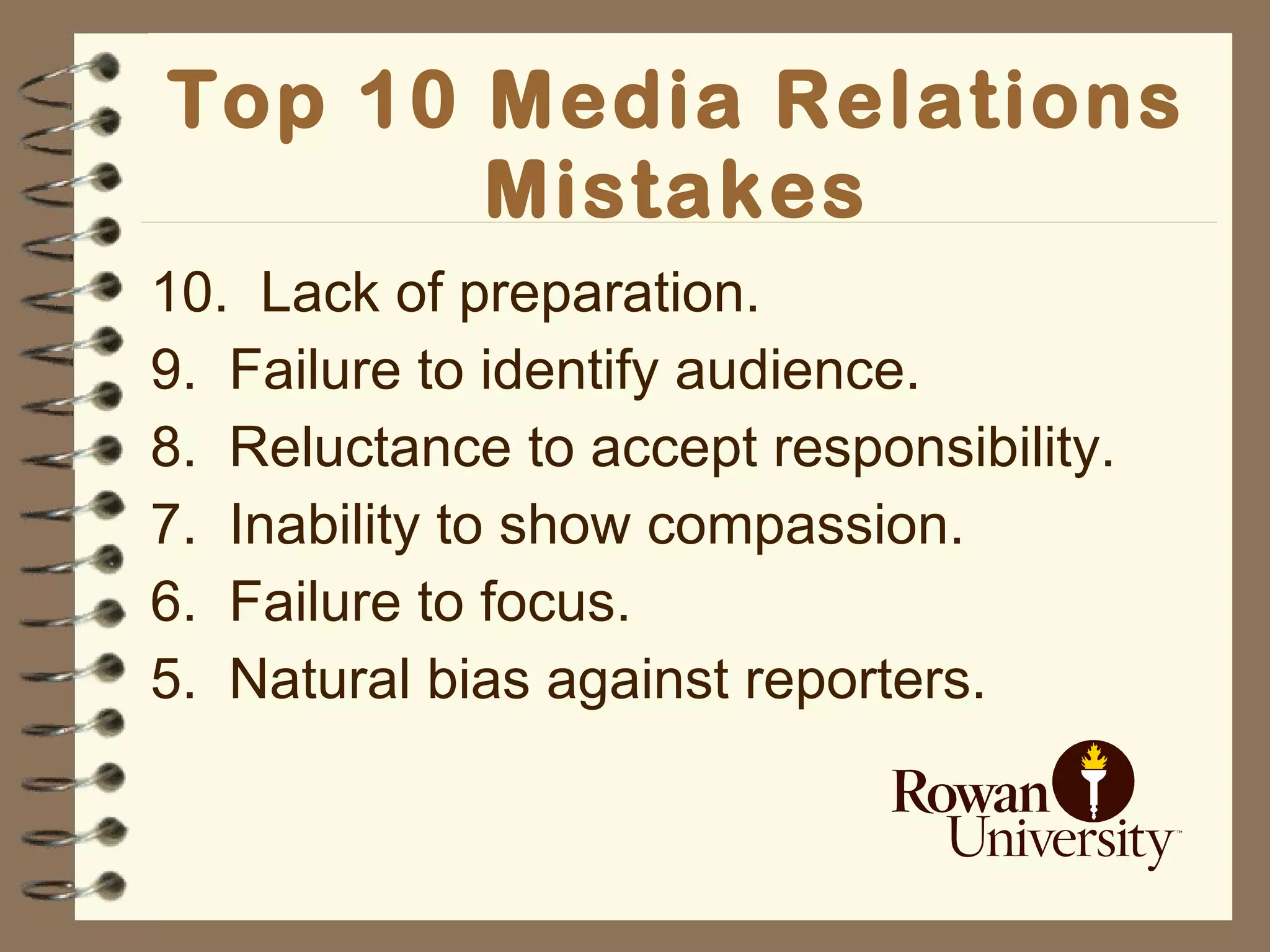
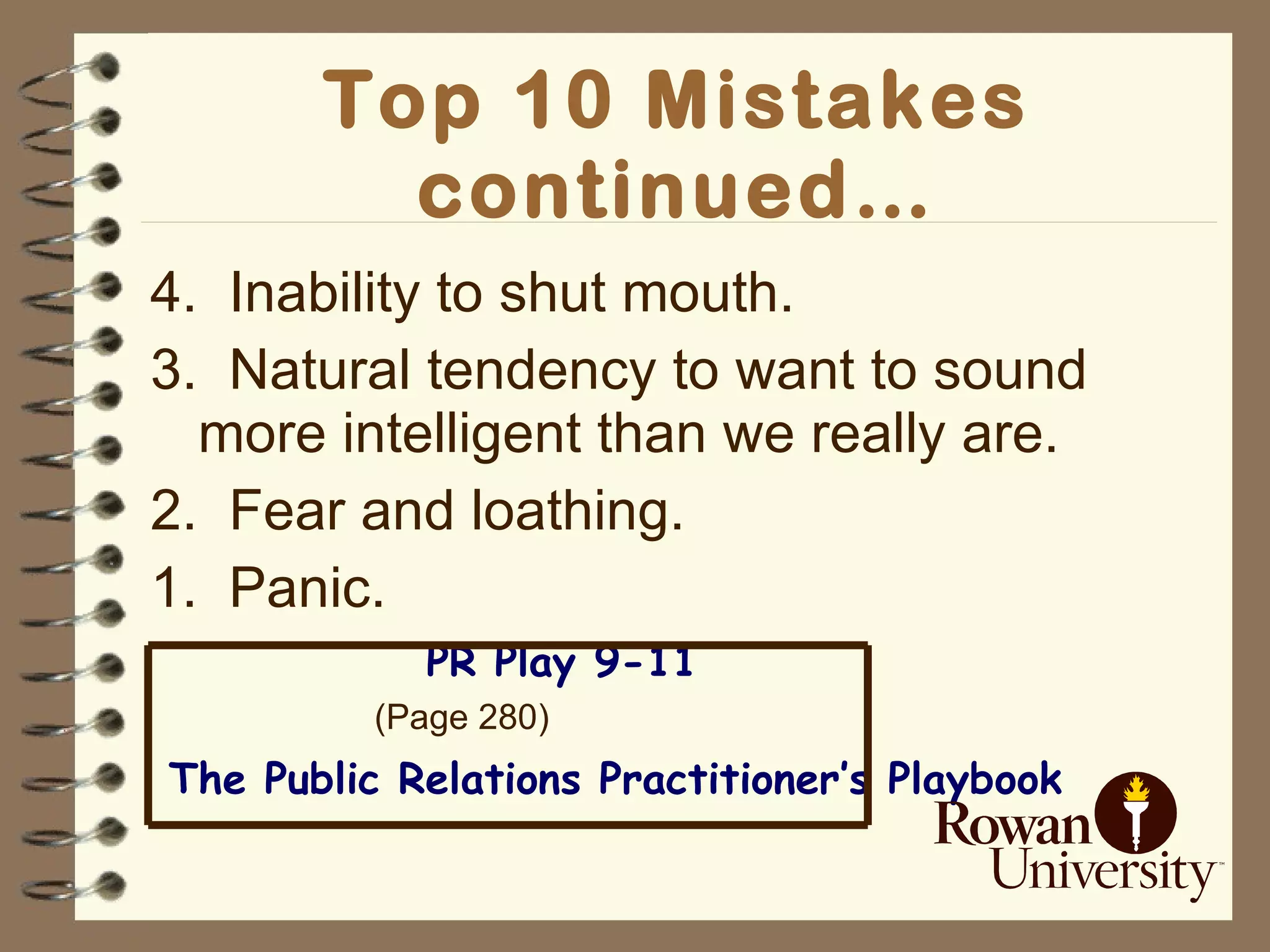
Top 10 Media Relations Mistakes 10.  Lack of preparation. 9.  Failure to identify audience. 8.  Reluctance to accept responsibility. 7.  Inability to show compassion. 6.  Failure to focus. 5.  Natural bias against reporters.
Top 10 Mistakes continued… 4.  Inability to shut mouth. 3.  Natural tendency to want to sound more intelligent than we really are. 2.  Fear and loathing. 1.  Panic. PR Play 9-11 (Page 280) The Public Relations Practitioner’s Playbook Provided by: Best Evidence, Cherry Hill, NJ
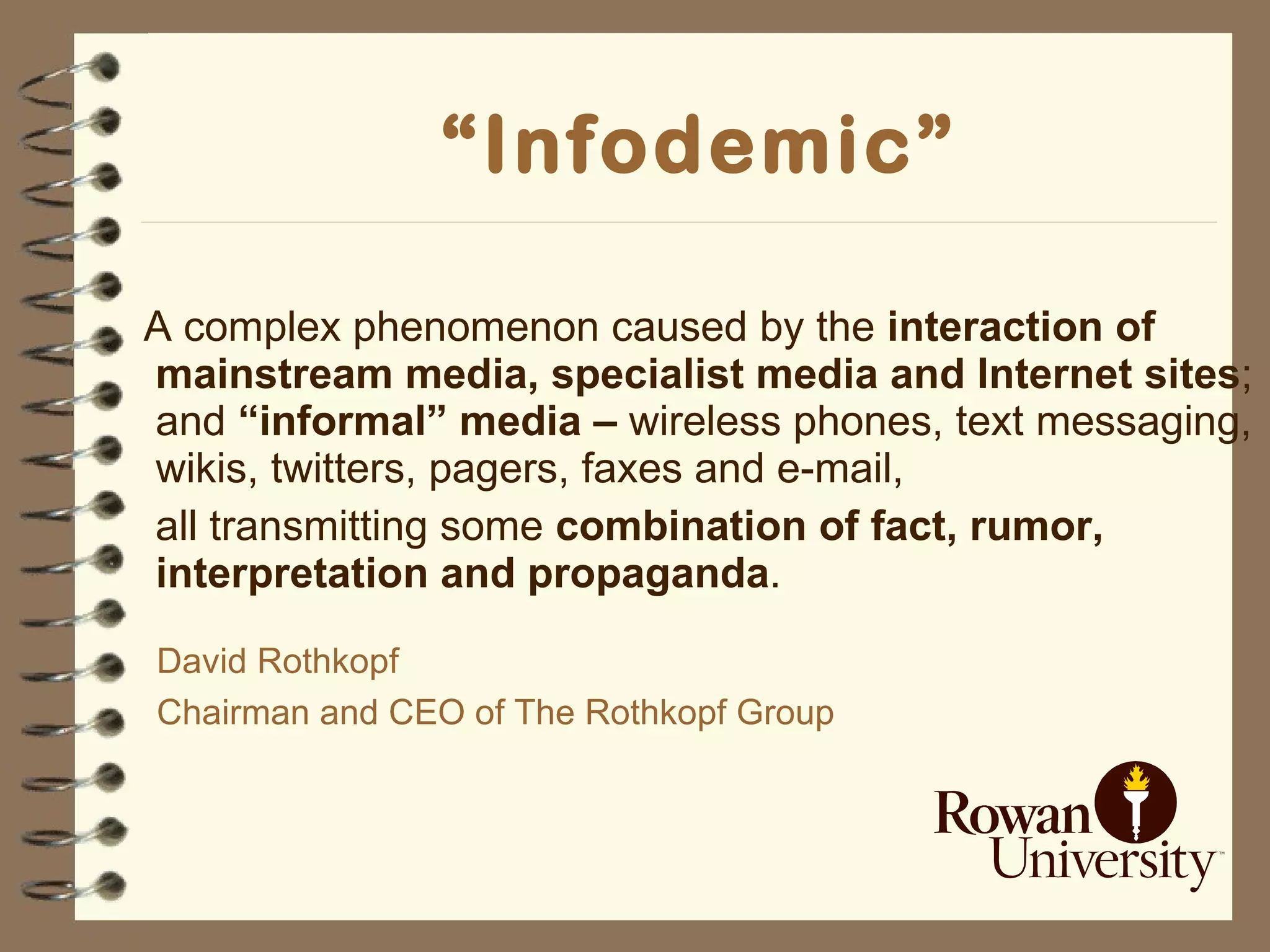
“ Infodemic” A complex phenomenon caused by the  interaction of   mainstream   media, specialist media and Internet sites ; and  “informal” media –  wireless phones, text messaging, wikis, twitters, pagers, faxes and e-mail,  all transmitting some  combination of fact, rumor, interpretation and propaganda . David Rothkopf Chairman and CEO of The Rothkopf Group
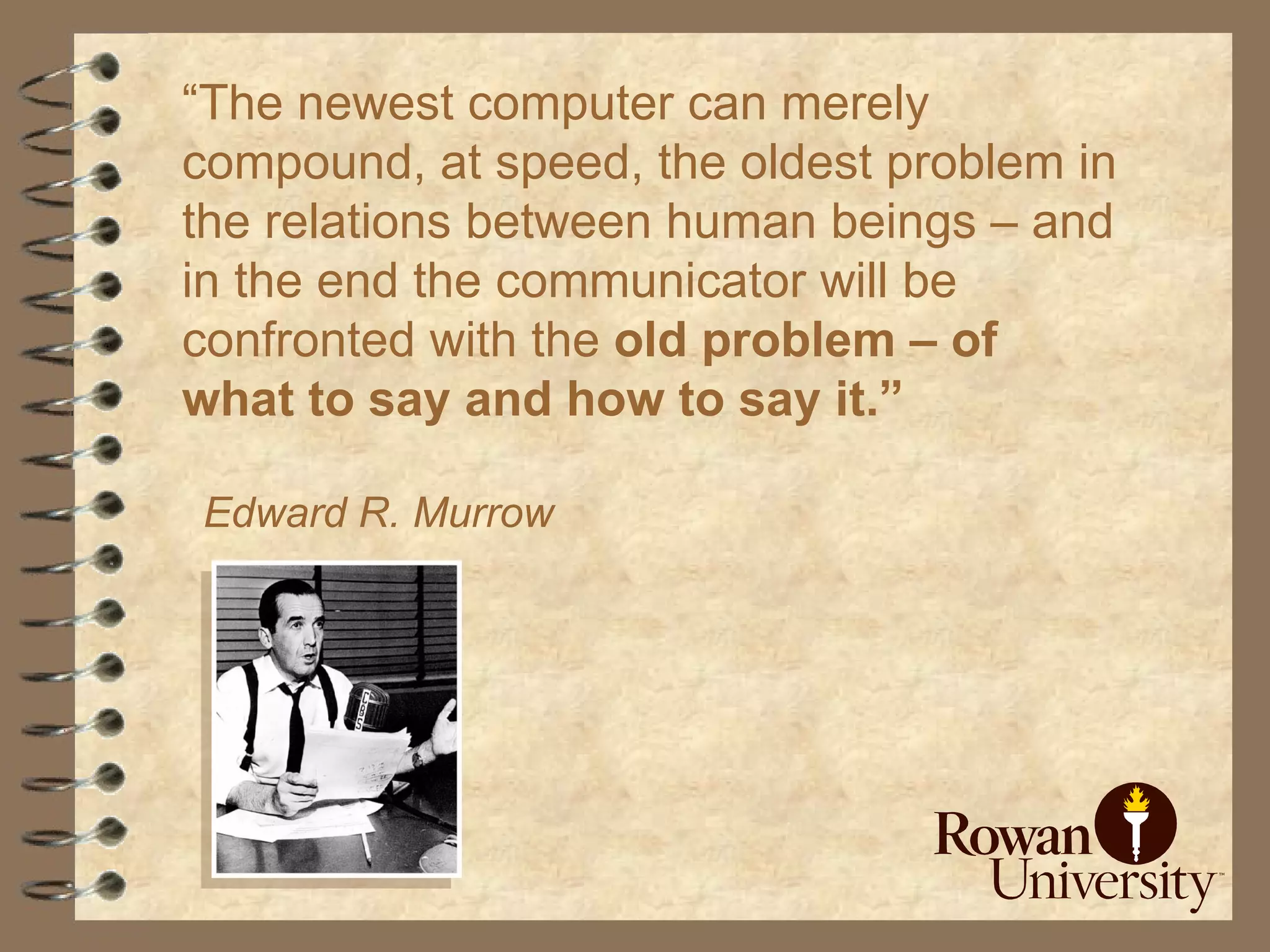
“ The newest computer can merely compound, at speed, the oldest problem in the relations between human beings – and  in the end the communicator will be confronted with the  old problem – of  what to say and how to say it.” Edward R. Murrow
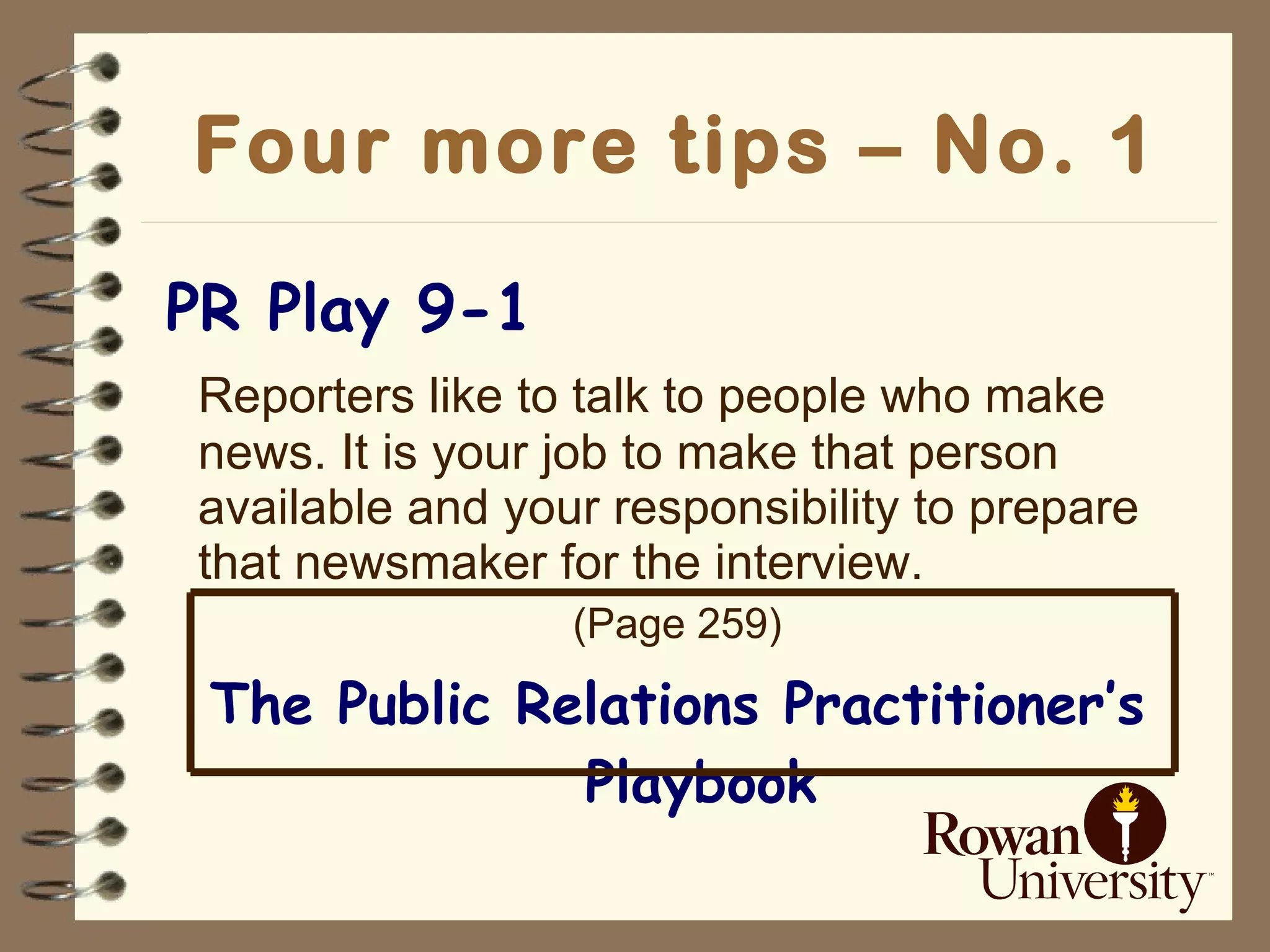
Four more tips – No. 1 PR Play 9-1 Reporters like to talk to people who make news. It is your job to make that person available and your responsibility to prepare that newsmaker for the interview. (Page 259) The Public Relations Practitioner’s Playbook
Four more tips – No. 2   PR Play 9-3 Preparing the “Pitch” (Page 263) The Public Relations Practitioner’s Playbook
Four more tips – No. 3   PR Play 9-12 Building Strong Reporter Relationships (Page 281) The Public Relations Practitioner’s Playbook
Four more tips – No. 4   Maybe  the  most important tip!   PR Play 9-2 “ Never argue with anyone who buys ink by the barrel and paper by the ton.” (Page 260) The Public Relations Practitioner’s Playbook
 
Electronic Release Template
Questions ??? M. Larry Litwin, APR, Fellow PRSA [email_address] www.larrylitwin.com 856-767-7730 © 2011

Media Relations from "The Public Relations Practitioner's Playbook"

  • 1.
    The Impact of Public Relations on the News – and – The Impact of the News on Public Relations [BIG Lecture] M. Larry Litwin, APR, Fellow PRSA Rowan University [email_address] www.larrylitwin.com © 2011
  • 2.
    Takenfrom… The Public Relations Practitioner’s Playbook and The ABCs
  • 3.
    Takenfrom…
  • 4.
  • 5.
    First Amendment Congress shall make no law respecting an establishment of religion, or prohibiting the free exercise thereof; or abridging the freedom of speech, or of the press; or the right of the people peaceably to assemble, and to petition the government for a redress of grievances.
  • 6.
  • 7.
  • 8.
  • 9.
  • 10.
  • 11.
  • 12.
  • 13.
  • 14.
  • 15.
    The Networked AgeRadio Television Internet (and Interactive–Web 2.0/Blogs/Wikis/YouTube) iPod ® (Podcasts, etc.) Vcasts ® Cell Phone iPhone ® Digital Signage Aroma Marketing WOMM Silent Publicity
  • 16.
    The Networked AgeCross Platform Print Digital Signage* Wireless* Broadband/Internet* TV Convergence of Distribution *Formerly referred to as “Alternative Media”
  • 17.
    The Networked AgeCross Platform News Convergence Print Digital Signage* Wireless* Broadband/Internet* TV *Formerly referred to as “Alternative Media”
  • 18.
    Basic Media ConceptsMedia mix The way various types of media are strategically combined in an advertising plan Media vehicle A specific TV program, radio station, iPod ® or Internet (Web 2.0)
  • 19.
  • 20.
    Recognizing News Isthe item relevant to a reasonable number of readers, listeners or viewers? Will the readers be interested in reading it? Is it timely? Does story have local hook?
  • 21.
    Hard vs. SoftNews Hard News News of the day Breaking/Immediate Relevant Local hook Factual Soft News Feature story Human Interest Side bar Evergreen Local hook Timely Factual
  • 22.
    What is News?Timeliness Impact Proximity Controversy Prominence Currency Oddity
  • 23.
    Whatis News? Information the public should be aware of? “ Something” officials are trying to keep it from the public?
  • 24.
    Treat Newsmen andNewswomen as You Would Want Them to Treat You! Never (well, almost never) play favorites with reporters. Get to know them on a first name basis (relationships). Make every effort to be fair. Treat them with trust and consideration.
  • 25.
    What Editors andReporters Expect of PR Practitioners Relationship(s) Know what news is Know deadlines Accuracy Timeliness A climate of trust/honesty Accessibility (when bad news hits)
  • 26.
    Establish a MediaPolicy Truthful Factual Admit problems and mistakes Responsibility
  • 27.
    Recent Examples DailyNews Rowan The Whit KYW Newsradio – CBS
  • 28.
    What’s the Difference?Off the Record Not for Attribution For Background Only PR Play 9-3 (Page 276) The Public Relations Practitioner’s Playbook
  • 29.
    On the Record– Off the Record Know the rules. Be certain the reporter knows the rules. Avoid casual comments at all times. PR Play 9-3 (Page 276) The Public Relations Practitioner’s Playbook
  • 30.
    Not for Attribution Know the rules. Be certain the reporter knows the rules. Anonymous. (Be careful) PR Play 9-3 (Page 276) The Public Relations Practitioner’s Playbook
  • 31.
    For Background Only Know the rules. Be certain the reporter knows the rules. Avoid casual comments at all times. PR Play 9-3 (Page 276) The Public Relations Practitioner’s Playbook
  • 32.
    Getting Coverage InPrint and On The Air Get to know your local media Develop relationships The “Beat” System Know how to “pitch” Supply information Tell the truth Rejection
  • 33.
    Why Hold aNews Conference? To announce item of significant impact. Major product announcement. To explain complex issues. To introduce a new chief executive. PR Play 9-5 (Page 270) The Public Relations Practitioner’s Playbook
  • 34.
    Key Points toRemember Almost nothing is “off the record.” State what you know as fact. Truth is the only way. Be prepared. Know your subject, objective, audience and interviewer. Expect the worst and have a plan for dealing with it.
  • 35.
    Key Points continued…Do not underestimate your interviewer. He/she has a job to do. Keep things simple – easy to understand and follow. Know what you want to say and get it said early. When confronted with a question you are not prepared for, don’t be afraid to say – “I don’t know.”
  • 36.
    More Key Points...Get to the interview early. You want time to get comfortable. Be a positive force – strong, energetic, sincere and straightforward. Detach yourself from the subject matter. Remember the importance of body language.
  • 37.
    Even More KeyPoints... Practice to a point – of comfort only. Take a witness or co-presenter if possible. You want to take control of every interview you give.
  • 38.
    Real Life “Pitching”Evolve your media list. Warm your pitch. Pitch like a journalist, not a salesman. Stay calm and focused. Take care with multiple reporters at the same outlet. Acknowledge the reporting. Learn from failure. Wait in the wings. Respect all reporters and outlets. Make personal contact.
  • 39.
    25 Ways to Deal with the Media 1. Make the CEO responsible for media relations . 2. Face the facts. 3. Consider the public interest in every operating decision. 4. Respond quickly. 5. Return calls.
  • 40.
    25 Ways continued...6. Know to whom you are talking. 7. Be a source before you are a subject. 8. If you want your views represented, you have to talk. 9. Be prepared. 10. Know your message.
  • 41.
    25 Ways continued...11. Put your story in context. 12. Use everyday language. 13. Don’t speculate. 14. Slow down. 15. You are always on the record. 16. Cage your lawyers.
  • 42.
    25 Ways continued...17. Tell the truth – or nothing. 18. Be available. 19. Don’t expect to bat 1.000 (to be perfect) 20. Be realistic. 21. Don’t take it personally.
  • 43.
    25 Ways continued...22. Control what you can. 23. Know with whom you are dealing. 24. Avoid TV unless you feel you can speak candidly. 25. Be human. PR Play 9-10 (Page 277) The Public Relations Practitioner’s Playbook
  • 44.
    News Judgment ImpactConflict Prominence Proximity Freshness Novelty
  • 45.
    Some DOs ofMedia Relations Always be available. Give reporters your cell/home phone number. Compliment reporters. “ Covering” for reporters. Notification of cancellations. Put facts in perspective. Respond promptly. Keep your own set of notes.
  • 46.
    Some DON’Ts of Media Relations Don’t expect releases to be published word for word. Don’t complain to an editor if a story isn’t published. Don’t ask to see a story before it’s printed. Don’t ask reporters for clippings. Don’t ask that photos be returned. (Scan and e-mail them.)
  • 47.
    More DON’Ts of Media Relations Don’t try to suppress unfavorable news. Don’t tell the reporter how to write the story. Don’t stress your title or your position. Don’t argue with anyone who buys ink by the barrel and paper by the ton.
  • 48.
    A Summary ofTips Be prepared. Anticipate sensitive questions. Be open, honest, thorough and valid. Never say “No Comment.” Try to avoid “off the record.” Think before you speak. Never lose your temper.
  • 49.
    Tips continued... Don’tlet a reporter put words in your mouth. Don’t use jargon. Stick to key message points.
  • 50.
    Top 10 MediaRelations Mistakes 10. Lack of preparation. 9. Failure to identify audience. 8. Reluctance to accept responsibility. 7. Inability to show compassion. 6. Failure to focus. 5. Natural bias against reporters.
  • 51.
    Top 10 Mistakescontinued… 4. Inability to shut mouth. 3. Natural tendency to want to sound more intelligent than we really are. 2. Fear and loathing. 1. Panic. PR Play 9-11 (Page 280) The Public Relations Practitioner’s Playbook Provided by: Best Evidence, Cherry Hill, NJ
  • 52.
    “ Infodemic” Acomplex phenomenon caused by the interaction of mainstream media, specialist media and Internet sites ; and “informal” media – wireless phones, text messaging, wikis, twitters, pagers, faxes and e-mail, all transmitting some combination of fact, rumor, interpretation and propaganda . David Rothkopf Chairman and CEO of The Rothkopf Group
  • 53.
    “ The newestcomputer can merely compound, at speed, the oldest problem in the relations between human beings – and in the end the communicator will be confronted with the old problem – of what to say and how to say it.” Edward R. Murrow
  • 54.
    Four more tips– No. 1 PR Play 9-1 Reporters like to talk to people who make news. It is your job to make that person available and your responsibility to prepare that newsmaker for the interview. (Page 259) The Public Relations Practitioner’s Playbook
  • 55.
    Four more tips– No. 2 PR Play 9-3 Preparing the “Pitch” (Page 263) The Public Relations Practitioner’s Playbook
  • 56.
    Four more tips– No. 3 PR Play 9-12 Building Strong Reporter Relationships (Page 281) The Public Relations Practitioner’s Playbook
  • 57.
    Four more tips– No. 4 Maybe the most important tip! PR Play 9-2 “ Never argue with anyone who buys ink by the barrel and paper by the ton.” (Page 260) The Public Relations Practitioner’s Playbook
  • 58.
  • 59.
  • 60.
    Questions ??? M.Larry Litwin, APR, Fellow PRSA [email_address] www.larrylitwin.com 856-767-7730 © 2011