Social Realism
By Grace Johansson
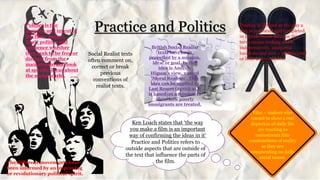
Practice and PoliticsPolitics is the
purpose and intent of
the film - maker.
Their politics will
influence whether
they seek to be free or
distinct from the
mainstream and look
at specific ideas about
the social world.
Ken Loach states that ‘the way
you make a film is an important
way of confirming the ideas in it’
Practice and Politics refers to
outside aspects that are outside of
the text that influence the parts of
the film.
Film – makers who
intend to show a real
depiction of daily life
are reacting to
mainstream film
constructions of reality
as they are
commenting on daily
social issues.
Social Realist texts
often comment on,
correct or break
previous
conventions of
realist texts.
The different movements have
been informed by an improving
or revolutionary political spirit.
British Social Realist
texts have been
propelled by a mission,
ideal or goal. In this
idea is Andrew
Higson’s view, named
‘Moral Realism’. This
idea can be applied to
Last Resort (2000) as it
is based on a mission to
show how poorly
immigrants are treated.
Practice is defined as the way a
film is produced and completed,
in British Social Realism this
term means making a film
independently, using real
locations and non – professional
or little known actors.
Practice and PoliticsLay explains that it is difficult to distinguish
between practice and politics because in many
aspects they inform each other.
John Grierson’s films stood out against the
mainstream film industry, Grierson’s mission
was to educate and inform audiences through
documentary and he accomplished this mission,
however it did create an uncomfortable
patronage from the government.
The lack of funds and resources affected the
style of documentaries in the 1930s and
1940s which meant it encouraged the
collaborative unit style of production
associated with documentaries.
Tony Richardson, Karel Reisz, Lindsay
Anderson and Lorenza Mazetti formed the
Free Cinema group which produced
creative short films and documentaries. The
Free Cinema group was free to make their
own content and free to choose whatever
subject matter they wanted. This means
that anything such as immigration, poverty,
gender change, jail and many other issues
could be shown in film.
The British New Wave wanted to expand
representation in film to include the working
class beyond London, such as industrial towns
and North English cities. They used unknown
regional actors as ensemble casts, this meant
that they made new claims to realism.
The British New Wave directors made their
claims to realism by situating their regionally
authentic casts in authentic locations. This can
be linked to the 1969 film Kes which uses
authentic actors in authentic locations to create
a sense of reality.
The New Wave directors established that
character and place were linked, and that
environmental factors largely determined a
characters fate and fortune. An example of
This is if a character grows up in a run down
environment they’re less likely to prosper due
to society and politics.
The work of Ken Loach has been shaped by
practice and politics. Loach is important in Social
Realism because he uses realist documentaries to
explore inequalities and conflicts in society.
Lay says the commitment to
the ‘truth’ in documentaries is
reflected in their practice,
from their use of non – actors
to locations.
Stephen Lacey connects film
– makers practice with their
political and critical stance by
quoting Lindsay Anderson,
she says that the rejection of
the studio system was linked
to a rejection of a particular
view of the world.
Practice and Politics/Issues and Themes
The collaborative style of
film – making has changed
from being attributed to
more than one person, to
being attributed to just one
person i.e. the director.
Content, in terms of themes and
issues is usually linked to a film –
makers intent, which, in Social
Realism is often reformist,
educational or has a social
purpose in some way.
An understanding of the way certain
themes and issues come to light at
different moments can reveal a lot about
social and cultural attitudes of the
period studied.
By looking at the contrast
in the way issues and
themes are dealt with
over different periods, it
can prove to be helpful in
finding out why certain
themes would have been
prevalent in different
time periods.
The implications of the
phrase ‘Slice of life’ are
that it is a slight insight
into the real world, using
film.
Lay says that all texts in a realist
mode are constructs, which means
that through analysing key themes
and issues we can see what type of
reality is being constructed and
from which point of view.
Content is made up of the
issues and themes social
realist texts seek to explore
and the types of
representations generally
constructed. Bullet Boy’s
content is made up of the
issues facing black men and
the theme of social
deprivation.
Issues are the social problems portrayed
in the films, which were topical around
the time of film production which were
a cause for concern. Whereas, themes
are not often as obvious but are more
often implied by the film, a theme for
example would be the changing role of
the working class in British social life.
History

Social realism 2

  • 1.
  • 2.
    Practice and PoliticsPoliticsis the purpose and intent of the film - maker. Their politics will influence whether they seek to be free or distinct from the mainstream and look at specific ideas about the social world. Ken Loach states that ‘the way you make a film is an important way of confirming the ideas in it’ Practice and Politics refers to outside aspects that are outside of the text that influence the parts of the film. Film – makers who intend to show a real depiction of daily life are reacting to mainstream film constructions of reality as they are commenting on daily social issues. Social Realist texts often comment on, correct or break previous conventions of realist texts. The different movements have been informed by an improving or revolutionary political spirit. British Social Realist texts have been propelled by a mission, ideal or goal. In this idea is Andrew Higson’s view, named ‘Moral Realism’. This idea can be applied to Last Resort (2000) as it is based on a mission to show how poorly immigrants are treated. Practice is defined as the way a film is produced and completed, in British Social Realism this term means making a film independently, using real locations and non – professional or little known actors.
  • 3.
    Practice and PoliticsLayexplains that it is difficult to distinguish between practice and politics because in many aspects they inform each other. John Grierson’s films stood out against the mainstream film industry, Grierson’s mission was to educate and inform audiences through documentary and he accomplished this mission, however it did create an uncomfortable patronage from the government. The lack of funds and resources affected the style of documentaries in the 1930s and 1940s which meant it encouraged the collaborative unit style of production associated with documentaries. Tony Richardson, Karel Reisz, Lindsay Anderson and Lorenza Mazetti formed the Free Cinema group which produced creative short films and documentaries. The Free Cinema group was free to make their own content and free to choose whatever subject matter they wanted. This means that anything such as immigration, poverty, gender change, jail and many other issues could be shown in film. The British New Wave wanted to expand representation in film to include the working class beyond London, such as industrial towns and North English cities. They used unknown regional actors as ensemble casts, this meant that they made new claims to realism. The British New Wave directors made their claims to realism by situating their regionally authentic casts in authentic locations. This can be linked to the 1969 film Kes which uses authentic actors in authentic locations to create a sense of reality. The New Wave directors established that character and place were linked, and that environmental factors largely determined a characters fate and fortune. An example of This is if a character grows up in a run down environment they’re less likely to prosper due to society and politics. The work of Ken Loach has been shaped by practice and politics. Loach is important in Social Realism because he uses realist documentaries to explore inequalities and conflicts in society. Lay says the commitment to the ‘truth’ in documentaries is reflected in their practice, from their use of non – actors to locations. Stephen Lacey connects film – makers practice with their political and critical stance by quoting Lindsay Anderson, she says that the rejection of the studio system was linked to a rejection of a particular view of the world.
  • 4.
    Practice and Politics/Issuesand Themes The collaborative style of film – making has changed from being attributed to more than one person, to being attributed to just one person i.e. the director. Content, in terms of themes and issues is usually linked to a film – makers intent, which, in Social Realism is often reformist, educational or has a social purpose in some way. An understanding of the way certain themes and issues come to light at different moments can reveal a lot about social and cultural attitudes of the period studied. By looking at the contrast in the way issues and themes are dealt with over different periods, it can prove to be helpful in finding out why certain themes would have been prevalent in different time periods. The implications of the phrase ‘Slice of life’ are that it is a slight insight into the real world, using film. Lay says that all texts in a realist mode are constructs, which means that through analysing key themes and issues we can see what type of reality is being constructed and from which point of view. Content is made up of the issues and themes social realist texts seek to explore and the types of representations generally constructed. Bullet Boy’s content is made up of the issues facing black men and the theme of social deprivation. Issues are the social problems portrayed in the films, which were topical around the time of film production which were a cause for concern. Whereas, themes are not often as obvious but are more often implied by the film, a theme for example would be the changing role of the working class in British social life. History