AS MEDIA STUDIES – KEY WORDS/DEFINITIONS AND CONTEXTS FOR MED1
AND MED2
This handout is designed to assist you in developing your knowledge, understanding
and application of theory as it relates to Med 1 (unseen media products) and Med 2
(exploring media topics). For a more detailed outline and explanation of many more
key terms and theories refer to the Barton Peveril AS Media intranet ‘glossary of
terms’ section.
INSTITUTION
Whether you are examining a mainstream or non-mainstream media product they all
originate from an institutional source. The intentions behind a product and the
implicit/explicit messages that are presented to readers/audiences are likely to be
directly influenced, once again at an implicit or explicit level, by the funder of the
media product. It is important to remember that mainstream media, whether it is
Carlton, News International or the BBC is big business (even though the main
funding of the BBC is through the licence fee it still tries to generate income through
selling its programmes to other countries; the sales of DVDs, books and magazines,
its link with UK Gold and digital broadcasting; and its occasional box office success
at cinemas all help to generate income for the institution).
In the past there was a clearer distinction between mainstream and independent
companies but in almost every sphere of the media today there are examples of
major corporations buying into and taking control of what were previously
‘independent’ companies, in order for these major companies to maximise revenue
and tap into new and emerging creative talent and ideas, which in time, may get
assimilated into the mainstream.
Examples of this include:
Disney Corporation owns Miramax pictures who have had successful films such as
Clerks, Pulp Fiction, Scream, Chicago, Gangs of New York.
When analysing any media product it is important to discuss it in terms of how the
institutional source is likely to have impacted upon all of the other key concepts.
However, specific attention should be made to the issues of representation and
ideology that are being implicitly or explicitly promoted within it to the reader/viewer.
REPRESENTATION
It is important to remember that all media products represent or re-present aspects of
gender, sexuality, race, class, nationhood and ideas, values and beliefs, most
commonly from the point of ideology (either to support or challenge widely accepted
values, attitudes or opinions). Whatever text is presented to you to analyse you
should ask yourself the following questions: who is being represented, who is
representing them in such a way, how are they being represented, and why are they
being represented in such a manner.
THE KEY WORDS YOU NEED TO KNOW AND BE ABLE TO DISCUSS
STEREOTYPES – oversimplified portrayal(s) that are often used (by the
media/people) to categorise and or label all who belong to a specific group. This can
often be linked closely to ideas based around myth.
GENDER-ROLE STEREOTYPING – the roles often ascribed to men and women are
most commonly linked to myths around roles and responsibilities, and power and
status. As an example it is presented as natural that women are more caring and so
it is assumed to be more natural for women to give up or put on hold their careers to
look after the children.
OBJECTIFICATION/OBJECTIFY – Representation of people merely as an object of
visual pleasure that is often linked to power and control of the sender, and in some
case the receiver. Traditionally, the object of visual pleasure has been for the
pleasure of the male gaze – looking at women, but certain sections of modern media
producers reflect the pleasures of women in looking at men.
SUBORDINATION – the representation of someone under the implicit/explicit
assumption that the sender/maker of the media product is of a higher status than the
person/group presented.
FETISHISATION – the selection of a part of the body (or inanimate object) that is
used to become representative of the whole. This is often linked to objectification
and subordination, and most commonly applies to women and is frequently present
in magazines, movies and fashion/beauty items.
PARIARCHY – it is often assumed that many of the negative portrayals that exist
within society (particularly with reference to gender portrayals) can directly be related
to the establishment and maintenance of the power and status of men.
MATRIACHY – there is a general assumption that we live in a male dominated
society however there are certain areas of media content where the power, status
and influence of women are given greater implicit/explicit space to be explored. For
example in soap operas audiences are frequently presented with strong and diverse
roles for women. In Hollywood, actresses such as Sandra Bullock and Julia Roberts
appear to have a greater control over the roles they play.
RACISM – it is suggested that the ideas and belief systems of the elite
(predominantly white) groups and institutions has directly impacted upon the types of
explicit and implicit portrayals of ‘minority’ groups such as blacks, Asians, asylum
seekers… It is argued that this has lead to a number of negative and cliched
portrayals. Some of the most common techniques used (though not necessarily
deliberately) to marginalise minority groups are through ‘absence’ in a range of
programming; given limited (subordinated) roles; given their ‘own’ media products (so
their views are heard by the minority group); these products to be scheduled at times
where very few people outside of the minority group would actively seek out the
product. It is argued that these strategies lead to the maginalisation and
ghettoisation of ‘minority’ viewpoints.
HETEROSEXUALITY/ETHNOCENTRICITY/HOMOGENEITY are values that are
generally privileged by mainstream institutions and as a consequence
HOMOPHOBIC/XNEOPHOBIC/ALTERNATIVE IDEAS are generally negatively
represented at an implicit and (sometimes) explicit level. Many of these ideas/points
can be linked to a discussion of racism.
GENRE
All media texts, whether audio, audio-visual or print-based belong to a particular
genre, that will possess specific codes and conventions. Media industries use
genres because they aid audience understanding and help them to reduce their risks.
Many modern media texts are said to be less rigid in their use of genre conventions.
It is often said that media texts are more playful in the way they tell their stories and
may steal or borrow from a variety of genres. This is most frequently discussed in
relation to post-modernism and hybridity.
During the course you should try to familiarise yourself with a number of genres in
order to prepare for your exam. This should include: game shows, chat shows,
discussion-based programmes, news broadcasts (radio, television and the internet),
documentaries (radio and television), music shows (radio and television), current
affairs/magazine-style programmes (radio and television), soap operas and dramas
(radio and television), newspapers and magazines (national, local and the internet),
films, advertising/marketing material (television, radio, print-based, and the internet).
GENRE – a way of categorising texts by identifying certain common characteristics in
terms of themes, form and content. It should always be referred to in relation to
style, structure, themes, iconography and narrative. When considering the
importance of genre it is important to give consideration to institution, audience,
marketing/selling, and the ‘creative’ motivation influencing the maker working within
their elected genre. Remember, genre conventions are never fixed, some products
are made to support the dominant themes and ideas whereas others actively play
against/subvert the conventions.
NARRATIVE
Whether you are examining print, audio or audio-visual media products they will
contain a narrative structure in which they present their ideas, opinions, values and
ways of understanding the topic or issue covered, to their audience(s). It is often the
case, particularly within mainstream narratives, that a deep structure or dominant set
of norms will directly influence the structure and ultimately, the messages presented
to the audience(s) at an implicit or explicit level. When exploring any media product
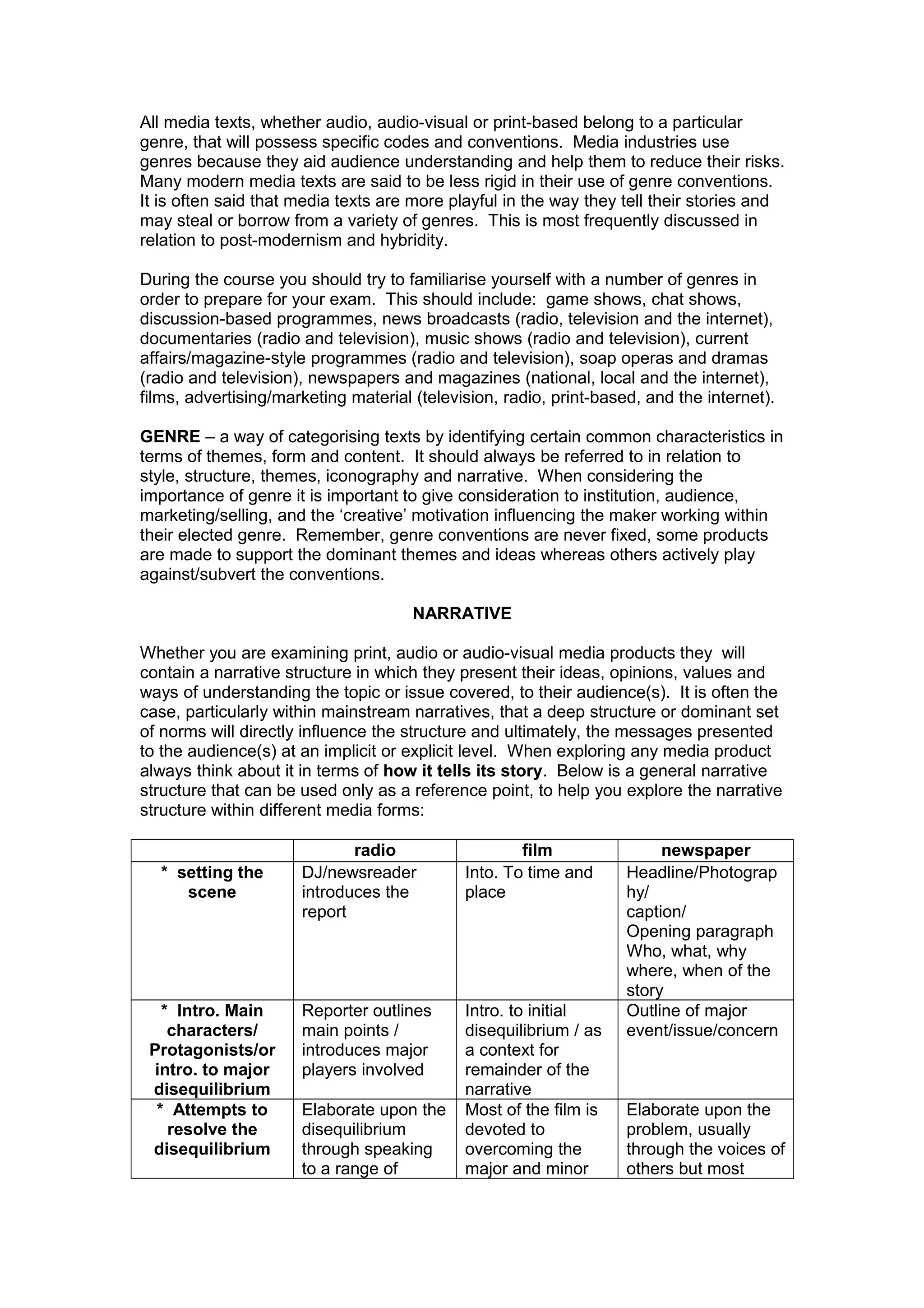
always think about it in terms of how it tells its story. Below is a general narrative
structure that can be used only as a reference point, to help you explore the narrative
structure within different media forms:
radio film newspaper
* setting the
scene
DJ/newsreader
introduces the
report
Into. To time and
place
Headline/Photograp
hy/
caption/
Opening paragraph
Who, what, why
where, when of the
story
* Intro. Main
characters/
Protagonists/or
intro. to major
disequilibrium
Reporter outlines
main points /
introduces major
players involved
Intro. to initial
disequilibrium / as
a context for
remainder of the
narrative
Outline of major
event/issue/concern
* Attempts to
resolve the
disequilibrium
Elaborate upon the
disequilibrium
through speaking
to a range of
Most of the film is
devoted to
overcoming the
major and minor
Elaborate upon the
problem, usually
through the voices of
others but most
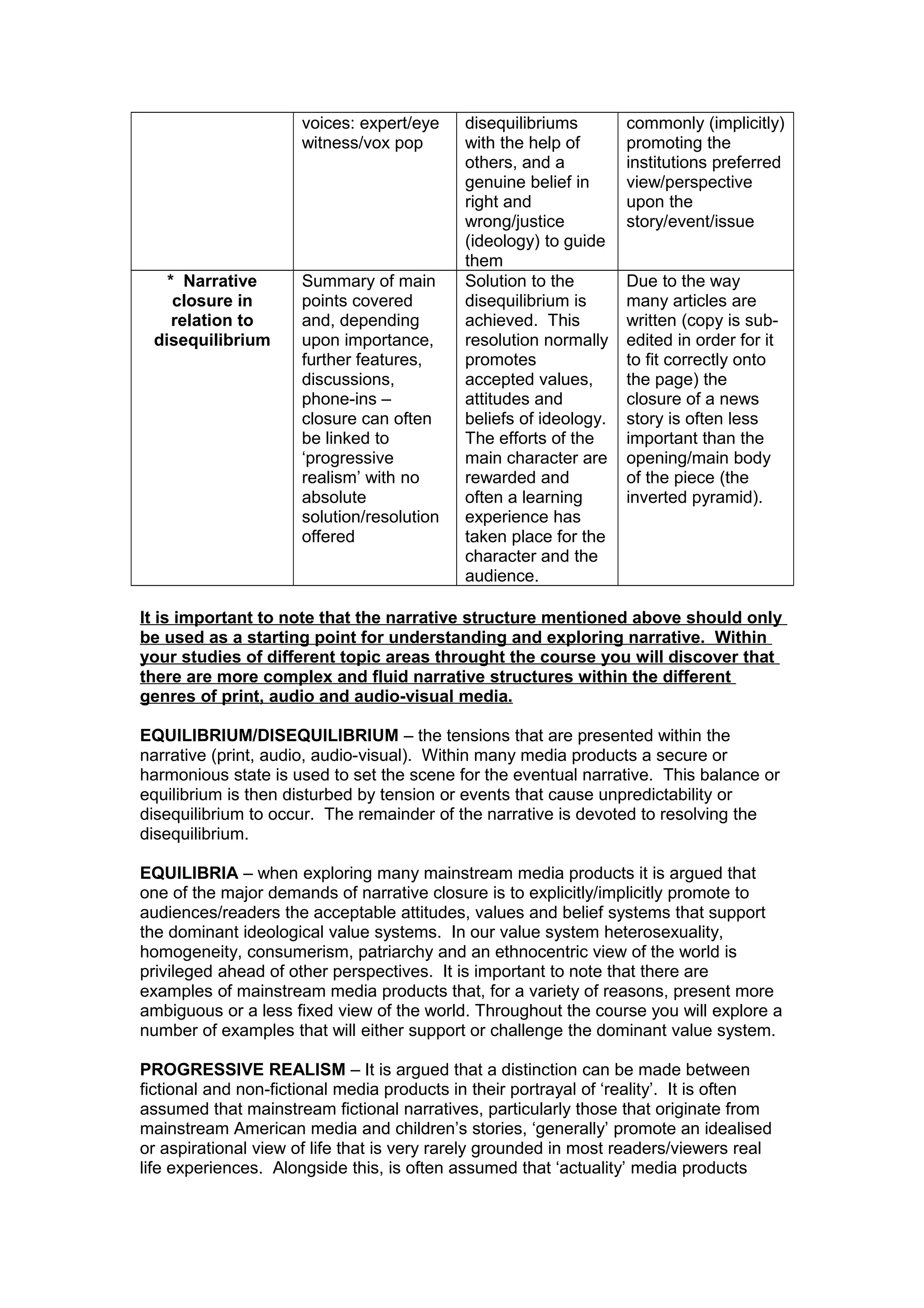
voices: expert/eye
witness/vox pop
disequilibriums
with the help of
others, and a
genuine belief in
right and
wrong/justice
(ideology) to guide
them
commonly (implicitly)
promoting the
institutions preferred
view/perspective
upon the
story/event/issue
* Narrative
closure in
relation to
disequilibrium
Summary of main
points covered
and, depending
upon importance,
further features,
discussions,
phone-ins –
closure can often
be linked to
‘progressive
realism’ with no
absolute
solution/resolution
offered
Solution to the
disequilibrium is
achieved. This
resolution normally
promotes
accepted values,
attitudes and
beliefs of ideology.
The efforts of the
main character are
rewarded and
often a learning
experience has
taken place for the
character and the
audience.
Due to the way
many articles are
written (copy is sub-
edited in order for it
to fit correctly onto
the page) the
closure of a news
story is often less
important than the
opening/main body
of the piece (the
inverted pyramid).
It is important to note that the narrative structure mentioned above should only
be used as a starting point for understanding and exploring narrative. Within
your studies of different topic areas throught the course you will discover that
there are more complex and fluid narrative structures within the different
genres of print, audio and audio-visual media.
EQUILIBRIUM/DISEQUILIBRIUM – the tensions that are presented within the
narrative (print, audio, audio-visual). Within many media products a secure or
harmonious state is used to set the scene for the eventual narrative. This balance or
equilibrium is then disturbed by tension or events that cause unpredictability or
disequilibrium to occur. The remainder of the narrative is devoted to resolving the
disequilibrium.
EQUILIBRIA – when exploring many mainstream media products it is argued that
one of the major demands of narrative closure is to explicitly/implicitly promote to
audiences/readers the acceptable attitudes, values and belief systems that support
the dominant ideological value systems. In our value system heterosexuality,
homogeneity, consumerism, patriarchy and an ethnocentric view of the world is
privileged ahead of other perspectives. It is important to note that there are
examples of mainstream media products that, for a variety of reasons, present more
ambiguous or a less fixed view of the world. Throughout the course you will explore a
number of examples that will either support or challenge the dominant value system.
PROGRESSIVE REALISM – It is argued that a distinction can be made between
fictional and non-fictional media products in their portrayal of ‘reality’. It is often
assumed that mainstream fictional narratives, particularly those that originate from
mainstream American media and children’s stories, ‘generally’ promote an idealised
or aspirational view of life that is very rarely grounded in most readers/viewers real
life experiences. Alongside this, is often assumed that ‘actuality’ media products
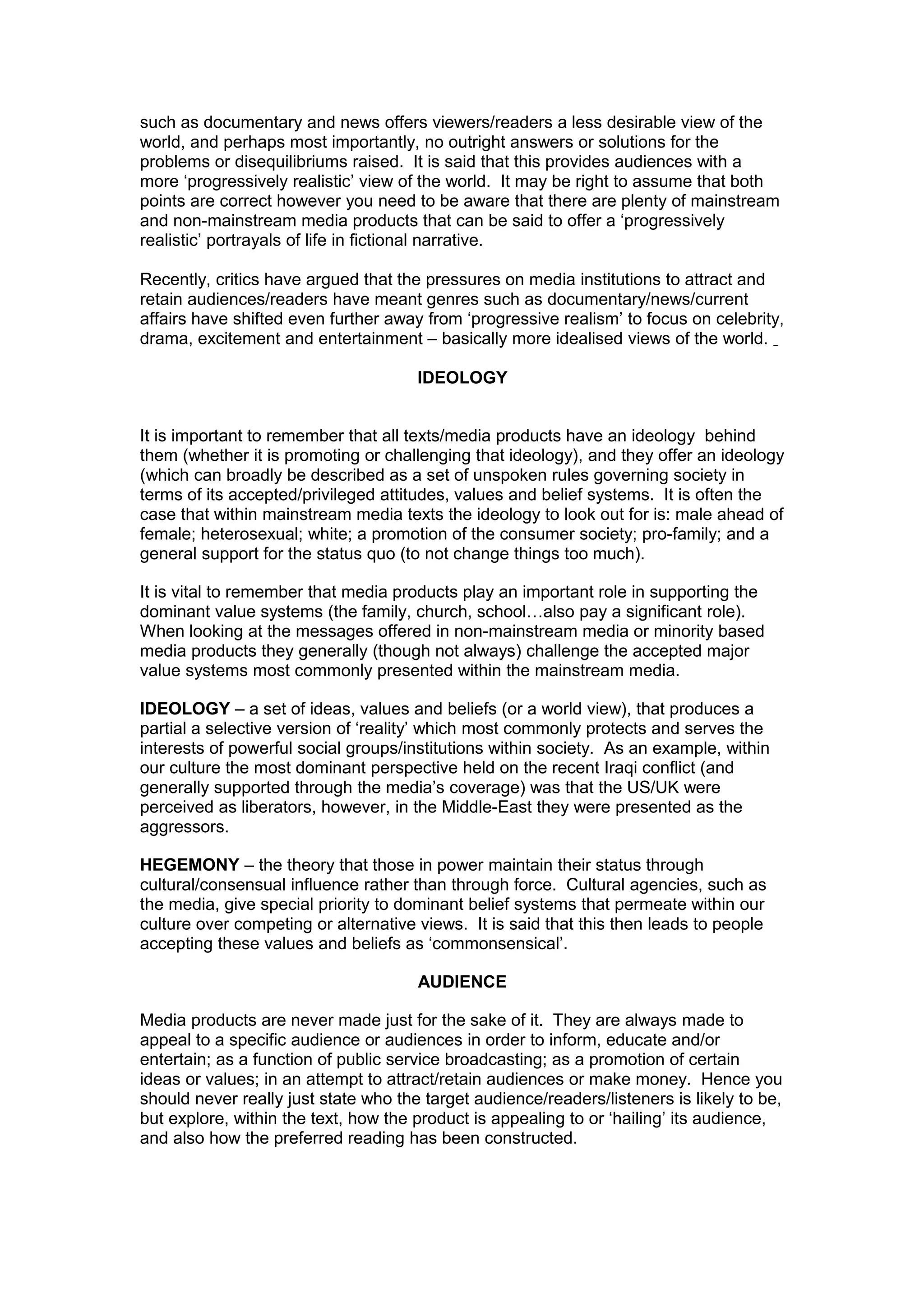
such as documentary and news offers viewers/readers a less desirable view of the
world, and perhaps most importantly, no outright answers or solutions for the
problems or disequilibriums raised. It is said that this provides audiences with a
more ‘progressively realistic’ view of the world. It may be right to assume that both
points are correct however you need to be aware that there are plenty of mainstream
and non-mainstream media products that can be said to offer a ‘progressively
realistic’ portrayals of life in fictional narrative.
Recently, critics have argued that the pressures on media institutions to attract and
retain audiences/readers have meant genres such as documentary/news/current
affairs have shifted even further away from ‘progressive realism’ to focus on celebrity,
drama, excitement and entertainment – basically more idealised views of the world.
IDEOLOGY
It is important to remember that all texts/media products have an ideology behind
them (whether it is promoting or challenging that ideology), and they offer an ideology
(which can broadly be described as a set of unspoken rules governing society in
terms of its accepted/privileged attitudes, values and belief systems. It is often the
case that within mainstream media texts the ideology to look out for is: male ahead of
female; heterosexual; white; a promotion of the consumer society; pro-family; and a
general support for the status quo (to not change things too much).
It is vital to remember that media products play an important role in supporting the
dominant value systems (the family, church, school…also pay a significant role).
When looking at the messages offered in non-mainstream media or minority based
media products they generally (though not always) challenge the accepted major
value systems most commonly presented within the mainstream media.
IDEOLOGY – a set of ideas, values and beliefs (or a world view), that produces a
partial a selective version of ‘reality’ which most commonly protects and serves the
interests of powerful social groups/institutions within society. As an example, within
our culture the most dominant perspective held on the recent Iraqi conflict (and
generally supported through the media’s coverage) was that the US/UK were
perceived as liberators, however, in the Middle-East they were presented as the
aggressors.
HEGEMONY – the theory that those in power maintain their status through
cultural/consensual influence rather than through force. Cultural agencies, such as
the media, give special priority to dominant belief systems that permeate within our
culture over competing or alternative views. It is said that this then leads to people
accepting these values and beliefs as ‘commonsensical’.
AUDIENCE
Media products are never made just for the sake of it. They are always made to
appeal to a specific audience or audiences in order to inform, educate and/or
entertain; as a function of public service broadcasting; as a promotion of certain
ideas or values; in an attempt to attract/retain audiences or make money. Hence you
should never really just state who the target audience/readers/listeners is likely to be,
but explore, within the text, how the product is appealing to or ‘hailing’ its audience,
and also how the preferred reading has been constructed.
Also, who it is aimed at will go a long way to explaining issues around representation,
and ideally this should be linked back to the institutional source of the product.
It is also important to be aware that the audience is not just one mass audience but
can be divided into a number of social groups: white/ethnic minorities; female/male;
affluent/less affluent; old/young; married/single; educated/less educated;
heterosexual/homosexual.
It is also important to be aware that gender, race, class, sexuality are all likely to
impact upon how an audience/reader is likely (though not definitely) to interpret the
messages presented within the text – this argument pre-supposes that the audience
is a little more active in the process of making meaning from a media product.
There are four possible readings of any media product:
PREFERRED – accept the implicit/explicit values presented
NEGOTIATED – challenge some aspects of representation, but generally accept the
overall validity of messages.
OPPOSITIONAL – directly challenge the ideological messages offered within the text
ABBERANT – either do not possess the ‘language’ (or cultural capital) to understand
the text or offer an intepretation that is either deviant or unexpected.
Finally, when exploring any media product it is important to establish very clearly the
devices and techniques employed within the text to ‘hail’ or capture the audiences
attention, and once this is achieved, how they are positioned to accept the preferred
messages offered explicitly/implicitly within the text.
Also, who it is aimed at will go a long way to explaining issues around representation,
and ideally this should be linked back to the institutional source of the product.
It is also important to be aware that the audience is not just one mass audience but
can be divided into a number of social groups: white/ethnic minorities; female/male;
affluent/less affluent; old/young; married/single; educated/less educated;
heterosexual/homosexual.
It is also important to be aware that gender, race, class, sexuality are all likely to
impact upon how an audience/reader is likely (though not definitely) to interpret the
messages presented within the text – this argument pre-supposes that the audience
is a little more active in the process of making meaning from a media product.
There are four possible readings of any media product:
PREFERRED – accept the implicit/explicit values presented
NEGOTIATED – challenge some aspects of representation, but generally accept the
overall validity of messages.
OPPOSITIONAL – directly challenge the ideological messages offered within the text
ABBERANT – either do not possess the ‘language’ (or cultural capital) to understand
the text or offer an intepretation that is either deviant or unexpected.
Finally, when exploring any media product it is important to establish very clearly the
devices and techniques employed within the text to ‘hail’ or capture the audiences
attention, and once this is achieved, how they are positioned to accept the preferred
messages offered explicitly/implicitly within the text.

Media Key concepts glossary

  • 1.
    AS MEDIA STUDIES– KEY WORDS/DEFINITIONS AND CONTEXTS FOR MED1 AND MED2 This handout is designed to assist you in developing your knowledge, understanding and application of theory as it relates to Med 1 (unseen media products) and Med 2 (exploring media topics). For a more detailed outline and explanation of many more key terms and theories refer to the Barton Peveril AS Media intranet ‘glossary of terms’ section. INSTITUTION Whether you are examining a mainstream or non-mainstream media product they all originate from an institutional source. The intentions behind a product and the implicit/explicit messages that are presented to readers/audiences are likely to be directly influenced, once again at an implicit or explicit level, by the funder of the media product. It is important to remember that mainstream media, whether it is Carlton, News International or the BBC is big business (even though the main funding of the BBC is through the licence fee it still tries to generate income through selling its programmes to other countries; the sales of DVDs, books and magazines, its link with UK Gold and digital broadcasting; and its occasional box office success at cinemas all help to generate income for the institution). In the past there was a clearer distinction between mainstream and independent companies but in almost every sphere of the media today there are examples of major corporations buying into and taking control of what were previously ‘independent’ companies, in order for these major companies to maximise revenue and tap into new and emerging creative talent and ideas, which in time, may get assimilated into the mainstream. Examples of this include: Disney Corporation owns Miramax pictures who have had successful films such as Clerks, Pulp Fiction, Scream, Chicago, Gangs of New York. When analysing any media product it is important to discuss it in terms of how the institutional source is likely to have impacted upon all of the other key concepts. However, specific attention should be made to the issues of representation and ideology that are being implicitly or explicitly promoted within it to the reader/viewer. REPRESENTATION It is important to remember that all media products represent or re-present aspects of gender, sexuality, race, class, nationhood and ideas, values and beliefs, most commonly from the point of ideology (either to support or challenge widely accepted values, attitudes or opinions). Whatever text is presented to you to analyse you should ask yourself the following questions: who is being represented, who is representing them in such a way, how are they being represented, and why are they being represented in such a manner. THE KEY WORDS YOU NEED TO KNOW AND BE ABLE TO DISCUSS STEREOTYPES – oversimplified portrayal(s) that are often used (by the media/people) to categorise and or label all who belong to a specific group. This can often be linked closely to ideas based around myth.
  • 2.
    GENDER-ROLE STEREOTYPING –the roles often ascribed to men and women are most commonly linked to myths around roles and responsibilities, and power and status. As an example it is presented as natural that women are more caring and so it is assumed to be more natural for women to give up or put on hold their careers to look after the children. OBJECTIFICATION/OBJECTIFY – Representation of people merely as an object of visual pleasure that is often linked to power and control of the sender, and in some case the receiver. Traditionally, the object of visual pleasure has been for the pleasure of the male gaze – looking at women, but certain sections of modern media producers reflect the pleasures of women in looking at men. SUBORDINATION – the representation of someone under the implicit/explicit assumption that the sender/maker of the media product is of a higher status than the person/group presented. FETISHISATION – the selection of a part of the body (or inanimate object) that is used to become representative of the whole. This is often linked to objectification and subordination, and most commonly applies to women and is frequently present in magazines, movies and fashion/beauty items. PARIARCHY – it is often assumed that many of the negative portrayals that exist within society (particularly with reference to gender portrayals) can directly be related to the establishment and maintenance of the power and status of men. MATRIACHY – there is a general assumption that we live in a male dominated society however there are certain areas of media content where the power, status and influence of women are given greater implicit/explicit space to be explored. For example in soap operas audiences are frequently presented with strong and diverse roles for women. In Hollywood, actresses such as Sandra Bullock and Julia Roberts appear to have a greater control over the roles they play. RACISM – it is suggested that the ideas and belief systems of the elite (predominantly white) groups and institutions has directly impacted upon the types of explicit and implicit portrayals of ‘minority’ groups such as blacks, Asians, asylum seekers… It is argued that this has lead to a number of negative and cliched portrayals. Some of the most common techniques used (though not necessarily deliberately) to marginalise minority groups are through ‘absence’ in a range of programming; given limited (subordinated) roles; given their ‘own’ media products (so their views are heard by the minority group); these products to be scheduled at times where very few people outside of the minority group would actively seek out the product. It is argued that these strategies lead to the maginalisation and ghettoisation of ‘minority’ viewpoints. HETEROSEXUALITY/ETHNOCENTRICITY/HOMOGENEITY are values that are generally privileged by mainstream institutions and as a consequence HOMOPHOBIC/XNEOPHOBIC/ALTERNATIVE IDEAS are generally negatively represented at an implicit and (sometimes) explicit level. Many of these ideas/points can be linked to a discussion of racism. GENRE
  • 3.
    All media texts,whether audio, audio-visual or print-based belong to a particular genre, that will possess specific codes and conventions. Media industries use genres because they aid audience understanding and help them to reduce their risks. Many modern media texts are said to be less rigid in their use of genre conventions. It is often said that media texts are more playful in the way they tell their stories and may steal or borrow from a variety of genres. This is most frequently discussed in relation to post-modernism and hybridity. During the course you should try to familiarise yourself with a number of genres in order to prepare for your exam. This should include: game shows, chat shows, discussion-based programmes, news broadcasts (radio, television and the internet), documentaries (radio and television), music shows (radio and television), current affairs/magazine-style programmes (radio and television), soap operas and dramas (radio and television), newspapers and magazines (national, local and the internet), films, advertising/marketing material (television, radio, print-based, and the internet). GENRE – a way of categorising texts by identifying certain common characteristics in terms of themes, form and content. It should always be referred to in relation to style, structure, themes, iconography and narrative. When considering the importance of genre it is important to give consideration to institution, audience, marketing/selling, and the ‘creative’ motivation influencing the maker working within their elected genre. Remember, genre conventions are never fixed, some products are made to support the dominant themes and ideas whereas others actively play against/subvert the conventions. NARRATIVE Whether you are examining print, audio or audio-visual media products they will contain a narrative structure in which they present their ideas, opinions, values and ways of understanding the topic or issue covered, to their audience(s). It is often the case, particularly within mainstream narratives, that a deep structure or dominant set of norms will directly influence the structure and ultimately, the messages presented to the audience(s) at an implicit or explicit level. When exploring any media product always think about it in terms of how it tells its story. Below is a general narrative structure that can be used only as a reference point, to help you explore the narrative structure within different media forms: radio film newspaper * setting the scene DJ/newsreader introduces the report Into. To time and place Headline/Photograp hy/ caption/ Opening paragraph Who, what, why where, when of the story * Intro. Main characters/ Protagonists/or intro. to major disequilibrium Reporter outlines main points / introduces major players involved Intro. to initial disequilibrium / as a context for remainder of the narrative Outline of major event/issue/concern * Attempts to resolve the disequilibrium Elaborate upon the disequilibrium through speaking to a range of Most of the film is devoted to overcoming the major and minor Elaborate upon the problem, usually through the voices of others but most
  • 4.
    voices: expert/eye witness/vox pop disequilibriums withthe help of others, and a genuine belief in right and wrong/justice (ideology) to guide them commonly (implicitly) promoting the institutions preferred view/perspective upon the story/event/issue * Narrative closure in relation to disequilibrium Summary of main points covered and, depending upon importance, further features, discussions, phone-ins – closure can often be linked to ‘progressive realism’ with no absolute solution/resolution offered Solution to the disequilibrium is achieved. This resolution normally promotes accepted values, attitudes and beliefs of ideology. The efforts of the main character are rewarded and often a learning experience has taken place for the character and the audience. Due to the way many articles are written (copy is sub- edited in order for it to fit correctly onto the page) the closure of a news story is often less important than the opening/main body of the piece (the inverted pyramid). It is important to note that the narrative structure mentioned above should only be used as a starting point for understanding and exploring narrative. Within your studies of different topic areas throught the course you will discover that there are more complex and fluid narrative structures within the different genres of print, audio and audio-visual media. EQUILIBRIUM/DISEQUILIBRIUM – the tensions that are presented within the narrative (print, audio, audio-visual). Within many media products a secure or harmonious state is used to set the scene for the eventual narrative. This balance or equilibrium is then disturbed by tension or events that cause unpredictability or disequilibrium to occur. The remainder of the narrative is devoted to resolving the disequilibrium. EQUILIBRIA – when exploring many mainstream media products it is argued that one of the major demands of narrative closure is to explicitly/implicitly promote to audiences/readers the acceptable attitudes, values and belief systems that support the dominant ideological value systems. In our value system heterosexuality, homogeneity, consumerism, patriarchy and an ethnocentric view of the world is privileged ahead of other perspectives. It is important to note that there are examples of mainstream media products that, for a variety of reasons, present more ambiguous or a less fixed view of the world. Throughout the course you will explore a number of examples that will either support or challenge the dominant value system. PROGRESSIVE REALISM – It is argued that a distinction can be made between fictional and non-fictional media products in their portrayal of ‘reality’. It is often assumed that mainstream fictional narratives, particularly those that originate from mainstream American media and children’s stories, ‘generally’ promote an idealised or aspirational view of life that is very rarely grounded in most readers/viewers real life experiences. Alongside this, is often assumed that ‘actuality’ media products
  • 5.
    such as documentaryand news offers viewers/readers a less desirable view of the world, and perhaps most importantly, no outright answers or solutions for the problems or disequilibriums raised. It is said that this provides audiences with a more ‘progressively realistic’ view of the world. It may be right to assume that both points are correct however you need to be aware that there are plenty of mainstream and non-mainstream media products that can be said to offer a ‘progressively realistic’ portrayals of life in fictional narrative. Recently, critics have argued that the pressures on media institutions to attract and retain audiences/readers have meant genres such as documentary/news/current affairs have shifted even further away from ‘progressive realism’ to focus on celebrity, drama, excitement and entertainment – basically more idealised views of the world. IDEOLOGY It is important to remember that all texts/media products have an ideology behind them (whether it is promoting or challenging that ideology), and they offer an ideology (which can broadly be described as a set of unspoken rules governing society in terms of its accepted/privileged attitudes, values and belief systems. It is often the case that within mainstream media texts the ideology to look out for is: male ahead of female; heterosexual; white; a promotion of the consumer society; pro-family; and a general support for the status quo (to not change things too much). It is vital to remember that media products play an important role in supporting the dominant value systems (the family, church, school…also pay a significant role). When looking at the messages offered in non-mainstream media or minority based media products they generally (though not always) challenge the accepted major value systems most commonly presented within the mainstream media. IDEOLOGY – a set of ideas, values and beliefs (or a world view), that produces a partial a selective version of ‘reality’ which most commonly protects and serves the interests of powerful social groups/institutions within society. As an example, within our culture the most dominant perspective held on the recent Iraqi conflict (and generally supported through the media’s coverage) was that the US/UK were perceived as liberators, however, in the Middle-East they were presented as the aggressors. HEGEMONY – the theory that those in power maintain their status through cultural/consensual influence rather than through force. Cultural agencies, such as the media, give special priority to dominant belief systems that permeate within our culture over competing or alternative views. It is said that this then leads to people accepting these values and beliefs as ‘commonsensical’. AUDIENCE Media products are never made just for the sake of it. They are always made to appeal to a specific audience or audiences in order to inform, educate and/or entertain; as a function of public service broadcasting; as a promotion of certain ideas or values; in an attempt to attract/retain audiences or make money. Hence you should never really just state who the target audience/readers/listeners is likely to be, but explore, within the text, how the product is appealing to or ‘hailing’ its audience, and also how the preferred reading has been constructed.
  • 6.
    Also, who itis aimed at will go a long way to explaining issues around representation, and ideally this should be linked back to the institutional source of the product. It is also important to be aware that the audience is not just one mass audience but can be divided into a number of social groups: white/ethnic minorities; female/male; affluent/less affluent; old/young; married/single; educated/less educated; heterosexual/homosexual. It is also important to be aware that gender, race, class, sexuality are all likely to impact upon how an audience/reader is likely (though not definitely) to interpret the messages presented within the text – this argument pre-supposes that the audience is a little more active in the process of making meaning from a media product. There are four possible readings of any media product: PREFERRED – accept the implicit/explicit values presented NEGOTIATED – challenge some aspects of representation, but generally accept the overall validity of messages. OPPOSITIONAL – directly challenge the ideological messages offered within the text ABBERANT – either do not possess the ‘language’ (or cultural capital) to understand the text or offer an intepretation that is either deviant or unexpected. Finally, when exploring any media product it is important to establish very clearly the devices and techniques employed within the text to ‘hail’ or capture the audiences attention, and once this is achieved, how they are positioned to accept the preferred messages offered explicitly/implicitly within the text.
  • 7.
    Also, who itis aimed at will go a long way to explaining issues around representation, and ideally this should be linked back to the institutional source of the product. It is also important to be aware that the audience is not just one mass audience but can be divided into a number of social groups: white/ethnic minorities; female/male; affluent/less affluent; old/young; married/single; educated/less educated; heterosexual/homosexual. It is also important to be aware that gender, race, class, sexuality are all likely to impact upon how an audience/reader is likely (though not definitely) to interpret the messages presented within the text – this argument pre-supposes that the audience is a little more active in the process of making meaning from a media product. There are four possible readings of any media product: PREFERRED – accept the implicit/explicit values presented NEGOTIATED – challenge some aspects of representation, but generally accept the overall validity of messages. OPPOSITIONAL – directly challenge the ideological messages offered within the text ABBERANT – either do not possess the ‘language’ (or cultural capital) to understand the text or offer an intepretation that is either deviant or unexpected. Finally, when exploring any media product it is important to establish very clearly the devices and techniques employed within the text to ‘hail’ or capture the audiences attention, and once this is achieved, how they are positioned to accept the preferred messages offered explicitly/implicitly within the text.