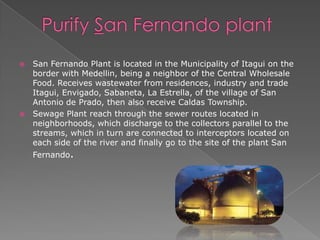
 San Fernando Plant is located in the Municipality of Itagui on the
border with Medellin, being a neighbor of the Central Wholesale
Food. Receives wastewater from residences, industry and trade
Itagui, Envigado, Sabaneta, La Estrella, of the village of San
Antonio de Prado, then also receive Caldas Township.
 Sewage Plant reach through the sewer routes located in
neighborhoods, which discharge to the collectors parallel to the
streams, which in turn are connected to interceptors located on
each side of the river and finally go to the site of the plant San
Fernando.
 .
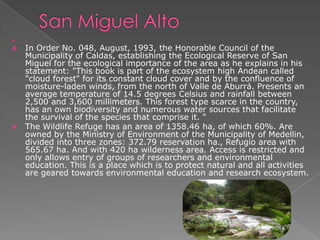
 In Order No. 048, August, 1993, the Honorable Council of the
Municipality of Caldas, establishing the Ecological Reserve of San
Miguel for the ecological importance of the area as he explains in his
statement: "This book is part of the ecosystem high Andean called
"cloud forest" for its constant cloud cover and by the confluence of
moisture-laden winds, from the north of Valle de Aburrá. Presents an
average temperature of 14.5 degrees Celsius and rainfall between
2,500 and 3,600 millimeters. This forest type scarce in the country,
has an own biodiversity and numerous water sources that facilitate
the survival of the species that comprise it. "
 The Wildlife Refuge has an area of ​​1358.46 ha, of which 60%. Are
owned by the Ministry of Environment of the Municipality of Medellin,
divided into three zones: 372.79 reservation ha., Refugio area with
565.67 ha. And with 420 ha wilderness area. Access is restricted and
only allows entry of groups of researchers and environmental
education. This is a place which is to protect natural and all activities
are geared towards environmental education and research ecosystem.
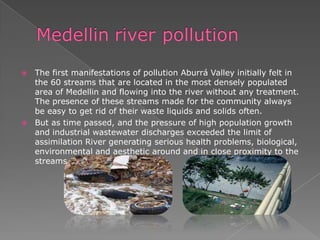
 The first manifestations of pollution Aburrá Valley initially felt in
the 60 streams that are located in the most densely populated
area of Medellin and flowing into the river without any treatment.
The presence of these streams made ​​for the community always
be easy to get rid of their waste liquids and solids often.
 But as time passed, and the pressure of high population growth
and industrial wastewater discharges exceeded the limit of
assimilation River generating serious health problems, biological,
environmental and aesthetic around and in close proximity to the
streams.
 Although the river is not navigable with which many dream, nor is that
of clear water where you could fish, who knew the grandparents, the
Medellin River flow has more oxygen and less polluted than in previous
decades. In 2010 the Medellin River will have 80 percent less pollution
thanks to for over 25 years Public Enterprises of Medellin (EPM) has
been developing the "Sanitation Program Medellin River and its
tributaries."
 The treatment plant wastewater San Fernando was perhaps the most
anticipated work by the Antiochian community, which is part of the
project. It receives waste residential and industrial sector in the
municipalities of Envigado, Itagui, Sabaneta, La Estrella and Caldas
later. 70% of this wastewater comes from purely human waste and
30% is from the industries.
 It is located in the municipality of Itagui near Central Wholesale, in a
park that has 40,000 natural species of ornamental plants, 2,000 trees
and large number and variety of birds. Occupies two lots, each with a
total area of ​​140,000 square meters.
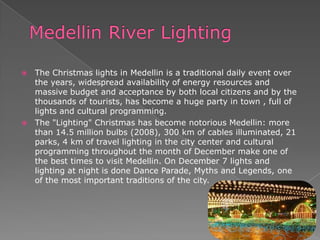
 The Christmas lights in Medellin is a traditional daily event over
the years, widespread availability of energy resources and
massive budget and acceptance by both local citizens and by the
thousands of tourists, has become a huge party in town , full of
lights and cultural programming.
 The "Lighting" Christmas has become notorious Medellin: more
than 14.5 million bulbs (2008), 300 km of cables illuminated, 21
parks, 4 km of travel lighting in the city center and cultural
programming throughout the month of December make one of
the best times to visit Medellin. On December 7 lights and
lighting at night is done Dance Parade, Myths and Legends, one
of the most important traditions of the city.
Medellin river
Medellin river
Medellin river
Medellin river
Medellin river
Medellin river

Medellin river

  • 2.
     San FernandoPlant is located in the Municipality of Itagui on the border with Medellin, being a neighbor of the Central Wholesale Food. Receives wastewater from residences, industry and trade Itagui, Envigado, Sabaneta, La Estrella, of the village of San Antonio de Prado, then also receive Caldas Township.  Sewage Plant reach through the sewer routes located in neighborhoods, which discharge to the collectors parallel to the streams, which in turn are connected to interceptors located on each side of the river and finally go to the site of the plant San Fernando.
  • 3.
     .  InOrder No. 048, August, 1993, the Honorable Council of the Municipality of Caldas, establishing the Ecological Reserve of San Miguel for the ecological importance of the area as he explains in his statement: "This book is part of the ecosystem high Andean called "cloud forest" for its constant cloud cover and by the confluence of moisture-laden winds, from the north of Valle de Aburrá. Presents an average temperature of 14.5 degrees Celsius and rainfall between 2,500 and 3,600 millimeters. This forest type scarce in the country, has an own biodiversity and numerous water sources that facilitate the survival of the species that comprise it. "  The Wildlife Refuge has an area of ​​1358.46 ha, of which 60%. Are owned by the Ministry of Environment of the Municipality of Medellin, divided into three zones: 372.79 reservation ha., Refugio area with 565.67 ha. And with 420 ha wilderness area. Access is restricted and only allows entry of groups of researchers and environmental education. This is a place which is to protect natural and all activities are geared towards environmental education and research ecosystem.
  • 4.
     The firstmanifestations of pollution Aburrá Valley initially felt in the 60 streams that are located in the most densely populated area of Medellin and flowing into the river without any treatment. The presence of these streams made ​​for the community always be easy to get rid of their waste liquids and solids often.  But as time passed, and the pressure of high population growth and industrial wastewater discharges exceeded the limit of assimilation River generating serious health problems, biological, environmental and aesthetic around and in close proximity to the streams.
  • 5.
     Although theriver is not navigable with which many dream, nor is that of clear water where you could fish, who knew the grandparents, the Medellin River flow has more oxygen and less polluted than in previous decades. In 2010 the Medellin River will have 80 percent less pollution thanks to for over 25 years Public Enterprises of Medellin (EPM) has been developing the "Sanitation Program Medellin River and its tributaries."  The treatment plant wastewater San Fernando was perhaps the most anticipated work by the Antiochian community, which is part of the project. It receives waste residential and industrial sector in the municipalities of Envigado, Itagui, Sabaneta, La Estrella and Caldas later. 70% of this wastewater comes from purely human waste and 30% is from the industries.  It is located in the municipality of Itagui near Central Wholesale, in a park that has 40,000 natural species of ornamental plants, 2,000 trees and large number and variety of birds. Occupies two lots, each with a total area of ​​140,000 square meters.
  • 6.
     The Christmaslights in Medellin is a traditional daily event over the years, widespread availability of energy resources and massive budget and acceptance by both local citizens and by the thousands of tourists, has become a huge party in town , full of lights and cultural programming.  The "Lighting" Christmas has become notorious Medellin: more than 14.5 million bulbs (2008), 300 km of cables illuminated, 21 parks, 4 km of travel lighting in the city center and cultural programming throughout the month of December make one of the best times to visit Medellin. On December 7 lights and lighting at night is done Dance Parade, Myths and Legends, one of the most important traditions of the city.